KCS 4687, You Have Permission to Depart Englewood

Fresh crew on board, KCS 4687 departs the west end of Englewood Yard on Feb. 18, 2008
(Click the picture for a large version of the shot to see more detail)
KCS 4687 crosses over to main 1 as it departs UP’s Englewood Yard in Houston with a solid consist of new KCS grain hoppers. This train originated in Kansas City and will terminate somewhere in the interior of Mexico.
In the background, you can see Englewood bowl tower right at the top of the frame about 20% over from the right side.
To the left you can see Tower 68, where operators formerly controlled all the traffic through Englewood Yard. Traffic is now controlled by Terminal Dispatchers out of UP’s Spring, Texas Dispatch Center.

Tower 68 at the west end of UP's Englewood Yard in Houston
Best Looking “Dip” Paint Scheme?
What’s a “dip” paint scheme. It’s where the locomotive is painted in one color, as if it could have been just dipped into a huge vat of the proper color paint.
Dip schemes weren’t terribly common. They were typically used by railroads that were in poor shape financially. MKT red, CGW red, KCS white and PC black come to mind in this group.
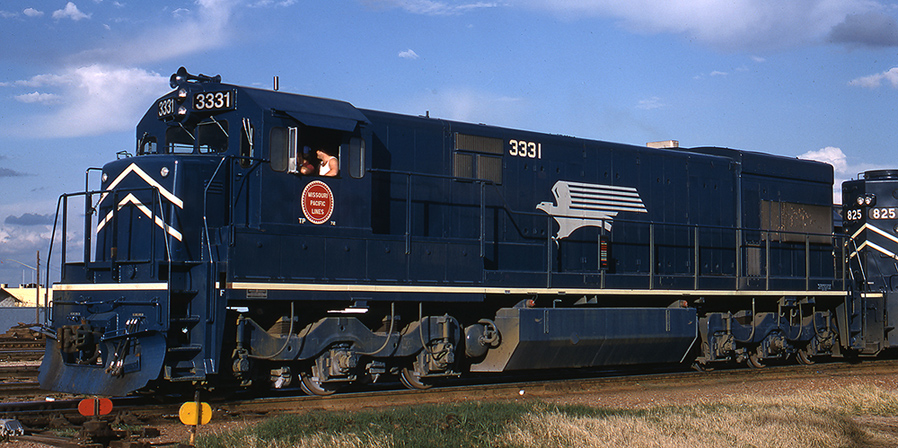
MP U30C 3331 in perfect sun on March 10, 1974. Location possibly Pueblo, CO.
I’d say the MP’s “screaming eagle” scheme as the best looking “dip” paint scheme, by virtue of the striking eagle on the long hood of the engine and the neat “buzzsaw” logo on the cab. Only MP’s turbocharged units received the eagle logo.
Unlike the other users of “dip” paint schemes, the Jenks blue scheme adopted by the MP in the early 1960’s wasn’t so much due to financial woes as much as was the fact that MP President Downing Jenks wasn’t going to “waste” money on fancy paint jobs.
That’s just how he rolled…
Racing the Storm – Pic of the Day

Santa Fe B23-7 6360 leads a loaded grain train just south of Sealy, TX on Oct. 22, 1988
This quartet of “little” units has its grain train at track speed just south of Sealy, TX as it tries to stay ahead of the looming storm. Just over 90 miles remain until this trains final destination of Port of Galveston.
For the Rivet Counters, err Bolt Counters
Rivet-counter is the mild perjorative that some railfans use to describe other fans that might be slightly, well, let’s just say detail-oriented.
It’s the railfan version of too-much-information. Let the record reflect that I have no quarrel with the rivet-counters. It’s just that when I saw the below photo, I couldn’t help thinking about them.
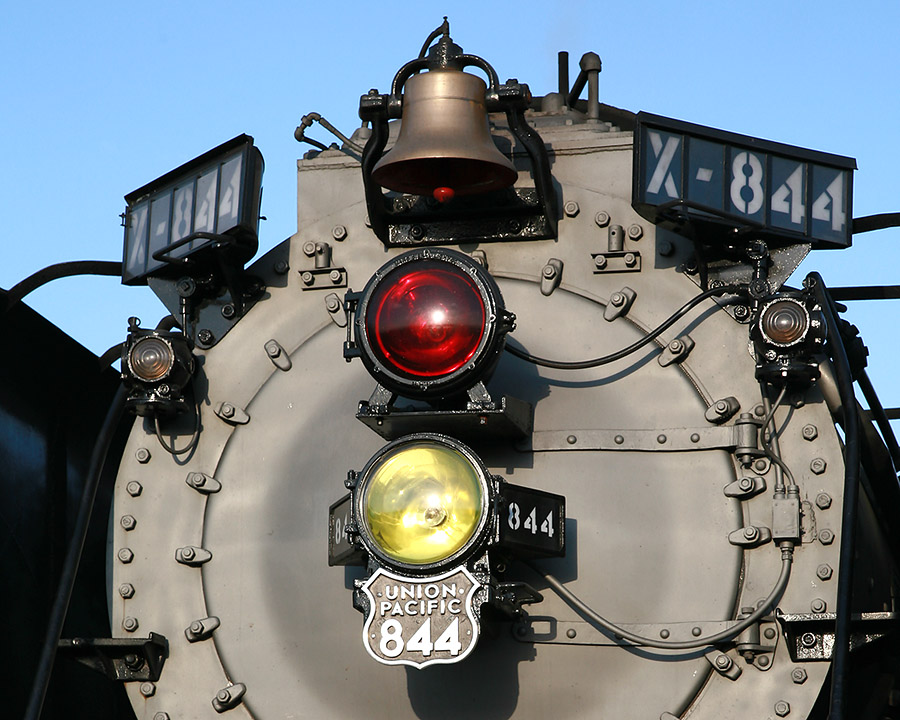
UP 844 at its Del Rio, Texas stop-over on May 12, 2006
I really like the way the soft morning light comes in at just the right angle to highlight the details on the face of UP 4-8-4 844. You can, if you’re inclined to, actually count the bolts.
Not that anything is wrong with that…
UP 9401 East – Pic of the Day

UP 9401 East passing through Stafford, Texas on Feb. 18, 2007
I’ve never particularly cared for shots looking up at a train. Whenever I’ve tried to get a shot from a low perspective, it never seems to look right. I’m either too low and the train looks distorted, or I’m not low enough to get the different perspective I wanted. But every so often, I’ll get a shot from the lower point-of-view that I actually like.
This shot of an EB UP manifest on Feb. 18, 2007 just works, IMO. I like being able to see daylight below the pilot. I also like being able to see the wheels from both sides making contact with the railhead. I think that having the camera very close to the same height as the rail is the key to making this angle work.
Profile of a Spartan
Can you imagine if there were 16,984 Spartans in the movie, instead of 300? But that’s a different topic. Remember, this is a railroad oriented site.
The spartans I want to discuss are the spartan cabs that were on 16,984* EMD locomotives from the first GP35 in July 1963 to the last SD70, IC 1039, in February 1999.
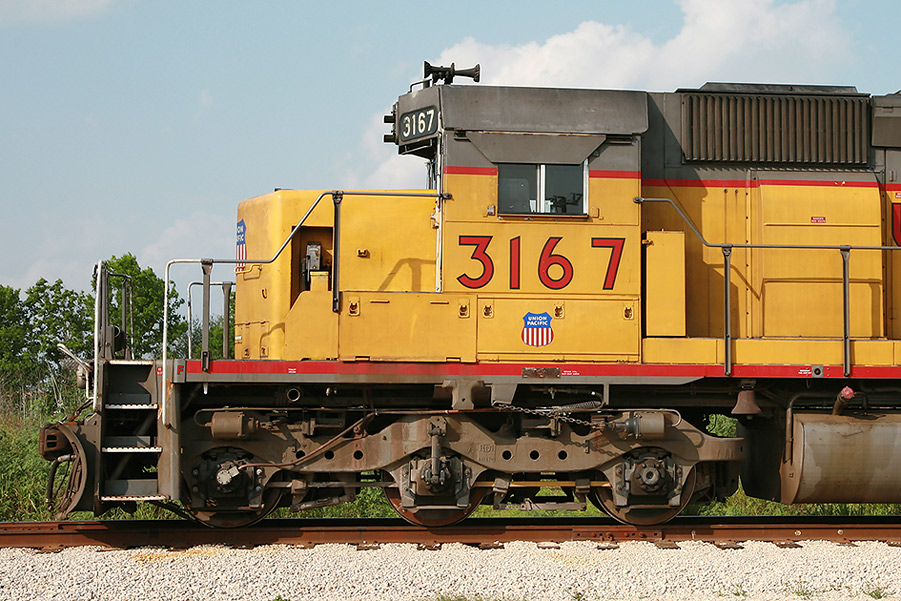
UP SD40-2 3167 showing its spartan cab profile at Stafford, Texas on April 24, 2006
I’m not sure where the term “spartan” came to describe this venerable cab design. Possibly because it’s a no-frills design that gets the job done. Which would explain why this design was in production almost 36 years.
Many railfans are melancholic about the paucity of spartan cabs on mainline freights these days, fearing that they’ll soon disappear on large railroads like the UP.
That day just might be further away than you think as there’s a rumor that the UP plans to overhaul up to 500 of their SD40-2’s over the next 10 years, with the work to be done at their North Little Rock shops.
One can hope….
*16,984 is based counting EMD locomotives from the GP35 / GP28 through the SD70’s built for IC and NS in the late 1990’s. I factored out passenger units like the F40PH, cowls like the F45, and any Canadian engines that had the original safety cab design.
Old School End of Train Device
Contemporary end-of-train devices (ETD) are pretty sophisticated little contraptions, but not particularly photogenic. If you’re looking for a good-looking ETD, you have to go old school.
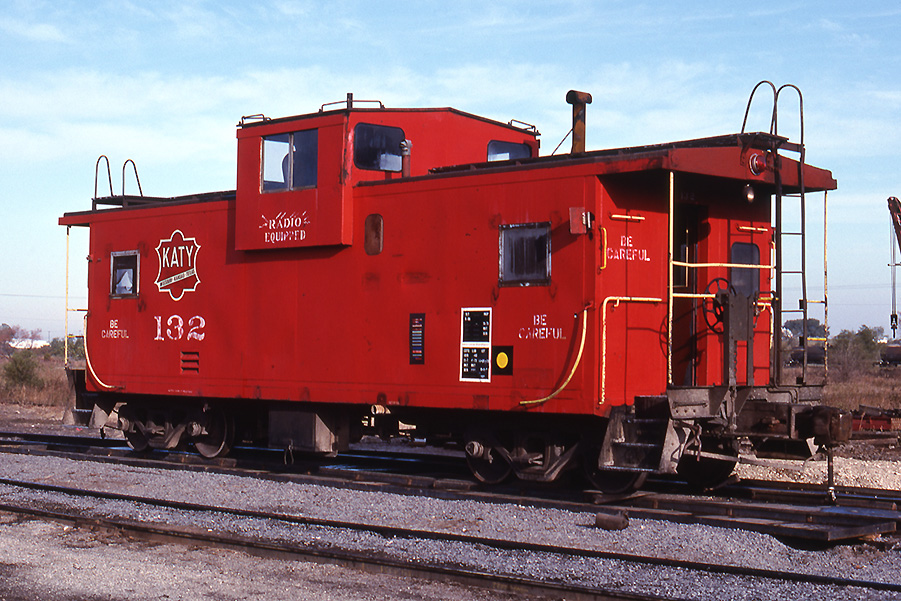
Old school ETD, MKT caboose 132 at Denison, Texas on Nov. 3, 1979
By 1979, most Katy locomotives had been re-painted into the “John Deere” scheme, so one can surmise that MKT caboose 132 is one of the last cabooses in red.
As the caboose era came to a close, many cabooses were preserved.

MKT 132, now in green, is the third caboose from the left.
MKT caboose 132 was preserved by the Railroad Museum of Oklahoma in Enid, OK.
I’m creating a new category for cabooses. Let’s call it ETD’s
You Sure Do Clean Up Good…
I’ve always liked the SP’s little GE’s, particularly the B30-7’s. They were common throughout the eastern part of the SP system, yet they could, and would, show up just about anywhere.
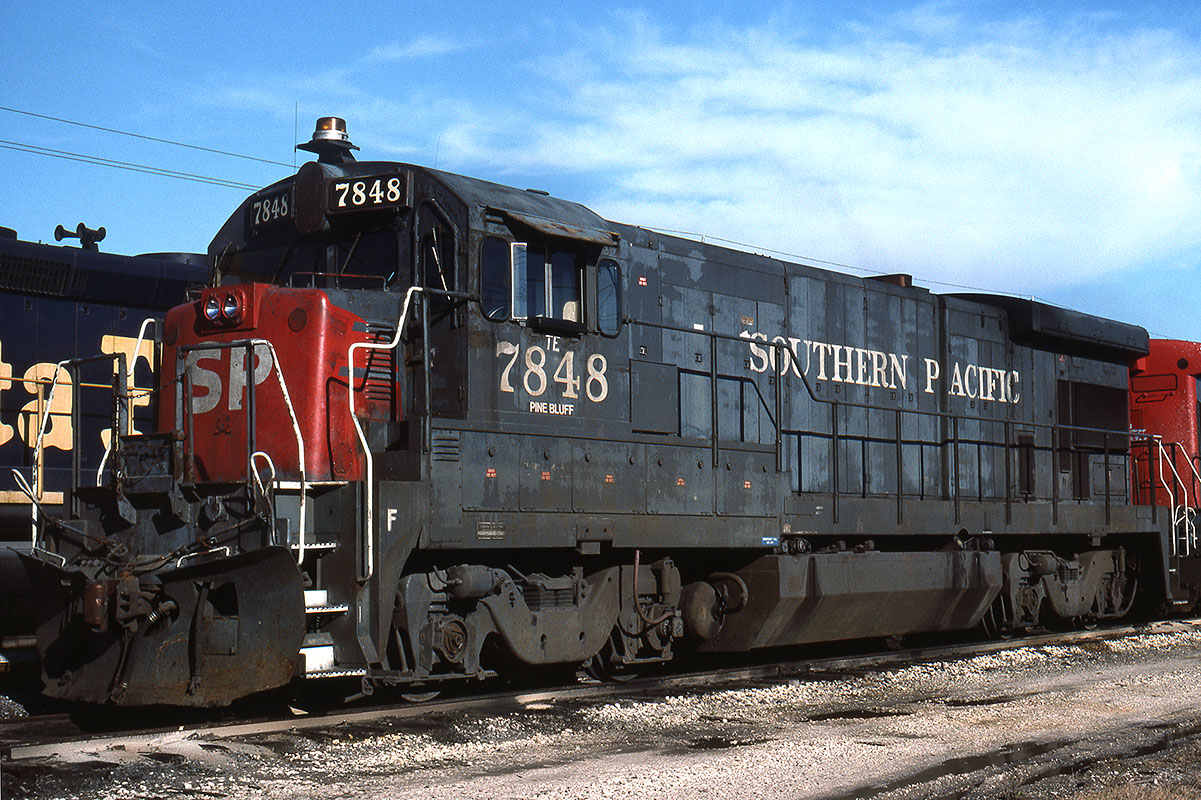
SP B30-7 7848 at the PTRA's Manchester Yard in Houston on Jan. 13, 1991
The 7848 was built in March of 1979. 13 years of tough service on the SP have taken a toll, yet the factory paint is still fairly intact. Shortly after this picture was taken, the SP contracted Conrail to overhaul its 7700 and 7800 series GE’s, with the work done at Conrail’s Enola, PA shop complex.
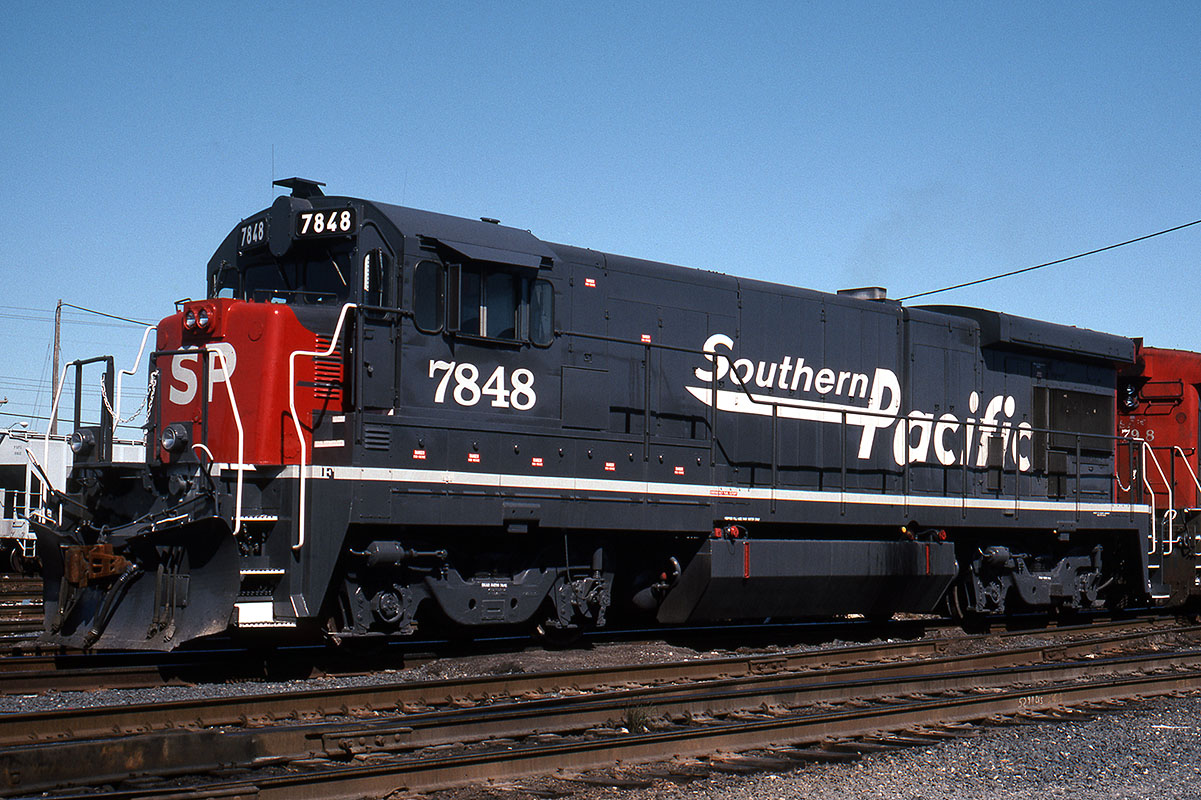
The 7848, fresh from overhaul, at Englewood Yard in Houston on Oct. 31, 1993
An SP purist can take issue with the white frame stripe and the “too fat” cab numbers, but you have to admit that the grimy unit in the first picture sure did clean up good…
PS- The 7848 was retired on April 19, 2004. Normally, that would be the end of the story, as most retired GE’s are scrapped. But in this case, the 7848 was used as the core for UPY 2671, a RailPower RP20GE genset.
As I finished this post, I wondered where the 7848 / UPY 2671 might be today. A trace of the UPY 2671 tells me that it’s at Englewood yard, the same place I photographed it over 16 years ago.
UP SD40-2 3376 Gets Around
You’ve seen posts from the “I get around” category before. It’s where I’ll have 2 shots of the same unit, but in different locations. Today, as that guy in an apron likes to say, “We’re going to kick it up a notch”.
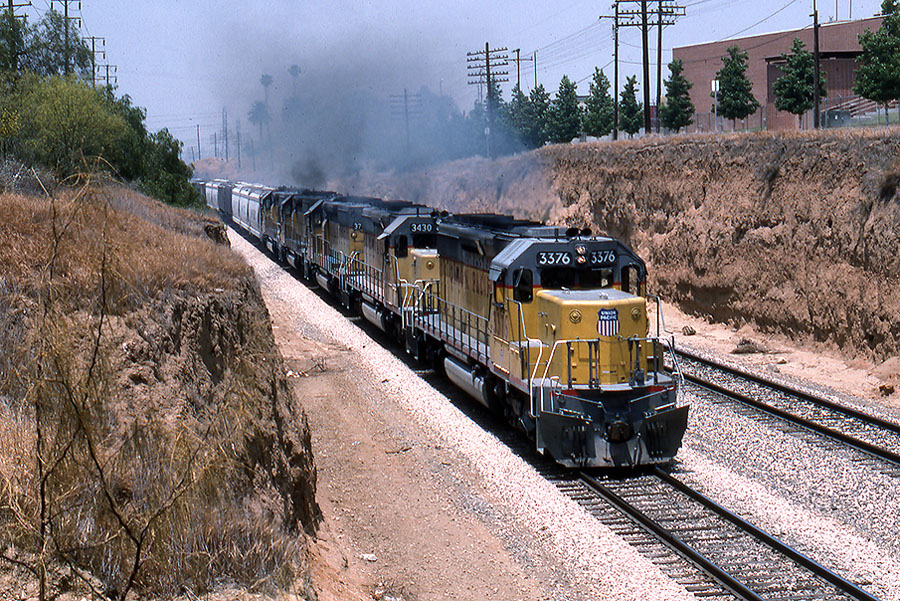
UP 3376 and 4 more SD40-2's with an EB at Colton, CA on July 7, 1987
A solid set of UP SD-40-2’s – the last thing a railfan wanted to see on a UP train back in 1987 as that’s what every UP train seemed to have at the time. The passage of time has mellowed my feelings about the once ubiquitous SD40-2
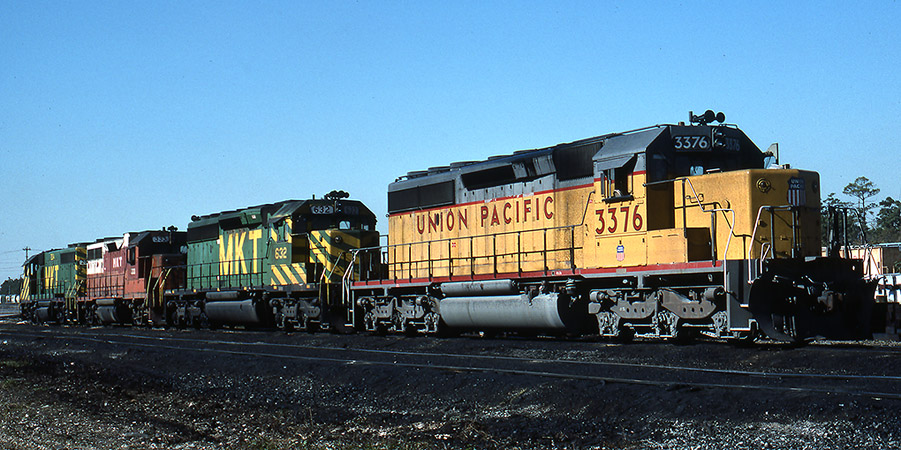
UP 3376 and 3 MKT engines at Eureka Yard in Houston on Nov. 27, 1988
14 months later I saw the 3376 on the ready track at Eureka Yard, the ex-MKT yard about 5 miles west of downtown.
I’m guessing that’s 50 years of spilled oil and diesel in the foreground here at Eureka. Say what you want about the EPA, I’m glad that railroads had to clean up the ground at their engine facilities.
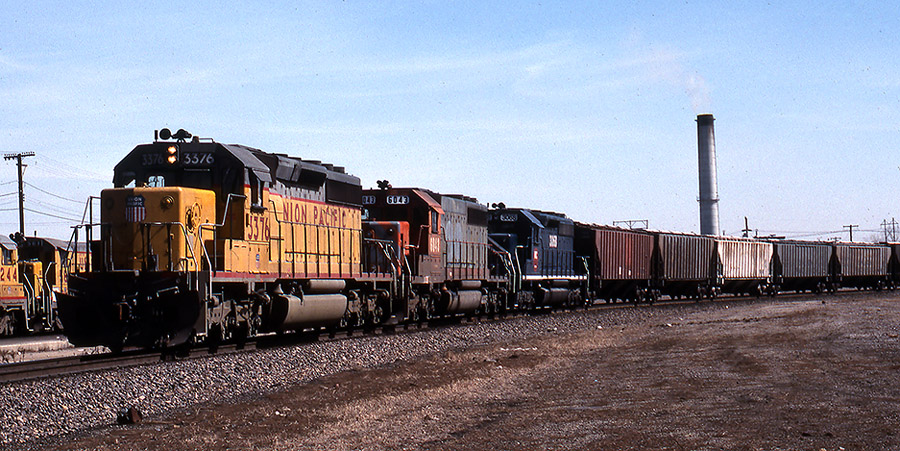
UP 3376 and two leased engines at Neff Yard in Kansas City
In the final view, the 3376 is pulling adjacent to the engine facility at Neff Yard, the ex-MP yard in Kansas City on March 8, 1989.
This particular SD40-2 was retired by the UP on Feb. 17, 2009, just shy of 32 years after entering service on the UP.
SP line-up for El Paso Nov 16, 1979
The holy grail for railroad photographers would be a document that showed what trains were running, and when to expect them.
This document actually exists. It’s called a line-up. Railroads create them so crews, maintenance-of-way and operations can have an idea what to expect in the next 24 hours or so.

SP El Paso, TX line-up for 11 PM, Nov. 16, 1979
An SP crewman gave me this line-up one day as I was hanging out near the El Paso passenger depot. By my count, there are 21 trains showing, 13 from the east through 6:30 PM, and 8 from the west through 6:30 A.M. the next day.
My ballpark guess for train count through El Paso in 2010 would be 60.
They Only Come Out at Night
When one thinks of nocturnal creatures, what comes to mind ? Vampires, zombies (I think…) and Amtrak trains in the Houston area. The current schedule puts #1, the WB Sunset Limited into the station at 9:13 PM. Eastbound counterpart #2 is carded into Houston at 4:40 A.M.
Train #1 has always been an evening arrival into Houston. Train#2, until a few years ago, was scheduled into Houston at 9:50 A.M. This schedule allowed me to catch #2 in pretty decent light as it passed through the Sugar Land/Stafford area.
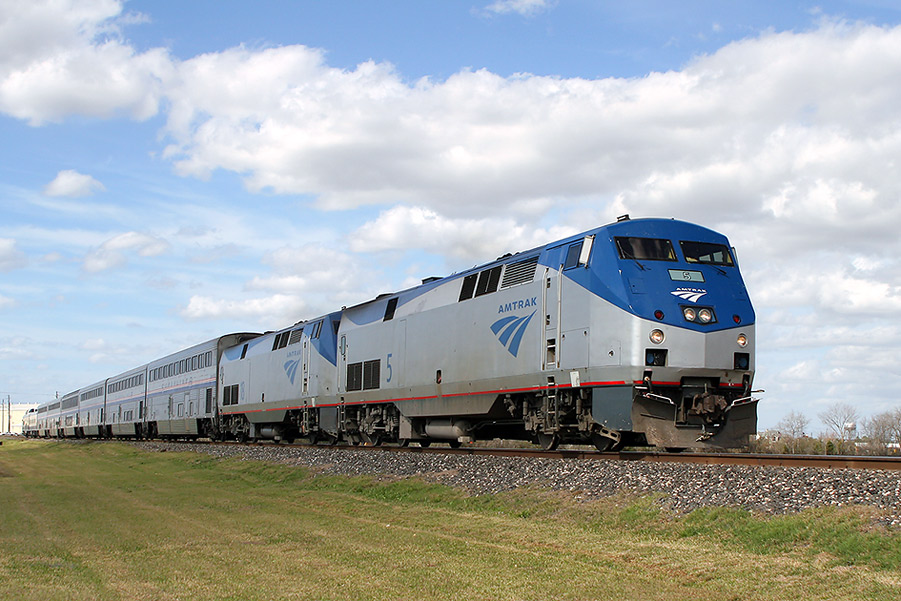
Amtrak Train #2, The Sunset Limited passing through Stafford, TX on Feb. 5, 2006
I didn’t notice it at the time I took the picture, but there’s no baggage car on this train.
As with the last shot I posted of #2, today’s train had two private cars bringing up the rear of the train.

These gentlemen have the best seat in the house as the Sunset Limited passes through Stafford, TX
Anything, Anytime, Anywhere
General Code of Operating Rules – 1.20 Alert to Train MovementEmployees must expect the movement of trains, engines, cars, or other movable equipment at any time, on any track, and in either direction.
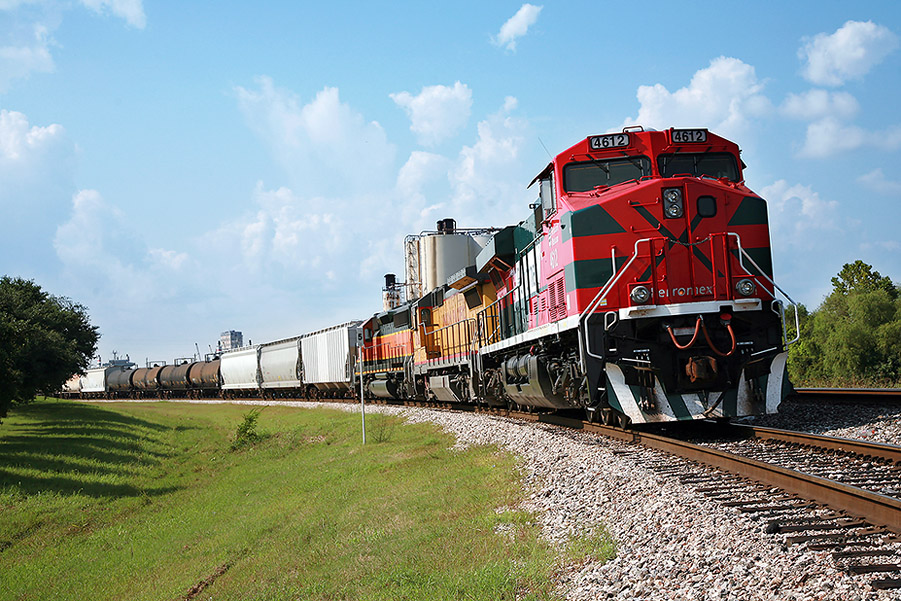
Ferromex 4612 awaiting a fresh crew at MP 5 of UP's Strang sub in Houston, Texas on July 22, 2007.
 Southwest Rails