Small Container, Big Implications
I got a chance to railfan in Houston this past May 5th. I was at the east end of UP’s Englewood Yard. I was waiting for a KCS manifest train to clear up so I could photograph a UP train that had an ex-UP SD9043MAC on the point. As the end of the KCS train came into view, I prepared to photograph the DPU.

But something seemed odd as I watched the DPU get closer. As I pressed the shutter release, I was able to see what had struck me as odd: trailing the DPU was a single well car with a red 20′ container. As the unusual end of train passed me, I took a few shots of it and forgot about it, preoccupied with freshly painted NS 7298 on the point of an MNSEW train.

Once I looked at the images, my curiosity was piqued because based on its appearance, this isn’t just any old 20′ container. A bit of research yielded quite the surprise. It’s much more than a container. According to the owner, BW & Corman Technologies, it’s a Corridor Information Modeling, or CIM, railcar.
These use a high-precision, high-speed scanner called LIDAR, or Light Detection and Ranging, to read the environment around a train, assessing everything from tree branches hanging down that might bump cargo to the condition of the rail infrastructure, Morrison said.
“It’s a sensor that allows us to collect very accurate, precise data points on the railroad,” he said.
LIDAR and technology are areas of expertise brought to the mix by Bartlett & West, while Corman works in nearly every service aspect of the railroad industry except technology, said Korey Colyer, Corman’s vice president of finance and administration.
But collecting millions of data points as a train speeds along at 60 mph creates a software challenge. How do you take data being collected in real-time and make it usable at the railroad’s main office? BW and Corman met that challenge with the development of IRIS, or Integrated Real-Time Intelligence Solution, an exclusive technology that helps railroads make data-driven decisions faster.
“The data is being streamed behind the scenes as the (CIM) car is traveling, traversing down the tract,” Morrison said. “It’s being sent to the web portal, and the railroads have access to the web portal. Approximately 10 minutes after we pass a feature, they’re getting a report on that feature.”
Those features include such things as signal stands and bridges along railways. Those features and the track currently are assessed manually, and it takes two to three weeks for information about problems to reach the railway.
The software, which allows nearly real-time analysis of data being collected as the CIM car speeds down the track, could be a game-changer for railroads and other industries.
Hmmm. LIDAR capturing millions of data points sounds suspiciously like the primary technology utilized in self-driving automobiles. The notion that they’re worried about tree branches bumping the cargo is cute. Indulge my speculation, but you’re looking at a device that’s developing technology to allow for autonomous train operation.
With CAD (computer aided dispatching), Trip-Optimizer, PTC, real-time locomotive diagnostic uploads and now this, would you agree that we’re getting very close to crew-less trains, at least technologically?
Should we?
Kodachrome: I Miss Yew
Yes, this has nothing to do with trains or railroads, but I can’t resist posting about this video that YouTube, in all its wisdom, thought I might enjoy. It’s a scene from a 1955 movie entitled “Strategic Air Command”. Simply put, it’s the most amazing aircraft take-off scene I’ve ever seen. The fact that it’s of a Convair B-36 bomber (6 props & 4 jets) makes it better. Of course, 1955 was just about the best time ever to be a railfan: still good amounts of steam and early diesels galore!
But the most compelling thing for me as a photographer in this video is just how beautiful Kodachrome imagery can be. Yes, movie film back in the day was Kodachrome. Check out the richness and depth of the images. Today’s technology is seemingly miraculous, but we lost something very special when we lost Kodachrome. Check out these two stills from the film. Can you say “Kodachrome skies”? 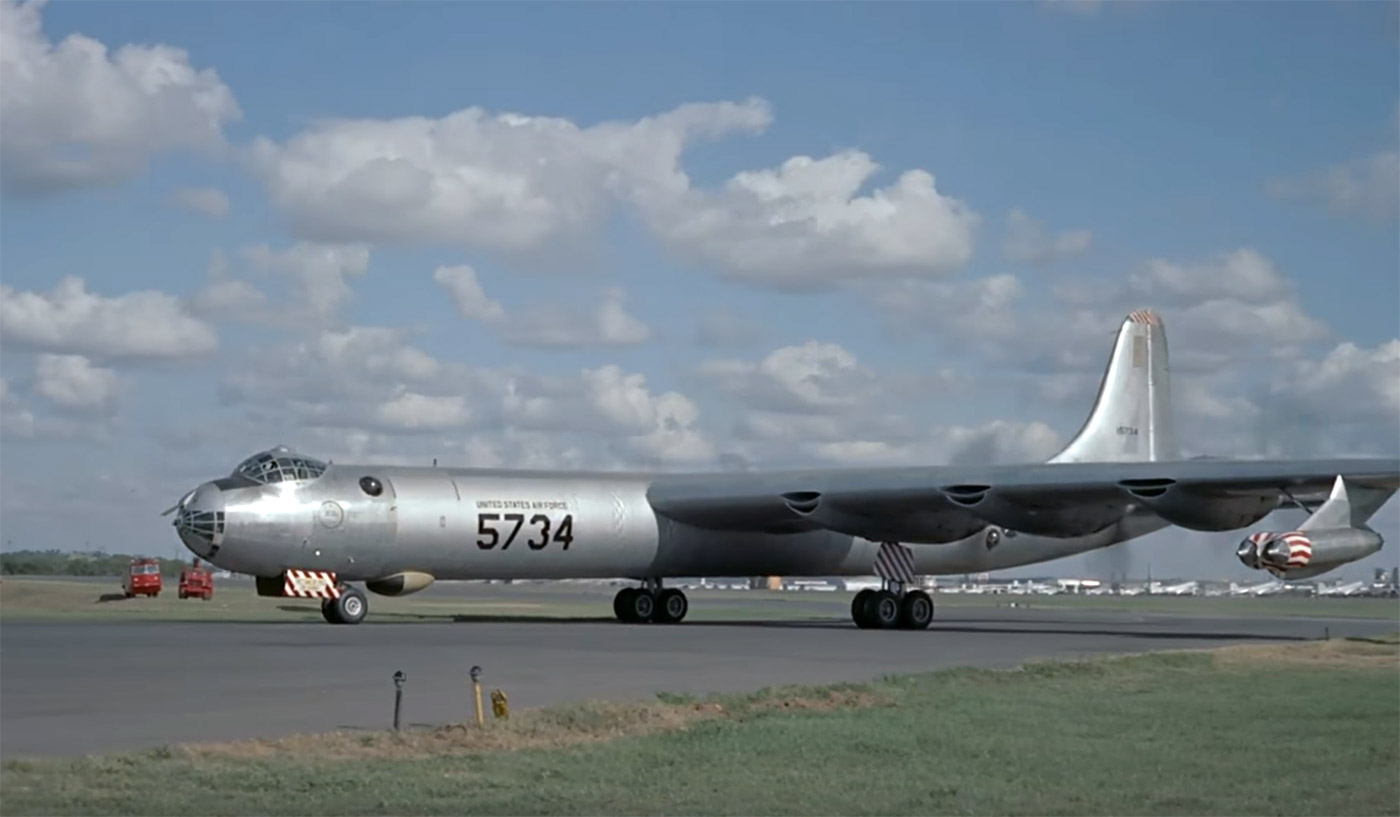
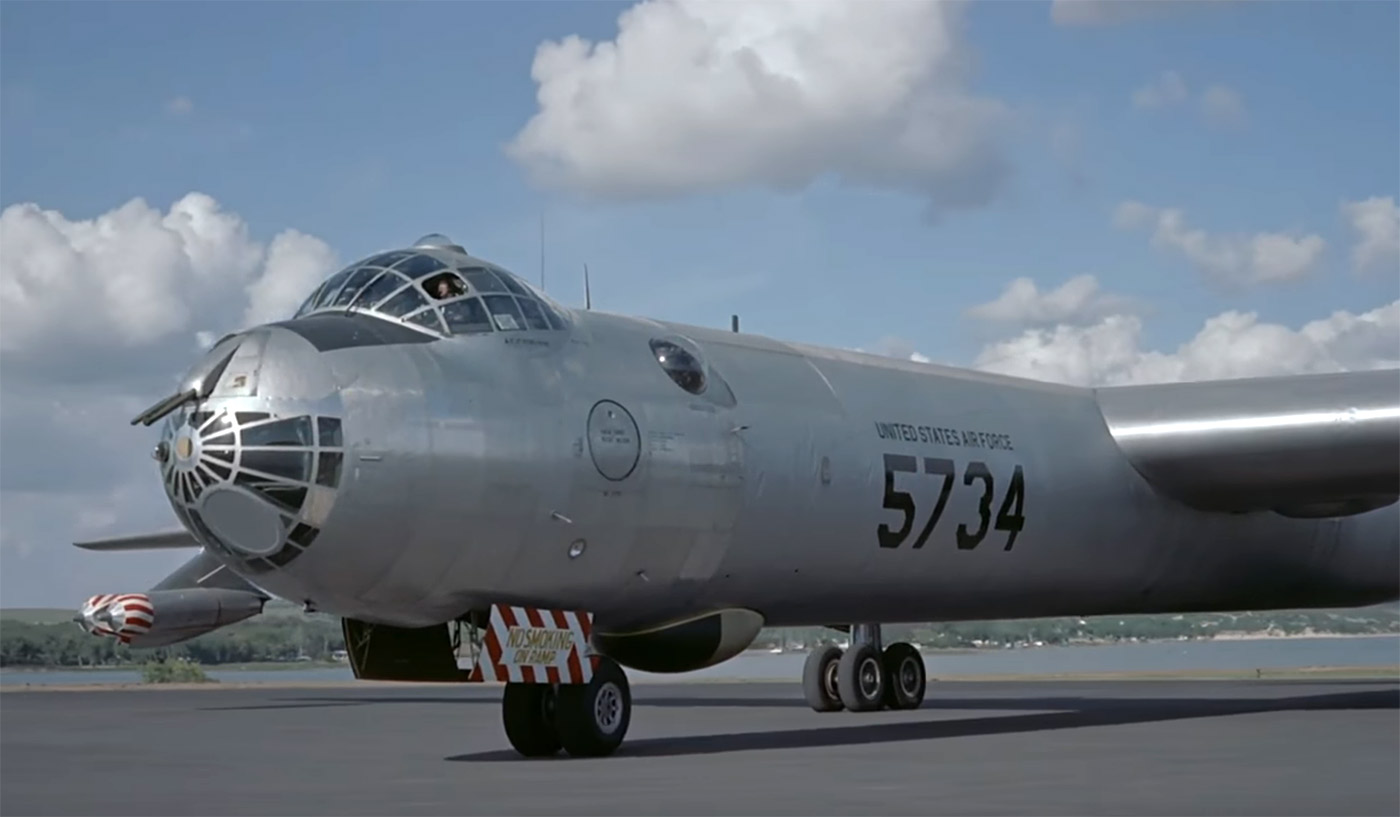
But I’m not done gushing about this video. As soon as the video starts you’ll be treated to an “in your face” shot as the B-36 lines up to take off. About 1:50 into the video, you’ll see the aircraft roll and rotate from a camera aboard a B-25 that’s pacing the B-36. It’s just an amazing piece of work. To be fair, something like this is no big deal for the CGI crowd, but to be even more fair, this was shot “in real life!” I wonder how many takes were required to get this down right? During the height of the cold war, the U.S. military would go to great lengths to accommodate the filmmakers. I’m glad they did. (Make sure you play the video full screen)
More about the B-36:
The Convair B-36 “Peacemaker” was a strategic bomber built by Convair and operated solely by the United States Air Force (USAF) from 1949 to 1959. The B-36 was the largest mass-produced piston engine aircraft ever made. It had the longest wingspan of any combat aircraft ever built, at 230 ft (70.1 m). The B-36 was the first bomber capable of delivering any of the nuclear weapons in the U.S. arsenal from inside its four bomb bays without aircraft modifications. With a range of 10,000 mi (16,000 km) and a maximum payload of 87,200 lb (39,600 kg), the B-36 was the world’s first manned bomber capable of intercontinental flight without refueling.
Entering service in 1948, the B-36 was the primary nuclear weapons delivery vehicle of the Strategic Air Command (SAC) until it was replaced by the jet-powered Boeing B-52 Stratofortress from 1955. All but five examples were scrapped in the 1950’s.
The B-36 set the standard for range and payload for subsequent U.S. intercontinental bombers.
Perfect Timing
A common theme in all railfan imagery is light, i.e. battling with clouds that wreak havoc with the best laid plans one had for a particular scene. When I set up for this scene in DeQuincy LA this past April 21, 2017, I knew there was a chance that the clouds would shiv me, but little did I know just how sadistically the clouds would twist it in me.
Notice how there’s full sun when the scene begins. As the head end gets near, the clouds roll in. The clouds remain for the 90 seconds that the train is rolling by. As the DPU passes by me, the clouds opened up, providing nice light on the DeQuincy depot, now part of a small railroad museum.
Normally when I’m victimized by the clouds, I get pretty annoyed. But I actually laughed when I stopped the camera because the timing of the clouds was so perfect. In a Bizarro World sort of way.
Typically a scene like this would never grace your screen, but clouds or not, check out the grain train rolling by at track speed making lots of noise for the Hwy 12 grade crossing.
Monster Sunset Limited
Today’s Sunset Limited through Houston had a monster consist of 3 locomotives and 11 cars, compared to the normal 2 units and 7 cars. The additional equipment will come off at San Antonio where it will be used for a special inspection train that will run from Oklahoma City to Kansas City later this week.
Sorry about the highway noise. Because it departed Houston nearly 30 minutes late, Heacker (CP SA014) was the only spot I could hope to get sun on the train. The sun and clouds did cooperate, providing nice soft light as the train passed me at 7:45 PM
What’s Past Is Prologue
The Bard: “What’s Past Is Prologue.”
Ecclesiastes 1:9: “The thing that hath been, it is that which shall be; and that which is done is that which shall be done: and there is no new thing under the sun.”
I know you’re asking yourself “what in the name of Hades is this guy talking about?” Let’s just say this is a literary heads-up.
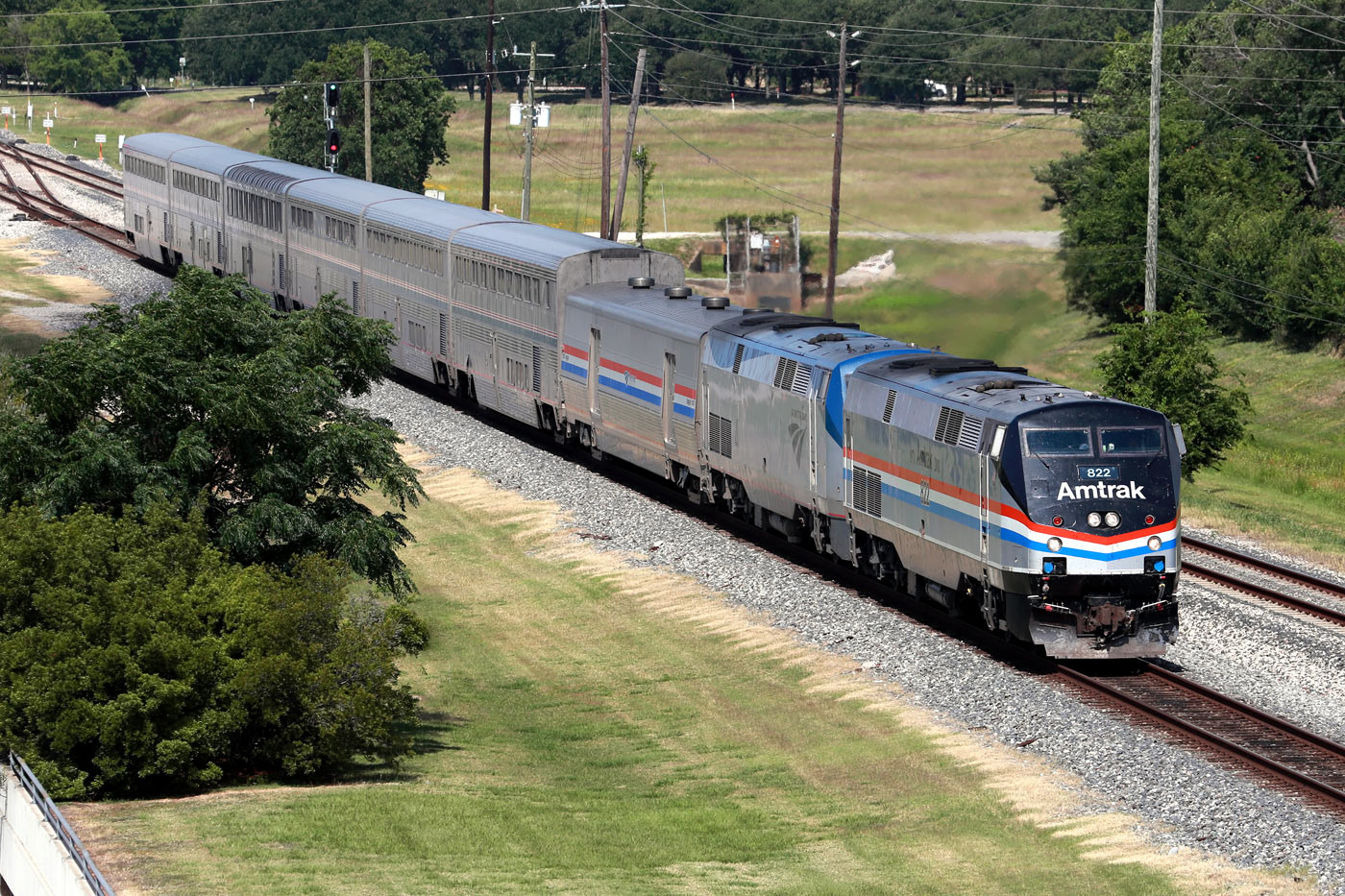
Amtrak #2 departed Los Angeles last night with the same power that was on it Tuesday before last, 5/16/2017, P42’s 822 & 4. Barring any unforeseen motive power problems, you’ll get another opportunity tomorrow morning to catch one of Amtrak’s heritage units leading a train into Houston.
In the event you can’t make it out tomorrow to see it, here are a few shots of what it looked like on its previous trip leading #2 into Houston.
I really wanted to shoot it further east, but thick clouds in that direction made me opt for the view from the US 59 overpass. As it turned out, clouds arrived seconds before the train got to the prime spot, but at least I was able to get this telephoto view.
My next intended shot was to catch it arriving at the depot, but upon hearing that #2 had to flag a signal at CP LF372, I decided to try a shot from the West Park Ave. overpass. Arriving scant moments before the train was a blessing in disguise because I didn’t have any time to curse the vegetation and power lines that totally ruin that shot. Instead, I used the 15 seconds I had before the train arrived to find the one spot on the overpass that wasn’t totally hosed.
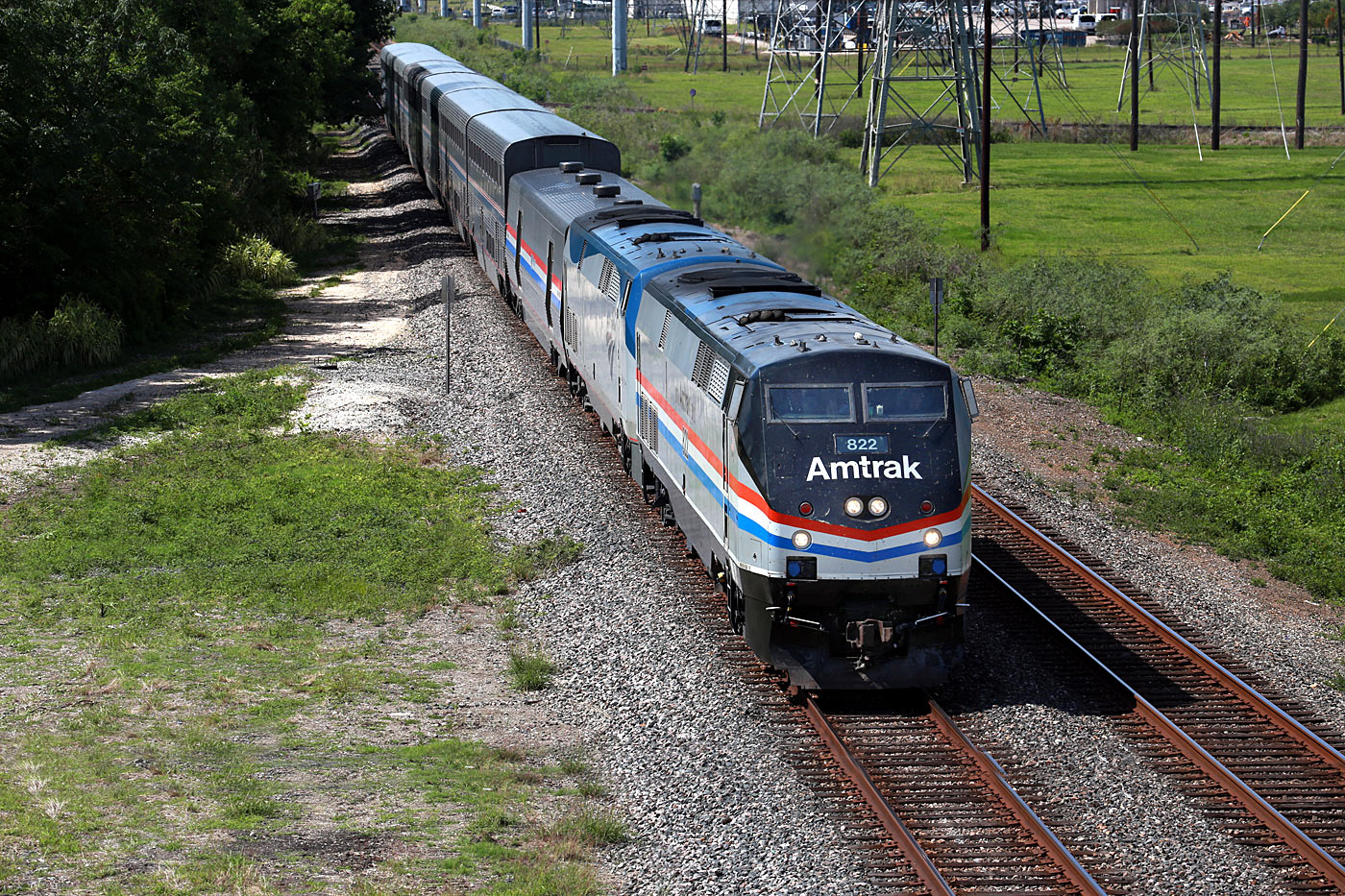
Being but 6 or so miles away from the depot, there’s no way I beat #2 there for my intended shot of it arriving. My next best bet will be to catch it as it leaves Houston so I headed to Chaney Junction to await its 12:10 PM departure.
My visions of how nicely the train would look when framed by the two searchlights was smashed by the brutal glare off of the nose of the lead unit. What can you really do?
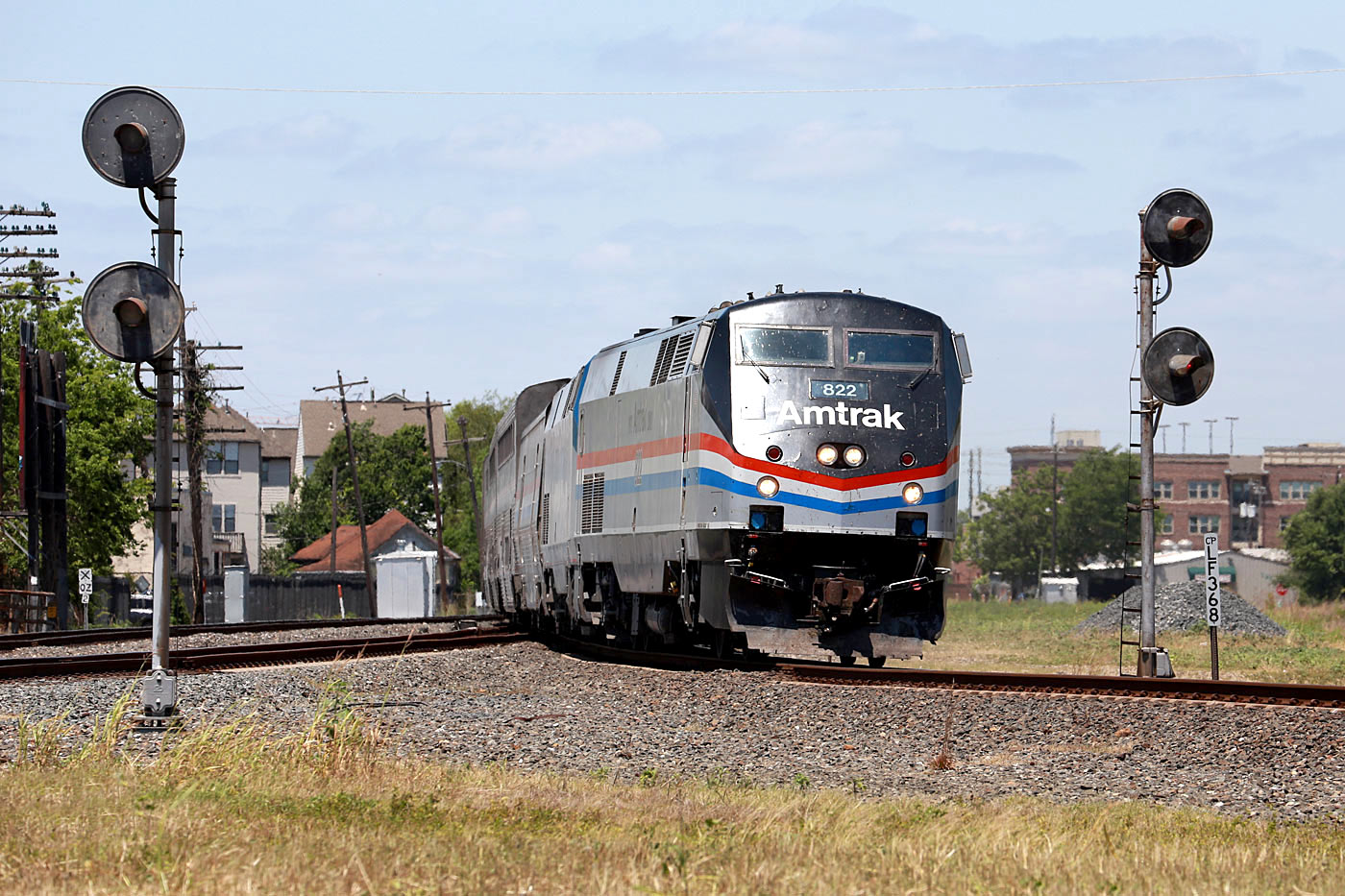
Fortunately, the glare is only an issue with head-on views, and resolved nicely as the train got by me.
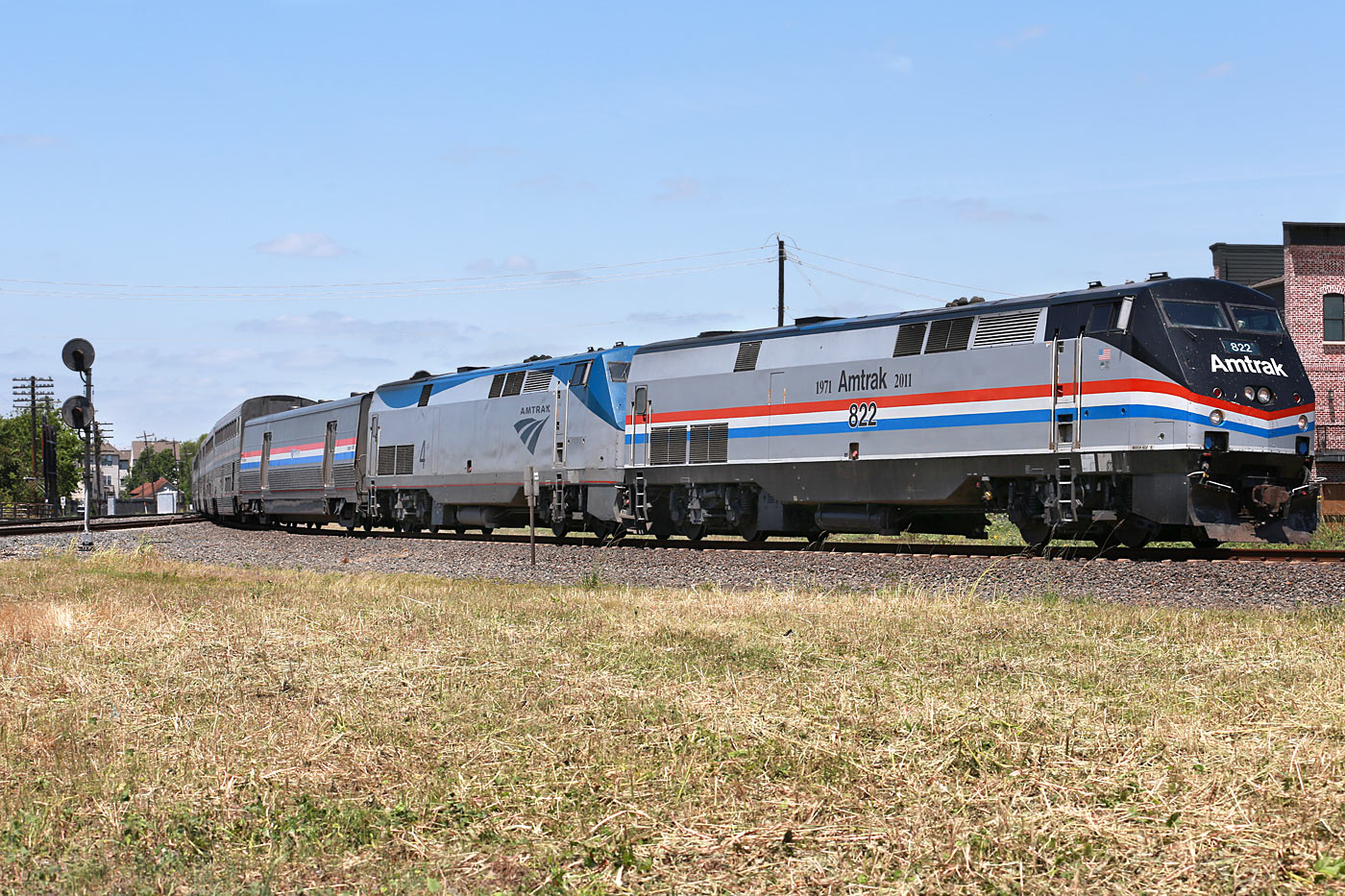
Finally, a broadside of the object of my obsession. The P42 will never win any beauty contests, but they don’t look too bad when in a nice looking scheme.
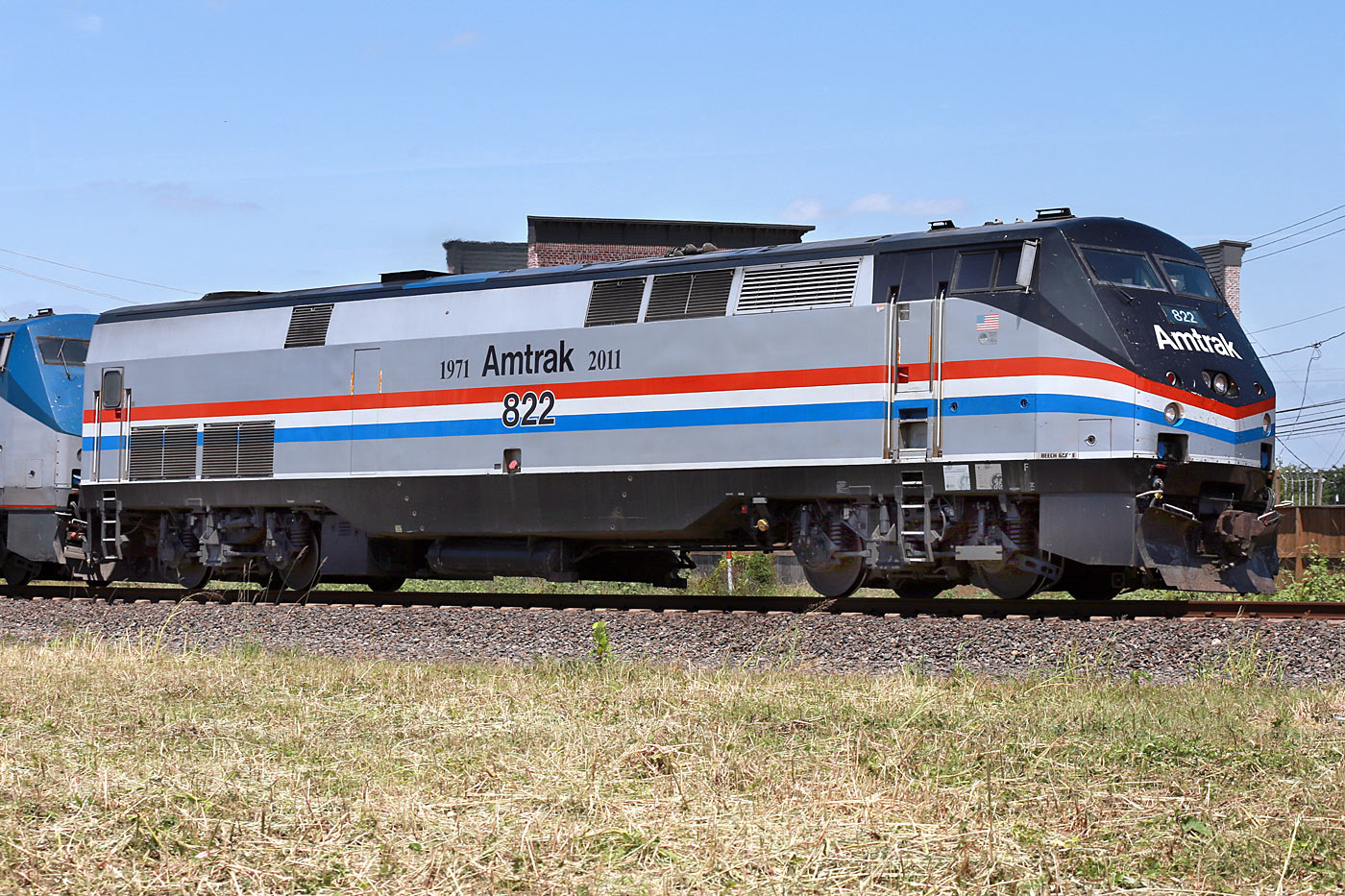
Partly cloudy skies tomorrow in the Houston area, so I’ll be rolling the dice one more time…
Sounds Like Heaven
On second thought, I didn’t hear any harps. So maybe it doesn’t sound like heaven. Either way, that’s not the point.
I passed by the east end of Englewood Yard a few weeks ago to photograph a thing or two. I noticed a hump set start dragging a cut of cars over the hump. There wasn’t any decent stills from where I was at so I just watched the move. I was taken with the sound of 3 SD40-2’s working.
Then the metaphorical light came on-capture some video. It seemingly took forever to change lenses and switch the camera over to video, but I’m still happy to have captured the sounds of heaven – on earth.
PS – Note the slug unit, UPY 937. It has a rich history, starting out as an SP U25B. It was rebuilt in to a road slug, a TEBU in SP parlance. The UP needed slugs in the late 90’s, so they re-built this slug again, numbering it S319 in 9/1997. It was re-numbered into its current UPY number in 8/2003.
Amtrak Excitement!
98% of Amtrak excitement is either budgetary or accident-related. I’d like to focus on the other 2%, which is consist-related.
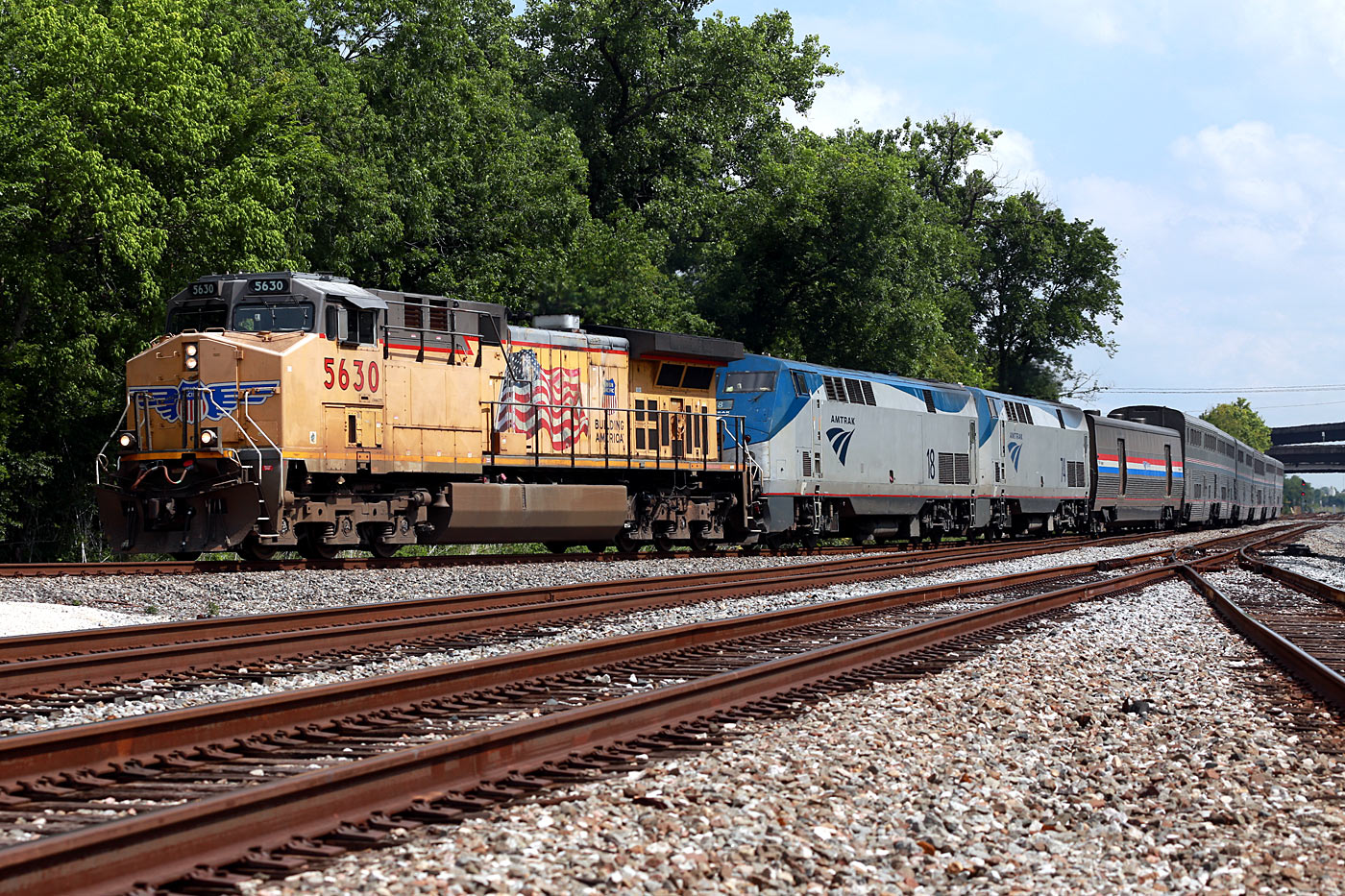
This past Sunday (Is it sacrilegious to railfan on Mother’s Day? A rhetorical question because the deed is done.) I learned that #2, the eastbound Sunset Limited, was running 3+ hours behind schedule because of locomotive failure. I later received word (Thanks!) that UP was providing a unit at San Antonio, AC4400CW 5630 specifically.
The best spot to minimize backlighting on an early afternoon eastbound is in Stafford, between MP 19.75 – MP 21.25. Of course the backlighting became a moot issue because clouds rolled in shortly before the train did.
Union Pacific AC4400CW 5630 steps up to help Amtrak train #2 on May 14, 2017 at Stafford, Texas near MP 20.5 of UP’s Glidden sub.
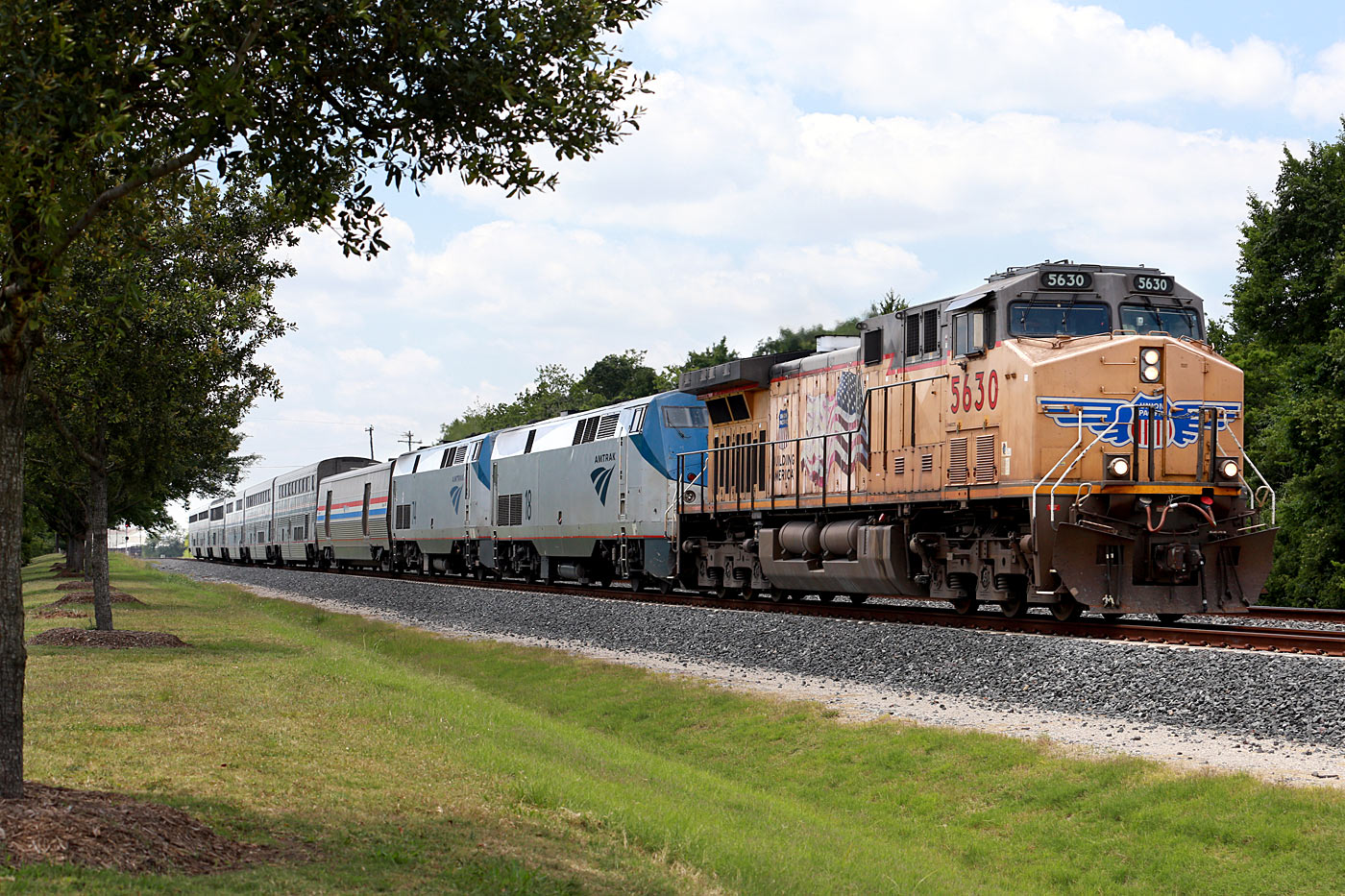
Since the train was flying, there was no chance of another shot before the train arrived to the depot downtown.
No problem. I’ll just drive 30 miles into town for a second bite of the apple once the train departs. My game plan was to catch it as it was pointed north on the approach to Belt Junction, expecting that this would be the best possible light before the train turned east there.
Fortunately, the sun cooperated and I was able to get better shots of what’s actually a rare occurrence, at least in my area, for freight power leading the Sunset Limited.
Amtrak’s Eastbound Sunset Limited has just departed Houston, Texas on May 14, 2017 and is approaching Belt Junction where it will diverge from UP’s West Belt sub to the East Belt sub.
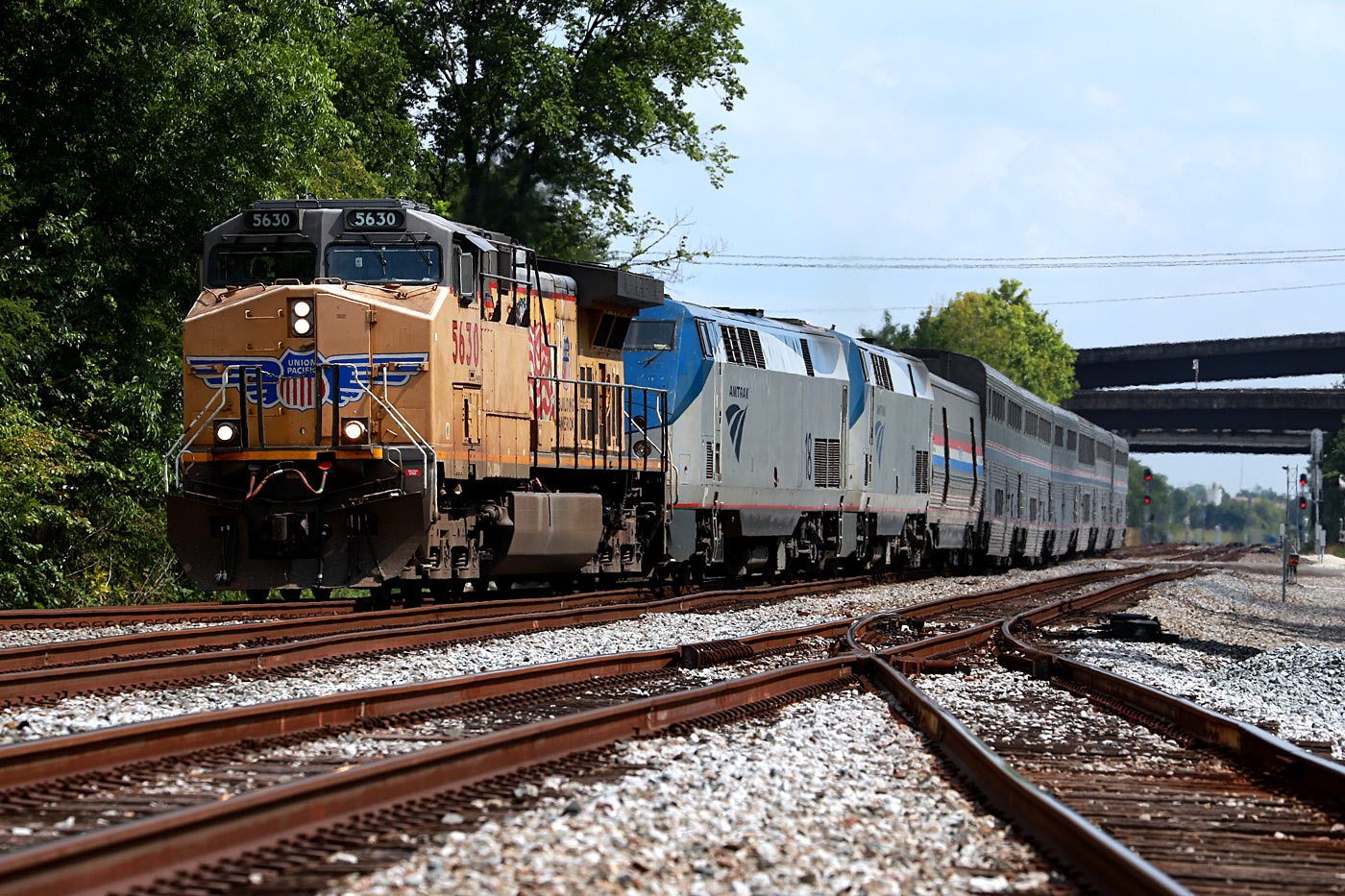
A more proper US flag on the conductors side of UP 5630 is a bonus as it makes the right turn at Belt Junction at 3:35 PM, over 3 hours later than normal.
Out & About – May 15, 2017
Nothing fancy today, just a few images from the two trains I saw today.
First up is KCS 4765 and a BNSF motor bringing an eastbound grain empty through the big curve at Stafford at 11:04 AM

A follow-up shot of this guy at West Junction was foiled by, you know it, clouds.
Grown-up duties occupied my day, but by late afternoon the metaphorical coast was clear and I headed out to catch Amtrak #1. To the extent sunset is getting later, I got brave and tried a new location for this train, CP SA029.
The train departed Houston on time at 1855, but for some reason, showed up at 1938, over 10 minutes later than is typical. The sun had almost hit the tree line when it showed up, but nothing that ISO 1000 couldn’t handle.
First shot across a corn field while the train was about a 1/2 mile away.
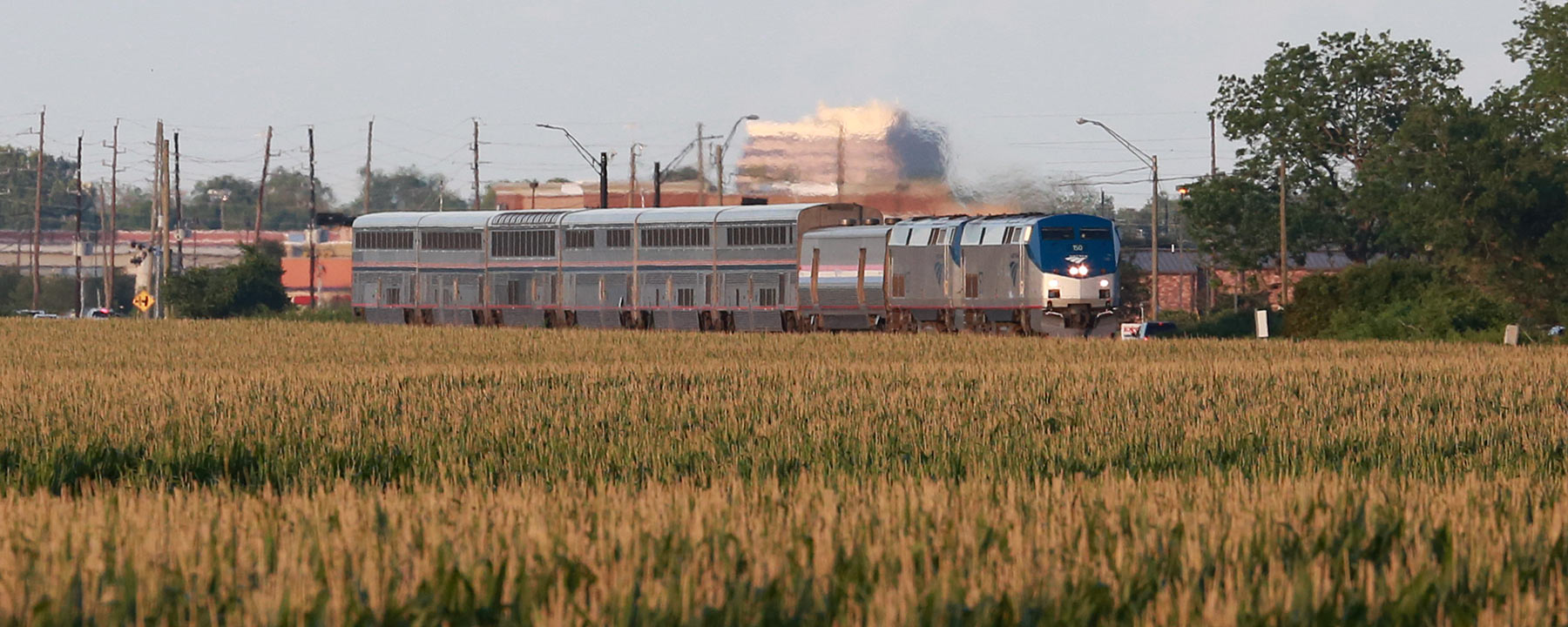
Second shot exiting the curve just east of CP SA029.

Finally, the last shot as P42 150 is gettin’ up in my face. This is the same unit that led #1 2 weeks ago. It was the co-star of my previous post.

Monday before last, 5/1/2017, I got out after dinner to photograph Amtrak train #1 as it passed through. It’s usual time through my area is 7:30 PM, shortly before sunset at this time of year.
Amtrak P42DC 150 leads the Sunset Limited at track speed as it passes MP 26 of UP’s Glidden sub at Sugar Land, Texas.
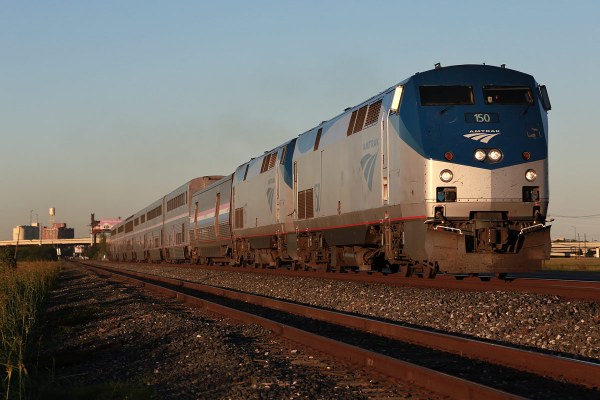
A nice image, but nothing remarkable. At least not today.
Which leads me to another image that was unremarkable shortly after it was made. Southern Pacific train #1, the Sunset Limited, is departing Alhambra, CA amid the lengthening shadows. #1’s scheduled time into Alhambra was 3:55 PM, putting sunset in Southern California less than an hour away on this clear mid-1950’s winter day.

Nothing in image 2 was remarkable in the mid-50’s. ALCO PA’s in the daylight-scheme were a daily occurrence. Just like Shamu-schemed P42’s are a daily (almost) event today. Will railfans in 2077 view P42’s the same way today’s railfans view the PA’s?
Only time will tell…
Glidden Sub Hosts BrightLine Trainsets
The third time is the charm, albeit with less than ideal conditions.
“What the heck are you talking about?” you ask. Sorry. Allow me to elaborate.
I missed the first two shipments of BrightLine trainsets through the Houston area because of misplaced priorities, namely work commitments.
I promised myself that the third, and last, shipment of these brightly painted trainsets would not evade my camera. Well, today was the day.
They departed Sacramento this past Saturday 5/5/2017, reaching the Houston area today, Monday, 5/8/2017.
A Good Lookin’ Girl
To follow up on my previous post, I snuck out this past Saturday evening to try my luck at some night views of this fine looking machine. Nothing but your basic roster views, but you don’t get to see them this clean very often.
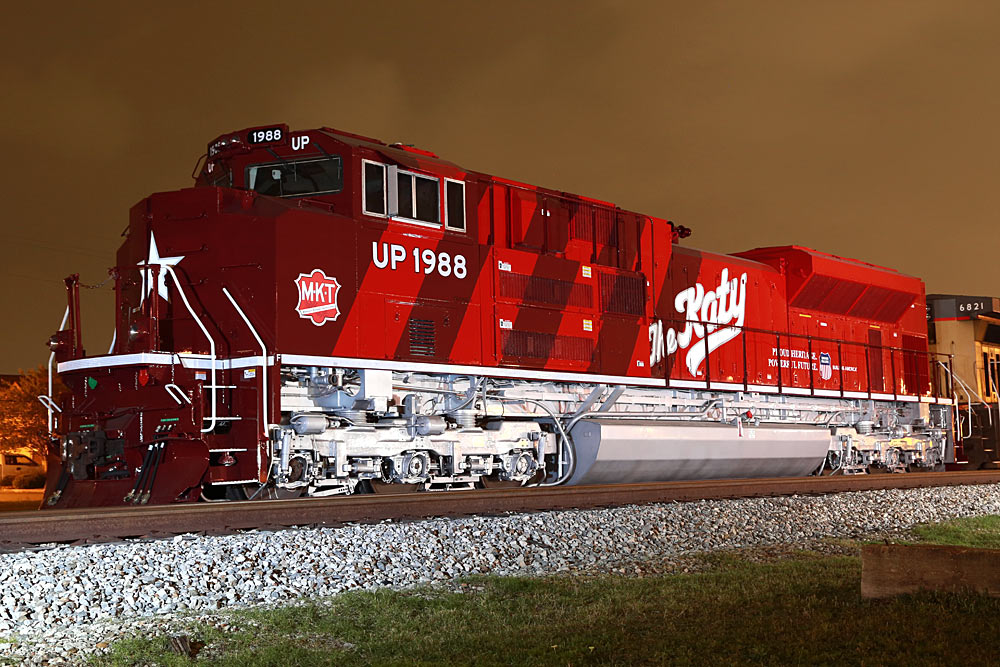
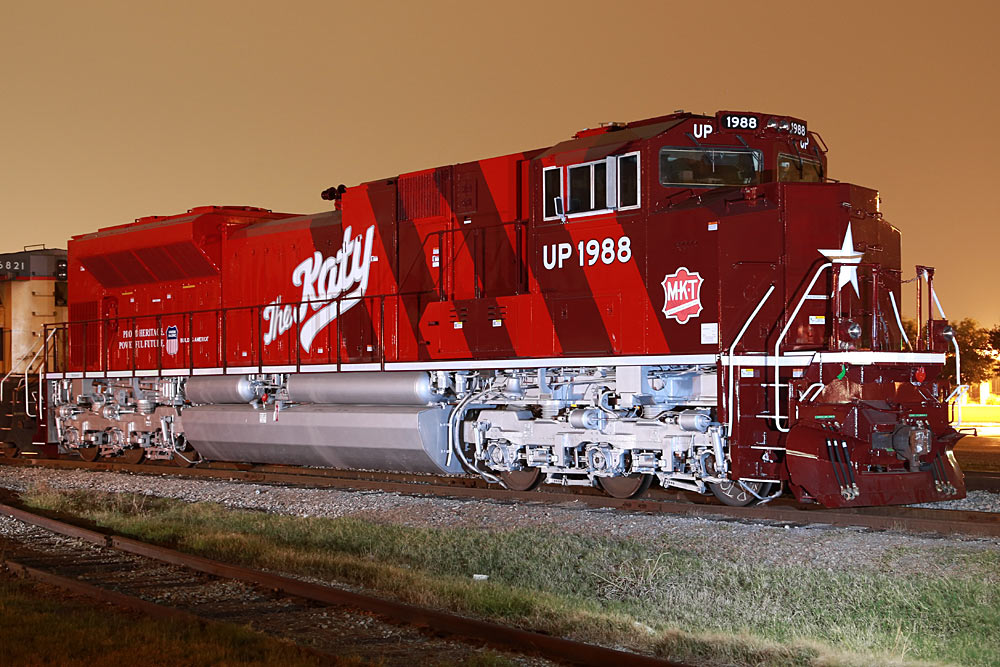
This unit was still at Katy as of this writing, but it will be leaving soon. It’s not making any money for the UP by just sitting there being beautiful.
Miss Katy Goes Home
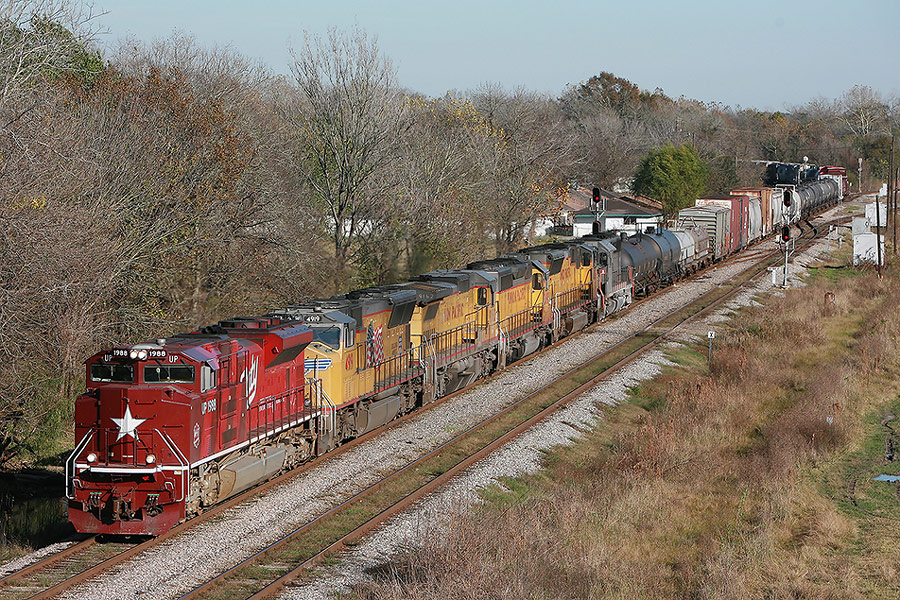
You probably know the Katy Railroad Historical Society is having their annual convention in Katy, Texas this year from 4/27 to 4/29. And you’ve probably heard that UP 1988, the Katy heritage engine, has just received a fresh coat of red paint. And you certainly are aware that the UP has graciously moved it to Katy, Texas for display in support of the Katy Railroad Historical Society convention. Good.
To join in the celebration of all things Katy, here’s a TrainOrders.com post of mine from 12/21/2007. Pretty hard to believe that it’s been 10 years ….
The QHONL 21 has just departed the top end of Settegast and is approaching Pierce Yard on the near North side of Houston.
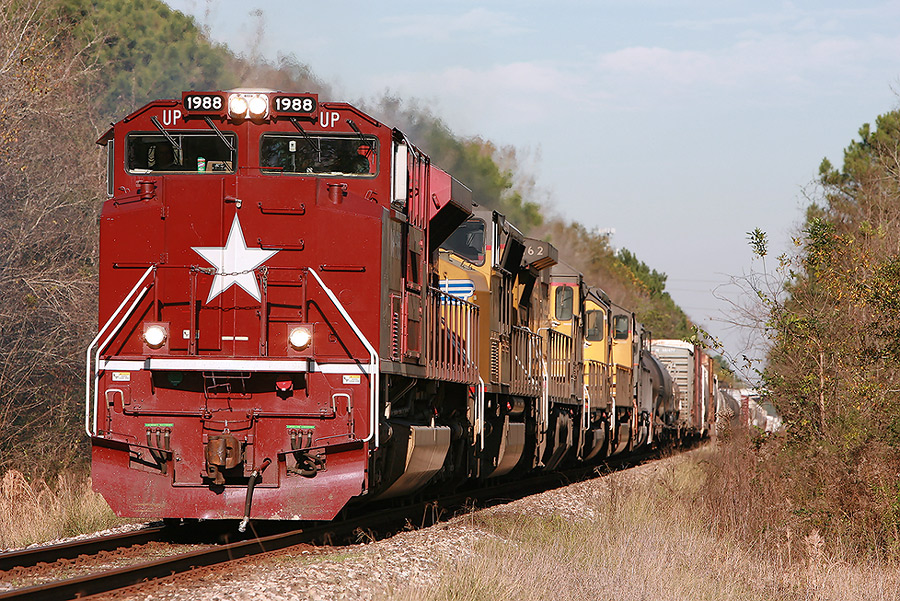
West of Pierce Yard, the UP 1988 heads into more favorable sunlight as it approaches the US 59 overpass where your photgrapher suddenly and unexpectedly had idiopathic car trouble. Most fortunately, the car trouble cleared up as soon as the train went by.
 Southwest Rails