A Few Recent Westbounds…
I’m headed out to a wedding, but I thought I’d post a few recent shots from the Glidden sub.
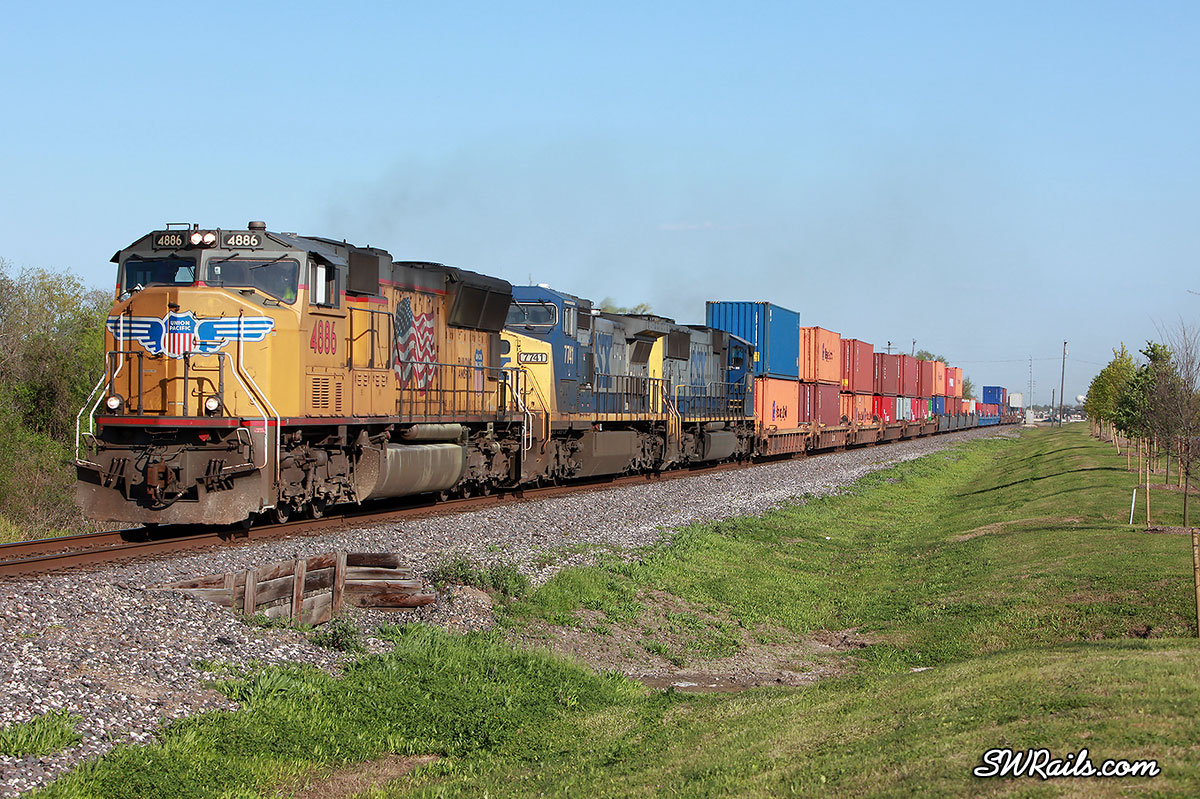
UP symbol KATCI westbound at MP 21 of the Glidden sub on March 28, 2010
The KATCI is the train that’s nicknamed “the juice train” because it frequently has a head end block of Tropicana reefers, but no juice today.
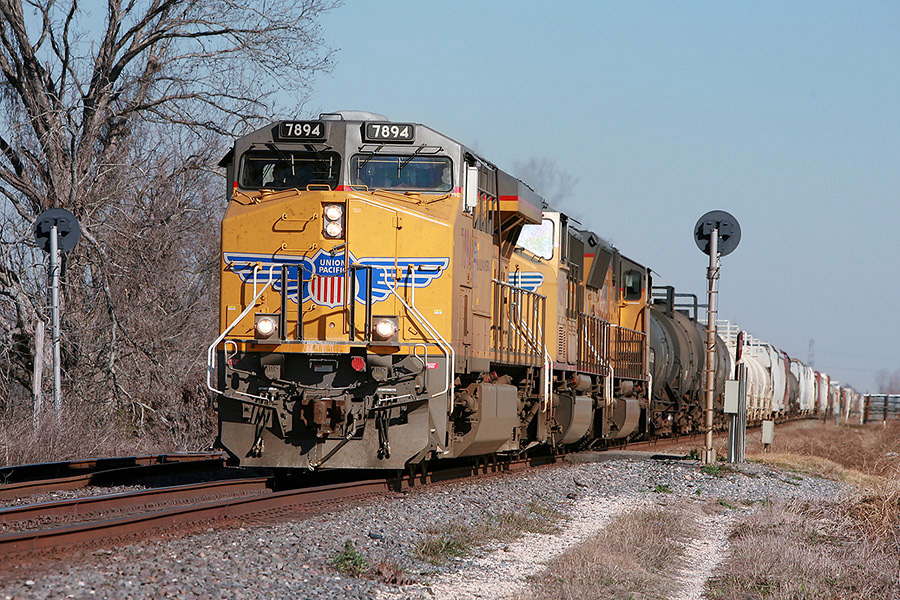
A QEWWC at the west end of Harlem, MP 30 on the Glidden sub, on Feb. 2, 2009
The QEWWC is a daily mid-afternoon departure from Englewood, which puts it in my neck of the woods in the late afternoon. This train always runs heavy, sometimes over 12,000 tons, making it a regular for DPU locomotives cut in, or on the rear.
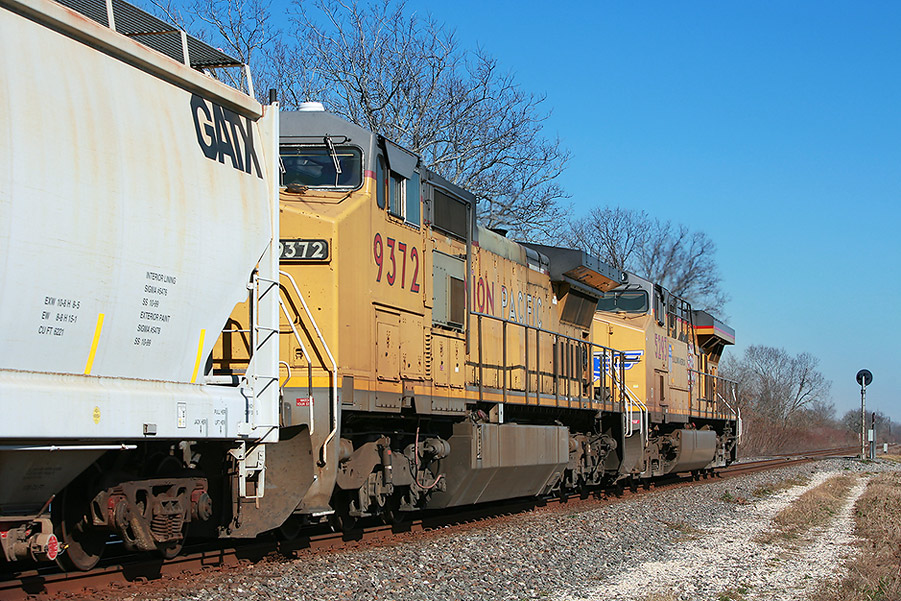
DPU power shoving on the above train
It’s not common to see older power like nearly 20-year-old C40-8W 9372 in a DPU set.
Out & About – June 25, 2010
I managed to get out for a few hours this morning to see what might be running.
Right off the bat, I heard the DS take up a warrant from the KCS 4106 as it came on to UP trackage at Rosenberg. 20 minutes later it blew by me in Stafford, doing a good 45-50 mph.
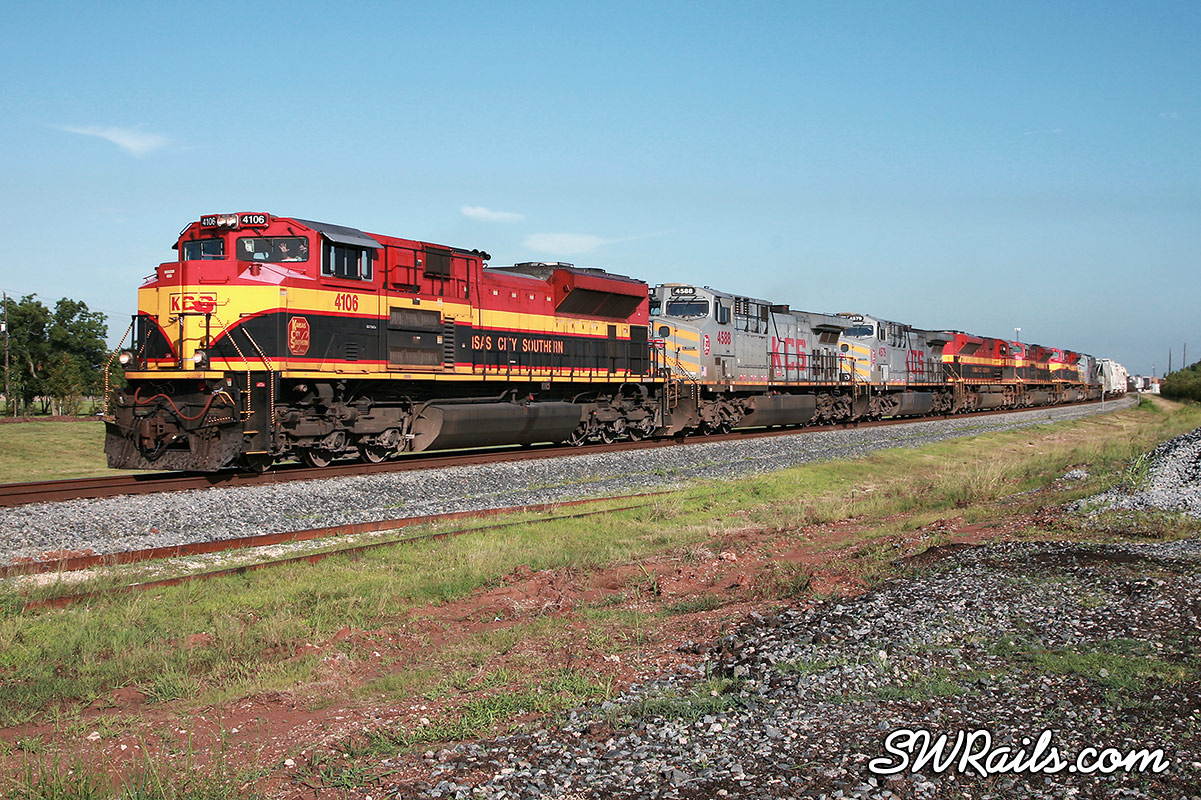
The MNLSH (Manifest Nuevo Laredo-Shreveport) passing through Stafford, TX on June 25, 2010.
I didn’t notice it at the time, but the conductor seemed to be in a pretty good mood. (Click the photo to see what I’m referring to….)
Due to the preponderance of southbound tonnage on the KCS, excess power will accumulate in Mexico. From time to time, northbound KCS trains will bring the excess power back to the north end of the KCS system. The trailing 4 units were dead-in-consist.
I thought I could catch him again either at West Junction or at Willowbend Blvd, but he smoked me.
Since I was only a few miles from BNSF South yard, I made it my next destination. Upon arrival, a BNSF transfer was shoving back into the bottom of South Yard via the wye at T&NO Junction.
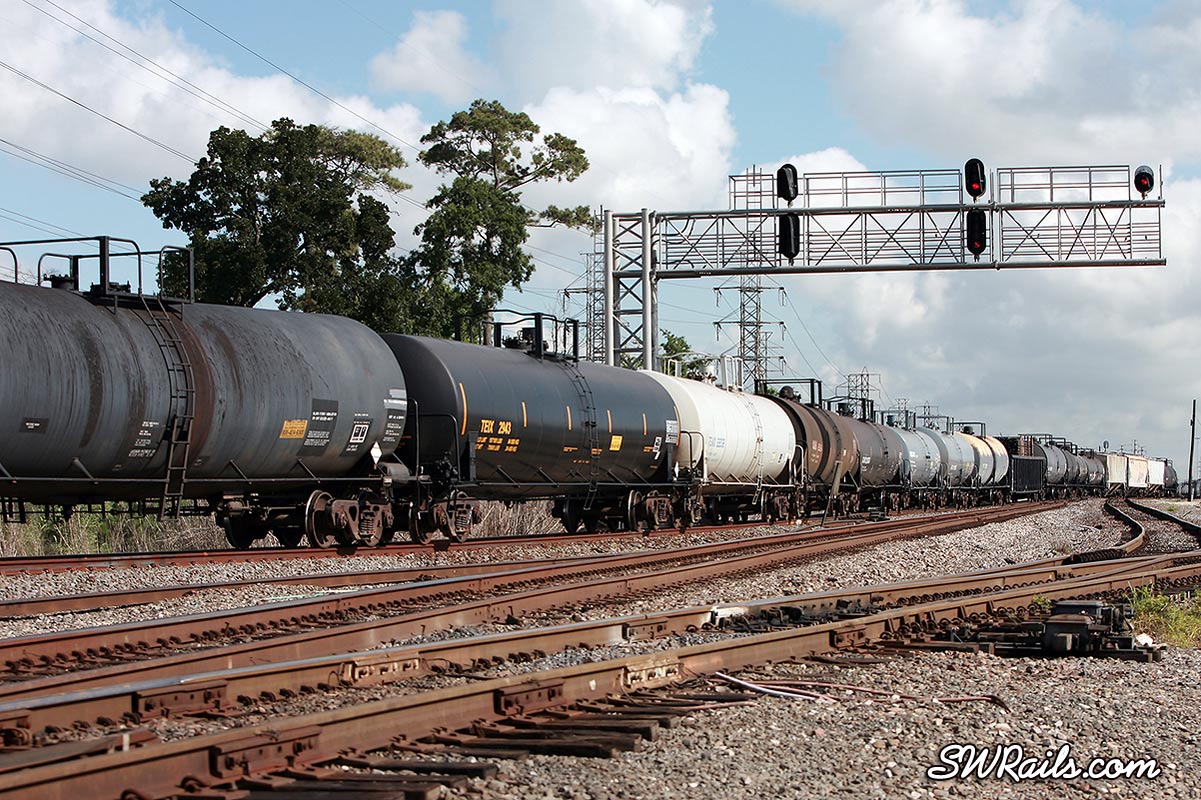
A BNSF Transfer shoving into BNSF South Yard in Houston on June 25, 2010
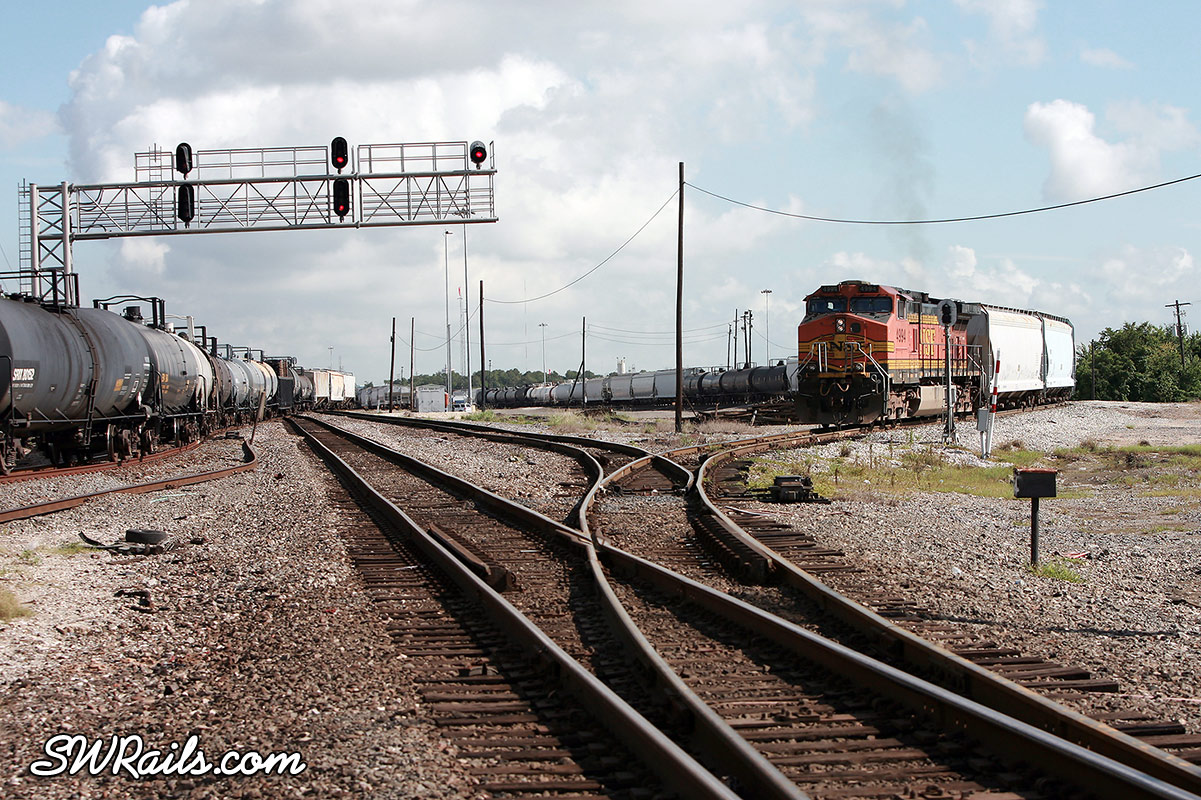
The head end of the transfer stopped 5-6 cars west of T&NO Junction. I suspected it had run out of room at the top end and would have to drag out to double over. 15 minutes went by with no movement. I was getting ready to give up and head out when I see a headlight heading toward me on a yard track.

BNSF 4994 waiting for the signal to shove back with its double over into South Yard.
Fortunately, the 4994 didn’t need more than a couple of minutes before making the shove.
Shortly after the 4994 cleared up, the BNSF transfer dragged out about 10 cars, stopped, and began his double over. Finally.
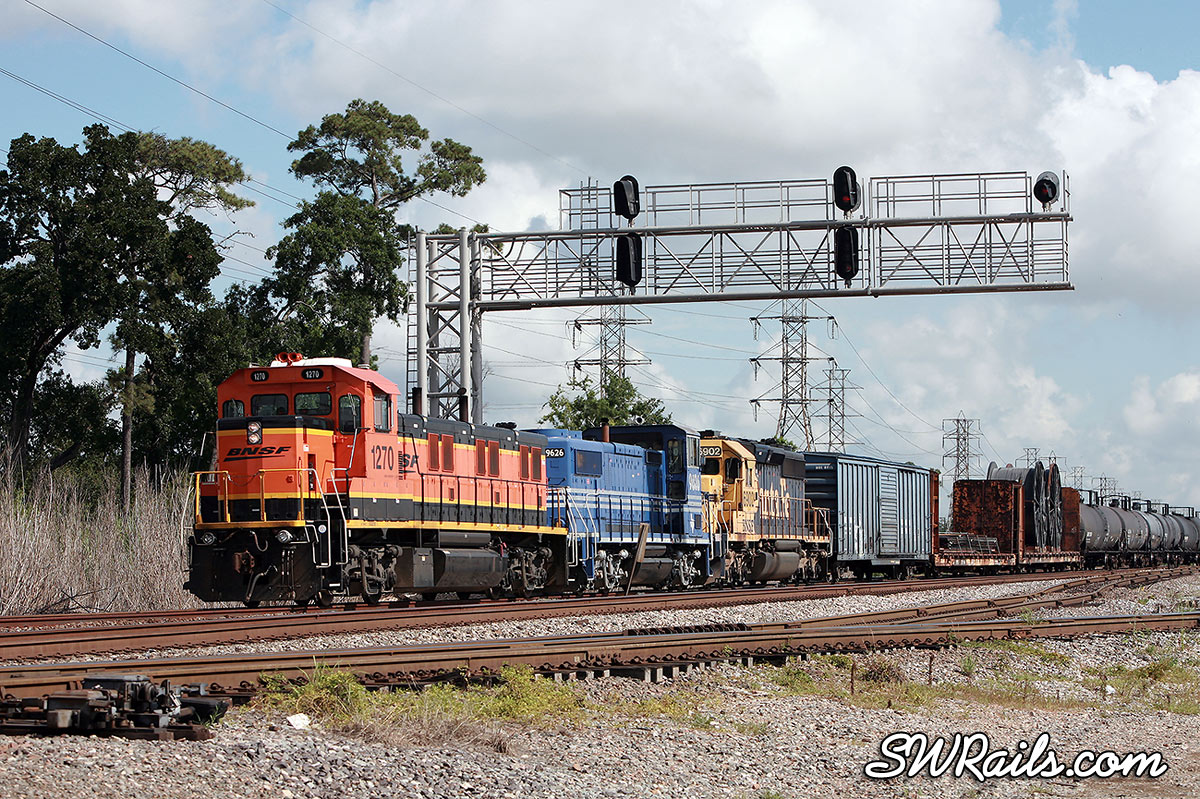
An interesting power lash-up makes a reverse move into BNSF South yard in Houston, June 25, 2010
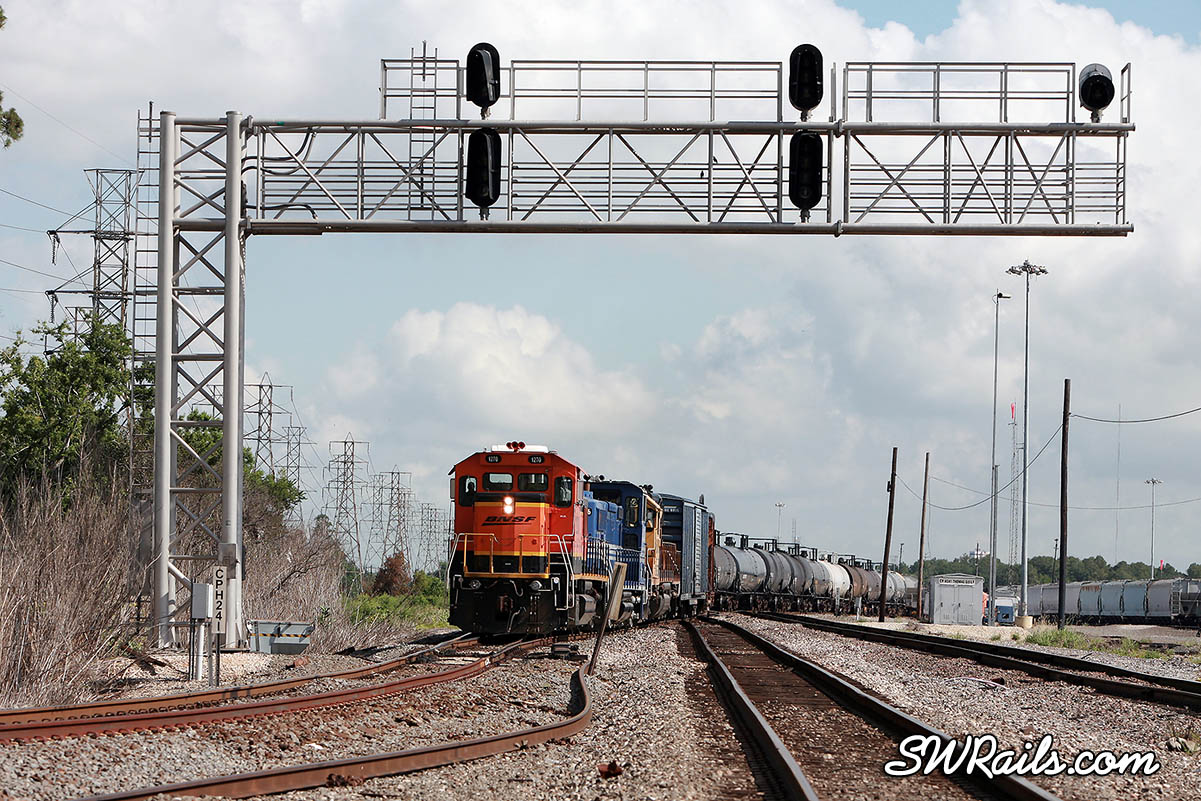
Note the flange lubricator just ahead of the lead unit. With as much screeching that this train made shoving back, I suspect the flange lubricators is out of service.
By this time it was 10:30 A.M. There was plenty of traffic on the radio,but the sun was getting pretty high in the sky for any more photography today…
Size Doesn’t Matter
It’s late afternoon on June 15, 2010. The diminutive Eagle Lake local, LHT47, is just west of Rosenberg, TX as it heads west.
A small train compared to the typical traffic through here, but size doesn’t matter as long as I can get a spartan cab on UP’s Glidden sub mainline in 2010!
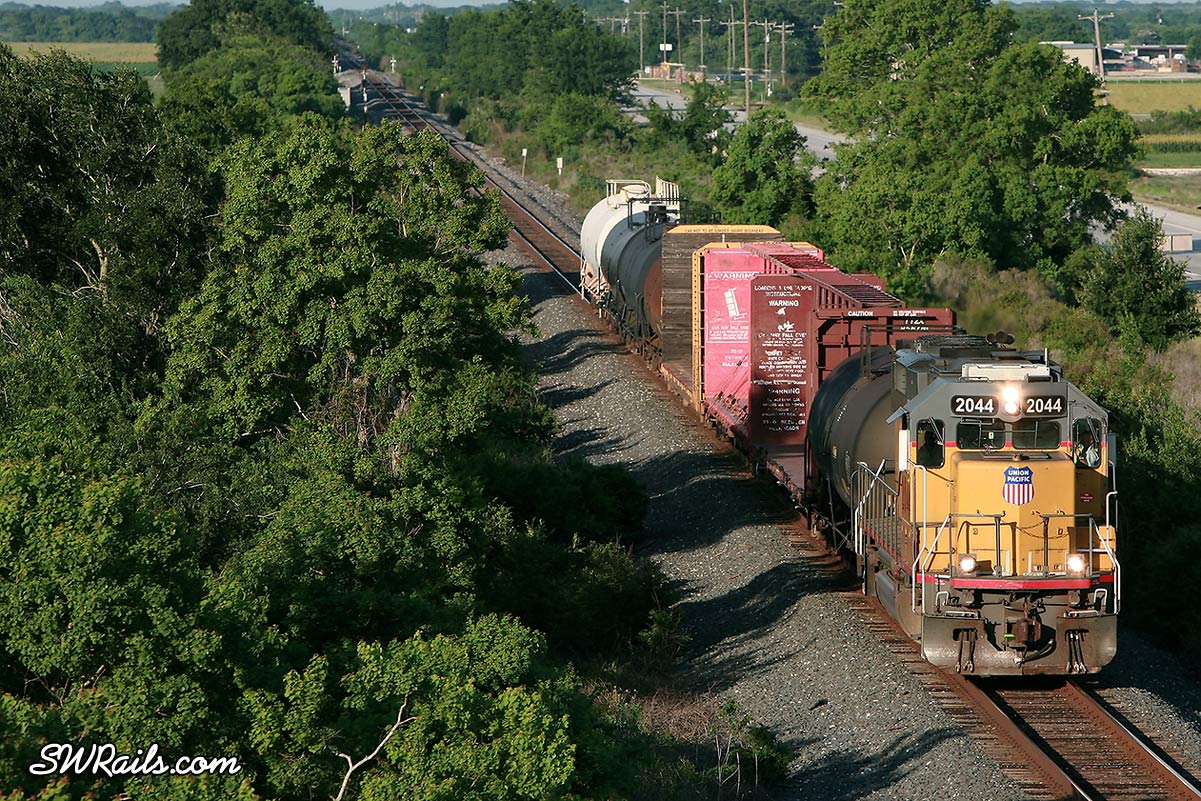
UP GP60 2044 en route to Arenal with the Eagle Lake local on June 15, 2010
GP60 2044 provides a welcome respite from the ubiquitous wide-nose locomotives that predominate contemporary trains.
I’m a Believer
I’m a believer in the power of digital photography. Actually, I have been for some time now.
For me, the biggest benefit from digital is the ability to make adjustments on the fly in order to capture an image that would be impossible with film.
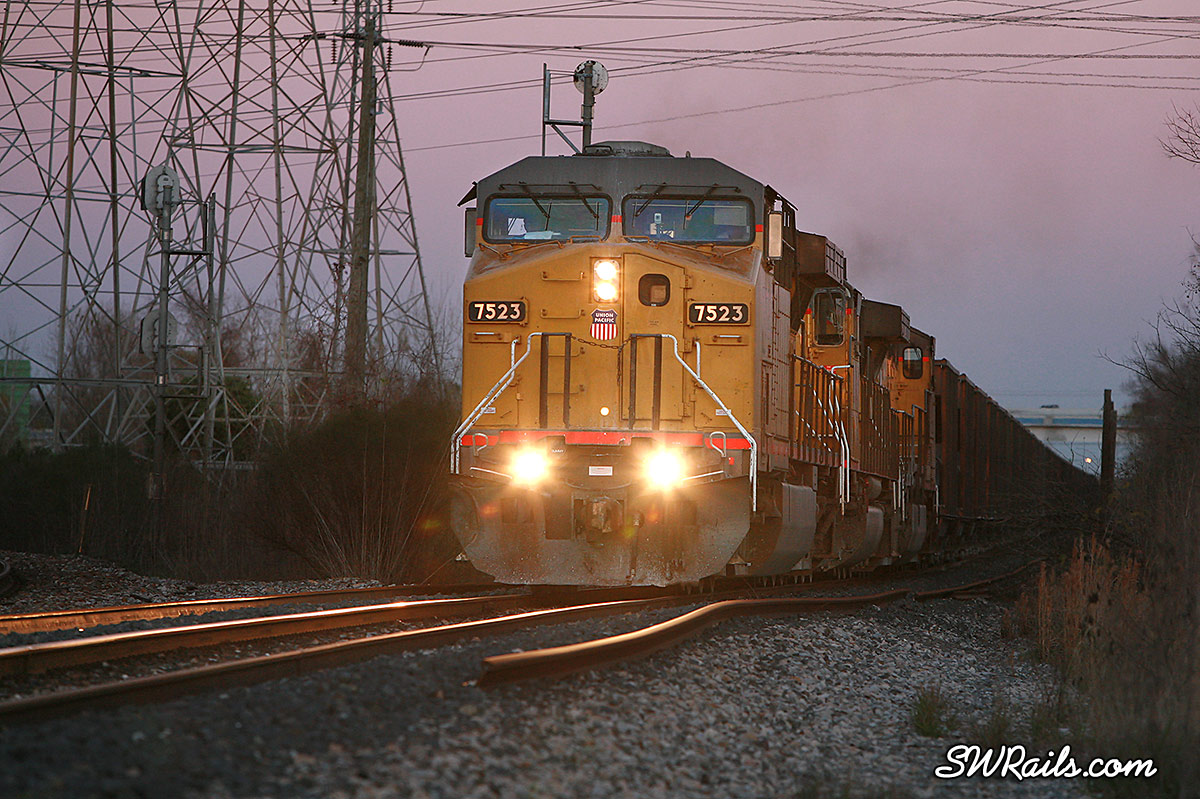
An empty rock train creeps westward at West Junction on Jan. 10, 2008
This picture of a slowly moving train was shot hand-held at 6:43 PM, a good hour after sunset. Without getting into the technical aspects, suffice it to say that this image can’t be done with film.
There’s a bit of noise in the image, but nothing that can’t be cleaned up with a few key-strokes.
There is a steeper learning curve with digital than with film, but it’s been worth it.
Three of a Kind
I don’t play poker, but I do know that having 3 like cards is a good thing. As for motive power consists, any time I can catch a train with 3 identical units, that’s a good thing also.
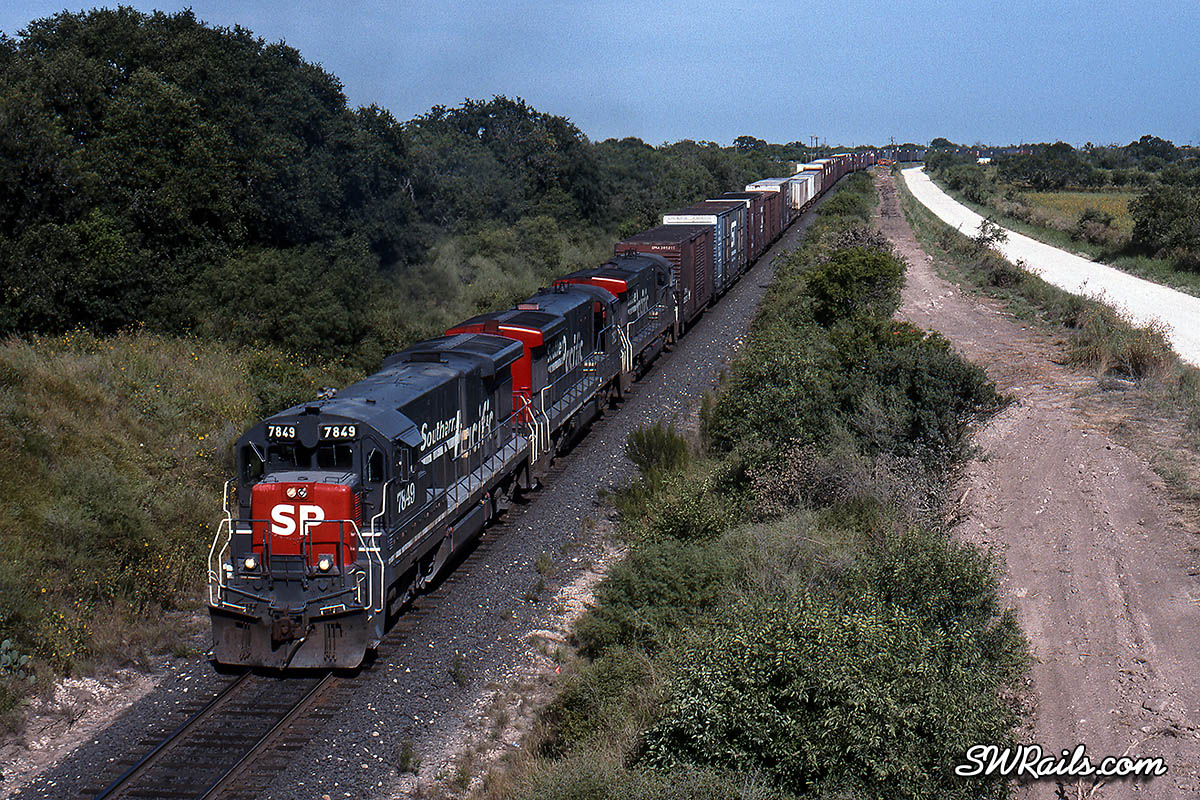
Three SP B30-7's power an ESEGA train westward at Dunlay, TX on July 20, 1997
The Un-glamorous Santa Fe
Among American railroads, the Santa Fe would be among the most glamorous railroads, if not the most glamorous. Hollywood movie stars rode its passenger trains, its freight trains among the fastest in the world, the warbonnet paint scheme among the most well-known, etc.
But there was another side of the Santa Fe, a side that didn’t get as much attention from the public, the media, or railfans.

Two CF7's and a GP7 bring an empty grain train through SP's Englewood yard on April 17, 1982
For every high-speed train, there were probably 5 that never exceeded 20 mph. This empty grain train passing along the west side of SP’s Englewood Yard is a good illustration of the countless yard jobs, transfers and branch-line trains that accounted for the vast majority of the day-to-day operations on the Santa Fe.
Even though these mundane trains accounted for the vast majority of the Santa Fe’s revenue, they garnered none of the fame or publicity that the Super C or the Super Chief did.
So even though the public could care less about these empty grain hoppers returning to Kansas for another load of grain, Santa Fe executives knew better. Santa Fe management understood that trains like this are the ones that pay the bills. And that’s what counts….
Sloan Yard, 1901-1996
The date is August 12, 1988. It’s a pleasant summer afternoon at the Katy’s Sloan Yard in San Antonio, Texas.
The acquisition of the MKT by the UP has been announced, but it will not become final until 12/1/1990. Yes, there will be some changes, green locomotives will become yellow, some traffic will be re-routed, etc.
At least, that’s what I expected, based on the changes that took place as a result of the UP/MP merger in 1982.
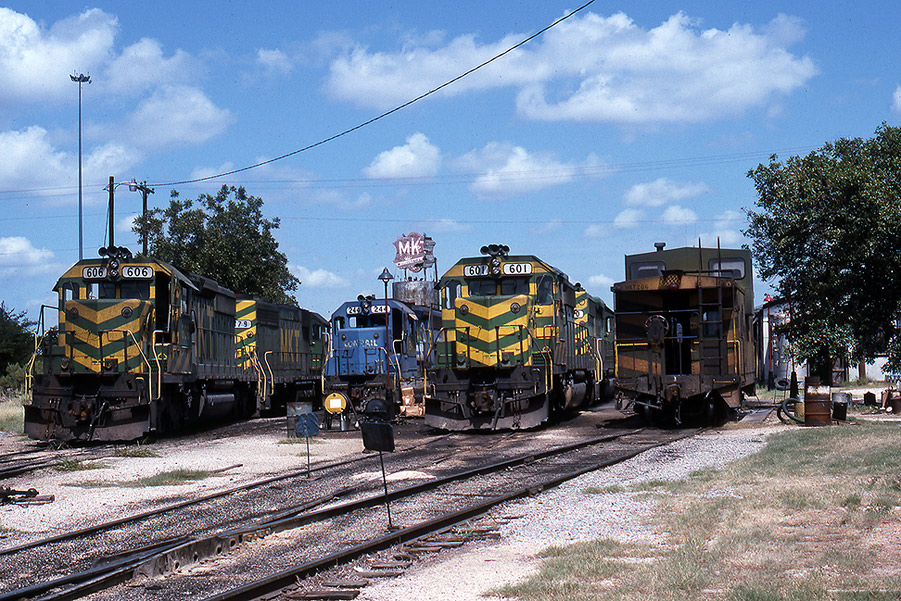
MKT power congregates under the iconic MKT sign at Sloan Yard on Aug. 12, 1988.
Little did I know that the changes in store for Sloan Yard would be a bit more dramatic.
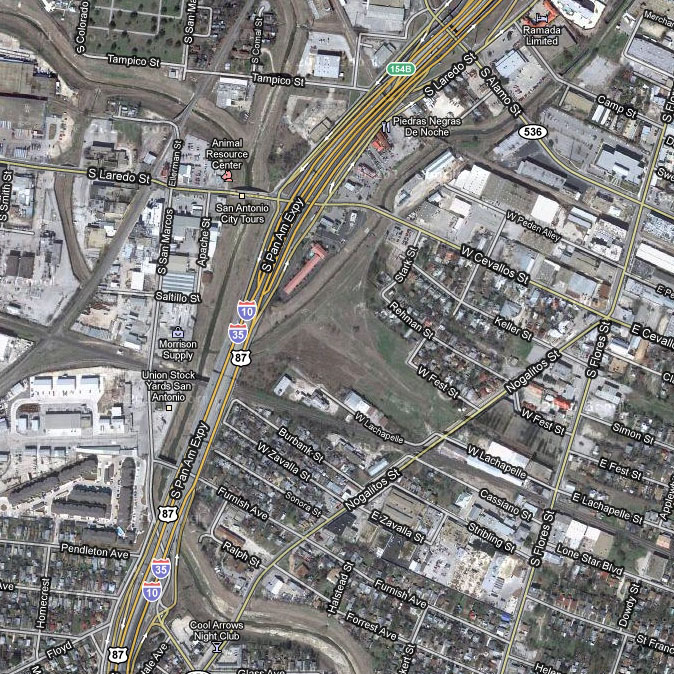
Katy's Sloan Yard in San Antonio was located in the open area at center of image.
By 1996, the UP had abandoned Sloan Yard. The Katy’s San Antonio base of operations since 1901, has disappeared. All that’s left is a large, triangular piece of land.
Sims Bayou – 1985 and 2005
UP’s Strang subdivision is a key generator of revenue for the UP. Every day, vast amounts of plastic pellets and petrochemicals are shipped from the dozens of refineries and chemical plants that line the Houston Ship Channel.
Sims Bayou, a modest tributary of Buffalo Bayou, passes under the Strang sub near MP 7. This is near the border between Houston and Pasadena.
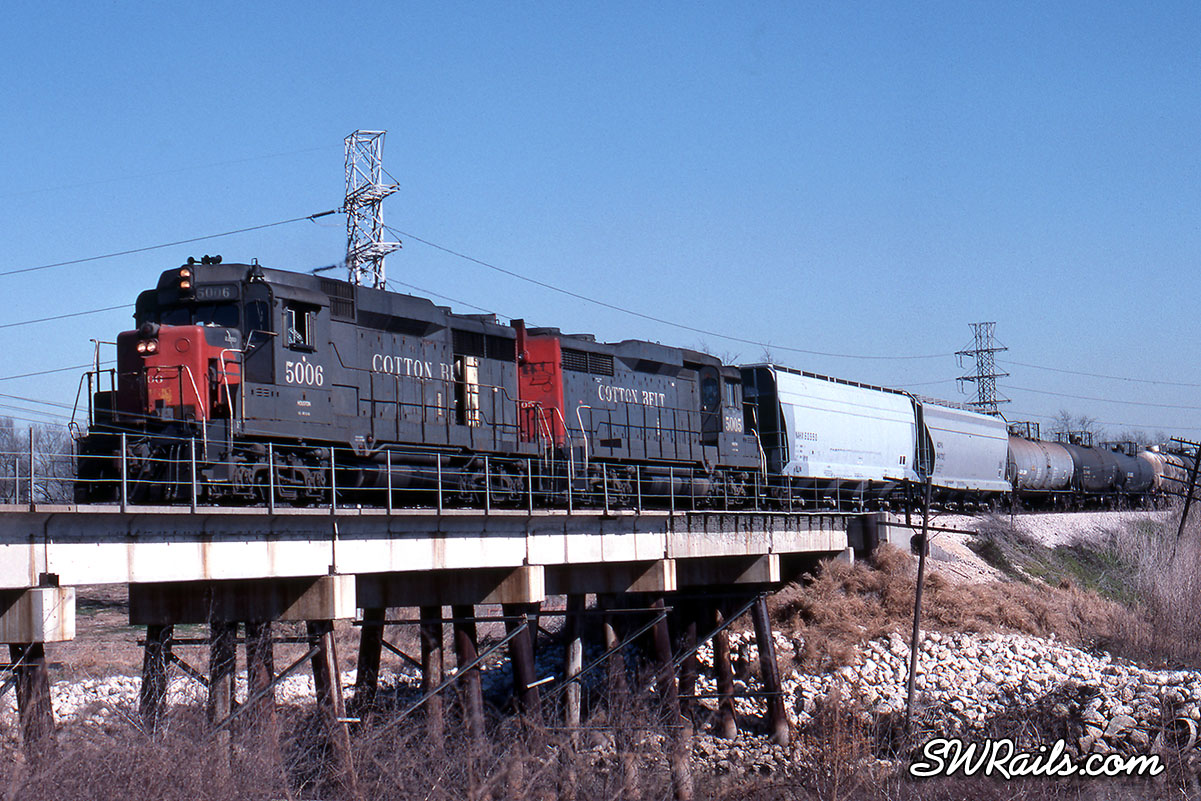
Two SSW GP30's lead an SRHOK (Strang-Houston Chemical) across Sims Bayou on Feb. 12, 1985.
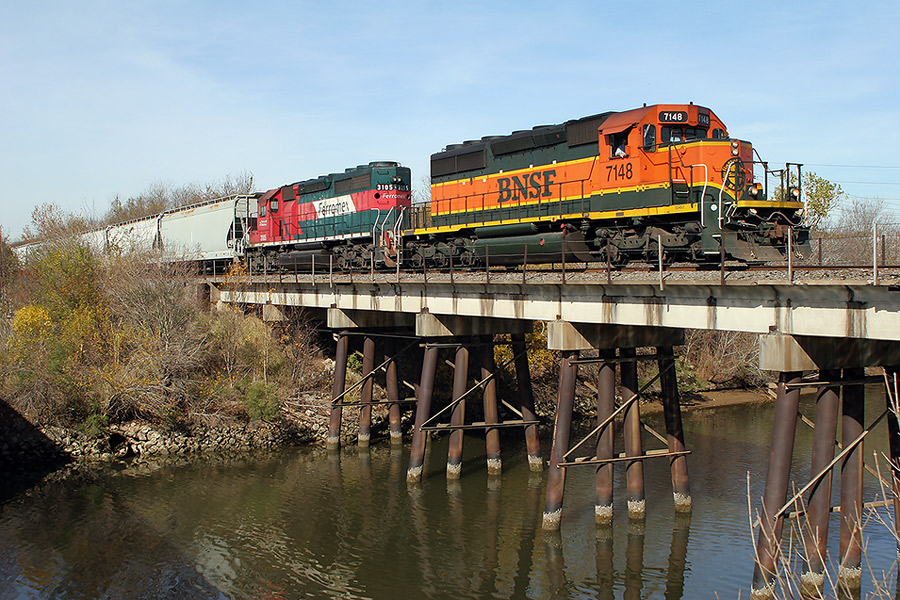
An international set of SD40-2's lead a BNSF train as it crosses Sims Bayou on Dec. 28, 2005
Note the vegetation and code lines have been removed, providing a much more open view of the scene. Finally, some progress that I actually like!
SP SD40T-2 8513 – Before & After
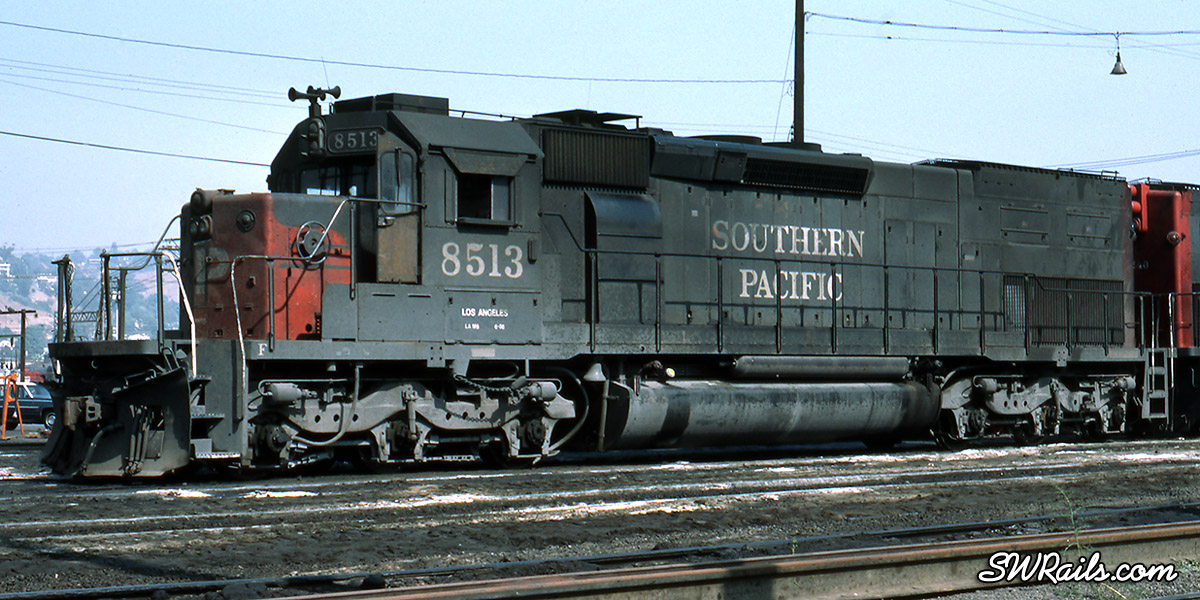
SP 8513, an SD40T-2, lays over at Taylor Yard in Los Angeles on Sept. 5, 1986
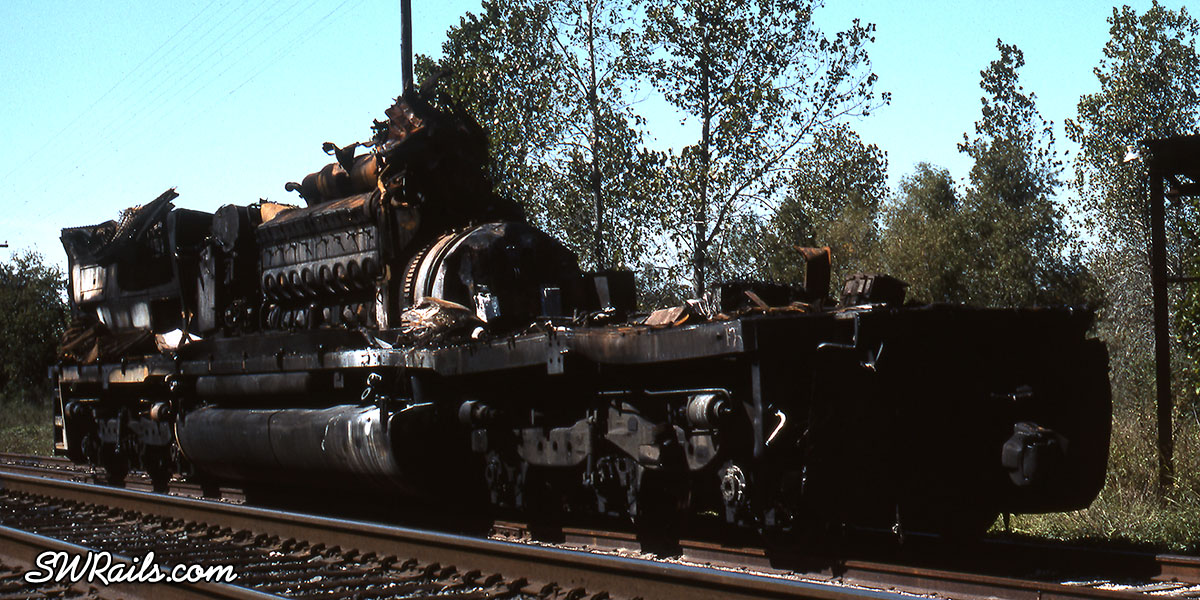
The remains of SP 8513 on Oct. 28, 1997, 3 days after a fiery head-on collision at West Junction
Information from Don Strack’s essential website, Utahrails.com
UP 5530, B2489, 5027, SP 8004, SP 8513, and SP 9712 were involved in a wreck at West Junction (MP 12.6) in Houston, Texas, on 25 October 1997. Following a head-on collision, five of the six units were completely destroyed by the resulting fire. There were no injuries to any of the four crew members. The collision occurred when the westbound 1HOLB25 (1st Section, Houston, Texas, to Long Beach, Calif.) stack train, with UP 5027 (leading), UPB 2489, UP 5530, and SP 9712, and 96 cars, failed to stop at a red signal, colliding with the eastbound 1MTUHO21 (1st Section, Manifest, Turlock, Calif., to Houston, Texas) autorack train, with SP 8004 (leading) and SP 8513 and 63 cars. Five of the six units involved were retired. The sixth unit, SSW 9712, sustained major frame damage and was removed from the wreck site. UP 5530, B2489, SP 8004, and SP 8513 were retired on 4 December 1997. UP 5027 was retired on 5 December 1997.
The remains of the 8513 were dragged to this set-out track about a mile west of the collision site. It was scrapped at this location several weeks after the photo was taken.
Rio Grande Valley This and That
I haven’t posted anything from the “good ole days” in the Valley recently, so here goes:
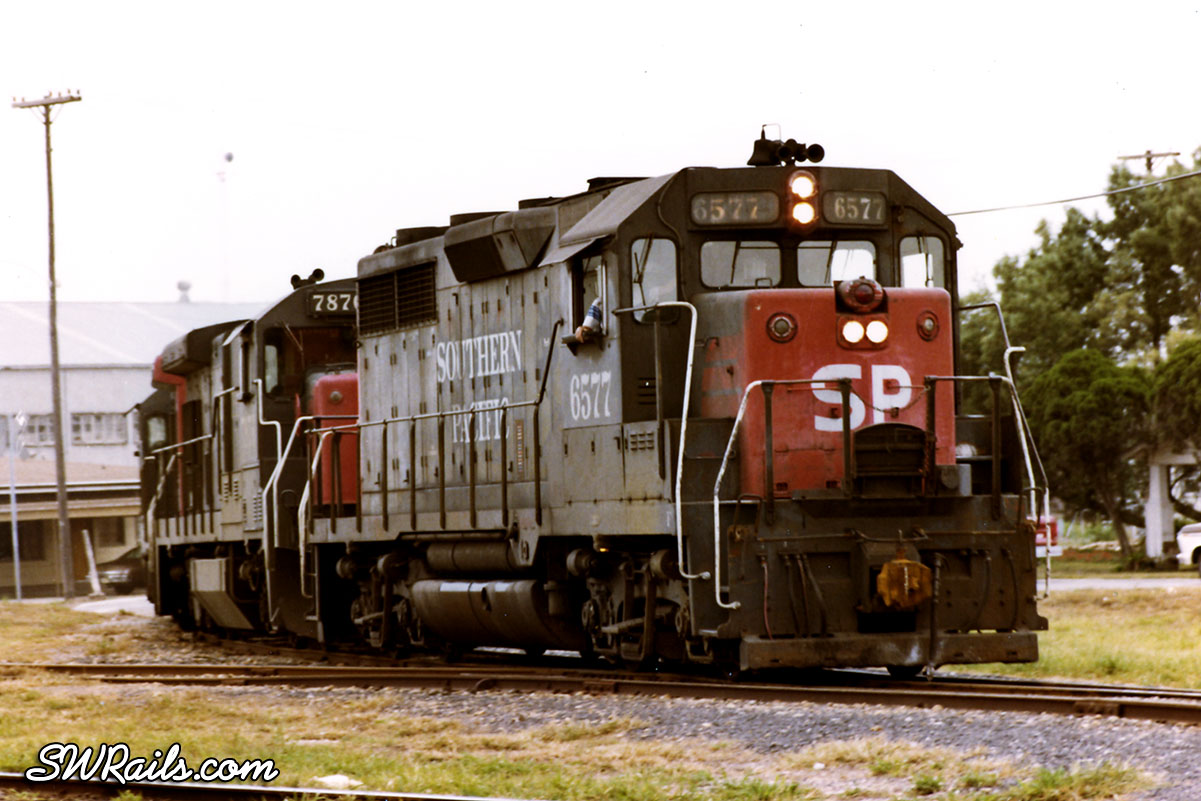
SP 6577 / 7876 / 7823 coming onto home rails at Harlingen, TX on May 5, 1980
The crew has just parked the HEBVY (Hearne-Brownsville Manifest) in the MP’s Harlingen, TX yard and they are coming onto SP track to tie down their power.
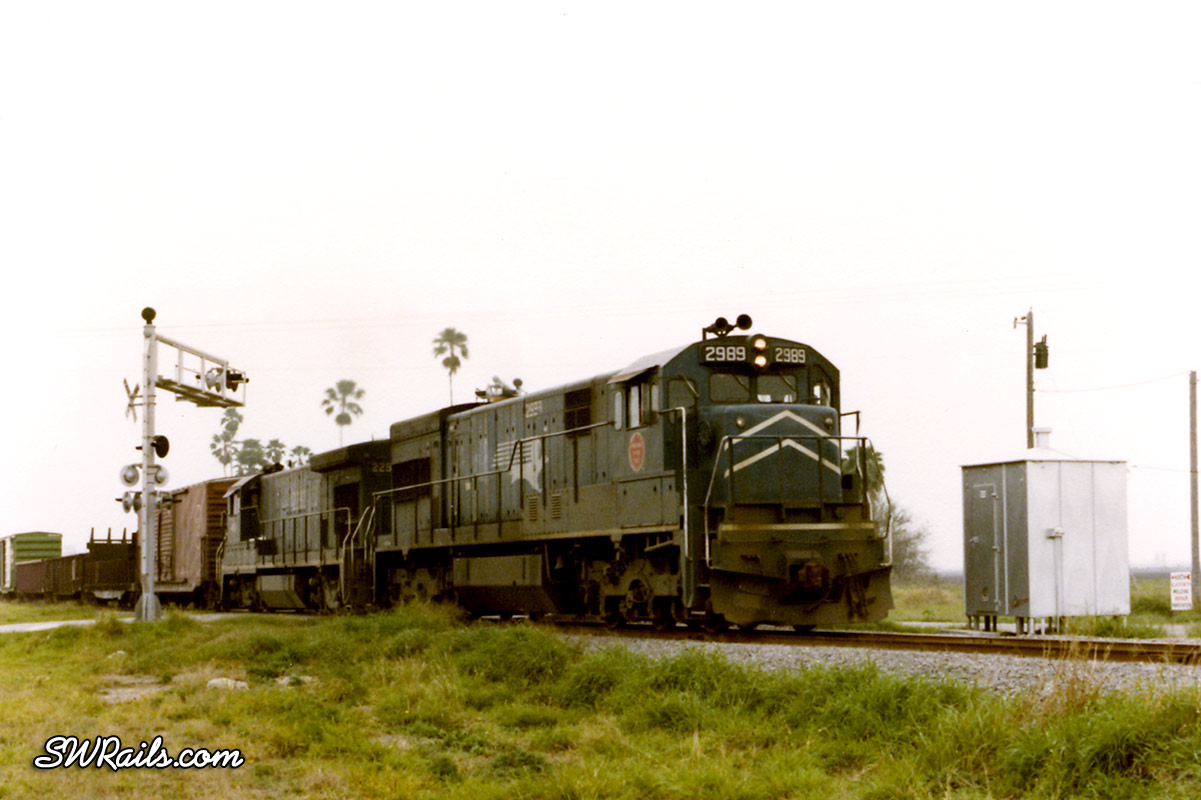
MP U30C 2989 and B23-7 2292 with a northbound manifest at Combes, TX on Jan. 29, 1980
Grubby weather or not, catching a U30C on the point of a train in the Valley was worth chasing, at least to Combes, the first little town north of Harlingen.

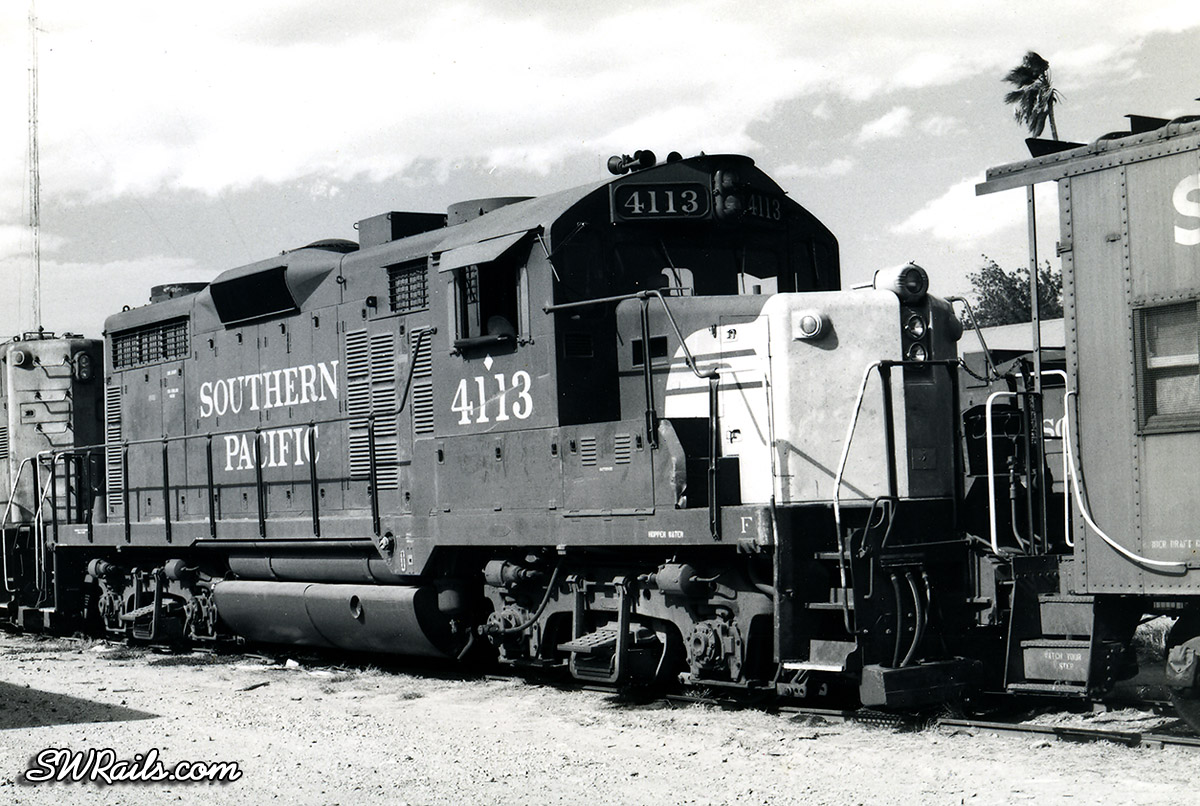
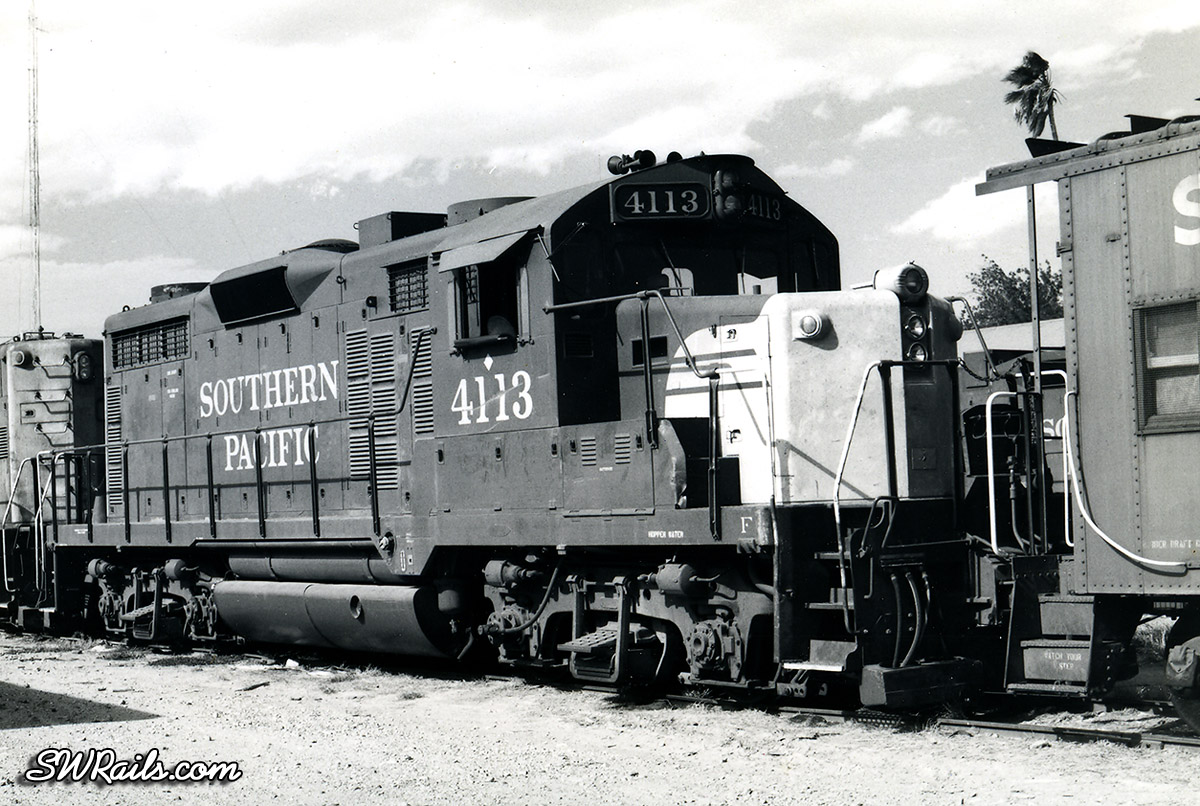
With McAllen being the end of the line for the SP in the Valley, 3 units was a good catch. The 3326 and 4113 came in on the road freight from Alice. In the background is GP9E 3762 which was holding down switching duties in McAllen. Photos taken in May, 1978, before SP abandoned its line from Victoria to the Valley in favor of MP trackage rights from Placedo to Harlingen.
UP 844 – Bloomington to Houston Video
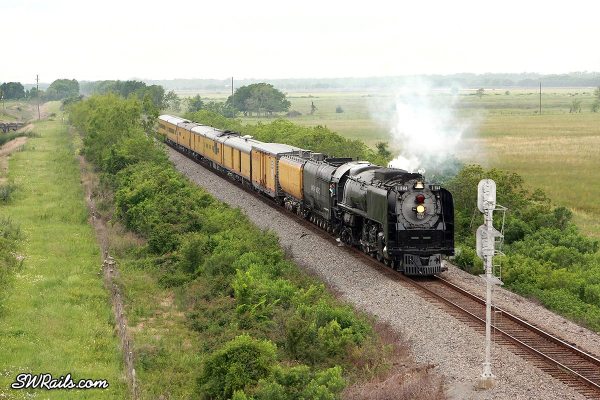
The Valley Eagle just south of Bay City, TX on April 17, 2010. Click image to view the video.
I finally broke down and edited the video from our chase of the April 17, 2010 run of UP 844. This was the Bloomington to Houston leg of the 844’s return from its visit to Harlingen, Texas.
We were able to catch it at 15 different locations, plus a bit of 55mph pacing footage (sorry about the wind noise!) between Angleton and Liverpool.
In a very classy move, the train made an un-scheduled stop in the small town of Sweeny. The dispatcher received a call from a UP employee that lived in Sweeny. He called to see if the train could stop in Sweeny because some of his fellow residents were hoping to see the “steam train”.
The dispatcher radioed the engineer of the 844 to ask if they had time to stop their train in Sweeny. The engineer relayed the question to the conductor, who replied that yes, they could stop the train in Sweeny.
Even though it was hard work that was very fast-paced, we had a great time chasing the 844.
PS – I’m hosting the video on a different server. It’s a very large file (122 mb) so it might take a moment to start playing. Please let me know if you have any problem watching the video.
AVAXT at Picacho, Arizona
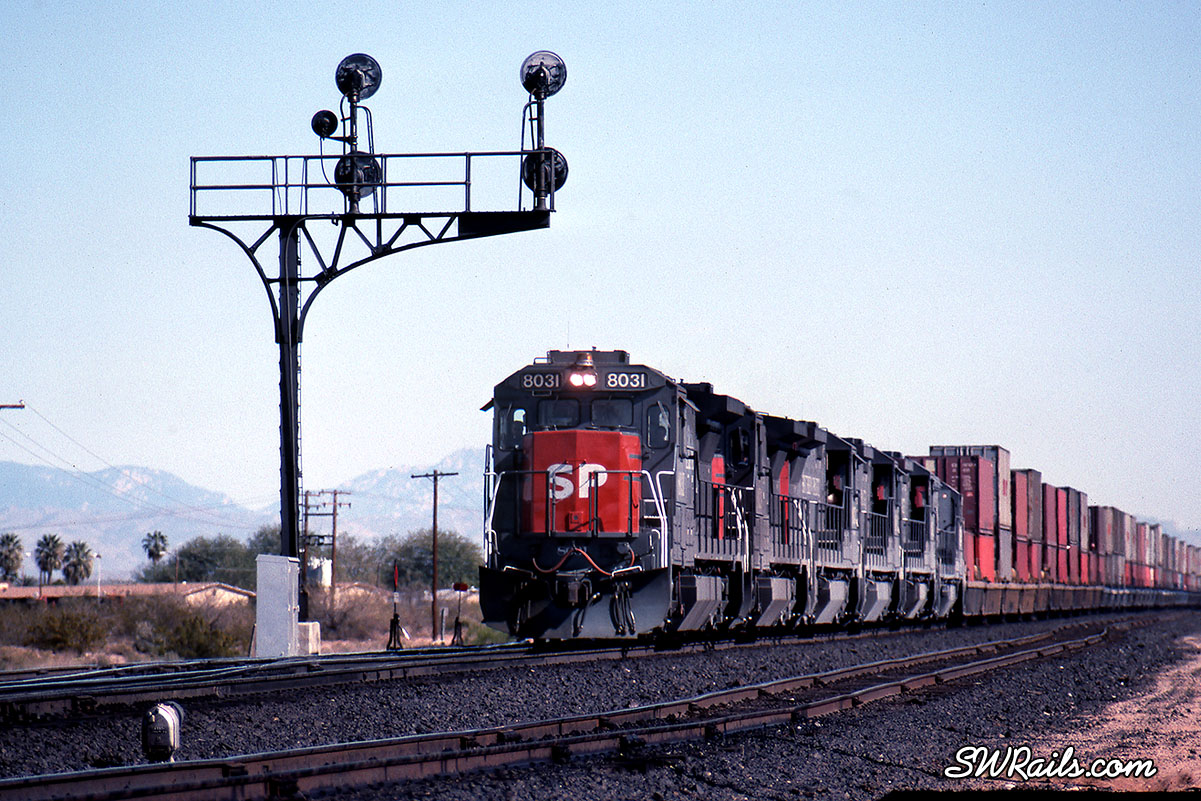
The AVAXT approaches the west end of Picacho, AZ on March 20, 1988
Six 4-axle GE’s are on the point of the AVAXT (Avondale,LA to American President Lines-Long beach, CA) as it passes through Picacho, AZ on March 20, 1988. This train operated 3 times / week in each direction for American President Lines, an early adopter of the land-bridge concept.
 Southwest Rails