A Quick Two-in-a Row
I had occasion to drive into Houston early this afternoon. I took the camera and radio just in case. I mean, you have to be prepared, right?
Right off the bat, the dispatcher tells a bridge gang working at MP 20 (UP Glidden sub) to clear up as he had some traffic to run.
Hoping the traffic was westbound, I headed east on Hwy 90A. As I approached CP SA014, I could see a westbound in the distance with its headlight dimmed. About the same time, the bridge foreman releases his track & time, so the stage is set. Let the show begin.
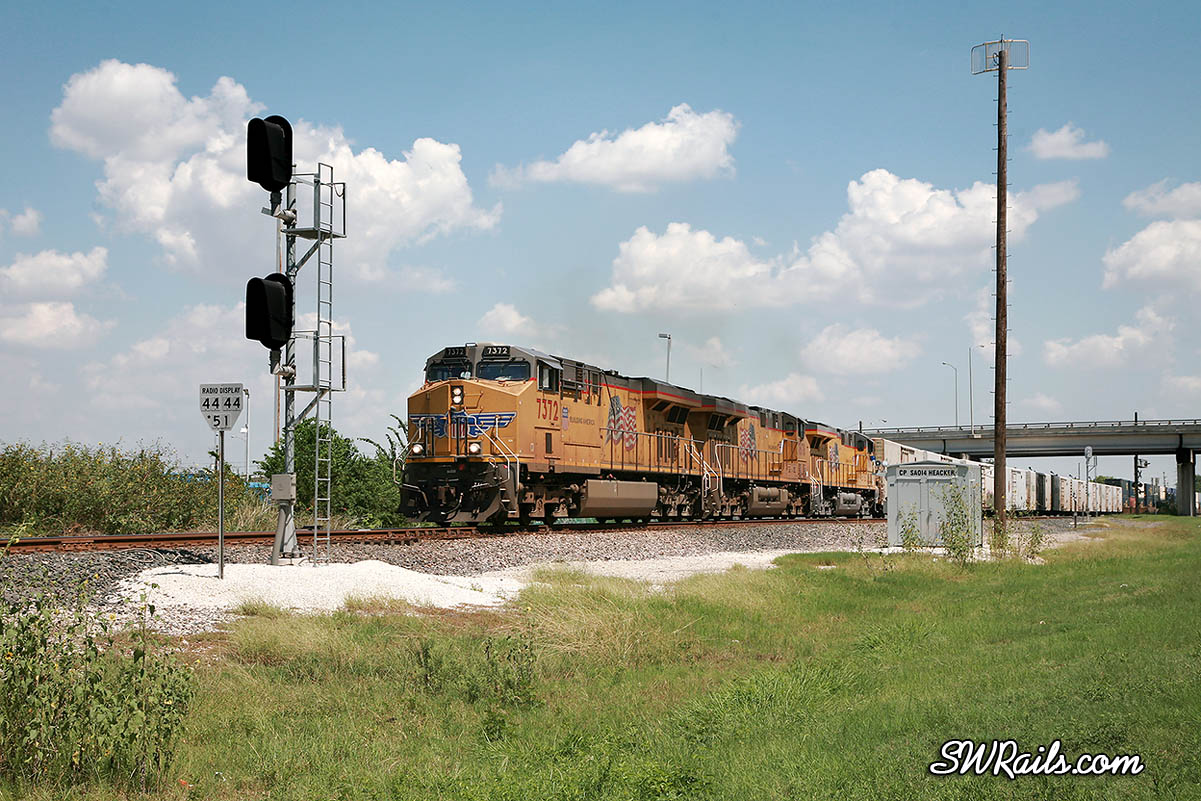
The Glidden sub's hottest train, the ZATLC, accelerates west at Heacker, TX on Sept. 15, 2010.
This is the renowned “juice train” that I posted about a while back. The symbol of this train has changed recently. Previously, this train’s symbol was KATCI. As of a few months ago, the symbol was changed to ZATLC.
The train still originates on the CSX at Atlanta. It still terminates in the LA Basin, albeit at the “Shops” Yard versus the City of Industry previously. The main difference if the prefix.
I’m not sure about the significance of the K prefix. But put a Z prefix on a train, and it becomes a “Z train”. Hottest of the hot. Everyone from track laborer to Executive VP-Operations knows that you don’t mess with Z trains.
My guess is the new symbol results from enhancing the priority of this train, or possibly combining all high-priority trains under one prefix, specifically Z.
As the ZATLC had just started pulling at Heacker, I was able to get ahead of it for one more shot at CP SA017, the east switch at Missouri City.
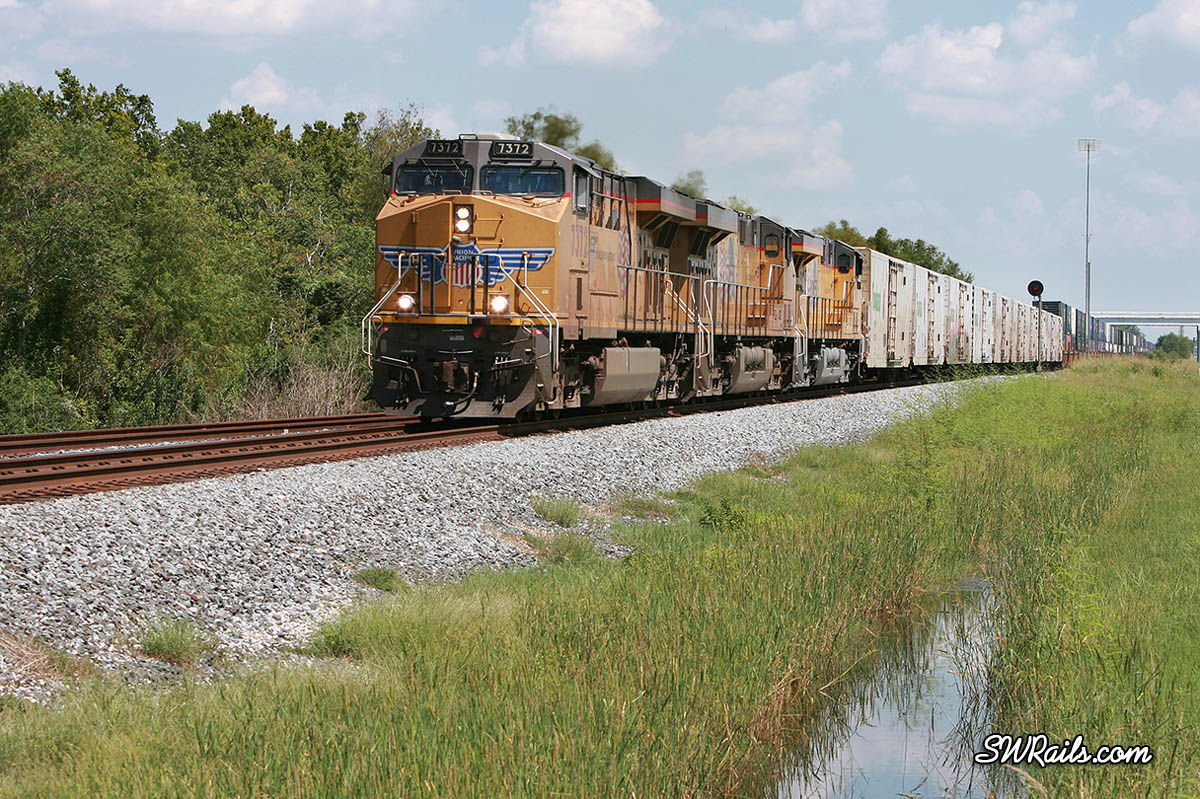
UP 7372 has the ZATLC at track speed at Missouri City, TX on Sept. 15, 2010
With the juice train by me, it was time to set up for the next westbound. Radio chatter indicated that it was right on the juice train’s block. I headed back east, but quickly u-turned west when confronted with some pesky clouds around MP 15.6.
By the time I set up CP SA019, the west switch at Missouri City, the next train was already between switches!
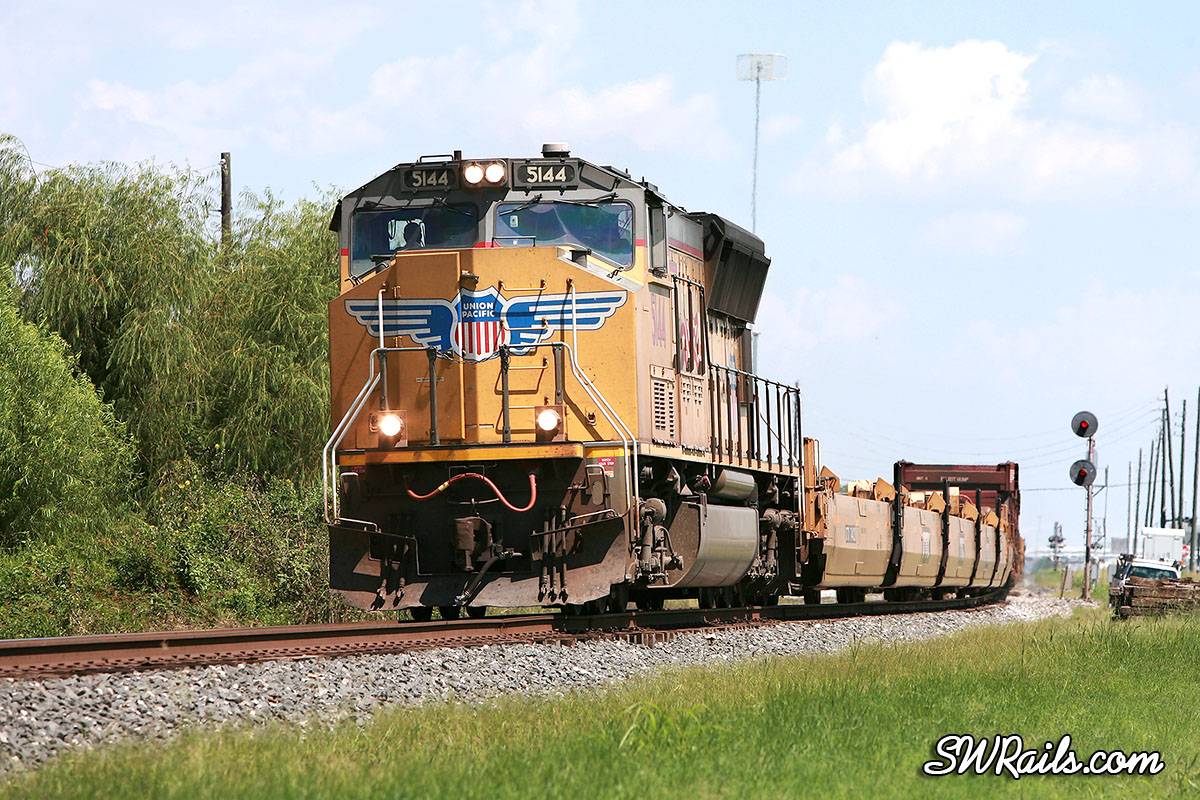
UP SD70M passes CP SA019 with a westbound bare table on September 15, 2010.
I don’t care much for photographing bare tables, but at least I had set up just into the curve, so most of the train out of sight. Getting a notch-nose SD70M on the point was a bonus.
There was more traffic, but it was eastbound. Not to mention, I still had some errands to run in Houston. If I wanted to avoid rush-hour traffic, it was time to put the camera away…
Rolling Meet at Sealy
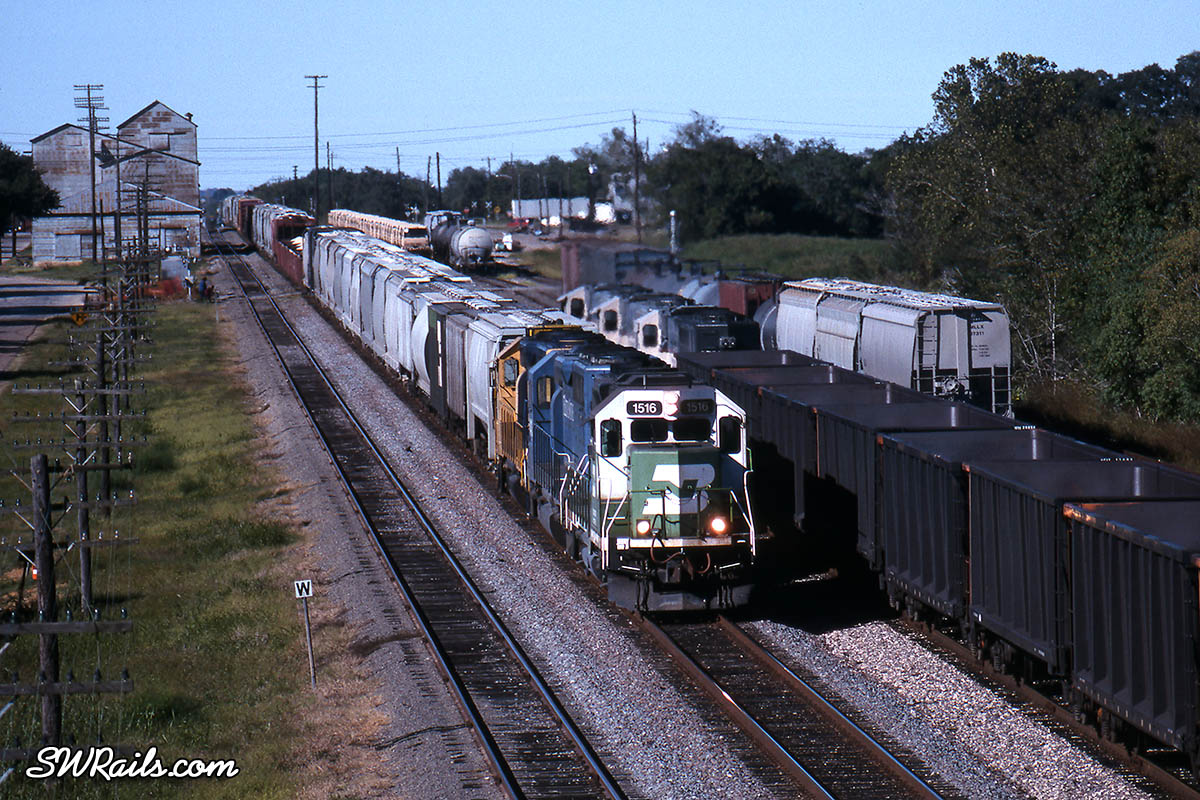
BN GP28M 1516 leads a southbound manifest through Sealy, Texas on Nov. 2, 1997
(Click image to see the details referred to below)
Sealy is a small town about 50 miles west of Houston. It’s main claim to fame is being the home town of Eric Dickerson, some guy that played football. Whatever…
Sealy’s main claim to fame these days, besides the McDonald’s on I-10, is the BNSF’s 10,400′ siding. Not only is it a popular siding for BNSF dispatchers to meet trains, there’s also a very convenient overpass for photographers near the mid-point of the siding.
Going back a few years, BN GP28M 1516 leads a southbound manifest while an empty Smithers Lake coal train slow-rolls in the siding on a crystal-clear November 2, 1997.
I like the image because of the many interesting details. Note the block of flats carrying tan U.S. Army light trucks. They were built at the Stewart & Stevenson plant, just west of Sealy.
Just above, and to the right of the trucks, you can see the grade crossing where the UP, ex MKT main, passes through Sealy. You might recall my recent post about the UP Katy Heritage unit being on the Katy, Texas local. The last image in that post was made at this same grade crossing.
That Was Quick – More KCS
Yesterday I remarked that I needed to photograph more KCS trains. I didn’t necessarily mean the very next day! I wish I acted that quickly on my other resolutions…
I was wrapping up the edit of a recent wedding around 10:00 this morning when I hear the Glidden sub dispatcher take back a warrant from KCS 3997 East. My attention was piqued because I knew that the 3997 was an ex-EMD demonstrator unit.
Then the dispatcher tells the 3997 that he needed to run 3 west before the terminal was ready for him. That wasn’t good, but hopefully he’d get cut loose before the sun got too high.
It wasn’t until 11:45 that the DS called the 3997 to look for a light at the east end of Sugar Land. Mid-day high-sun or not, I grabbed the camera and headed out to try my luck.
I went to CP SA017, the east end of Missouri City siding, where I knew the light would be as good as it could be for a mid-day shot. I wasn’t there for 30 seconds when I see its headlight come around the corner at CP SA019.
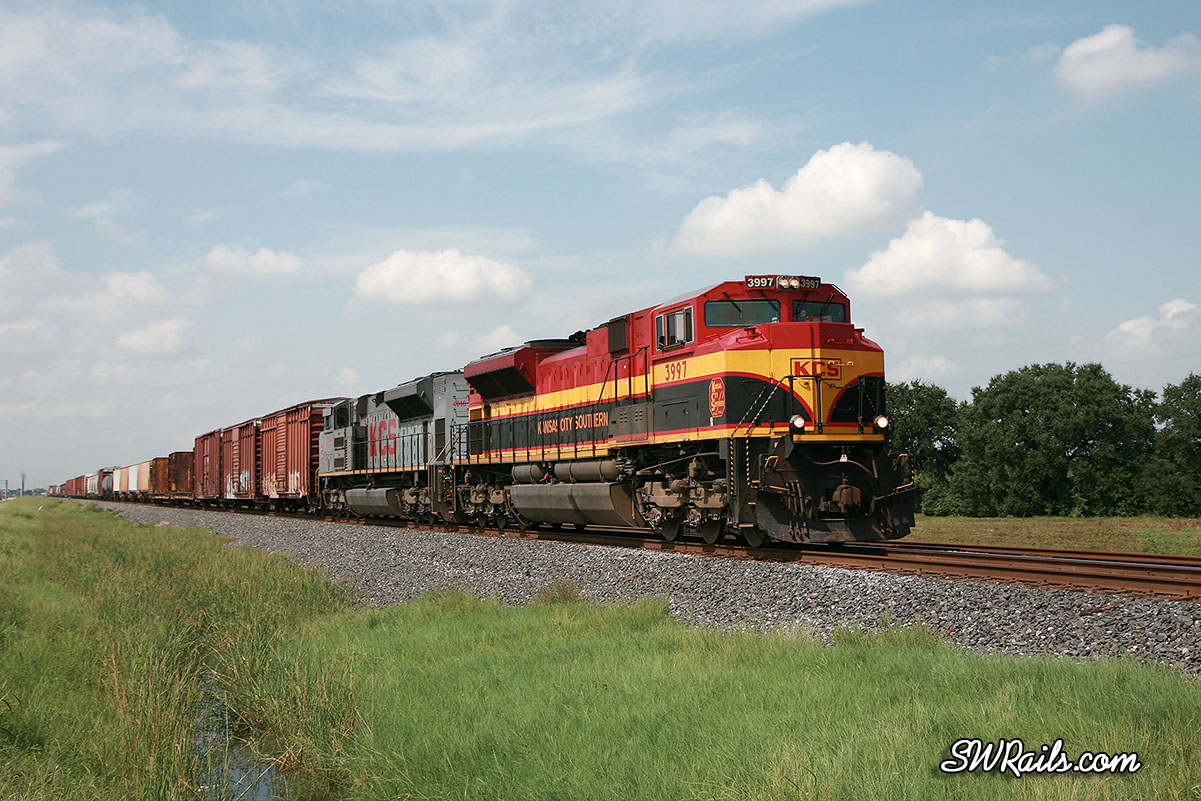
KCS 3997 and 4016, both SD70ACe's, power an EB manifest at CP SA019, Sept. 13, 2010
All the recent trackwork around here has paid off, because the 3997 was doing a good 50 mph when it went by me. Can I catch him again at West Junction? I won’t know if I don’t try, right?
I passed the head end as the train hit the detector at MP 15.6. Shortly, the detector tells me that the train is still doing 44 mph, with West Junction less than 3 miles away.
Between the train slowing for the turn at West Junction and light traffic on Highway 90, I was able to get to the switch at West Junction with a good 45 seconds to spare.
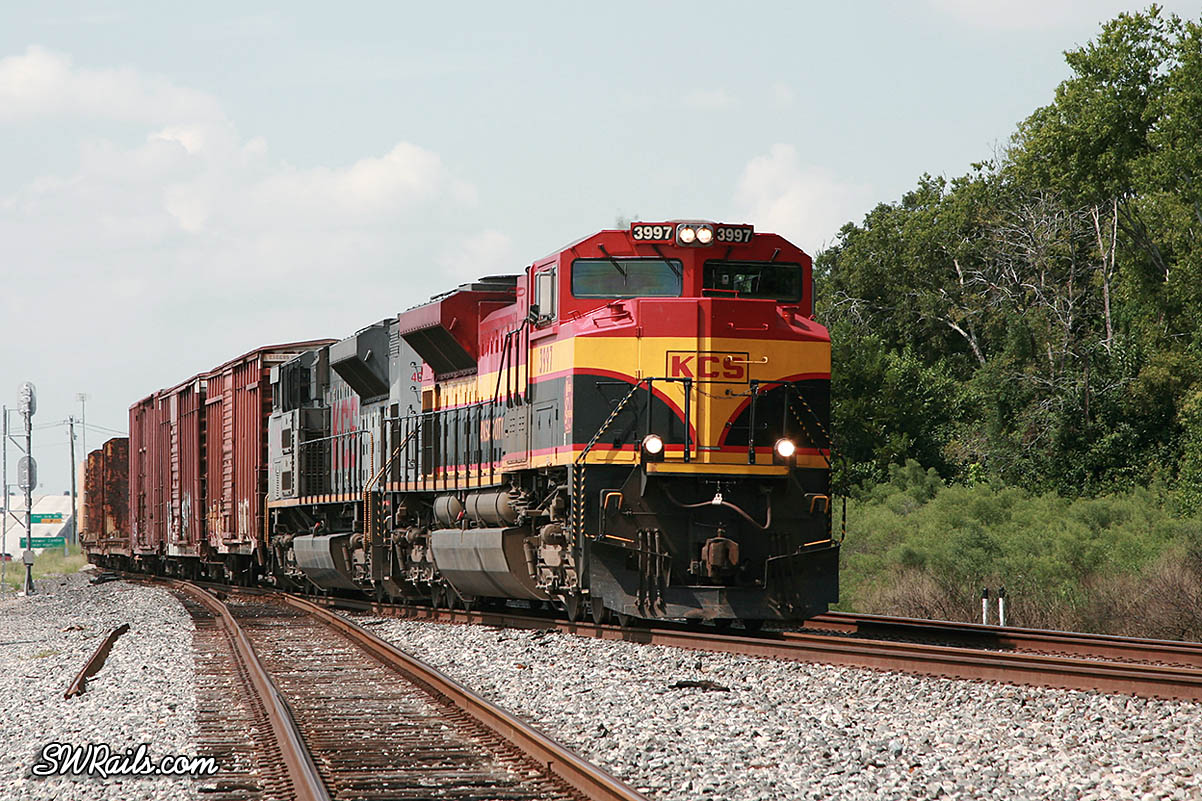
KCS 3997 at West Junction in Houston,TX at 11:58 AM on Sept. 13, 2010.
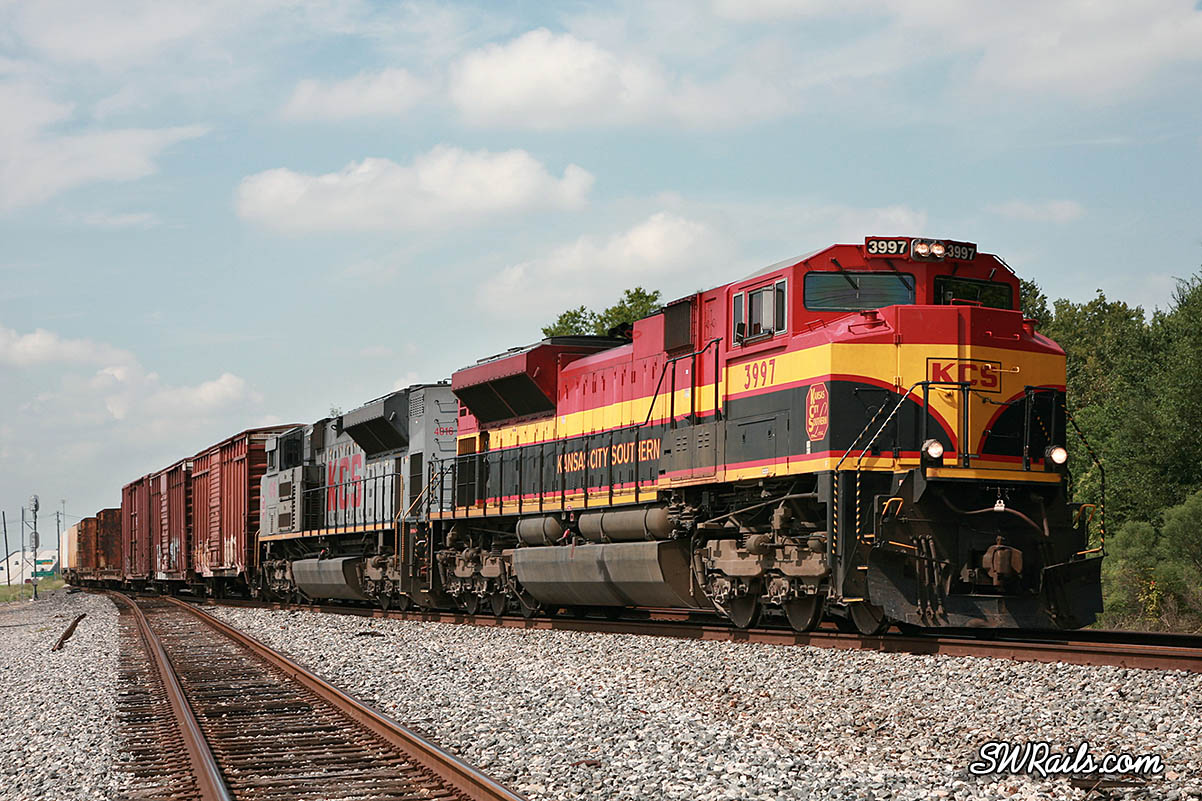
The 3997 is entering UP's Terminal sub trackage. The Glidden sub is in the foreground.
KCS acquired SD70ACe demonstrators GM 71 – GM 73 in early 2007. They were numbered KCS 3997 – KCS 3999. They operated in EMD colors for several months before being painted into Southern Belle colors.

KCS 3997 at Alorton, IL on Feb. 10, 2007. Keith Belk Photo
UP Veranda Gas Turbine & Big Boy Double Header
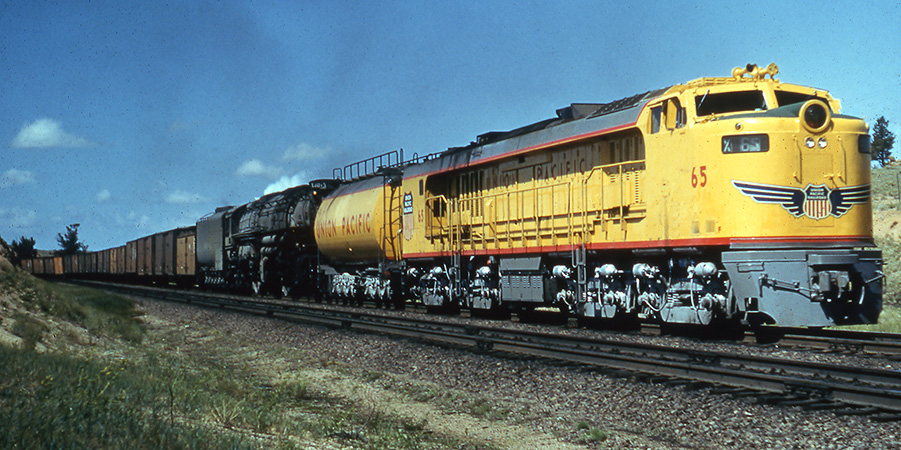
UP Gas Turbine 65 leads Big Boy 4015 with a solid train of reefers.
I’m pressed to come up with a wilder motive power lash-up than this one. I’d also submit that the sound from this consist at speed must have been amazing.
There’s no date or location on the duplicate slide. Based on the delivery date for UP 65 and the retirement of the Big Boys, the shot was taken between 1955-1958. It appears to be between Cheyenne and North Platte.
For more information about the lead unit, look at an older post that talks about these gas-turbines.
BTW, the older post I did about the Veranda gas-turbines is the most popular post I’ve done, with 208 hits in the 6 months since I posted it.
KCS: A New Symbol and A New Track
In preparing the images for this post, I’m reminded that I really need to photograph more KCS trains on its newly opened Rosenberg Sub.
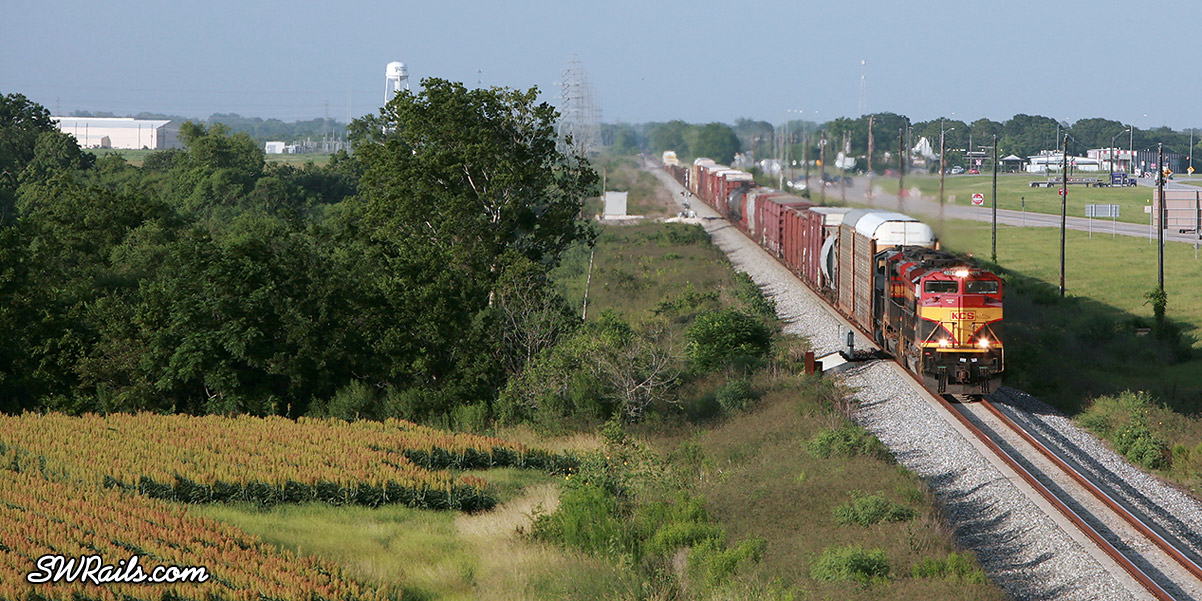
KCS train ISHTL passing some sorghum fields just outside of Rosenberg, TX on June 11, 2010

The ISHTL is about to pass under Spur 10, just southwest of Rosenberg, TX on June 11, 2010.
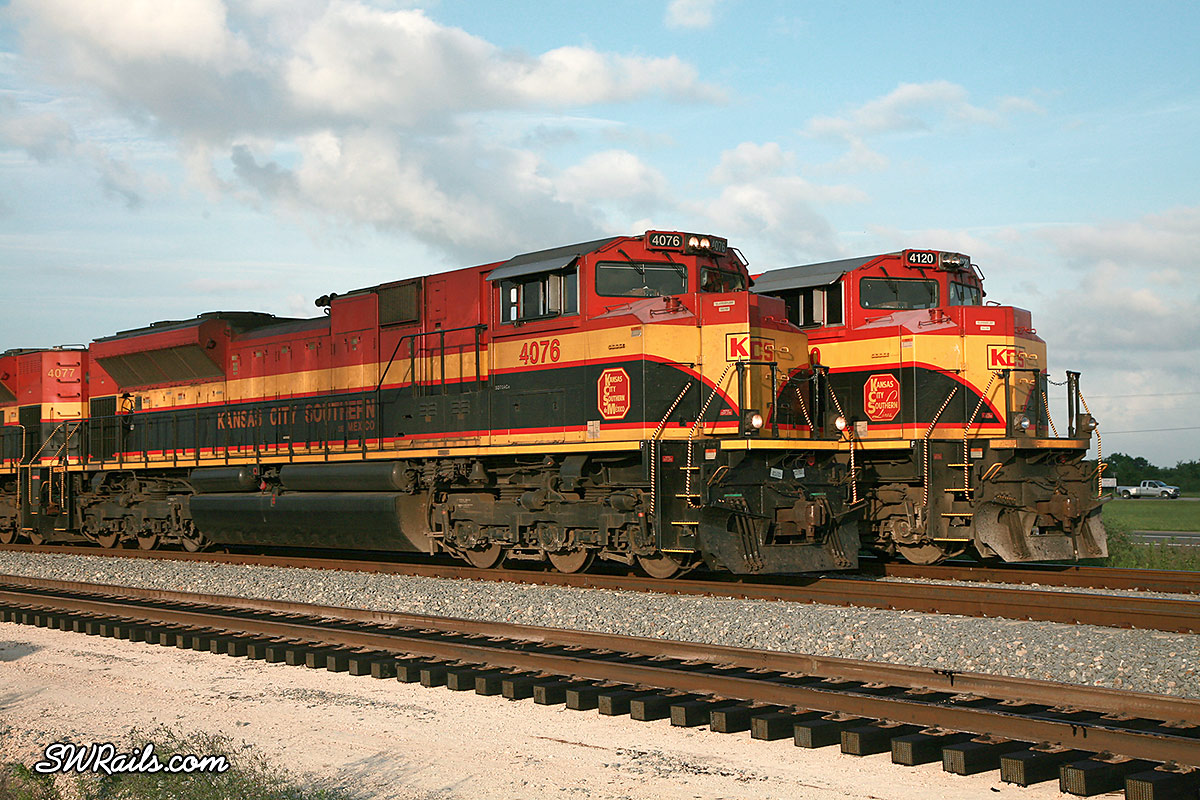
The ISHTL pauses next to another KCS train at Kendleton, TX on June 11, 2010
When taking the above shot at Kendleton, the KCS Trainmaster drove up. He told me that the ISHTL was a new symbol for the KCS. It originates in Shreveport, LA, with a final destination of Toluca, Mexico.

KCSM 4076 and KCS 4120 at the south end of KCS' new intermodal facility in Kendleton, TX.
Note the new track in the foreground above. KCS is already expanding its capacity at Kendleton, less than a year after inaugurating service on its new Rosenberg-Victoria, TX mainline.
Reincarnation Is A Fact! SSW GP35 6502- Before & After
I’ve never believed in re-incarnation. Until now.
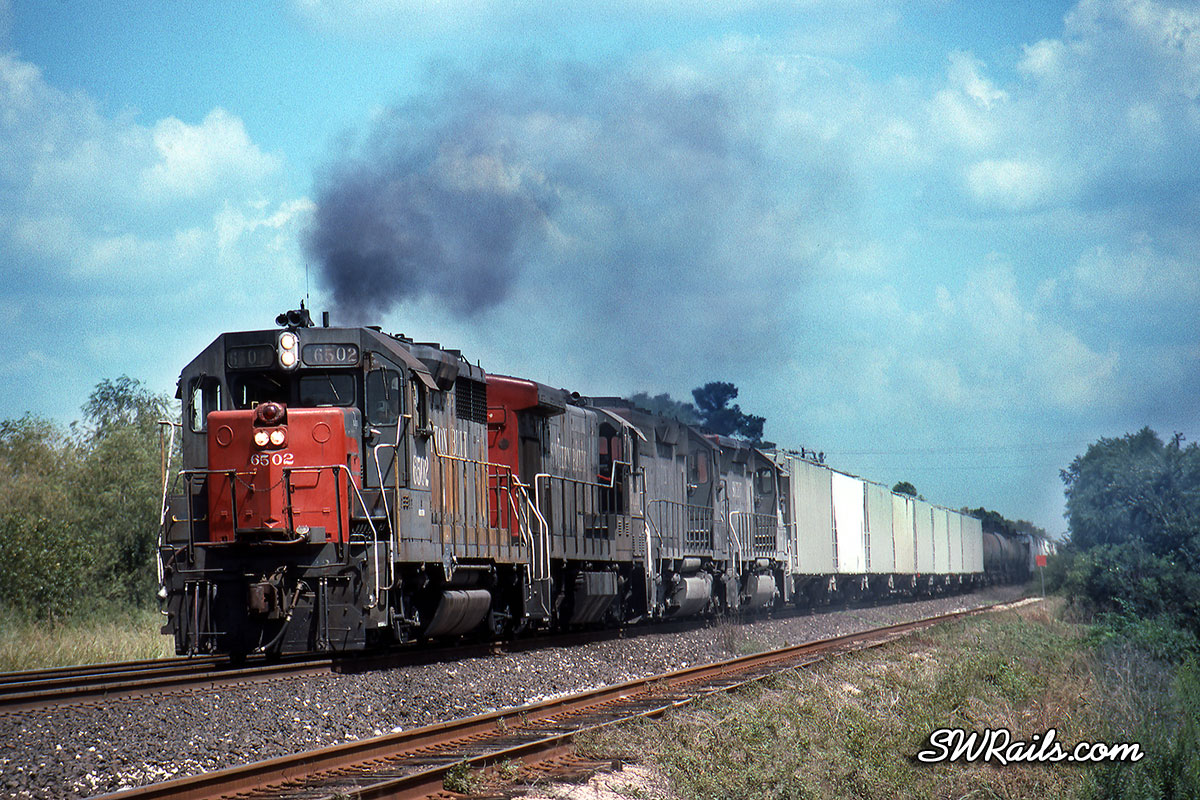
Cotton Belt GP35 6502 pulling hard on a BEHOM manifest at Dawes,TX on Sept. 20, 1988
The lead unit above, Cotton Belt GP35 6502, is quite the senior citizen. It was manufactured in January, 1964, making it nearly 25 years old in this photograph.
That’s 25 locomotive years. Converted to human years, it’s almost 75 years old!
Yet it was still out there, generating revenue for the SP. On the main line, to boot!
Nothing lasts forever, though. The 6502 was retired in early 1991. Typically, that would be the end of the story. But not this time.
By the end of 1991, through the miracle of re-incarnation*, the 6502 came back to life as BN GP39M 2896.
*Re-incarnation defined as re-manufacture of the locomotive by Morrison Knudsen Rail Corp. BN received 30 GP39M’s in 1991 from M-K. They were all originally GP30’s and GP35’s that were upgraded with 645E3 prime movers, Dash-2 electrical systems and rated at 2300 HP. Of these 30 units, 24 came from GP35’s retired by the SP. The other 6 came from GP30/GP35 ‘s retired by BN or NS.

BNSF GP39M 2896 rests at Seattle, WA on 6/14/2008.
It later became BNSF 2896, and to this date, is still out there pulling freight over 45 years after departing the EMD erecting bays in La Grange.
Rio Grande Heritage in Texas – Part 1
Union Pacific SD70ACe 1989, the Rio Grande Heritage unit, made a few trips in the Houston area recently. The 1989 was the only heritage engine I haven’t seen, so I was pretty keen on seeing it.
According to a trace around midnight on Aug. 18, the 1989 was assigned to a junk train, a MEWSA (Manifest Englewood-San Antonio), scheduled to depart Englewood at 10:00 AM the next morning. According to my calculations, this would put it into the Sugar Land area, MP 25 on the Glidden sub, around Noon.
My plan was to catch it as it came off the Terminal sub at West Junction and chase it west of Rosenberg as far as was practical based on the conditions. As mid-day light in mid-Summer isn’t the best of conditions for still photos, I decided to shoot video only of this train.
As 10 AM rolled around, I did a quick trace of the 1989 to get a better idea of when to expect it into Sugar Land. Listening to the trace results, this is what I heard:
“UP 1989, empty, departed Stafford Texas 10:01 AM….”
SNAP!
The Stafford scanner is at MP 20.6, I’m at home sipping coffee, the camera gear isn’t packed, and the train is already past me!
I cursed my foolishness for not tracing it earlier, but who knew that a junk train would get out 2 hours earlier than the previous evening’s intel said it would? At first, I considered blowing it off because I was totally out of position and because the light was going to be even worse than I expected.
Then again, I’ve never been one to allow some foolishness to get in the way of more foolishness. So I grabbed the video camera, tripod, radio, car keys, and a bottle of water and ran out the door and set out to catch my white whale.
I finally get on the road about 10:25. As I headed west from Sugar Land, the radio was completely silent. Finally, after about 10 minutes on the road, I heard the detector at MP 34.6.
I was hoping it was an eastbound, because if it was the 1989, it was about 8 miles ahead of me. Worse yet, at MP 36, westbounds can open it up to 60 mph, and I hadn’t even begun battling the traffic lights along Hwy 90 in the Richmond/Rosenberg area.
All I could think was stay the course, surely a lowly manifest will get put into a siding. Rosenberg (MP 38), East Bernard (MP 49), even Lissie (MP 63), anywhere so I can catch up.
Fast forward 45 minutes, and about 50 miles. I’m at Lissie when I hear the DS tell the 1989 that he will hold them on the main at Eagle Lake for a while due to M-O-W around Alleyton.
Finally, a break! I would catch up with the 1989 at Eagle Lake, 50 miles after I first set out. You’d think I’d been chasing Amtrak with the way the MEWSA had the railroad to himself!
This video begins at the west switch of Eagle Lake with the 1989 on the move again at 11:45 AM.
PS-Once the video starts, click where it says 360p at the bottom of the player.
It will switch to 480p, greatly improving the quality of the video.
The Other F Units
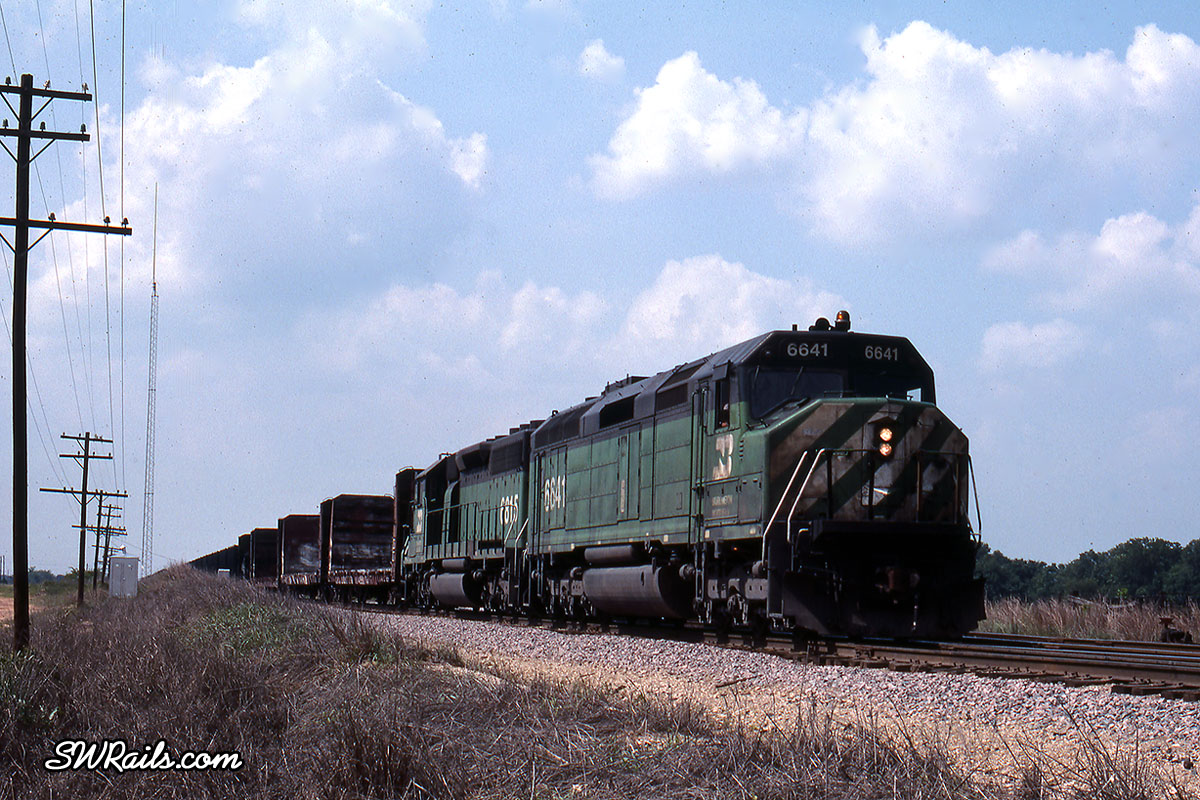
BN F45 6641 is southbound at Jewett, TX on May 24, 1984
Whenever you think of F-units, it’s always the EMD product of the 1940’s and 50’s that comes to mind. Rightfully so, because F-units from the FT through the F9 were ubiquitous on U.S. railroads for over 25 years.
But don’t forget the F45. Acquired only by the ATSF (40 units) and BN (45 units), these 85 units could be found just about anywhere on the BN and Santa Fe systems between 1970 and 1995.
Always popular with railfans, F45’s were also popular with operating crews due to their spacious cab and being much less drafty in cold weather than conventional cab locomotives.
Mixed-Up Motors at Missouri City
As a consequence of the economic slowdown, U.S. railroads have thousands of locomotives in storage. Just a few years ago, it was the other way around. Railroads were desperate for motive power. It was the best of times for locomotive leasing companies.
As a result, “rainbow” lash-ups were the norm.

BNSF 105 departs the west end of Missouri City, TX on Nov. 30, 2003
This train took it to the extreme: five motors in five different schemes. Too bad the lead motor was so dirty, but as another railfan once philosophized, “What can you really do?”
SD60-To M or not to M
EMD’s SD60’s locomotives are interesting because they were made in three distinct versions. Between 1984 and 1989, they were equipped with EMD’s venerable spartan cab. From 1990 on, they were equipped with EMD’s two versions of the North American safety cab.

UP SD60 2185 at Stafford, Texas on August 31, 2006
UP 2185 sports the spartan cab that has been standard on EMD locomotives beginning with the GP35 in 1965.

UP SD60M 2399 at Stafford, Texas on April 19, 2006
UP 2399 has EMD’s first safety cab design. The 3 window design has been nicknamed Cyclops due to the ungainly appearance of the middle window.

UP SD60M 2438 at Harlem, Texas on January 8, 2010
UP 2438 is equipped with the later cab design. This cab design was used on the SD60M through the SD90MAC.
In all three images, the locomotives are identical below the frame, and from the electrical cabinet back.
Happy 4th of July!
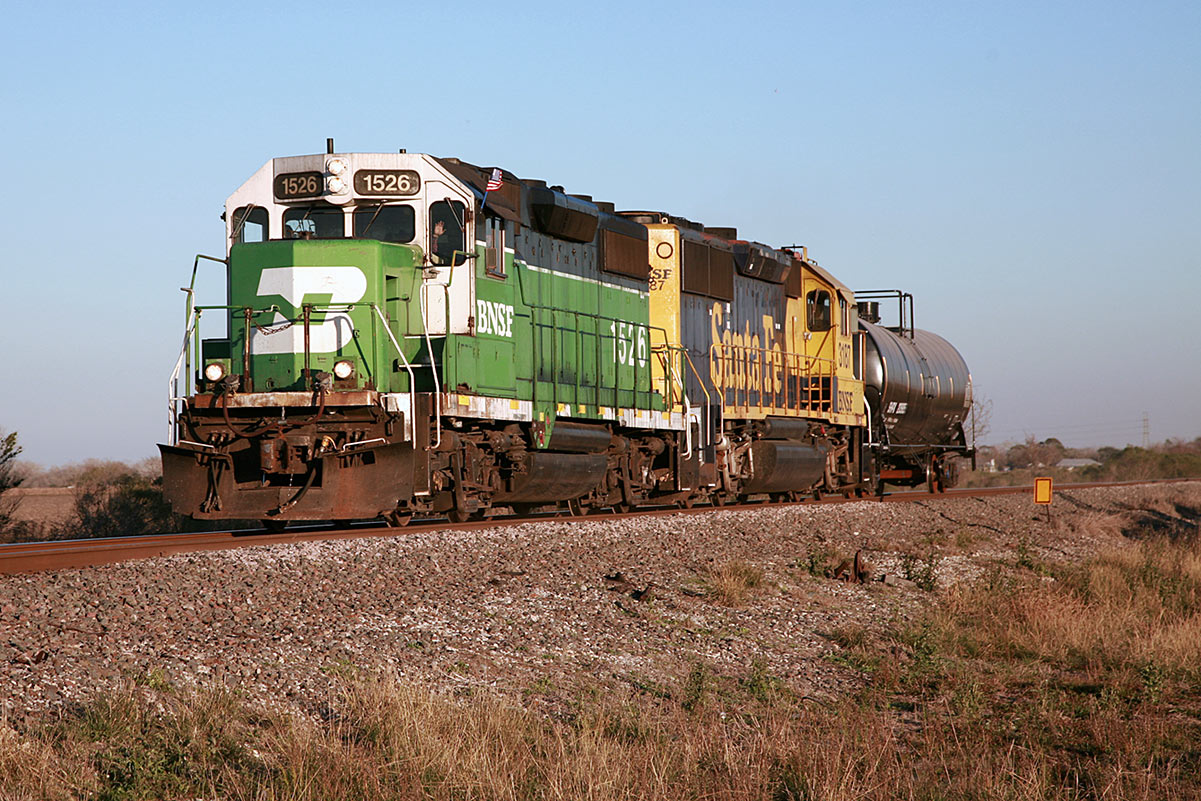
The BNSF Rosenberg local departs Rosenberg, TX on Jan. 9, 2009
A friendly wave from the conductor caught my attention when I took this photo last year. It wasn’t until I processed the image that I noticed the American flag waving from the conductor’s window.
Happy Independence Day to you!
Southern Pacific GP9 3438 Gets Around
As McAllen, Texas was at the end of a sleepy branch line, the same locomotive might be there for 1-2 weeks at a time. As such, I’d photograph one side one day, the other side another day.

Engineer's side view at McAllen, TX on Jan. 15, 1978
Southern Pacific GP9 3438 drew the assignment to be the McAllen switcher in early 1978. I was able to photograph it on two consecutive days, Jan. 15 and 16.
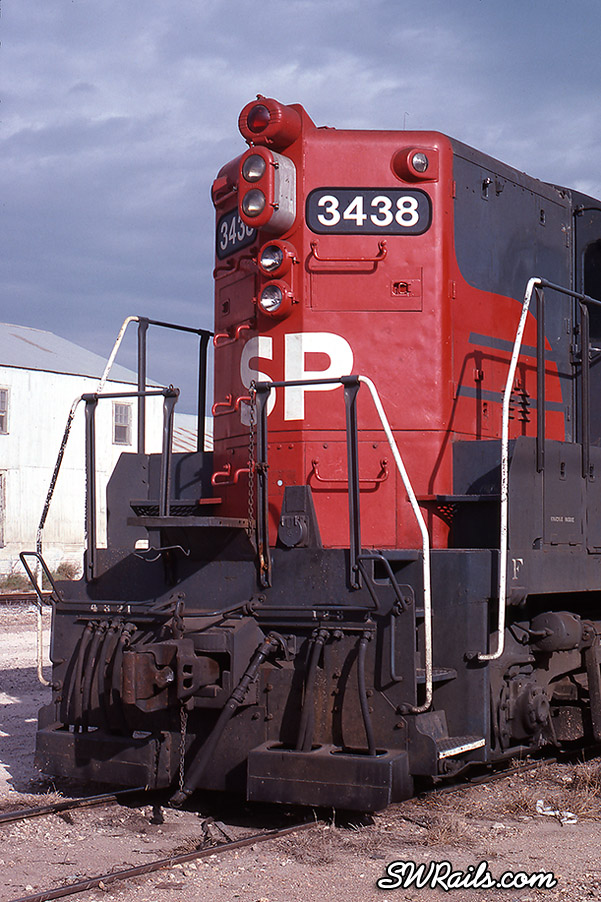
Nose view of SP 3438 at McAllen, TX on Jan. 16, 1978
Note the non-typical numbers in the number board. They should be in the same Roman type style that’s on the cab.
I’ve seen this sans-serif style number style on several other SP locomotives over the years, but they were uncommon.
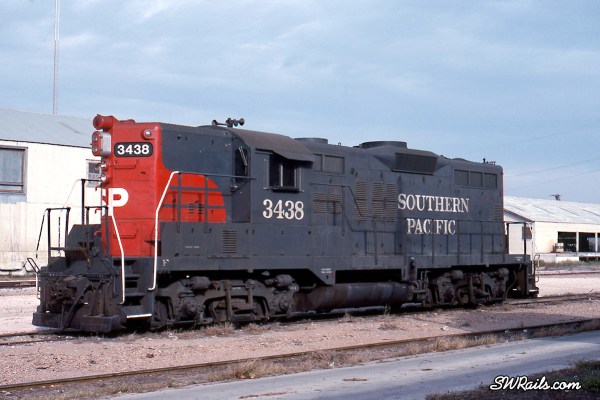
Fireman's side of the 3438, McAllen, TX on Jan. 16, 1978
In the caption above, I refer to the fireman’s side of the locomotive. That sounds funny, doesn’t it? Actually, the fireman and the head brakeman rode across from the engineer. The conductor rode in the caboose,Conductors rode in the caboose, accompanied by the rear brakeman.
That’s right. Train crews consisted of 5 employees. It makes you wonder how contemporary two-man crews can get the work done…

SP GP9 3438 mingles with larger units at Los Angeles, CA in May, 1979.
Seventeen months later, we see that SP 3438 has exchanged the solitude of McAllen for the always crowded service tracks at Taylor Yard in Los Angeles.
 Southwest Rails