Out & About – Oct. 3, 2010
We made a quick run to Pasadena this afternoon to visit my mother, and have dinner. As the sun was out, I made sure to bring a camera just in case we came across something.
We hadn’t been in the car more than a minute when the KCS 3924 called the dispatcher for a track warrant for the Rosenberg sub. The DS asked “Who’s copying, and location?” “Conductor Roberson at Missouri City” was the response.
With that bit of comint, I knew that the train was a westbound, and he was about 4 miles east of me. Traffic lights actually cooperated, and I was able to get set up near the Dulles Ave. grade crossing (MP 20.1 – Glidden sub) with a few minutes to spare.

A "Belle Sandwich" powers a Mexico-bound grain train at Stafford, TX on Oct. 3, 2010
We didn’t come across anything else on the way to Pasadena, which was fine with me, as we were all quite hungry.
We watched a bit of football during dinner. The Texans played well, despite injuries, and were able to beat the Raiders 31-24. Once we were done with dinner, I snuck out to see if something might be running in the Pasadena area.
Approaching Sinco (MP 8 on UP’s Strang sub), I could see the tail end of a northbound. I decided to stay on the freeway so I could get ahead of the train more easily.
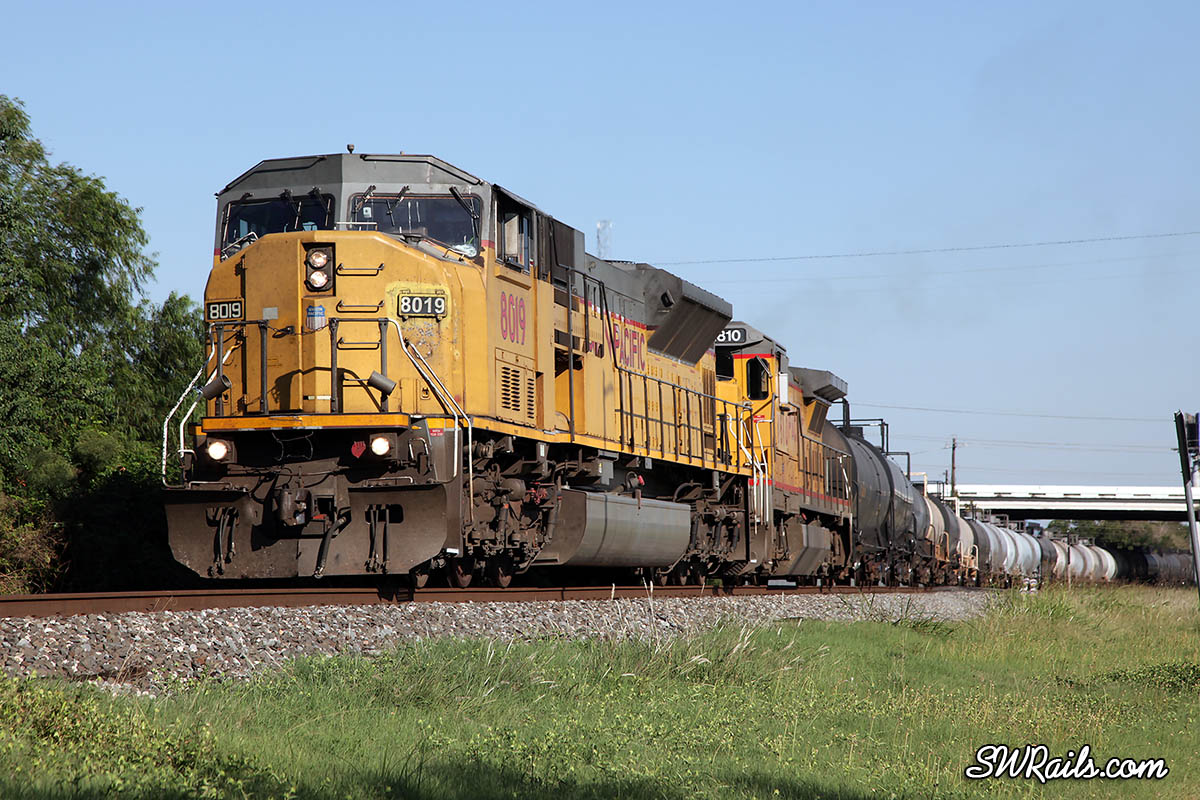
Just another Strang to Houston key train (haz-mat) approaches Manchester Jct. on Oct. 3, 2010
Note the second unit, UP 1810. It’s a B40-8, most of which are in storage around the system, but there are a handful running in the Houston area.
I moved up a few miles to the Tower 30 interlocking area, where UP’s Strang, Glidden, and Galveston subdivisions intersect each other.
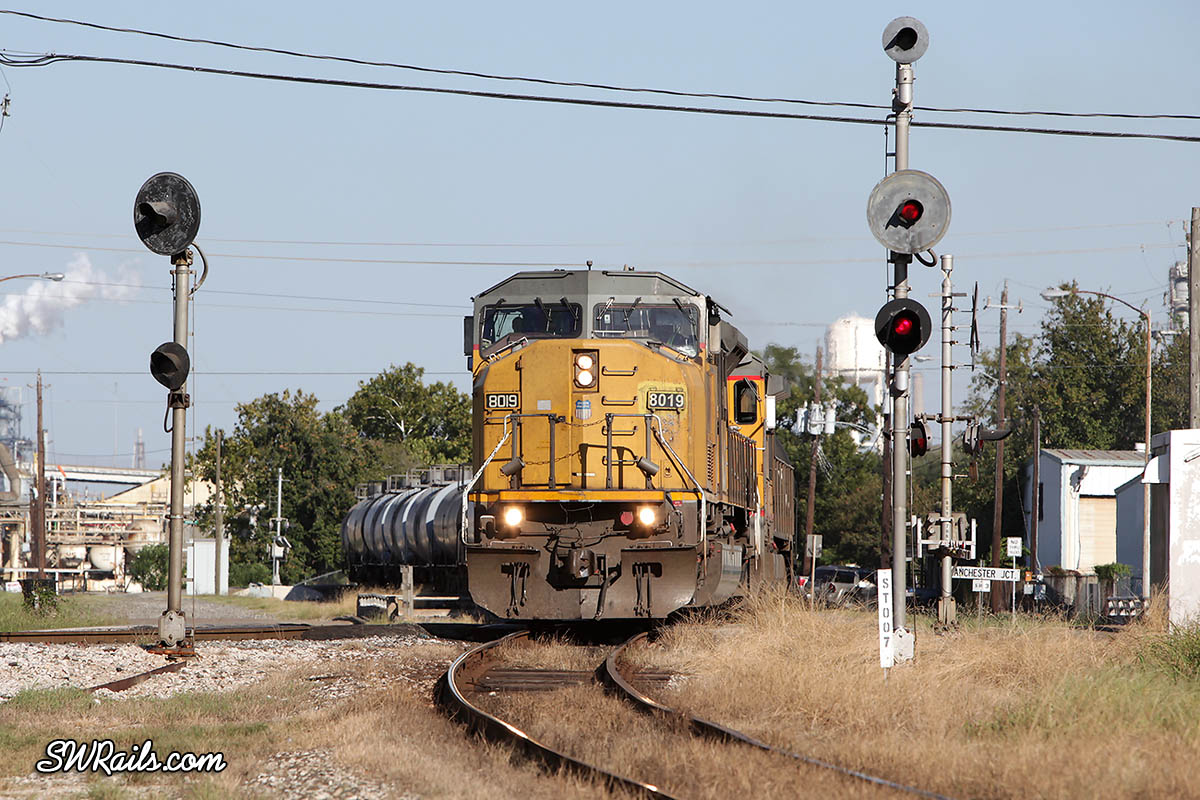
The 8019 switches from the Strang sub to the Glidden sub at Manchester Junction
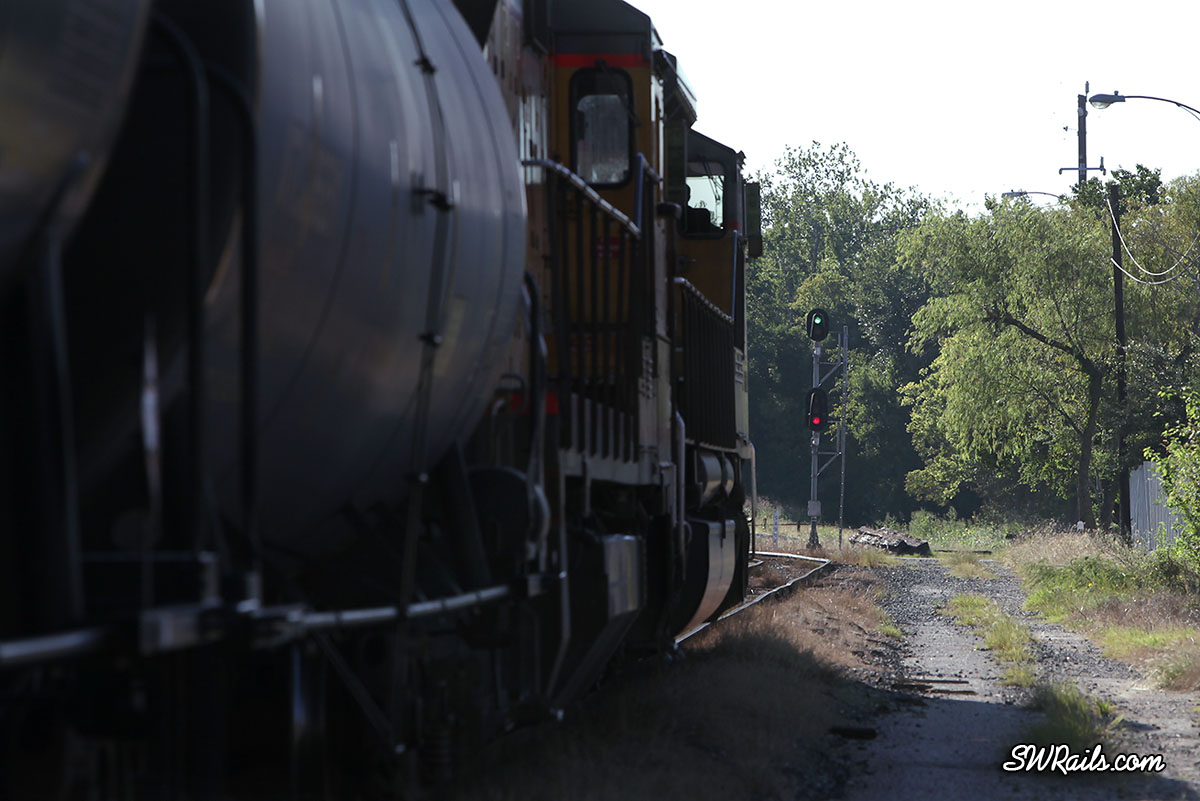
The signal indicates the 8019 will switch over to the Galveston sub at GH&H Junction. This routing is common for trains that will terminate at Settegast yard in northeast Houston.
With that, I decided to head back to Pasadena before I got in trouble for being AWOL.
Southern Pacific GP35 6653 Gets Around
It’s been a while since I posted anything from the early days of my career as a railfan. So I scanned a few prints from the Instamatic days, among others this shot of SP GP35 6653.
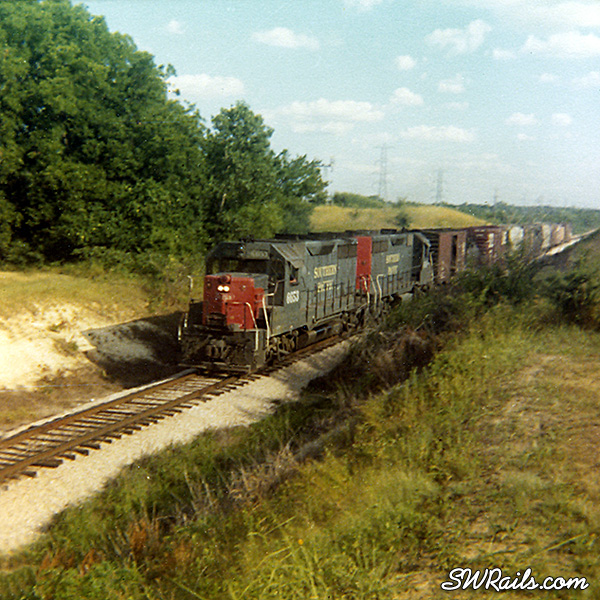
SP GP35 6653 leads a short northbound on the Dallas Belt in July of 1972
The 6653 is traveling on a section of the SP known as the Dallas Belt Line. It’s a bypass, running through the east side of Dallas, that was built to reduce rail traffic on the streets of downtown Dallas.
Due to the growth of downtown Dallas by the early 1900’s, the amount of trains on the Houston & Texas Central (acquired by the SP in 1883) tracks through downtown had become a safety and traffic congestion problem.
In 1926, the Dallas Belt Line was completed to permit the Southern Pacific to bypass downtown. The 8.9 mile long bypass started at Tower 118 and rejoined the original line at Gifford, north of downtown.
By November 1927, the Dallas Belt Line was averaging 68 through train movements and 35 switch engine movements daily. I suspect removing over 100 trains from the streets of downtown Dallas made a difference!
The original north/south main line was downgraded to secondary status and was eventually abandoned. After World War II, the H&TC right-of-way was sold to the City of Dallas to be used for the construction of Central Expressway.
I have another view, and information about the current status of the Dallas Belt.
It was very interesting to research, and learn more about this line that I railfanned as a kid.
But the best part was when I scanned the print. Due to the small size of the original print, I had never been able to make out the number of the lead unit. Now I was finally able, after nearly 40 years, to ID the lead unit as SP 6653.
Now I wanted to know if I had ever seen the unit since that summer day in Dallas in 1972? Quick, run to the SP slide boxes.

SP 6653 at Victoria, TX on March 29, 1989. Note the EMD GP60 demonstrator at far right.
Bingo! In 1989, unbeknownst to me, I had encountered the same SP GP35 that had thrilled this 12 year-old kid on a bike with his parents Instamatic camera.
So many things had changed for me between 1972 and 1989, but as for SP 6653, it was unchanged other than having the class lights removed from the short hood. The 6653 never even received the “SP” initials on the nose.
But change was coming for the 6653. It was retired by the SP in 1990, sold to Morrison-Knudsen, which proceeded to re-manufacture the 6653 into Burlington Northern GP39M 2870 in 1991. It later became BNSF 2870.

BNSF GP39M 2870 at Interbay,WA on Sept. 5, 2007
I was unaware that my old friend, SP 6653, was even still out there until I was wrapping up this post. I wanted to learn the disposition of the unit, so I did a quick Google.
Needless to say, I’m quite tickled to see that one of my first rail photo subjects is still out there nearly 40 years after I was able to get a snapshot of it. I found a shot of BNSF 2870 switching stacks here
In hindsight, I should have realized that this unit might still be running. It was only 3 weeks ago that I did a post about the “reincarnation” of Cotton Belt GP35 6502, in which I mentioned that 24 ex-SP/SSW GP35’s found their way into a “next life” as GP39M’s for the BN.
Sidenote: I thought I’d never end this post! I kept coming across more and more information that shed light on the history of the tracks or the GP35 in question. I went through 5 revisions before the post was ready to publish…
Santa Fe Sprint Coasts Into Cajon
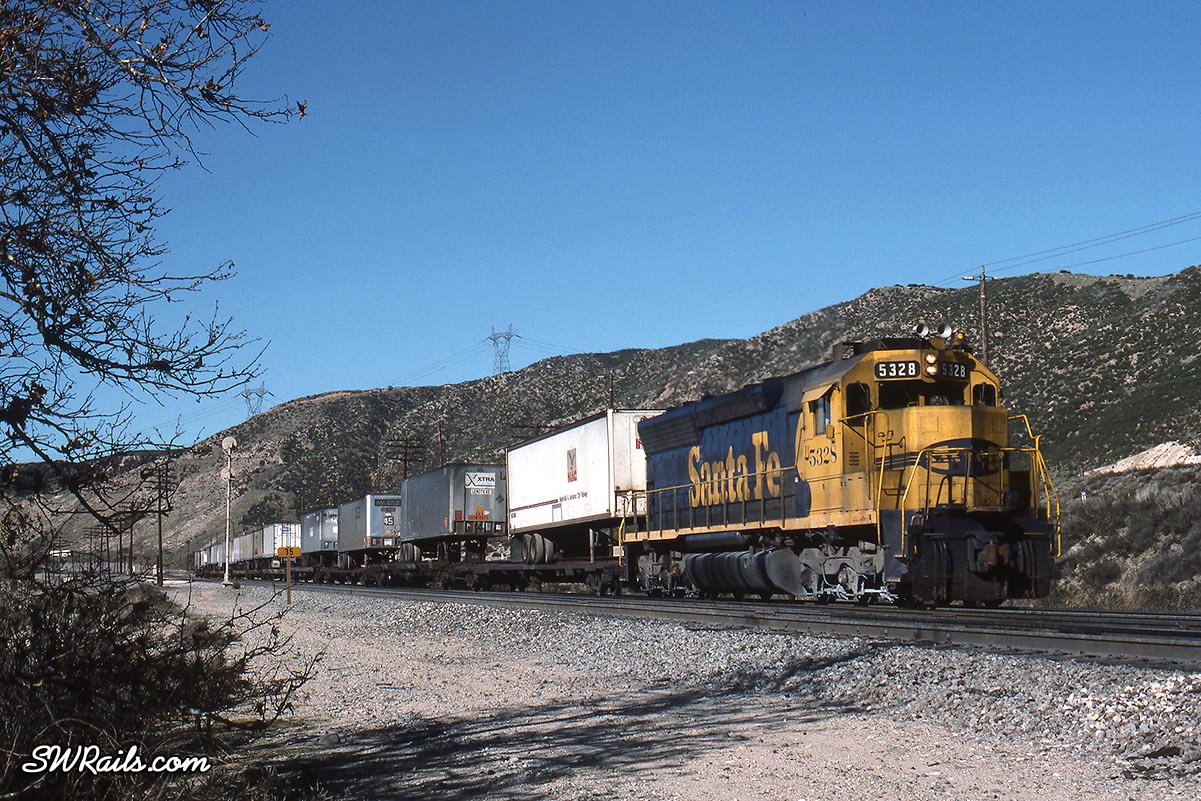
Descending the 2% of Santa Fe's Cajon Pass South Track, SD45 5328 is in full dynamics with the 998 (Richmond, CA - Los Angeles) Sprint train on as it passes the Cajon crossovers on Dec. 12, 1987.
In the mid-1980’s, the Santa Fe and SP both developed “Sprint” trains, short-haul intermodal trains in certain markets. Dallas-Houston, Phoenix-LA, Richmond, CA (Oakland) – LA were some of the corridors serviced. The intent was to provide a guaranteed overnight service for trailers in those corridors at a price that was more competitive than highway.
The concept was sound, but there never was enough traffic to justify the continued operation of these trains. Sprint train operations ended by 1990 or so.
Three Servings of Pumpkin
There had been very little scanner traffic the afternoon of Dec. 30, 2007, so when I heard the DS tell BNSF 4825 ( Empty Grain symbol 9GP31C 29) that he’d see one at Sugar Land, I figured that would be my best chance to get a shot or two before the day ended.
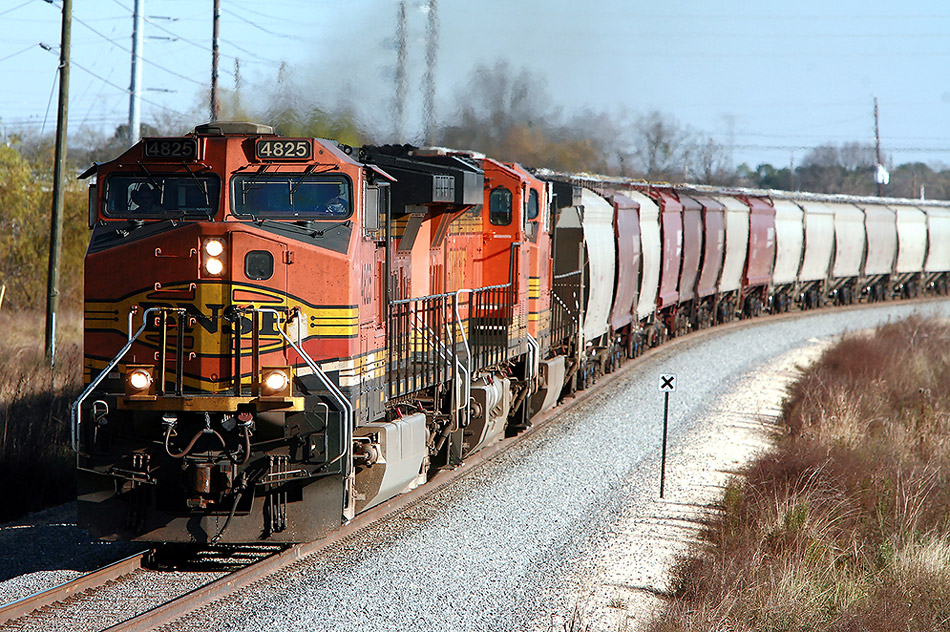 A gravel pile affords me some elevation at MP 20.5 of of UP’s Glidden sub (Stafford,TX) as the empty grain train traverses brand-new track resulting from a slight re-alignment of the UP main. Note the engineer appears to be a real Texan.
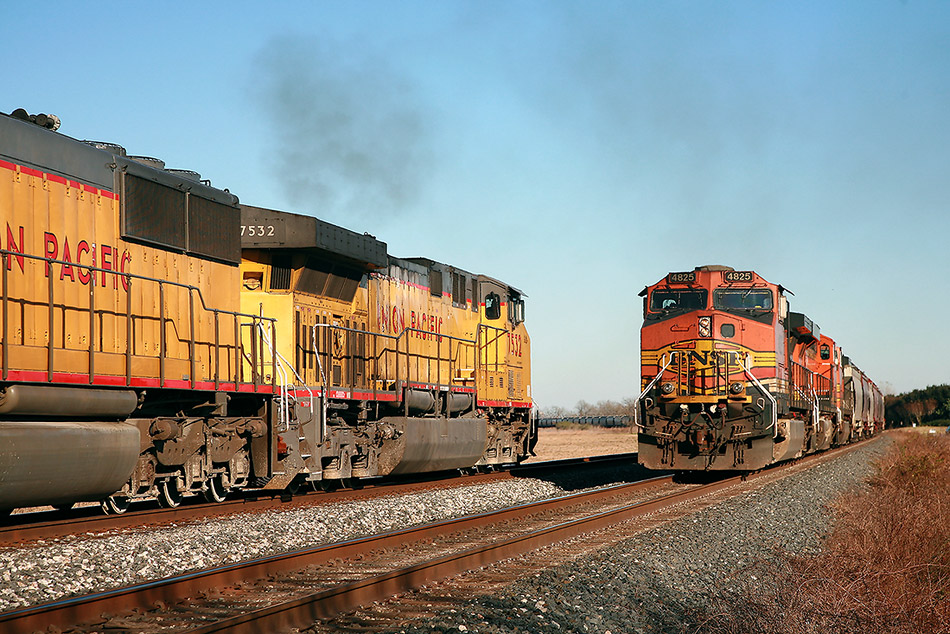 The 4825 holds the main at the west end of Sugar Land (MP 28) for the eastbound promised by the dispatcher.. The UP 7532 (loaded rock train symbol (RBMBD 29) emits a nice plume of exhaust as the engineer goes to full dynamics as he passes the head end of the 4825.
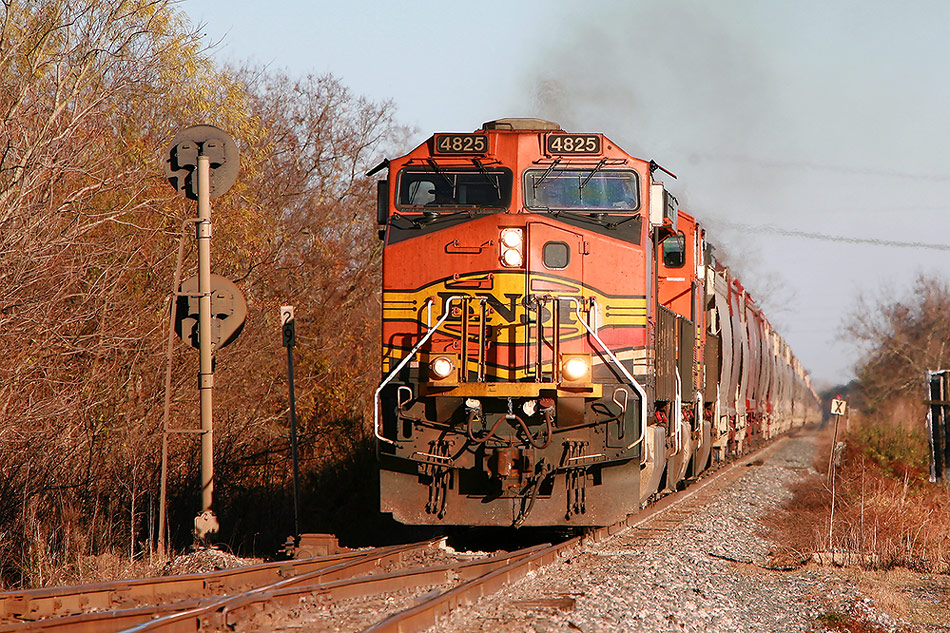 Freed of the pesky opposing traffic, the 4825 is accelerating to track speed at MP 29, the east end of Harlem. Seven miles ahead is Tower 17, where the 4825 will depart UP trackage rights to travel on home rails.
This last location has changed somewhat, as the UP extended the Harlem siding one mile to the east.
Kodachrome Reflections
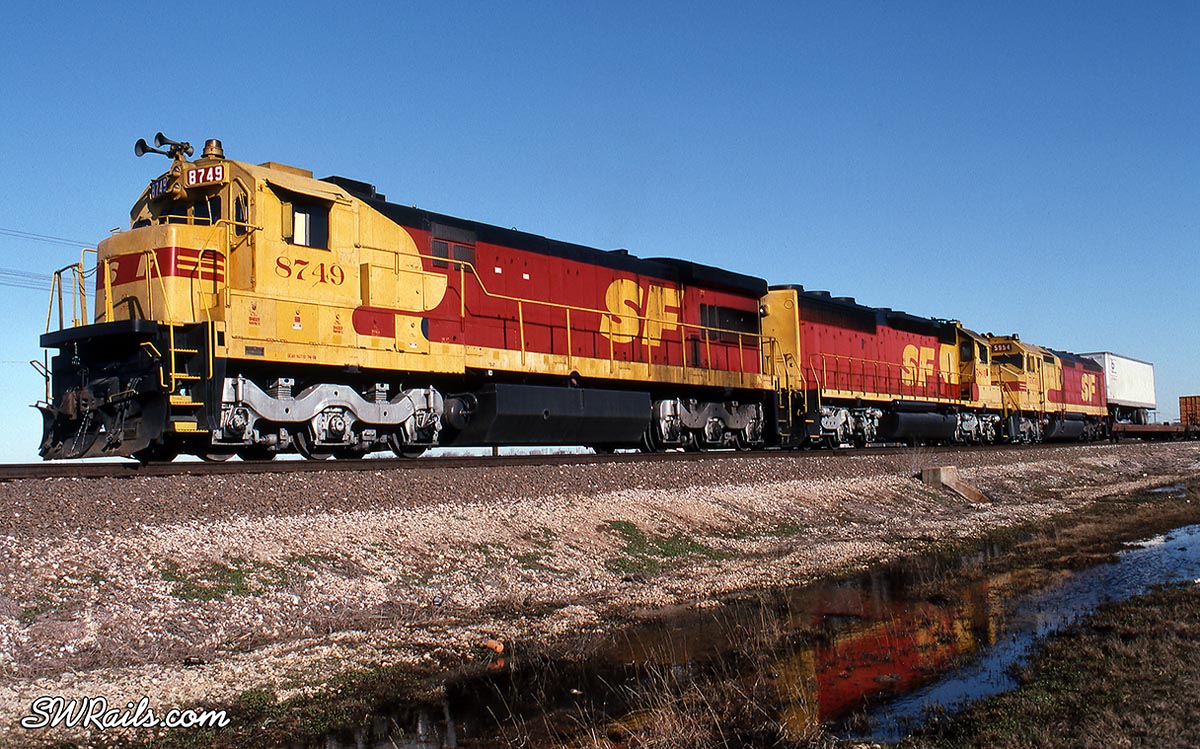
Three "Kodachromes" hold an 885 train (L.A.-Houston Priority) at Crowley, TX on Feb. 22, 1989
Uncommon even in the heyday of the ill-fated merger between the Santa Fe and the Southern Pacific, a solid lash-up of Santa Fe “Kodachromes” was a rare catch by the late 1980’s.
Santa Fe U36C 8749, with an SD45-2 and an F45, holds its train at Crowley, TX. The train is waiting for a northbound to enter the siding, allowing the 885 to continue its journey with trailers and containers for Houston.
Crowley is the first siding south of Fort Worth, about 12 miles south of Tower 55.
The Diesel That Did It
Just over 50 years ago in February of 1960, TRAINS magazine published an article about the EMC FT locomotive entitled “The Diesel That Did It”. “Did What?”, you ask.
Introduced in 1939, the FT proved the economic superiority of diesel-electric locomotives vs. steam locomotives, foreshadowing the end of steam locomotives in U.S. railroads.

Santa Fe FT 127, unknown location, in the mid 1950's.
A Matter of Perspective
My standard lens for railfanning is Canon’s EF 70-200mm f/2.8L IS USM. Putting this lens on the 5D II makes a rig that weighs just under 5 lbs – not something you can walk around with all day.
My sore back notwithstanding, it’s my favorite lens because the stabilization allows me to capture sharp images, without the hassle and delay of a tripod, especially in the heat of a chase.
Here’s a couple of shots to illustrate the different perspectives that I can capture as a train approaches.
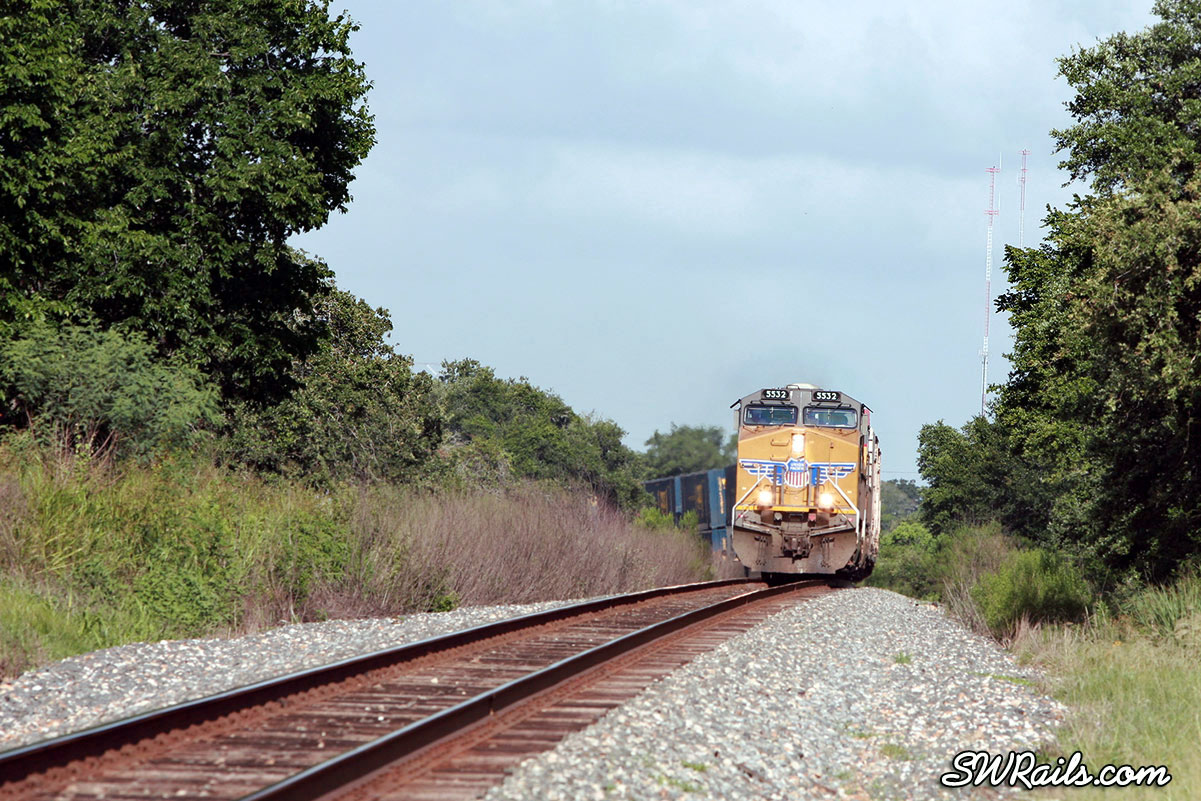
UP 5532 leads a ZATLC train just west of Glidden, Texas on June 11, 2010
This first shot is at 200mm. I like how this focal length magnifies the grade that the train is climbing. I framed the train to be a small part of the image because I felt that the rails would create leading lines directing the viewer’s eye directly to the train in the distance.
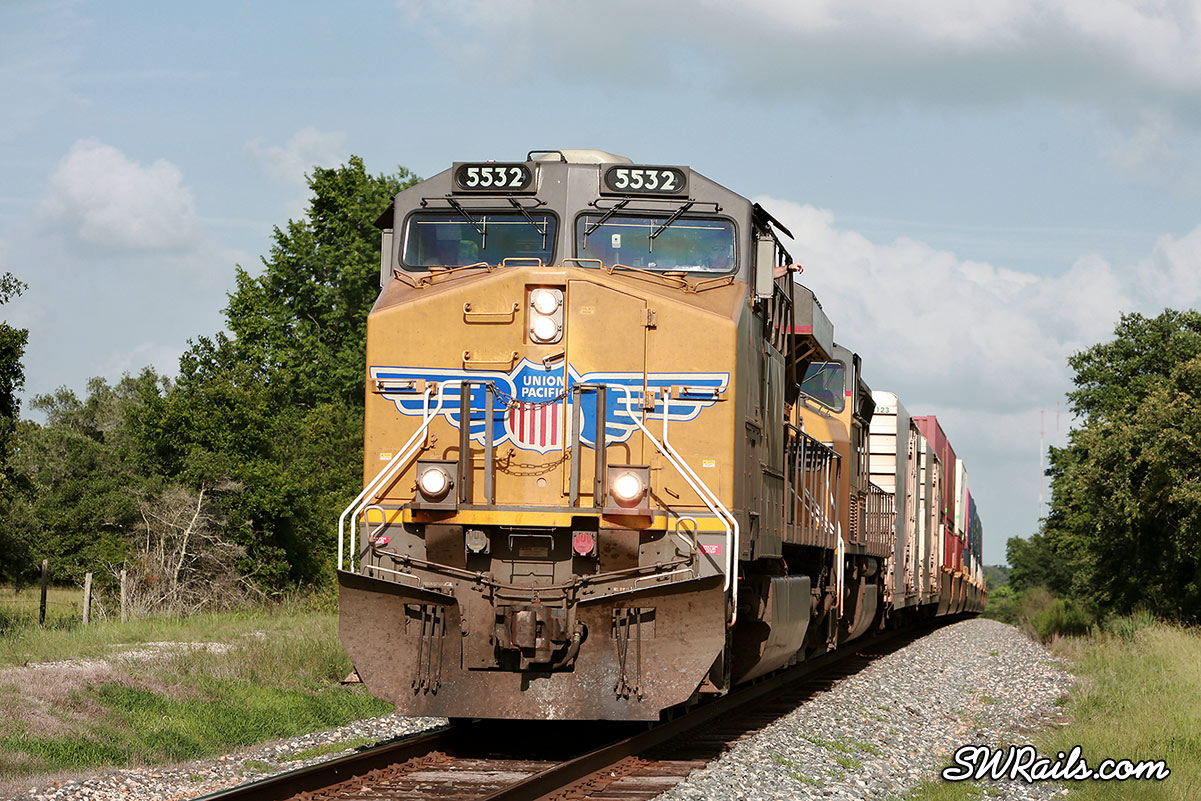
The conductor has a friendly wave as his train passes by me, west of Glidden, TX on June 11, 2010
Pulling the lens back to the 70mm focal length allows me to capture a classic wedge view, where the train is the predominant part of the image.
A zoom lens will never be as critically sharp as a prime lens, but I’m more than happy with the sharpness of 20×30 enlargements made with this lens.
Expect the Expected
Mid-to-late afternoons on the Glidden sub mean one thing. Expect to see the QEWWC (Quality Englewood-West Colton) train. The QEWWC is typically called at Englewood around noon, placing it in my area 2-3 hours later.
The QEWWC is a daily priority manifest between Houston and Southern California. The primary traffic on this train is petrochemical products, primarily chemical tank cars and covered hoppers with plastic pellets. The balance of traffic is general manifest.
As the UP likes to run the QEWWC heavy, over 12,000 tons regularly, you’ll expect to see a 2 unit DPU on the rear.
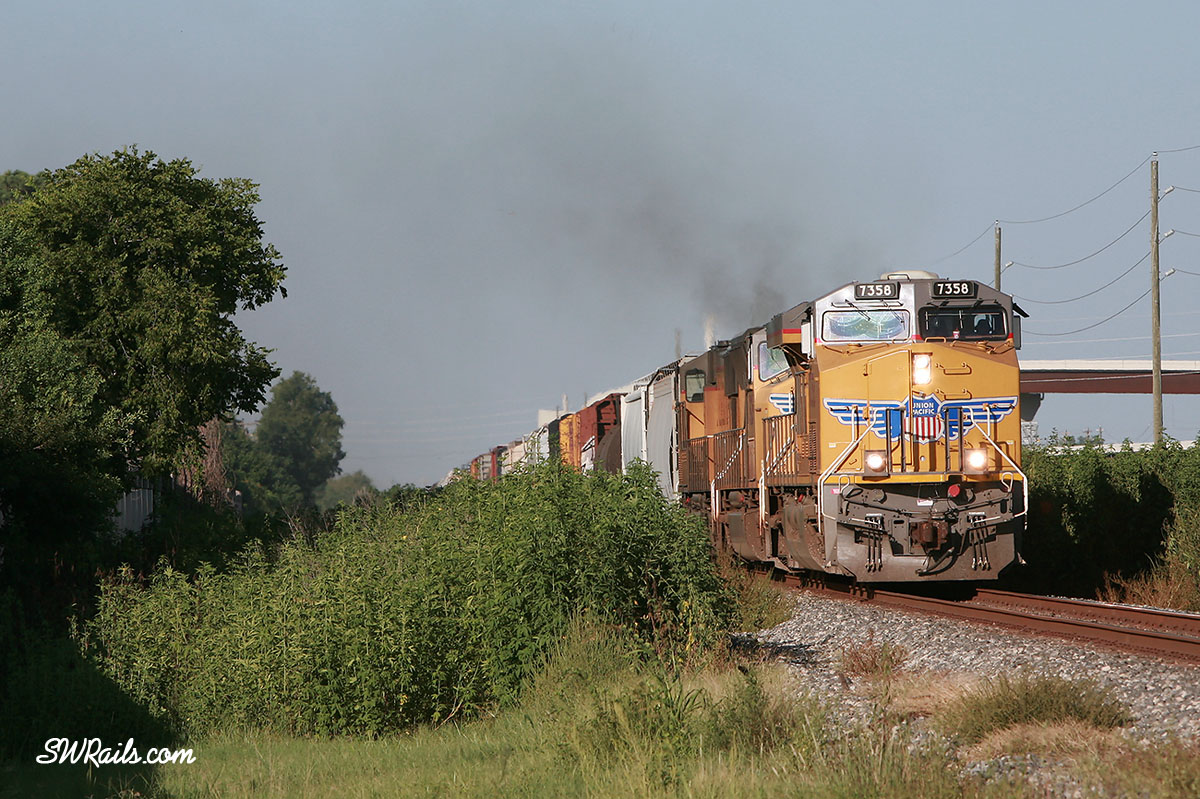
UP's QEWWC comes out of the weeds at MP 15.6 in far southwest Houston on July 31, 2010
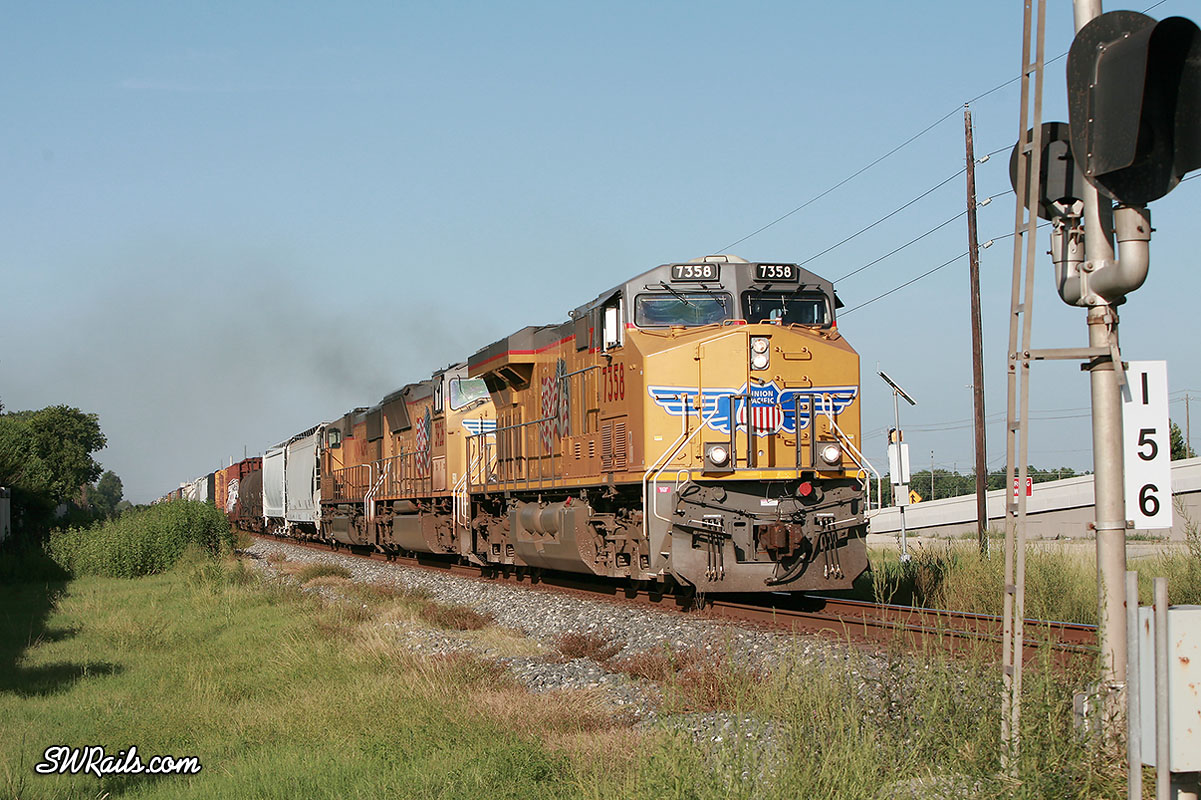
UP 7358 is about to take the signal at MP 15.6 on the Glidden sub, July 31, 2010
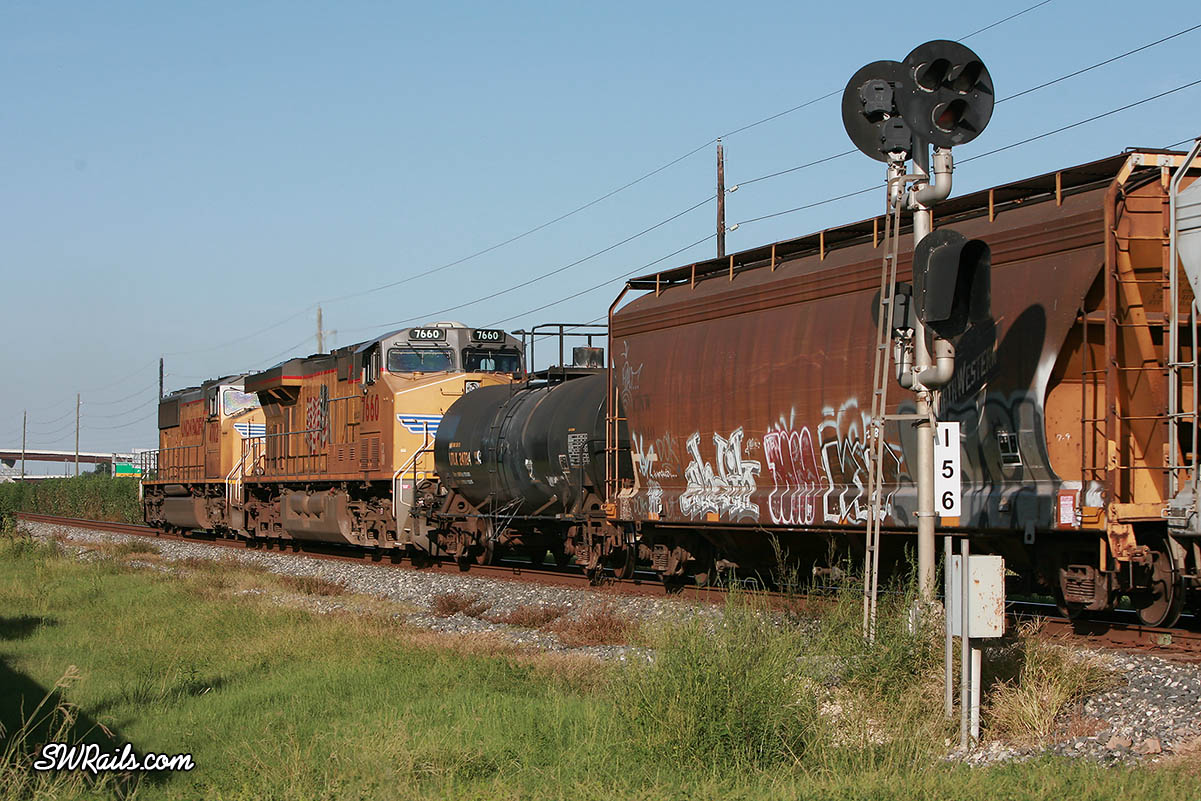
The typical DPU on the QEWWC has 2 units, July 31, 2010 being no exception
SP B39-8 8006 Gets Around
Back when GE B39-8’s were front-line power on the SP, they were used system-wide on expedited trains. The first group, 8000-8039, arrived in September, 1987.
They initially operated in sets of 4, primarily on stack trains. Later, the sets were broken up and could be found in just about any combination of units.
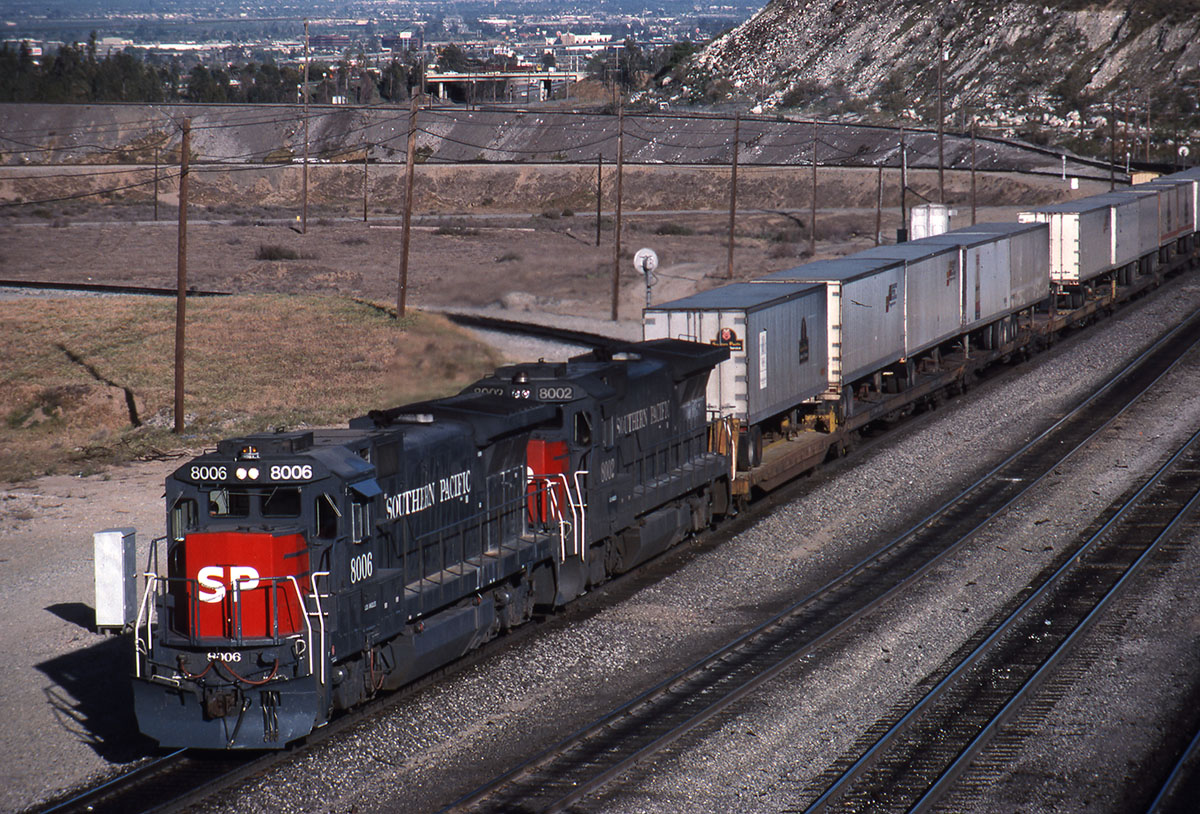
SP 8006 leads a PXLAQ Sprint train into West Colton, CA on March 18, 1988

55 months later, to the day, the 8006 leads an ESDAF through Big Sandy, TX on Dec. 18, 1992
Today, some of these units are in local service around the Union Pacific system, but the majority are stored pending an upturn in business.
Two Sides of the Same Coin
How do you like your MKT F3A’s? Classic or contemporary?
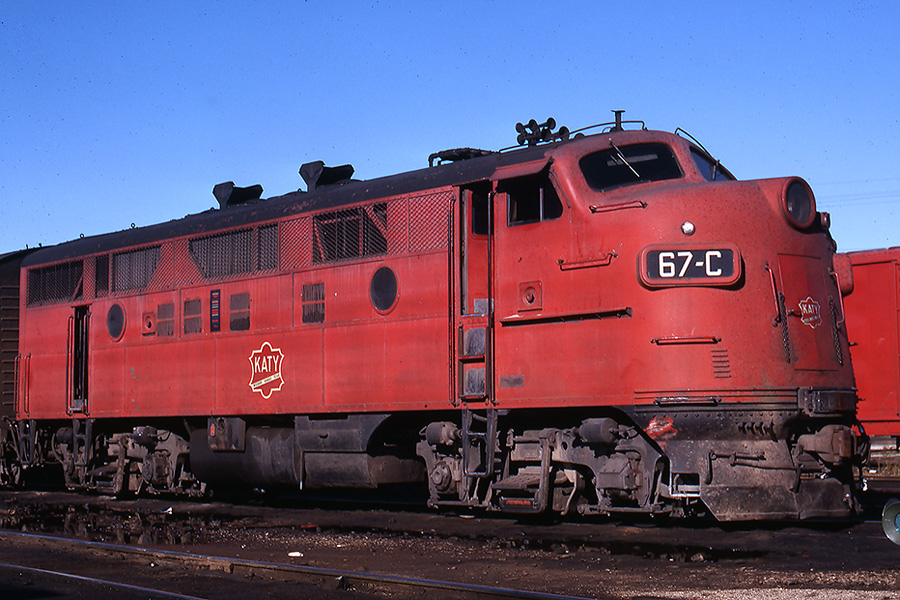
MKT F3A 67-C at Parsons, KS in November of 1971
The above view shows the 67-C in the classic red scheme which adorned the unit for the vast majority of its career with Katy.
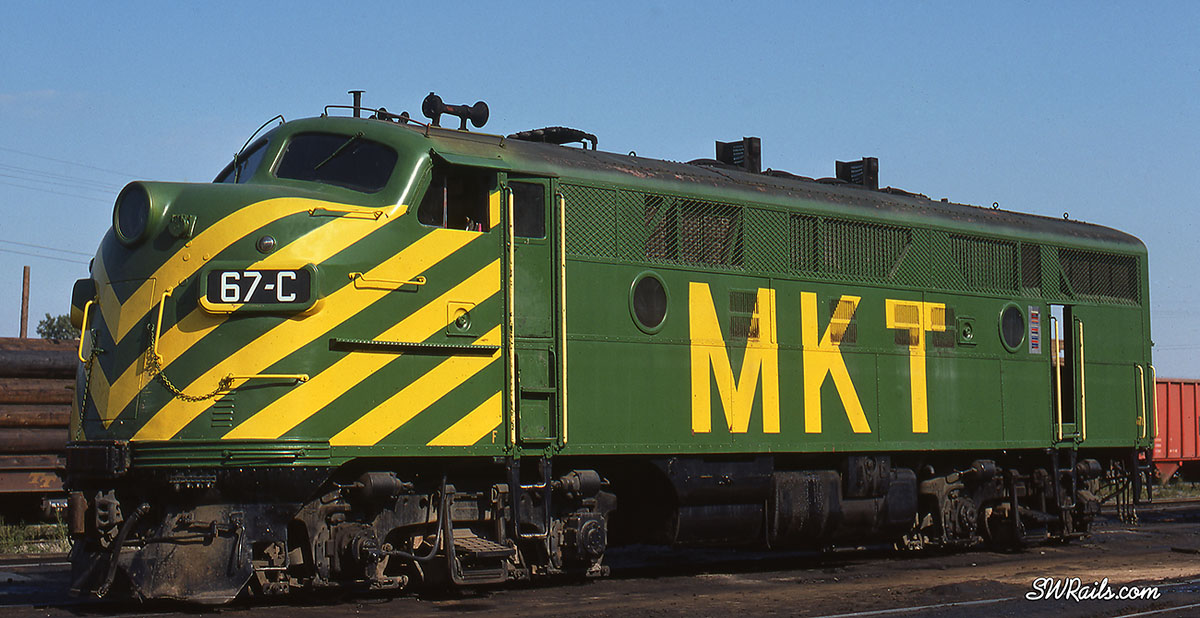
By February 1974, the 67-C had been re-painted in the Katy's new colors, again at Parsons, KS.
In 1971, MKT management decide to update its paint scheme. It selected a high-visibility green and yellow scheme that was nicknamed “John Deere” because of the similarity to the color of John Deere farm equipment.
As the Katy had a reputation of being very cost-conscious, it’s interesting that it would spend the money to re-paint its F units in the twilight of their careers.
Classic or contemporary? How do you prefer your Katy F units?
Missouri Pacific Where Is It?
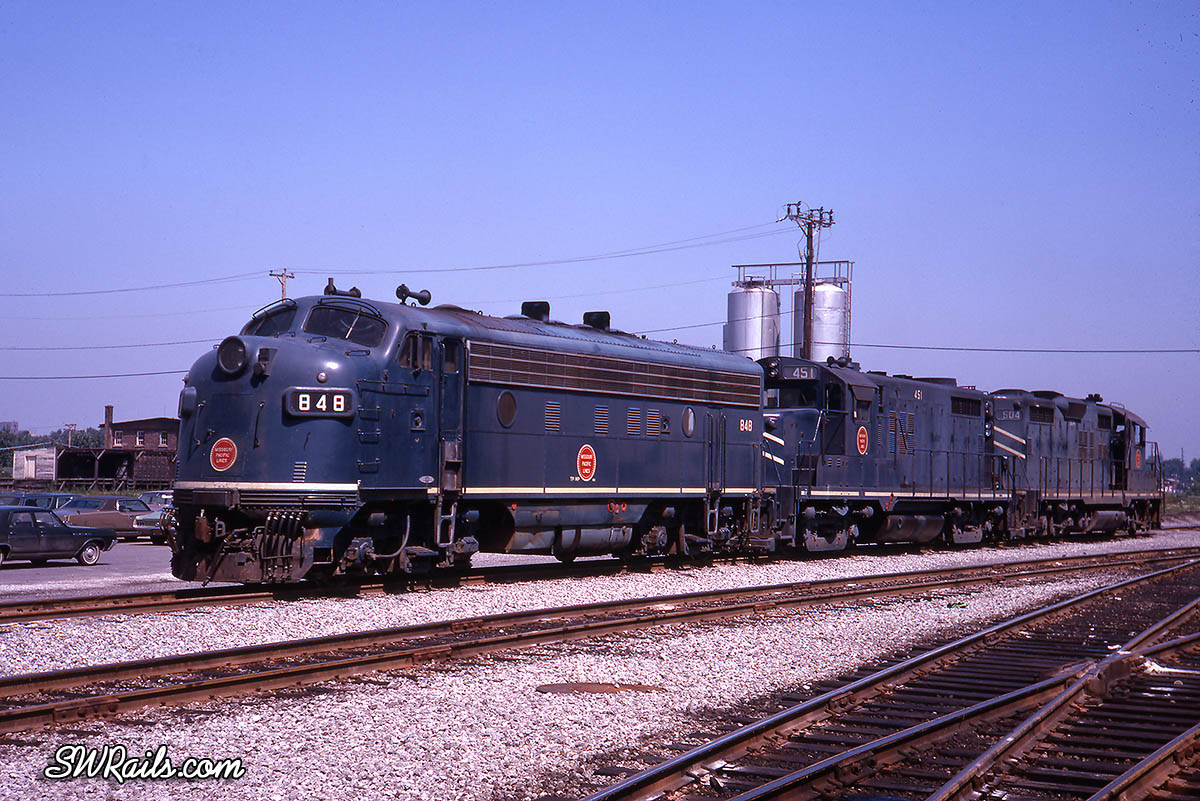
MP F7A 848 and 2 GP18's await the next call to service in Sept. 1969
I came across this slide while looking for something else recently. It’s a fine view of a typical 1960’s MP lash-up of non-turbo’d EMD’s, but what intrigued me was the location. More specifically, the lack of location on the slide mount.
My guess is North Little Rock because of the wide open space in the background, but that is just a guess. If you recognize the location, please let me know in comments.
Manned ETD’s on the Southern Pacific
Yes, end-of-train-devices used to be manned by actual crewmen. A conductor and a rear brakeman, to be precise. But time, technology, and cost-cutting waits for no one.
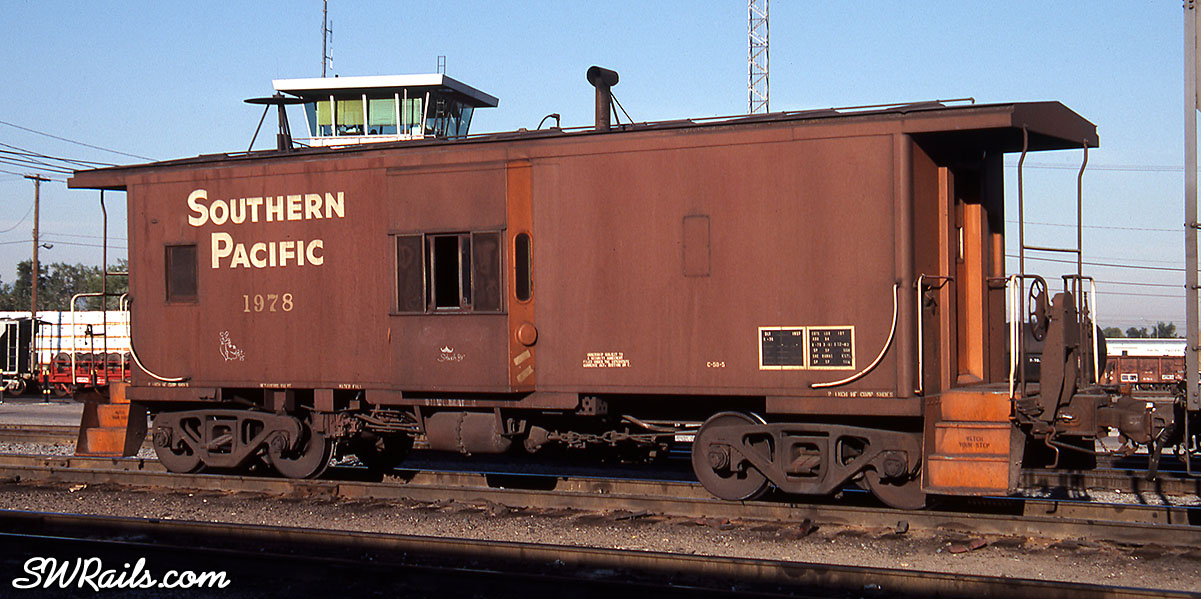
SP caboose 1978, a C50-5 bay window caboose, at Salt Lake City, UT on July 1, 1985
This is the archetypal design and paint scheme for SP cabooses since just after WWII. But there were a few exceptions.
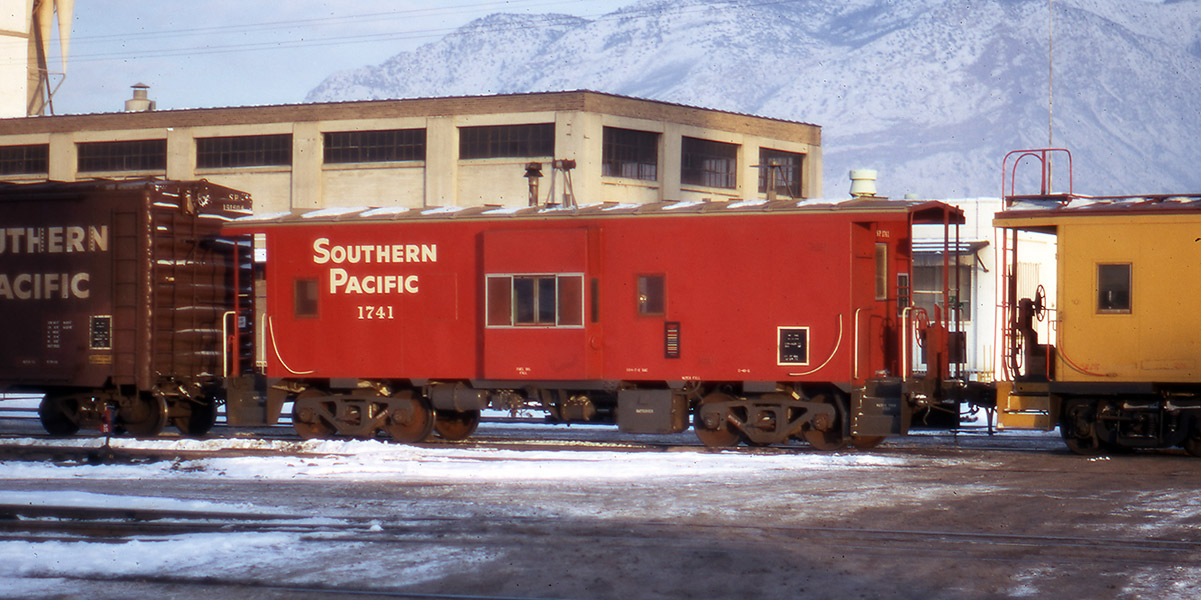
SP caboose 1741 at Ogden, UT in January 1973
In 1972 Southern Pacific repainted C40-6 Bay Window Caboose 1741 into an experimental paint scheme. It had a bright red body, natural aluminum roof, gray trucks and under-body.
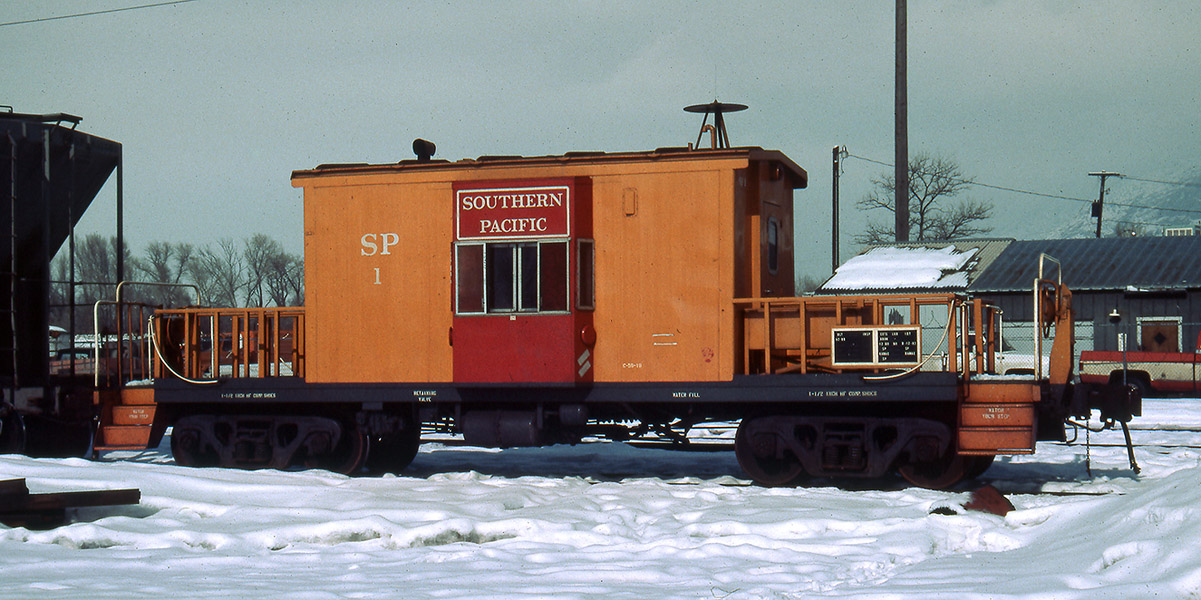
One-of-a-kind SP caboose 1 at Ogden, UT on Feb. 18, 1984
The wildest caboose experiment took place in 1980. SP’s only example of Class C-50-10, it was built from damaged C-50-3 #4401 in 1980, and painted to match ‘Orange Bird’ SD40 7342. The frame length remained the same, but the body was shortened and it had no roof overhang.

A bolder lettering scheme on this side of SP caboose 1, shown at Oakland in 1982
Each side had different lettering and lettering placement. No others were built because the savings weren’t significant and SP management knew that cabooses would be phased out relatively soon.
 Southwest Rails