Fill ‘Er Up
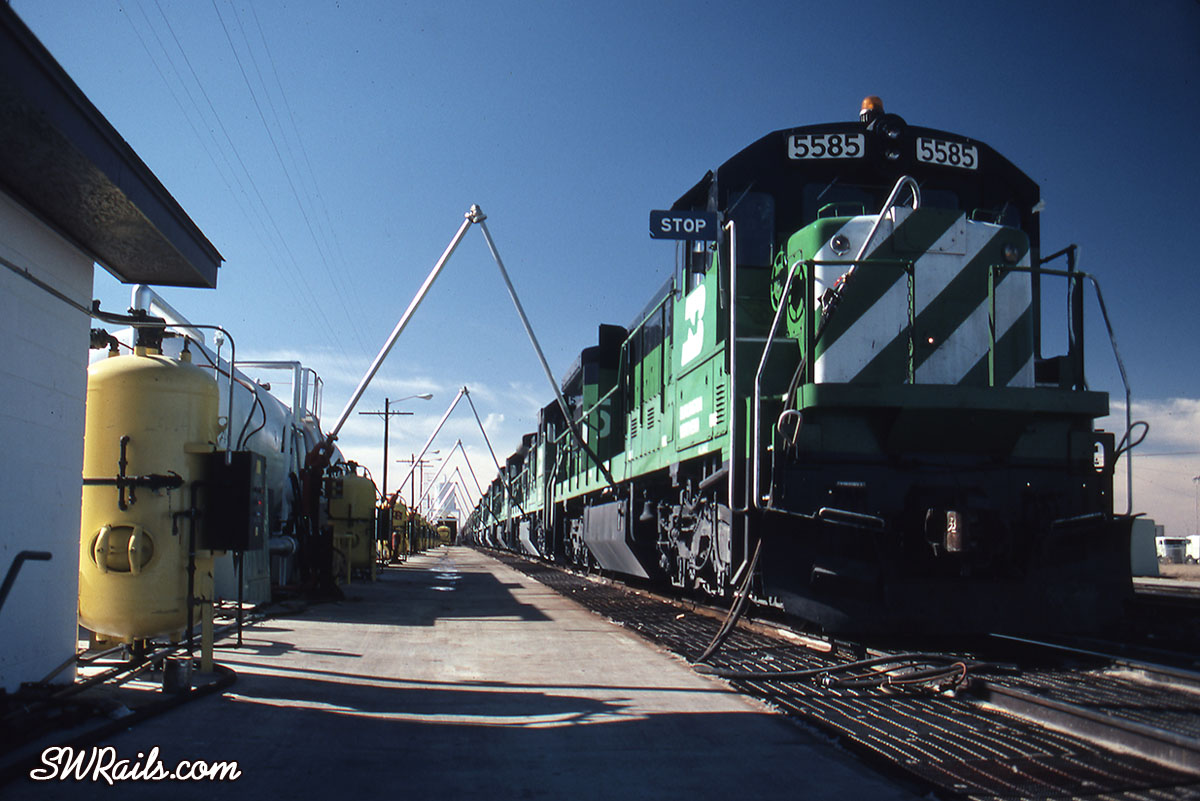
A UFIX loaded coal train pauses for diesel, sand, and supplies at Amarillo, TX on Feb. 14, 1981
Just one more trainload of Powder River Basin coal pauses at Burlington Northern’s fuel pad in Amarillo, Texas nearly 30 years ago, on Feb. 14, 1981.
Six locomotives were the norm for Texas-bound coal trains, typically a mixture of SD40-2’s and C30-7’s. On this day however, a solid consist of 3000 HP C30-7 locomotives has drawn the assignment.
Once fuel tanks and sandboxes are filled, cab supplies replenished, and a fresh crew comes aboard, the train will depart southbound to Fort Worth.
At Fort Worth, the train will be interchanged to the Santa Fe for the last 280 miles to Thompsons, Texas, location of Houston Lighting & Power’s Smithers Lake power plant.
The Ultimate Survivor
My previous post showed MKT GP40 171 leading a southbound manifest into Dallas in 1972.
In preparing that post I came across this slide of the same unit leading another southbound manifest, but in Fort Worth, and 15 years later.

MKT 171 leads a southbound across the Tower 55 interlocking in Fort Worth on Feb. 11, 1987
The Katy’s GP40’s became an endangered species as a result of the UP acquisition of the Katy in late 1988. Understandably so, as they were over 20 years old, with pre-Dash-2 electrical systems, and had never been overhauled by the Katy. It lasted on the UP for right at one year. It was then leased to Nacionales de Mexico from October 1989 to May 1990.
Upon its return from Mexico, it was sold to Morrison Knudsen in May of 1990. MK needed cores to fill an order for 65 GP40M-2 re-builds from the Southern Pacific. MKT 171 served as the core for SP GP40M 7297 which was completed on Feb. 9, 1991.
In addition to a complete mechanical and electrical re-build, the 65 units received the Positive Traction Control wheel-slip control system, along with Southern Pacific standard features: roof-mounted beacon lights, air conditioning, ditch lights, and snowplows. Dynamic brakes were added to the 171, one of nine core units (eight former MKT units and one former Rock Island unit) not originally equipped with them.

"New and improved" MKT 171 is assigned to the Ski Train, shown in Denver on March 14, 1993
Can you guess the next step in the career of this locomotive? If you answered “it was acquired by the UP as a result of the UP-SP merger”, you are correct. SP 7297 remained in SP red & gray until 2004, when it received UP colors and was re-numbered UP 1532.

UP 1532 is switching cars at Alorton, IL on July 23, 2009
So what’s up with this locomotive today? The GP40 that I first saw behind the old Dr. Pepper plant in North Dallas in 1972, was hauling freight through the hills of Missouri for its fifth operator, the Union Pacific.
As of this writing at 2300 on Oct. 30, 2010, UP 1532 had just passed through Gads Hill, Missouri en route to Poplar Bluff, Missouri with an ETA of 0405.
Not too shabby for a nearly 45-year-old locomotive that was “retired” over 20 years ago…
Southbound Katy at Mockingbird Lane
Let’s look at a few photos I took back back when I was a 12 year-old railfan in Dallas in 1972 and a K-Mart 10-speed was my mode of transportation.
I wanted to explore some tracks near near the intersection of Mockingbird Lane and Greenville Ave. It was an easy bike ride as it was only about about 3 miles north of home. Of course I took the family Kodak Instamatic camera just in case a train came by.
My explorations typically consisted of looking at the tracks and switches, throwing some rocks, and hoping a train would come along. Usually, no train would come along.
Then again, sometimes one did.
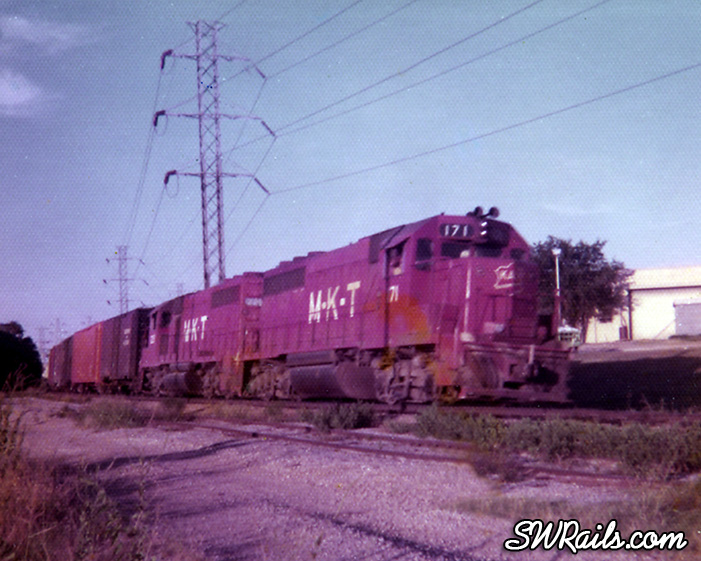
(Image scanned from the original 1972 print, hence the color shift below the engineer's window)
Two Katy GP40’s, 171 and 221, are bringing a southbound manifest in from Dennison. By this point in time the Katy had already started re-painting its fleet into the John Deere scheme, so I was glad to get a matched set in the red scheme.
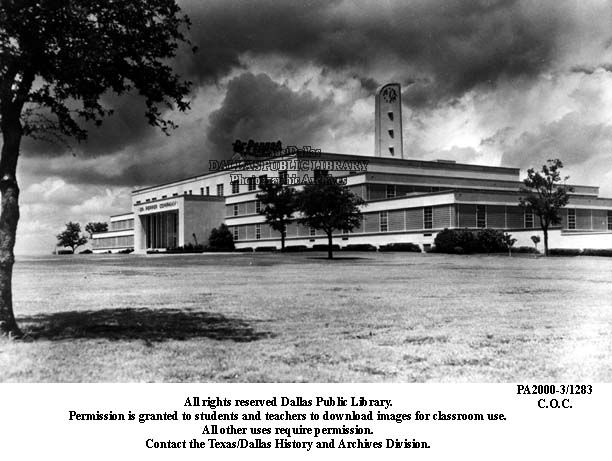
The building in the background is the iconic Dr. Pepper bottling plant, long a fixture on Mockingbird Lane. At least until 1996, when it was demolished to make room for some apartments. That’s progress, don’t you know.
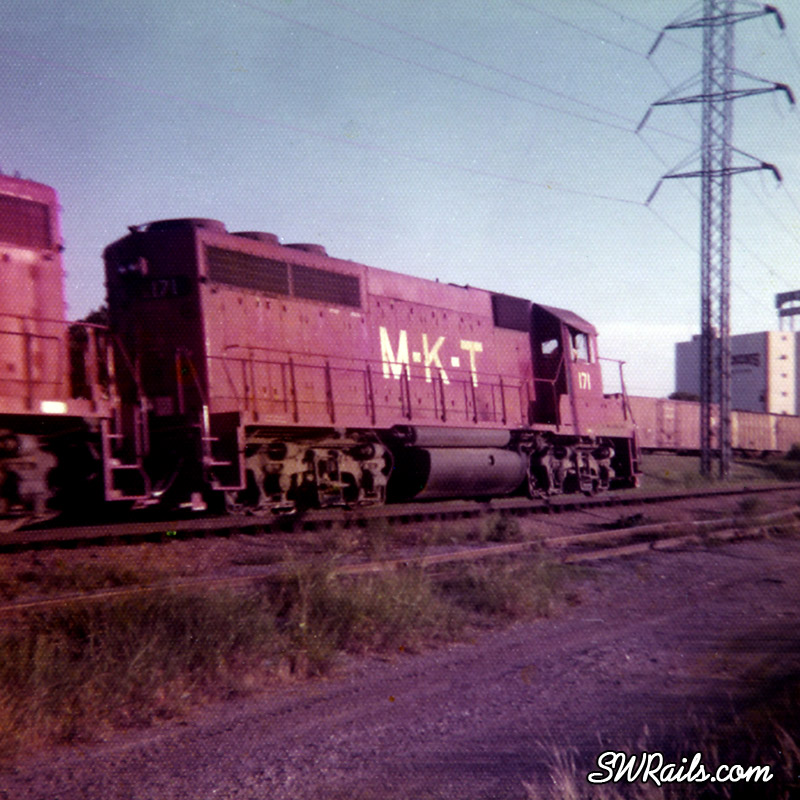
Somehow I managed to advance the film quickly enough to get a going away shot of the lead unit.
Note the spur in the background leading into the Dr. Pepper plant. Beyond the covered hopper, you’ll see the Bekins Moving & Storage building. That building is still there, but it’s now occupied by Public Storage.
Union Pacific merger mania in the 1988-1996 period made this line redundant. The tracks were pulled up and the right-of-way was sold to DART (Dallas Area Rapid Transit) for use as a light rail corridor.
The spot where I stood for these two photos is now the location of DART’s Mockingbird Station, but it is below ground level.
I’ve embedded a Google street view from where the Katy main line crossed Mockingbird Lane. It’s looking north toward where I was when I took these shots. (The street view loads kind of slow, so give it a moment.)
There’s no hint that a railroad once passed through here, but look at the high tension power lines. They haven’t changed a bit from how they looked in my two photos. Drag the street view so you can look to the right and you’ll see the old Bekins building. Drag it a bit more to the right and you’ll see where the the old right-of-way was, just to the right of the mini-storage units.
It’s interesting to see that regardless of all of the changes in the last 38 years, some things haven’t changed at all. Which permits me to see where I was on that lazy summer afternoon in 1972 when I decided to get on my bike to see what was going on at the tracks on Mockingbird Lane.
Sunday Before Last in Sugar Land
I was able to get out twice the Sunday before last, prompted both times by the dispatcher making reference to several trains running closely together.
First up was a UP ALDLI (Autos Laredo-Livonia) train, led by SD9043MAC 8136.

SD9043MAC 8136 leads an ALDLI train through Sugar Land, TX on Oct. 9, 2010
I relocated a mile to the west, wanting to work the old Imperial Sugar mill into the shot. Less than 10 minutes later, KCSM 4569 East appeared.

KCSM 4569 is the only unit on-line on this eastbound at Sugar Land, TX on Oct. 9, 2010
As the lead engine approached me, I noticed it seemed to be working pretty hard. As the lead engine got by me, I discovered the reason it was notched out: the other 5 engines were DIC (dead-in-consist).
Another power balancing move by the KCS due to motive power accumulating in Mexico due to the imbalance of tonnage in the KC to Mexico corridor.
A quick pivot allowed a going-away shot.
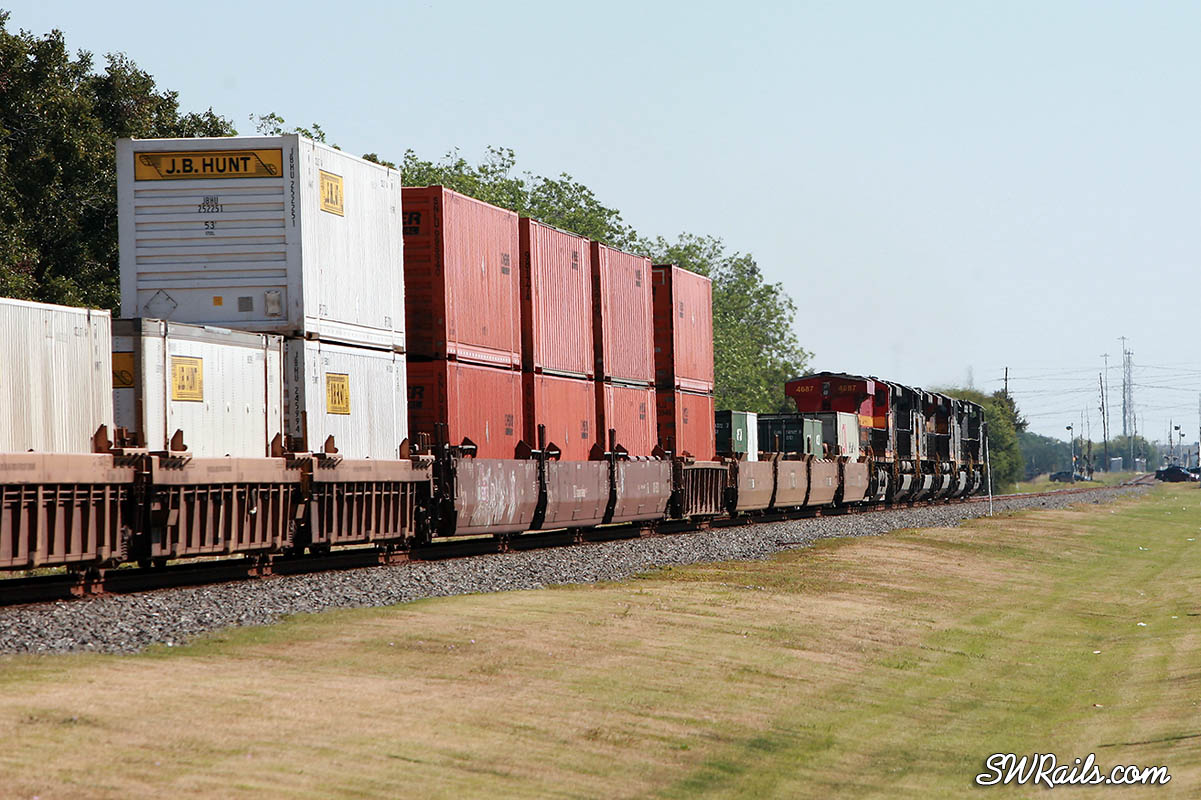
KCSM 4569 East at Sugar Land, TX on Oct. 9, 2010
There was more traffic out there, but as I had some “grown-up responsibilities” that prevented any more pictures.
Fast forward about 6 hours. We had some errands in Houston, so why not grab the camera just in case?
We were in Stafford (MP 20) when I heard the “no defects” message from the detector at MP 15.6. The only problem was I didn’t know if the train was coming or going. If it was eastbound, it was already by me. Westbound, it was coming at me.
I found a spot near MP20.6 and waited for the westbound that might be coming. After a 10 minute wait, it became apparent that the train was going.
I packed up and started heading toward errand #1. I hadn’t gone more than a mile when the Glidden sub dispatcher tells a crew “I have to hold you at Sugar Land. The terminal wants to run 2, maybe 3 westbounds, before they can take you.”
That’s more like it! My chores aren’t going anywhere, so I make a quick u-turn, heading back to the spot at MP 20.6 to await the fleet.
First up was a KCS grain train, 4592 West.
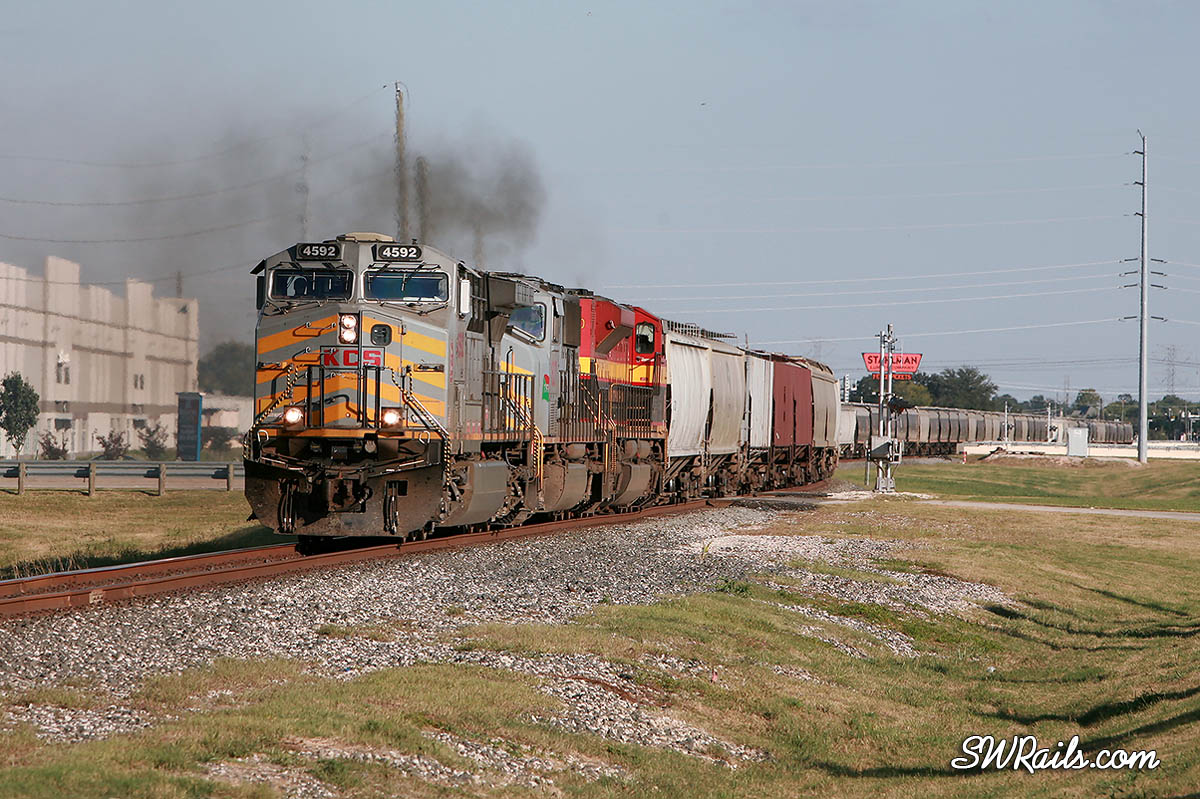
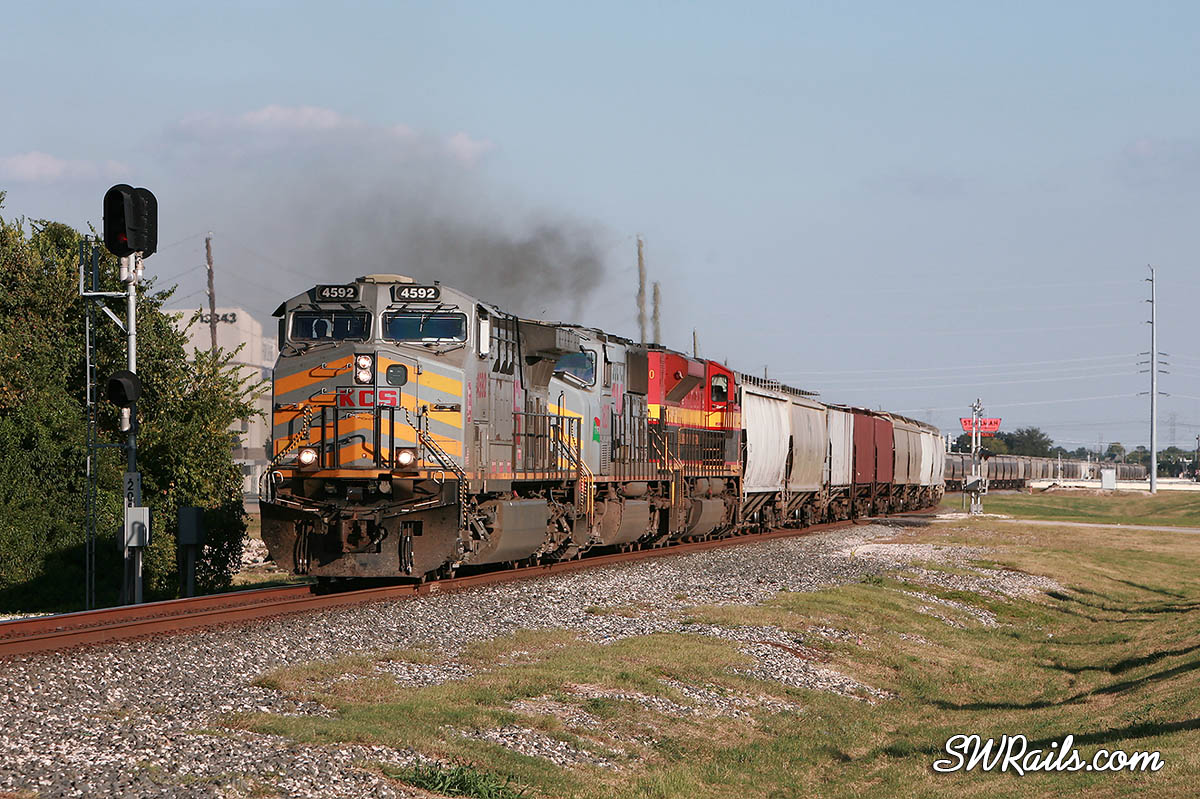
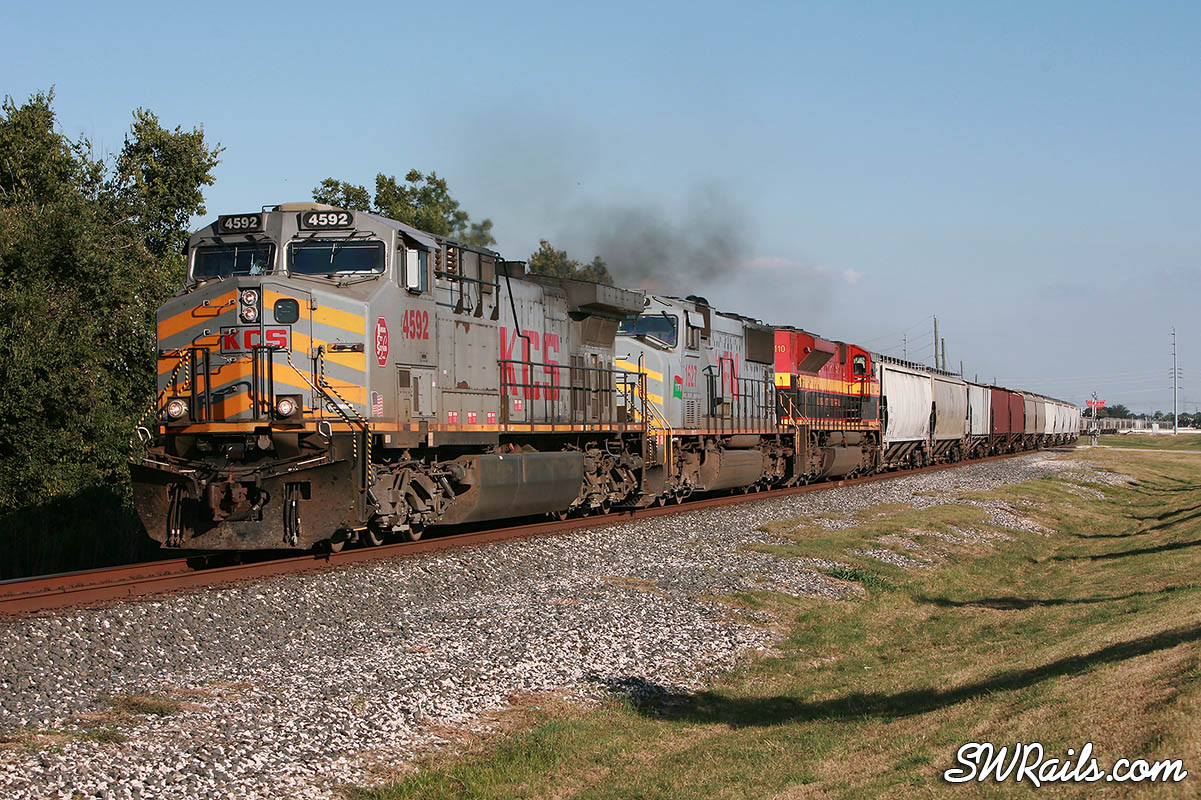
It was nice to see a loaded KCS grain train with a proper motive power consist, configured as God intended. All of the locomotives on the point.
8 minutes later, the next train comes into view.
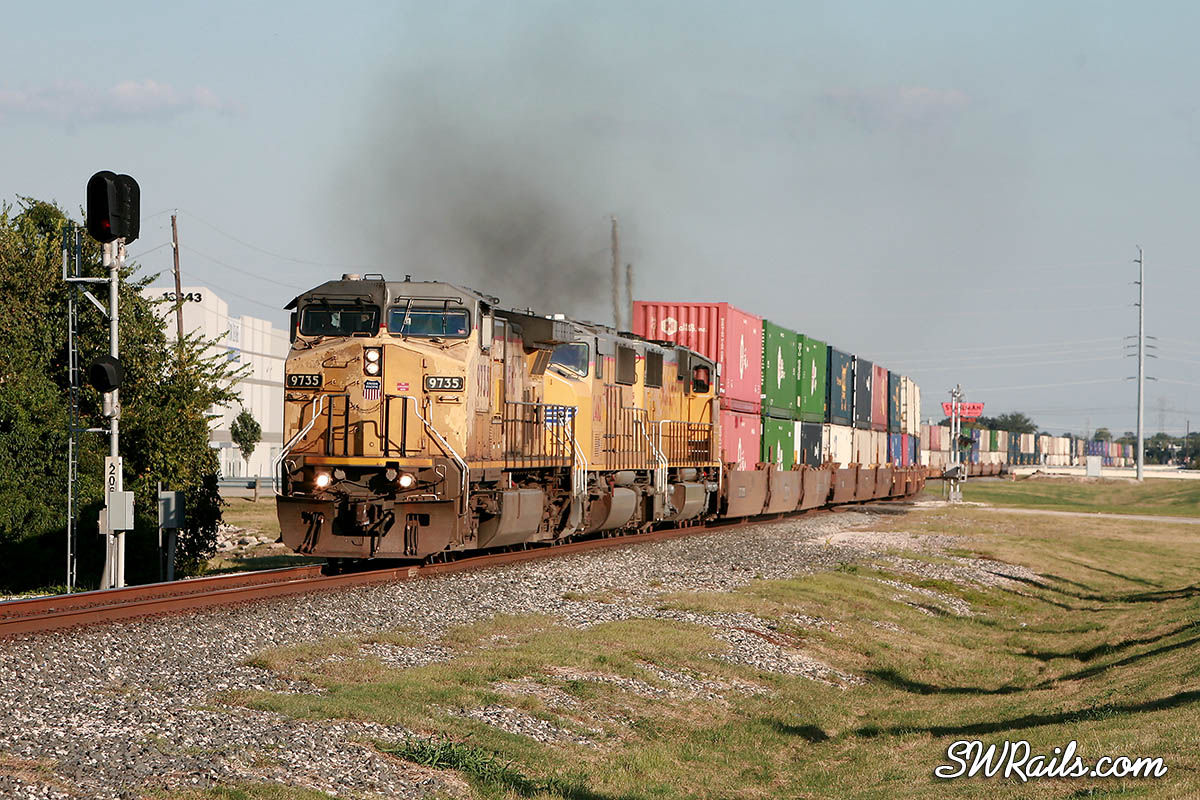
Union Pacific IHOSA train (intermodal Houston-San Antonio) at Stafford, TX on oct. 9, 2010.
This power on this train is a real blast from the past: a C44-9W and 2 SD60M’s. The lead unit’s paint was pretty tired, but the two trailing units looked great.
I relocated to the curve at MP 19.7. Thanks to the TXDOT geniuses that program the traffic lights on this stretch of Hwy. 90, it took me 9 minutes to go less than one mile. On a Sunday afternoon. With virtually no traffic.
The next train was in view before I could even get out of the car. Thank goodness for the 25mph slow order.
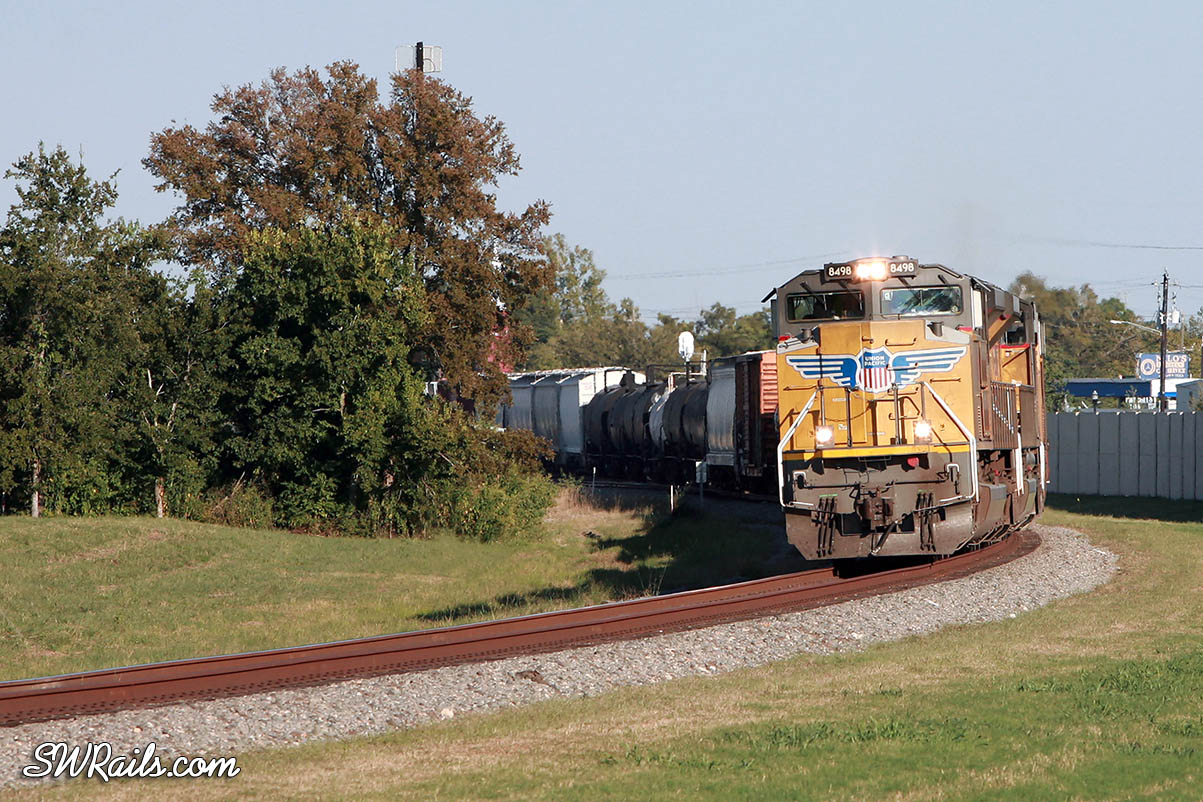
UP 8498, a QEWWC train, traverses the long curve at Stafford, TX on Oct. 9, 2010
With the passage of the QEWWC, the dispatcher was going to run his east man out of Sugar Land. Hmmm. I’ve been wanting to shoot some trains that are strongly back-lit, but errands await me.
Cotton Belt GP20E in 1993 – Video
One of my first attempts at videotaping a train. The camera was a Sony Hi-8 model. It was infamous for losing focus with engine headlights, especially if zoomed in at all. At least I didn’t have to deal with ditch lights with that camera.
Hence, I had to shoot everything fairly wide. But to have had today’s grade of equipment back in the day….
Cotton Belt GP20E 4152 leads a long Strang-Englewood chemical train near MP 1.5 of the Strang sub in May of 1993. This is just south of Englewood Yard.
Note the graffiti-free freight cars. Good times…
Rio Grande Heritage in Texas – Part 2
You might recall I posted about my chase of the UP’s Rio Grande Heritage unit about 5 weeks ago. You might also recall that I mentioned there was another segment of that chase.
I’m finally posting part 2 from that epic chase.
My first post about my chase of the MEWSA, UP 1989 West, mentioned that I ended up in Kingsbury. What I didn’t mention that it was 150 miles west of home in Sugar Land.
All said, the trip was over 300 miles round-trip. All spur-of-the-moment.
Of course, I’m a highly trained professional. Needless to say, kids, don’t try to do that at home.
PS-Once the video starts, click where it says 360p near the right, bottom corner of the player. It will switch to 480p, greatly improving the quality of the video.
Just Another Missouri Pacific Geep – Not!
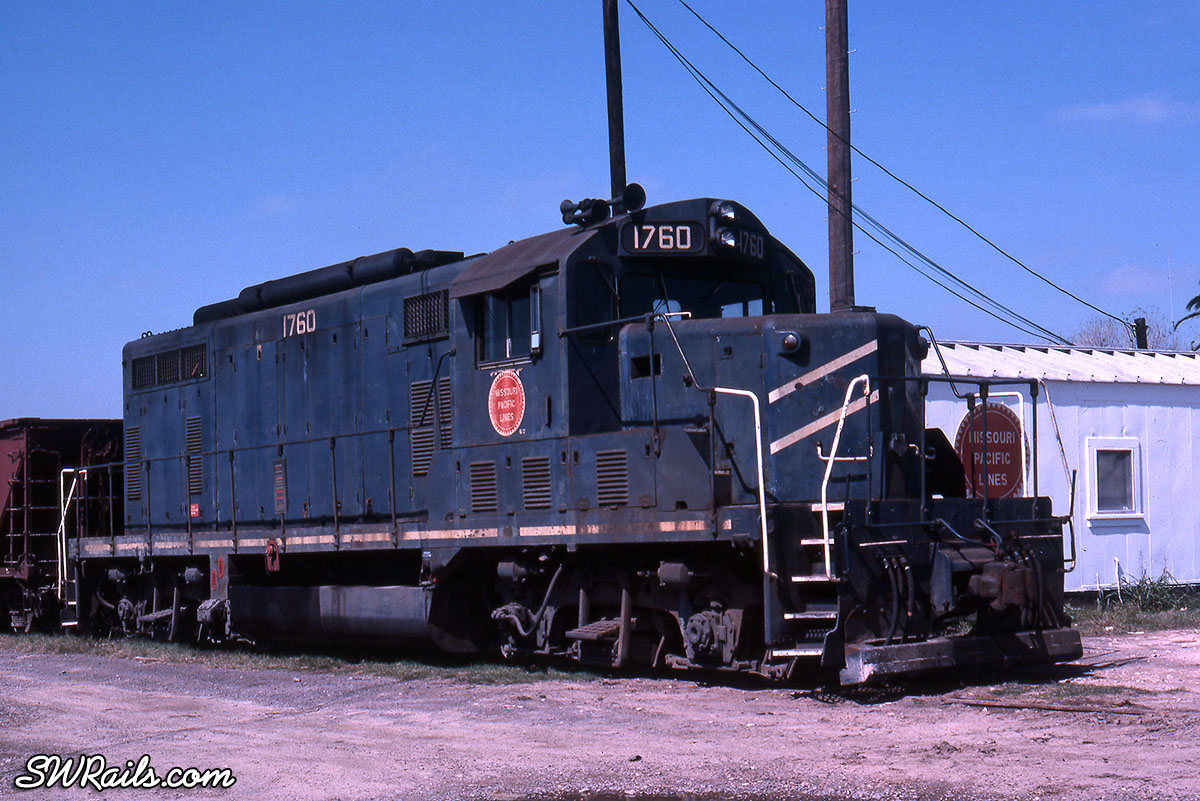
Missouri Pacific GP7 1760 lays over next to the MP's Mission, Texas yard office on Feb. 14, 1980. (Click image to better view the details)
Don’t be fooled by the utilitarian appearance and MP freight colors on MP GP7 1760. It looks like any other MP Geep of the era, but a closer look reveals its heritage as a passenger locomotive.
Note the rooftop air tanks and dual gauges (just forward, and above the trailing truck).
Dual gauges: passenger service Geeps were built with steam generators to provide heat and hot water for the passenger cars. This required enlarging and splitting the fuel tank into two reservoirs, one for fuel and the other for water for the steam generator. That is why you see 2 gauges.
Rooftop air tanks: placing the air tanks on the roof increased the amount of room available under the frame, increasing the capacity of the fuel/water tank.
Missouri Pacific took delivery of GP7 4241 in mid-1952. It was re-numbered 309 before becoming 1760 in the 1975 system re-numbering. In the early 1970’s, the MP cut down the high short hood of many of its GP7’s.
Here’s a picture of a sister unit in passenger service, showing the original high short hood. Note the rounded steam generator exhaust vent just forward of the cab roof.

Missouri Pacific passenger service GP7 322, date and location unknown.
The 1760, and all of the MP’s early Geeps, were retired by 1981. They were used as trade-ins for the MP’s GP15-1 and GP38-2 orders of 1980 – 1981.
If I’m not mistaken, the MP was the first major railroad to retire its GP7’s and GP9’s.
The Colorful Southern Pacific
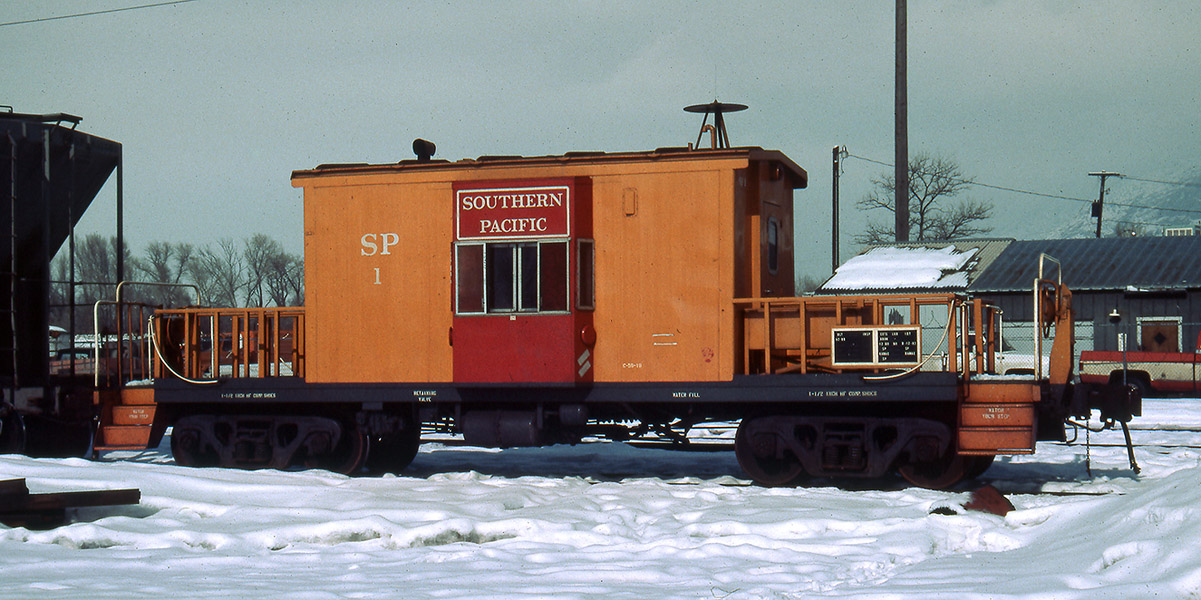
Colorful isn’t an adjective associated with the Southern Pacific since the 1950’s, but there was a short period of time some 30 years ago when a handful of SP locomotives were quite colorful.
In the late 1970’s / early 1980’s, the SP flirted with the idea of changing its locomotive colors from scarlet & lark gray to a variation of the classic Daylight colors, red, orange and black.
These experimental paint schemes were applied to SD40E 7342, SD45E 7399, and caboose #1 in the 1981-1982 time frame.
But the very first application of these colors to freight power took place a few years prior, when the SP took delivery of 4 TE70-4S locomotives from Morrison-Knudsen in early 1978.
These 4 units had been re-built from U25B’s that had been retired from the SP. The re-build program was less-than-successful, and no others were ordered by the SP.
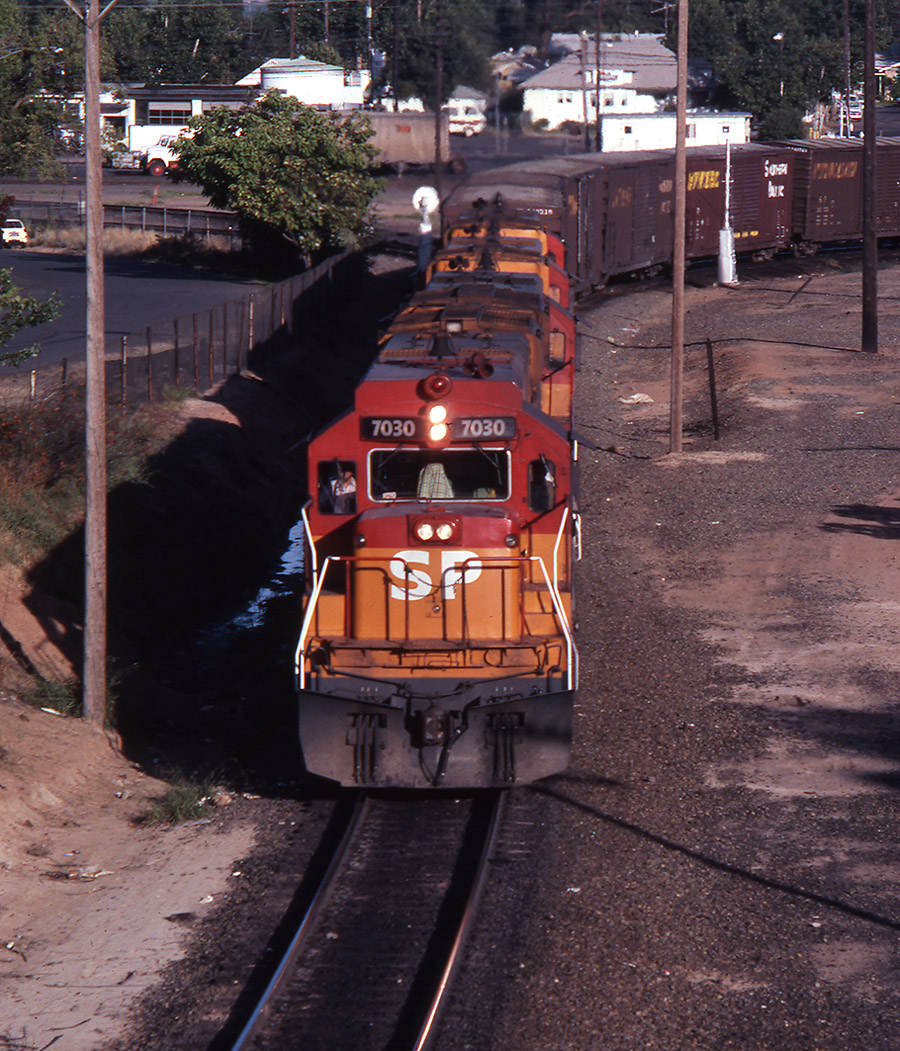
All 4 Southern Pacific TE70-4S's power a northbound manifest departing Roseville, CA on June 16, 1980
KCS Business Train Surprise – Video
The video shows the train at Richmond, the south end of Rosenberg, and at Beasley. There’s also a bonus segment of KCS 4057, a 1×1 grain train, departing Kendleton.
The train layed over at the KCS yard in Kendleton. It departed to Laredo at 0615 this morning.
It’s scheduled to leave Laredo tomorrow morning, 10/13/10, running back to Shreveport with no layovers.
Once the video starts, click where it says 360p at the bottom of the player. It will switch to 480p, greatly improving the quality of the video.
PS-Note the folks scurrying away from the track at the beginning of the video. They arrived a few minutes before the train arrived.
At first I thought they were there for the train.
I was wrong. The gentleman, a “photographer”, had been posing the ladies on the bridge when the gates came down.
KCS Business Train Surprise
I have gotten into the habit of taking the railroad radio with me, even if no railfanning is planned. It’s interesting to hear what’s going on, plus you never know what surprises may pop up.
I was in Houston for some errands when I heard the Glidden sub dispatcher issue track & time to a track foreman at Harlem. I noticed that the DS was emphatic about the track permit being for 90 minutes. If the foreman could not get the work done in 90 minutes, the dispatcher had been instructed to deny the permit. The foreman accepted the conditions, promising to be off the track by 1650. I assumed the hard-line was because of a fleet of trains that needed to get by.
About 1635, I hear a UP M-O-W Director from Omaha call this foreman on the radio. The Director reminded the foreman that his track & time expired shortly and telling him to get off the track at the agreed upon time.
All of this was quite odd. It’s common to hear a dispatcher fuss at M-O-W, but I’ve never heard Omaha call a foreman in the field to discuss something like this. The foreman explains that he still needs to drill 8 holes into the replacement rail so he could bolt it into place. He adds that they’re working as fast as they can and that they’re “not playing around out here.”
Hmmm. Something is going on…
At 1650, the dispatcher calls the foreman to release his track & time. The foreman explains that he needs another 15 minutes to finish. The dispatcher tells the foreman to get done ASAP because the KCS CEO Special is leaving Houston.
That’s all I needed to hear…
By this point I was already back home, so I grabbed some gear, a bottle of water, and headed out.
It was cloudy around Sugar Land, but it appeared there might be some sun to the west. 20 minutes later, I ended up at Richmond. I set up just west of the Brazos River bridge.
At 1812, the distinctive 5-chime horn of KCS 1 announced the passage of the Southern Belle through Richmond, Texas.
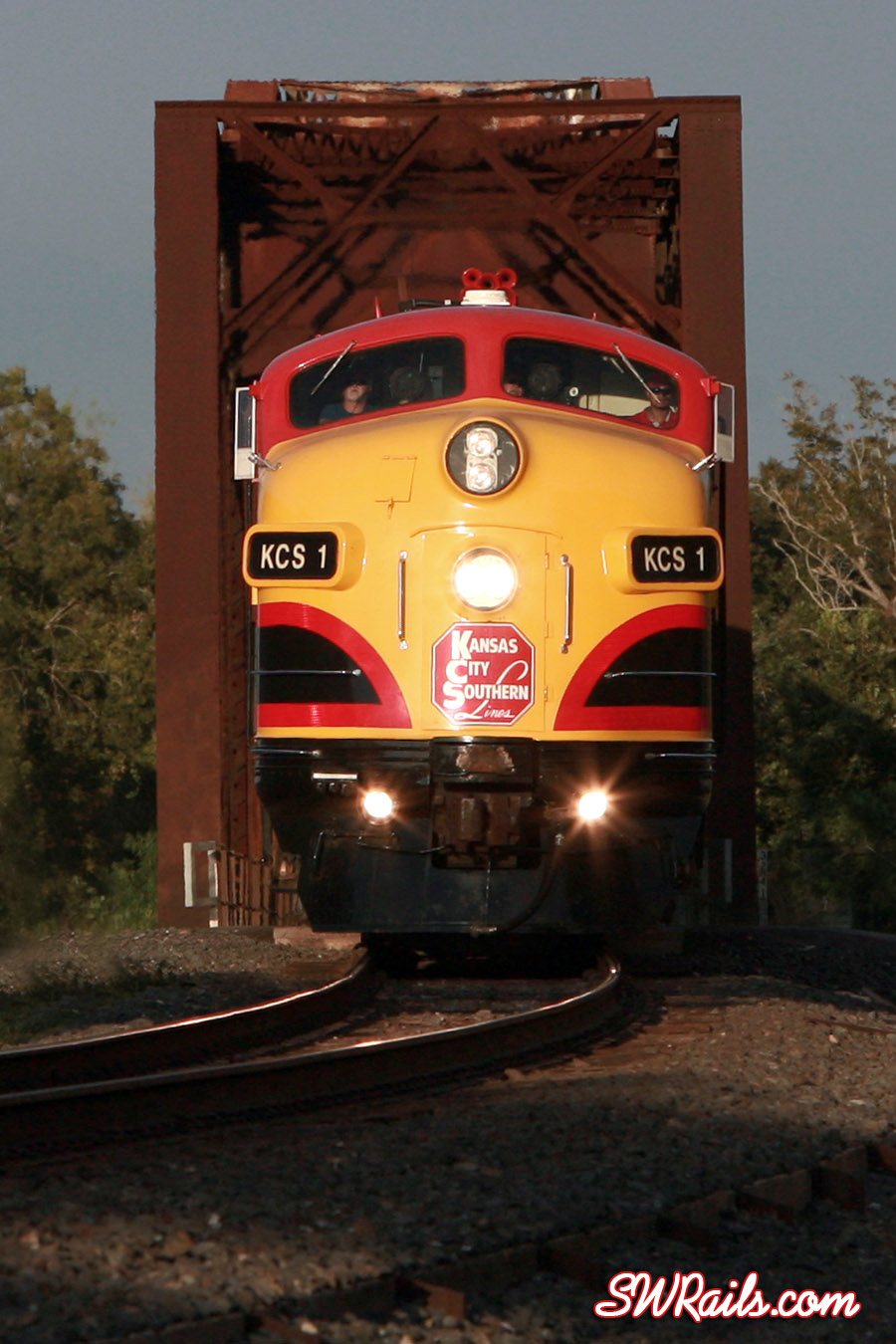
KCS business special crossing the Brazos River, Richmond, Texas on Oct. 11, 2010
The Sugar Land Skyline is Changing
The increased pace of demolition at the old Imperial Sugar mill here in Sugar Land has motivated me to get out and capture some views before the Sugar Land “skyline” changes forever.
Pretty much everything will be demolished save the “char house”, the iconic red brick building. The interior of the char house will be converted into loft apartments. I guess this is what happens when progress is defined as developers making money…
This past Wednesday morning, I heard one eastbound and 2 westbounds were waiting for a welder to clear up at Harlem. I headed out just before the welder’s track & time expired, hoping for a quick trifecta.
First up was a KCS manifest with 2 KCSM Belles leading a KCS SD70MAC.

KCSM 4720 East crossing Oyster Creek, just east of CP SA025, on October 6, 2010
A BNSF empty grain train arrived about 15 minutes later. I was glad to see a warbonnet on the point, albeit with an orange cab door and A/C unit.
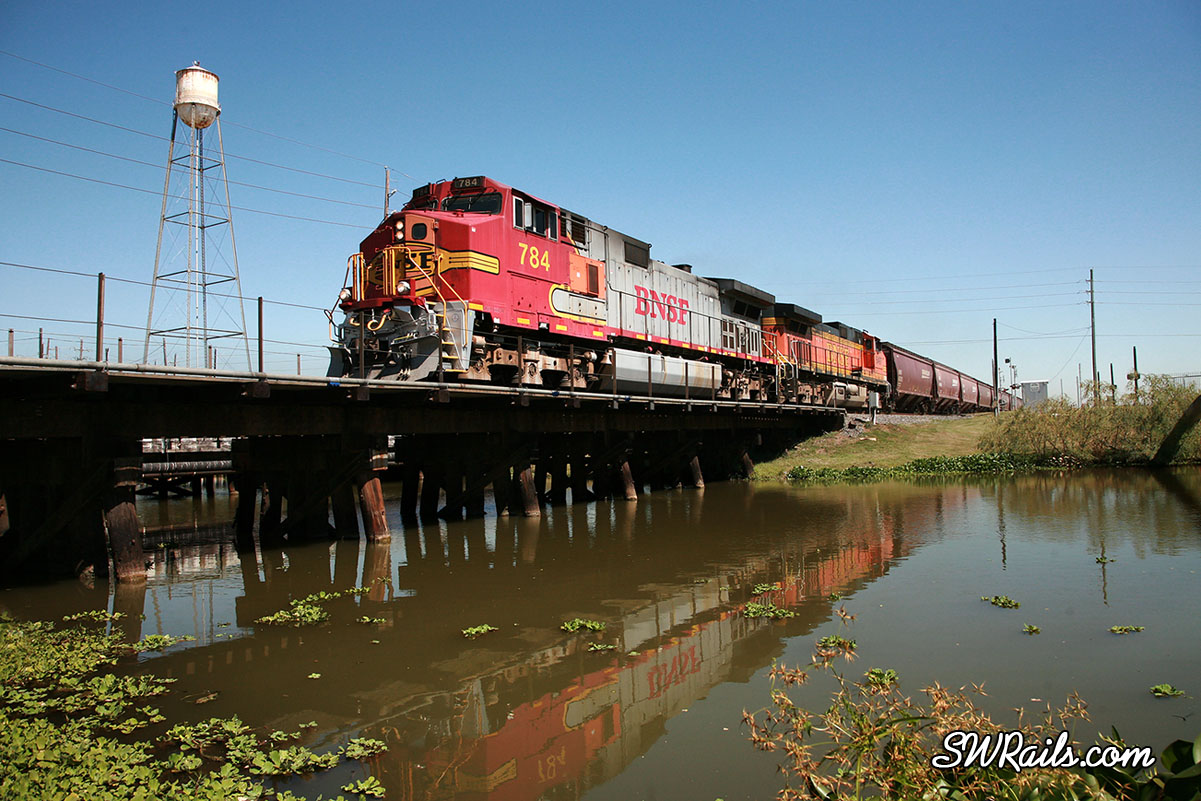
An empty grain train, BNSF 784 West, crossing Oyster Creek in Sugar Land, TX on Oct. 6, 2010
These first two shots are taken from the same location, just from different sides of Oyster Creek.
Right on the grain train’s block was an MEWSA train, UP 4097 West. This shot is about 1/2 mile west of Oyster Creek.
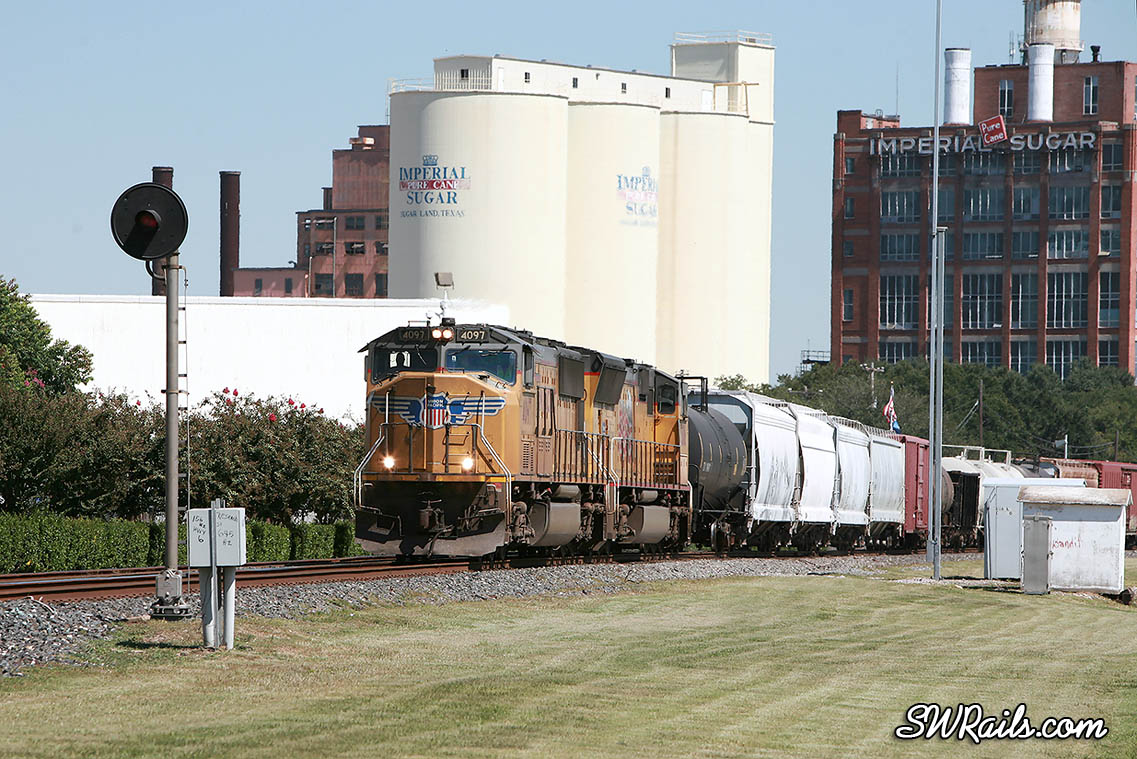
UP 4057 West at the east switch of Sugar Land, CP SA025, on Oct. 6, 2010
Trifecta Mission Accomplished.
We Meet Again – KCS NAFTA Unit
Back in February, I posted about the NAFTA commemorative paint scheme that KCS applied to two different locomotives. At the end of the post I noted that the unit had been re-numbered to KCS 4575.
So when I heard UP’s Glidden sub dispatcher tell KCS 4575 East to hold back at Willowbend (MP 374, UP Houston Terminal Sub) due to MOW work, I knew that I might have a chance to see it again.
Only one way to find out: grab the gear and head out the door. It was a quick 20 minute drive from home to Willowbend. Upon arrival, I could see see the train stopped several hundred yards short of the Willowbend grade crossing.
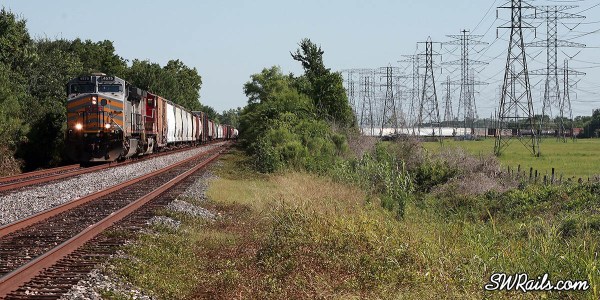
- KCS 4575 East stretched out around the corner at West Junction on July 31, 2010

I walked down a bit to get a more head-on view. Props to the engineer for leaving the lights on.

The dispatcher advised the 4575 that he would cross over once a westbound got by him. Within a few minutes, a headlight appeared from the north (railroad east).


UP C44-9 9650 (ex SP8186) leads an empty rock train near West Jct. on July 31, 2010

The KCS conductor completes the roll-by inspection of the empty rock train.
As soon as the rock train cleared, the engineer on the 4575 complied with GCOR rule 5.8.2 (3) by sounding the whistle twice, advising that he was releasing the brakes to proceed.

KCS 4575 East, with BNSF 700 trailing, on the move again at Willowbend

KCS AC4400CW 4575 still sporting its NAFTA Railway commemorative logos, July 31, 2010
Once the 4575 cleared up, the radio was quiet. I took that as my cue to go back home and get back on task with whatever it was that I was doing…
 Southwest Rails