A Redhead and a Blonde
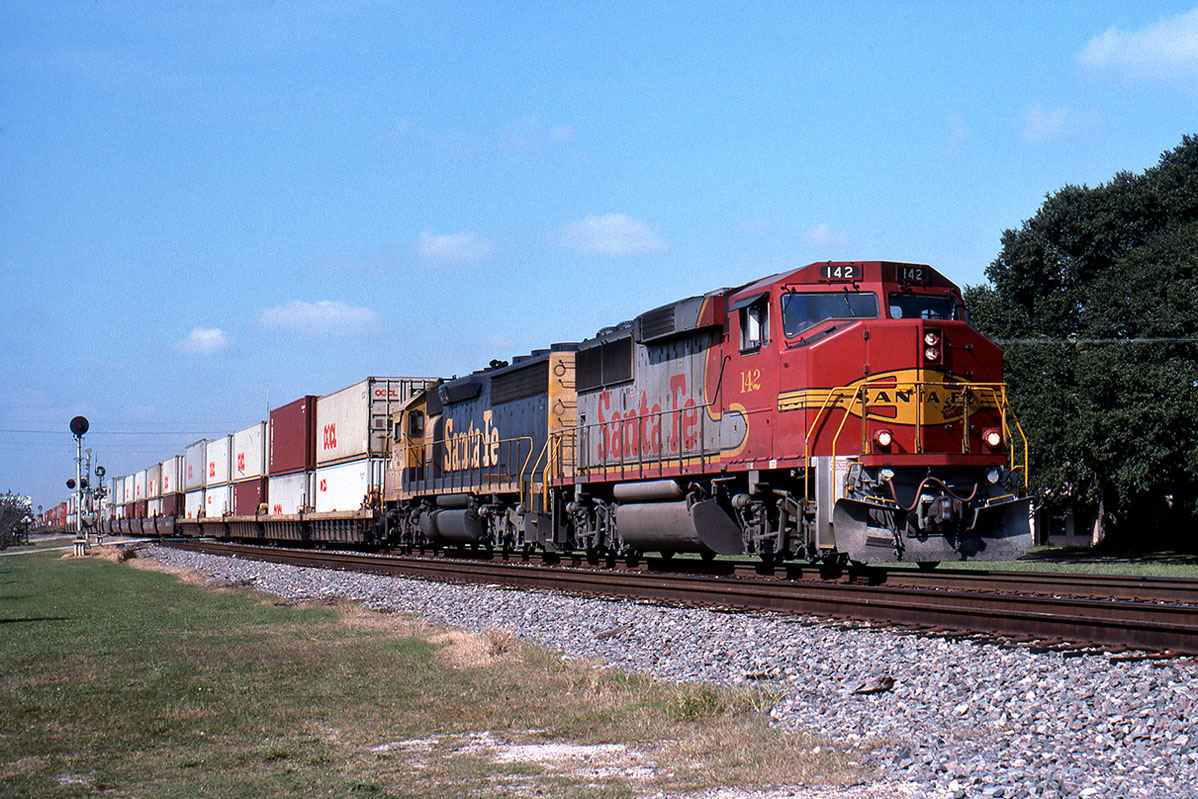
Santa Fe GP60M 142 passing through Wallis, TX with Houston-bound stacks on Nov. 8, 1997
A redhead and a blond have this Houston-bound intermodal well in hand as they pass through the sleepy little town of Wallis, Texas on Nov. 8, 1997.
The BNSF merger took place 11 months ago, but nothing has changed yet as far as the motive power of this train is concerned.
Westbound KCS at Sunset
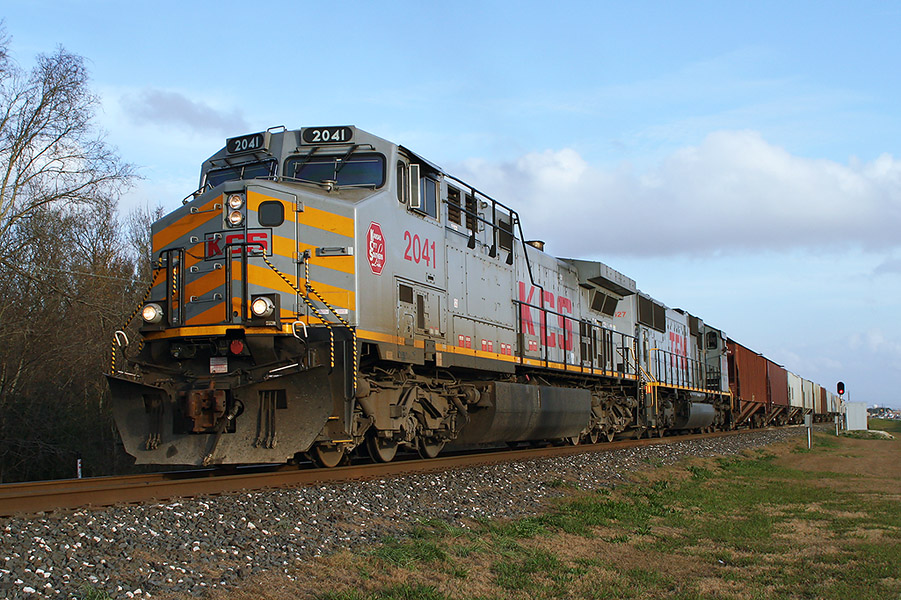
KCS 2041 with a manifest train at Stafford, TX 0n Jan. 3, 2005
The sun has just dropped below the horizon on Jan. 3, 2005 as KCS AC4400CW 2041 and a TFM SD70MAC lead a Port Arthur-Laredo manifest past the intermediate at MP20.5 on UP’s Glidden sub. This train will travel west on the Glidden sub until it reaches Flatonia where it will switch over to the UP’s Cuero sub for the rest of this crews trip to Victoria.
Englewood Yard in Houston – Pic of the Day
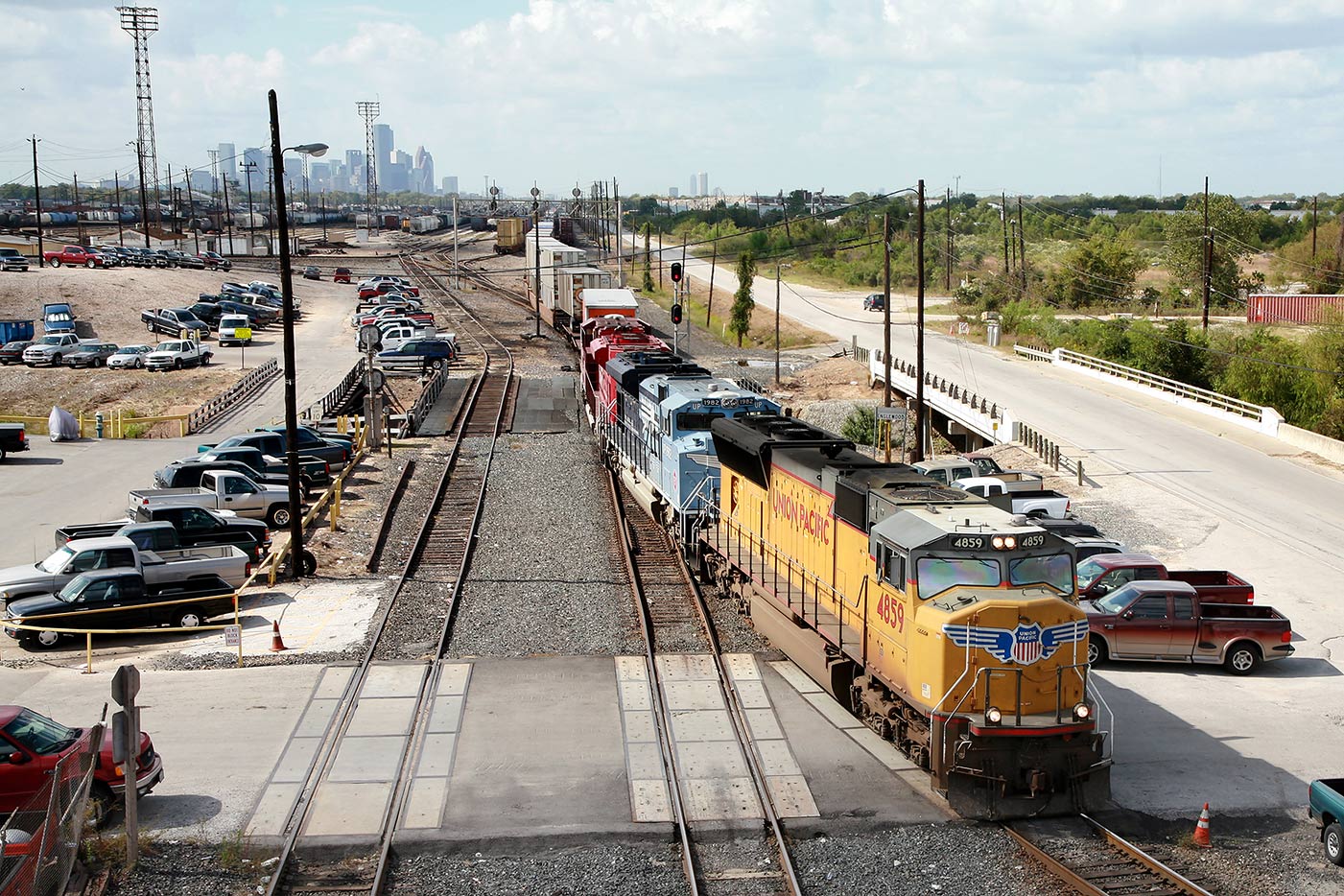
UP Train ZYCHO at Houston, TX on Oct. 31, 2006
This photo was one of my attempts to get the UP 1982, MP Heritage unit, on the point of a train.
I knew the 1982 was in the consist of the ZYCHO (Expedited Yard Center[Chicago area] to Houston), and typically the Heritage unit will lead, but as you can see, it wasn’t meant to be.
I selected this shot to post because it gives a nice view of Englewood Yard. I’m at the east end of the yard, looking west. The yard office and hump are just out of the frame, to the left.
You can click on the picture to see a larger version of the shot. It’s 1400 pixels wide to allow you to really see some detail. Enjoy…
Does Anything Not Change?
It was a pleasant March 8, 1981. I had just photographed the head-end of an empty BN coal train departing Rosenberg, Texas. As the trainset of fairly new UFIX hoppers was rumbling by, I noticed something odd at the end of the train.
As it got closer, I realized that the caboose on the train was not your garden variety green caboose, but a blue caboose still showing Great Northern colors. I wasn’t one that normally cared about cabooses, but this one was different.
Raising the camera quickly, I got off one shot of the caboose. As I got in my car, I was quite pleased with myself for having noticed the caboose, and for having reacted quickly enough to get the shot.
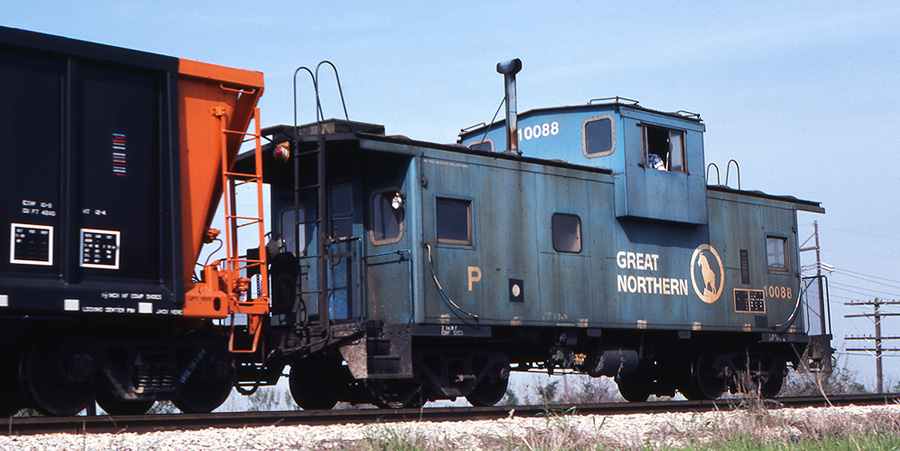
An ex-GN caboose brings up the rear of an empty coal train at Rosenberg, TX on March 8, 1981
I was even more content with myself when I got the slide back and saw that my grab shot of this caboose was actually was in focus.
I mean, the GN had gone away some 11 years prior. The attractive blue paint scheme on this caboose would soon change, and you have to get pictures before things change, or even disappear, right?
Looking at this picture now, I realize that I was wrong, so wrong about virtually everything.
Sure, I got the shot of the caboose before it was re-painted into BN green. But I couldn’t see the forest for one tree.
I failed to document so many other things that would change, even disappear.
What did I miss?
- cabooses on trains – gone
- the code line in the background – gone
- the new UFIX hoppers – gone
- steel hoppers on coal trains – gone
- owner of the track, the ATSF – gone
- originator of the train, the BN – gone
- the SD40-s and C30-7’s on this train – gone
- 5-6 units on the point of each coal train – gone
- Consignee for the coal, Houston Lighting & Power – gone
- Operator of the power plant, Utility Fuels, Inc. (UFIX) – gone
- 5 crewmen on the train- gone
- Tower 17 at the crossing of the ATSF and SP – gone
The only constants between 1981 and 2010: there’s still a power plant at Smithers Lake and trains deliver coal.
The moral of this too-long post: get your pictures today because everything, I mean everything, will change before you know it.
Don’t say I didn’t warn you….
Really Tough Where Is It
The members of TrainOrders.com have a game called “Where is it?” The game consists of posting a photo from some obscure location and seeing if the members can identify the location. Most of the time the game ends quickly as someone can usually ID the photo.
Most of the time…

ATSF CF7 2619 in Dallas, TX in the middle of 1972.
I submitted the above photo on Jan. 25th. Over 450 people viewed the post over the ensuing 3 days before member Rick L correctly identified the location as East Dallas. It’s very close to the southern tip of White Rock Lake.
This shot is again from the early days, when I would travel around the Dallas area with my 10-speed and an Instamatic camera. (The above photo is again from a 126 color print, please forgive the textured finish, as it doesn’t scan well.)
Both of the tracks have been removed, but the flyover is still there. The track on the bottom is the Cotton Belt line from Dallas to Denison. I’m not sure when it was abandoned.
The 2619 is pulling a NB freight from Dallas to Gainesville, and beyond. When DART (Dallas Area Rapid Transit) was looking for R-O-W in the Dallas area, the Santa Fe was glad to sell virtually all of its Dallas area trackage, including its East Dallas Yard. The Santa Fe never had much traffic through here, just whatever originated/terminated in Dallas. The Santa Fe’s primary north-south route goes through Fort Worth.
9/8/2010 Update: An alert reader advises that the bottom track was not a Cotton Belt Line, but a proper SP line. This SP line was a bypass around the East side of Dallas called the “Dallas Belt”.
I was able to get a much better view by looking at this map
Rivals Today, Partners Tomorrow
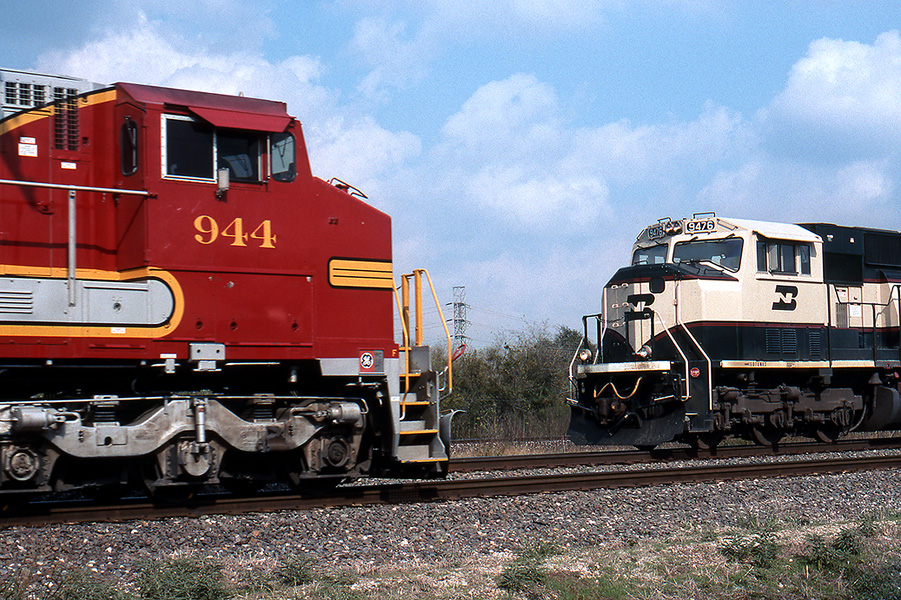
BN 9476 patiently holds the main as ATSF 944 enters the Rosenberg, TX siding on Nov. 21, 1995
The handwriting is already on the wall, but since the official merger date is still over 13 months away, ATSF 944 and BN 9476 are still competitors.
The 9476 is stopped between switches at Rosenberg, TX with its empty coal train to allow the 944 to enter the ATSF Rosenberg siding with a Houston-bound stack train.
Back to the Valley – The McAllen local
A previous post showed a photo I took in McAllen, Texas back in 1978. A reader asked for anything else I might have from that part of Texas.
Since we here at Southwest Rails aim to please:
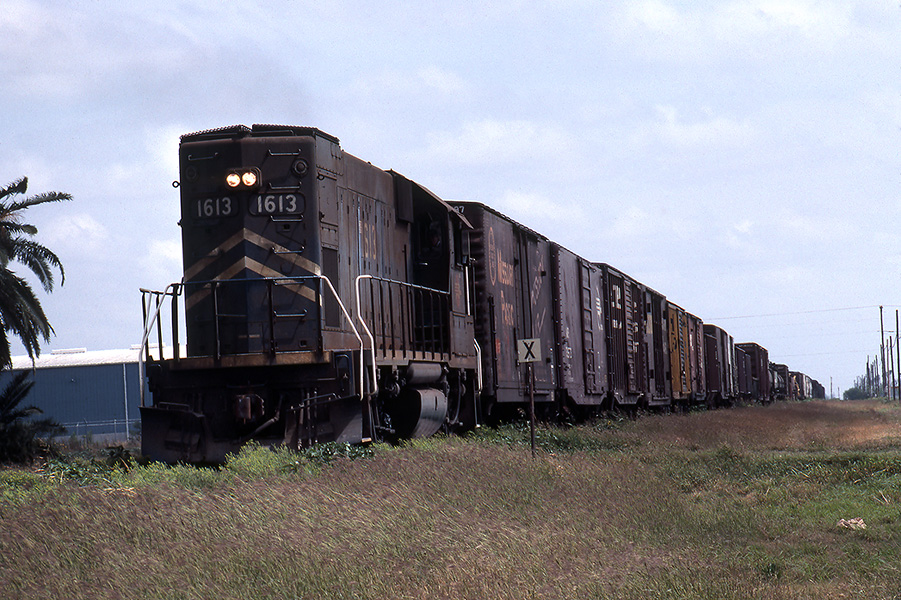
MP GP15-1 1613 working westward at Donna, Texas with the McAllen local on March 11, 1980
You’ll have to trust me on this, but there is definitely a railroad track in the above image. It’s just that the weed sprayer didn’t get this far south very often.
We’re at Donna, Texas, about 10 miles or so from the U.S.-Mexico border. Donna is roughly the midway point for the McAllen local, which originated in the MP yard in Harlingen, and would go to McAllen doing what locals do – picking up and setting out cars to the lineside clients.
I still recall the train pictured above because the engineer had his 1500 hp GP15-1 pegged out in order to maintain track speed (probably 30mph) with the sizable train. It looks like he’s got a good 40 or so cars.
Has It Really Been That Long?

UP 4141, 1988 and 1982 in Houston on Jan. 28, 2006
I wasn’t even looking for this evening. What caught my attention was the date I took the photo- Jan. 18, 2006.
I don’t know about you, but it seems like just yesterday that the UP rolled out the heritage engine program. The notion that railfans will still chase these things (myself included) is testament to the uniqueness of these units, but also just how homogeneous motive power has become over the last 10 years.
SP GP20E 4108 Gets Around
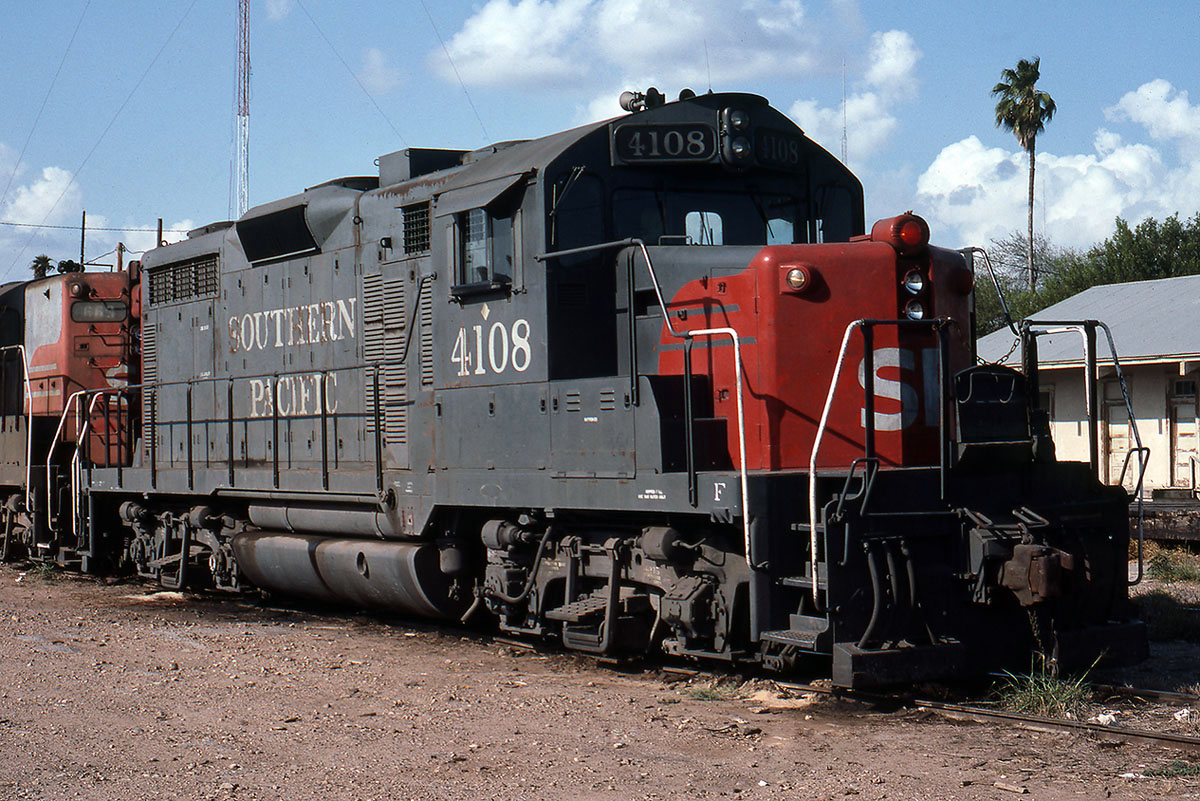
SP GP20E 4108 at McAllen, TX on May 30, 1978
We’re just a few miles from the U.S.-Mexico border at McAllen, Texas. In 1978, McAllen was a sleepy town of maybe 45,000 souls. It was at the end of a short branch that began about 8 miles away in Edinburg, TX.
SP’s line to the Rio Grande Valley came down from Beeville, TX to Edinburg, where it split into two lines: one to McAllen on the west side of the Valley, the other line going to Harlingen and Brownsville on the east side of the Valley.
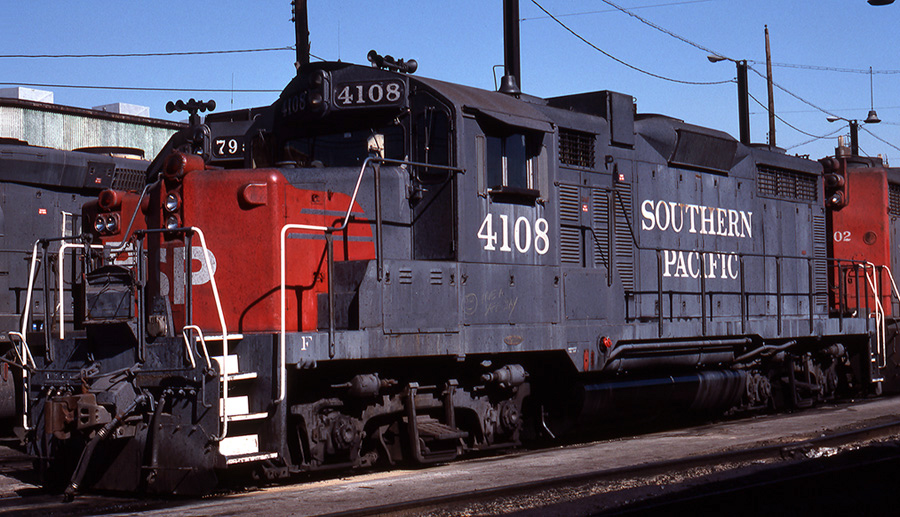
SP GP20E 4108 at the Hardy Street roundhouse in Houston, TX on Dec. 3, 1988.
10 years later, we see the 4108 amid a sea of scarlet & lark gray at the Hardy Street roundhouse, just west of downtown Houston.
There is no longer a roundhouse, proper, but SP employees referred to the engine service facility here as the roundhouse.
At first glance, the 4108 looks unchanged over the 10 years. Looking carefully though, you will notice numerous minor changes.
Smithers Lake Coal Train – Pic of the Day
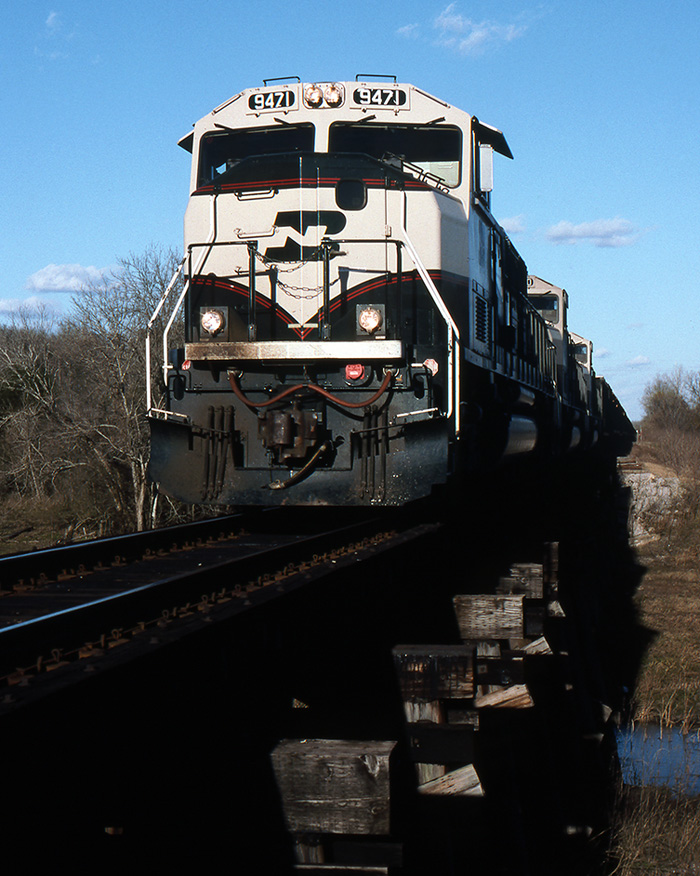
BN 9471 and 2 other SD70MAC’s cross a bayou less than a mile from the entrance to the W.A. Parrish generating plant on Dec. 27, 1997. This plant typically receives 2-3 trainsets a day of PRB coal.
Today, the BNSF refers to this plant as the Smithers Lake Plant (symboled SLP), for the semi-artificial lake almost wholly within the site’s confines.
The W. A. Parish Station has been providing electrical generation for the greater Houston area since 1958. Today, this facility produces enough electricity to make it the largest fossil fuel power plant in the country. The amount of electricity produced at the station has the capability of supplying over three million homes.
UP 6936 on Inspection Train – Video
On Feb. 18, 2008, UP operated an SAVBL (Special Avondale LA-Bloomington, TX) inspection train powered by DDA40X 6936. This video shows it between Houston and Bloomington, TX
I know some of you have seen this video, but I needed to figure out how to embed a video here, so I chose this one.
Not to worry though, I have some fresh video coming up…
GE’s Rule the Roost – Pic of the Day
I know it’s fashionable to complain about the thousand and thousands of look-alike wide-cab GE’s that seem to be on every BNSF and NS train, with UP and CSX not quite as bad.
There used to be a time when seeing a bunch of GE’s together was a good thing. Of course that was when GE was the minority builder.
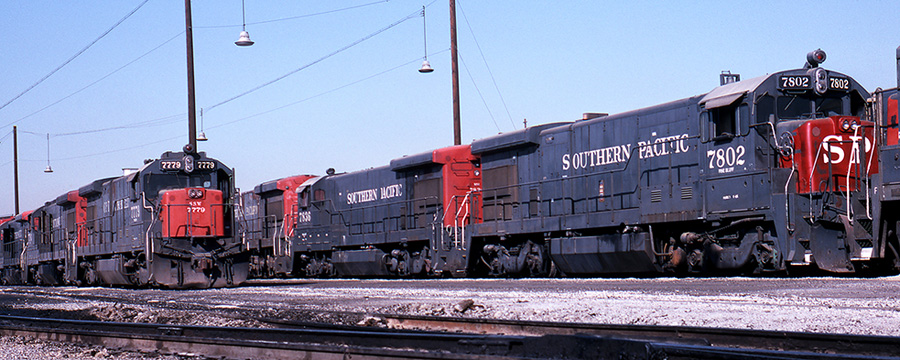
SP 7802 amid a group of B30-7's and a U33C, West Colton service track in August 1986.
We’re deep inside forbidden territory at the West Colton engine facility where a gaggle of GE’s await the next call to service. The unit just to the left of the 7779 is U33C SPMW 8653. It was no longer in revenue service. It and the 8669 were kept at West Colton for some time as stand-by sources of electricity.
 Southwest Rails
