This Is A Coal Train
I posted some shots yesterday of BNSF 4815. It was a train of empty hoppers that bore a resemblance to a coal train, but I had doubts because, well, it just didn’t look right.

BNSF 5746 EB through Stafford, TX on Jan. 10, 2010
This is what a coal train is supposed to look like: AC power, aluminum hoppers and…
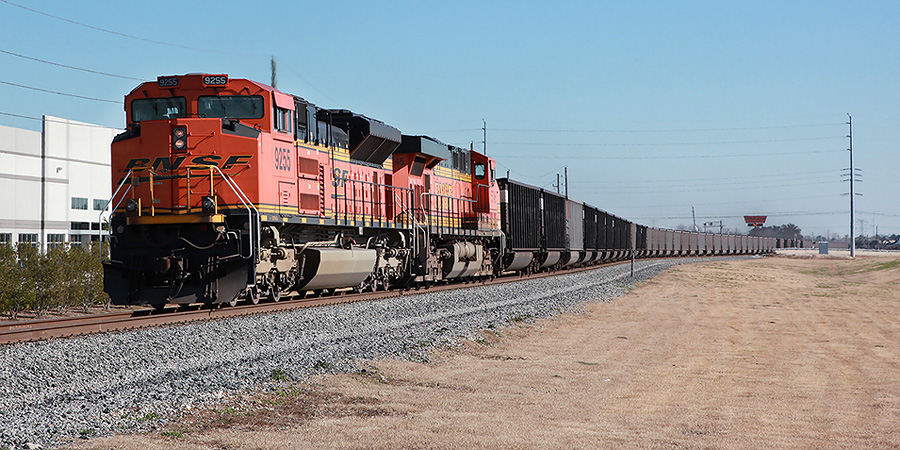
DPU's shoving on the BNSF 5746 at Stafford, TX on Jan. 10,2010
…DPU’s at the back end of the train. This train of Powder River Basin coal is destined for NRG Corporation’s Big Cajun II plant at New Roads, LA, between Lafayette and Baton Rouge.
Doing a 360 at The Loop – Pic of the Day

4 month-old Santa Fe SD45-2 5686 with a westbound manifest at Walong, CA Oct. 8, 1973
Santa Fe 5686 has been in dynamics since cresting the summit at Tehachapi some 10 miles back. It’s between switches at Walong, site of the spectacular Tehachapi Loop. It has another 38 miles of mostly downhill running before reaching Bakersfield.
The 5686 is part of the same order of SD45-2’s that included Santa Fe’s 5 bi-centennial painted units, 5700-5704.
A Pale Shadow of Its Former Self
At its height, St. Louis Union Station was the terminal for the passenger services of 22 railroads, the most of any single terminal in the world. At its opening, it was the world’s largest and busiest railroad station and its trainshed was the largest roof span in the world. In the 1940s, it handled 100,000 passengers a day.
With the decline of passenger service in the 1950s and 1960s, the massive station became way too large and expensive.
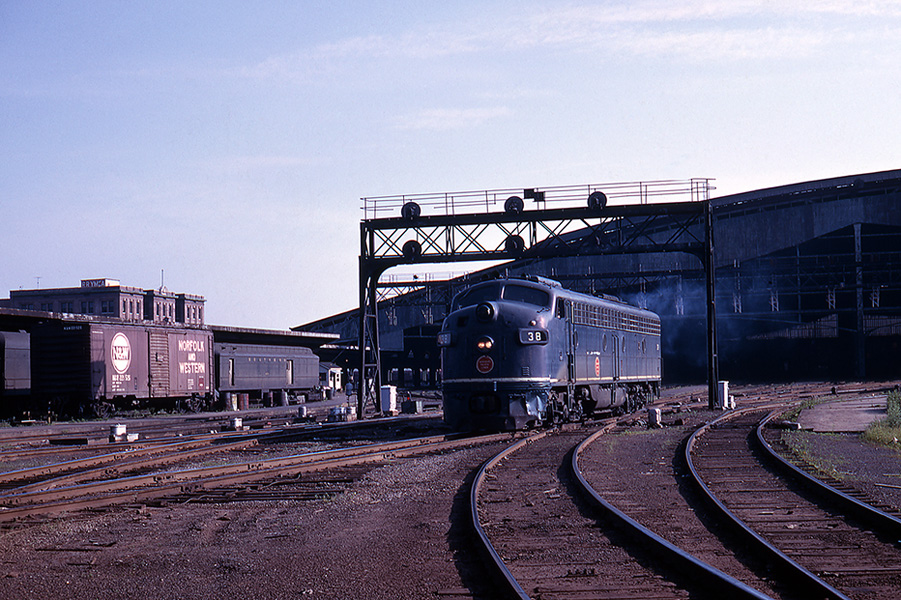
MP E8A 38 pulls out of the trainshed at St. Louis Union Station on May 24, 1970.
By the time of the above photo, St. Louis passenger service had dropped to only 3 trains per day. When Amtrak took over the operation of inter-city passenger trains in 1971, it continued using St. Louis Union Station until 1978.
This terminal did not meet the same fate (wrecking ball) as most other large passenger terminals. Federal historic rehabilitation tax credits to the tune of $150 million were used to transform Union Station into one of the city’s most visited attractions, including a 539-room hotel, shopping mall, restaurants and food court.
Power Re-balancing on the KCS
Most railroads have directional traffic and/or tonnage imbalances. The KCS and TFM have more southbound tonnage going to Mexico which creates imbalances of motive power at the south end of their system.
These imbalances are corrected by loading up northbound trains with the excess units. Railroad operating rules require that any units beyond what’s needed for the tonnage at hand be isolated to conserve fuel.

TFM SD70MAC leads 5 other KCS/TFM units with an EB* through Stafford, TX on Oct. 11, 2006
TFM SD70MAC 1603 and KCS AC4400CW 4617 have 4 additional motors DIC (dead in consist) as they pass through Stafford, TX on Oct. 11, 2006.
*KCS traffic through here is North-South. I say the above train is eastbound because it’s operating on the UP, via trackage rights stemming from the UP/SP merger. Trains on the Glidden sub are deemed eastbound / westbound.
BNSF 4815 – Today in Houston
I had a few errands this afternoon in Houston. With the weather finally clearing up, I thought it prudent to take the camera just in case.
Driving back to Sugar Land, my preferred route is via South Main (US 90A) which parallels the UP Glidden sub beginning at West Junction, MP 12.7.
As luck would have it, a westbound was on the move at Heacker, a new control point 1/2 mile west of West Junction. Traffic nor sun permitted a shot until MP 20.6 at Stafford, where the BNSF 4815 arrived literally seconds after I bailed out of the car and set up for the shot.
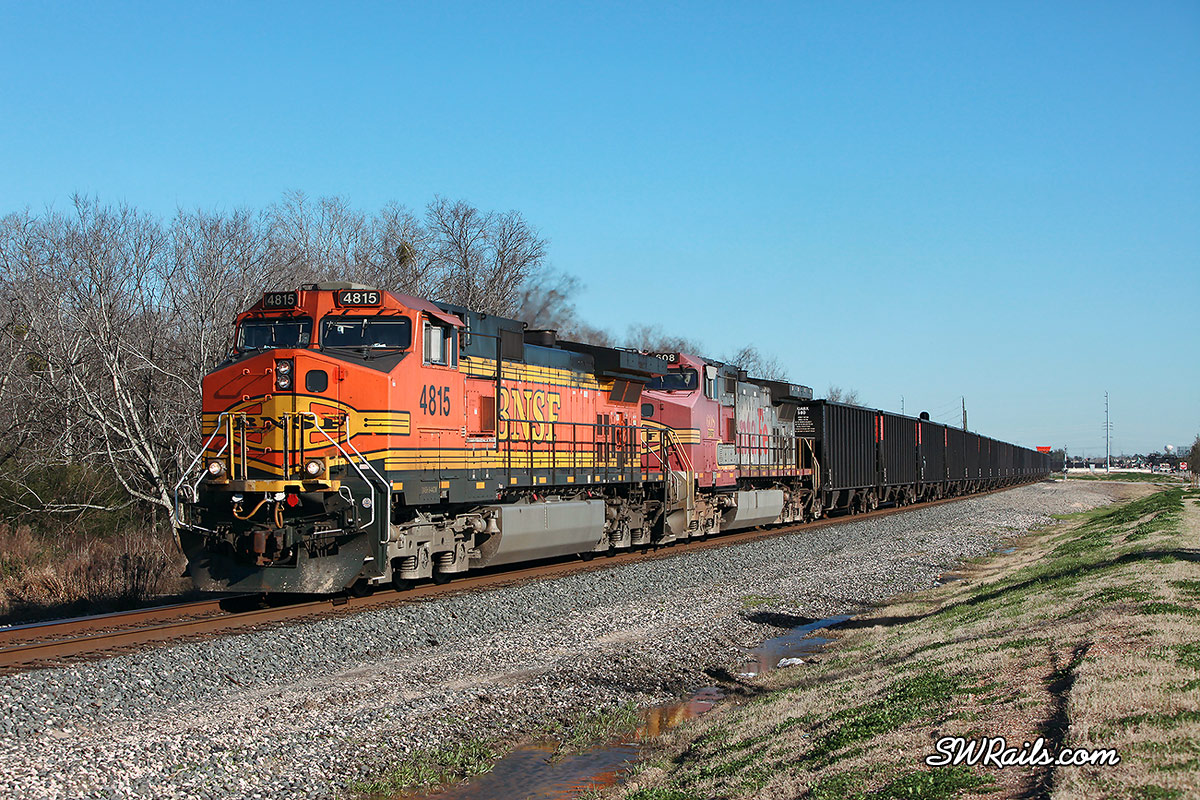
BNSF 4815, WB with 97 empty GATX hoppers at Stafford, TX on Feb. 15, 2010.
The train consisted solely of empty GATX hoppers. As I overtook the train coming down Main Street, it appeared that the wind was kicking up coal dust. The only problem is neither the power nor the hoppers are typical for Powder River Basin Coal.

Empty GATX hoppers westbound through Stafford, TX on Feb. 15, 2010
My guess is this is an empty coke train that unloaded at the Port Of Houston. Any additional information about this train would be appreciated. You can add a comment, or email me via the contact page.
Georgetown Railroad’s Dump Train
One of the more creative ideas is the Dump Train, invented in 1986 by Ned Snead, co-owner of the Georgetown Railroad.
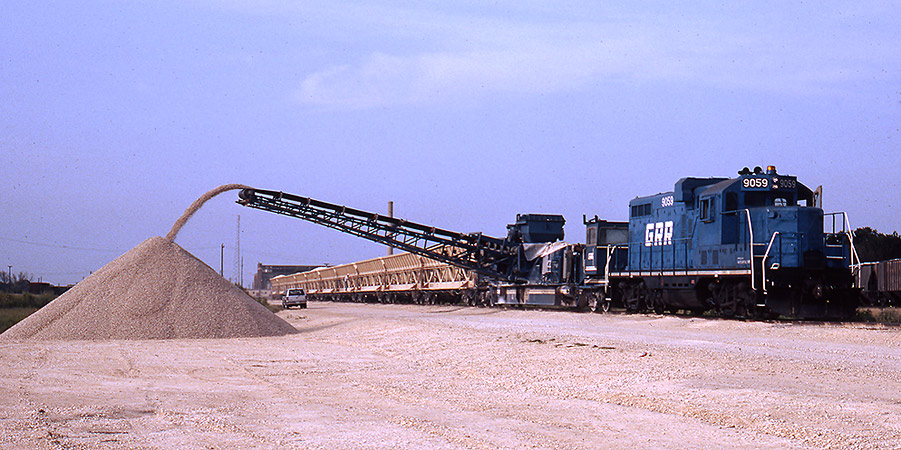
Georgetown Railroad's Dump Train in action at UP's Bellmead, TX Yard on July 16, 1991
The aggregate cars have a conveyor along the bottom of each car that brings material to another conveyor on the boom. The boom swings out up to 35′ to drop the material where desired.
There’s a short video on YouTube showing this train in operation. Lastly, a good article from the Victoria, TX newspaper that talks about the manufacturing of these trainsets, done by Safety Steel Corp. in Victoria.
Westbound Into The Sunset…Pic of the Day
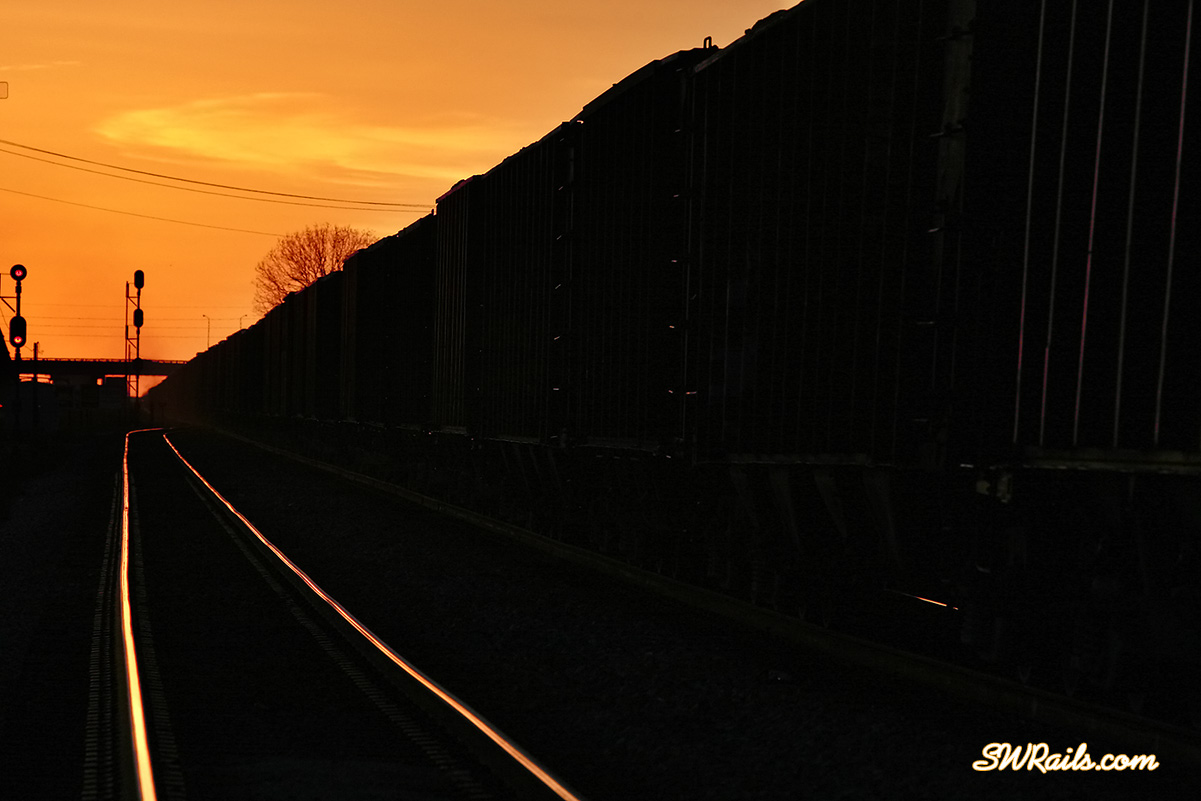
An empty UP rock trains heads west from West Junction on Jan. 8, 2007
A long UP empty rock train heads west from West Junction, just after sunset on Jan. 8, 2007. West Junction is in Southwest Houston. It’s at MP 13 of UP’s Glidden Subdivision, where the western terminus of the Terminal Sub meets the Glidden Sub.
PS-This is the same train that you see on the right side of the Southwest Rails header above.
The Juice Train
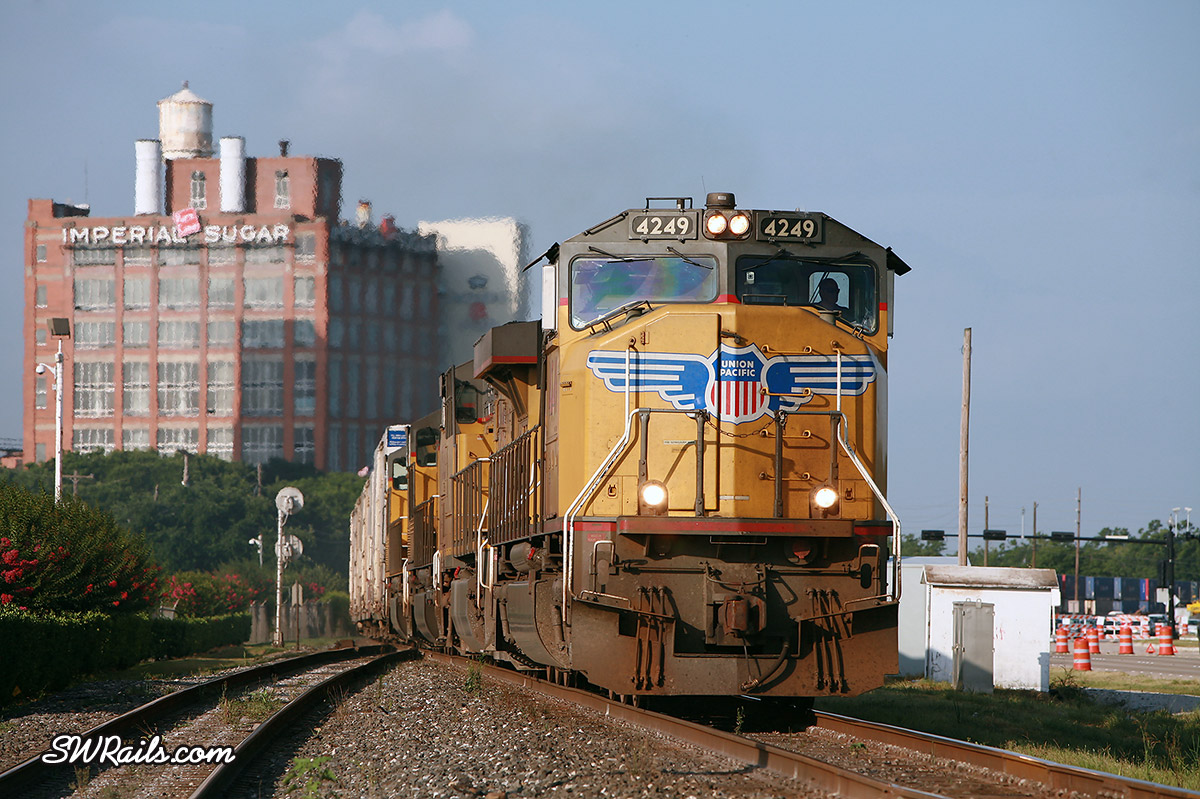
UP 4249 with symbol KATCI WB at MP 25 of the Glidden Sub on June 11, 2007 © Robert Pierce
UP symbol KATCI is a run-through from the CSX that originates in Atlanta and is primarily domestic containers, but its main claim to fame is the block of Tropicana reefers that typically is placed right behind the power.
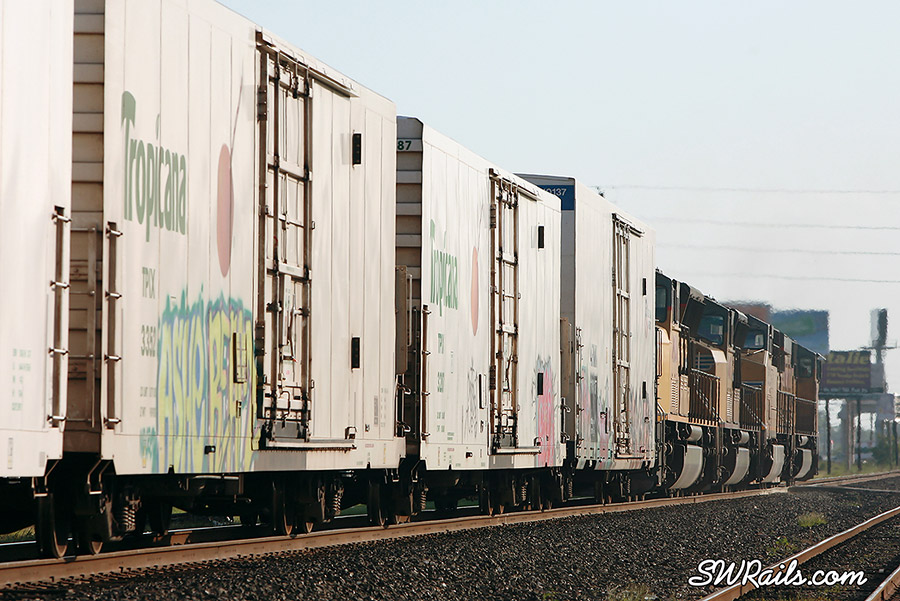
A WB block of Tropicana reefers at Sugar Land, TX on June 11, 2007 © Robert Pierce
The Tropicana loads originate at its plant in Bradenton, Florida, where CSX picks up for delivery throughout the U.S. CSX runs solid trains of Tropicana traffic from Florida to the New York market, where other markets get smaller blocks of these distinctive freight cars.
Hurry Up & Wait
Hurry Up & Wait. Anybody with a military or railroad background knows this expression well.
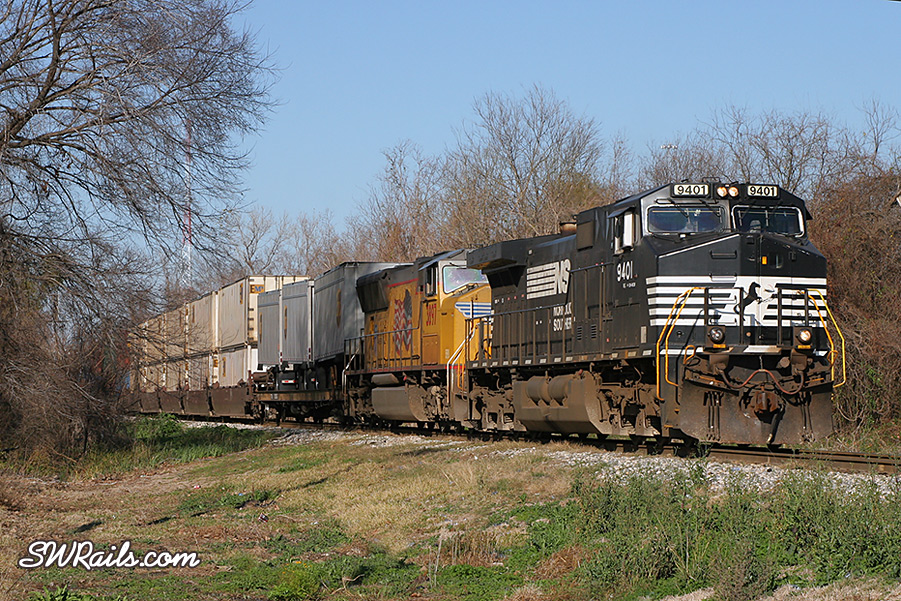
UP train ZYCHO at MP 3 of the Lufkin Sub in Houston, Texas on Jan. 29, 2006 ©Robert Pierce
Norfolk Southern 9401 is holding the ZYCHO (Expedited Yard Center – Houston) at Jensen Avenue in Northeast Houston on January 29, 2006. Jensen is at MP 3 of the Lufkin Sub.
The letter ‘Z’ at the beginning of a UP train symbol indicates that it’s the highest priority traffic on the railroad. Crews love to get called for Z trains because it’s the quickest trip on their crew district.
For the crew here, it was a quick trip over most of their run, because they’re waiting just a few miles out from the Settegast Ramp. The engineer said they’d been waiting over an hour due to congestion ahead.
Track speed from Shreveport, then wait for a route through Tower 26, Englewood, Tower 87 and Interstate Junction before you can shove your train into the Settegast ramp and go to the house.
Hurry up and wait. A typical day on the railroad.
Matched Set of AC6000W’s – Pic of the Day
I recently posted how UP’s 7500 series AC6000CW’s had become an endangered species. Let’s look at an action shot of them in their “prime”, hauling aggregate from Central Texas quarries to the Houston area.

A loaded aggregate train is eastbound at MP 370 of UP's Terminal Sub on March 23, 2008.
The 7500’s were originally acquired for high-speed intermodal service, but prime mover reliability issues could never be resolved by GE to UP’s satisfaction. They were re-assigned to Texas rock trains in 2006 .
They arrived in 3 groups, 10 in 1996, 45 in 1999 and the last 25 in 2001.
Santa Fe U23B’s Depart East Dallas Yard
I haven’t posted anything from my Instamatic days recently, so let’s go back to Dallas in 1971. East Dallas Yard was too far from home for me to bicycle there, so I would catch a Vickery bus which dropped me off downtown. I would then transfer to a Fair Park bus which dropped me off a few blocks away from the yard.
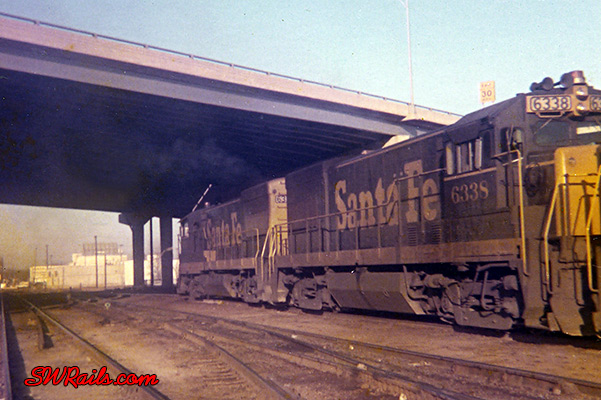
Three Santa Fe U23B's depart East Dallas with a NB manifest in late 1971
The daily Dallas-Gainesville manifest is about to pass under the Thornton Expressway as it departs the Santa Fe’s East Dallas yard in late 1971.
East Dallas Yard was sold to DART (Dallas Area Rapid Transit) some years back. DART built their main service facility and storage yard here.
Kodachrome Santa Fe 5808 Gets Around
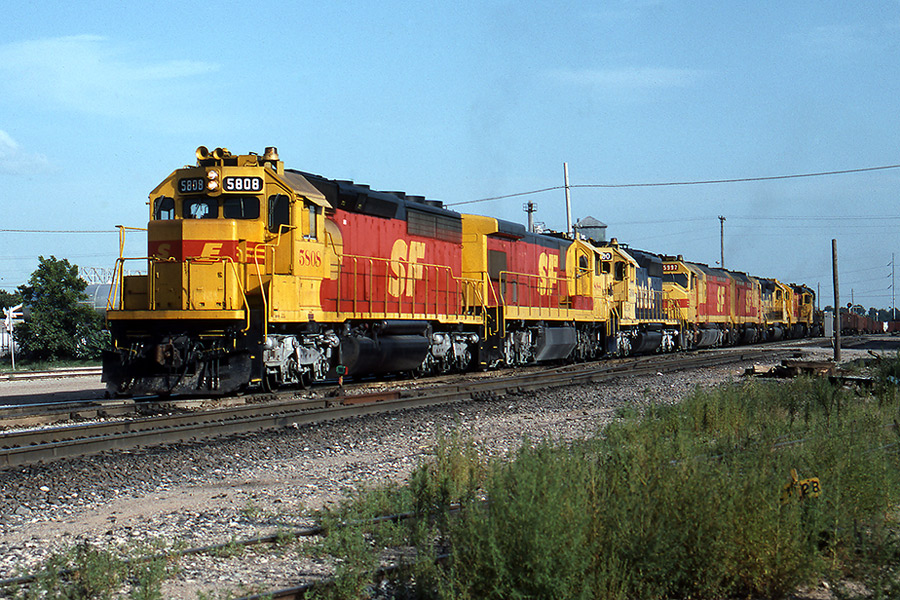
Santa Fe SD45-2 5808 leads 7 other units through Cleburne, Texas July 10, 1987
Santa Fe Kodachrome SD45-2 5808 is leading a manifest through Cleburne, Texas with a consist of power that appears to be out of proportion for a train of gondolas in the flat part of Texas.
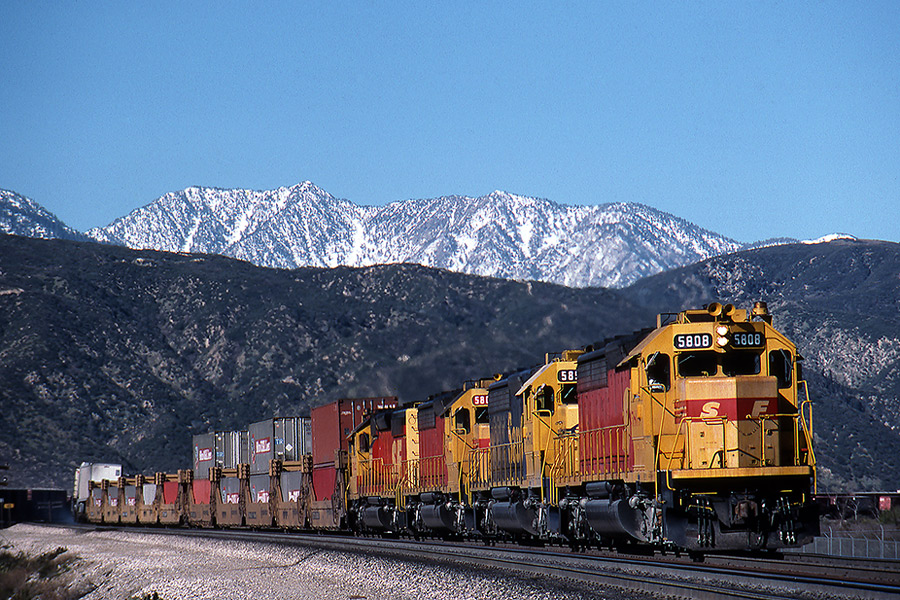
Santa Fe 5808 brings a588 intermodal train through Verdemont, CA on Jan. 24, 1988
Six and a half months later I encountered the 5808 leading 2 other SD45-2’s and a SD40-2 with a 588 train. The consist is in dynamics as there’s another 5-6 more miles of 2.2% descending grade until it levels out at the San Bernardino Depot.
 Southwest Rails