Out & About – June 26, 2012
I got out a bit this morning with our oldest son, Andy, who’s home on leave from his Senior Airman duties at Dyess AFB.
MOW had the railroad most of the morning, but they gave back their track & time to let Amtrak #2 get by. The sun was much higher than I cared for, but you gotta do what you gotta do.
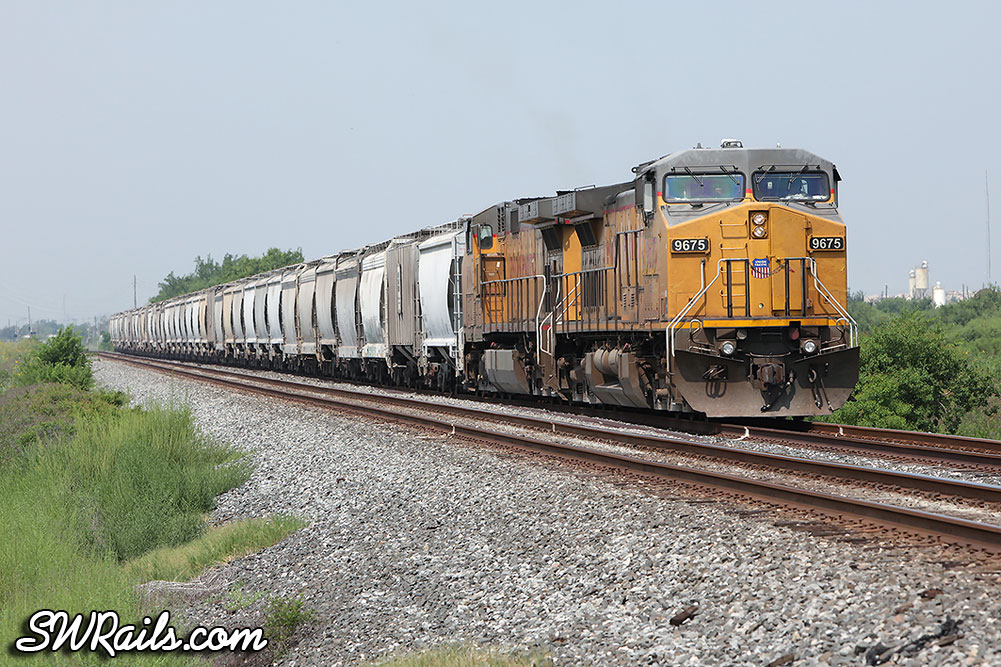
We went to CP SA017, the east end of Missouri City siding, for our first shots as there was a short UP eastbound waiting for Amtrak to get by.
Within a few minutes, Amtrak #2, the eastbound Sunset Limited, came into view.
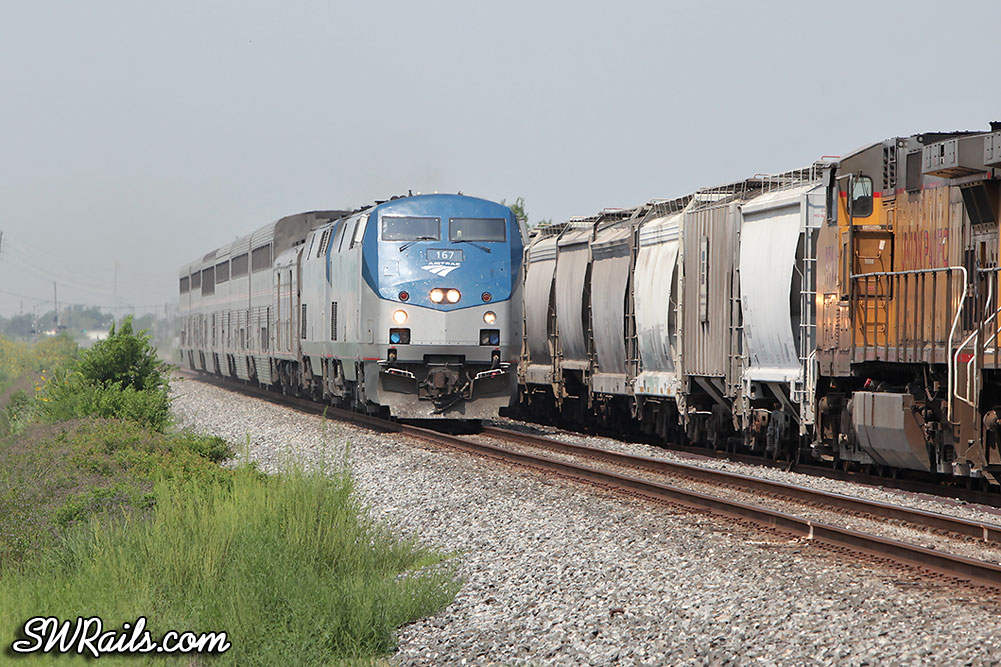
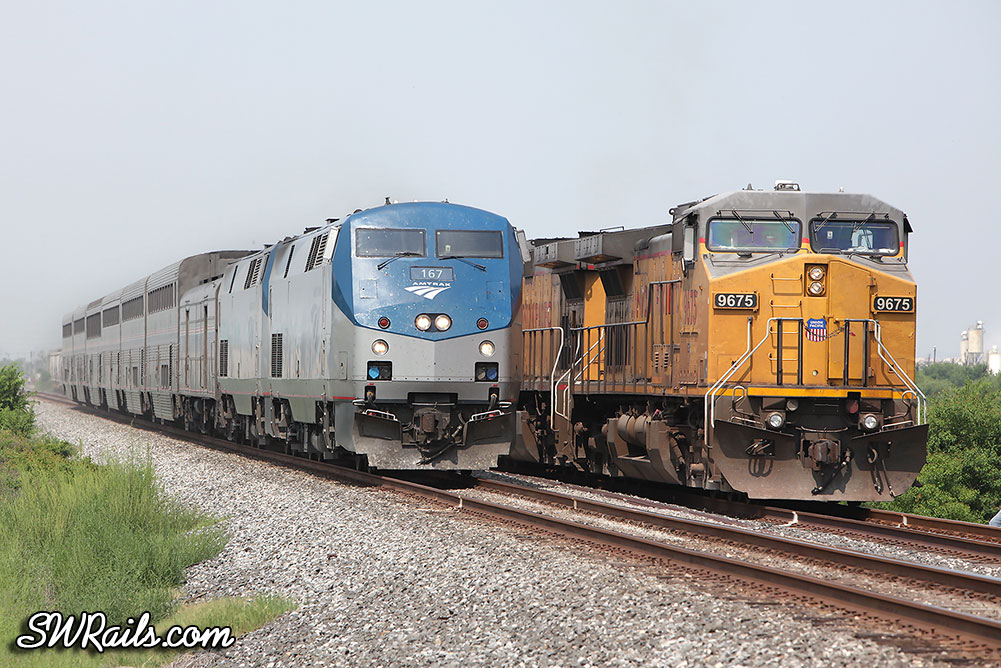
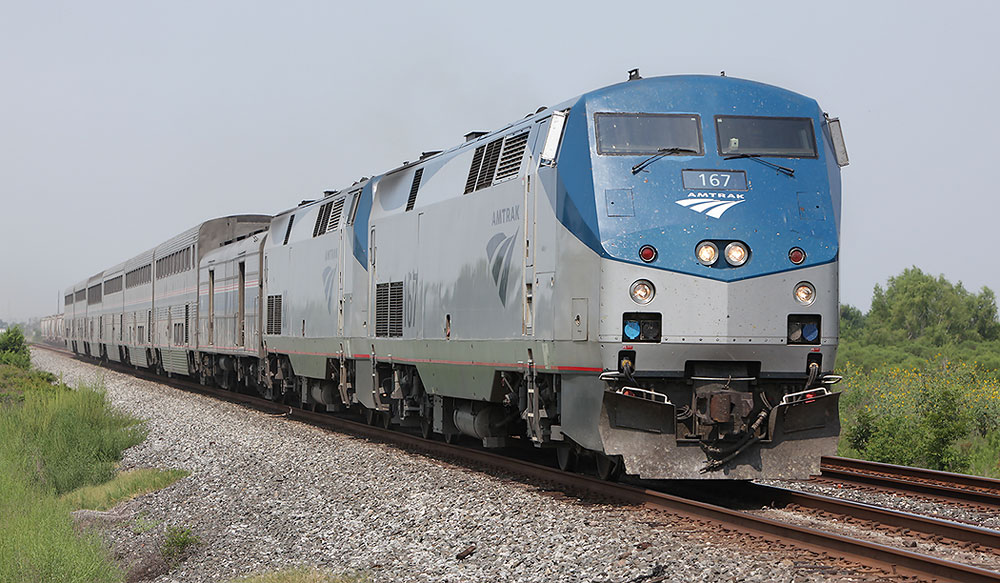
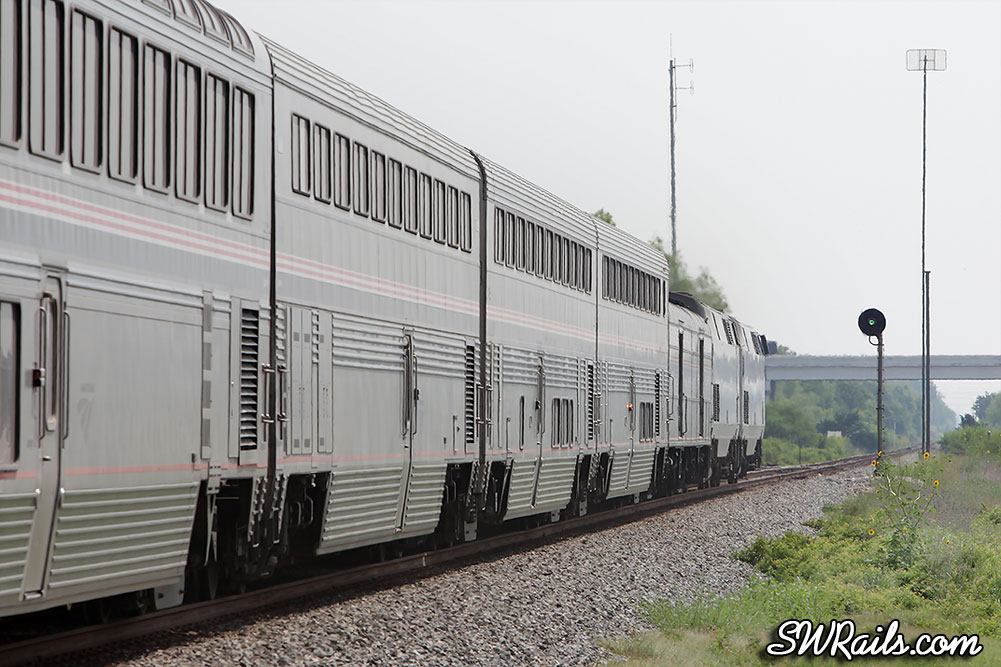
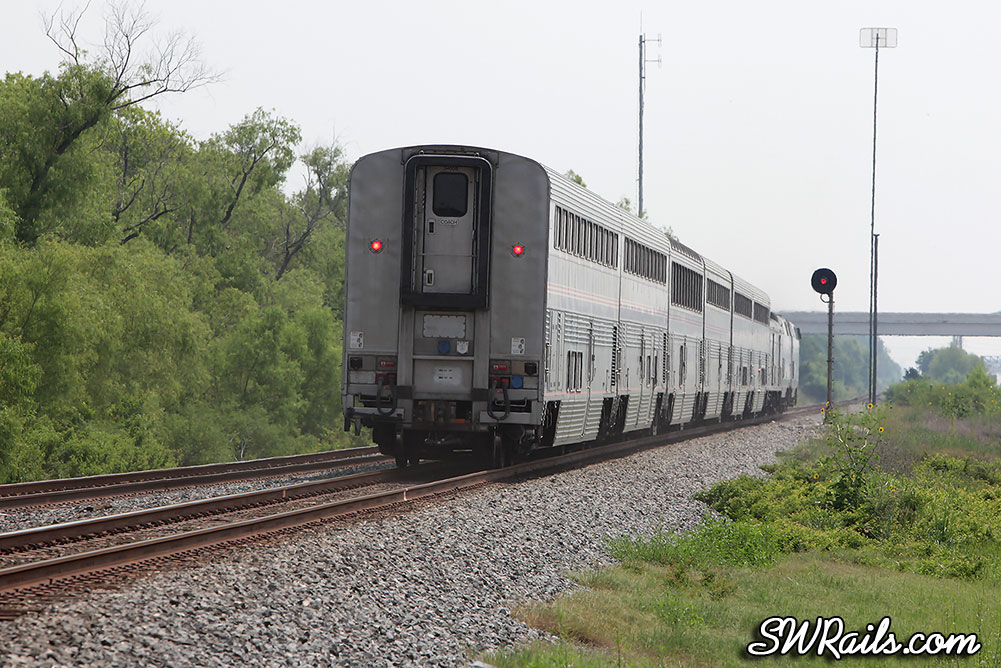
The dispatcher told the UP 9675 to sit tight as he needed to get a west and an east by him before he could take them into Houston. That info suggested a meet at Sugar Land, so we headed west to see if we could get a shot of the meet.
We met the eastbound, KCSM 4070, in the Sugar Land siding as it was slowing to a stop.
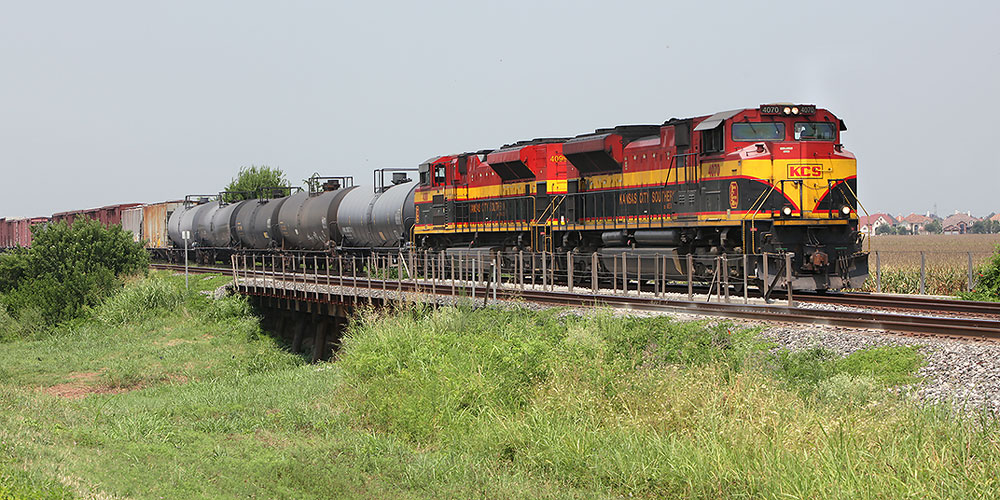
The planned shot of the meet didn’t happen due to the westbound arriving while we were battling traffic lights. No problem. Plan B was to get the eastbound coming out of the siding at CP SA 025.
How about the SP searchlight signal? How about the azaleas? How about the brutal light? Two out of three ain’t bad… ( Not to be confused with one of the most horrific songs of all time. Disclaimer: I’m not responsible for any mental trauma you suffer as a result of clicking the link)
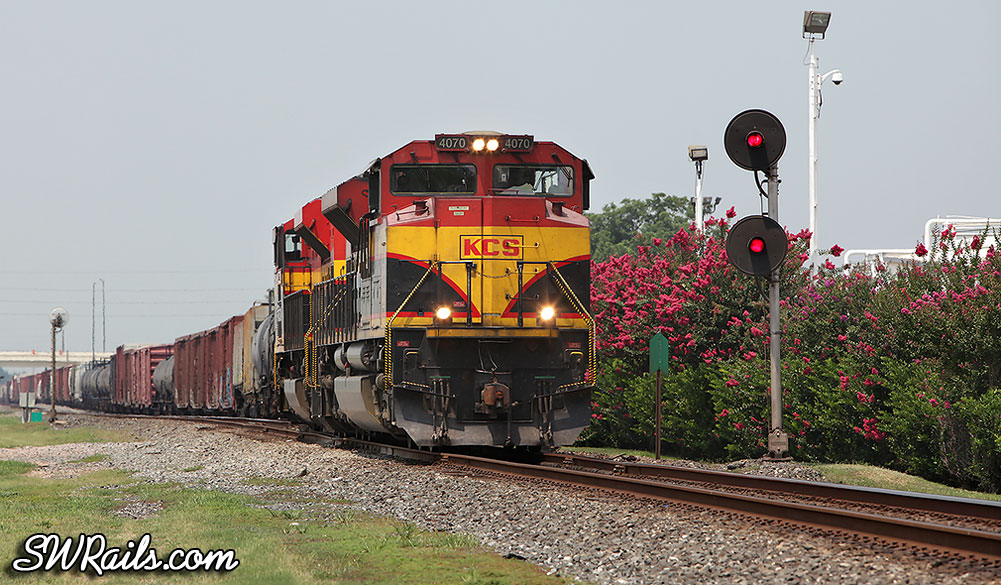
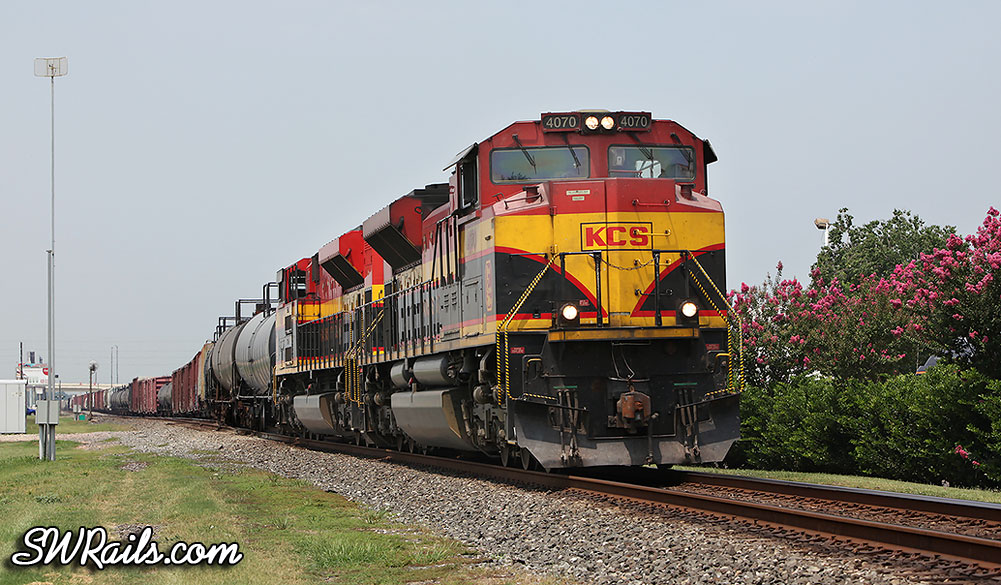
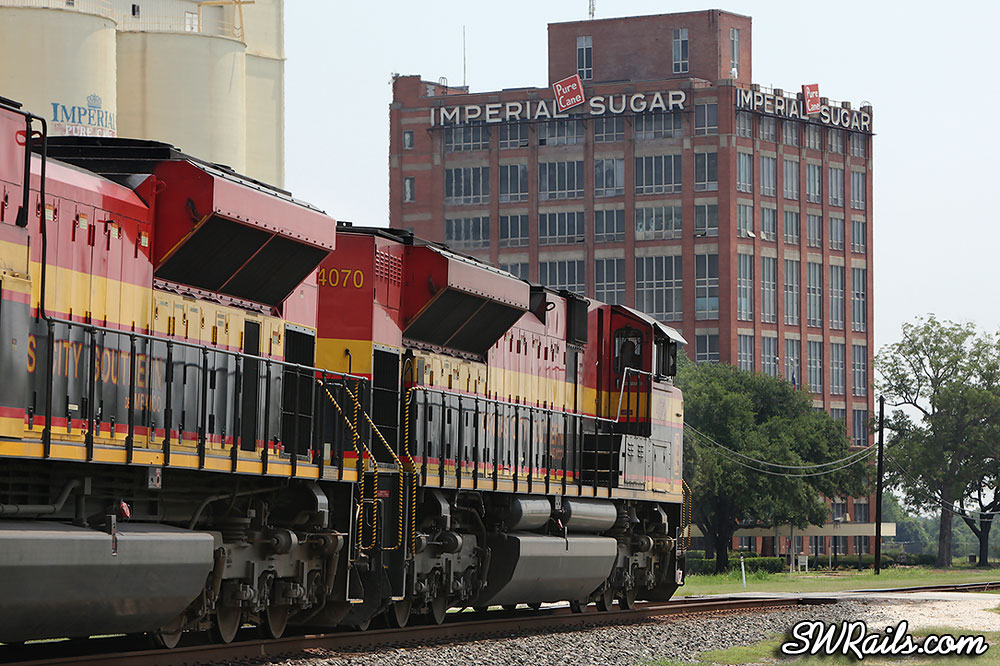
There was another eastbound behind KCSM 4070, but with the temperature at 101°F at 12:01 PM (on the way to our high of 104°F), the comforts of home were more enticing.
Out & About – May 22, 2012
I’ve been inundating you with Amtrak recently. Today will be no exception.
I was home this morning, working on a wedding album, when I heard the Glidden sub DS give track & time limits to MOW between CP SA061 and CP SA049, behind AMTK 167. It was 10:30 AM, so that should put the eastbound Sunset Limited through Stafford just after 11:00 AM.
With that tidbit of knowledge, I headed out to photograph #2 for the first time since the new schedule kicked in on May 7, 2012. I went to the west end of a long curve that starts near MP 20 and continues almost to MP 19.
AMTK 167 came into view at 11:08 AM, with my first shot as it entered the long curve. Note the 3/4 milepost marker adjacent to the head end, signifying MP 19.75.
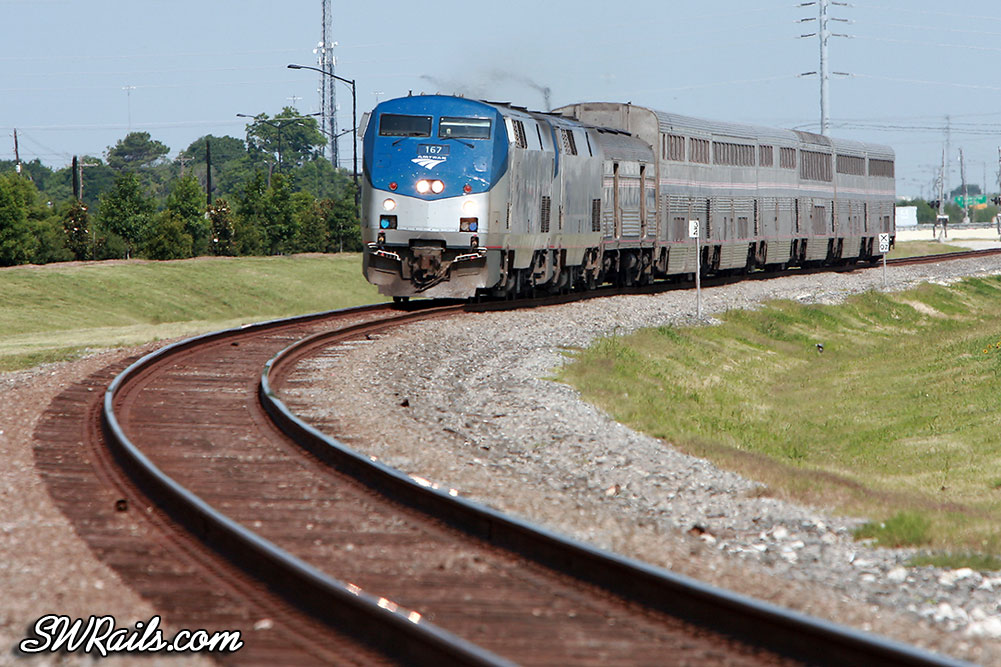
I know that all grade crossings in the Sugar Land / Stafford area are designated as Quiet Zones. Nevertheless, it’s still disconcerting to see a train approaching Stafford Road at 50 mph without whistling for the grade crossing.
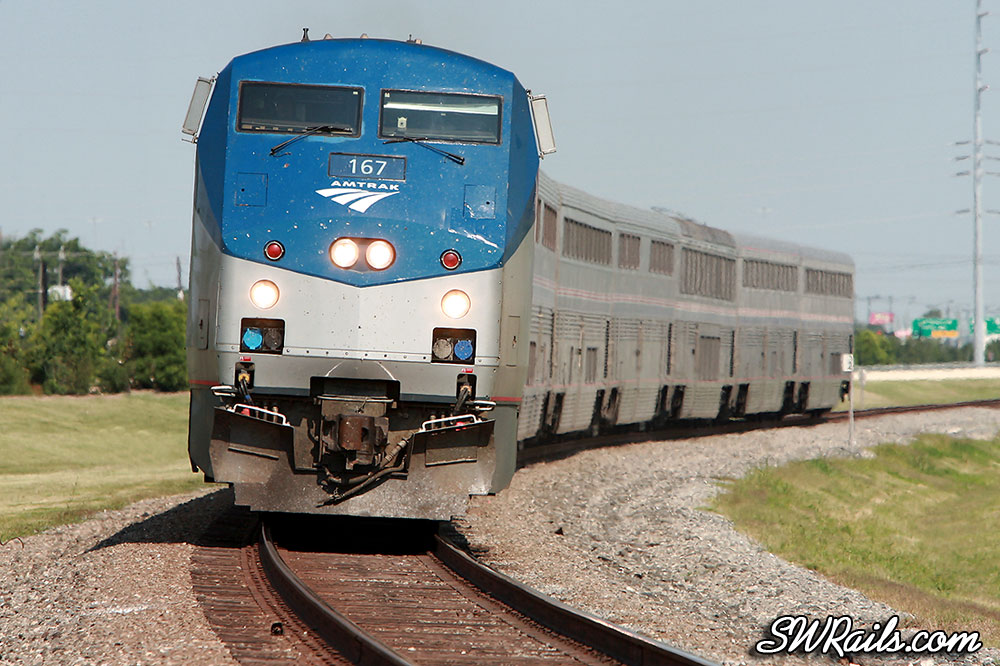
The going-away shot nicely illustrates the length of the curve, with the head end near the 1/4 milepost marker. The 1/2 milepost marker is at the far left of the frame. Straight track resumes just before MP 19, making this curve about 7/10 mile long.
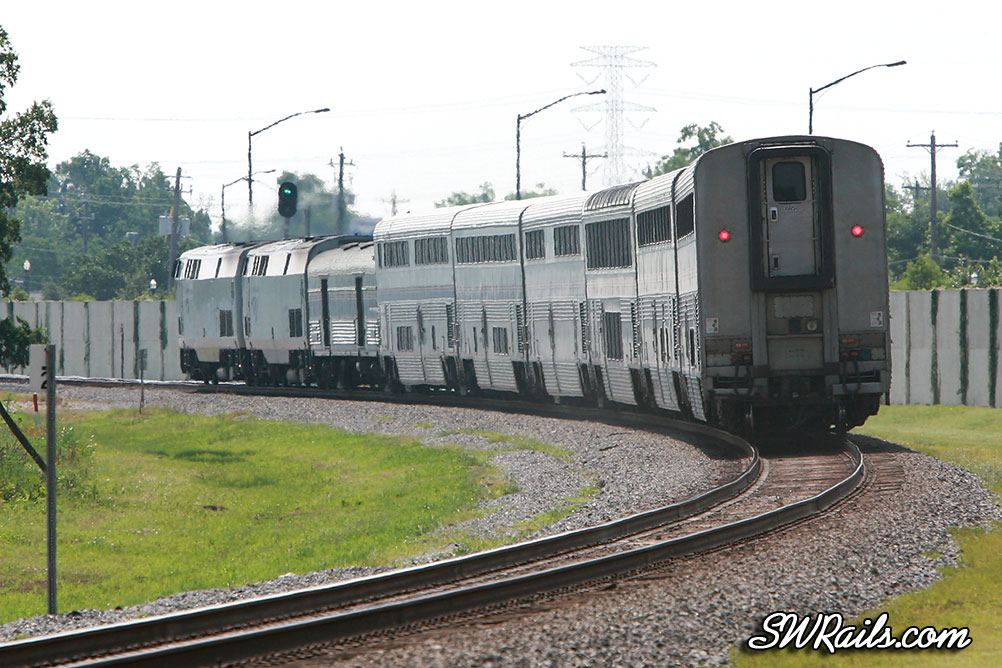
Based on its passage by me at 11:08 AM, the train won’t be making its scheduled arrival time into Houston at 11:10 AM. But thanks to a generous 60 minute layover in Houston, #2 should be able to make an on-time departure at 12:10 PM.
Fly like An Eagle
We had a few errands on tap for this past Saturday, May 19, 2012, none of which involved anything railroad related. Perpetual optimist that I am, I grabbed a camera and an extra lens before we headed out in search of some new planters.
We checked out several stores on our side of town but did not find anything that met my wife’s requirements (large, pretty, and cheap), so I suggested we head into Houston to continue the search. After checking out a few other stores and not finding anything worthwhile, we gave up the search for the perfect planter around 5:15 PM. But the trip to Houston didn’t have to be a complete bust; the sun was out and I had a camera.
As we were near downtown, I thought I’d take a look at Bringhurst (MP 359.85 on the Terminal sub) and see if there might be a westbound waiting to depart. As I looked east from the Eastex Freeway feeder road overpass, I saw a headlight. Thinking that the train was on the move, I stopped and quickly set up for a shot of what appeared to be a somewhat faded, gray KCS on the point.
When it became apparent that the train wasn’t moving, I retreated to the car to wait and see what the plan was. Within a few minutes, I hear the DS call for the QEWWC, UP 1982.
I instantly realize that the “somewhat faded KCS” engine I had seen was actually UP 1982, the Missouri Pacific heritage engine! Sweet! Or maybe not. There’s literally one cloud in the sky, and it just slowly drifted in front of the sun. Even more annoying, the train, 1/2 mile away, was in full sun. Since the crew on the QEWWC didn’t respond to the dispatcher, I decided to make the quick dash to Bringhurst to get the train in full sun.
You know where this is going, don’t you? In the 2 minutes it took me to get on to Liberty Road and look south toward the track, the train had pulled, taking with it my vision of a nice overhead shot of the MP heritage engine.
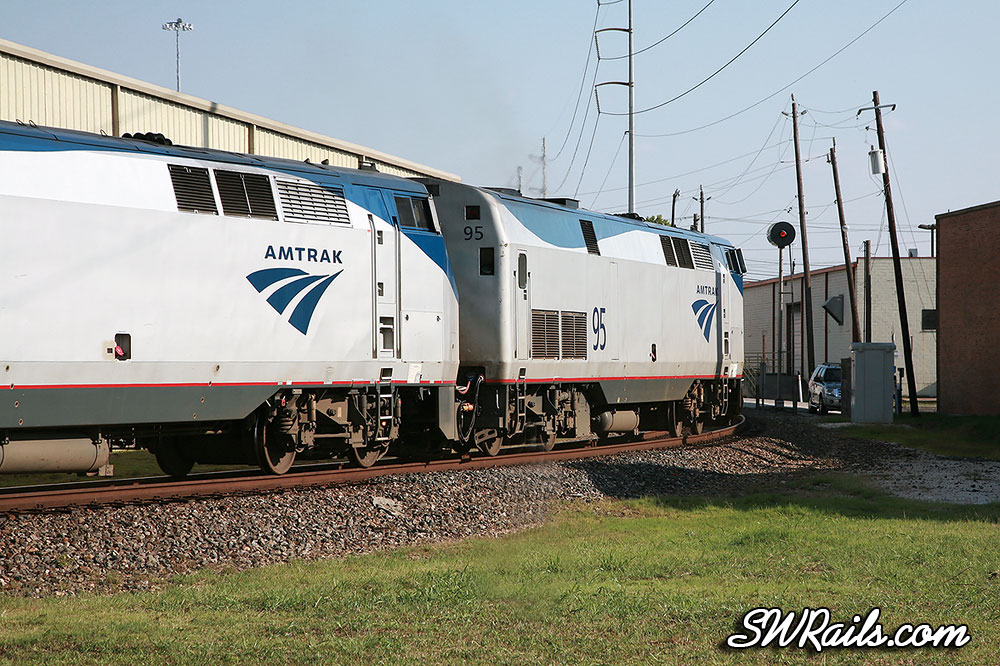
As I started thinking how far I’d have to go to get decent light on the QEWWC, the radio comes to life again, this time with AMTK 95 on the westbound Sunset Limited calling an approach signal at CP LF360. It’s right behind the QEWWC!
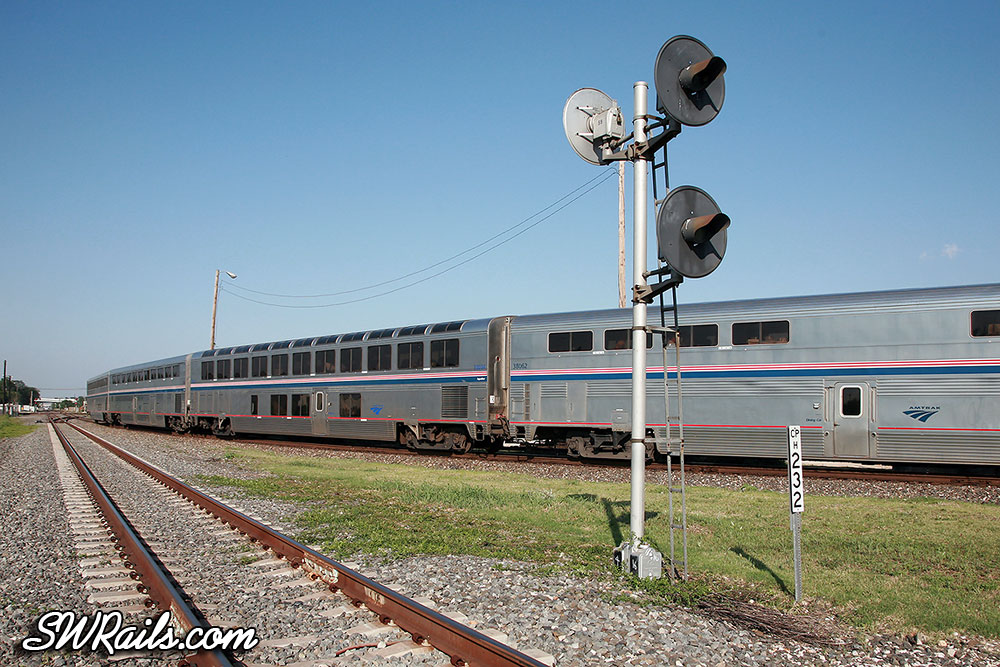
I put the QEWWC on the back burner, knowing that I could shoot it in the Sugar Land area when we headed home. I headed to CP H232, Tower 26. This is where main 2 diverges to head into the Amtrak Depot.
The last 20 cars and DPU’s of the QEWWC went by as I was setting up. As soon as it cleared up, AMTK 95’s headlight was in view. It passed by me at 5:45 PM, about 25 minutes ahead of schedule based on its 6:18 PM scheduled arrival into the depot.
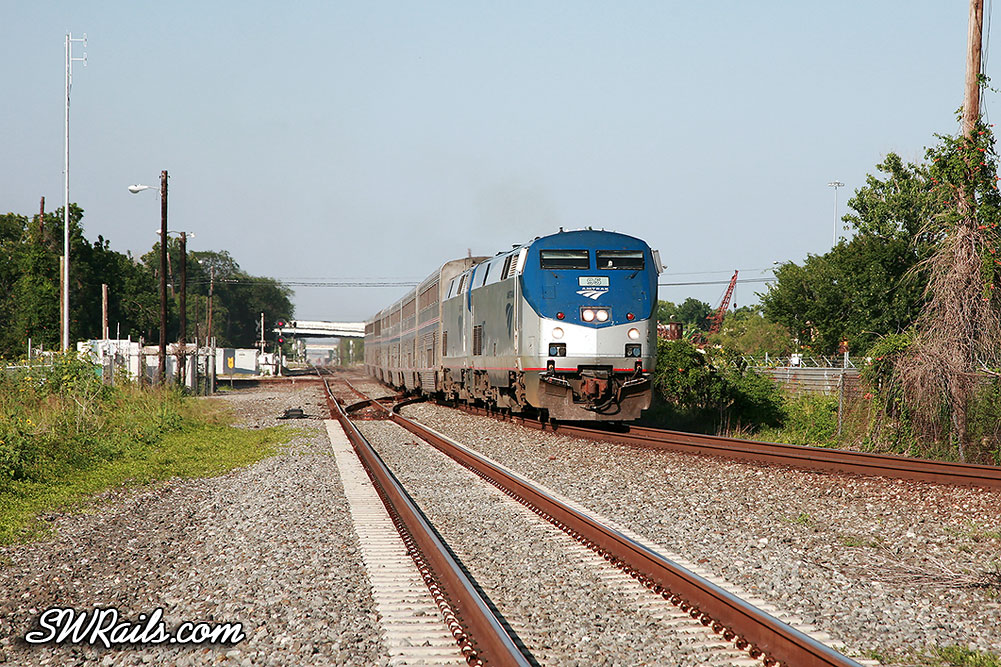
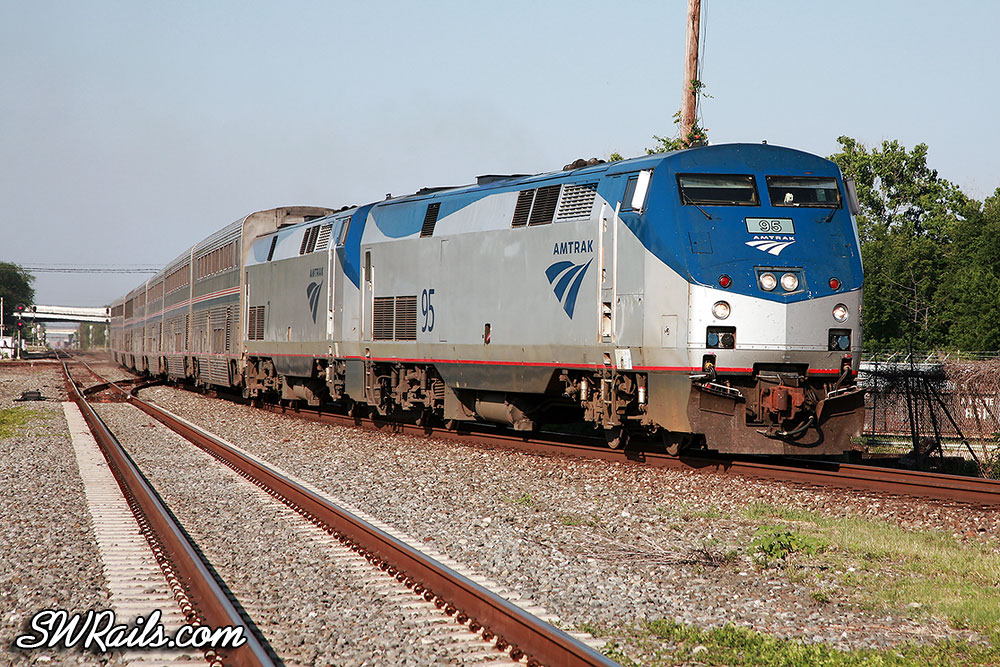
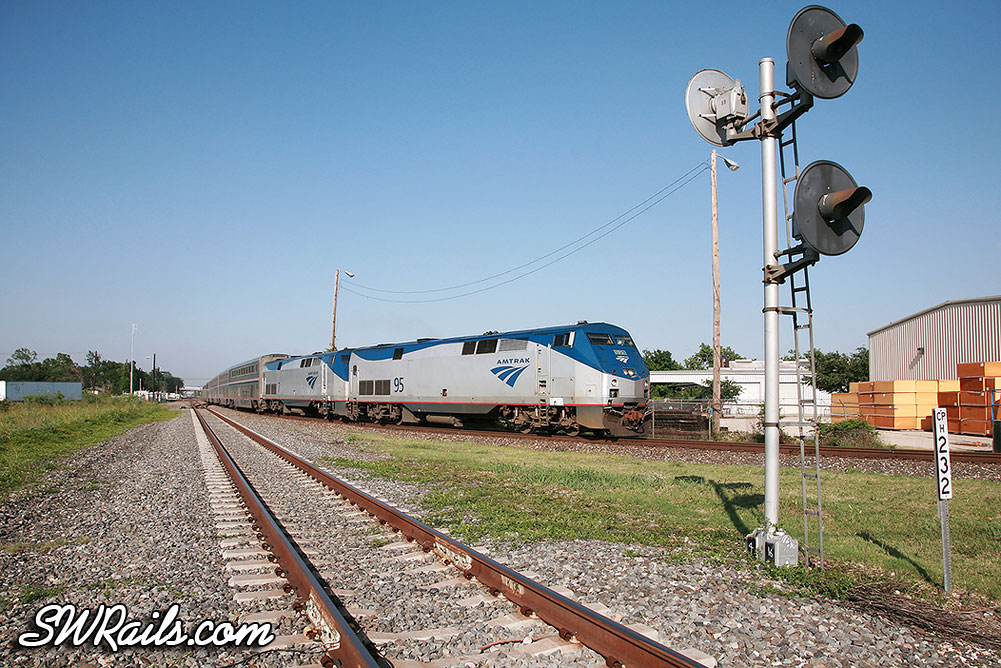
As I got back into the car, I heard the MP 366.4 detector (just east of Eureka) go off , signifying that the QEWWC was about 6 miles ahead of me. No problem. I would be getting on the freeway shortly for the 27 mile trip to MP 25, the east switch of Sugar Land, where I knew the light would be nice.
As I passed by West Junction, lo and behold, there was the head end of the QEWWC, making the turn off of the Terminal sub on to the Glidden sub!
Wonderful. The train is entering 60 mph railroad and I still have to deal with traffic lights in Stafford and Sugar Land. The detector at MP 15.6 advised that the train was traveling at 49 mph, giving me hope that I would make it.
When it was all said and done, I was able to get to MP 25 with a minute or two to spare, allowing me to get my first shots of the Missouri Pacific heritage engine on the Glidden sub at 6:24 PM.
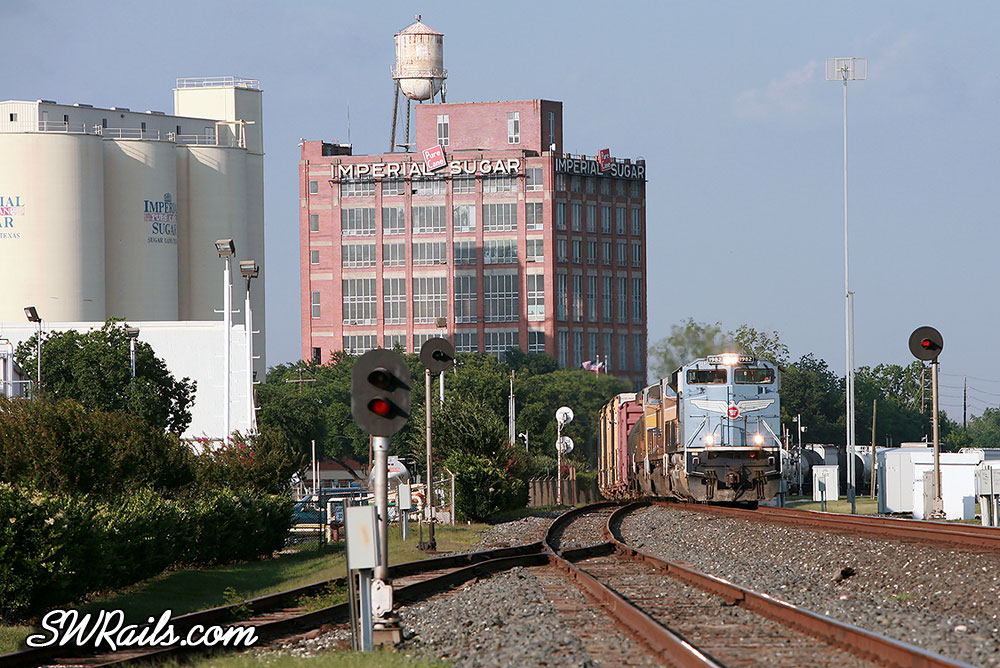
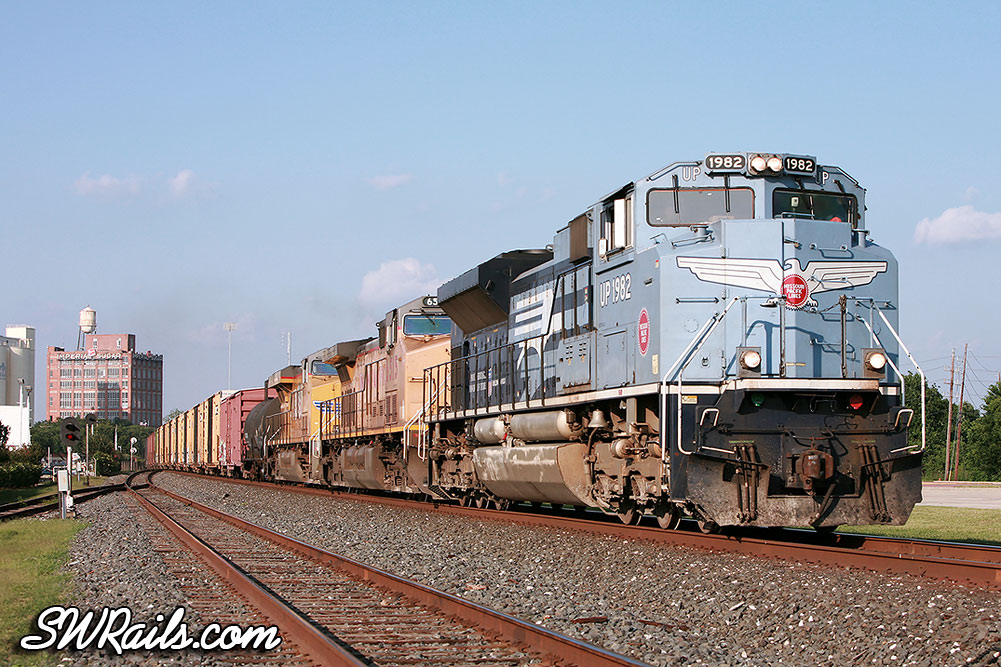
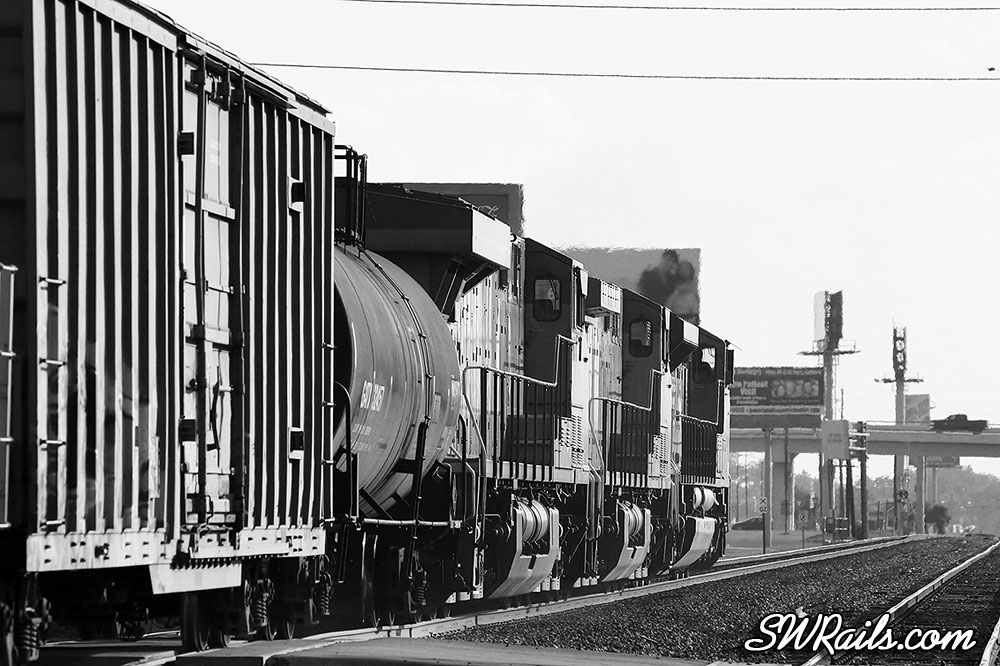
The UP operating plan calls for DPU’s on the QEWWC / QWCEW trains regardless of train size.

Once the train was by me, I took a moment to calculate just how quickly this train got here from downtown Houston. It passed Tower 26 at 5:40 PM. It covered the 27 miles to Sugar Land in 44 minutes, giving it an average speed of 37 mph. It may not seem that fast, but when you consider just how much congestion trains typically have to navigate while passing through the Houston terminal, this train was flying!
We still hadn’t found our planters. There’s a WalMart a mile or so from where we were, so we headed there to try our luck. Luck was with us as we were able to find 2 planters that met my wife’s specs. We got back in the car about 7:15 PM, ready to get some dinner.
I mentioned to my wife that Amtrak was due shortly through Sugar Land, it would only take a few minutes, and then we’d eat. She was OK with the plan as long as it didn’t take more than a few minutes. Shortly thereafter, the detector at 15.6 announced a train with 36 axles travelling at 55mph, so I knew the plan would work.
I opted to try something a little different with today’s shot of #1, setting up at a little curve near MP 26. At 7:32 PM, AMTK 95 blew by, doing a good 60 mph.
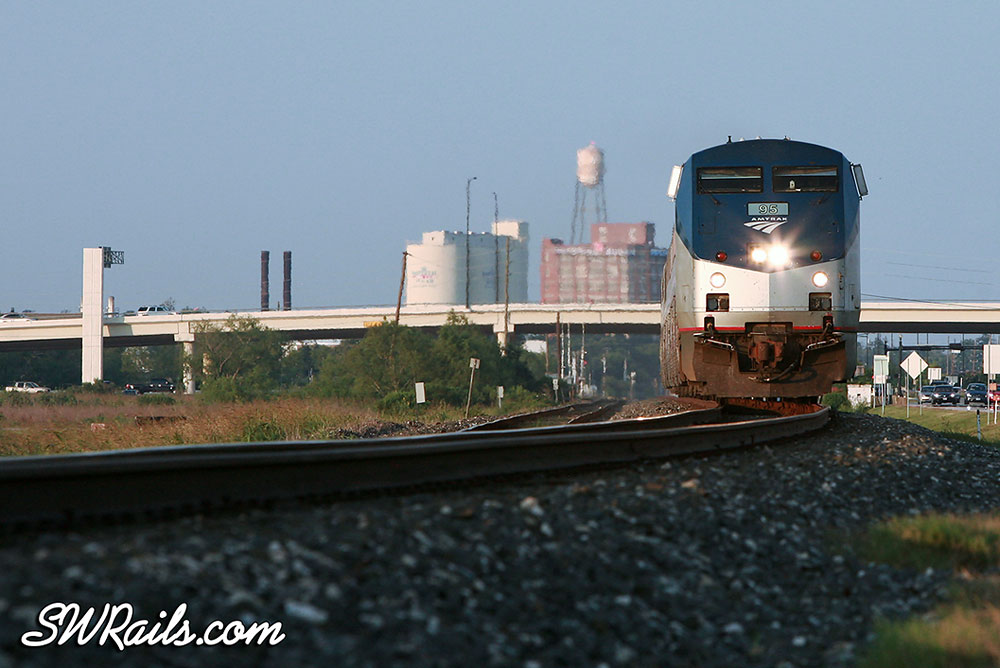
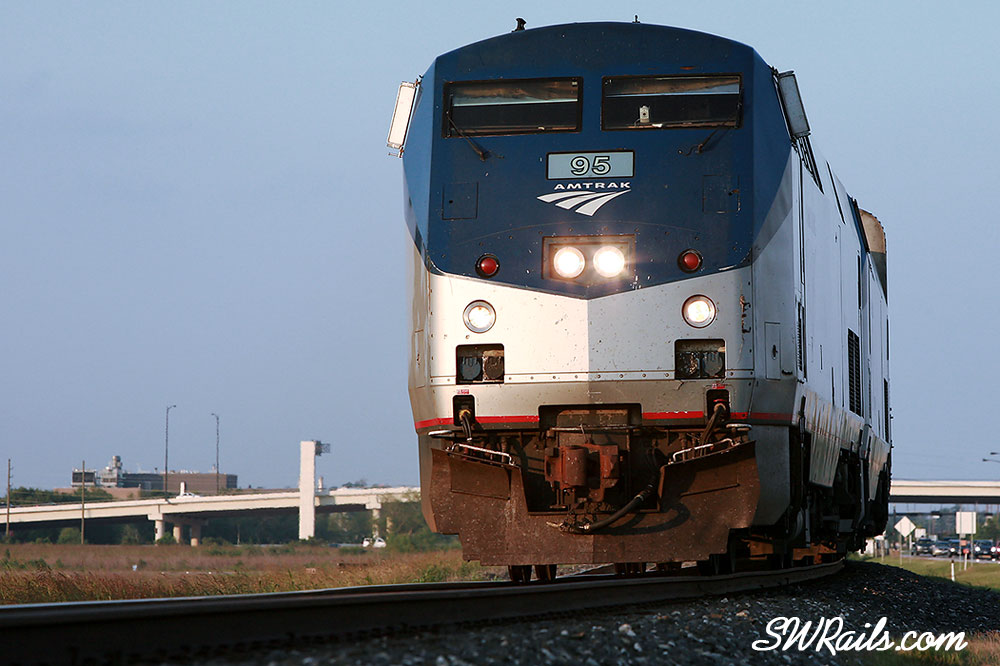
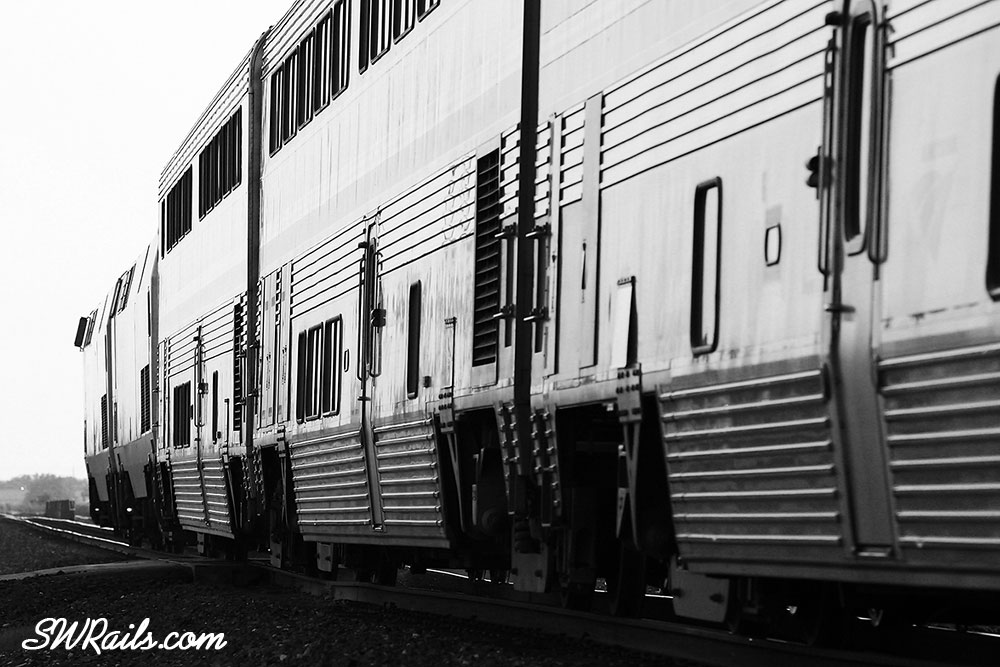
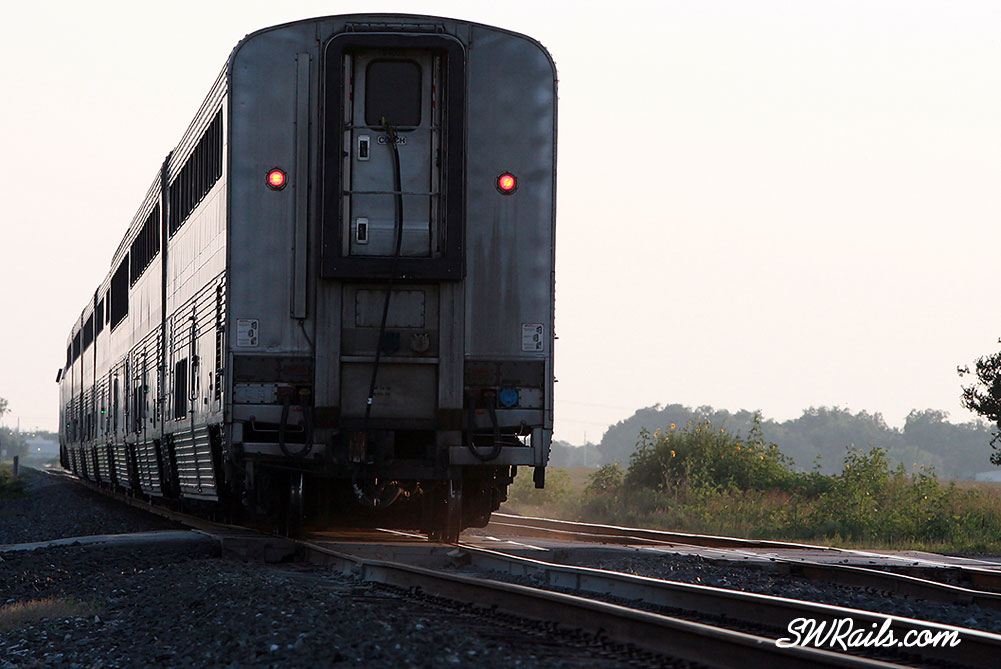
At this point, we headed straight to dinner. I was satisfied because I was able to get some quality railfanning in while tending to domestic matters. My wife was satisfied because my railfanning didn’t take away too much from what she wanted to accomplish. I love a happy ending!
Let me follow-up on the speed of the QEWWC, between downtown and Sugar Land. It covered the 27 miles in 44 minutes, giving it an average speed of 37 mph. Big whoop?
Amtrak departed the depot at 6:55 PM, passing by me at MP 26 at 7:32 PM, traveling 26 miles in 37 minutes. Its average speed was 42 mph for this stretch, only 5 mph faster than the 522 axle long QEWWC.
Of course, that’s not a typical speed for a freight train trying to get out of Houston. But it does show you how quickly a freight train can get out-of-town when it doesn’t have to deal with MOW, crossing protection / slow orders, or oncoming trains.
Love The One You’re With
I suspect the sight of a Santa Fe passenger train passing through Southern California’s Cajon Pass might have been a non-event for railfans in the 1950’s.
With The Super Chief, The California Limited, The Chief, El Capitan, and lowly train 23/24 serving the Chicago-Los Angeles traveler, 10 Santa Fe streamliners every day was today’s equivalent of orange GE’s on a BNSF train-nothing worth writing home about.
Fortunately, some photographers took the time to document what was a very common occurrence, allowing us a momentary glimpse back into the glory days of U.S. passenger trains.
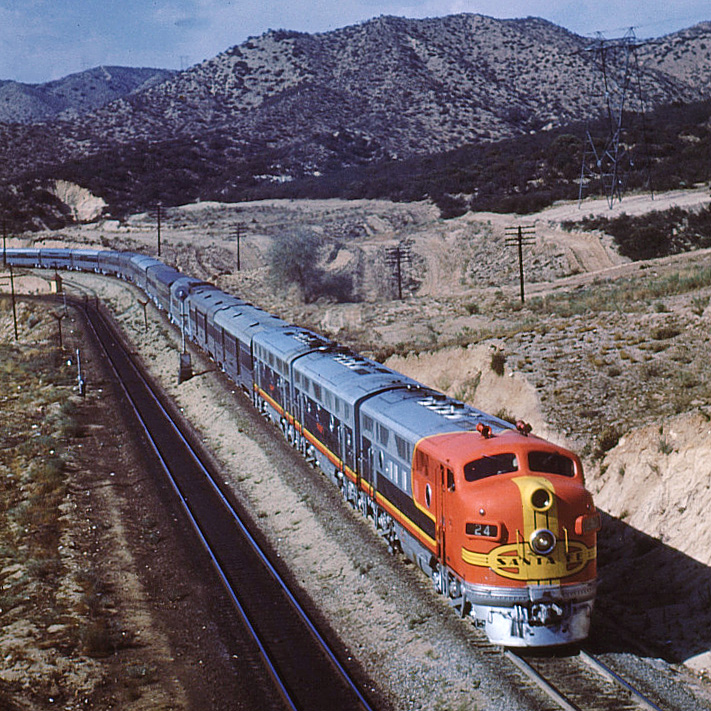
The slide had no information on it. It’s obviously on Cajon Pass. A bit of sleuthing allowed me to fill in some details.
I recognize the location. It’s where the North track and South track converge just east of Summit, with the train heading east. The direction and angle of the sun tell me it’s late afternoon sometime between September to March.
The only eastbound train over Cajon Pass at this time of day would be El Capitan. It departed San Bernardino at 3:07 PM, placing it at Summit around 3:45 PM, give or take.
What year was the photo taken? The lead unit, 24L, was built in April, 1948. The power looks good, but it’s not brand new. My guess is it’s a couple of years old, placing the year about 1950 – 1952.
As the train is made up with standard Budd passenger cars, the above image must be before 1956, as that’s when the Santa Fe took delivery of its iconic hi-level passenger equipment. Compare its profile to that of the hi-level equipped El Capitan below. Click here for more information about the hi-level equipped El Capitan.

Santa Fe’s El Capitan departing LAUPT with hi-level equipment
The photographer? No name is on the slide, but I, for one, owe him a debt of gratitude for taking the time and effort to capture the moment in time when just another Santa Fe passenger train went by.
Is there a moral to the story? Of course there is. What’s here today is gone tomorrow. The days of boring SD40-2’s on every UP train are long gone. Today’s boring orange GE’s on the BNSF will be gone, sooner that we think.
Photograph today’s rail scene. It’s the only one we have. Stephen Stills said it best: Love the One You’re With.
UP 844 In 1940’s Passenger Scheme
Union Pacific re-launched its passenger train service in 1946, accelerating schedules, and expanding service in some cases. Among the changes was the adoption of a handsome two-tone gray scheme for the passenger car fleet. It was important to the UP that the train present a color coordinated image, so over 100 UP steam locomotives were painted in this scheme.
Among the locomotives assigned to this service was the very last steam locomotives purchased by UP, 4-8-4 844. Built in December, 1944, the 844 was in its new colors by 1946.
The two-tone gray image for UP passenger equipment was a short-lived program. In Spring of 1952, the order went out to re-paint the equipment into standard colors: armour yellow for the passenger cars and black for the steam locomotives. And that’s how it stayed through 1959, when the 844 was removed from regular service and became a part of UP’s Heritage Collection.
Over the next 28 years, the 844, in black, would be the power for hundreds of excursions throughout the Union Pacific system.
In 1987, the decision was made to return the 844 into the two-tone gray scheme. It made its debut in October 1987. I was able to catch it on September 16, 1989 as it passed through Greer, Wyoming with a Denver-bound excursion train.
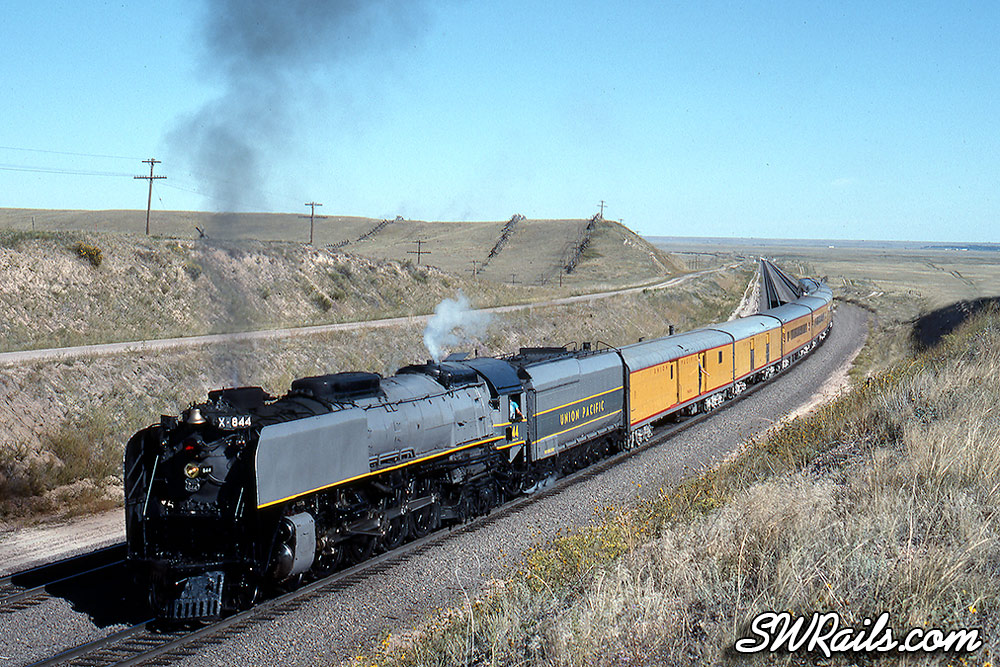
By the time the 844 was nearing an overhaul in 1991, the decision had been made to return the 844 to standard black mainly because it was near impossible to keep the grey paint looking clean. It’s last run in the two-tone gray was October 20, 1991.
P.S. – I found this video of the 844 that shows it operating the excursion train to Denver on the same day that I photographed it.
Down By The Corner
If there’s any point on the Union Pacific in the Houston area that can be called a corner, it would be Eureka, at MP 366.3 of the Terminal subdivision. Westbound trains make a fairly sharp 90 degree turn, from Northwest to Southwest.
I had seen a westbound QEWWC manifest departing Englewood this past July 17, 2011, but there just wasn’t proper light for a shot. Knowing that the track makes the 90 degree turn at Eureka, I made the 8 mile drive there to wait for the train.
The train arrived within 15 minutes, allowing me to capture this series of images as it traversed the big curve.
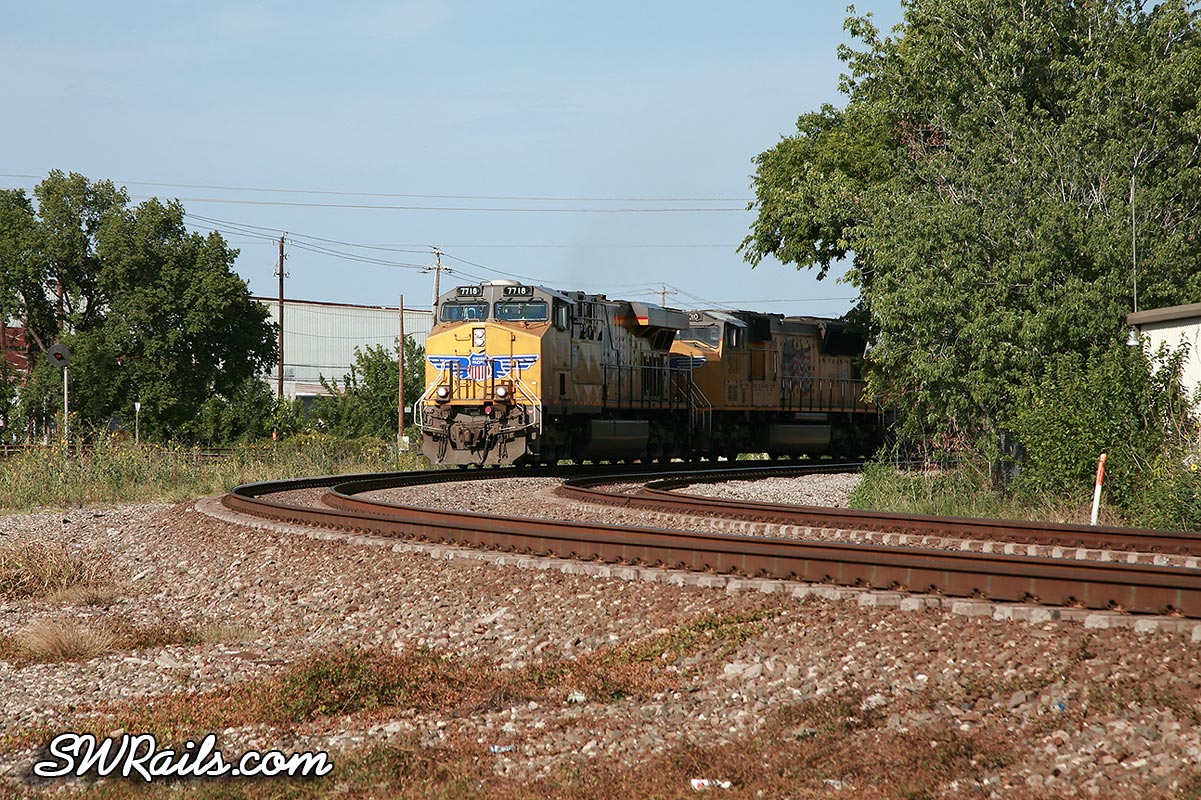
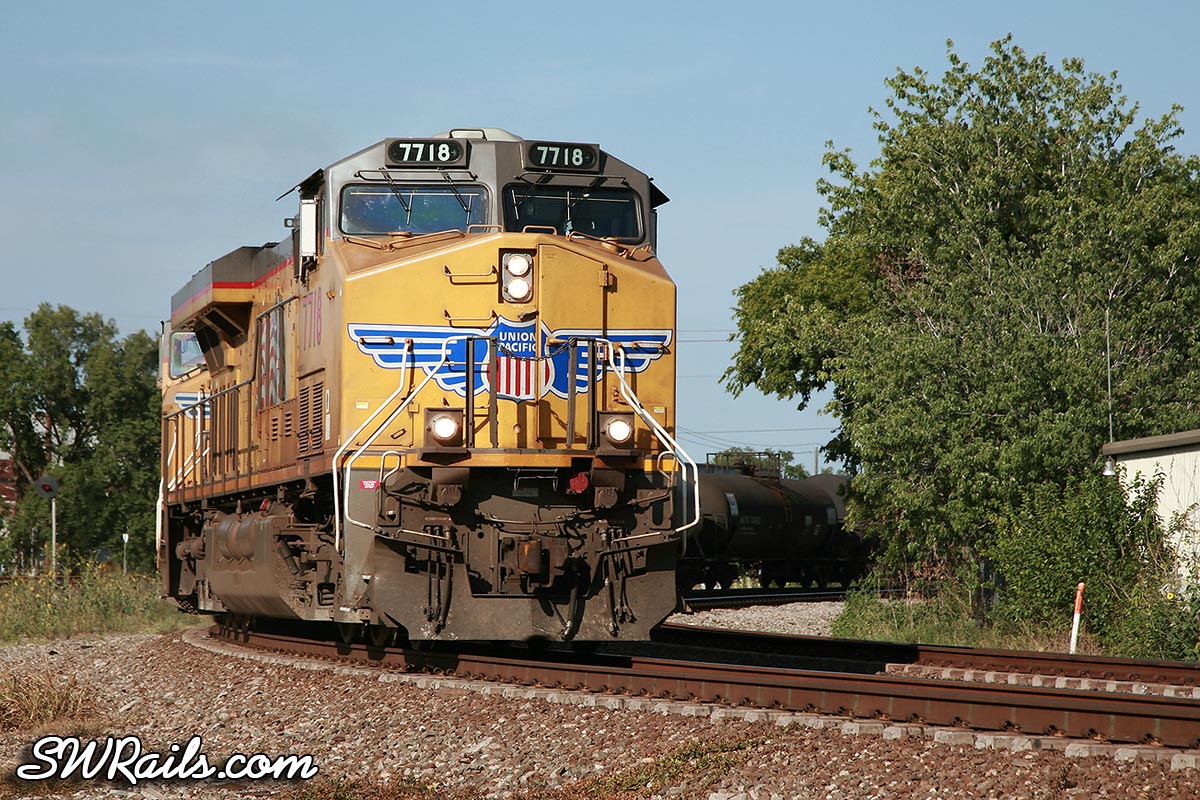
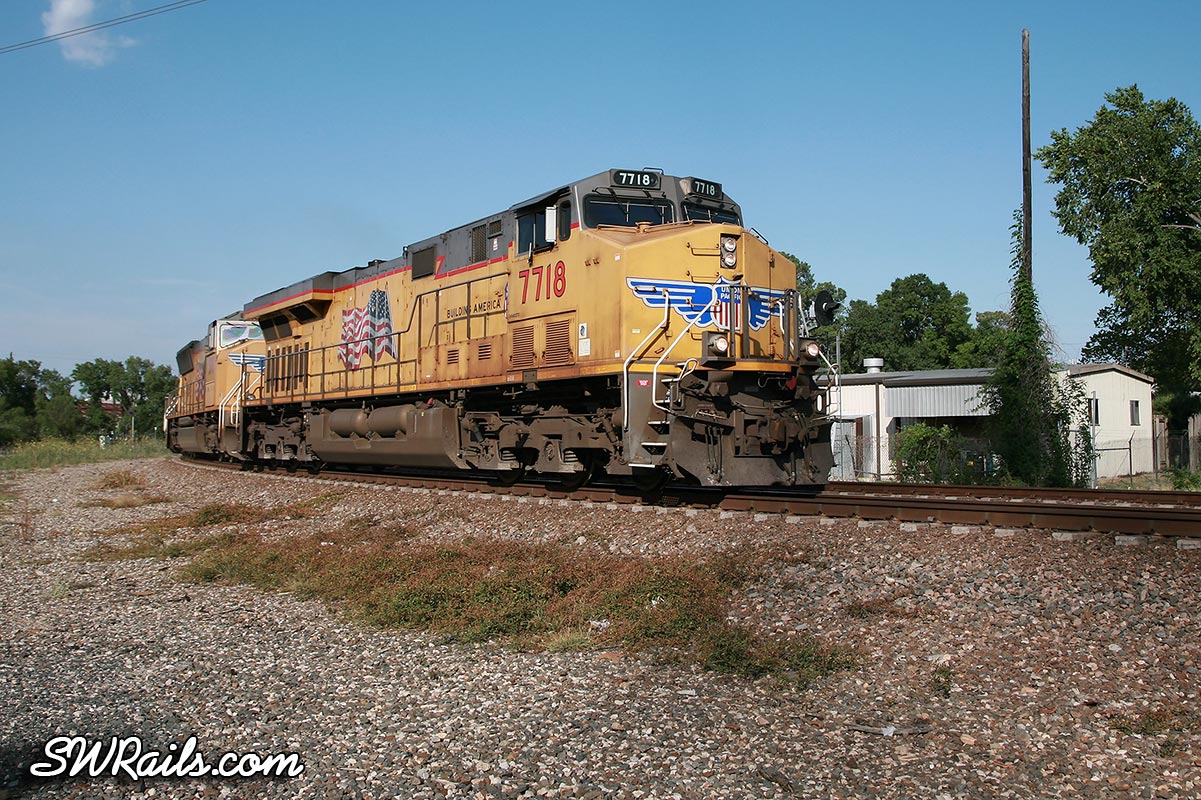
The track in the foreground serves double duty. It’s a lead into the ex-MKT Eureka Yard and a connector to the Eureka sub. An SD70M/SD9043MAC duo have the DPU duties today.
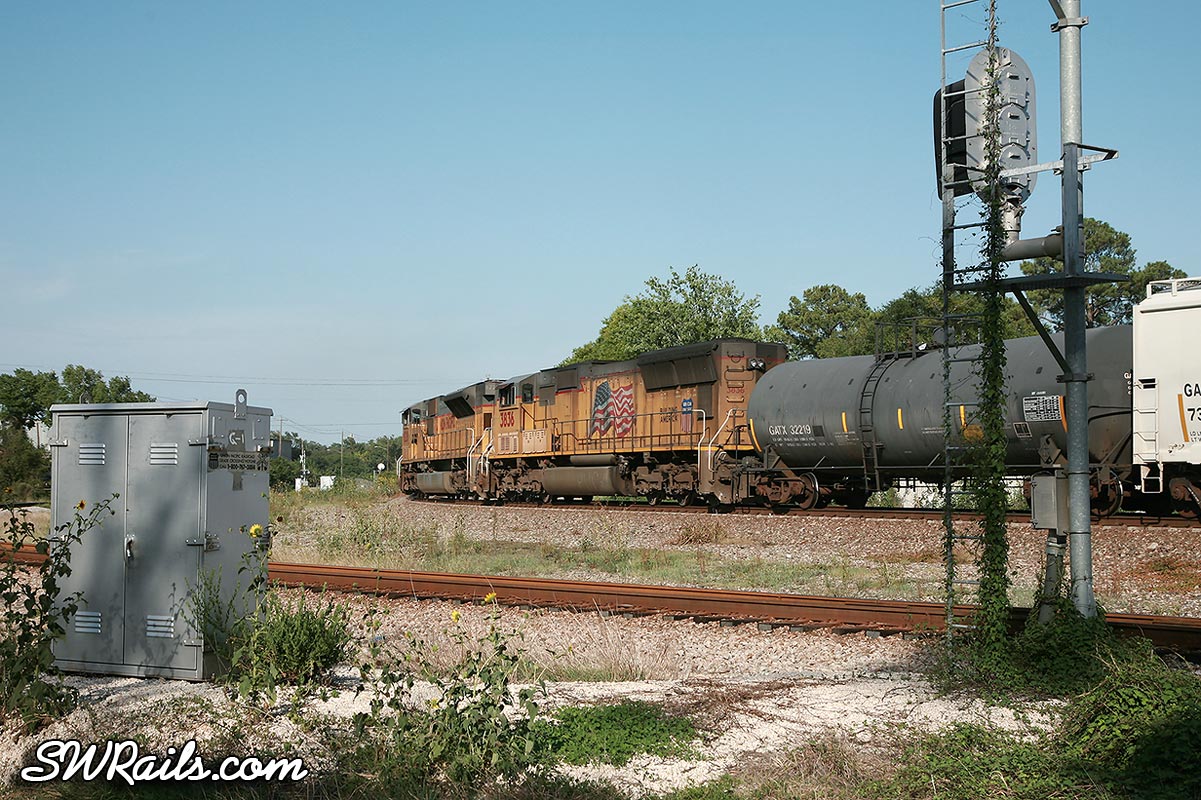
The DPU’s pass a train tied-down on Main 2. Eureka is a convenient spot to tie it down eastbounds when the crew is on short time, or Englewood isn’t able to take it.
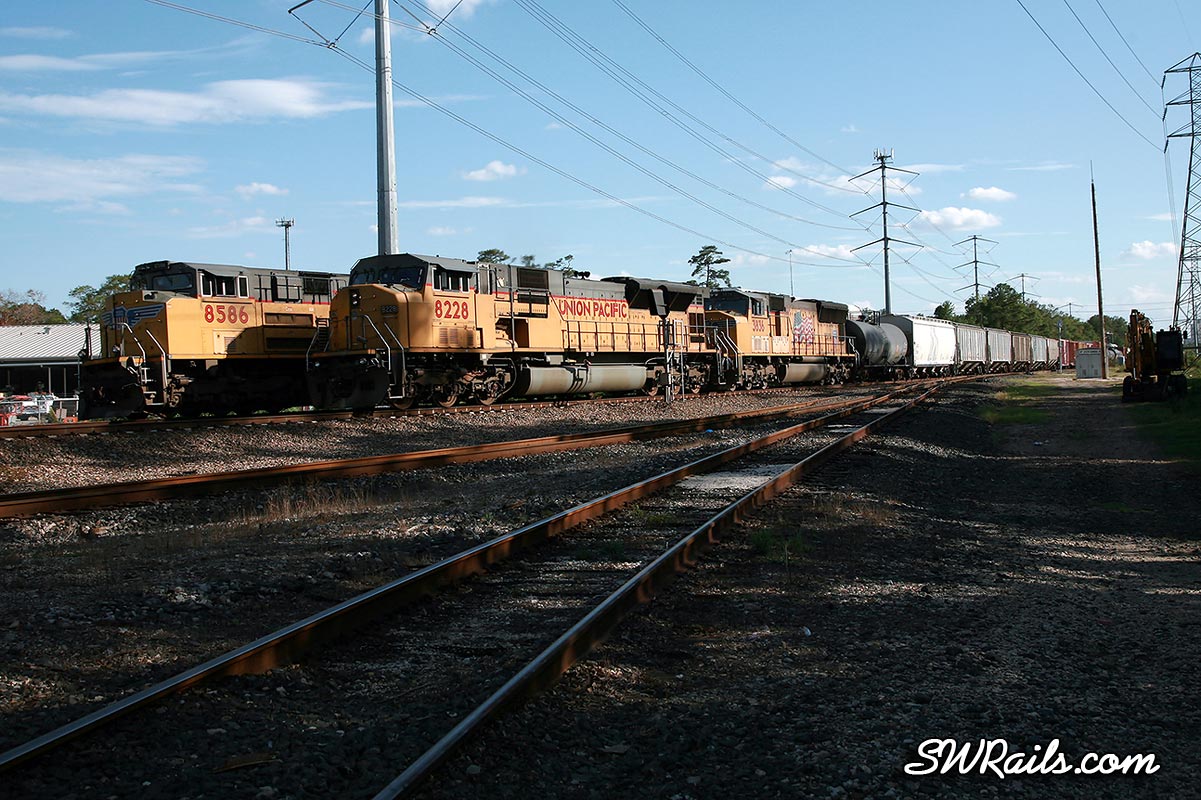
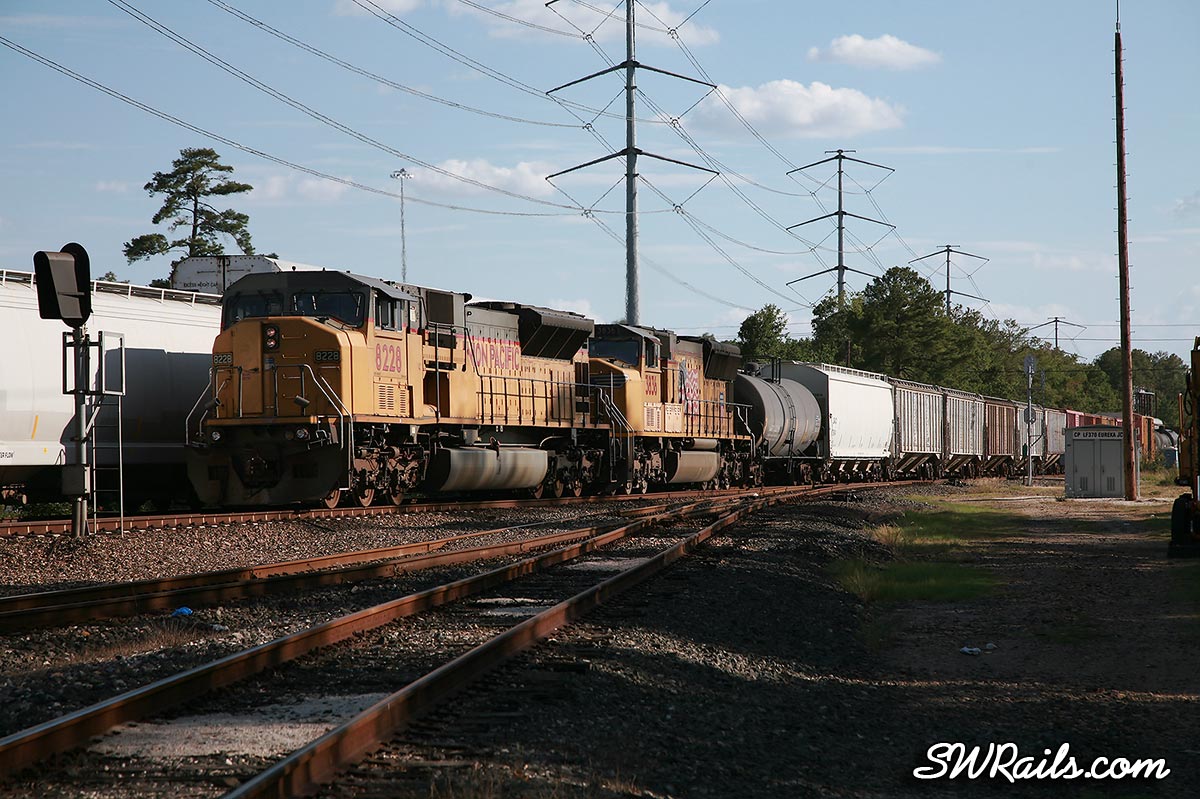
Once the train gets out of this curve, track speed jumps from 20 to 40 mph for the 9 miles to West Junction. There, the Glidden sub begins and track speed increases to 60 mph.
I headed home to Sugar Land at this point, traveling via Loop 610 and Hwy 90. As I was passing through Stafford, I heard the detector at MP 15.6 go off. The detector’s exit message announced the train’s speed at 51 mph.
I set up inside the curve near MP 20. Not the best location, but just not enough time to get to a better spot. As expected, the train arrived shortly. Interestingly, the same train I just photographed at Eureka 25 minutes prior!
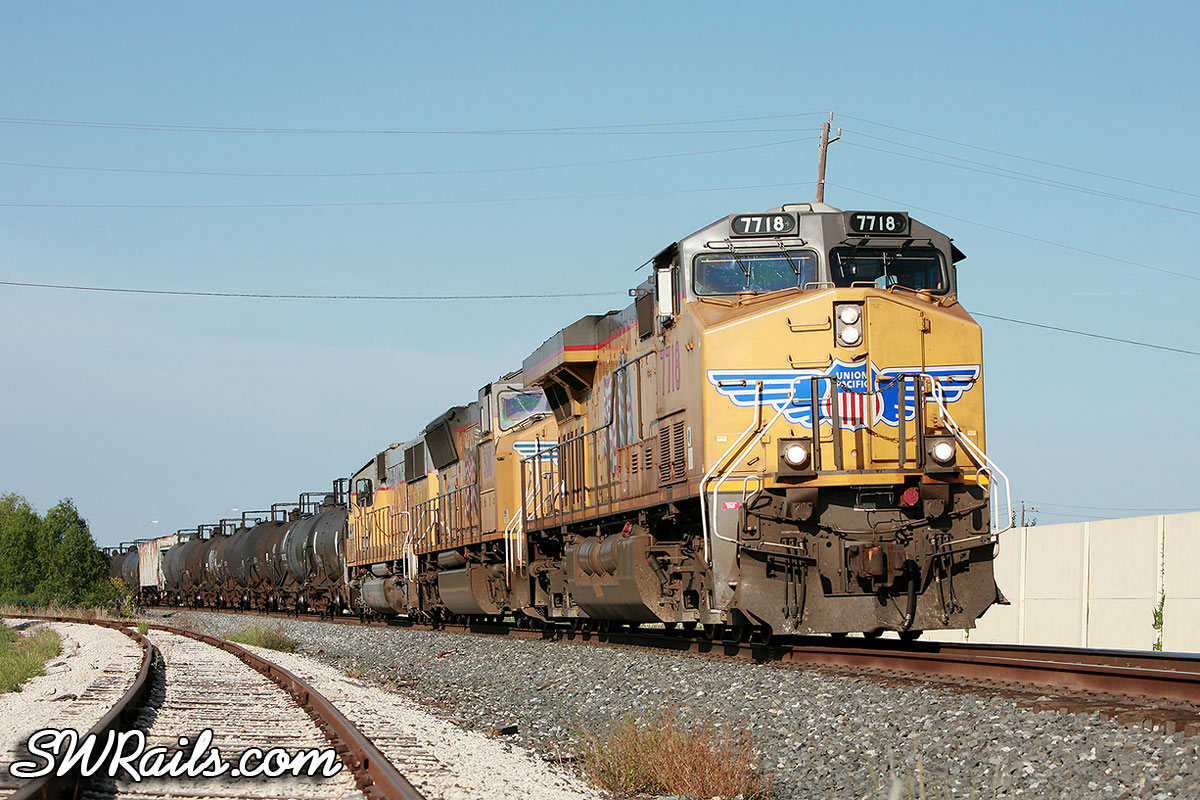
I didn’t try a shot of the DPU’s as the shot would have been almost straight into the sun. Homeward bound again. As I was pulling in to my driveway, the detector at 15.6 announced another westbound.
There’s still plenty of light, why not? I headed to my favorite location, the Imperial Sugar shot at MP 25. A friendly wave from the engineer accompanied the verboten whistle. (All of Sugar Land is a quiet zone, but crews may sound whistle to alert pedestrians.)

Once the KCS 4672 got by me, the sun was almost at the horizon, signifying that it’s really time to head home. Honest!
Missouri Pacific’s Texas Eagle
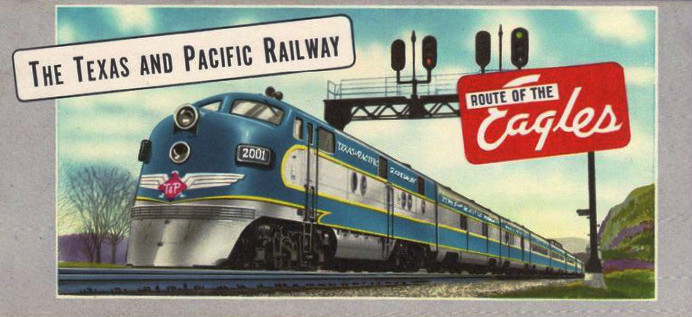
Missouri Pacific’s premier passenger train was the Texas Eagle, trains # 1 and #2, operating daily between St. Louis and all over Texas. I know, “All over Texas” isn’t a destination. That’s the point. You could buy a ticket from St. Louis to Laredo, Houston, or El Paso and you’d leave St. Louis on the same train.
The MP accomplished this by operating a very long train from St. Louis and splitting into 3 different trains in Texas. A West Texas section (serving Dallas to El Paso destinations) would come off at Longview, a Houston section would come off at Palestine, with the remainder of the train continuing to Austin, San Antonio and ultimately Laredo.
The MP’s route structure made this possible. The St. Louis-Laredo line is a straight shot, with a T&P line diverging westward at Longview and another T&P line diverging southward from Palestine.
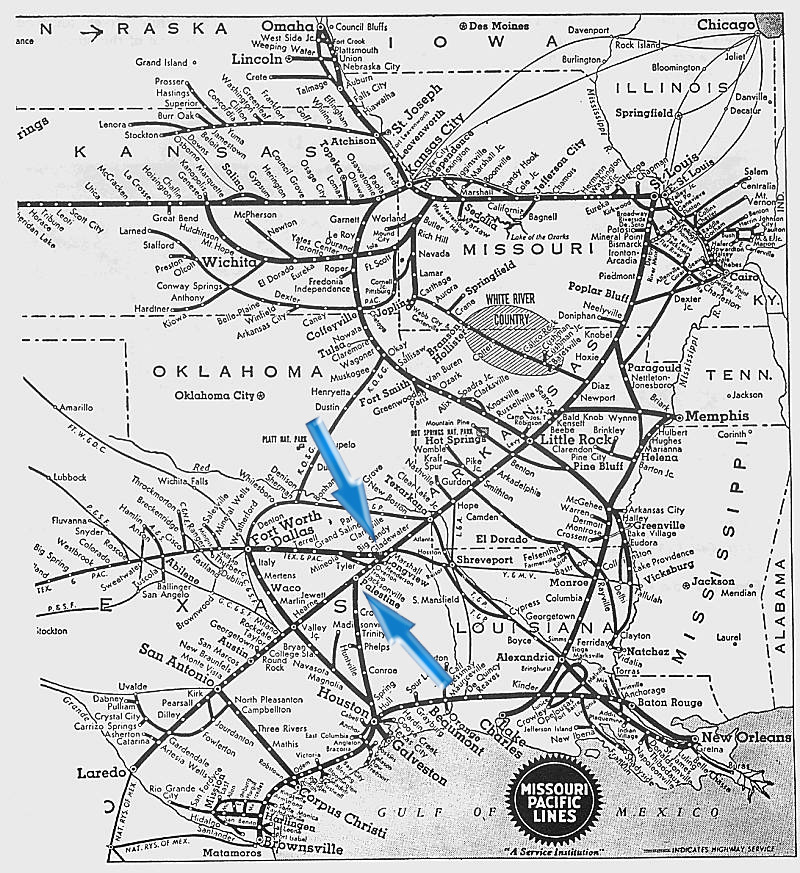
The opposite procedure would take place for the northward Texas Eagle, 3 different trains coming together in Texas to form one very long train to St. Louis.
Here’s an image of MP Train #2, the northbound Texas Eagle nearing St. Louis Union Station in December of 1965.
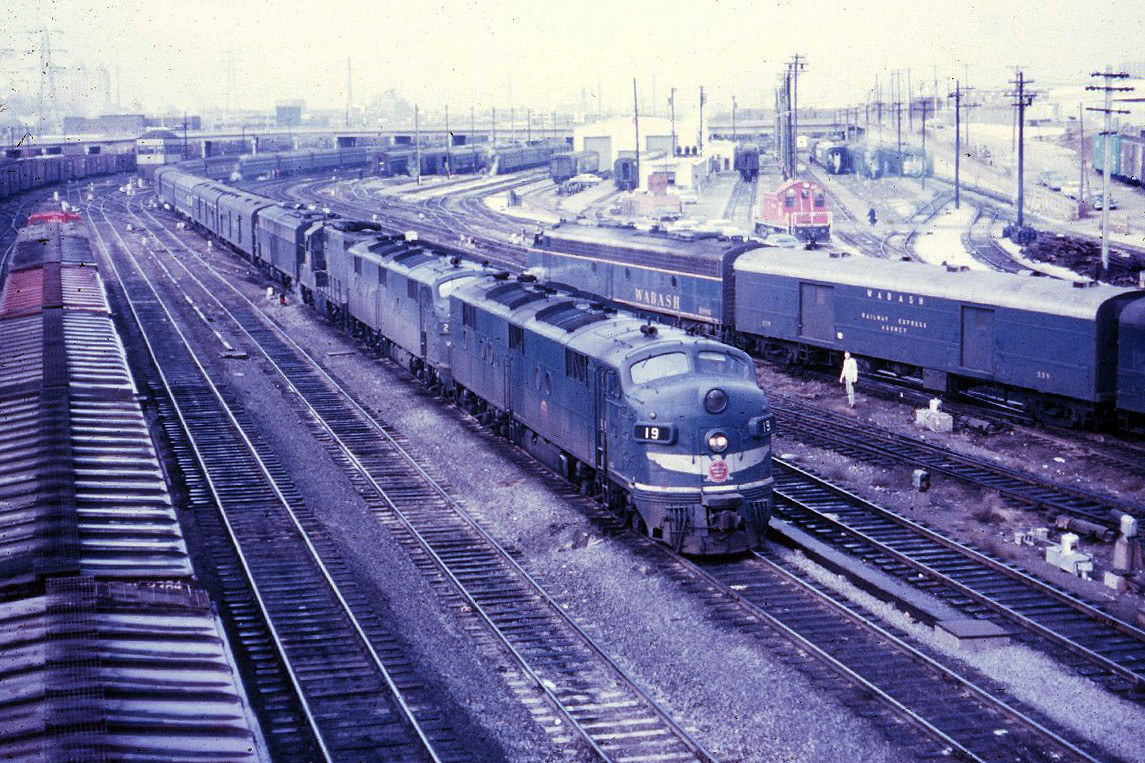
The MP was able to discontinue the Texas segments of this train by 1970. St. Louis to Texarkana was the only segment that continued until Amtrak, when that service ended.
But it was a temporary end to passenger service for this corridor. Laredo to St. Louis service was restored by Amtrak’s Inter-American in 1974. It was re-named “The Eagle” when the route was truncated in 1981, dropping the San Antonio – Laredo segment.
Abilene Road Trip
Disclaimer: No railroad-related content in this post. You can’t say I didn’t warn you. However, if you have any interest in USAF bombers….
We made a quick road trip to Abilene, Texas a couple of weeks ago. Our oldest son, Andy, is a Senior Airman stationed at Dyess AFB. He invited us to join him at the Dyess Big Country Air Fest that took place this past April 28th.
We enjoyed a long, hot day on the Dyess flight line. I ended up with way too many images to post here, but here are a few of my favorites.
Dyess is home to the 7th Bomb Wing, operating 40 B-1B bombers in a training capacity stateside and combat missions over Afghanistan. Here’s s/n 86-0108 on display.

S/N 85-0090 taxied by us several times
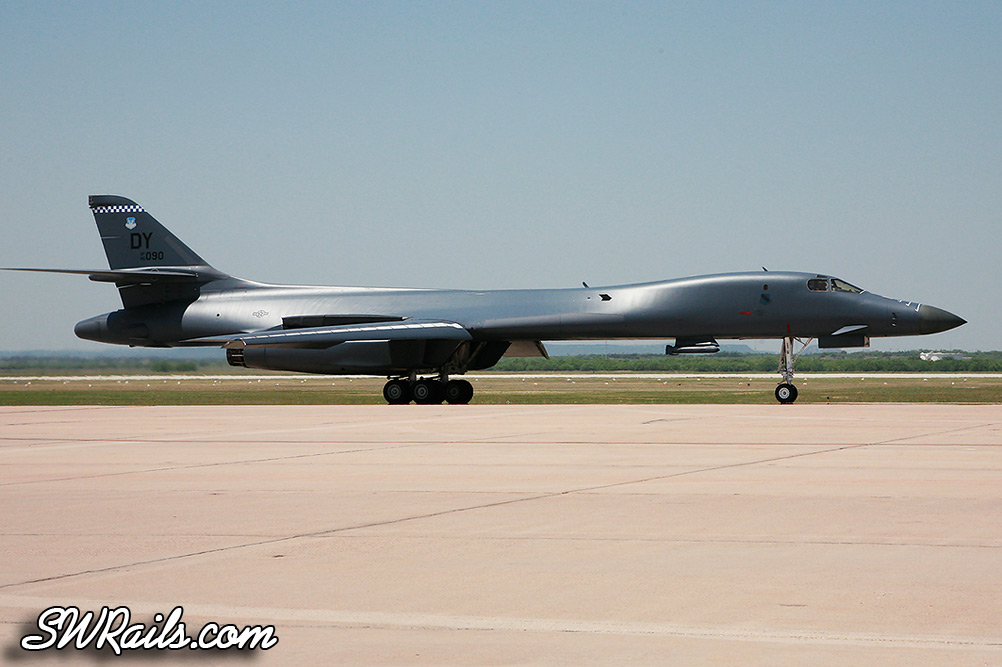
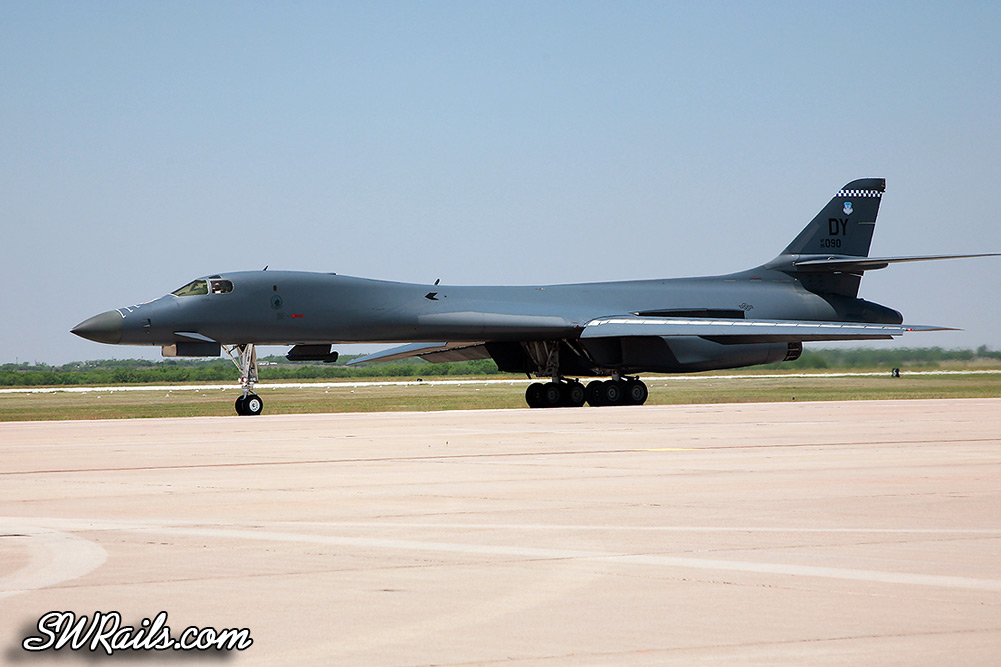
Later, the 090 did a high-speed, wings swept back flyover :

The B-1’s immediate predecessor, the B-52 was on hand from Barksdale AFB in Shreveport.

The B-52’s mission has evolved dramatically over the years. It began as a strategic nuclear bomber in the 1950’s, becoming a conventional carpet-bomber in Viet Nam in the 1960’s, later a cruise-missile platform in the 1980’s and 90’s, and now a tactical bomber in Iraq and Afghanistan. USAF intends to keep the B-52 in service until 2045, more than 85 years after the B-52 entered service and an unprecedented length of service for a military aircraft.
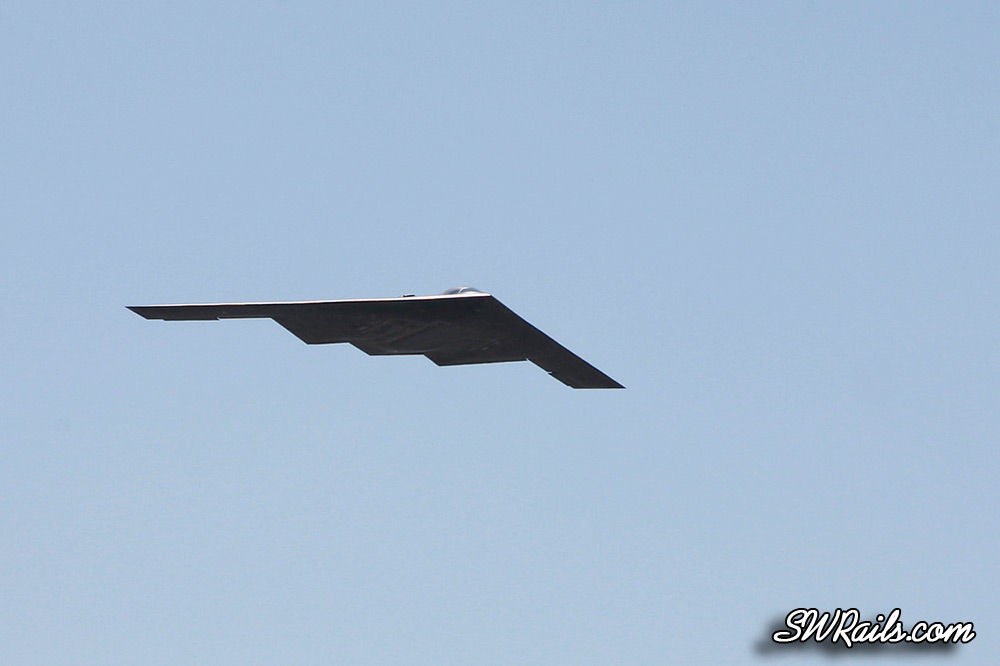
Later, a B-2 from Whiteman AFB did a few passes over Dyess. It’s hard for me to grasp how an airplane can cost over $2 billion dollars, $2.131 billion (1996 dollars) to be precise, but it’s still an amazing thing to see fly by.

At the other end of the cost spectrum is the A-10 Thunderbolt, a steal at $11.8 million (1994 dollars). The A-10 is unique in that the aircraft was designed around the GAU-8 30mm cannon, among the largest, heaviest and most powerful aircraft cannons U.S. military. Designed specifically as an anti-tank weapon, the GAU-8 delivers very powerful depleted uranium rounds at a high rate of fire.

A wide spectrum of other aircraft, from Japanese Zero fighters to a USAF KC-10 tanker were on hand. They may be the subject of a later post. We shall see…
Fifties Flashback: Southern Pacific F Units
Another installment of EMD F-units operating on the Southern Pacific in California during the 1950’s:
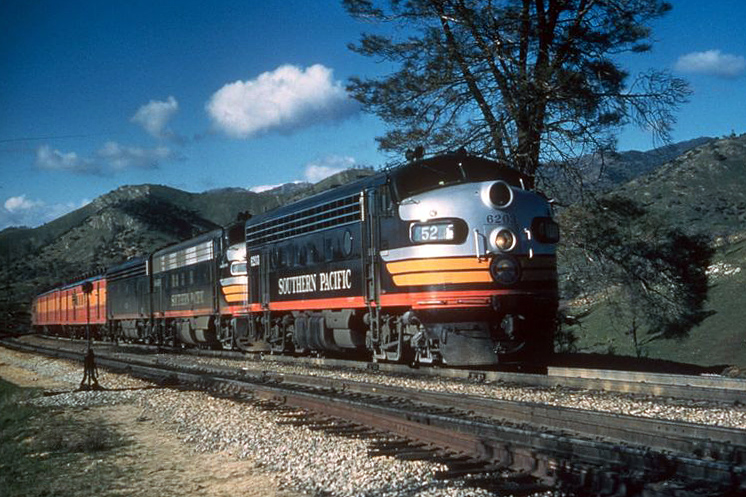
First up is SP Train #52, the southbound San Joaquin Daylight, at Walong, CA (Tehachapi Loop) on March 16, 1958. Train 52 departed San Francisco at 0800 and was scheduled to arrive at Los Angeles Union Station at 2200, covering 483 miles in 14 hours.
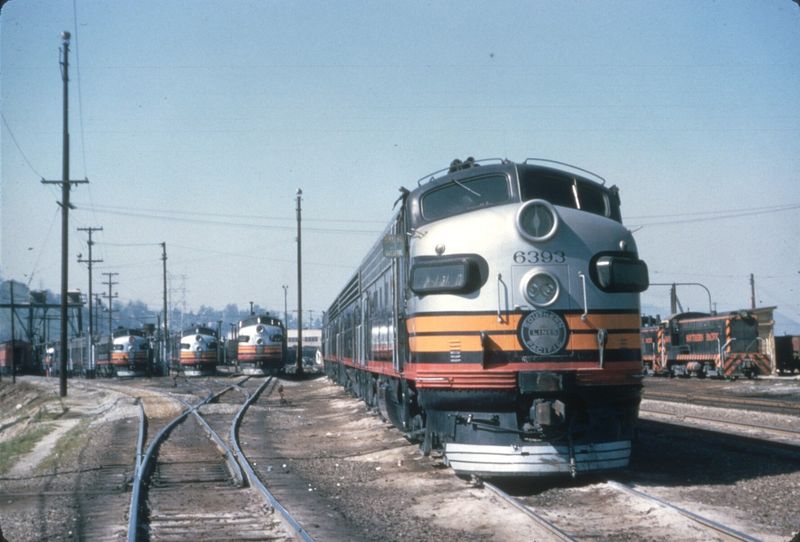
Next up is a view of the ready tracks at Taylor Yard on May 21, 1954, with 5 sets of Black Widow liveried F-units ready to go. Note, at right, the two Baldwin switchers sporting fresh Halloween colors.
What a glorious time to be wandering around Southern California with Kodachrome in your camera…
If You Don’t Succeed At First
After photographing the inaugural run of Amtrak’s westbound Sunset Limited at its new time this past Monday in less than ideal conditions, I found myself trackside this evening hoping for better luck.
When I arrived at the east switch of Sugar Land siding (MP 25) at 1920, there was nice light. I thought I could replicate the shot from Monday, but by 7:30 PM I had to re-locate due to shadows from the Nalco Chemical offices creeping across the right-of-way.
I ended up about 200 yards west of where I had originally set up, not the shot I wanted, but light trumps scenery. It’s not ideal light, but then again the sun is barely above the horizon, so I won’t complain.
At 7:36 PM, the train arrived.
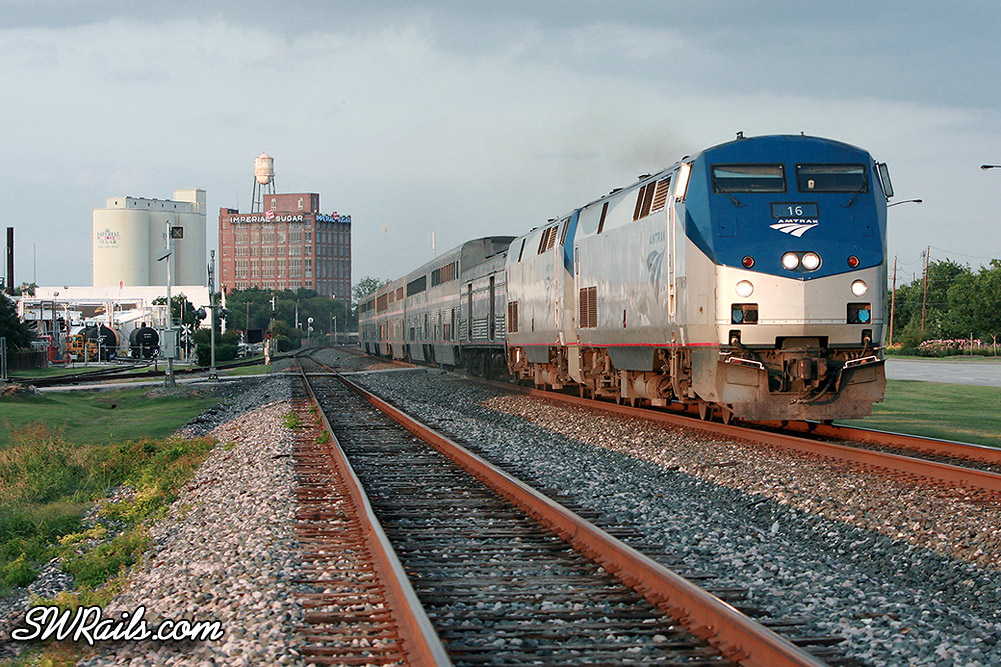
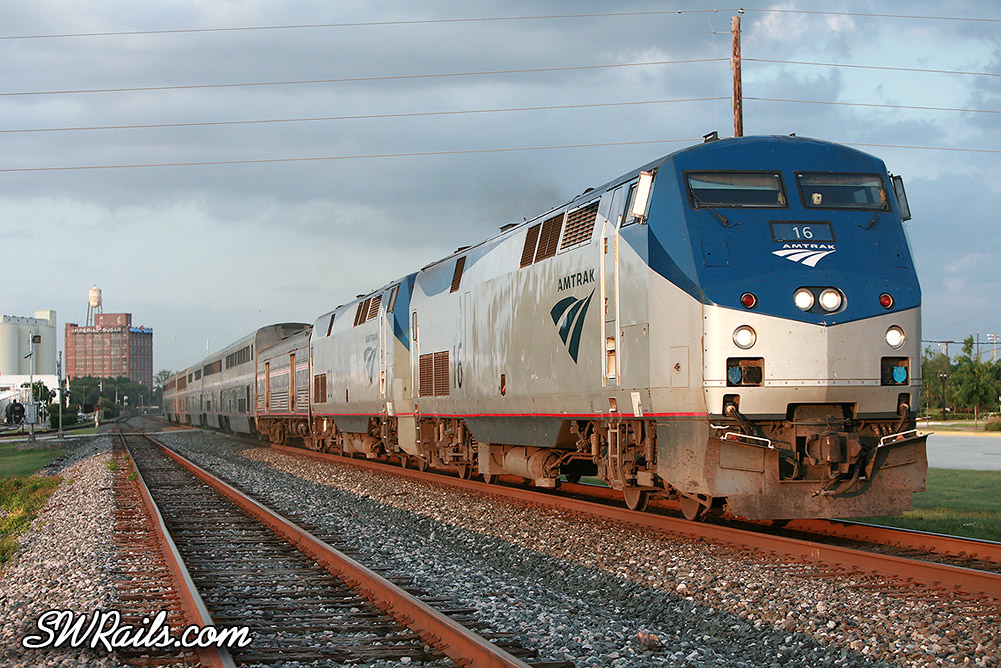
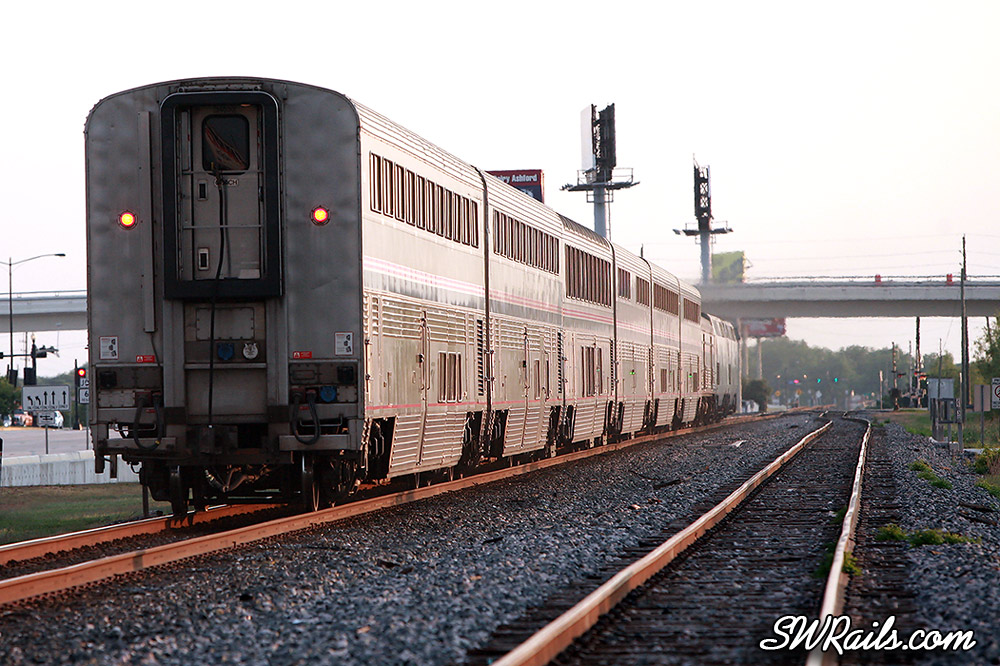
Just like that, the train was by me. In reviewing the file data, I see the first image was captured at 7:36:02, the last image was made at 7:36:16.
It seems like a lot of time and effort must be expended for a mere 14 seconds of photography, but somebody’s got to do it…
First Trip of Amtrak #1 Under New Schedule
It’s official! Amtrak train #1, the westbound Sunset Limited, is a daytime train now.
Today was its first day to operate under its revised schedule. Its new departure time from Houston is 6:55 PM, much more photo-friendly that its previous 9:50 PM departure.
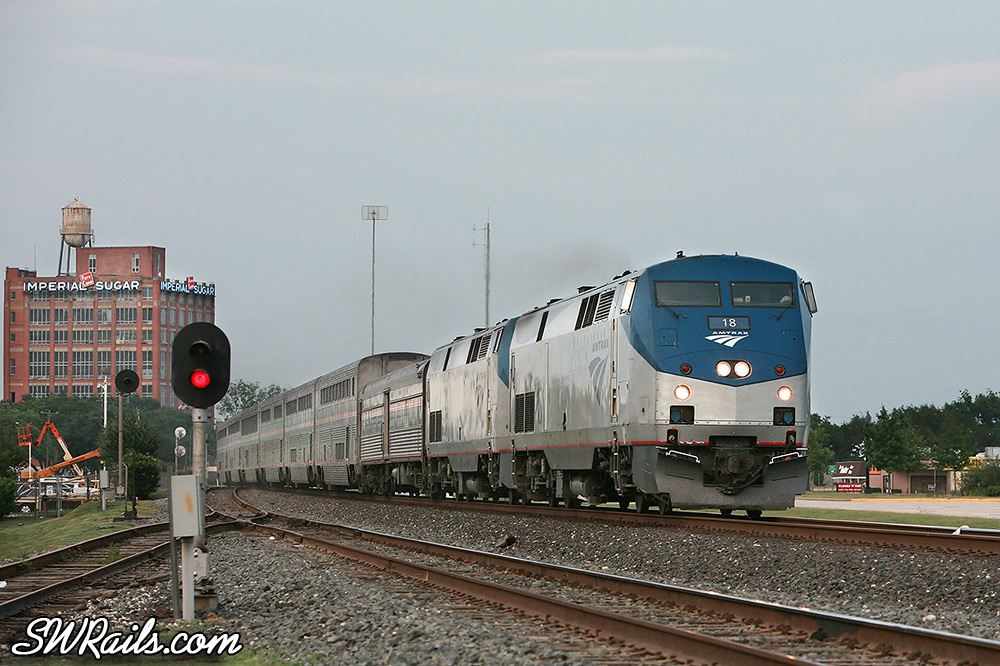
Here’s what it looked like earlier this evening when it passed by the old Imperial Sugar Mill in Sugar Land at 7:29 PM.
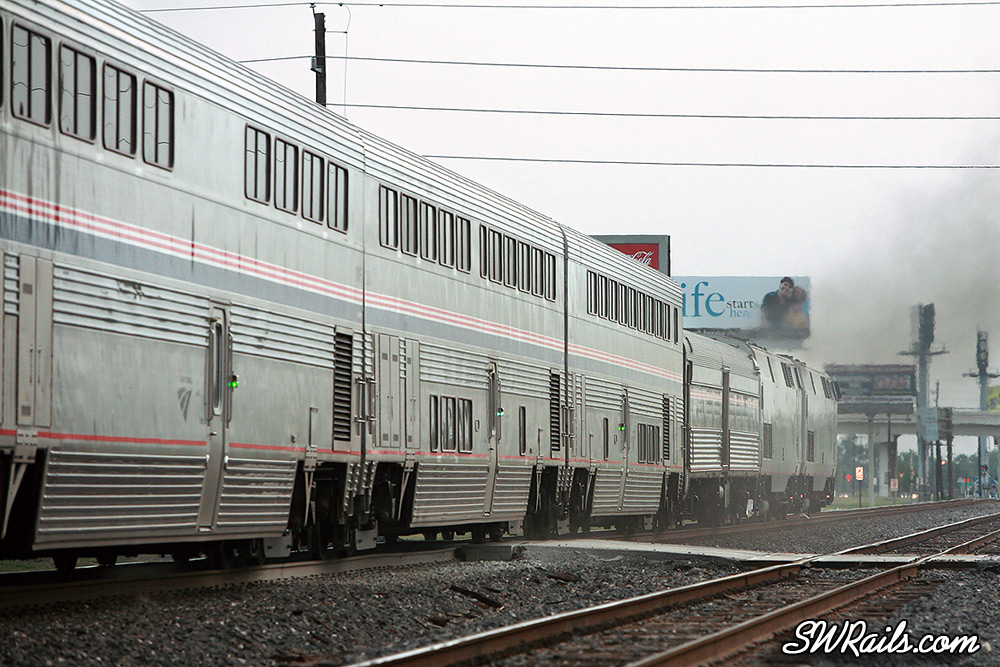
Today being such a momentous day in Amtrak history, I felt obligated to capture this event on video as well. </ Hyperbole >
The eastbound Sunset is a daylight train through the Houston area, beginning tomorrow morning. Its new arrival into Houston is 11:10 AM, a welcome change after 3-4 years of a 4:40 AM Houston arrival.
I plan on catching it tomorrow if work and weather cooperate…
Back to the Future, Amtrak Style
Amtrak rolls out a new timetable today. It makes significant changes to the schedules for trains #1 and #2 (PDF), the westbound and eastbound Sunset Limited. The new schedule calls for Houston departures in daylight (excepting the few months of CST in winter), something that stopped happening 48 years ago!
In 1964, the Southern Pacific changed the westbound departure time of the Sunset Limited from 7:40 AM to 9:00 PM. When Amtrak took over in 1971, westbound departure was pushed back to 9:50 PM. This is pretty much where it has been until now.
Effective today, #1’s new departure time from Houston is 6:55 PM, making photography of it in the Sugar Land area feasible. To commemorate the occasion, I plan on getting a few shots of it later this afternoon.
Since 1950 at least, the eastbound Sunset has been a mid to late morning arrival into Houston. This changed about 2008, when Amtrak made it a 4:40 AM Houston arrival. As of tomorrow, #2’s schedule calls for an 11:10 AM Houston arrival. Work permitting, I’ll get shots of it also.
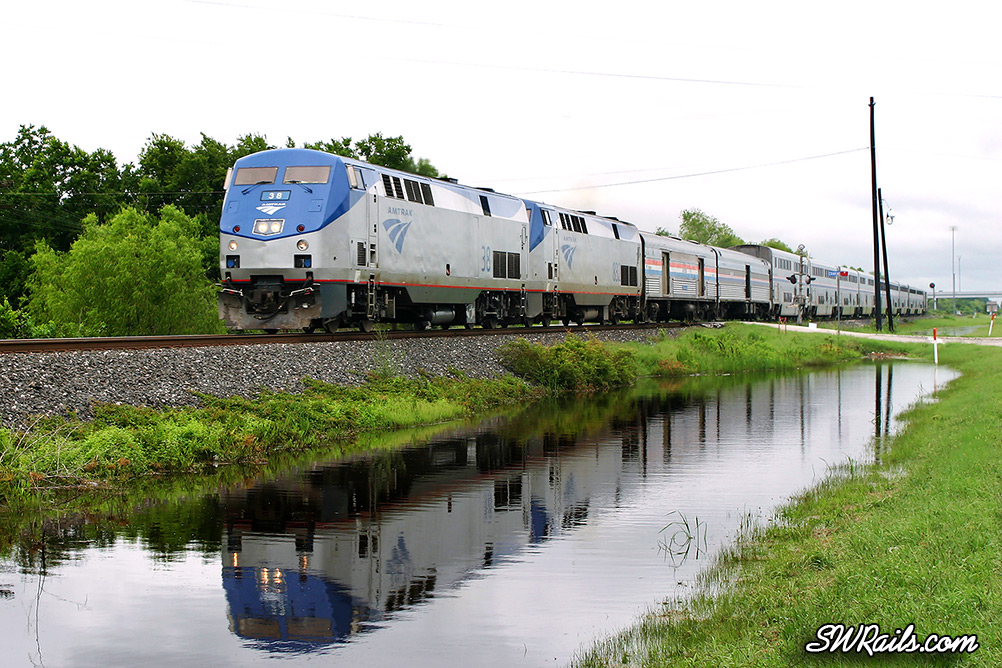
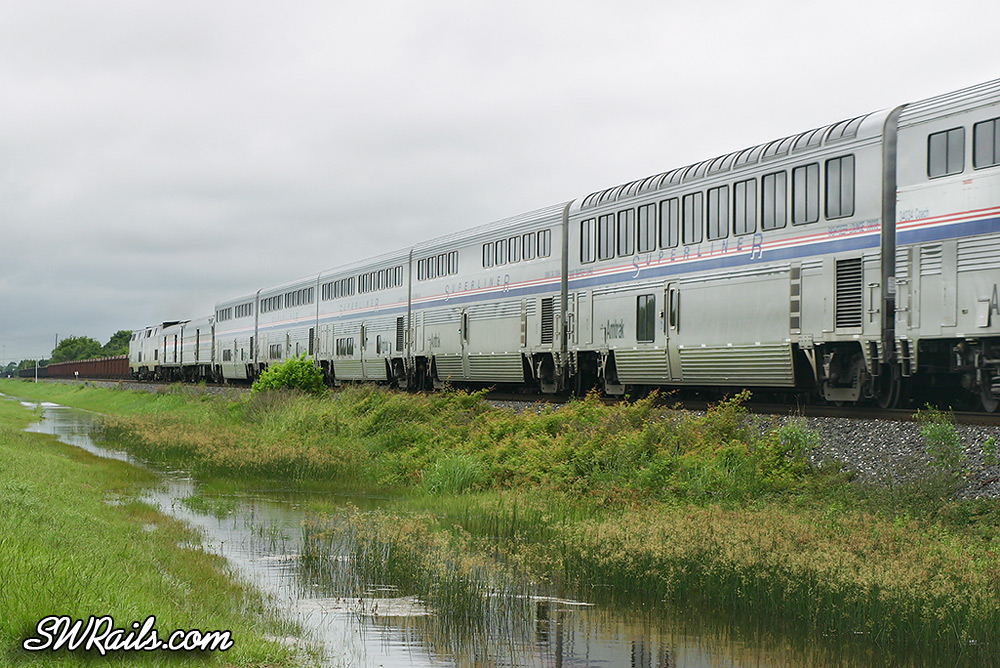
Since no post is complete without photos, I dug up some shots of very late Amtrak #1 that I took on Thursday, June 24, 2004. This train should have departed the previous evening at 9:50 PM . The photo was taken at 2:26 PM, making this Sunset Limited over 16 hours late!
I had no idea that this train was even coming. I was taking some pictures of a rock train in the Missouri City siding when I saw a westbound headlight. I realized it was Amtrak a second or two before it blew by me. I’d never seen a train go by so fast through here! The current maximum authorized speed for passenger trains here is 79mph, which is just about how fast I estimated the speed of this train.
 Southwest Rails