Bass Ackward Consist and Train Vs Tow Truck
I was traveling through downtown Houston the Saturday before last, August 11, 2012, when I saw a westbound intermodal on the Terminal Sub as it was passing over I-10. I too, was westbound on I-10 en route to a quinceanera reception in northwest Houston. I was running ahead of schedule so I figured that I could get ahead of the train and grab a quick shot or two.
I exited I-10 at Washington Avenue and doubled back to Sherwin Street, near MP 365.9. It’s the last grade crossing before Eureka Junction. As it was nearly 100 degrees outside, I waited in the car until I saw the headlight approaching. It wasn’t too long before the headlight of UP 7641, a ZATLC train, came into view. The power has just passed over I-10 on the second of three UP overpasses of I-10 in a 6-7 mile stretch of the Terminal Sub. You can see part of the overpass at right in the first image.
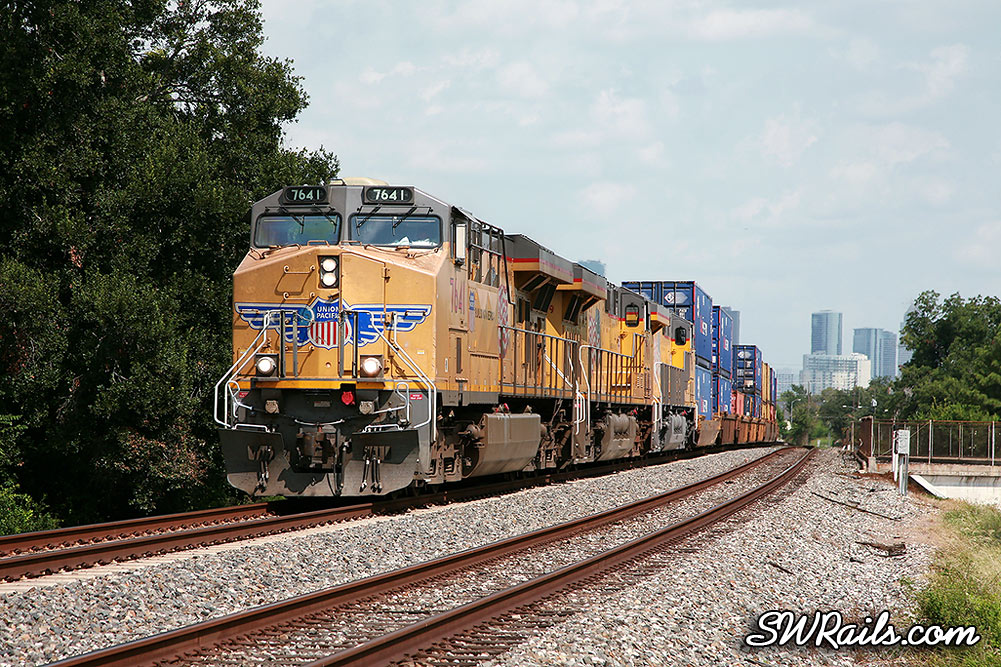
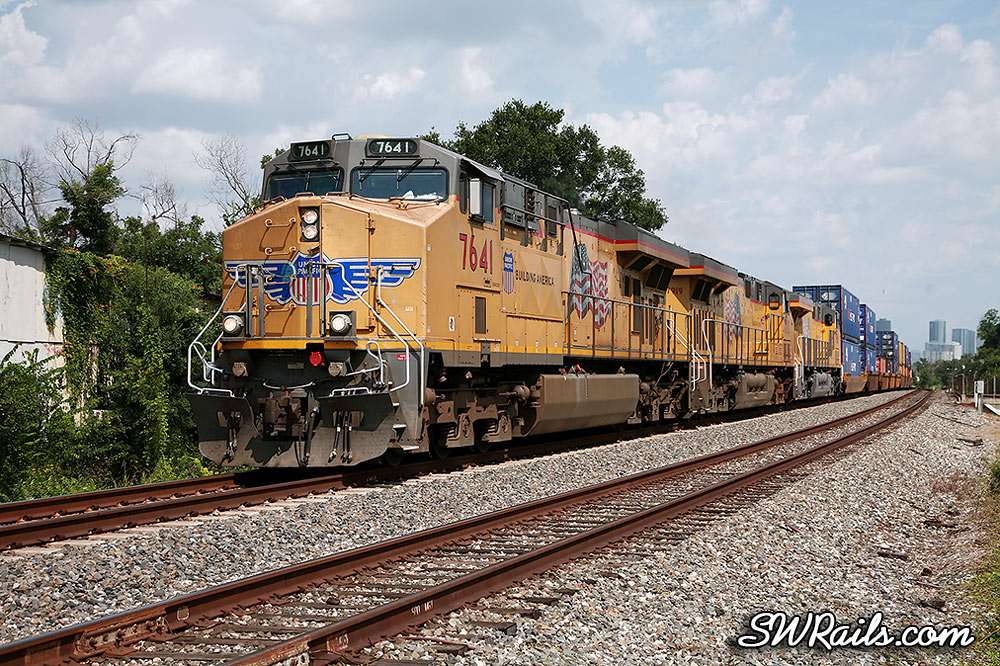
As the trailing unit passed by me, I realized that it was a brand-new GE. UP ES44AC 7960 is looking pretty sharp, being less than 2 months old! Just my luck! The brand-new unit is trailing!
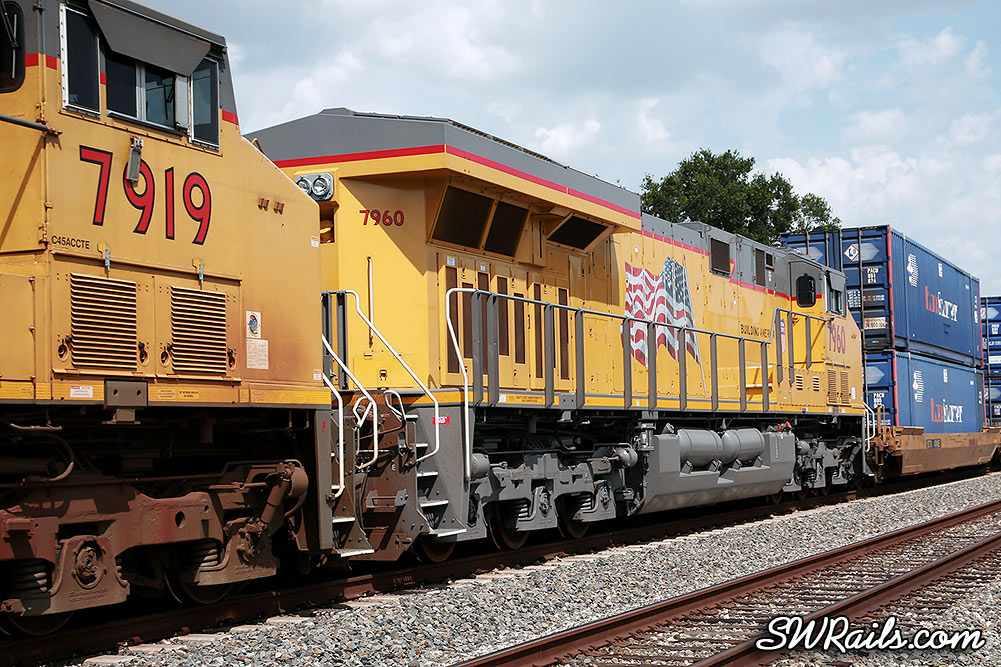
The going away shot shows the contrast between UP 7960 and the two leading units. C’est la vie…

Here’s a Google Street View of the Sherwin Street grade crossing where I took these photos. I was on the other side of the crossing, the train came from the left side of the Street View image.
I included the Street View so you could see the last thing a tow truck driver saw, or should have seen, before he got his rig high-centered on the UP track. Note the warning sign at right.
You already know the rest of the story. Click here to see the story, and short slide show, that was in the Houston Chronicle this past January 25th.
PS – I would have preferred to embed the Chronicle’s story, but they don’t seem to allow that anymore.
Out & About – July 31, 2012
I did see and photograph a few trains during my outing of July 31 to document the double tracking project of 5 miles of UP’s Glidden Sub . I didn’t include photos of those trains in the previous post because that post was already too long.
As I was leaving the house I heard the DS tell a ZLCAT train that he would take them to Willowbrook Drive where he’d run Amtrak around them. I went to Stafford to wait for the two trains. My wait at MP 19.7 for the first train was brief. The head-end block of Tropicana reefers confirms this is the ZLCAT.
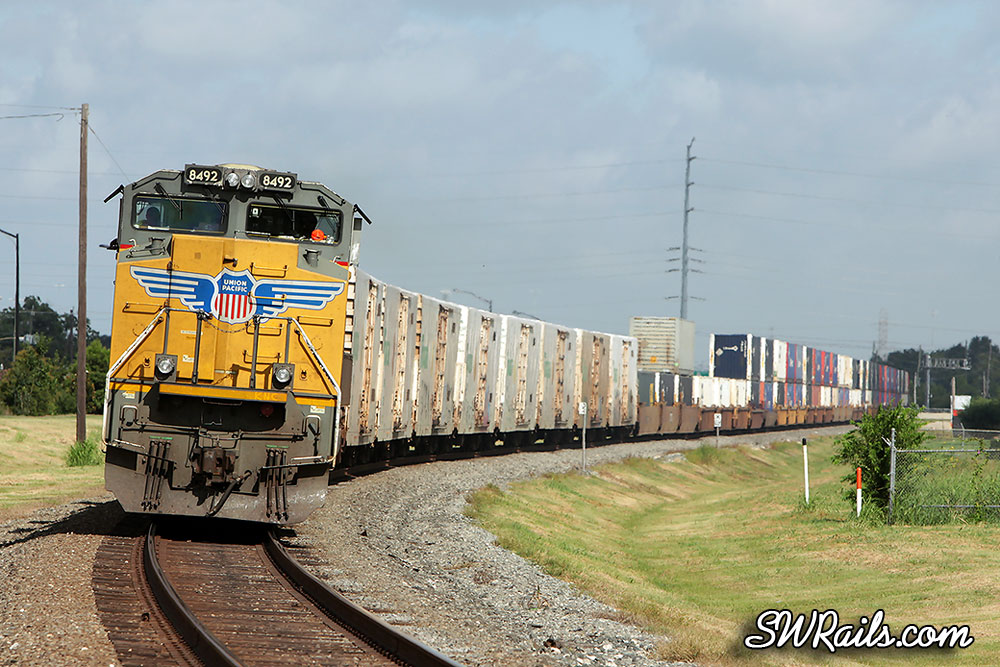
A big wave from the engineer is a nice touch in the second shot of the ZLCAT. The bright orange cap visible through the conductor’s windshield suggests there’s a conductor-trainee along with the regular crew.

Next up was Amtrak #2. I knew that Heritage P42DC 145 was in the consist, but probably trailing, so I had to set up for a wedgie. The only problem is that by this time in the morning, the sun is just too high for a properly lit wedgie. The least bad spot available was at MP 20.5…what can you really do?
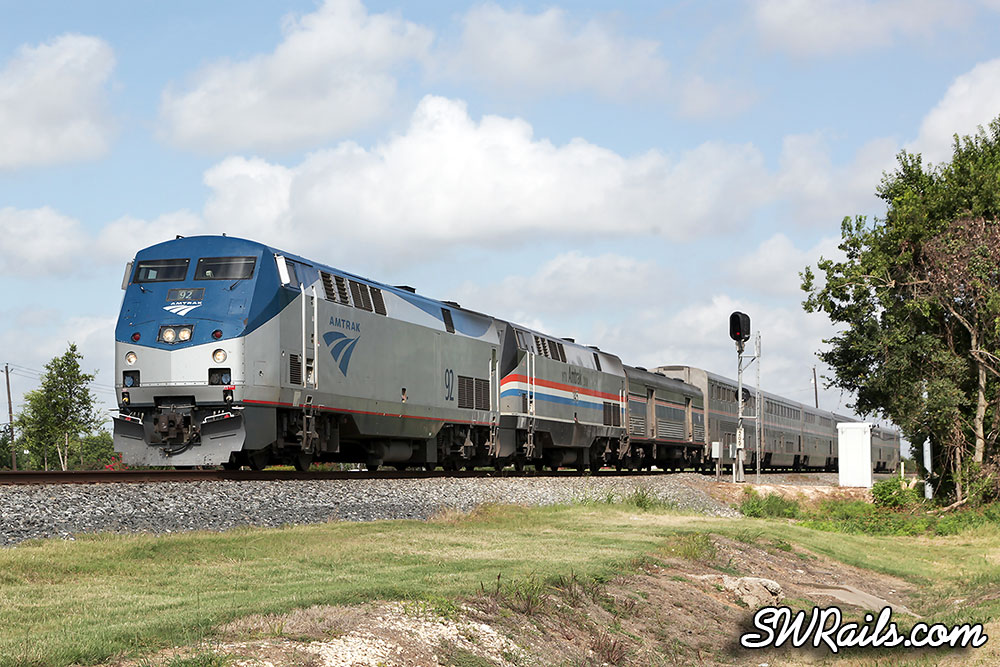
Once Amtrak passed by, the DS gave track and time to MOW forces, so it was a good time for me to get the shots I used for the previous post.
I had finished getting my shots when I heard UP 9756 ask for clearance through the limits. Even though it was high-sun-thirty, I went back to Heacker to catch it at the red board there.

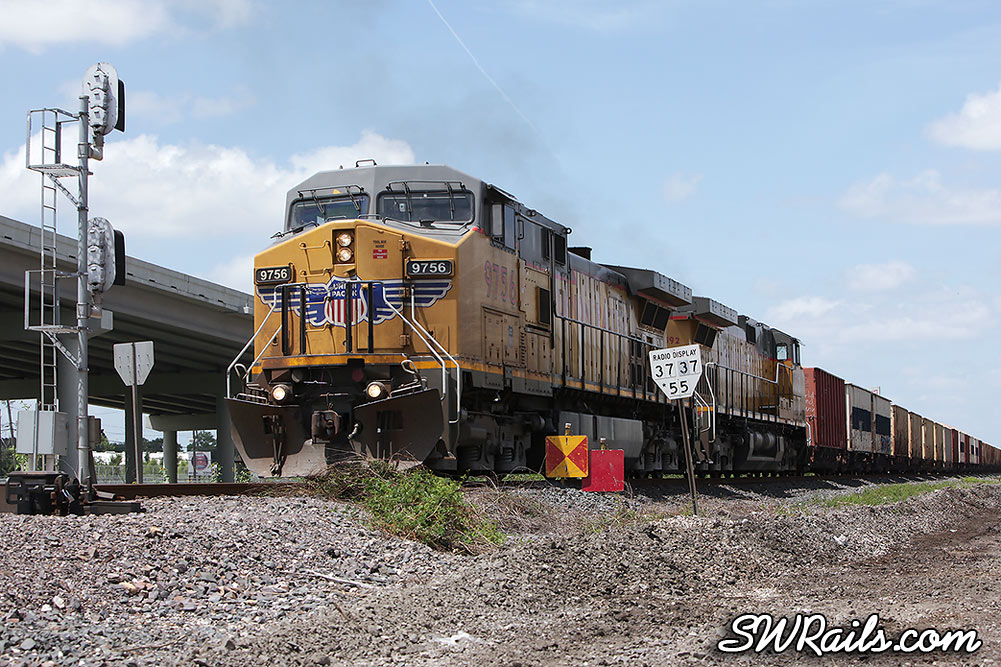
With no traffic on the immediate horizon, I took that as a sign that I should get out of the brutal heat, go home, and try to get some legitimate photography work done…
The Union Pacific has started work to expand capacity on its Glidden Subdivision. The 187-mile sub that connects Houston and San Antonio will receive its first stretch of double track, 5 miles of 2 MT between Heacker (CP SA014) to the west end of Missouri City (SA 019).
The east end of the Glidden sub is particularly congested because in addition to UP’s Sunset Route traffic, KCS and BNSF trains operate via trackage rights between Heacker and Rosenberg (CP SA036). Serious ground work began in late July. Here are some images of the project as of July 31, 2012.
Looking west from Heacker (CP SA014) you can see initial grading. Note the red and red/yellow boards protecting the all-day Form B’s.
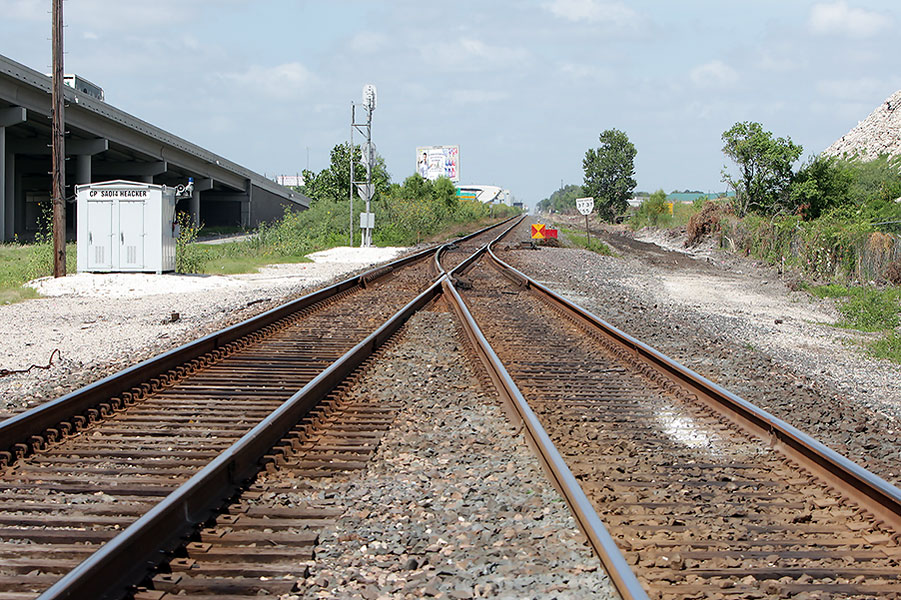
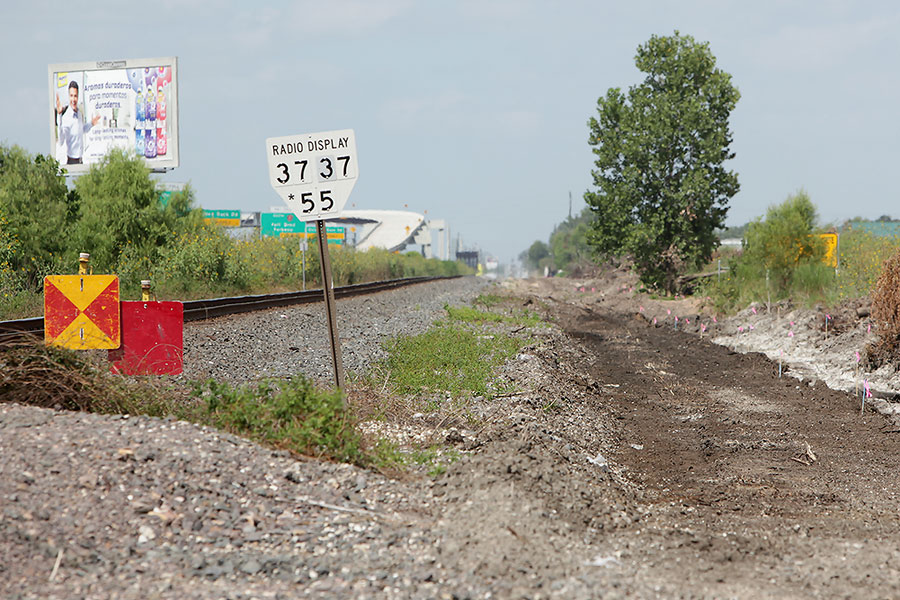
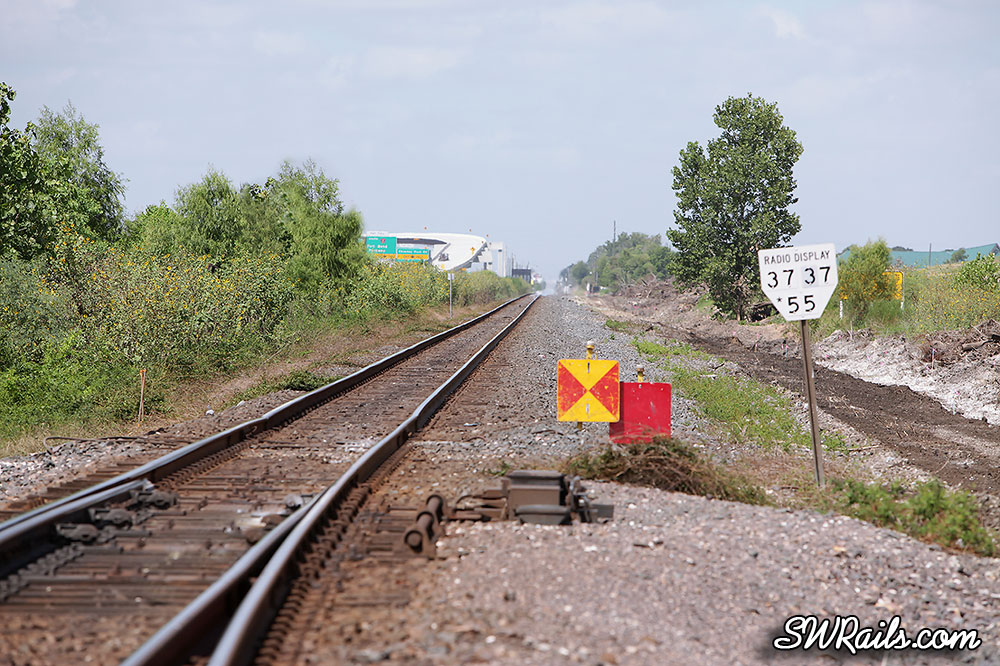
The next views are looking east from the Chimney Rock Road grade crossing, near MP 14.8. If you’ll click on the second image, you’ll be able to see the signal at Heacker in the distance.
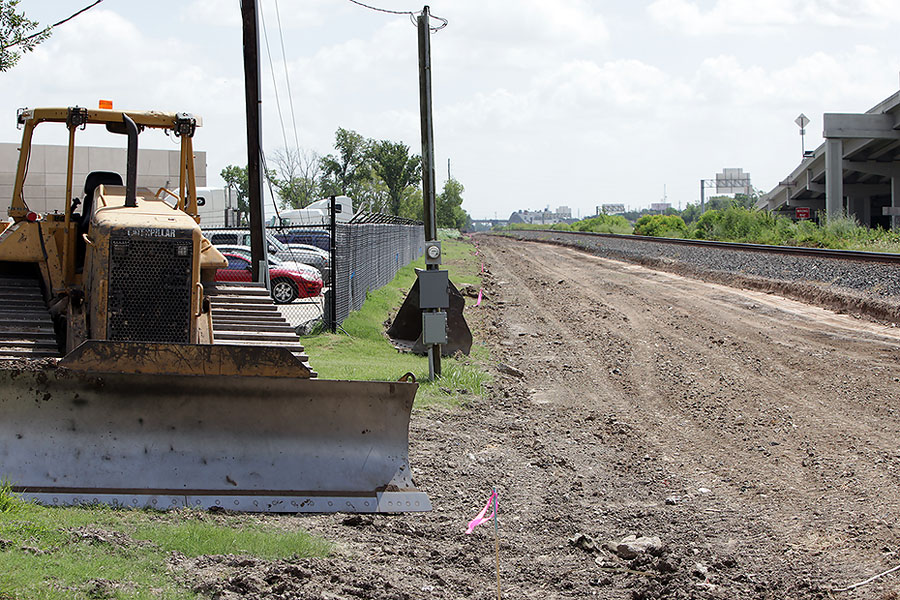
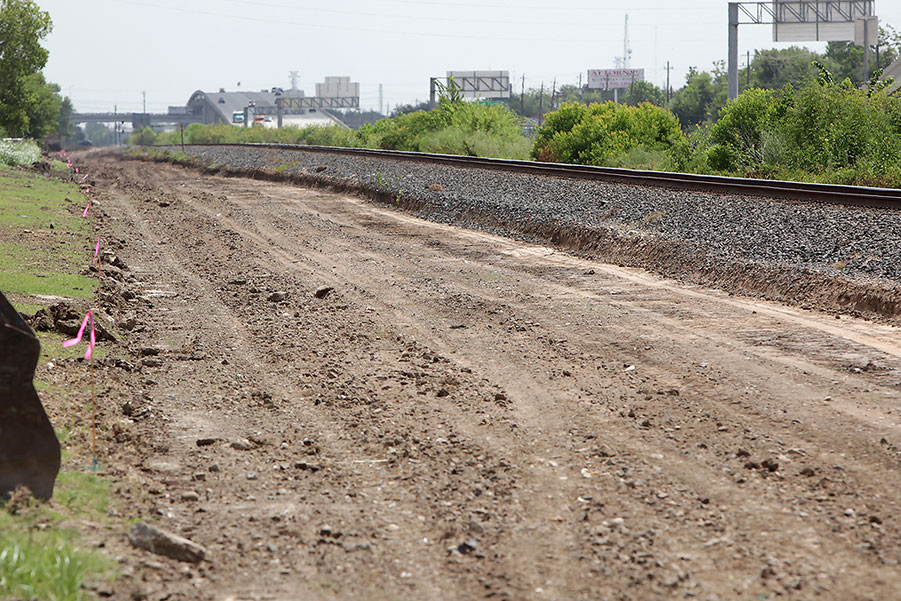
Looking west from Chimney Rock, grading hasn’t started, but you can see the new cable trenching.

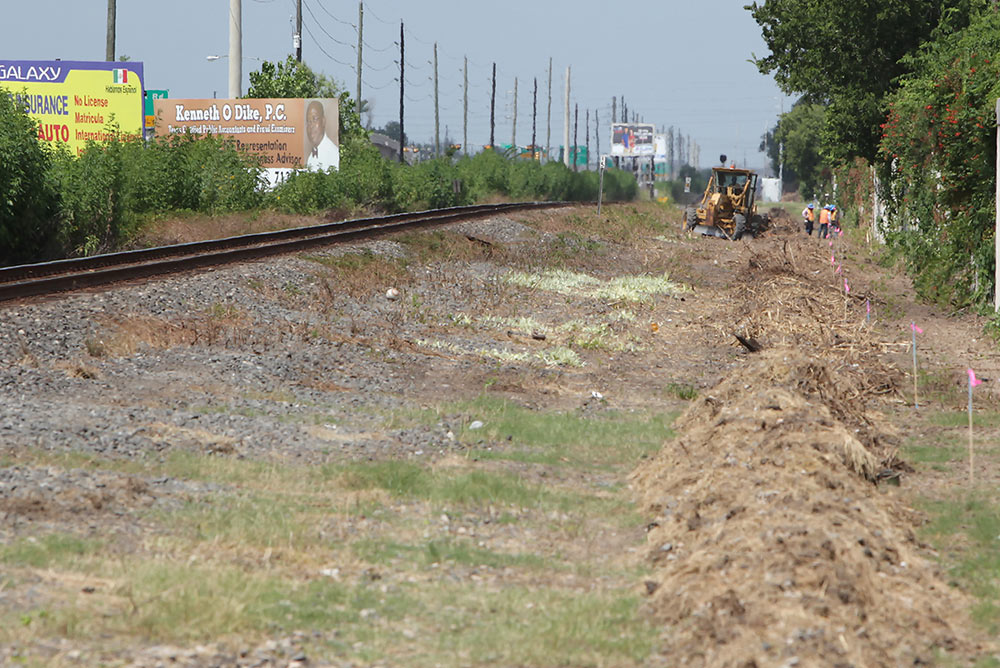
Still at Chimney Rock, a new base for the re-located grade crossing signal is already in place.
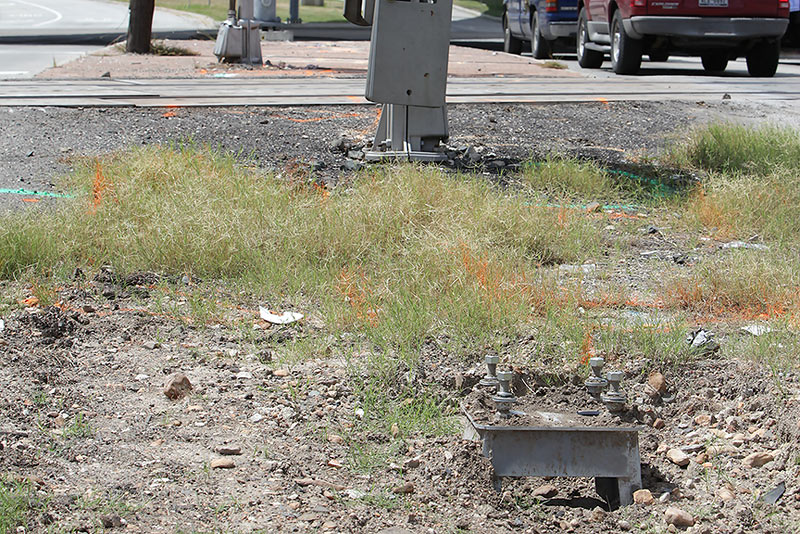
The next two grade crossings to the west are Hillcroft Blvd and Haviland St, near MP 15.6. There wasn’t much visible work there, other than some survey markers in place, which I didn’t bother to photograph.
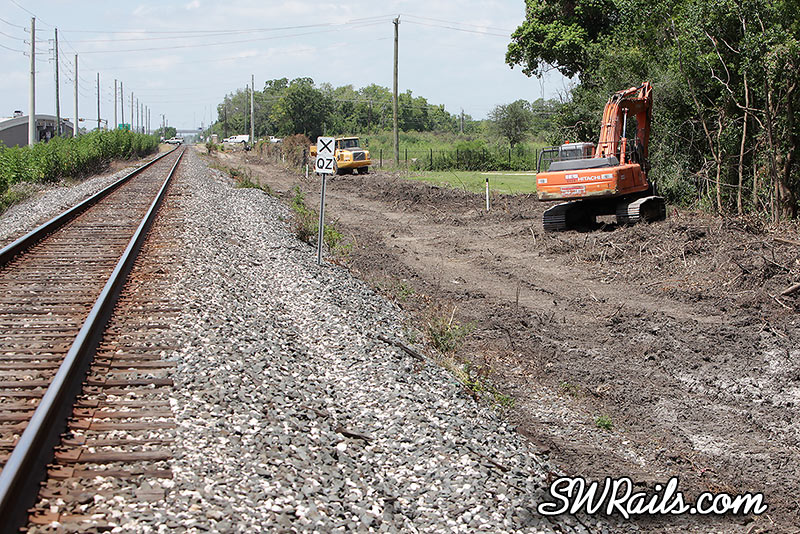
The next shot is mid-way between Haviland St. and Fondren Road, looking west as contractors clear the right of way.
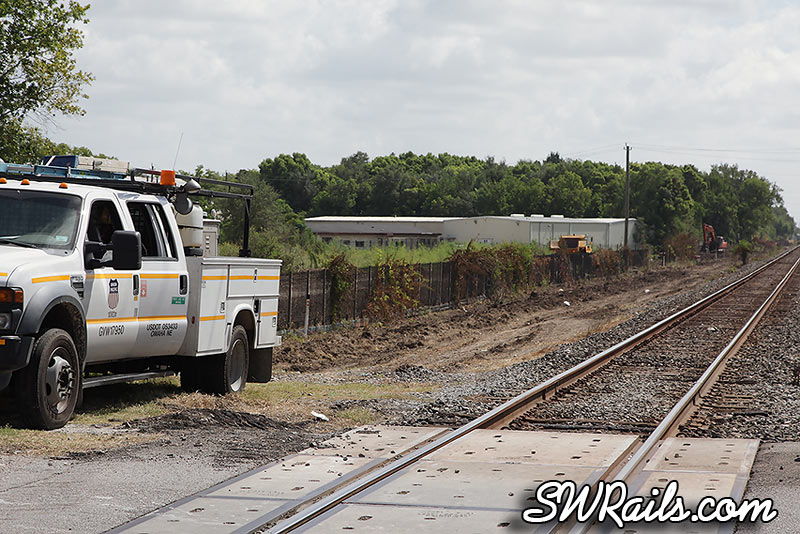
Proceeding westward to the Fondren Road grade crossing, near MP 16.25, contractors were running conduit. The next two images are looking east.

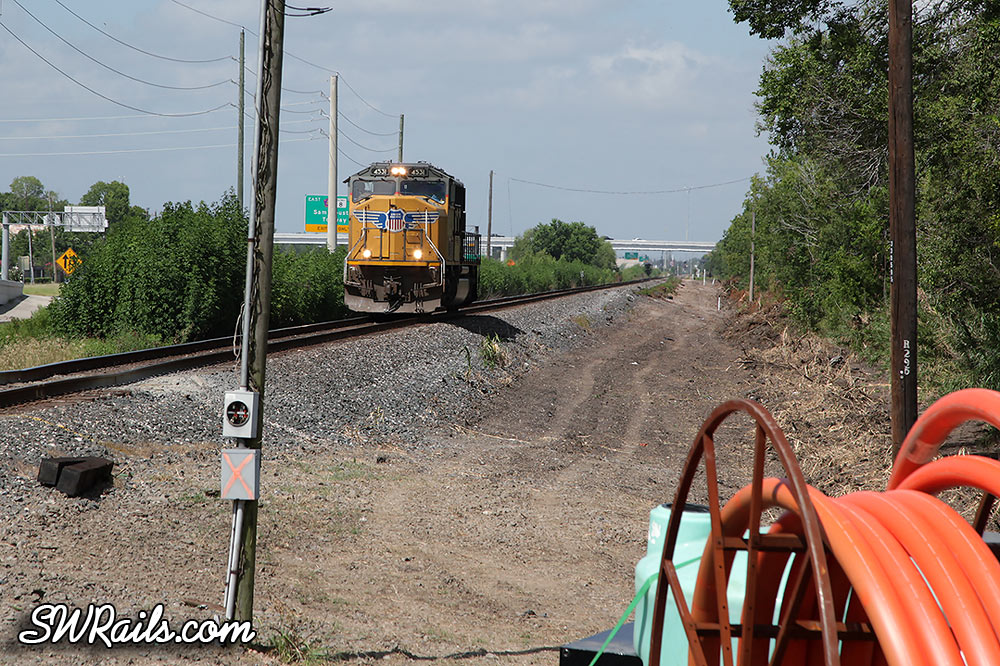
I was still at Fondren when an eastbound light power move, UP 4531, passed the newly cleared right of way west the grade crossing. The overpass in the background is Beltway 8.
My last stop was MP 17. The first two images are looking east toward the Fondren road grade crossing.
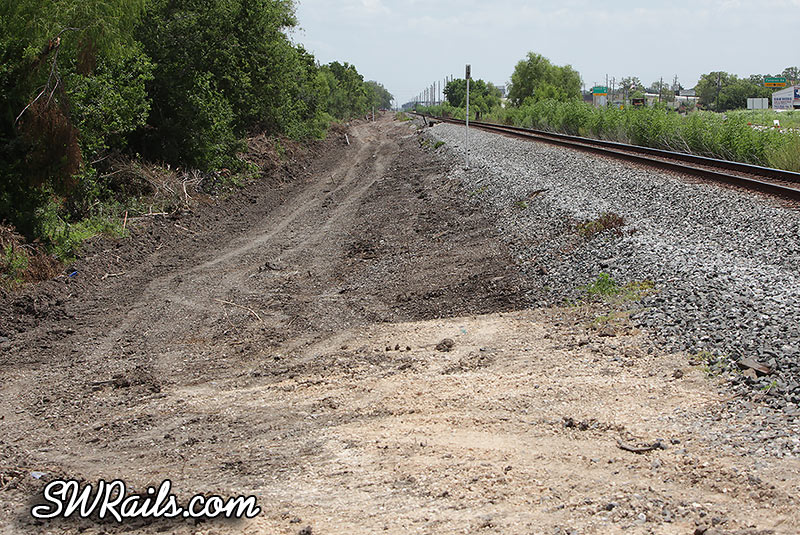
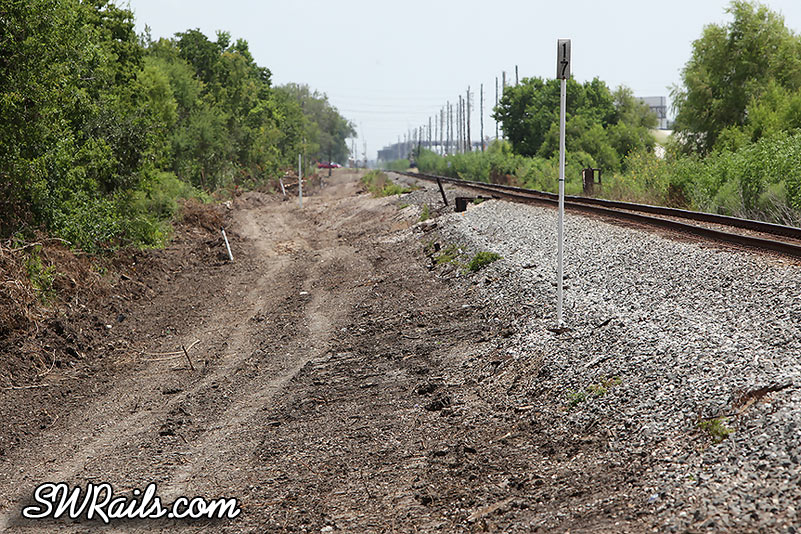
Turning to the west, you can see the overpass over the Beltway 8 feeder roads. When the Beltway was built through here, approximately 1997-1998, the UP overpass was built to accommodate a future second track.
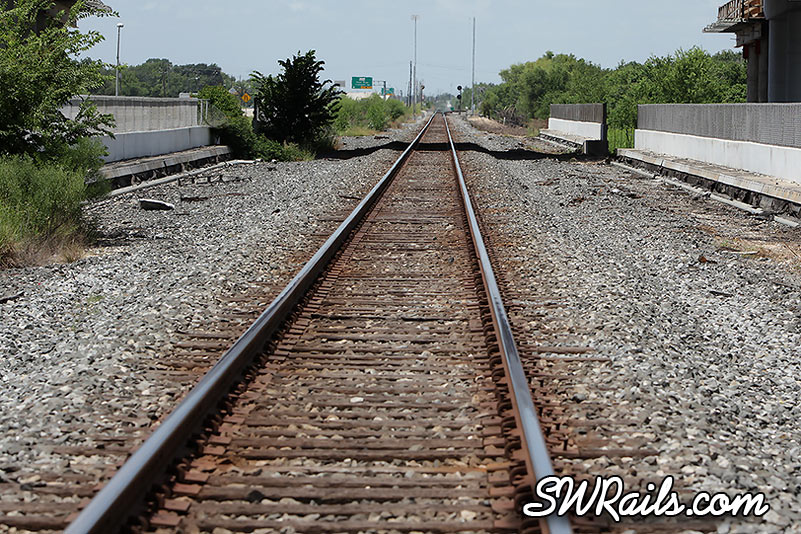
The last two views are from the west side of the overpass. You can see the signal at the east end of Missouri City (CP SA017). I suspect when the second track gets here, they’ll tear out the Missouri City siding, using its alignment to accommodate the second main track.
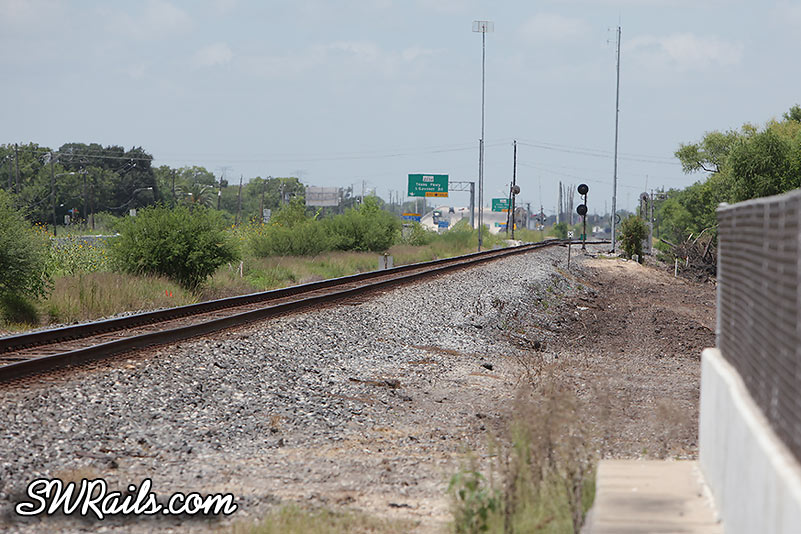
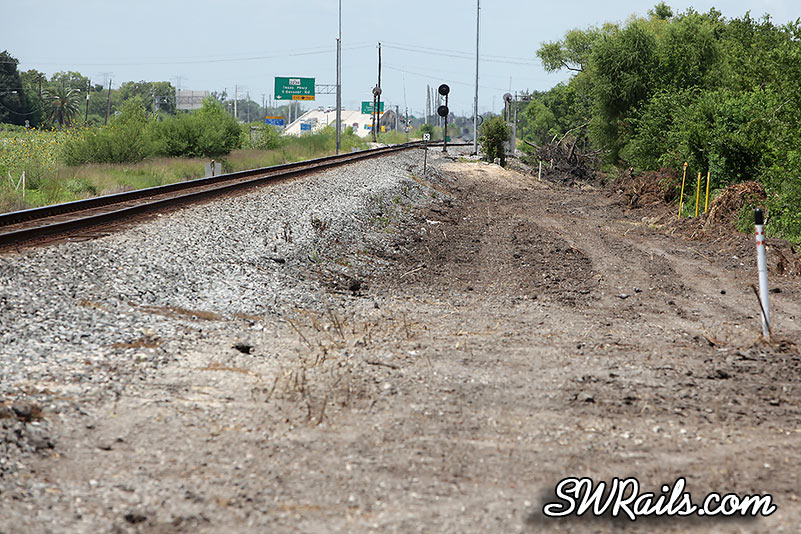
An employee ventured a guess that this project would be complete by the end of the year, meaning that the days of train meets at Missouri City are an endangered species.
BNSF Detour
I was on my way home from covering a deposition in the Medical Center this afternoon when I came across a westbound BNSF train waiting at CP SA014. I thought about stopping to get a shot or two of it, but the light was pretty marginal, so I continued homeward, westbound on Hwy 90.
I was nearing home when I heard BNSF 6263 calling for clearance through a Form B. I was tired and hungry, but I haven’t shot much BNSF recently, so a quick detour was in order. What’s another 30 minutes?
I ended up near MP 21.5, near the west end of a curve that runs between Dulles Avenue and US 59, the Southwest Freeway, overpass. Some 10 minutes later, BNSF 6263 came into view.
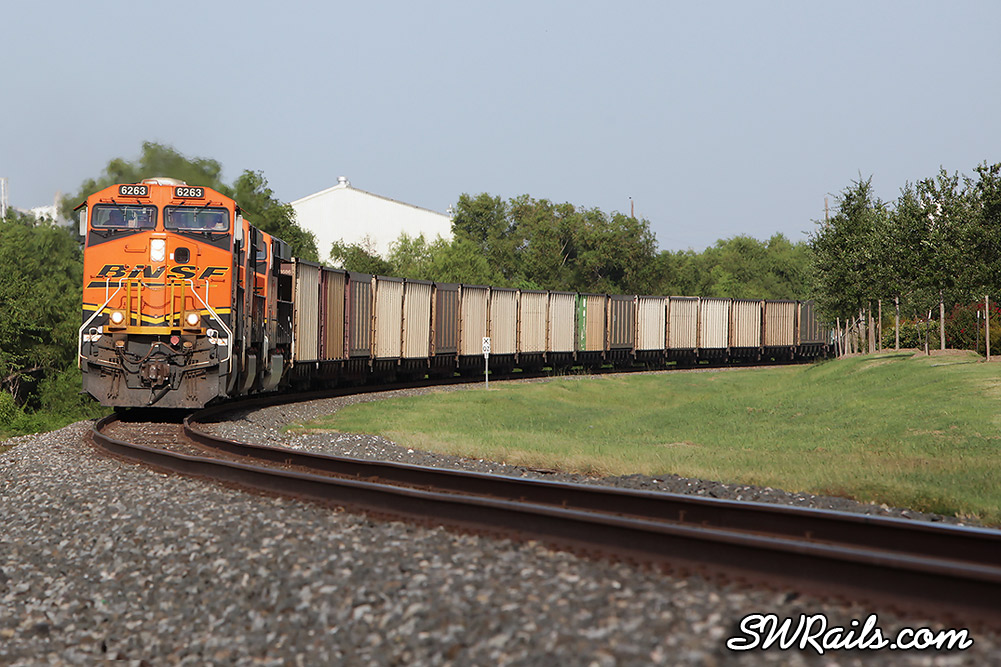
The crew responded to my wave by lightly tapping the whistle twice as they went by me. Unbeknownst to me at the moment, the conductor also had a big wave for me, which I discovered when processing these images. Click the below image for a larger image.

One last shot as the head end passes the 60mph speed board shortly before ducking under US 59.
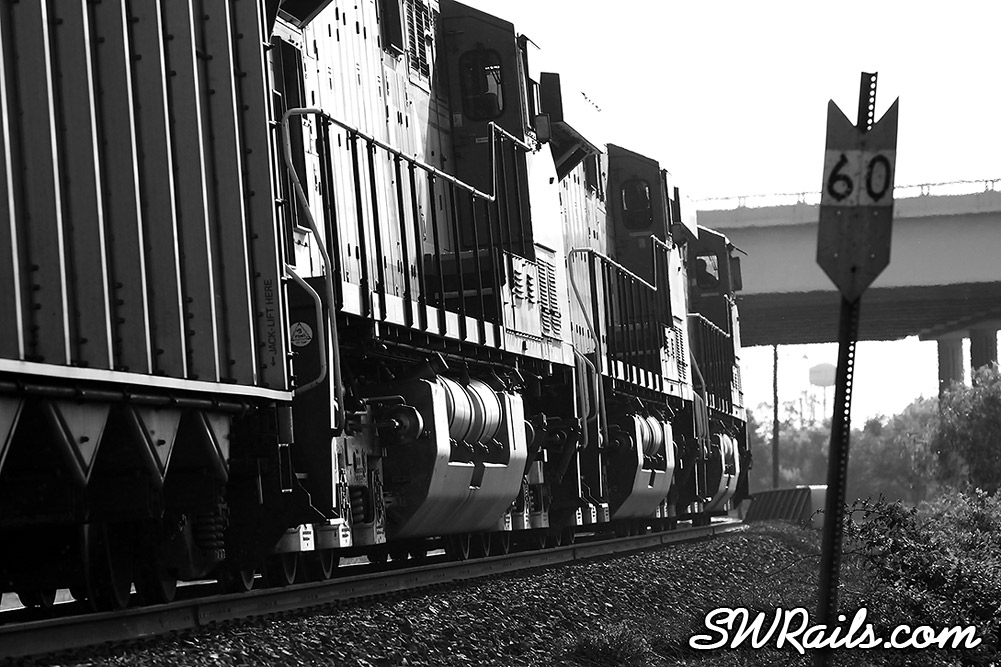
The DS had one more westbound about 20 minutes behind this BNSF, but that was “a bridge too far” for me. I wasn’t able to have lunch today, so dinner at home was more enticing.
Out & About – August 9, 2012
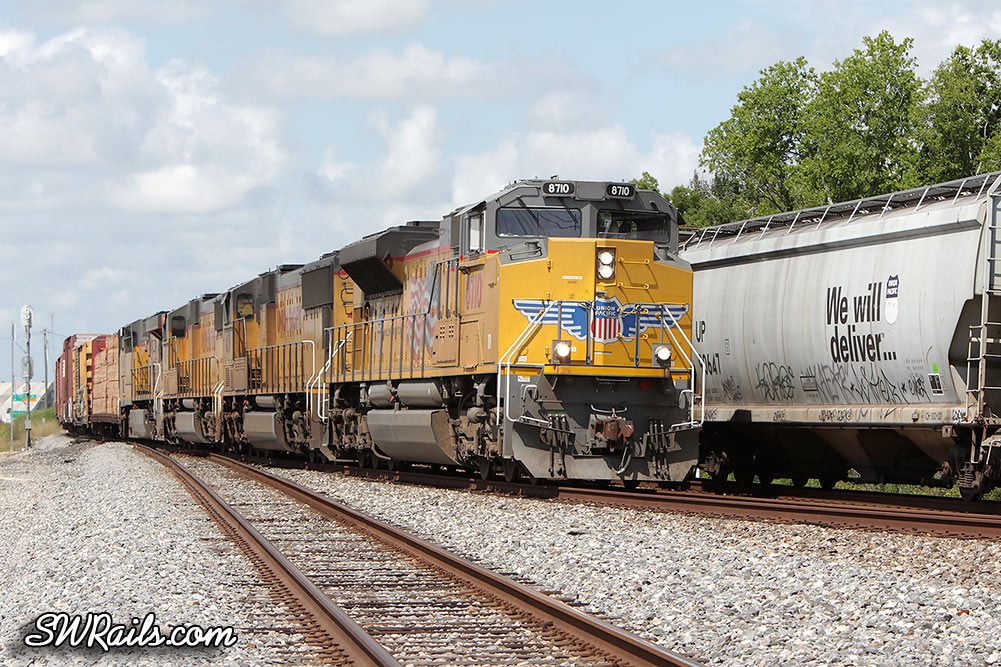
I got out a bit this morning to catch at least one train this week. I heard the DS tell the QWCEW train, UP 8710, that he was ready for them at the east end of Sugar Land, CP SA025.
My plan was to catch the 8710 in the curve at the west end of Missouri City, CP SA019. Typical running time from CP SA025 to CP SA019 is about 10 minutes. Driving time from home to CP SA019 is about 10 minutes, so I hit the door pronto.
My wait was literally less than one minute when the headlight of the QWCEW (Quality West Colton-Englewood) came into view as it leaned into the super-elevated curve.
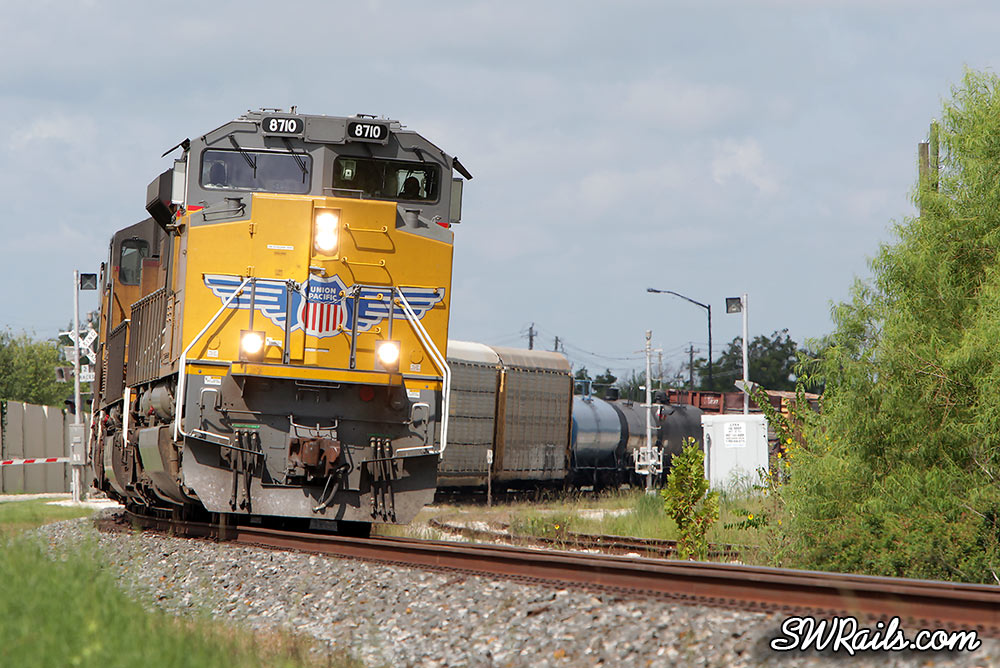

As the head-end got by me, I noticed the lead motor seemed to be working fairly hard. Before I could wonder why, noticing that the 3 trailing motors were off-line provided the answer. The UP isn’t kidding about fuel conservation!
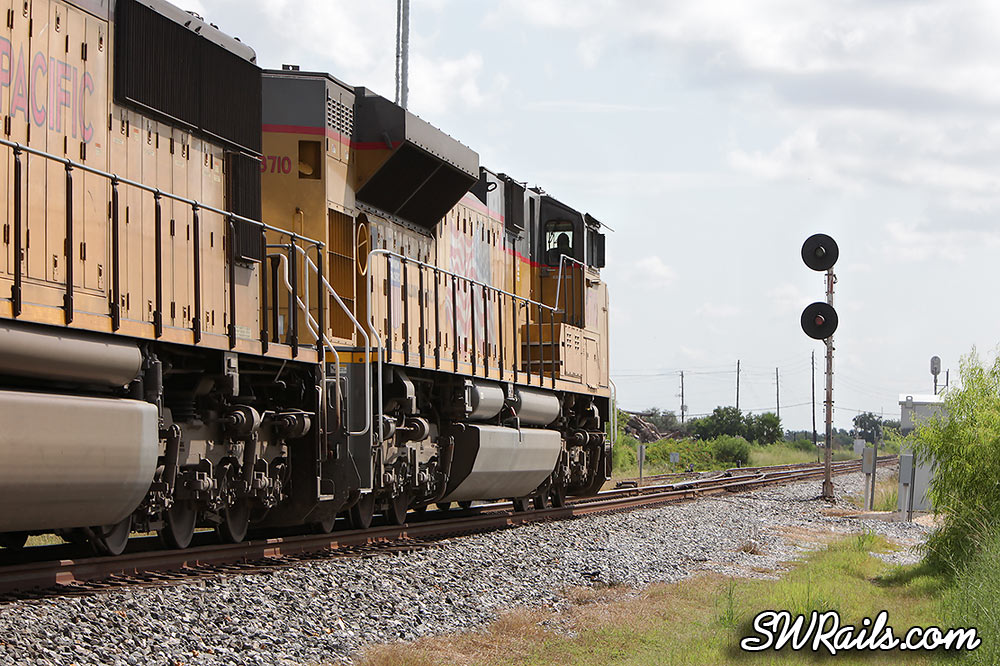
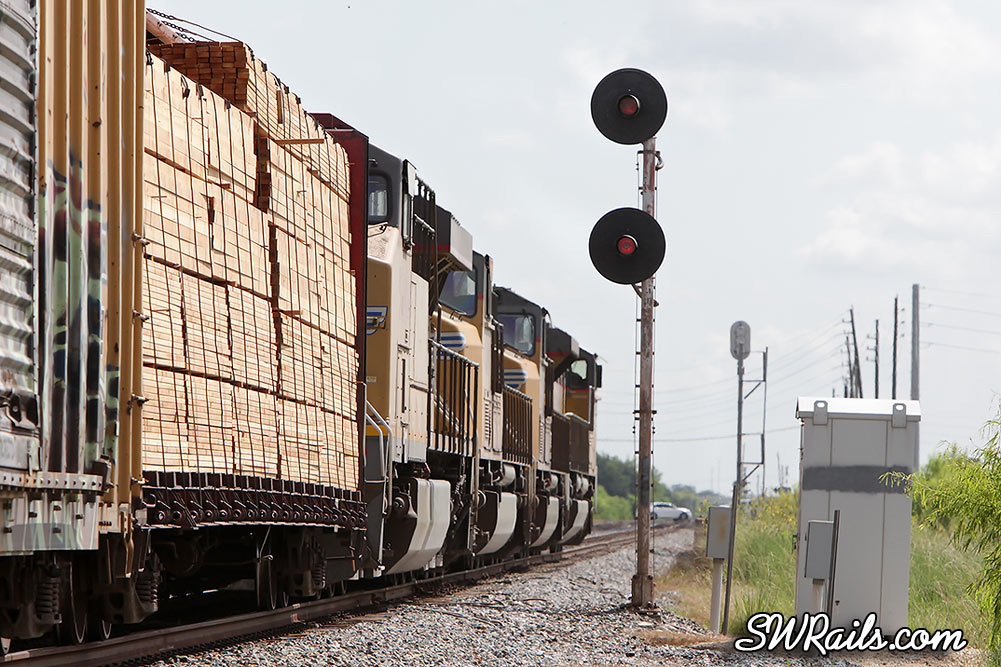
This train typically runs with DPU power, but I didn’t stick around to see what might be shoving as I wanted to get another shot of this train at West Junction.
A westbound was already there, waiting for the 8710 to clear up before continuing its trip to San Antonio.
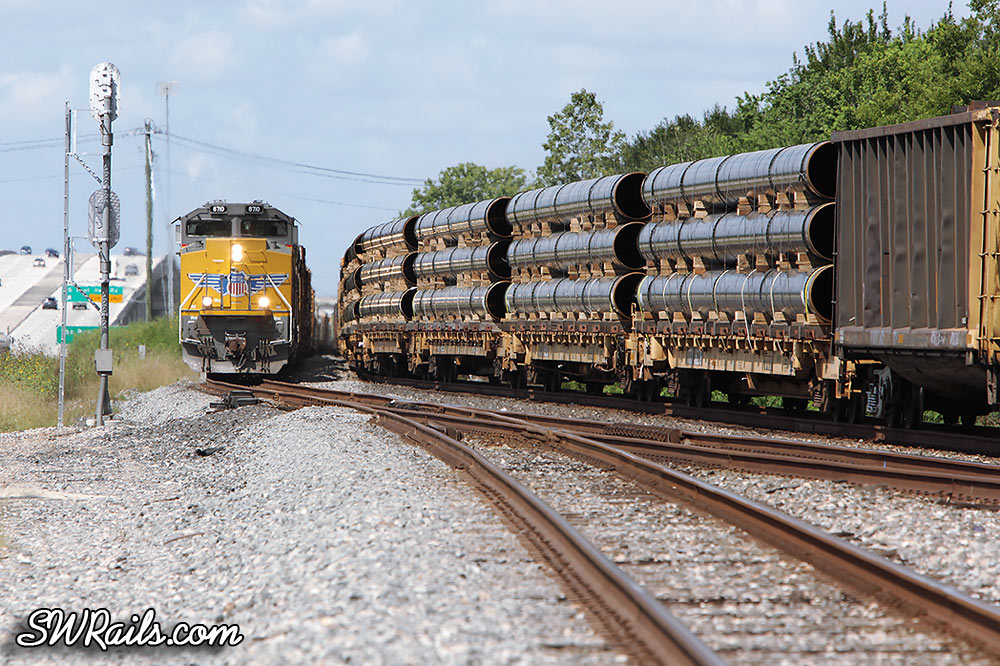
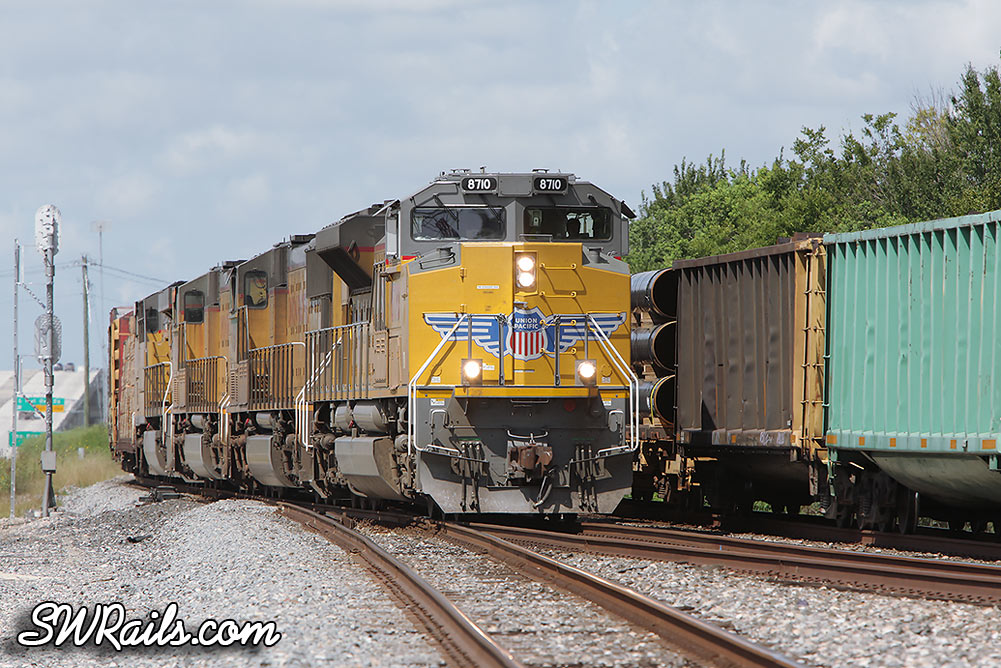
There was an interesting load in the train. It appears to be some sort of counter-weight for a massive crane. Emmert is a heavy-haul/ lift contractor based in Clackamas, Oregon near Portland. Regardless, it seems to be really heavy based on being loaded on 2 12-axle flat cars, QTTX 131101 and 131103.
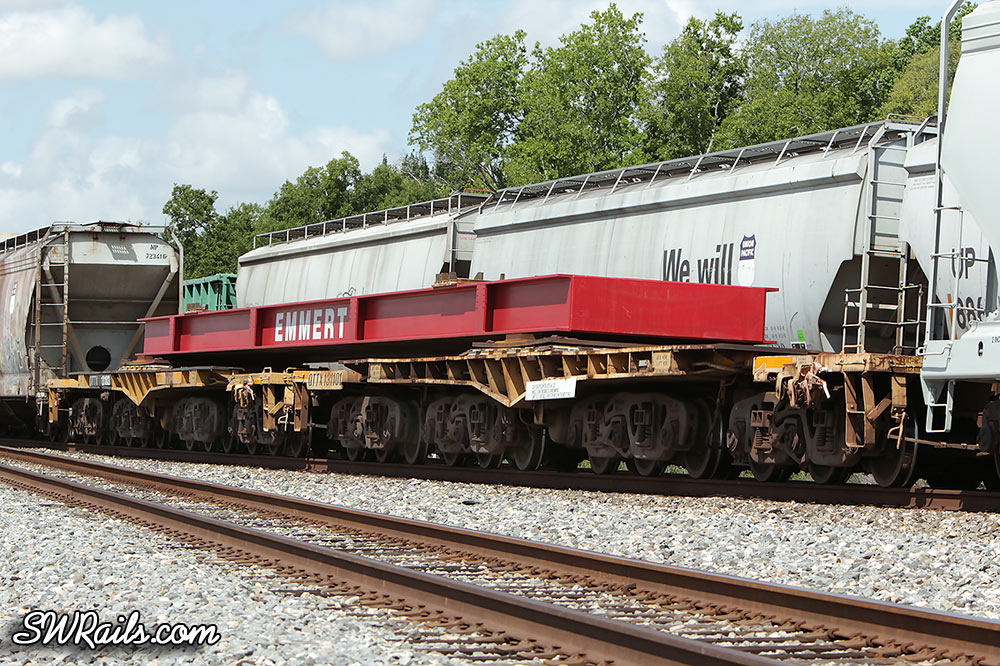
I was curious where the Emmert load is headed but all I could learn from a trace this evening is that the load is at Settegast account bad order brake rigging. Any additional information will be appreciated.
Vintage Auto Racks
In the interest of mixing it up a bit around here, let’s go back some 35-45 years to the era of open auto racks. Yes, there was a time when you could actually see the vehicles that were loaded on an auto rack. Contemporary auto racks are so well sealed that you can’t even tell if they’re loaded or empty. Of course, I understand why. One luxury SUV today can cost more than an entire carload of 18 Ford Pintos in 1975!
First up is a view of new Plymouths passing through St. Louis in 1966. I don’t have any clue what model of Plymouth is shown. Maybe a reader can let us know in comments.
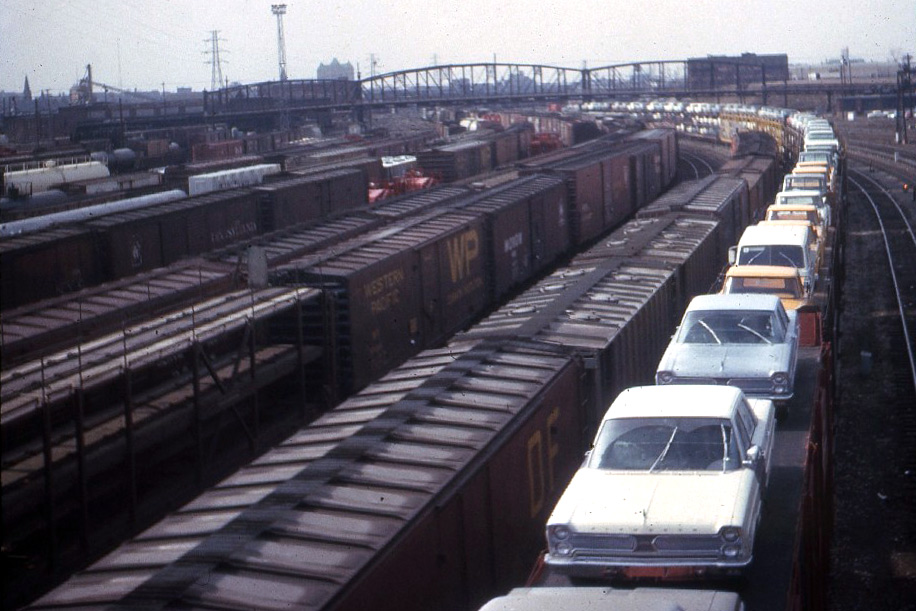
Speaking of carloads of Pintos. Note the side shields, an early protection measure for new auto shipments, on the auto racks on each end of TTX 904697, shown at Detroit in October of 1975.

Last, is there any guy in the 1970’s that didn’t want a Trans Am? Well, besides me. I was happy in my Mustang. Here’s a carload of new Camaros and Firebirds, the poor man’s TransAm, passing through Detroit in October of 1976. Again, this open rack has side-shield equipped racks on each end, suggesting that completely open racks were being phased out by the 1975-1976.

I don’t guess that any of the vehicles in these 3 images are still on the road. Then again, the N&W is long gone. Heck, even Plymouth is gone. Well, at least Detroit and St. Louis are still with us…
Railfan Hat Trick
If I were a betting man, today would have been the day to play the lottery because I achieved my first railfan hat trick.
I know you’re probably thinking “Whiskey Tango Foxtrot is this guy talking about?” Fair question, so read on.
We had just finished cleaning up the kitchen this evening, August 1, 2012, when I heard the DS tell an eastbound that it would be at Sugar Land for two trains, Amtrak and a KCS.
I looked out the window and saw that it was fairly clear. I grabbed a camera and made the quick trip to MP 21.5 on the Glidden sub to indulge in my current favorite pastime, photographing Amtrak #1, the Sunset Limited in the last light of the day.
I wanted to catch it from the US 59 overpass, but I didn’t want to park on the shoulder any longer than necessary. I ended waiting in a shopping center parking lot until I heard the detector at MP 15.6 announce 36 axles at 65 mph. That was my cue that I had 5 minutes to drive the mile or so and set up.
I have done this shot a few other times, so I knew exactly where to park on the shoulder. With my emergency flashers on, I moved over to the passenger side, opened the window, folded the mirror in, made a few camera adjustments and waited no more than 2-3 minutes when I saw the train enter the curve just west of MP 21. Show time…


Shots in the bag, I contorted myself across the center console, back behind the wheel. My plan was to set up for the KCS that was following #1, but the DS mentioned that it was just leaving Eureka. That’s a good 20 miles away. By the time it got out to me it would be too dark, so I went home to savor my hat trick.
So what’s this hat trick business? I will put the question to you. If you read the 6 paragraphs and looked at the two pictures, you have all the data you need to divine just what the heck I’m talking about.
Go to Comments below and give your best guess of what my railfan hat trick was. You won’t win anything, but you will be able to impress all of your friends, neighbors, family, and co-workers with your feat…
Surprise Espee Catch
Our oldest son, Andy, took several weeks of leave to visit us in early July. When it was time for him to return to Dyess AFB in Abilene, he drove via his normal route, Texas Hwy 36. It’s a straight shot from Rosenberg all the way to Abilene. It also has some nice scenery, as it parallels the BNSF Galveston sub mainline from Rosenberg to Temple.
He returned to Abilene two Mondays ago, July 16th, about 11:30 A.M. Shortly after noon, he called me to tell me that he had just seen a northbound rock train on the BNSF, several miles south of Sealy. Power was one unit, an un-patched Southern Pacific locomotive! Did I mention he’s a hard-core SP fan that’s quite bothered by the fact that he was born in 1990, way too late to properly experience the SP?
But he hadn’t been able to get a shot of it since he encountered it. I told him that it was a Union Pacific train and that it would probably make a left at Sealy onto the old MKT mainline, now UP’s Smithville Sub. His one chance at a decent shot (at noon in July!) would be somewhere off of FM 1094. I gave him some directions and wished him luck.
Ten minutes later, he calls back to tell me that the train did in fact take the route I mentioned, and that he was stoked to get his first shot of an SP unit leading a train since ever.
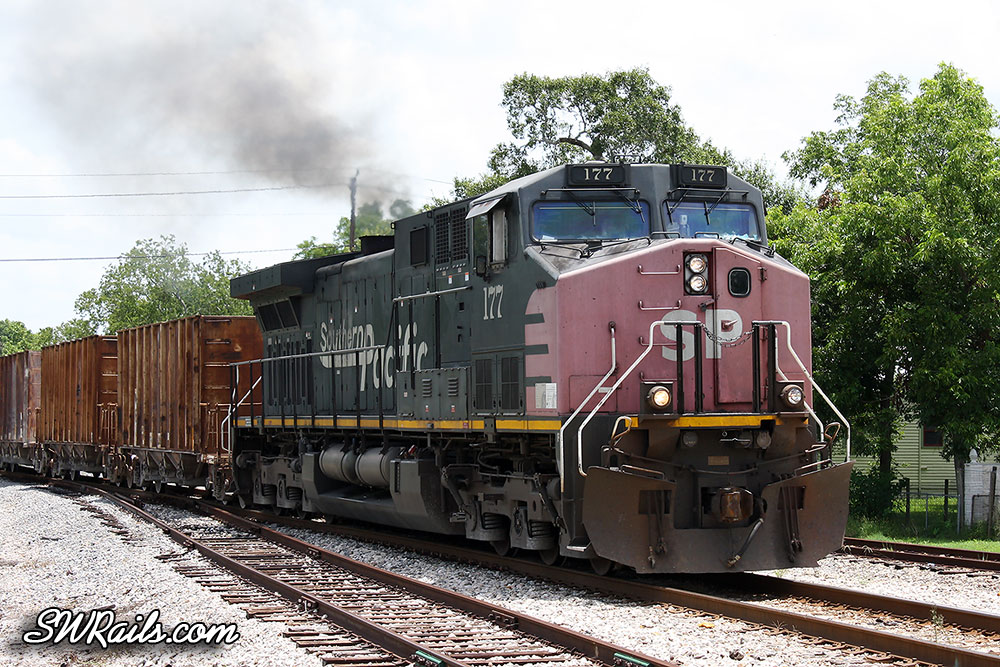
Other than the red nose being faded, the unit looks pretty good considering its age, almost 17 1/2 years at this writing. When I say “looks pretty good”, that is, of course, a relative term.
Let’s look at an image of SP 177 from 1999, when it looked absolutely, not relatively, pretty good.

Can you believe that it’s been 16 years since the UP took over the SP? Neither can I…
Head-On Collision of 2 UP Trains at Goodwell Oklahoma
On June 24, 2012, about 10:01 a.m. CDT, eastbound UP intermodal ZLAAH-22 and westbound UP auto train AAMMLX-22 collided head-on UP’s Pratt Subdivision near Goodwell, Oklahoma.
As a result of the collision, both crewmen on the eastbound train and the engineer on the westbound train were fatally injured. The conductor on the westbound train jumped from the locomotive prior to the collision and survived, with no major injuries. Speculation is the eastbound crew had fallen asleep.
The ZLAAH-22 consist was UP 8542 / UP 5482 / UP 7914 / UP 7735 DPU; 108/0/7915/6328. The 3 lead units and first 24 well cars derailed.
The AAMMLX-22 consist was UP 8692 / UP 4855 / UP 7215 DPU; 80/0/7743/5760. The 2 lead units and first six cars, loaded auto racks, derailed.
The maximum authorized speed for freight trains in the area of the accident is 70 mph. Event recorders from the lead locomotives of both trains were severely damaged during the collision and the data could not be retrieved. Event recorder data from the rear locomotives of both trains, as well as recorded data from the signal system, is being examined to determine train speeds and signal aspects prior to the collision. Initial data review from the rear locomotives indicates that the eastbound train was traveling about 64 mph and the westbound train was traveling about 38 mph at the time of the collision.
The westbound was lined into the east end of Goodwell siding, while the eastbound was to hold the main. The eastbound ran through the red signal, and switch, at Goodwell. Impact was about one mile east of the east switch.
Here’s an NTSB investigator measuring the switch point gap created where the eastbound ran through the east switch at Goodwell.

(Click to view high resolution image)
Here’s another view showing NTSB inspectors at the collision site.

(Click to view high resolution image)
The final NTSB report with likely causes of the accident, and NTSB recommendations, is expected next summer.
Sunset and a Belle at Sunset
The window of opportunity to photograph Amtrak #1 in the Sugar Land area in decent light is starting to close, what with the days becoming shorter and shorter. As such, I’m trying my luck as often as the weather permits.
This evening was looking pretty good, no heavy clouds in the west, so I grabbed some gear and went to the east switch of Sugar Land. By the time I arrived there at 7:25 PM, the quality of the light had deteriorated. As the sun neared the horizon, it had entered a thick layer of haze. No matter, I was already there and there was a high green at CP SA025.
As it turned out, the train was running about 12 minutes behind the norm, not coming into view until 7:40 PM. P42DC 142 has just come out the shadow of the Imperial Sugar Building.

Amtrak’s westbound Sunset Limited, passes through Sugar Land TX on July 28, 2012
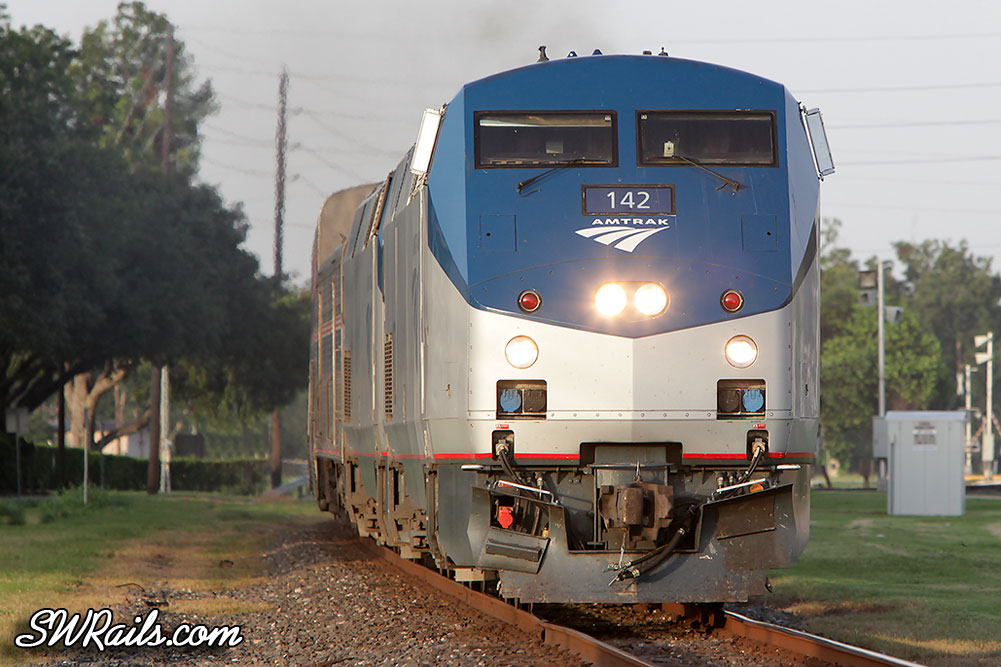
I wanted the next shot to show the head end coming out of the curve, with a clear view of the mainline ahead of the train. Close, but no cigar. As you can see, the lead unit got into the frame a bit too much, just blocking the mainline in the distance. But I’m not gonna beat myself up too much over missing the shot because the train did blow by me at 55-60 mph. Note to self: next time take picture 1/10 second sooner.

Amtrak #1 approaching CP SA025, the east switch of Sugar land

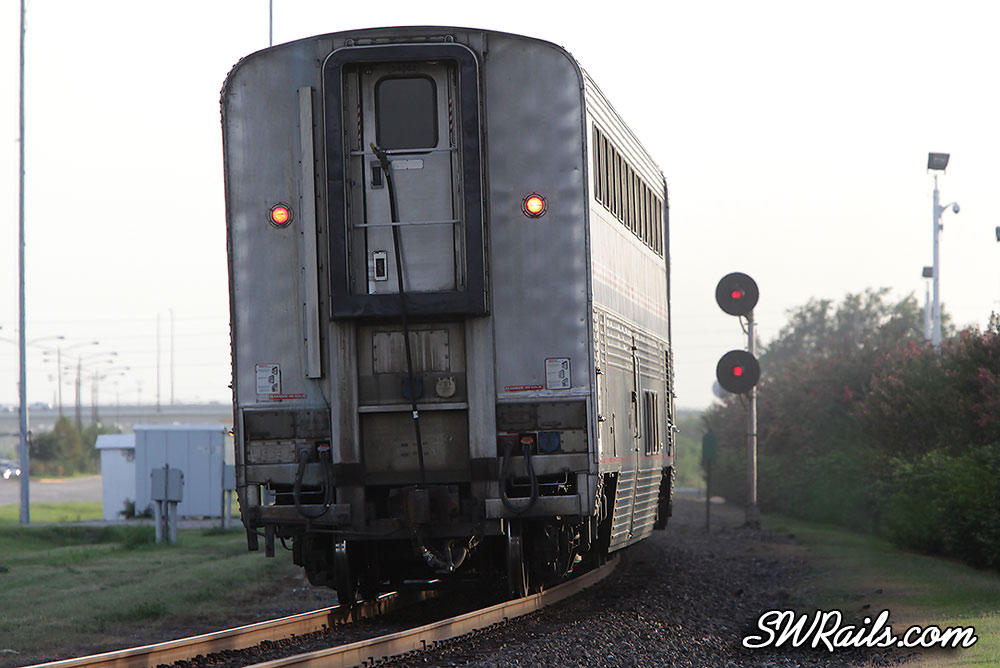
Shortly before #1 arrived, I learned there was an eastbound KCSM in the Sugar Land siding that would get lined out as soon as Amtrak got by. Of course it would be a backlit shot at best, but what the heck, digital images are free, right?
KCSM 4664’s headlight came into view within a minute or two, after which it led its northbound intermodal train back onto the mainline at CP SA 025.


A final shot as the head end finds a small patch of sunlight in the final moments before sunset.

As the KCSM 4664 approached me, I almost put the camera down because the light looked that brutal. I can’t say that I like the sequence of shots, but I do find them interesting. What say you?
FXE 4031 Runs from the Border
Lots of traffic through my neck of the Glidden Sub today, but clouds and oppressive heat kept me indoors for most of the day. My reluctance to venture out was tempered when I heard the DS talk to FXE 4031 on an ALDLI (Autos Laredo-Livonia) train.
I initially heard the DS talk to the ALDLI around mid-day, telling the crew that they were pretty much stuck in the Rosenberg siding until terminal congestion cleared up. It wasn’t until 1445 that the train finally got into the Sugar Land area, too late for anything than a very back-lit shot around here.
I ended up driving to Willowbend Drive in Houston, where the track turns to the north, in anticipation of better light on the FXE 4031.
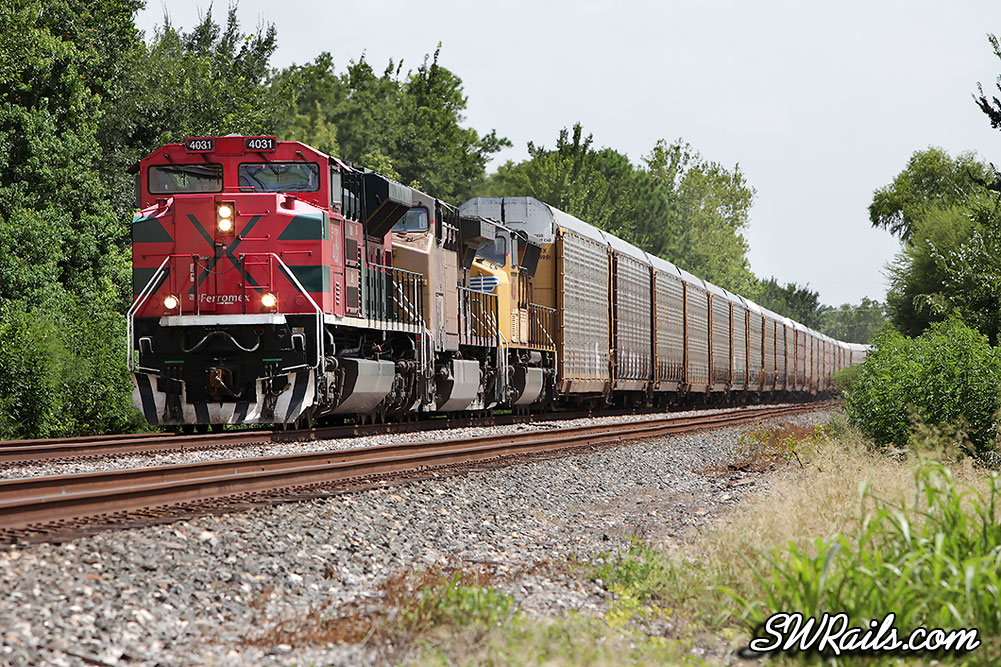
I’m not crazy about the white sky in image 1, so I did a bit of work on image 2 to see if I could get a better rendition of the sky. It does look a lot better, but I’m still partial to the deep blue winter skies.
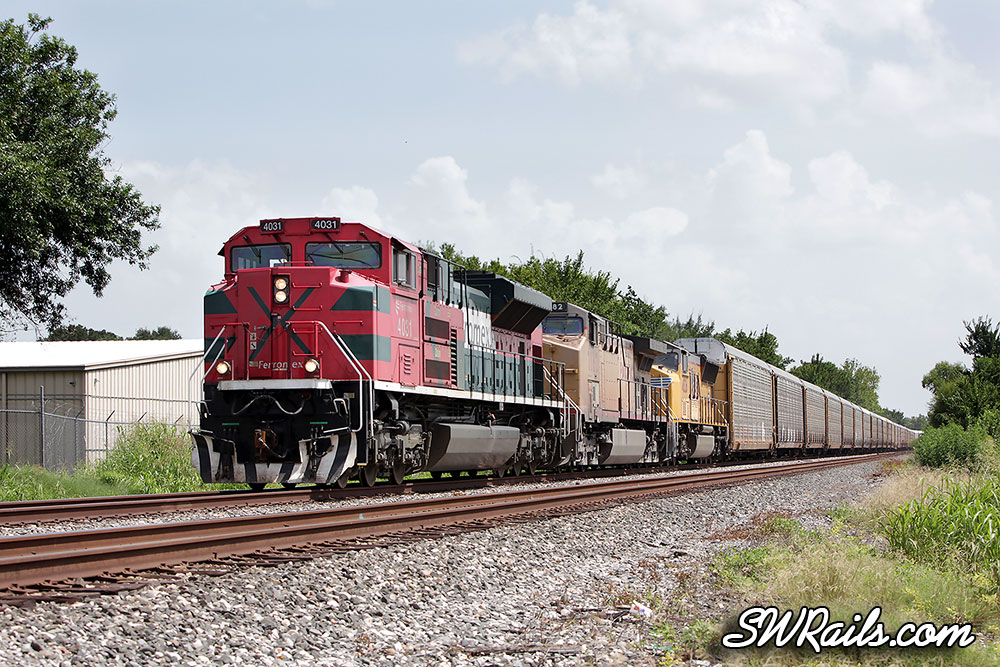

There were 2 trains following the ALDLI, but gnarly clouds were rolling in, persuading me to start the 12 mile journey back home.
ACe in Your Face
I haven’t gotten much railfanning in recently due to the last 2-3 weeks of clouds and rain around Houston. Not that the weather pattern has changed, but I did get out this afternoon.
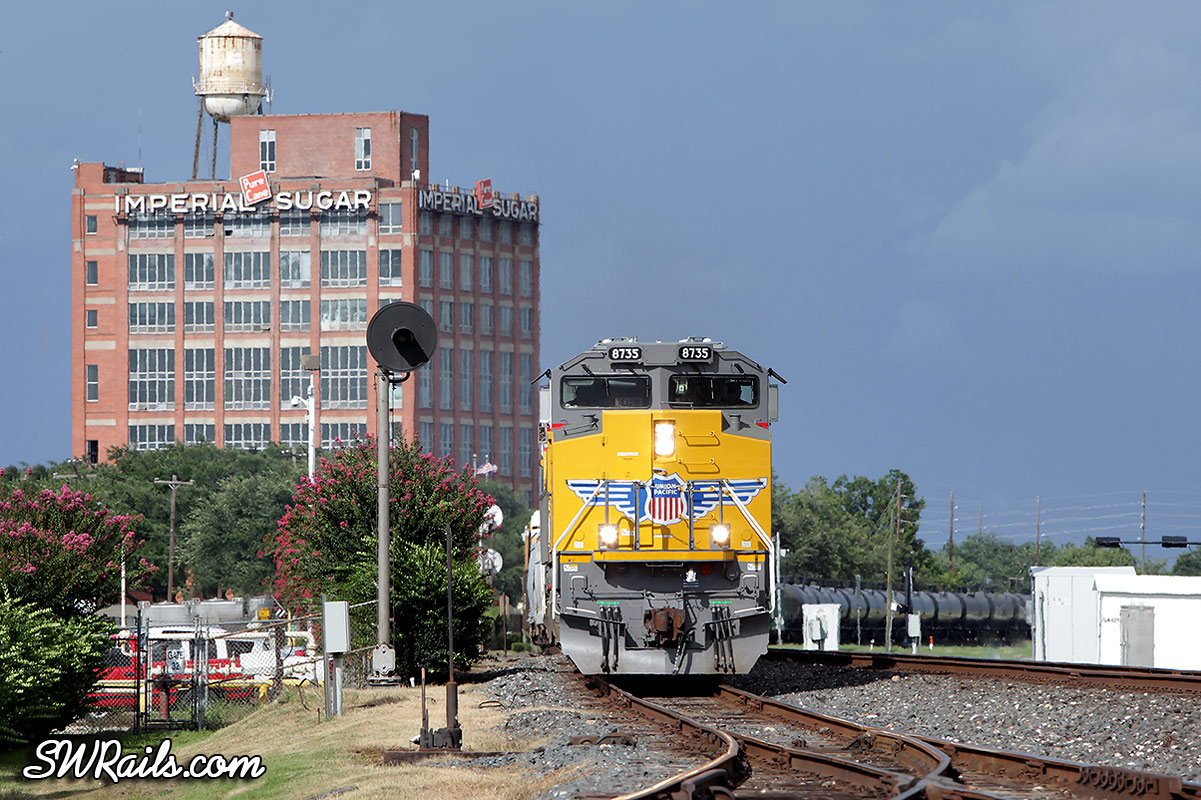
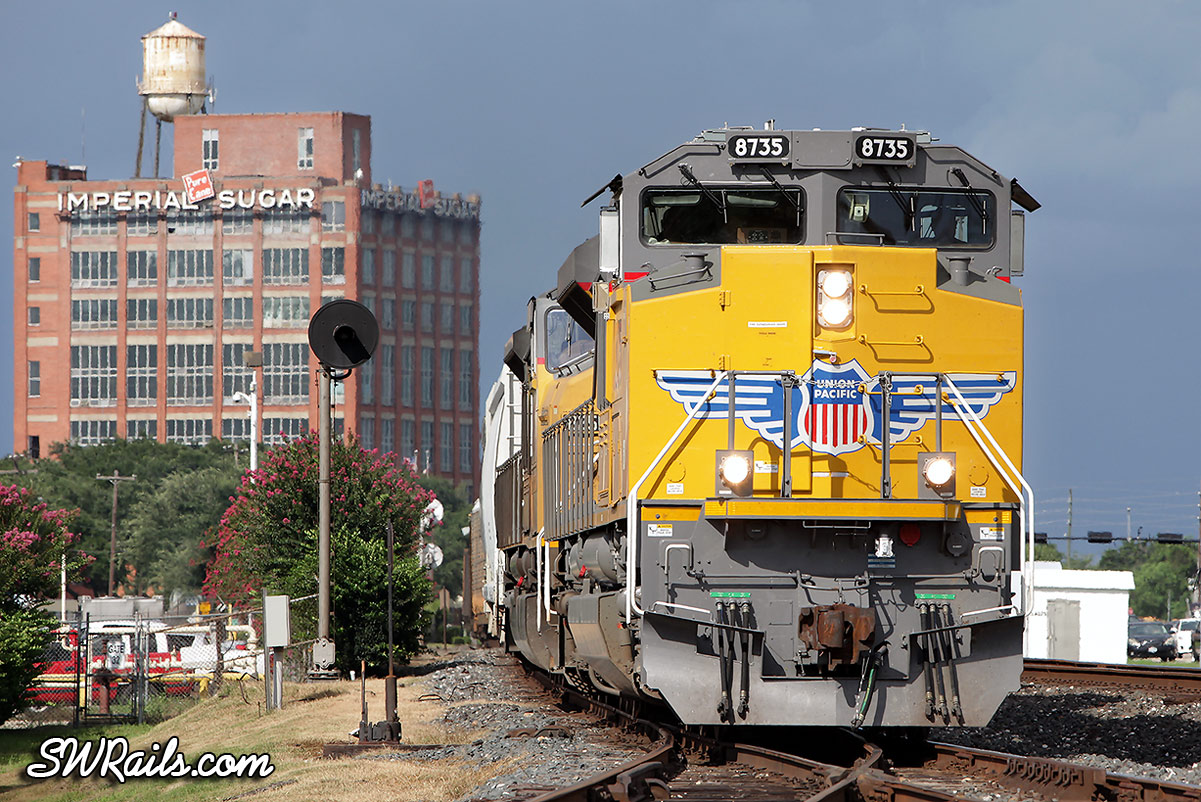
I was monitoring the road channel when I heard UP 8735, the MEWSA-19, get cleared through a form B near Heacker. I knew UP 8735 is a fairly new SD70Ace, so it was worth a shot at a shot.
I could see thunderstorms to the east, so westward I went. I headed to CP SA025, the east switch of Sugar Land siding, hoping that I could stay west of the heavy clouds and use them as a dramatic backdrop for the (hopefully) bright yellow locomotive.
As it turned out, the MEWSA took the siding at Sugar Land, giving me a more head-on shot than I wanted, but how ’bout them clouds?
There was a fleet of trains, but they were all eastbounds, so it was an easy decision to head home.
I have got a huge backlog of stuff from the last several months, so bad weather or not, I should be able to get a few more posts up in the near future.
 Southwest Rails