GE’s NextFuel Locomotive Demonstrator
(Images taken Sept. 4, 2014)
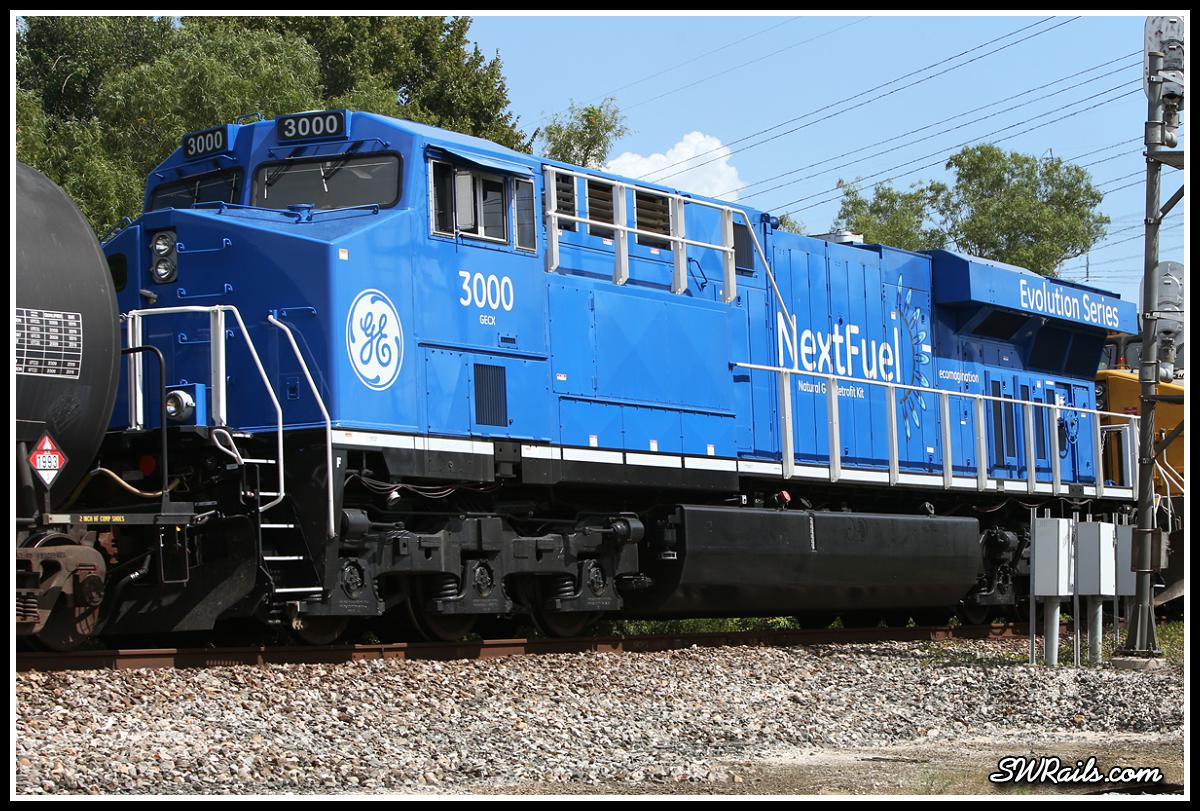
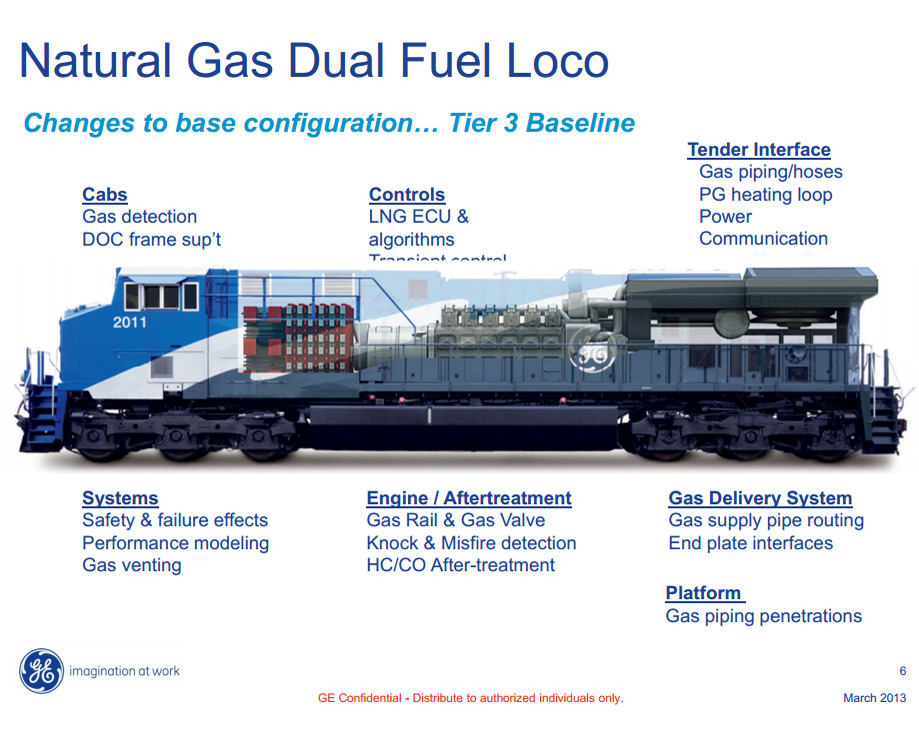
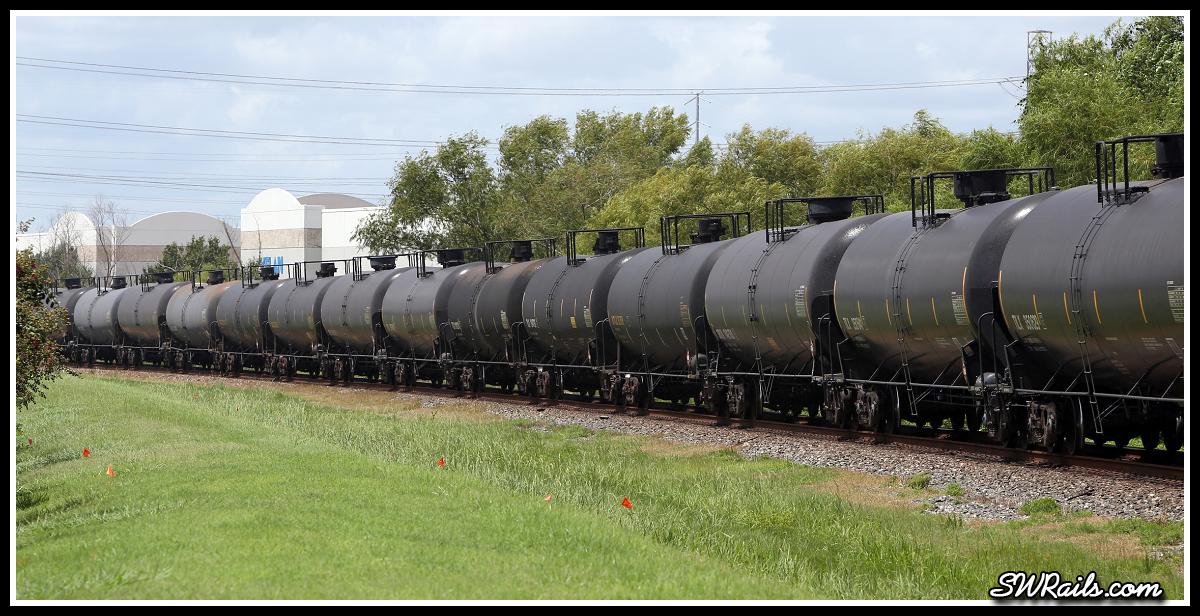
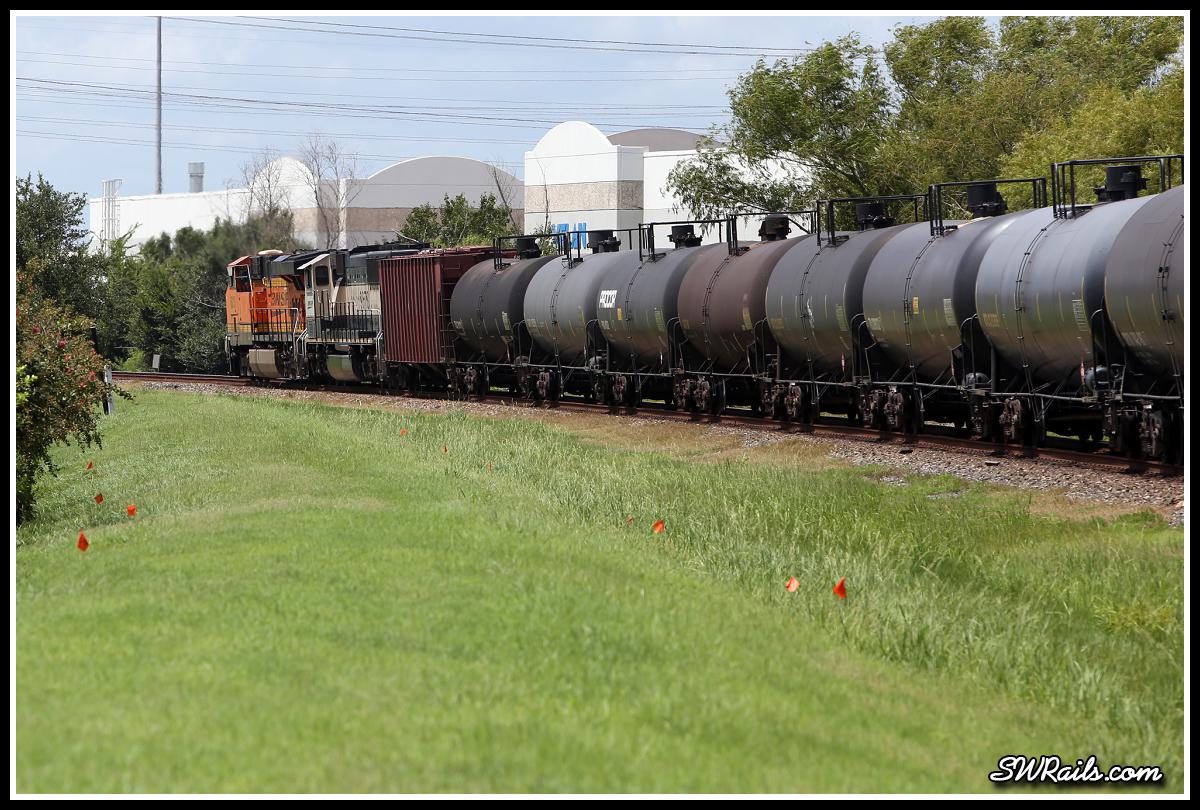
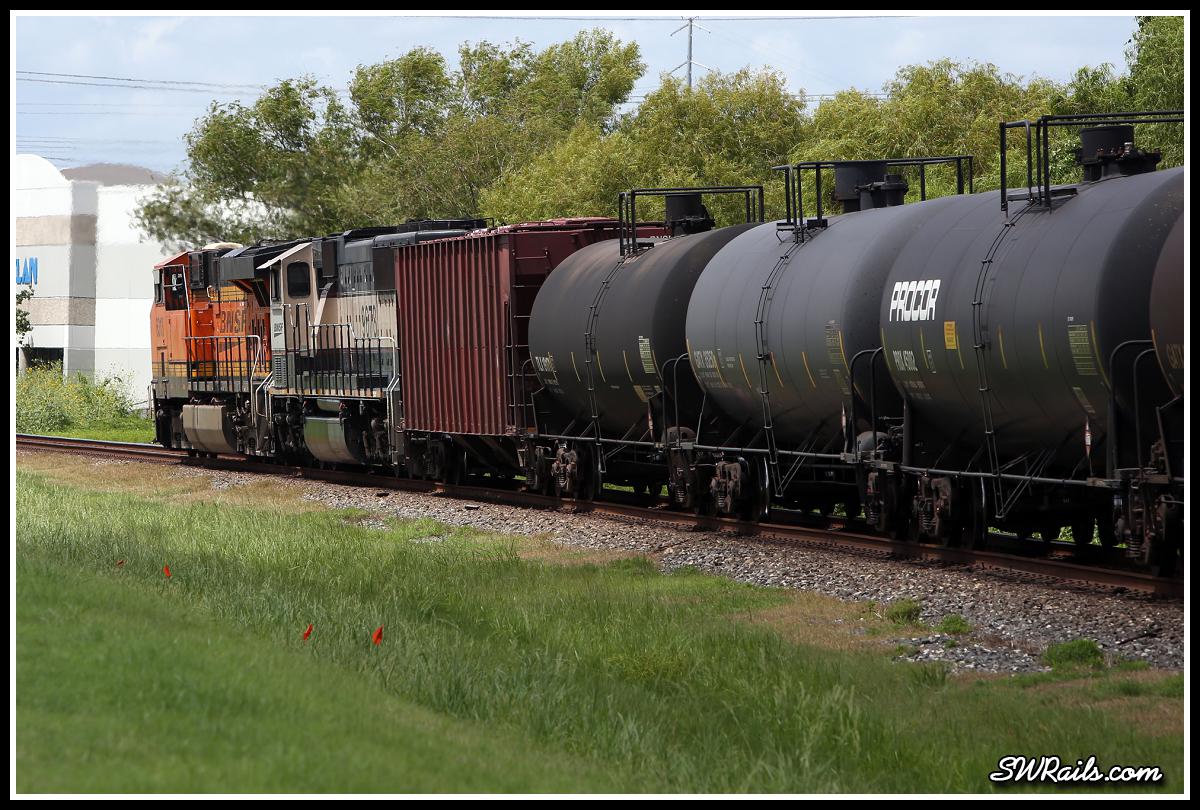
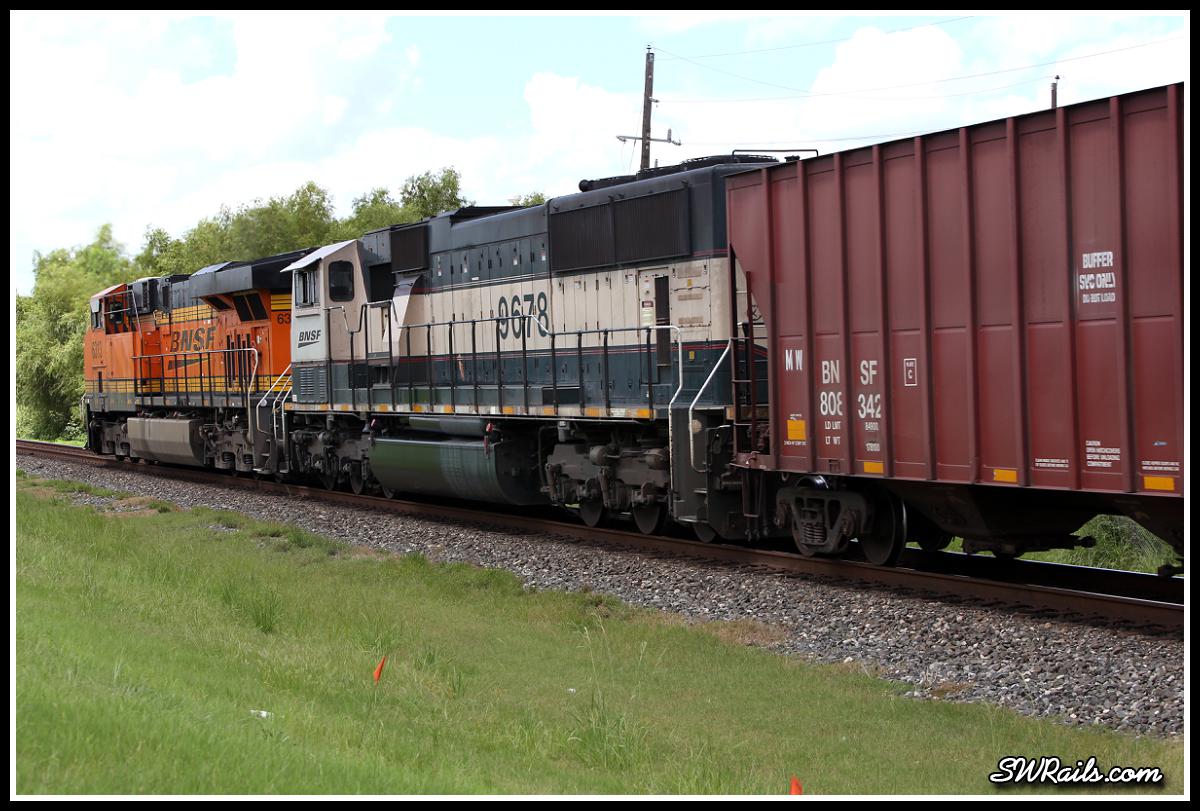
During a short railfan outing this past Thursday, I had a chance encounter at West Junction with GECX 3000, GE’s demonstrator for its new natural gas retrofit kits. It was the trailing unit, DIC, on UP 4767 East, the MEPEWX-02.

This unit is one of 2 test beds for GE’s NextFuel concept. This unit will test with BNSF ES44AC 5815 with an LNG fuel tender . BNSF has 2 cars for this testing, 933500 and 933501.

According to GE:
GE Transportation’s new NextFuelTM Natural Gas Retrofit Kits enable existing Evolution Series locomotives to operate with dual fuel capabilities. This gives railroads flexibility to run on both diesel fuel and liquid natural gas (LNG) with up to 80 percent gas substitution as well as run 100 percent diesel. GE’s NextFuel kits allow railroads to use natural gas as a fuel source, reducing emissions and potentially reducing fuel costs by 50 percent while not compromising performance.
GE has been testing this low-pressure natural gas technology since spring of 2013, and is working closely with its Class 1 partners for further field testing. The use of liquid natural gas (LNG), which is cryogenically stored in a tender in the consist, provides enough fuel for a fully-loaded train to travel longer distances without refueling stops. An Evolution Series locomotive equipped with the NextFuel Natural Gas Retrofit Kit meets US EPA Tier 3 emission standards. A pilot program with the BNSF to test the use of natural gas as a fuel source for locomotives will proceed in 2014.
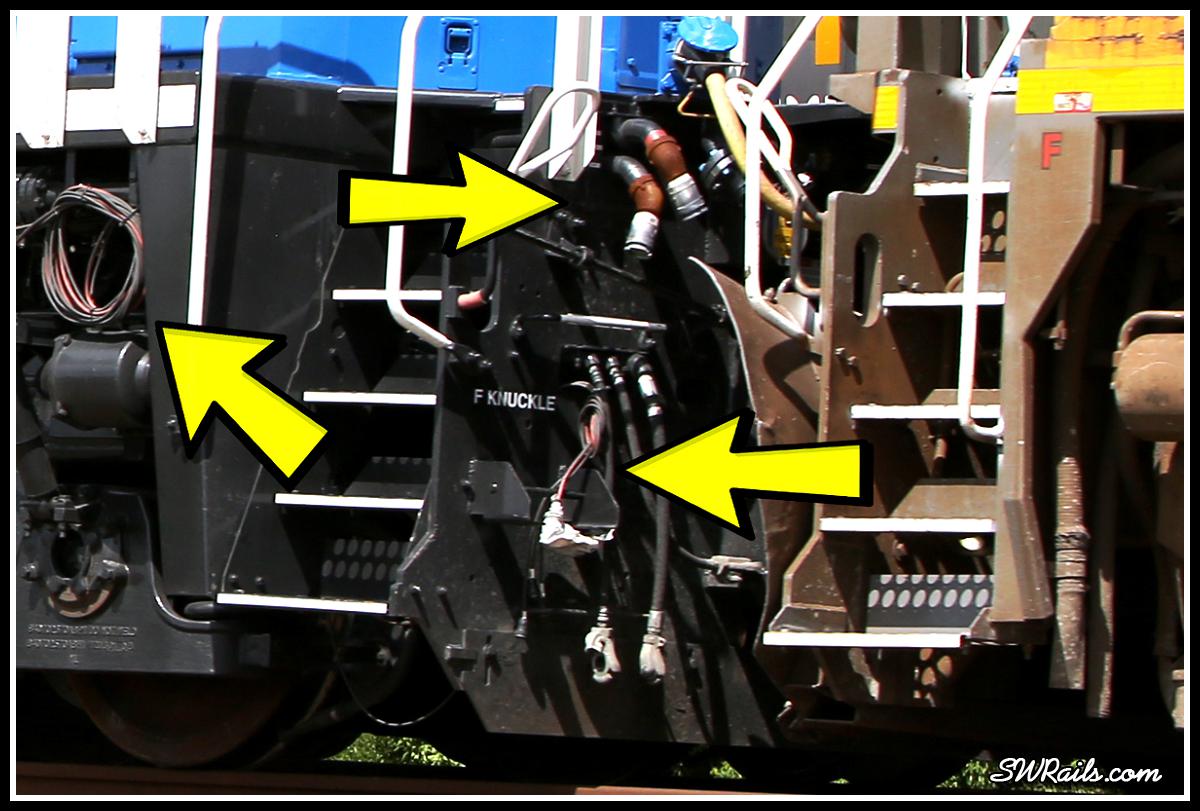
I was able to catch of few shots of some of the details on the unit. As usual, click any small image to see a larger image.
The top arrow shows the connections to the LNG tender. The bottom arrows point to some of the external wiring that was used to convey locomotive performance telemetry to the test equipment car.
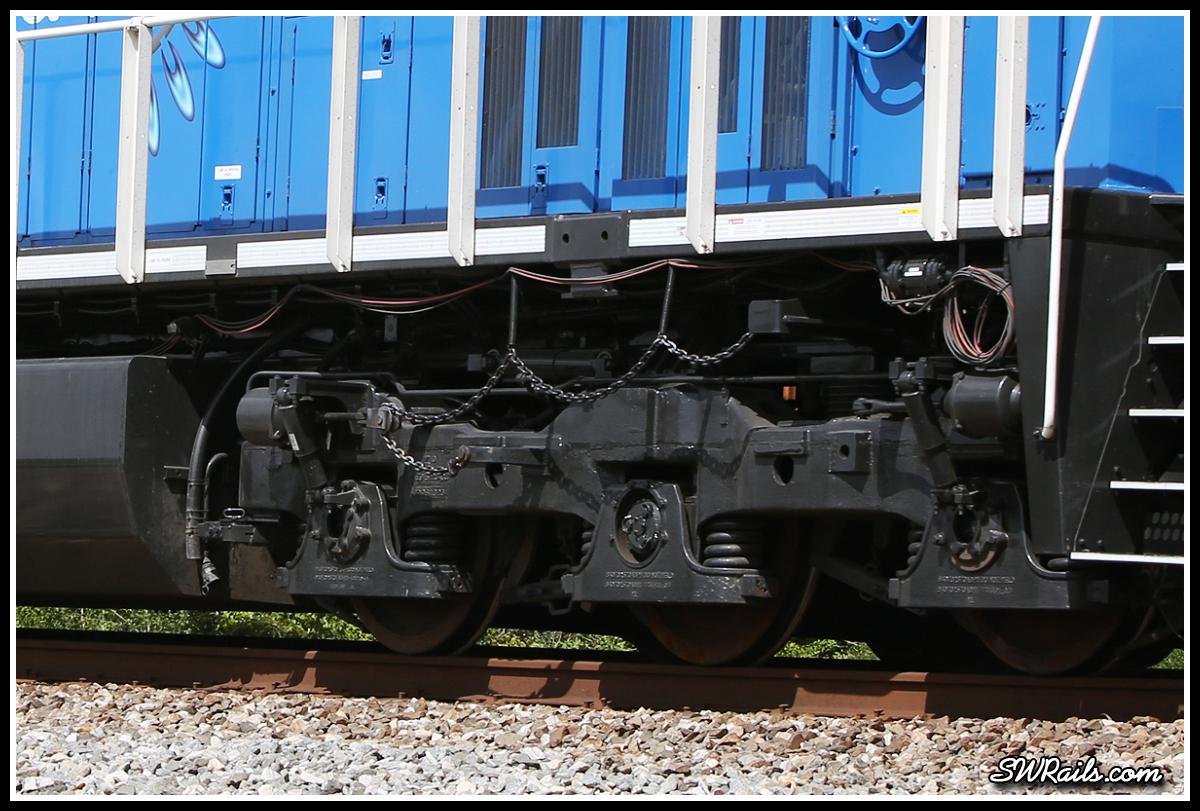
I’m still surprised at just how short contemporary trucks are, especially compared to SD40-2 trucks.
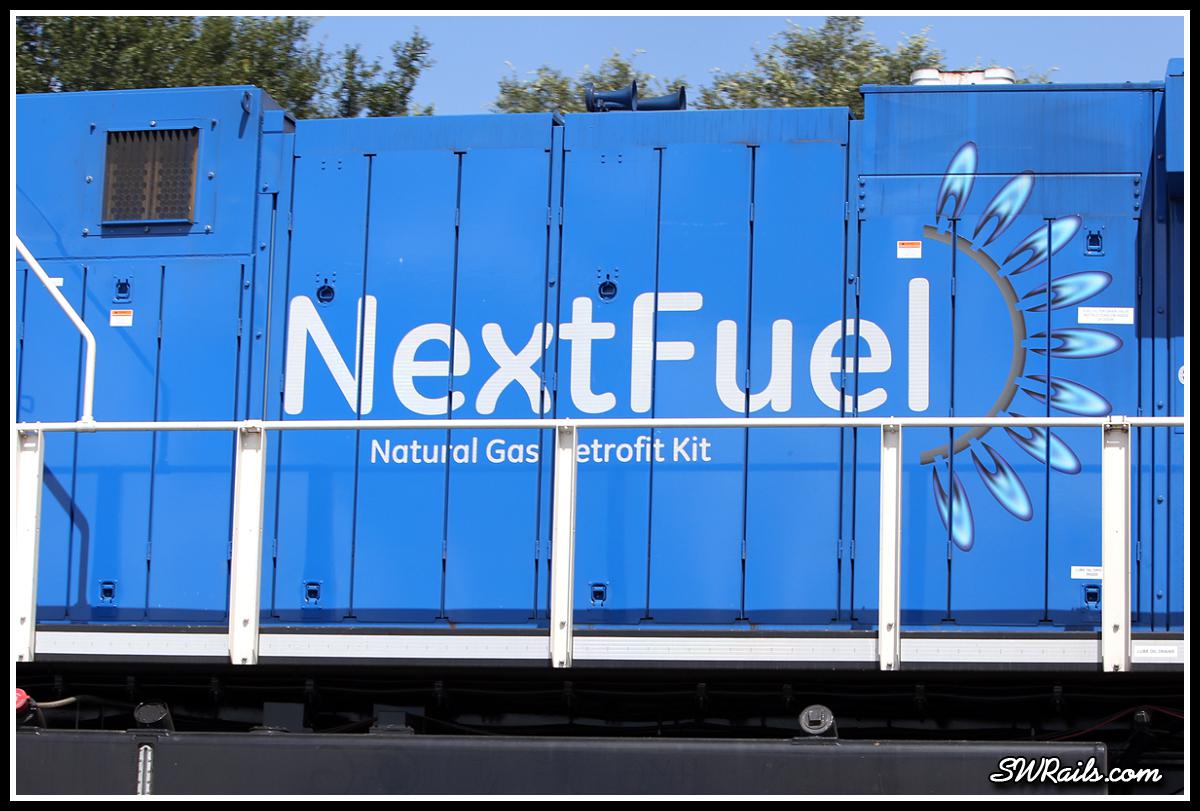
When I first saw the artwork, it appeared to be some sort of headdress, which made no sense to me. Upon further review, the artwork does make sense.
Had I known it was coming, I would have set up a bit further back.
To the extent you’re interested in the technological aspect of the unit, click here to view a GE technical document (PDF) Update:the PDF has been pulled and the link doesn’t work anymore. I knew I should have saved the entire PDF!
Lastly, GE has a short video that outlines the technology and potential benefits to the industry.
High Sun Heritage
(Images taken September 2, 2014)
I received word last night that Amtrak’s Phase 1 heritage unit, P42DC 156, would be leading the eastbound Sunset Limited into Houston today. I’ve seen it a few times before, but have never been able to photograph it adequately.
Before going to bed I checked #2’s status. It was west of Del Rio. More importantly, it was running on schedule. This would put it into my area around 10:30 in the morning, early enough to avoid the mid-day high sun.
I checked Amtrak’s website at 8:15 AM to learn #2’s location. It’s schedule calls for a 6:25 AM departure from San Antonio and an 11:10 AM arrival into Houston, so I expected it to be somewhere between Luling and Harwood. Imagine my dismay when I saw that #2 hadn’t even left the San Antonio depot yet!
Oh well, I guess I can work on some editing to pass the time.
It was just after noon when the DS told MOW working between near MP 25 that he would be fleeting 5 eastbounds through their limits. A quick check of Amtrak.com indicated that #2 was between East Bernard and Rosenberg, so it was time to hit the road.
Signal indication at CP SA019 for the first eastbound was approach diverging, telling me that it would be crossing over from main 2 to main 1 at CP SA916, aka Ormandy.
As I set up just east of the cross-over, the headlight of the first train appeared in the distance. Perfect timing!
UP 7652 on the MLDEW-01 (Manifest Laredo-Englewood) arrived at 12:32 PM.
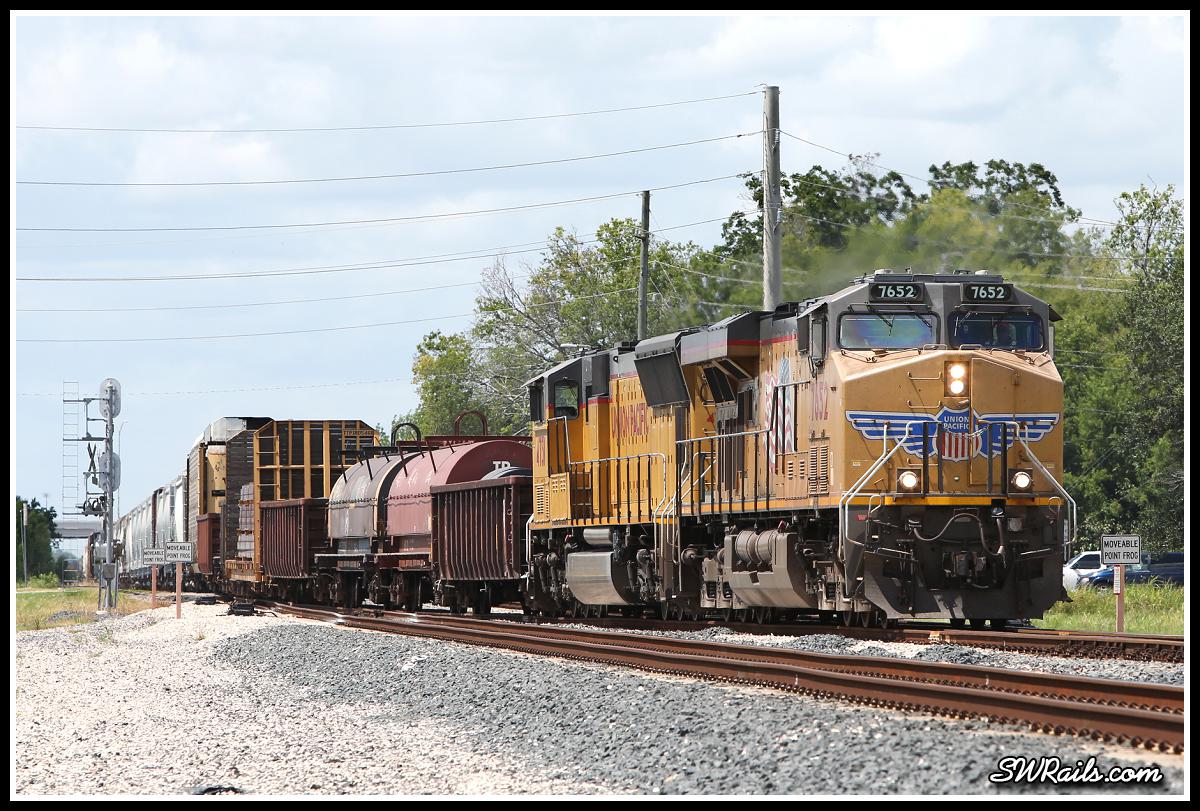
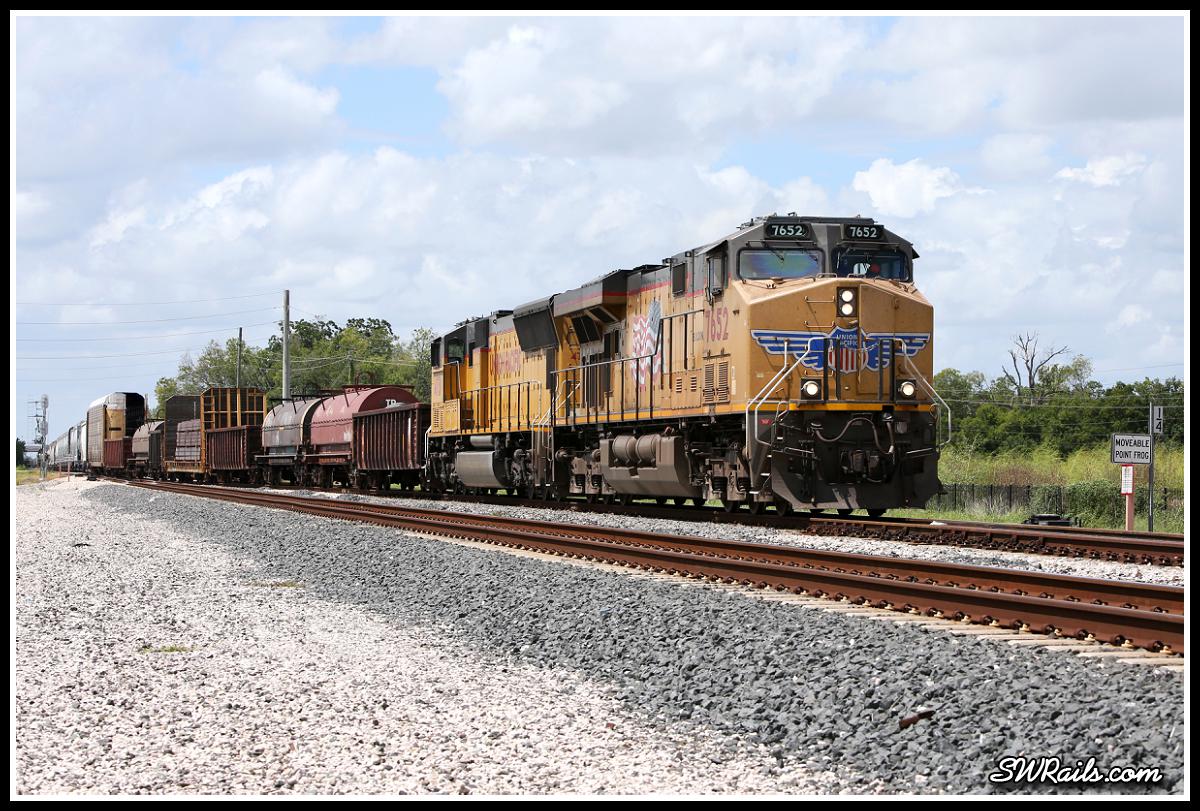

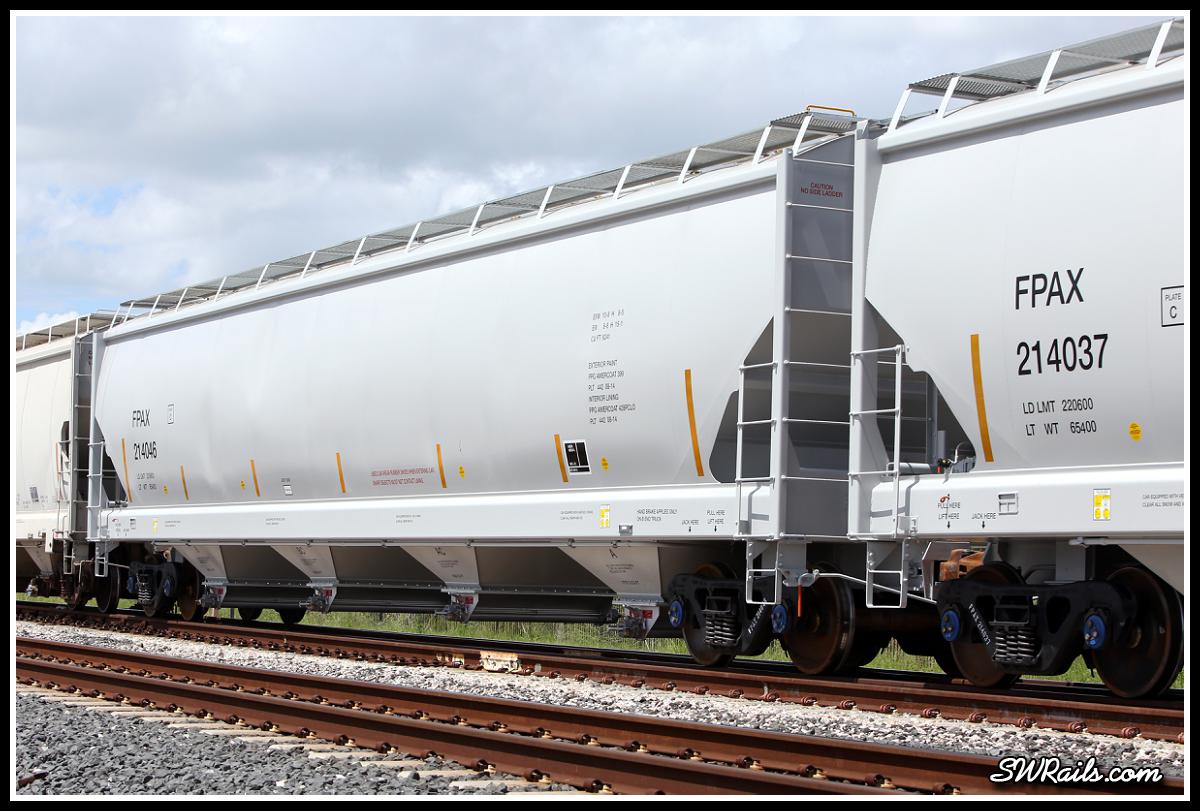
This train will frequently have brand-new freight cars coming into the U.S. from the Mexican car builders.
There was a block of coil steel cars at the end of the train that caught my eye. The middle car, CR 63155, really sticks out due to the different cover.
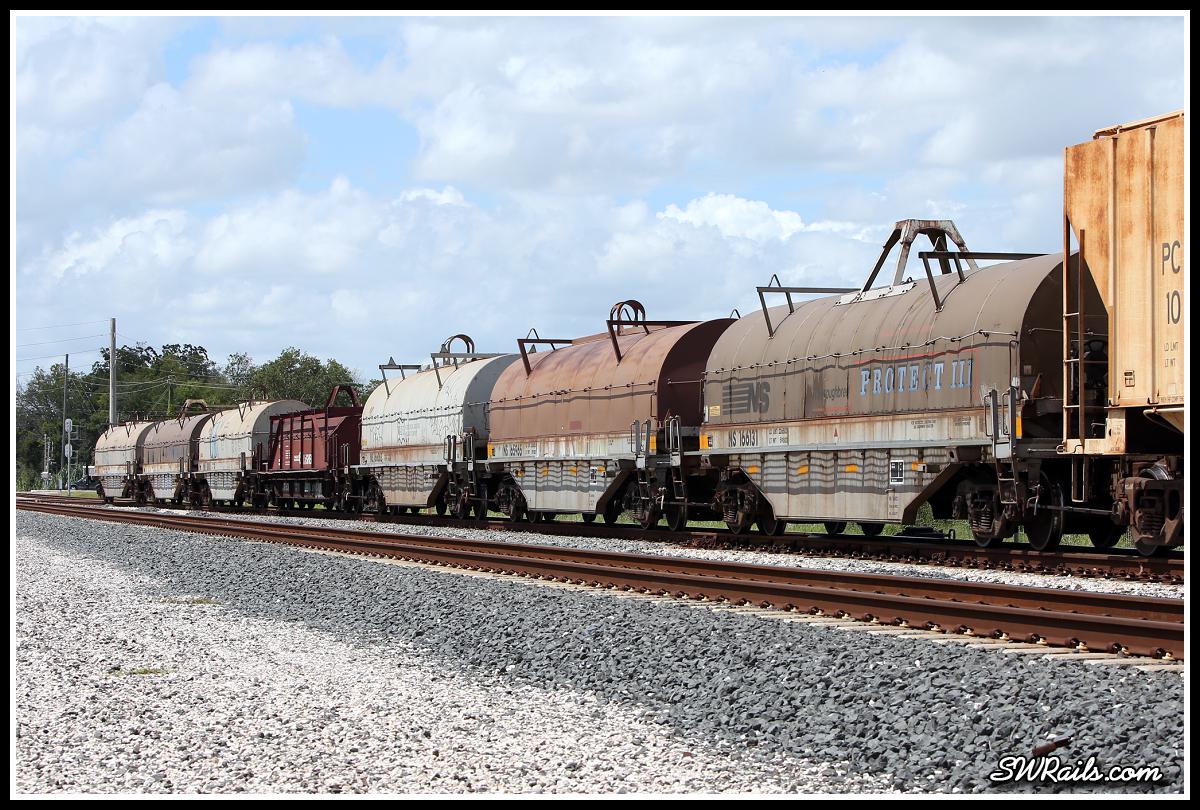
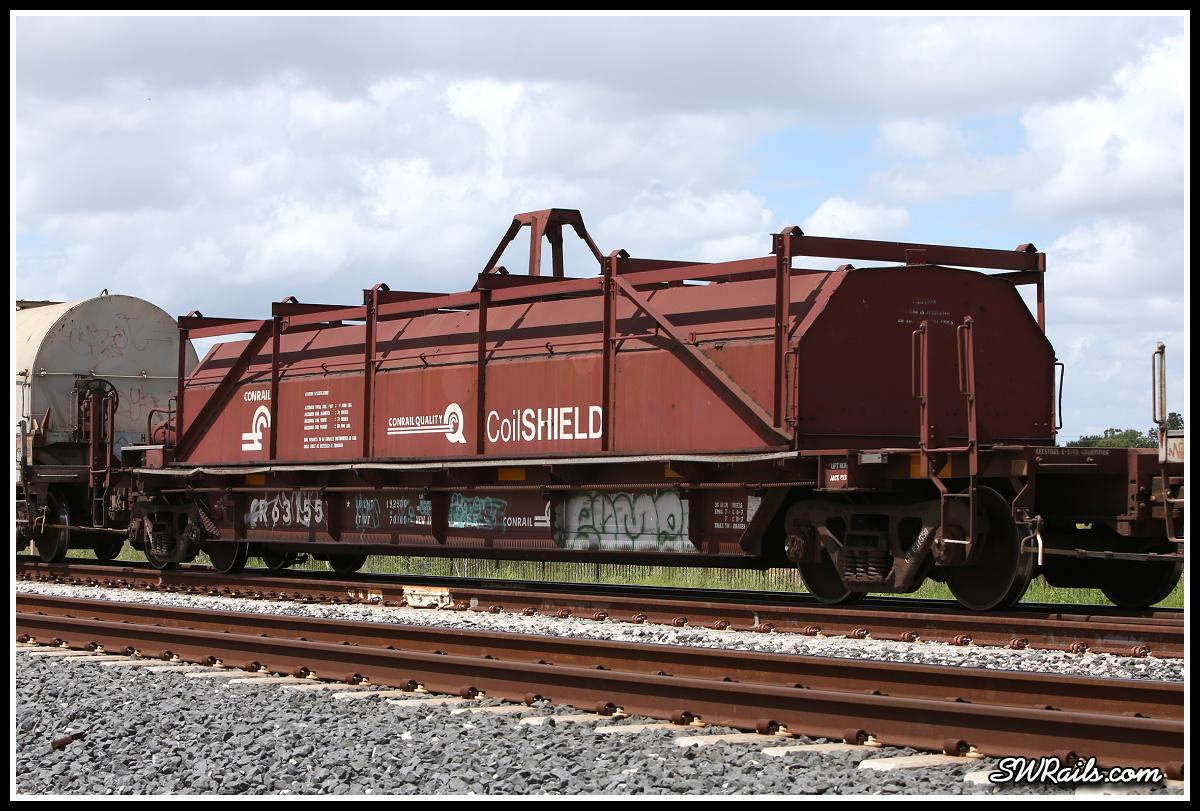
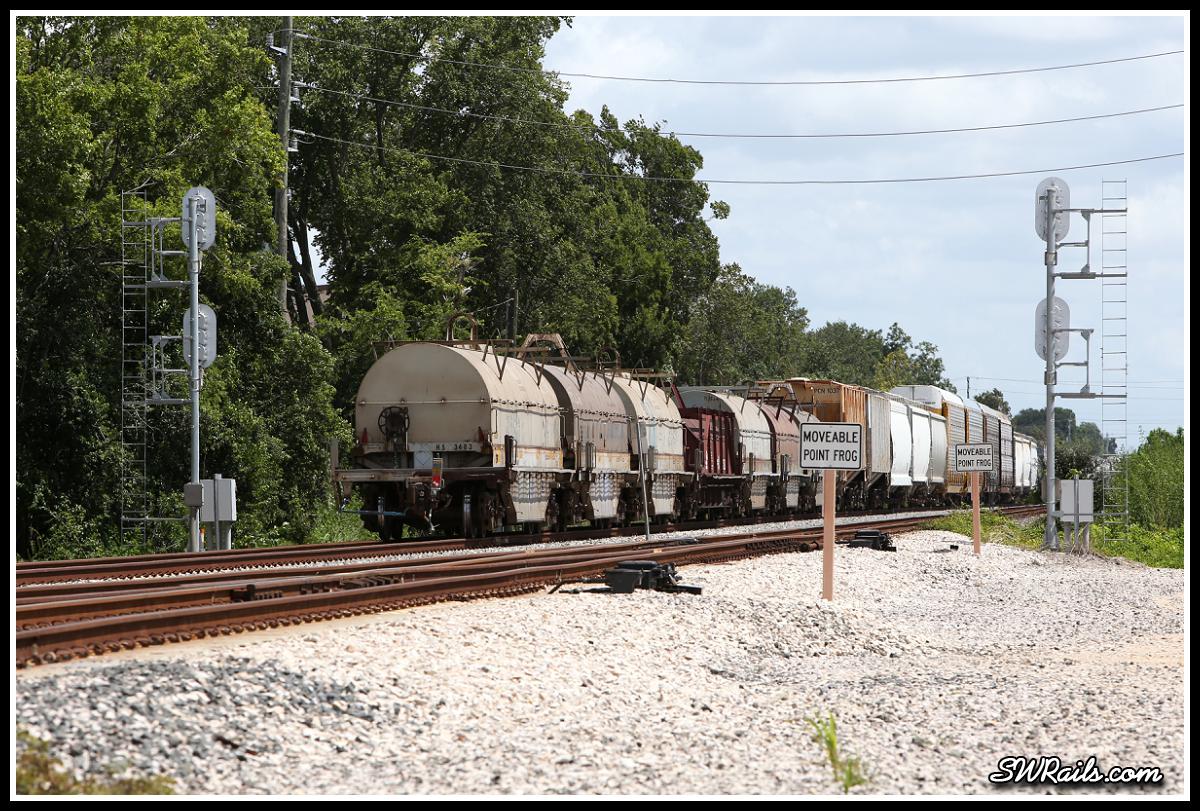
As I waited for the second train, a large, slow-moving cloud did a number on the sun. I was reluctant to move because the second train wasn’t far off, but the allure of sunlight about a mile to the west convinced me to take the risk. I was able to get to a crossing near MP 17 a few minutes before the 12:49 PM arrival of UP 8794 on the QWCEW.
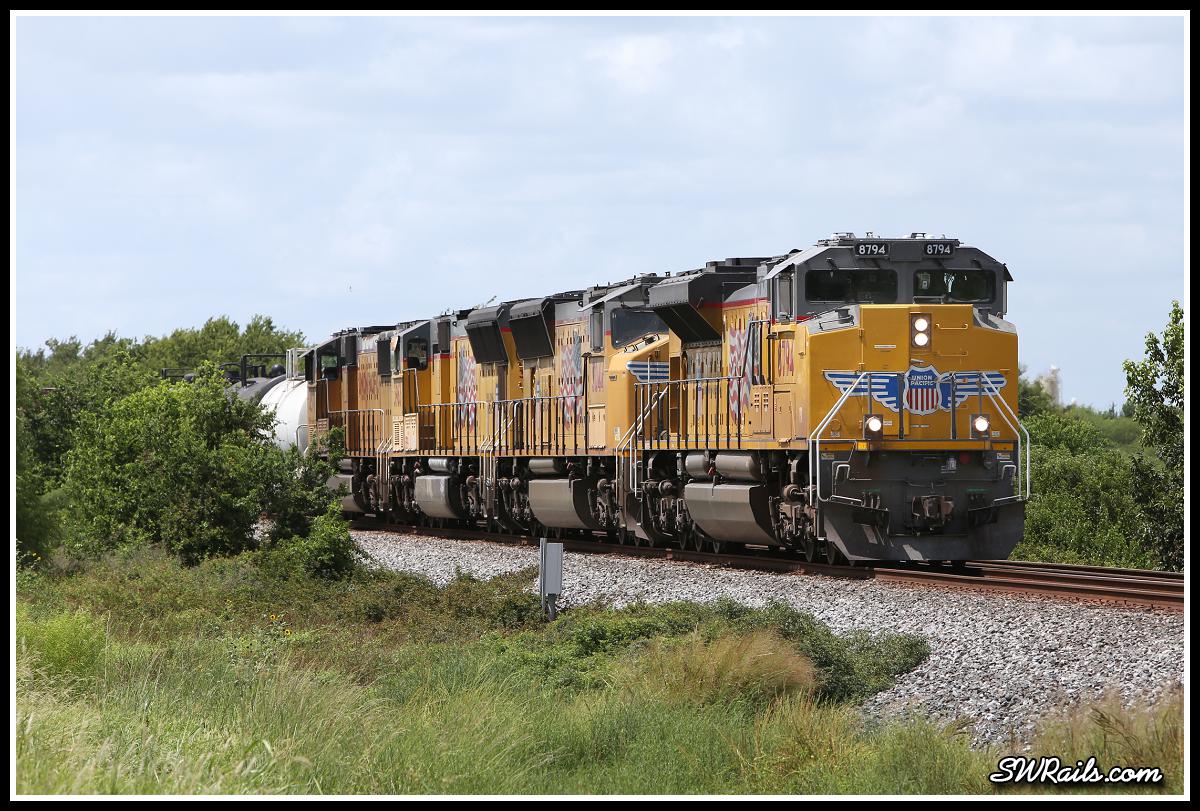
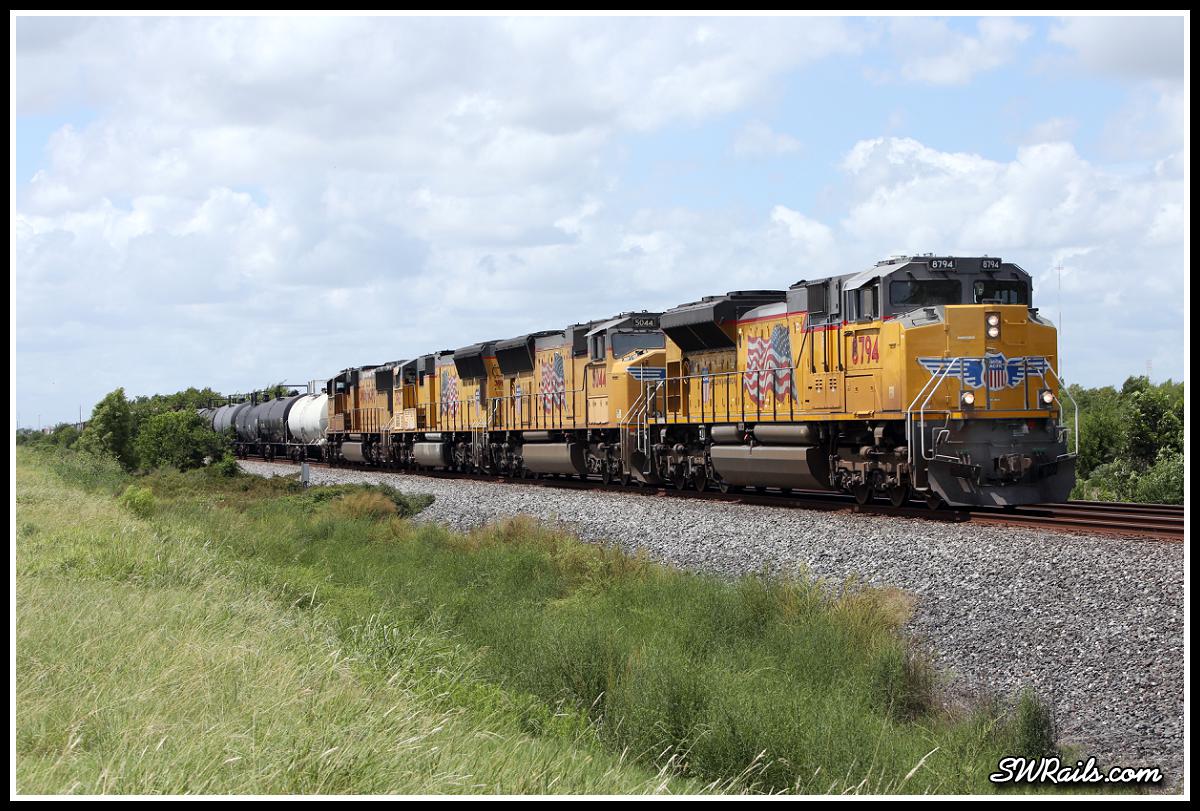
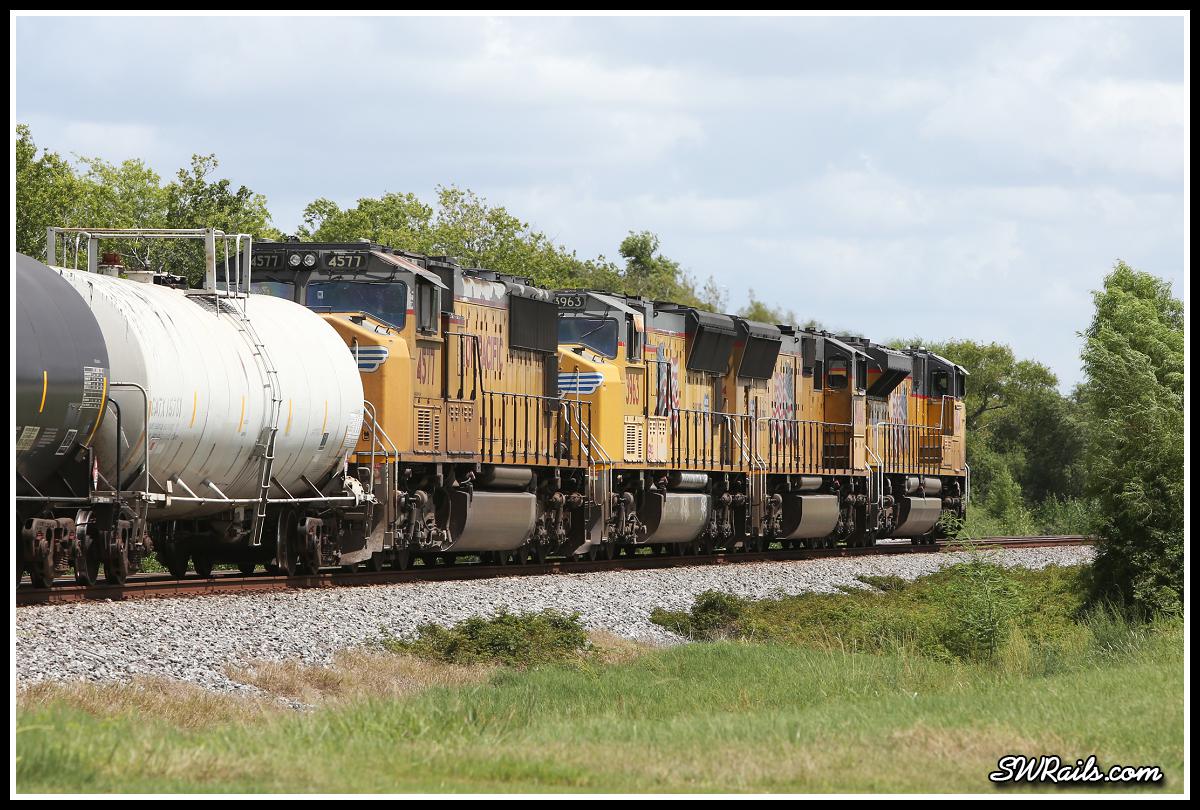
The QWCEW typically has DPU power, so I stuck around to photograph it. It wasn’t a smart decision because #2 was following the QWCEW and I intended to move 3 miles west to get better light. Of course, it had to be monster QWCEW. The detector reported 542 axles!

My last shot of the DPU was at 12:52 PM.

I made a very nervous drive to the crossing at MP 20.5. In some sort of cosmic harmonic convergence, I caught all 4 of the traffic lights en route. Otherwise I would have blown the shot, because #2 came into view as I was jumping the curb to park.
High sun or not, #2 looked real good as it passed by me at 12:58 PM at a good 50 mph.
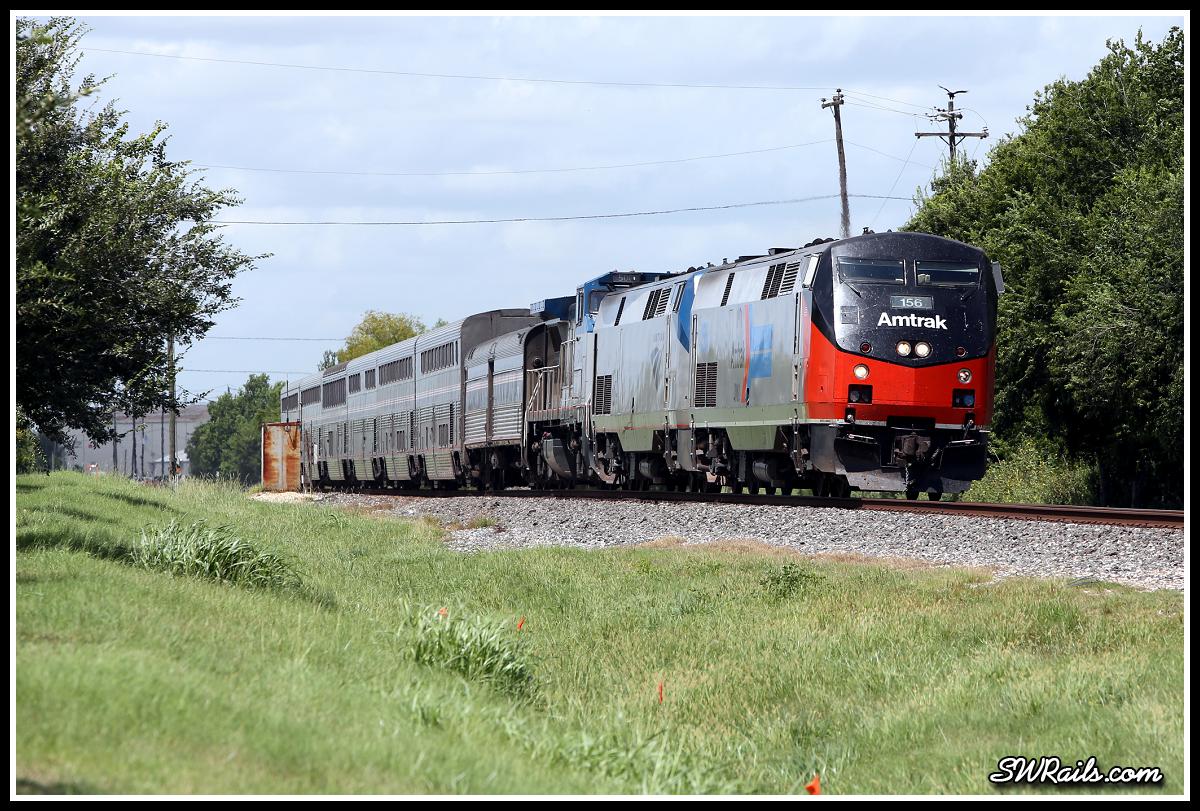

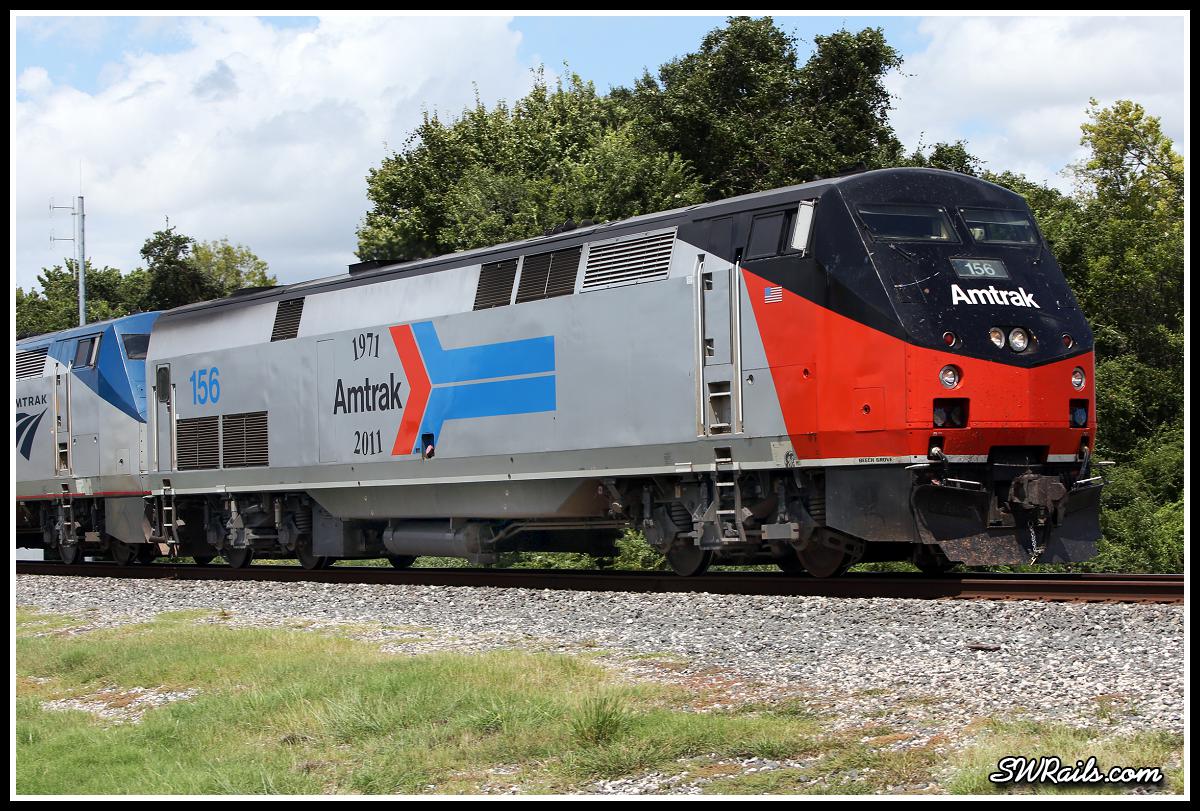
I was so intent on the mechanics of executing the shot properly that I didn’t even notice that there was an extra unit in the consist until it was by me. It’s actually my second time to see P32-8BWH 500 on the Sunset Limited, but alas, both times it was the third unit.
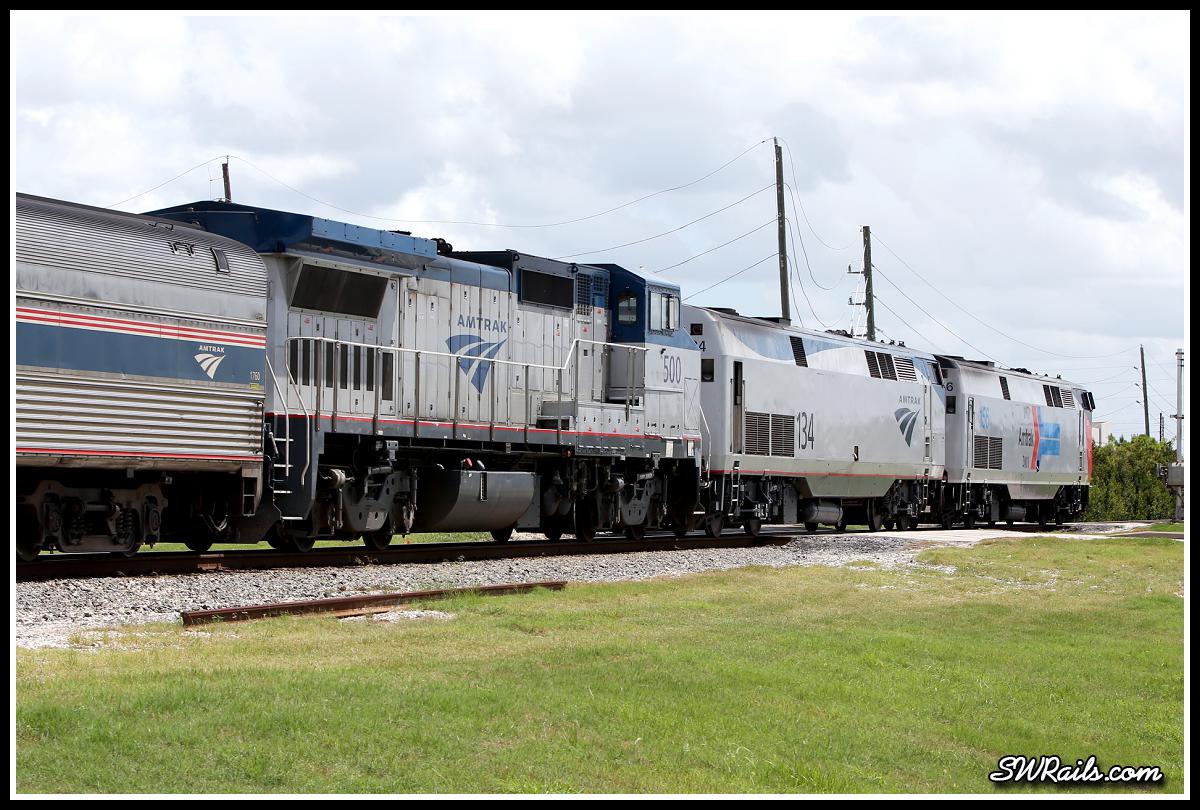
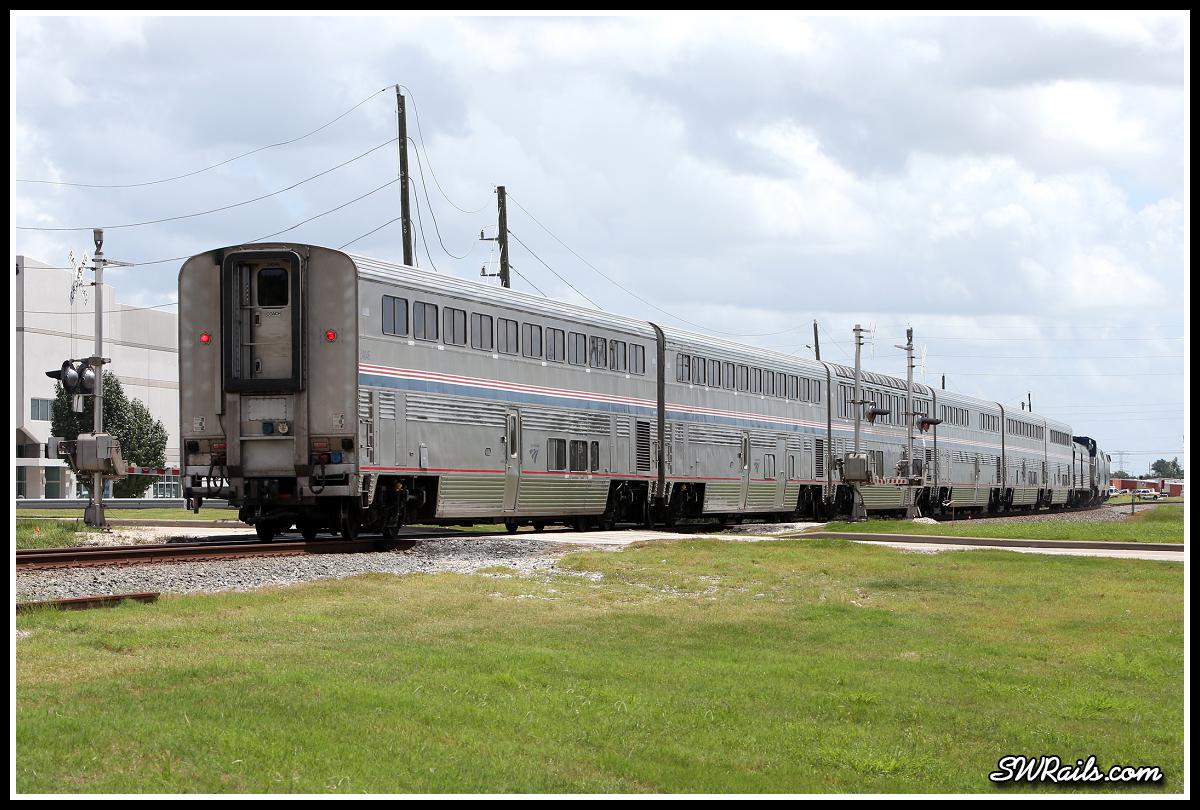
Well, that wasn’t too shabby. It would be nice to have the 156 go back west on #1, but it’s not likely because of the Sunset’s tri-weekly schedule. Amtrak is chronically short on power. There are 2 daily long-distance trains out of New Orleans and Los Angeles where Sunset Limited engines can get right back out versus waiting for the next Sunset Limited is set to run.
There was no reason to move because this location has the best light for early afternoon eastbounds. UP 7764, the MKBHO-01, arrived at 1:11 PM.
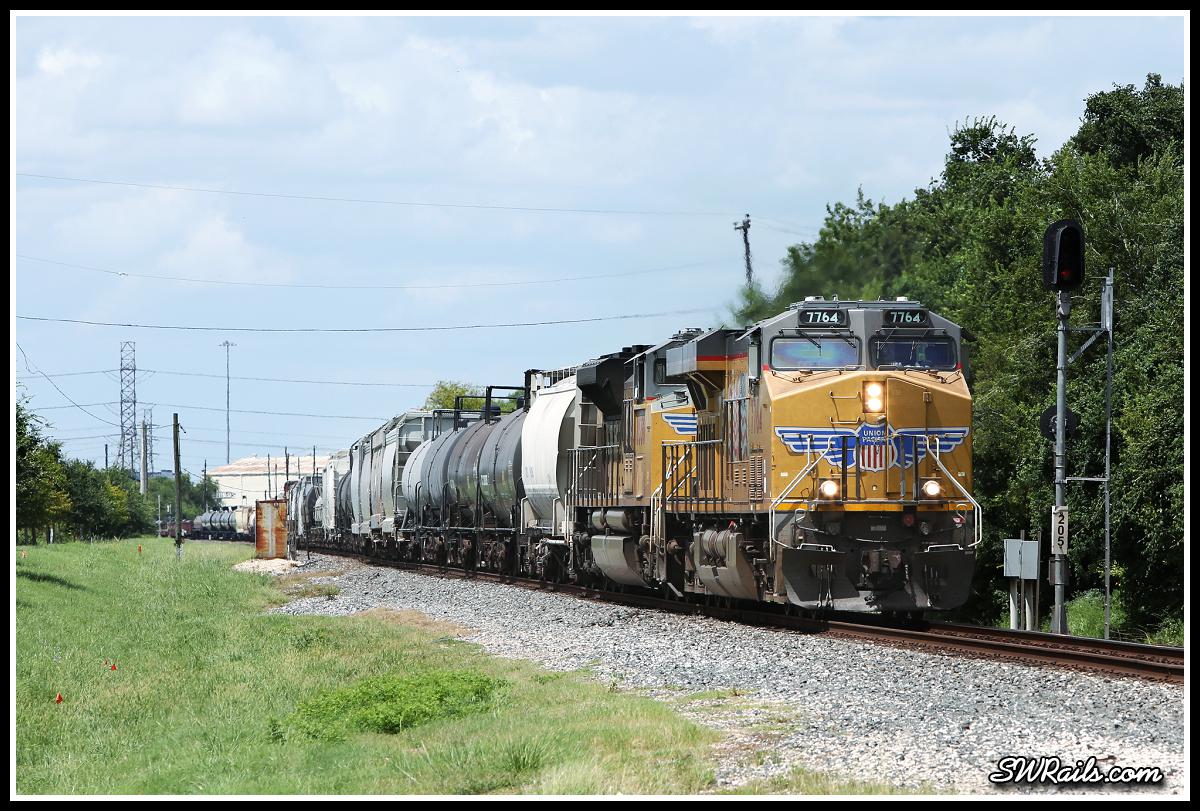
Today’s MKBHO was lacking the customary block of auto racks. It makes sense, though. Being the day after Labor Day, no Toyota Tundras were shipped from the San Antonio assembly plant over the holiday weekend.
Five gons of pipe and a long block of 20 or so brand-new XOM oil tank cars were interesting. Yes, I did attempt a shot of a single tank car, but I messed it up. Sorry.
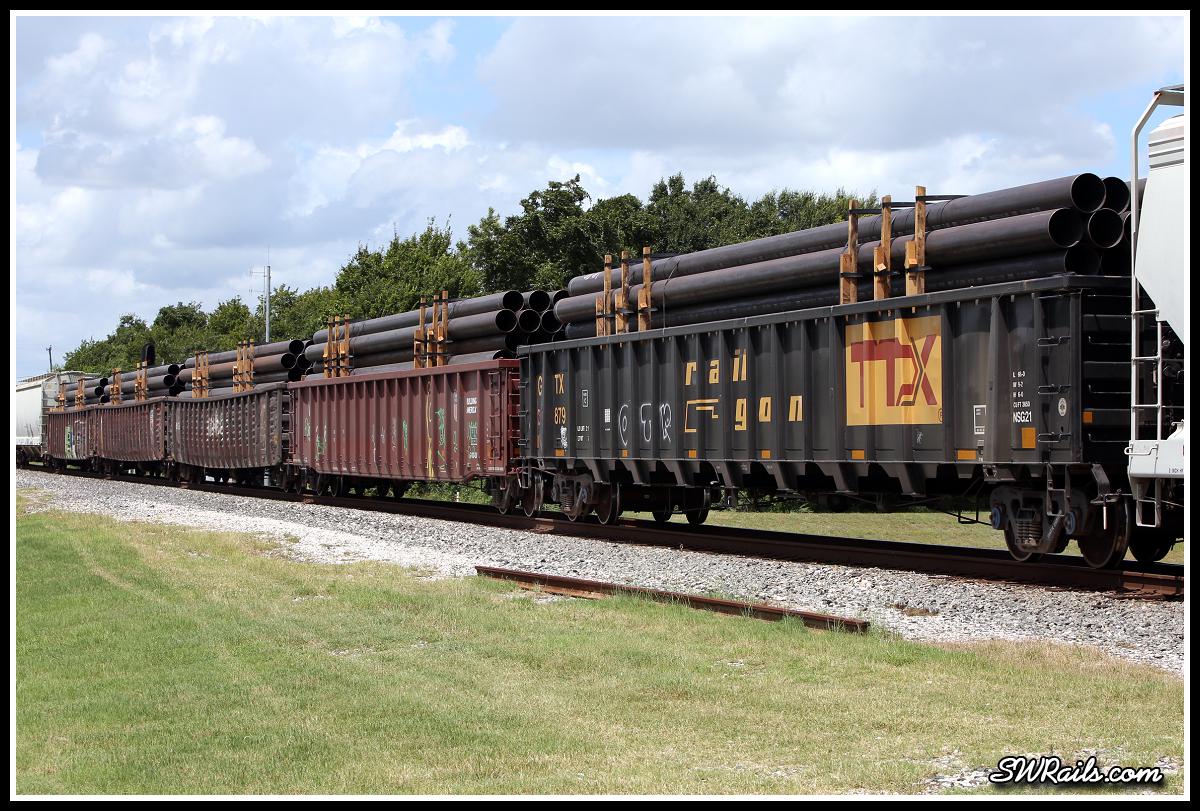
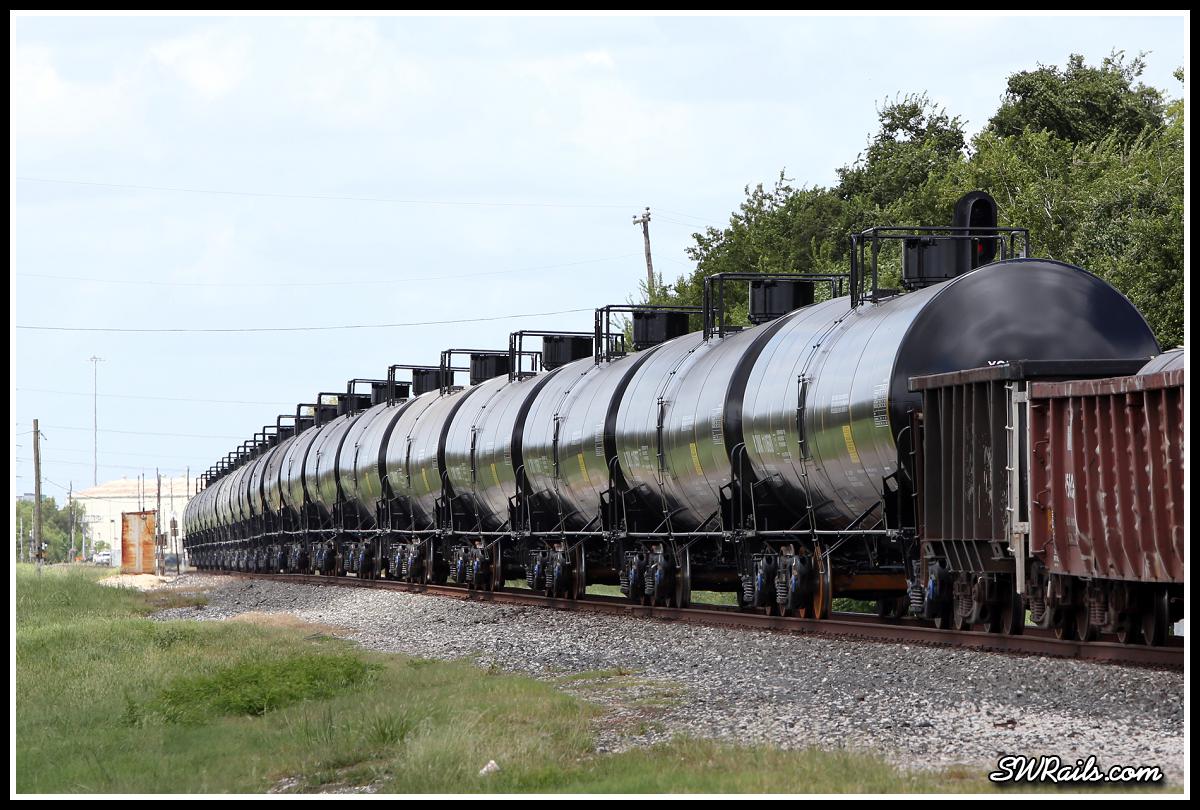
I almost didn’t stick around for the last train of this episode because it started raining at MP 20.5 After waiting a few minutes, it appeared that I might get lucky west of my location so I decamped to a crossing near MP 22.
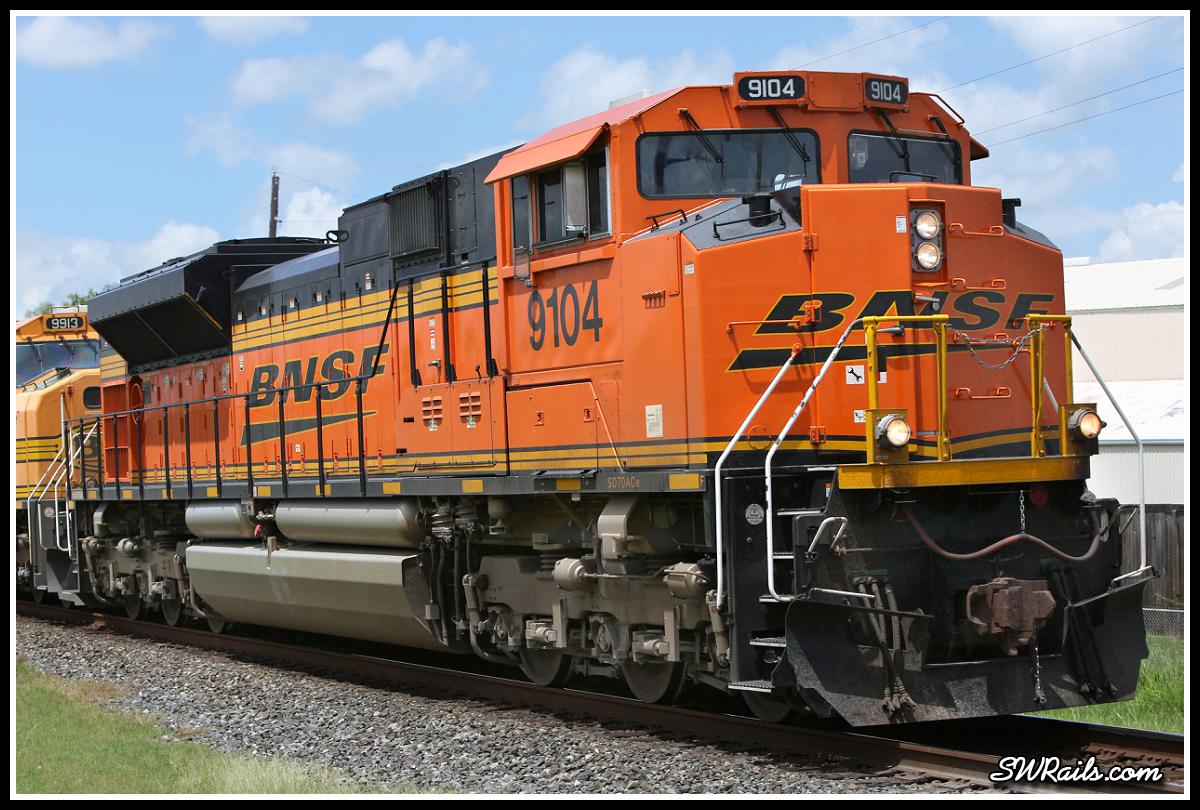
BNSF 9104 on an oil load arrived at 1:24 PM, 13 minutes behind the MKBHO. Note the little orange flags marking the location of underground fiber-optic cable in preparation for the upcoming second main track through here.

No need to adjust your monitor. The lead unit is really fresh and the trailing unit is really that faded.
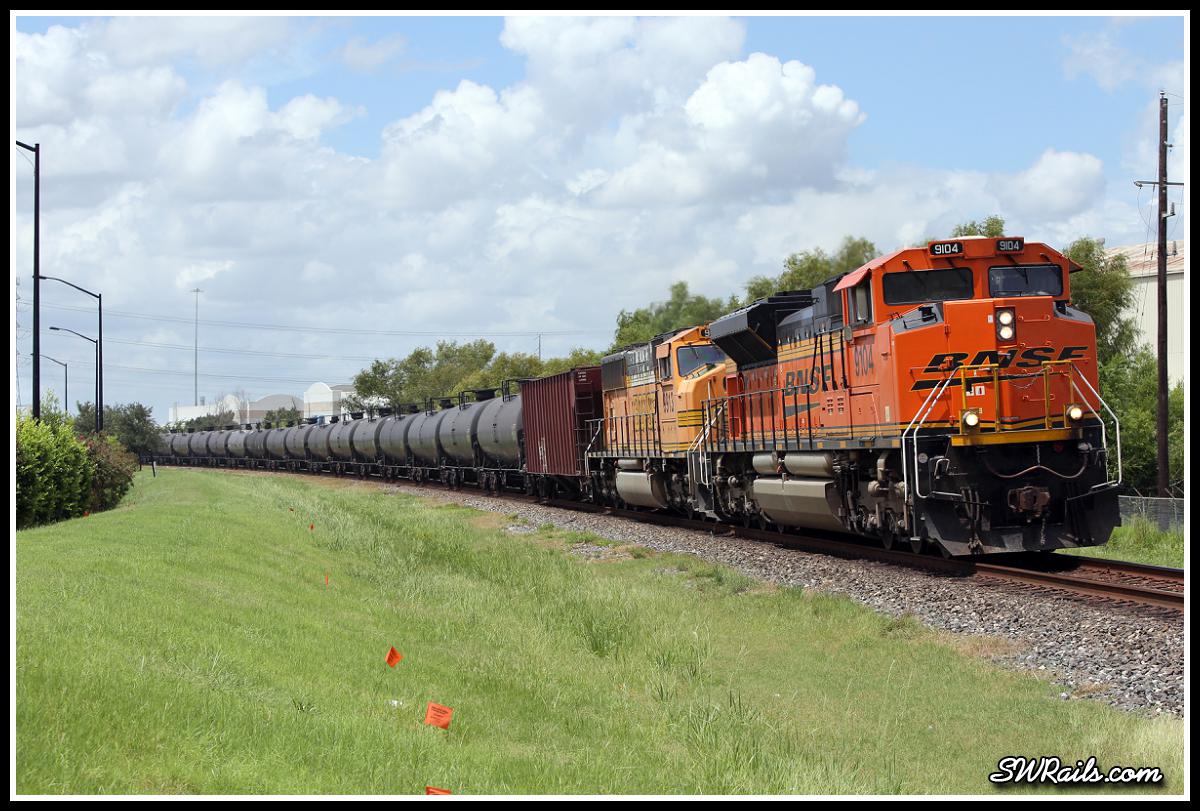
I’m sure I’ve said it before: SD70ACe’s are the best looking of all of the contemporary engines. Of course, there’s only 2 basic models out there: the 6-axle GE and the 6 axle EMD product.
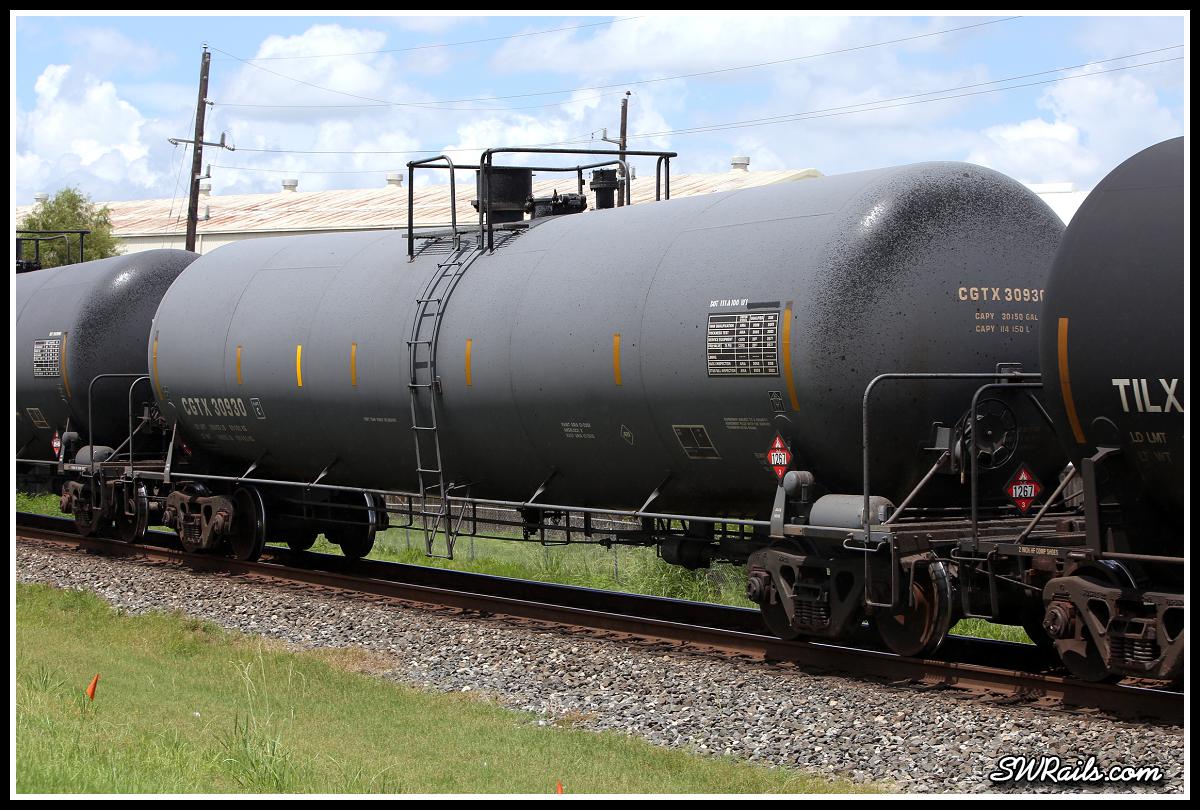
By the time the DPU’s came into view, some serious clouds were just about to make their presence known.
I was satisfied with the outing. Five trains in less than an hour, not to mention a decent shot of Amtrak 156, worked for me…
Southern Pacific Dash 9-44CW’s
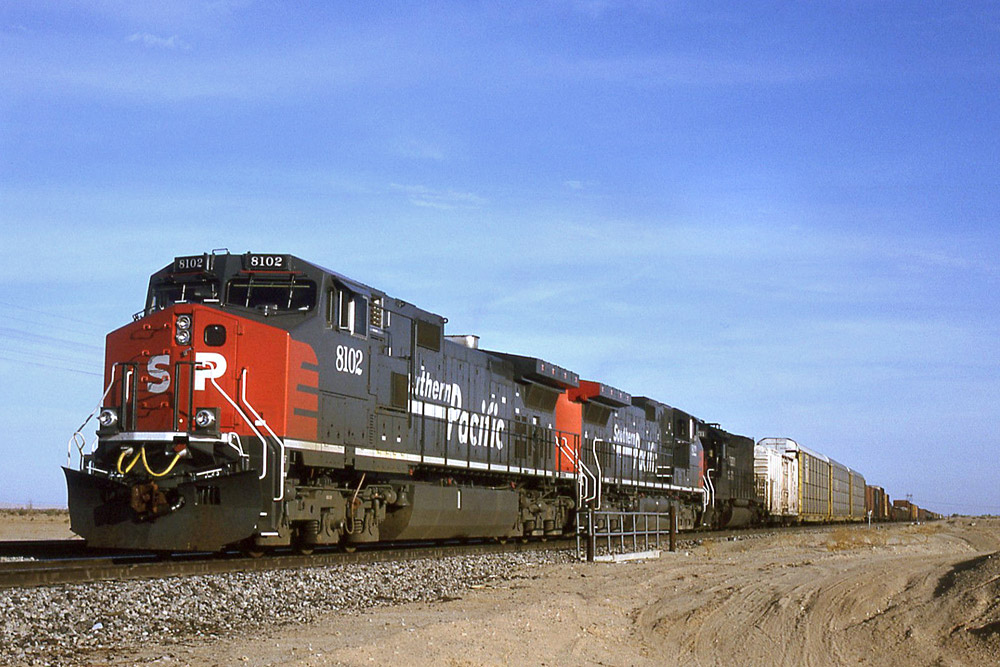
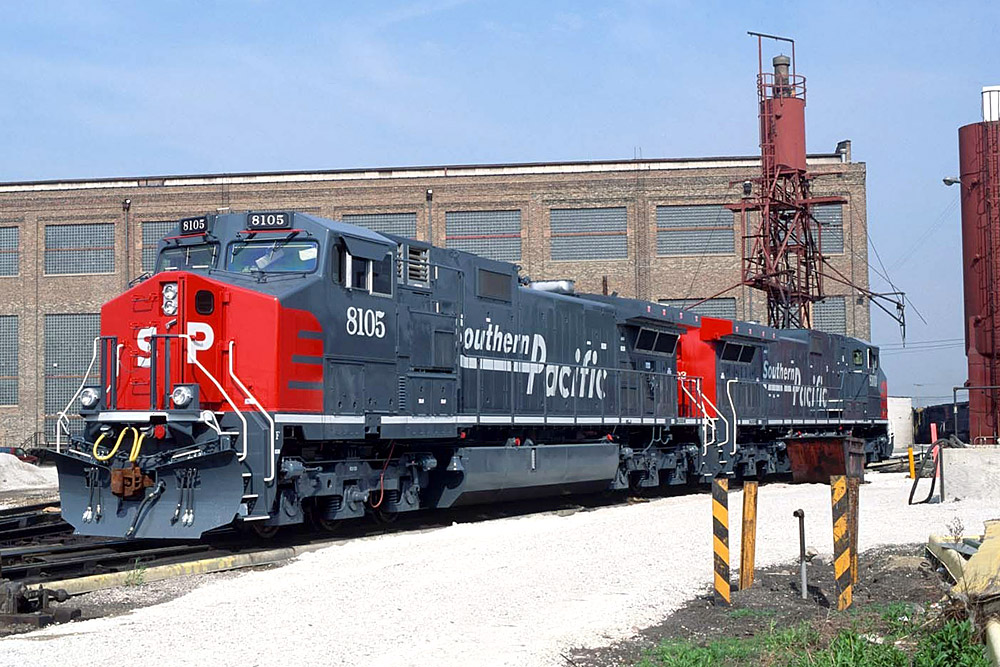
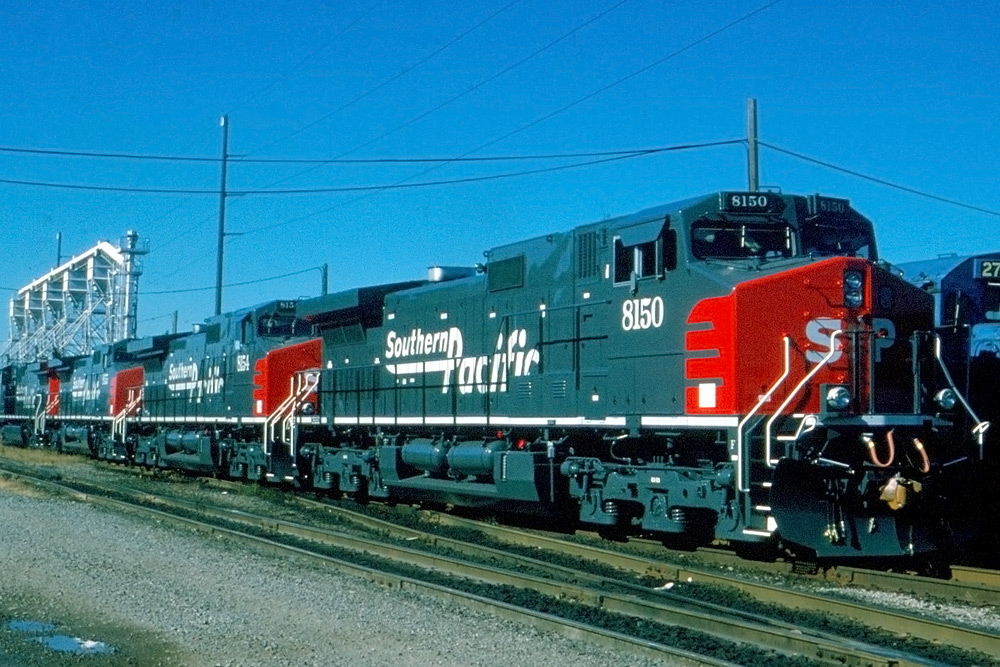
Southern Pacific took delivery of 101 Dash 9-44CW’s in 1994. Units 8100-8149 were built during May and June. The balance, 8150-8200, were built October-December of 1994. Here’s a few views of these big GE’s during their first year of service.
SP 8102 is on the point of a manifest whose crew hogged out just west of Yuma, AZ on July 26, 1994.
Factory-fresh SP 8105 and 8103 are at the Belt Railway of Chicago’s Bedford Park in May of 1994. Note the red grab irons above the windshields, which were unique to the 8100-8149 batch.
SP 8150 and 3 sisters have yet to turn a wheel on SP tracks. The 4 units are in transit from GE-Erie to the SP in Chicago. They are at Conrail’s Collinwood engine facility in Cleveland, OH on October 11, 1994.
Out & About – June 29, 2014
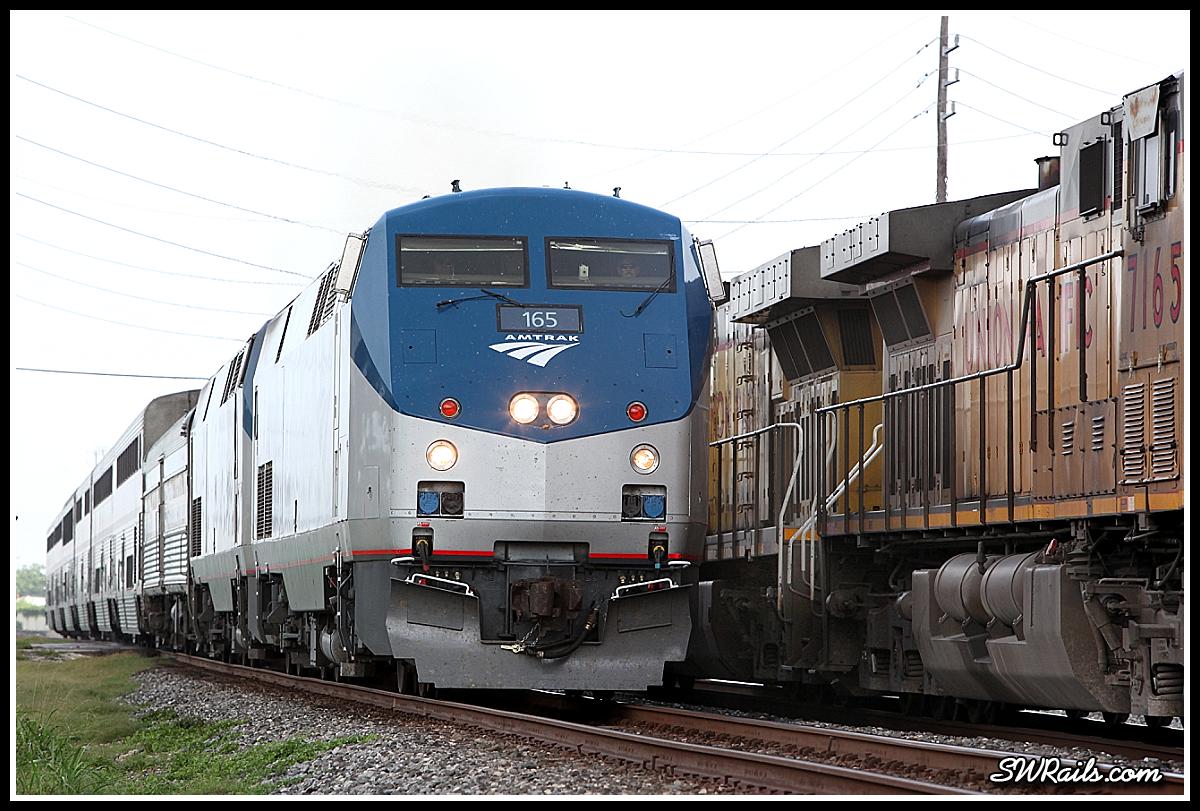
The nice thing about living near the main line is I can work in a quick photo-op when I have an errand to run. I timed a doughnut run right before Amtrak #2 was due to pass by. At first I thought I could get good sun. But as #2 got closer, some heavy clouds moved in. I almost aborted the mission, but I fell prey to the sunk cost fallacy.
I set up near CP SA019 where UP 7071, the MEWEG-29, was waiting for #2. By the time #2 arrived, the cloud cover was thick enough to require an ISO of 1000, compared to 250 for full sun. So be it.
AMTK 165 came into view at 10:29 AM.
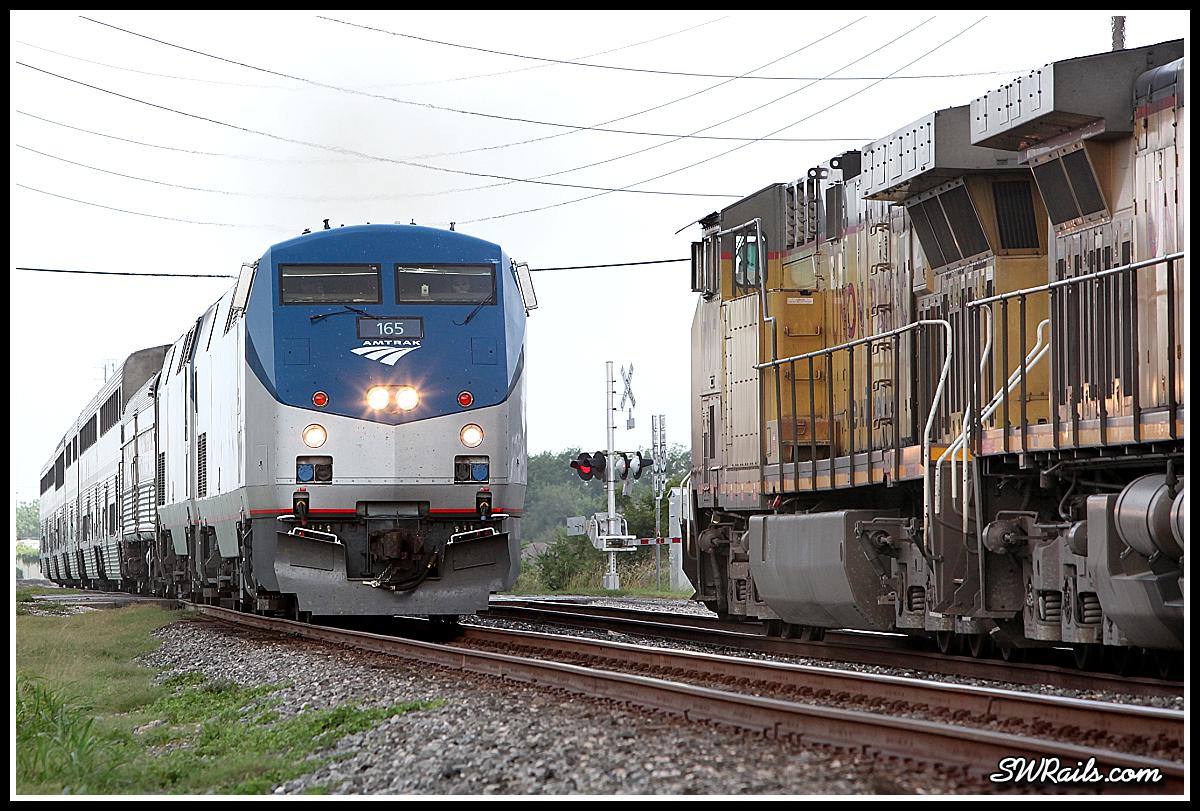
The red marker lights appear to be lighted, but I think it’s an illusion based on the fact that there’s no direct sun on the nose.
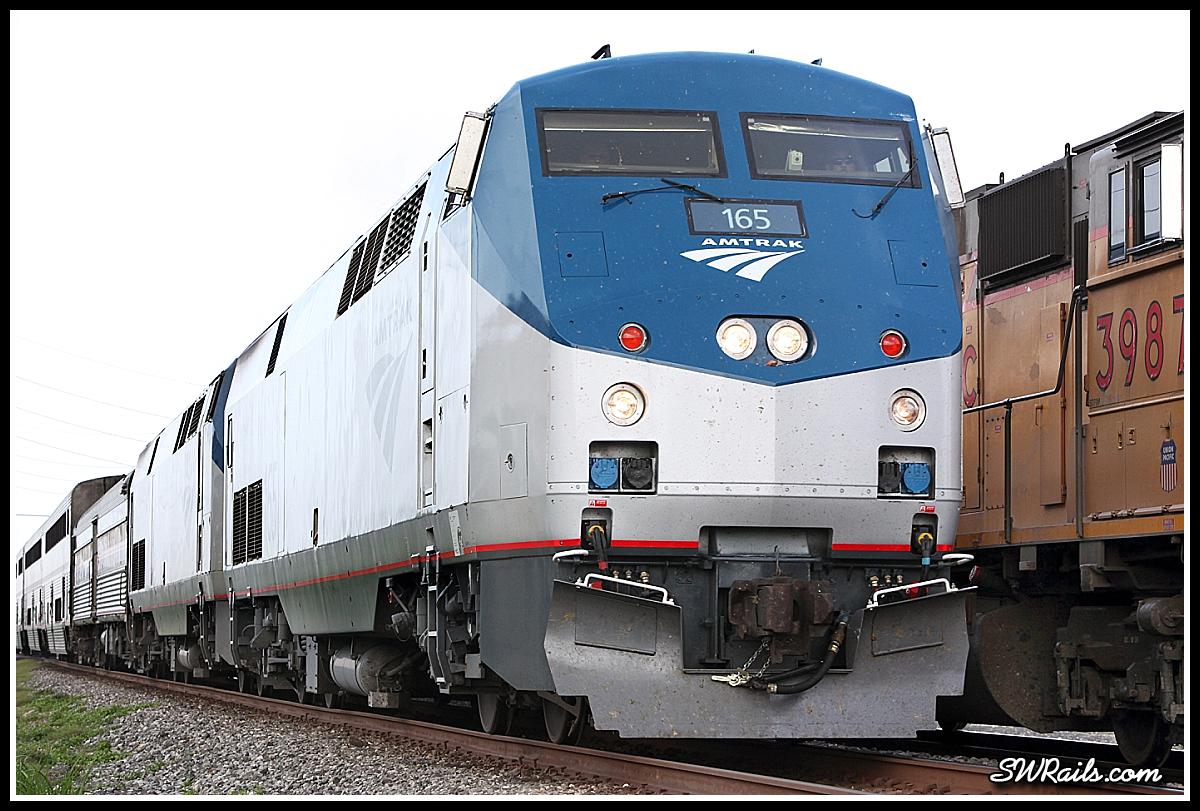
The trailing unit of the MEWEG, UP 3987, is ex-SP 9812.
One #2 cleared up, the MEWEG got the light to proceed west. As it resumed its trip westward, I resumed my trip to Shipley’s.
Out & About – June 9, 2014
Welcome to another episode of after-dinner railfanning in and around Sugar Land, Texas. Todays adventure starts at 7:15 PM when I leave home in hope of catching Amtrak #1 in sun. It seemed to be a fools errand because the day has been mostly cloudy, but there were just enough sucker holes to entice, well, a sucker.
Upon arriving at my favorite late afternoon location, CP SA025, it didn’t look good. A slow-moving cumulonimbus cloud to the west made it clear that it wouldn’t be clear, at least not within the next 10 minutes when #1 would arrive.
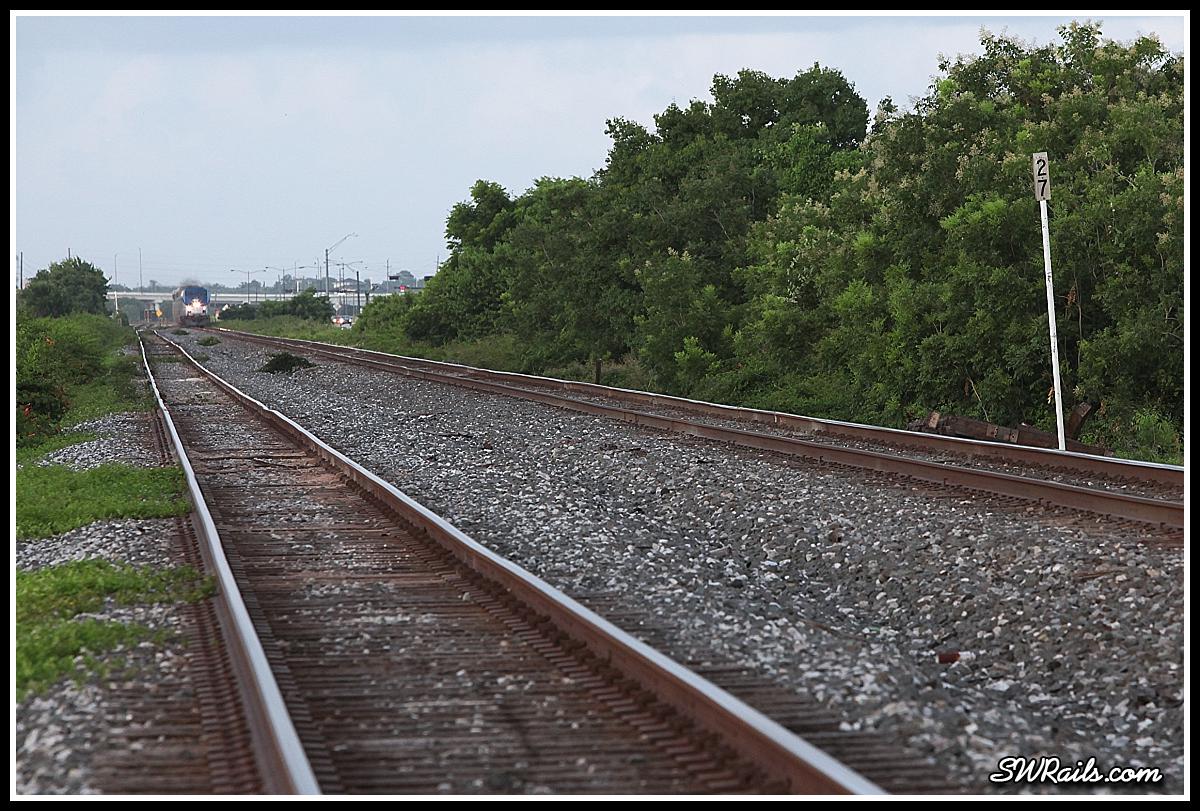
No problem. I’ll just head west until I can find some sun, or the prospect of sun. I ended up at MP 27, where it appeared the sun might drop under the cloud bank in the next few minutes.
The sun did pop out for several minutes, but as #1’s headlight came into view, the sun went into cloud-magnet mode. A quick camera adjustment and test-shot rendered this view at 7:40:02 PM.
As I watched #1 approach through the viewfinder, the scene appeared to be brightening up a bit. Then it really started to brighten up. I fumbled with the camera settings, hoping to anticipate just what the light level would be in the next several seconds. No time for a test shot, because #1 is upon me at 7:40:44 PM.
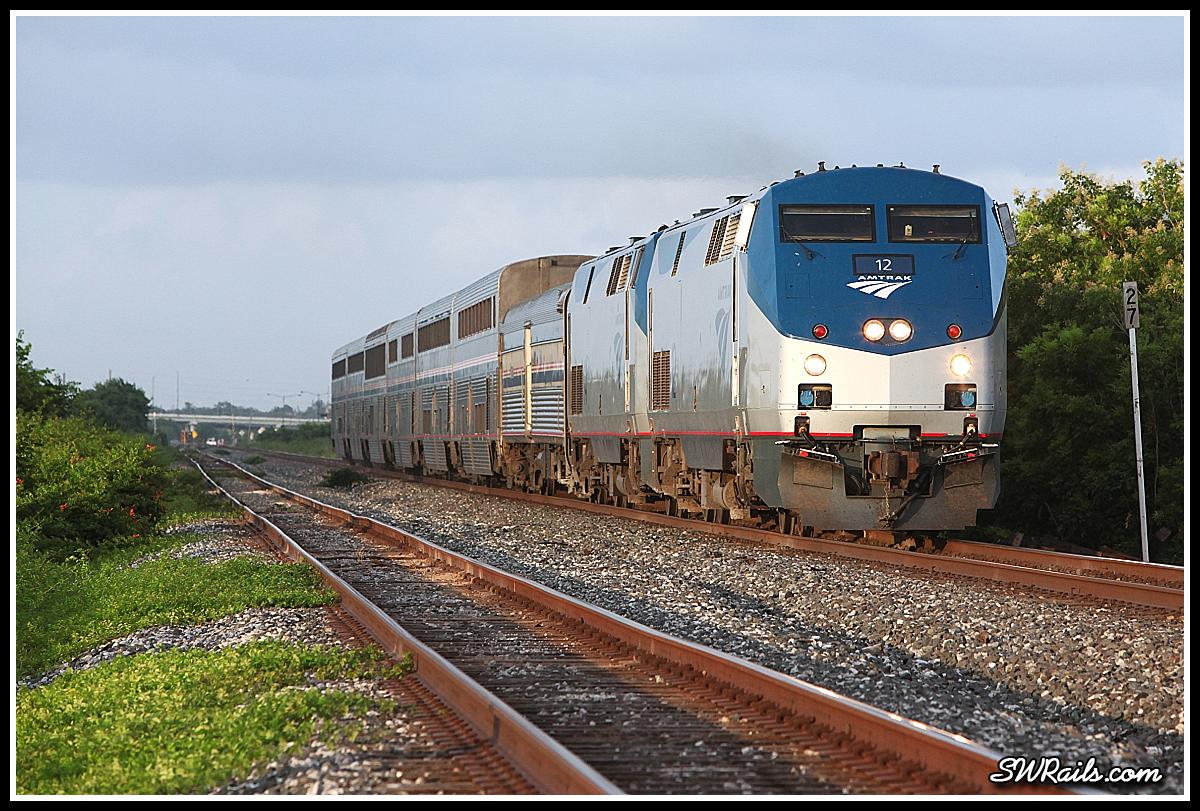
One more shot at 7:40:48 PM.
By the time the last car gets by me at 7:41:05 PM, the light was gone.
Wow! 30 seconds of light, timed perfectly! Thanks be to all of the cloud deities!
An eastbound KCS intermodal hasn’t quite made it to Harlem to clear up for #1, hence the approach indication at CP SA028. (Can’t see signal? Click to little one to see a big one.)
I drove west to CP SA030 to see if I could scare up another shot of #1. Upon arrival there, the KCS train has just cleared the west switch as #1 waits for the signal to proceed.
At 7:51 PM, #1 gets a clear signal at CP SA030. Headlights back to full power, the engineer notches the throttle out to resume its westward journey.
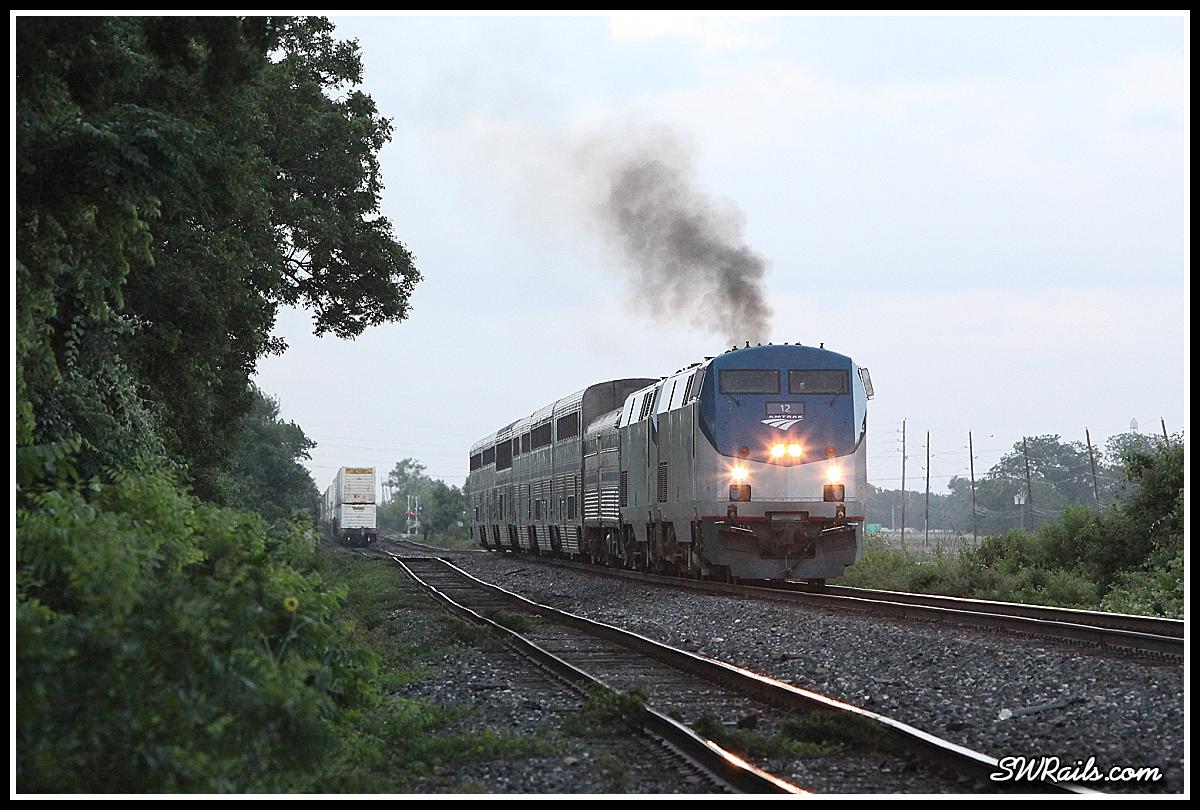
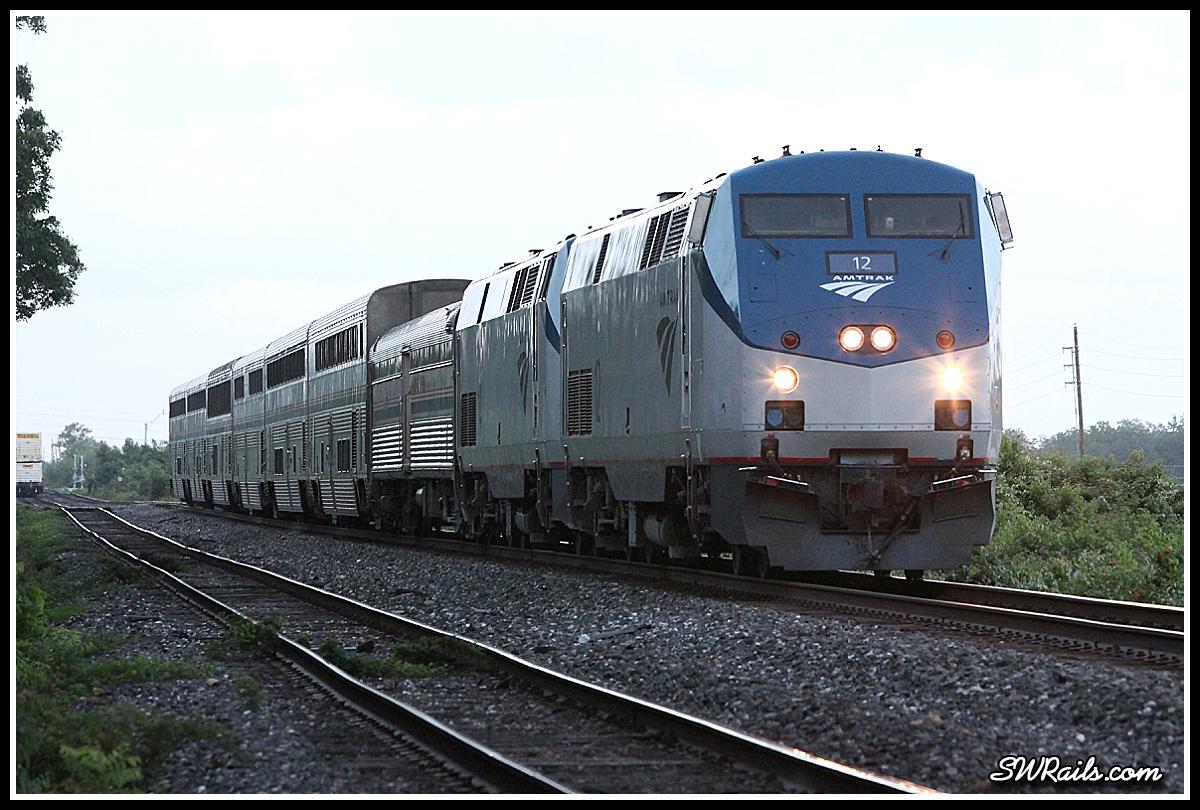
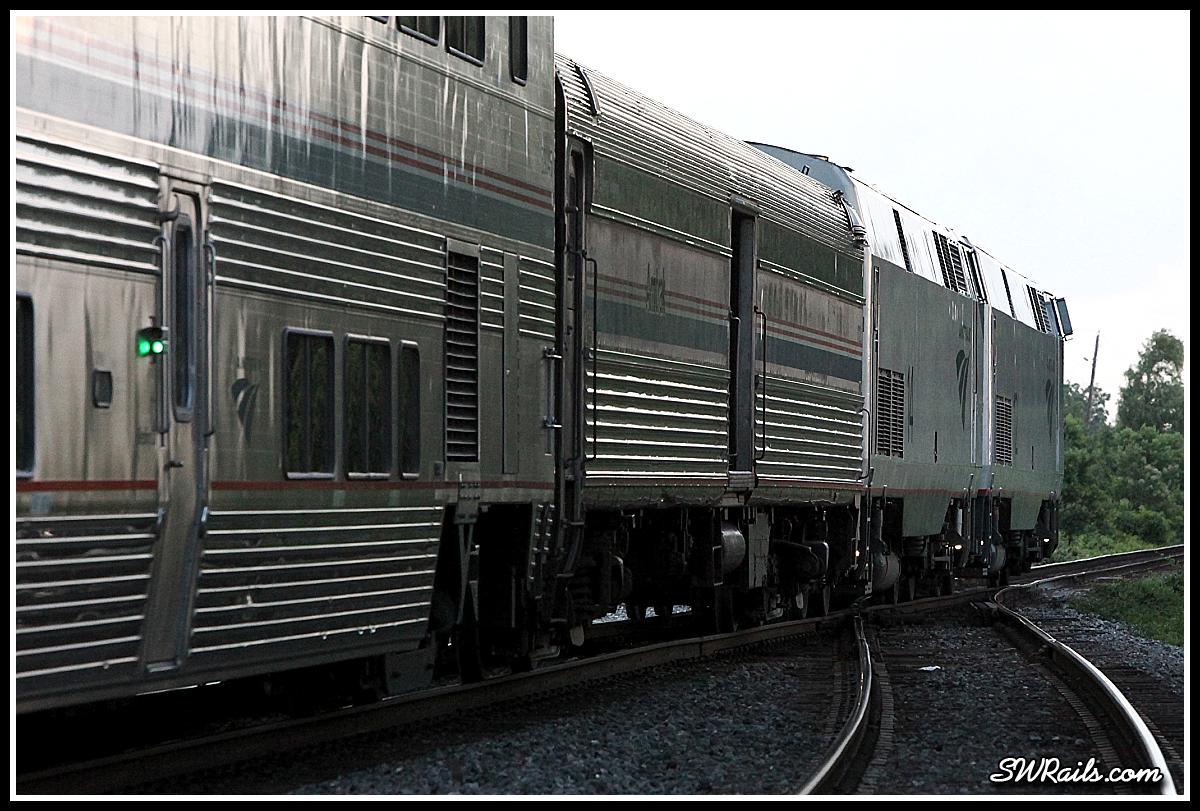
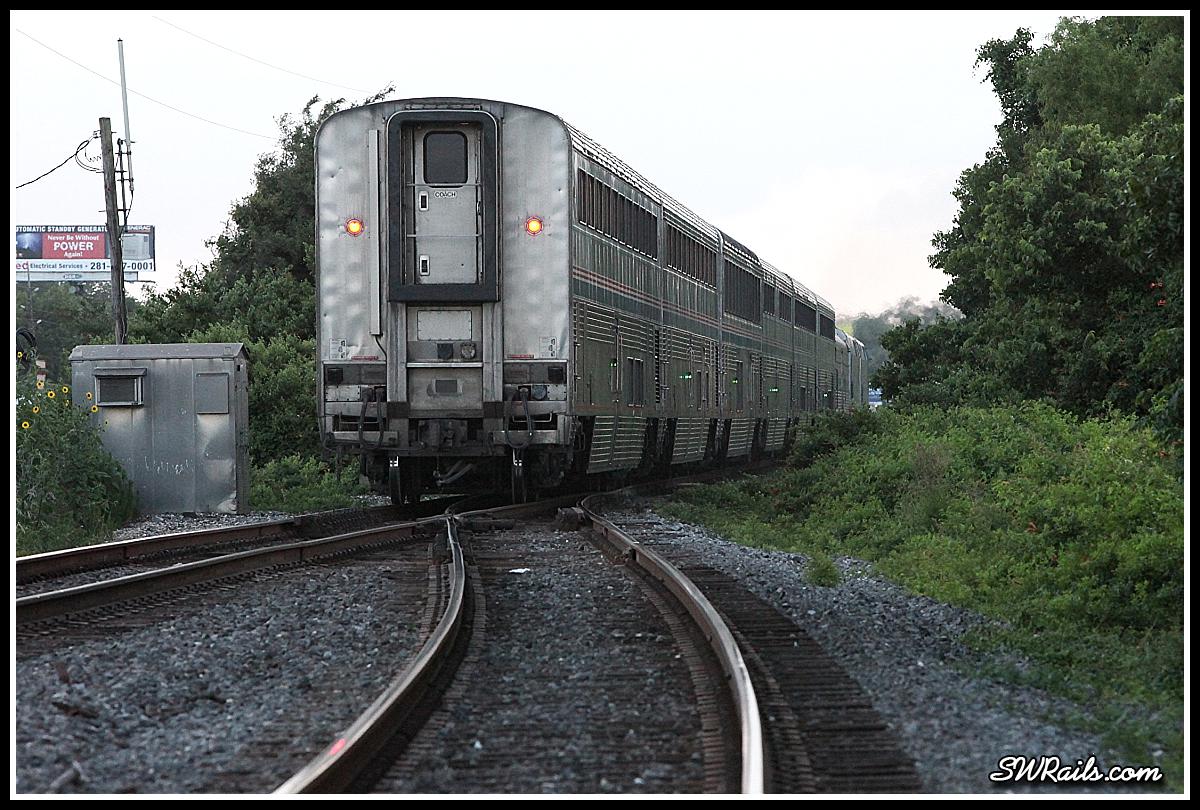
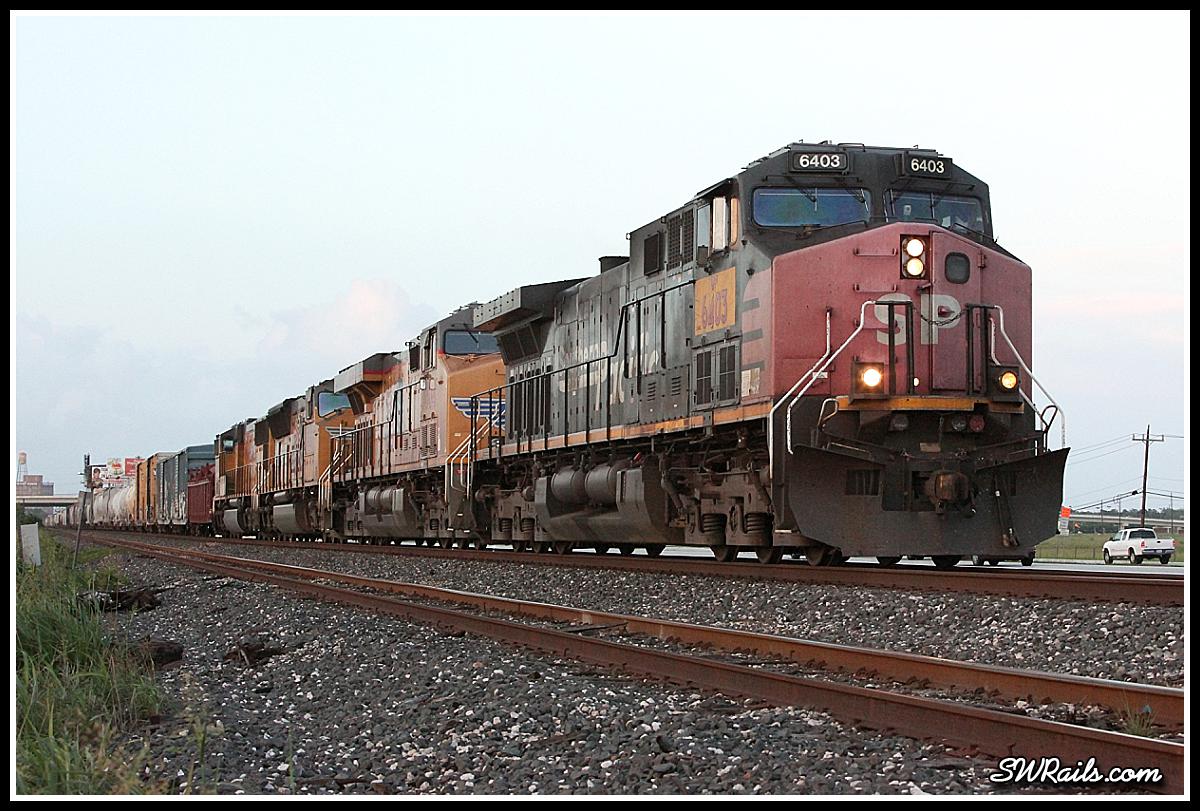
I knew there was a westbound, UP 6403, following #1. But there wasn’t any light left to speak of. Normally, that’s my cue to head home, but I was curious about the lead unit of the next train, as I don’t see many 6400’s. I headed to Prison Road crossing to wait for it.
My curiosity paid off, as the lead unit was a patched SP AC4400CW. Sun or no sun, I’m always glad to shoot anything that reminds me of the glory days!
UP 6403, ex SP 357, leads Laredo-bound manifest MEWMX-09 by me at 8:13 PM.
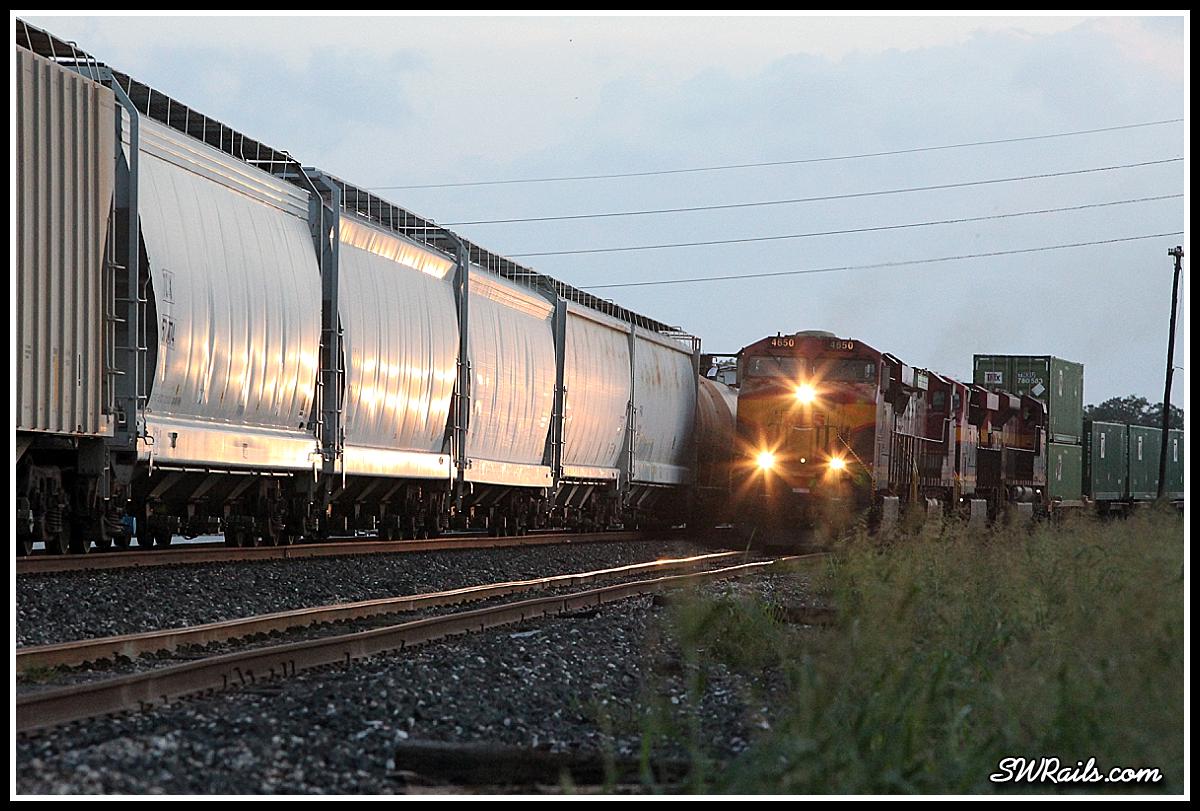
The eastbound KCS intermodal we saw earlier at Harlem had been bumped up to Sugar Land. The DS had told them to go east after one westbound. They’ve taken the directive to heart, and have started pulling toward the east switch.

KCSM 4650 approaches me at 8:15 PM.
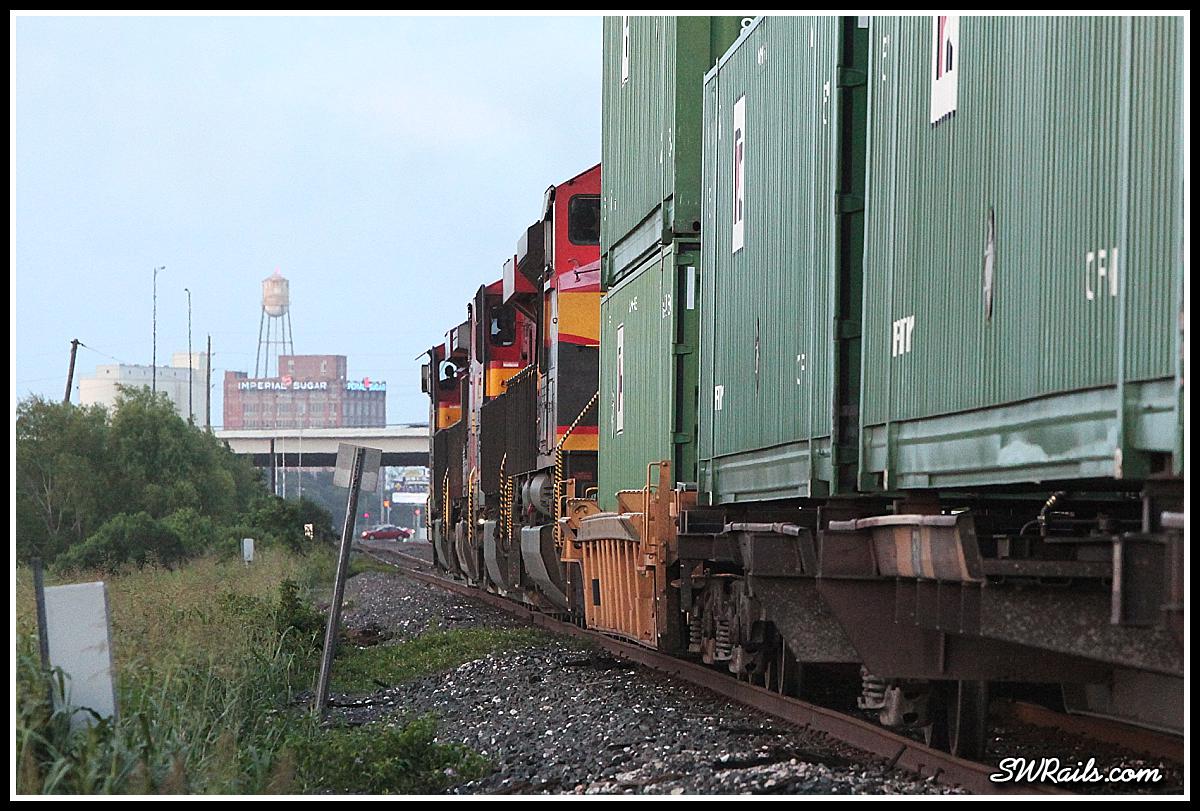
Speaking of glory days, ex-ATSF C44-9W 695 takes us back to the storied SuperFleet era.

It might not look like it, but the Sugar Mill is still over a mile away.
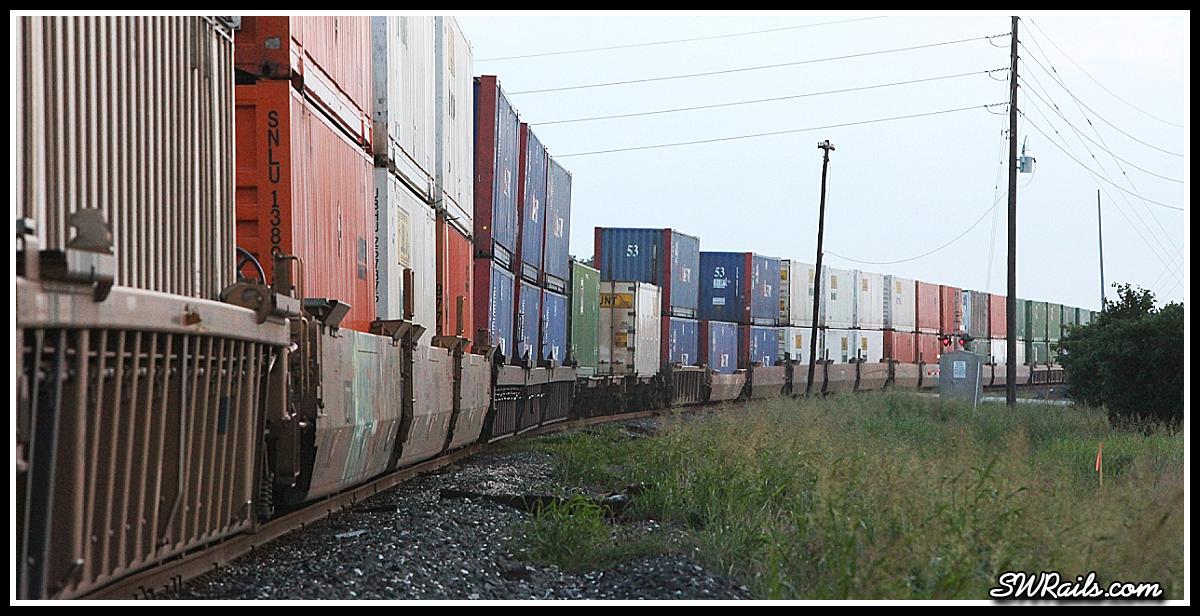
KCS has historically been a manifest traffic railroad, with some PRB coal trains added to the mix in the 1970’s. I suspect many fans aren’t aware of it, but the KCS also runs some serious intermodal trains. 2-3 solid trains like this one a day, and 2-3 other trains a day with sizable intermodal blocks.
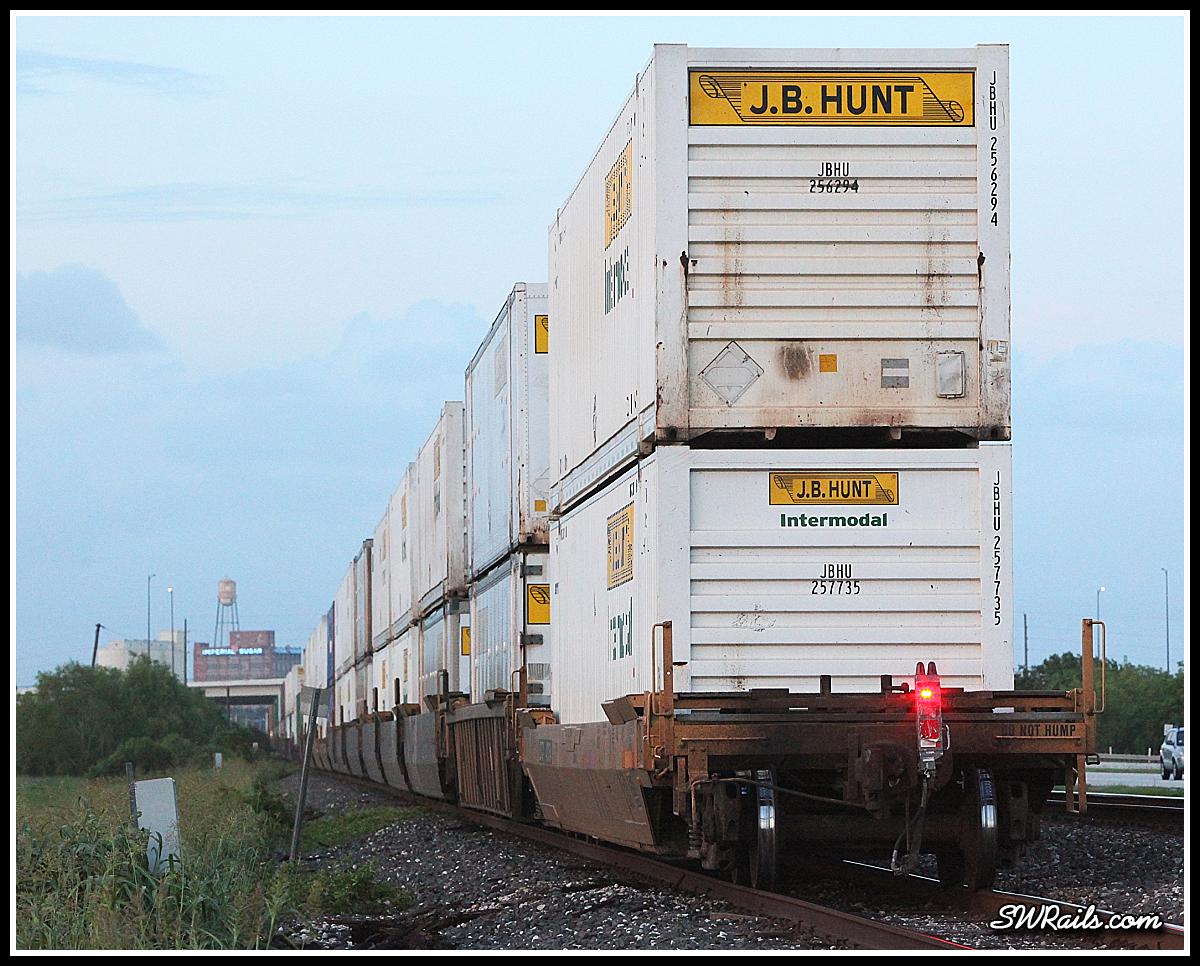
That’s all for this episode of after-dinner railfanning.
PS – Apologies to the ADD crowd. I see 3 trains and end up with a Tolstoyesque post.
Running The Table
Images taken on June 4, 2014
There was a MofW curfew this afternoon to allow BNSF forces to do trackwork on both sides of the Tower 17 UP/BNSF interlocking in Rosenberg. Due to issues completing the work, the BNSF foreman wasn’t able to release his time until 6:40 PM, over an hour later than planned.
Listening to the radio during dinner, I knew it was a mess. I heard the dispatcher talking to 3 different westbounds, all stopped in the Sugar Land area. We finished dinner right about the time the BNSF foreman gave back his track and time. I left home around 6:45 to try my luck.
As I drove west on Hwy 90, I’d never seen so many stopped trains in the Sugar Land area. This is how they were staged at 7:10 PM:
MP 29 – UP 9766 – stopped on the main at Harlem
MP 27 – UP 7950 – stopped on the main at the west switch of Sugar Land
MP 27 – KCS 2011 – stopped in the siding at Sugar Land
MP 19 – BNSF 7909 – slow-rolling on the main at Missouri City, headed into Sugar Land siding so Amtrak #1 can get by.
MP 12 – AMTK 44 – Amtrak #1 slow rolling at West Junction, to allow the “cluster” ahead to clear up.
Since I didn’t leave home until the track re-opened, I didn’t expect to catch the first 3 westbounds, as the lead one was 8 miles away. My goal was to just get the BNSF and Amtrak around MP 25-27, depending on the light.
But it turned out that the first train to move across the Tower 17 interlocker was KCS 4778 East. It would go into Harlem siding before the parade could start. Upon hearing this development, I realized I had a shot at “running the table”.
I arrived at the west switch of Harlem, CP SA030, just as the rear end of the KCS was clearing up. Within a minute or so, the DS calls UP 9766, telling them “I’m ready for you at the west end of Harlem”.
Let the games begin!
The MEWEG-04, UP 9766 arrives at 7:14 PM.
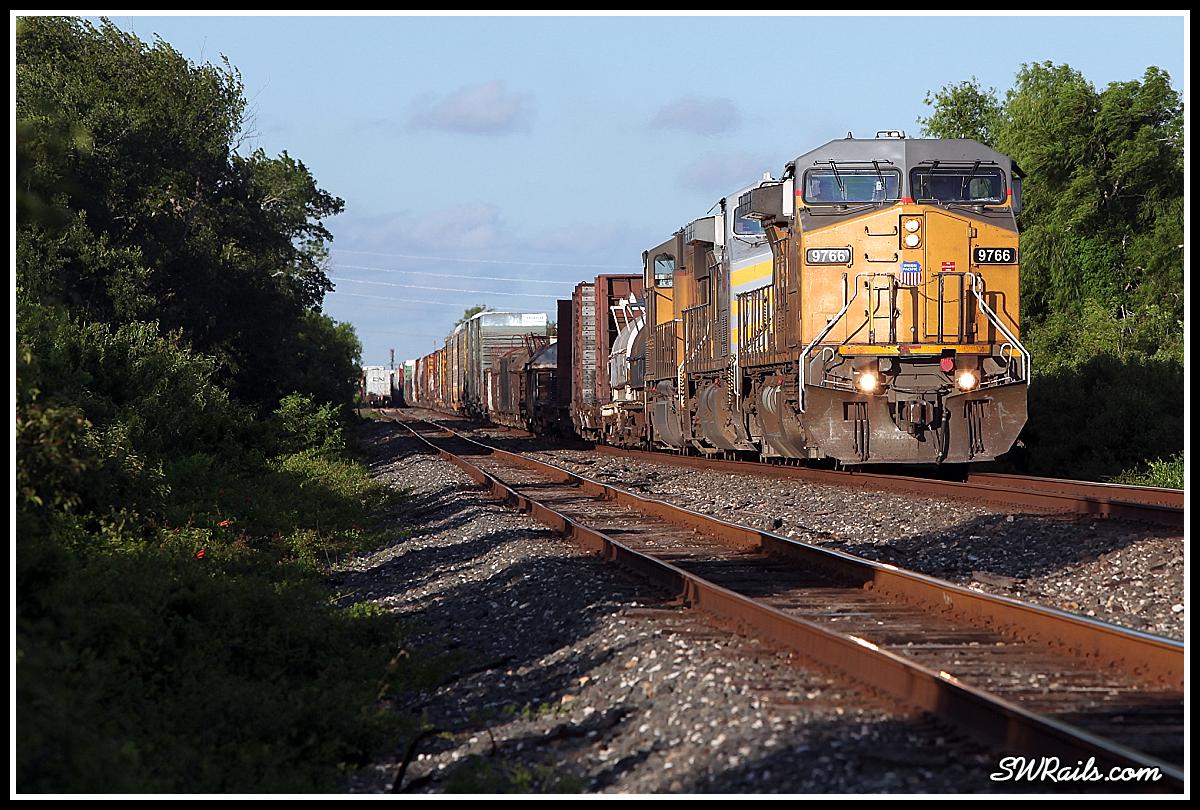
The second unit is KCS 4583, an AC4400CW.

UP 9766 approaches the clear signal indication at CP SA030. What clear signal? It’s there, just hard to spot in the small image. If you click the image, it will be easier to see the signal just ahead of the lead motor.
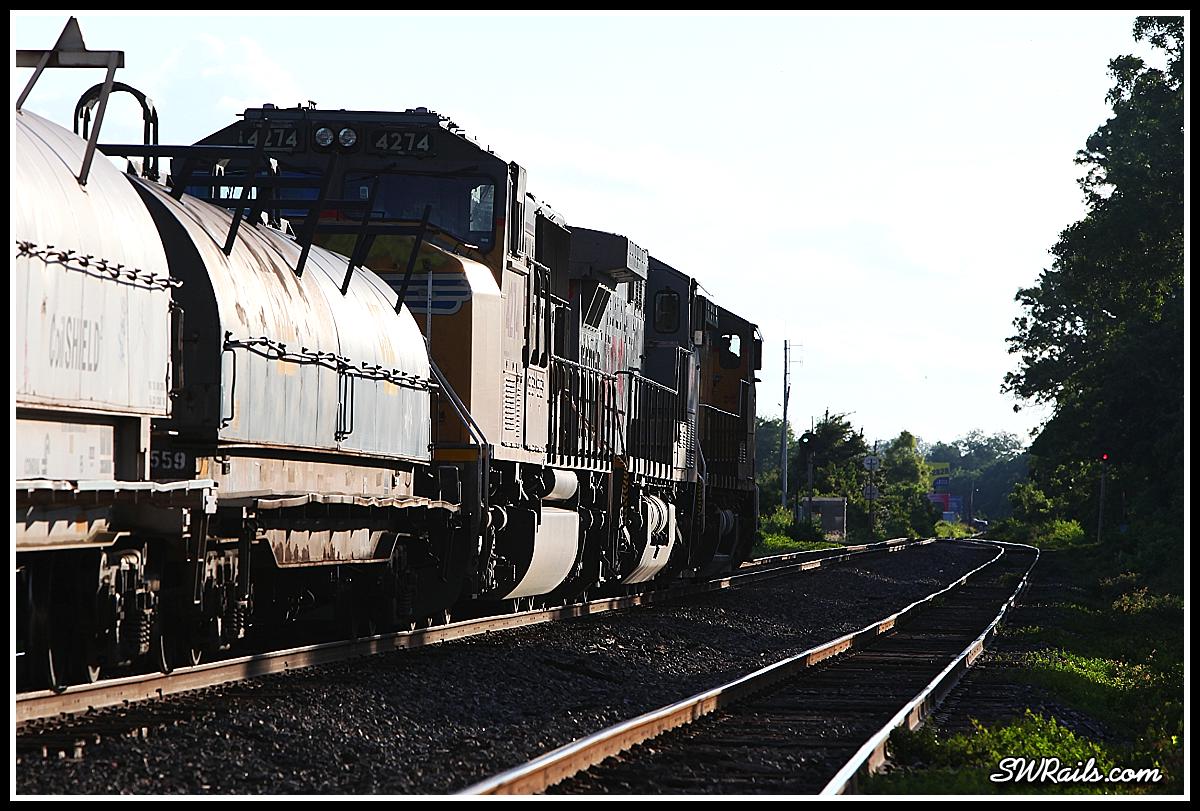
The shadows were getting too long for me to stay at Harlem, so I headed west to Richmond to look for better light. I ended up at the Eight St. grade crossing, MP 32.96.
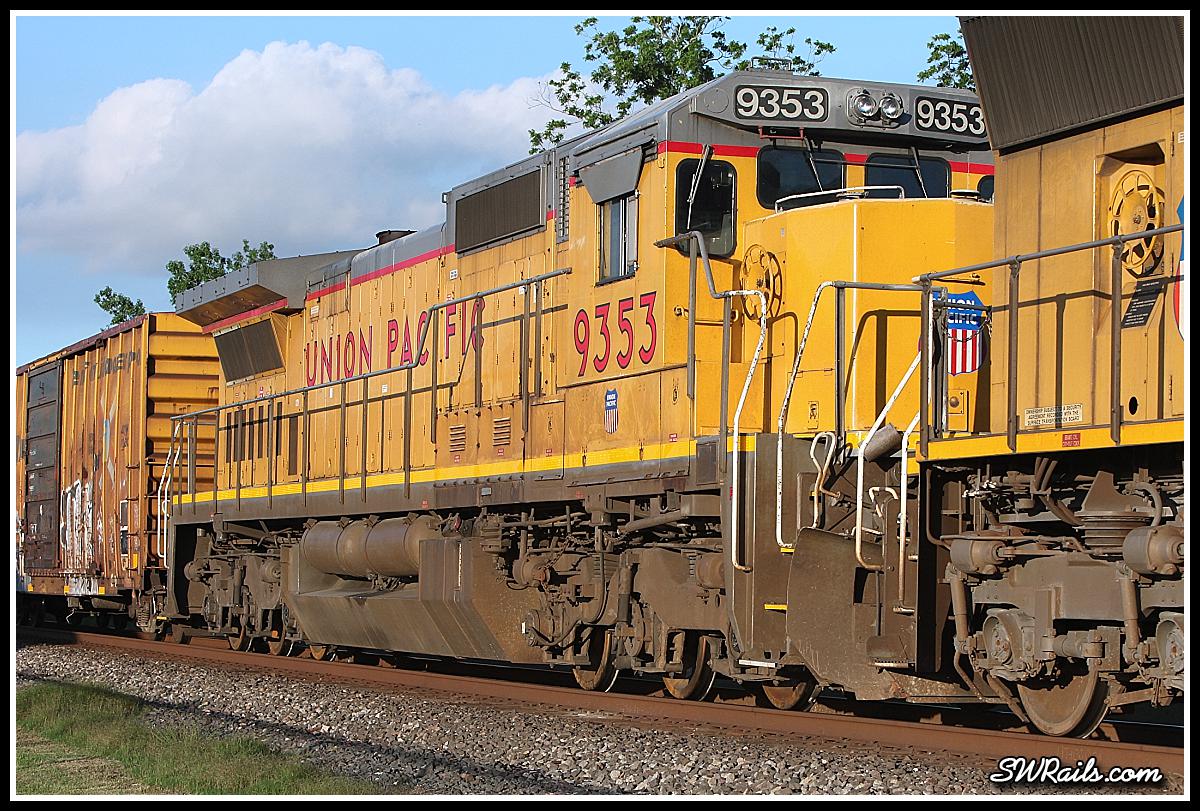
UP 7950, the QEWWC-04, arrived at 7:35 PM in amazing light. But I could sure do without that building shadow…
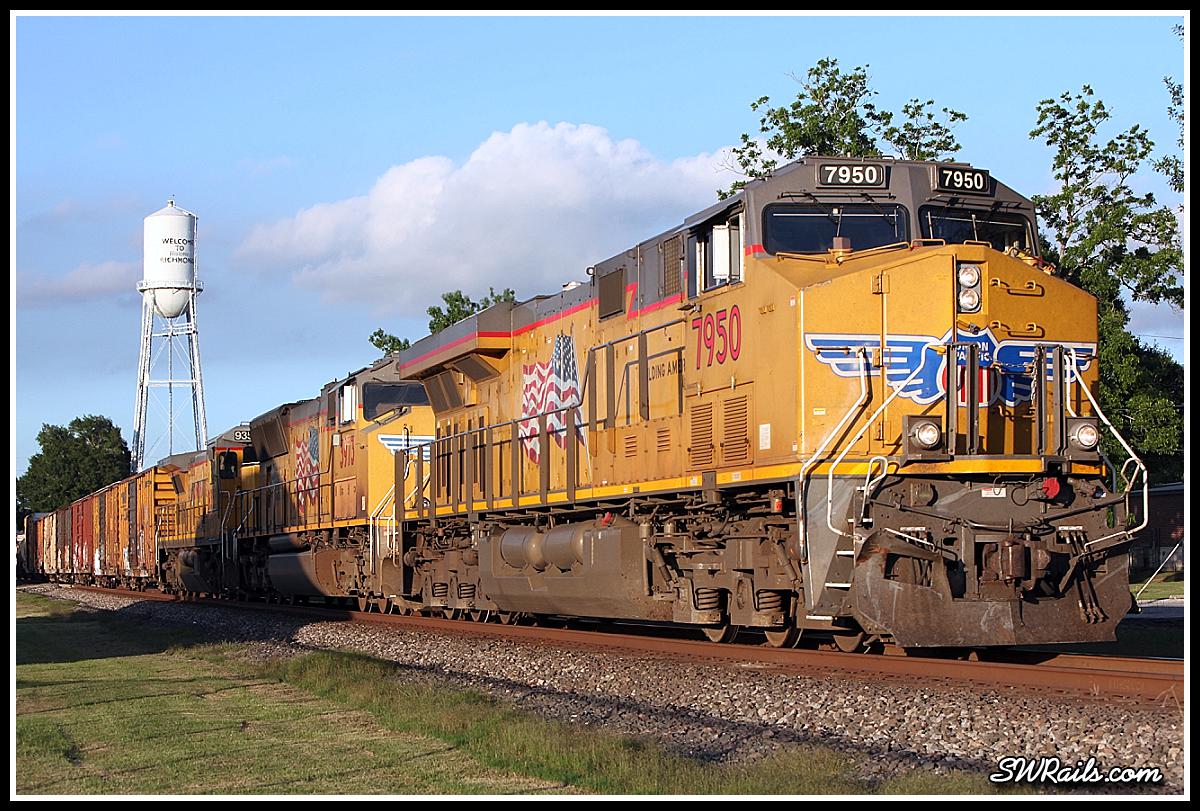
The trailing unit, UP 9353, was a fine sight with its standard cab. The fact that it was DIC didn’t bother me at all.
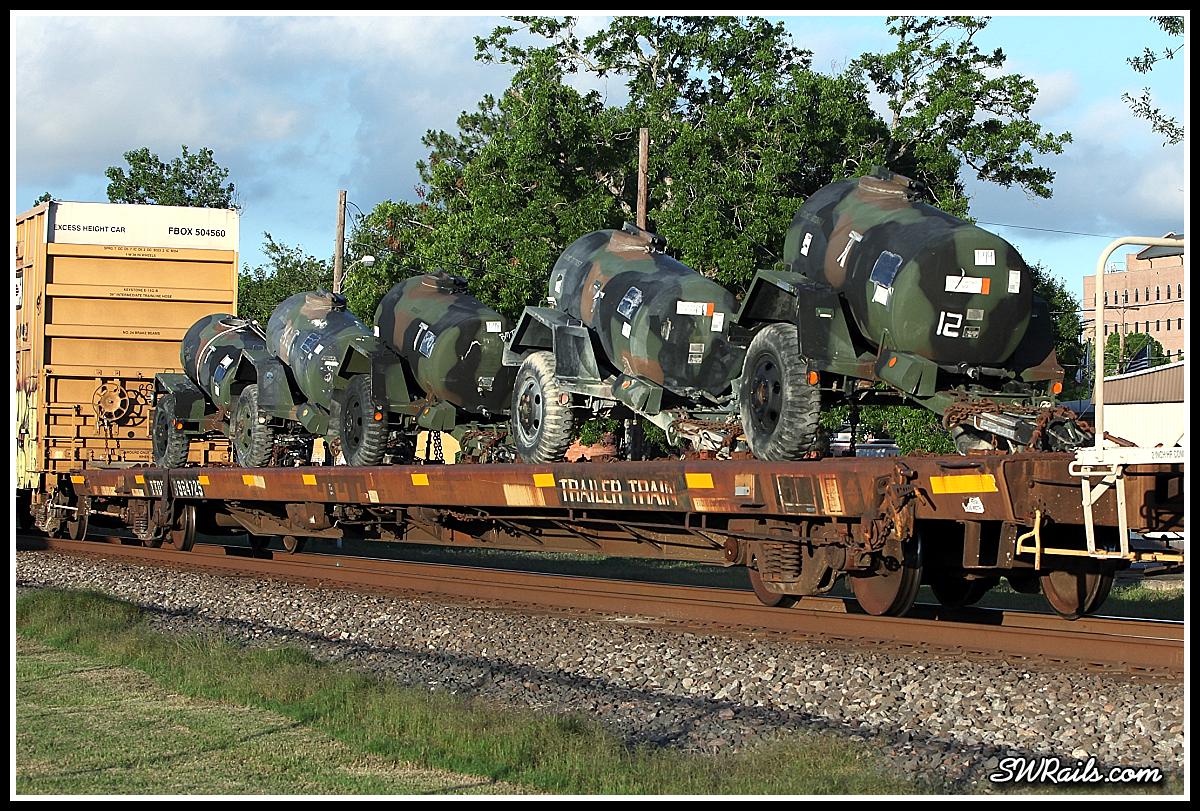
An interesting load on TTDX 964725. The trailers have USMC stencils on them. Any idea what these little tank-trailers are for?
As the DPU’s come into view, the trailing unit looks out-of-place.
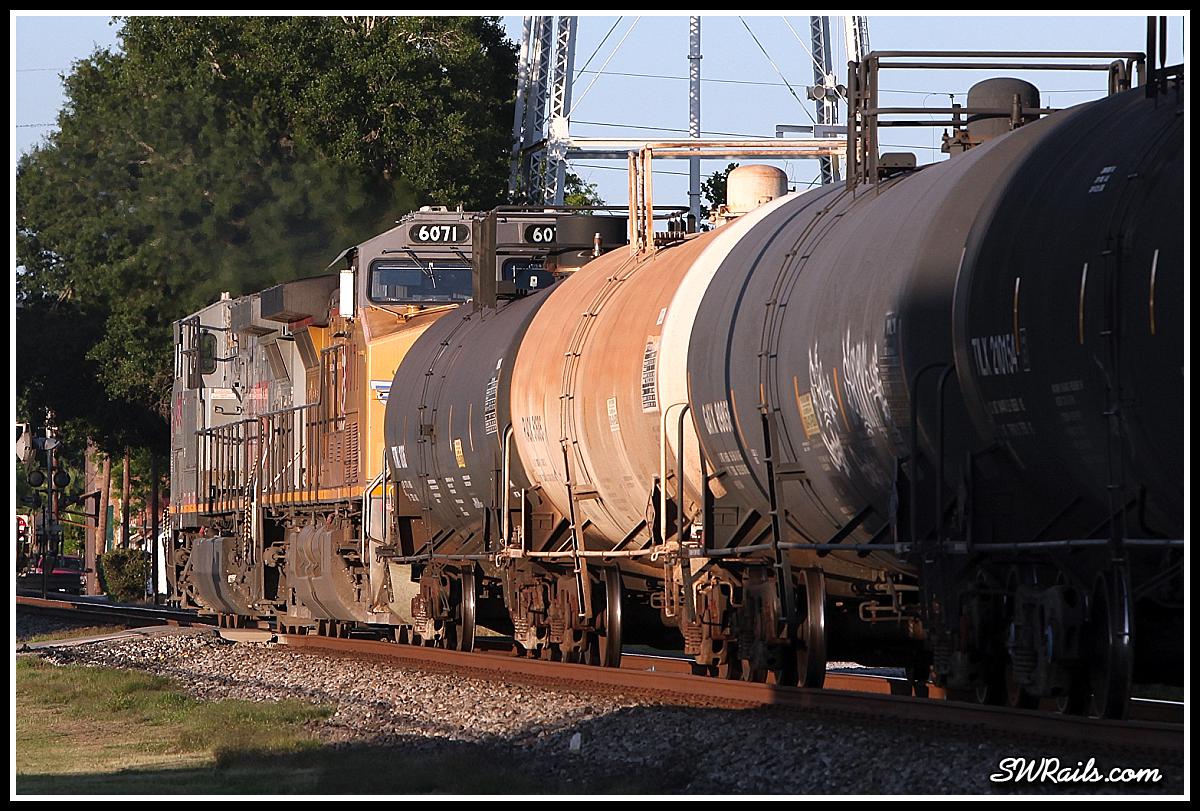
Not bad-two consecutive UP trains with KCS power!
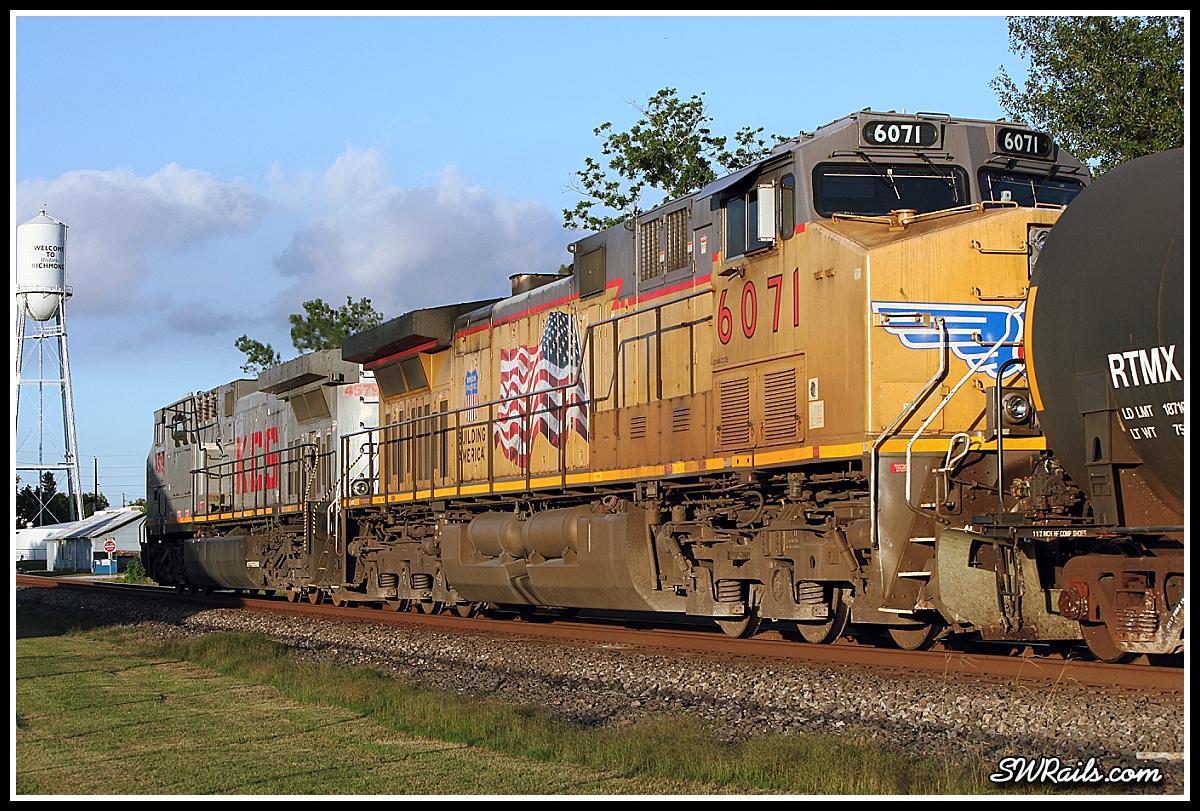
KCS AC4400CW 4579 brings up the rear.

The light was still nice here, but I don’t like to shoot back-to-back trains at the same location if it can be avoided. So I headed a few blocks east to the Brazos River bridge to wait for the next train. Upon arrival, I was pleasantly surprised to see that I could get nice light from the north side of the bridge.
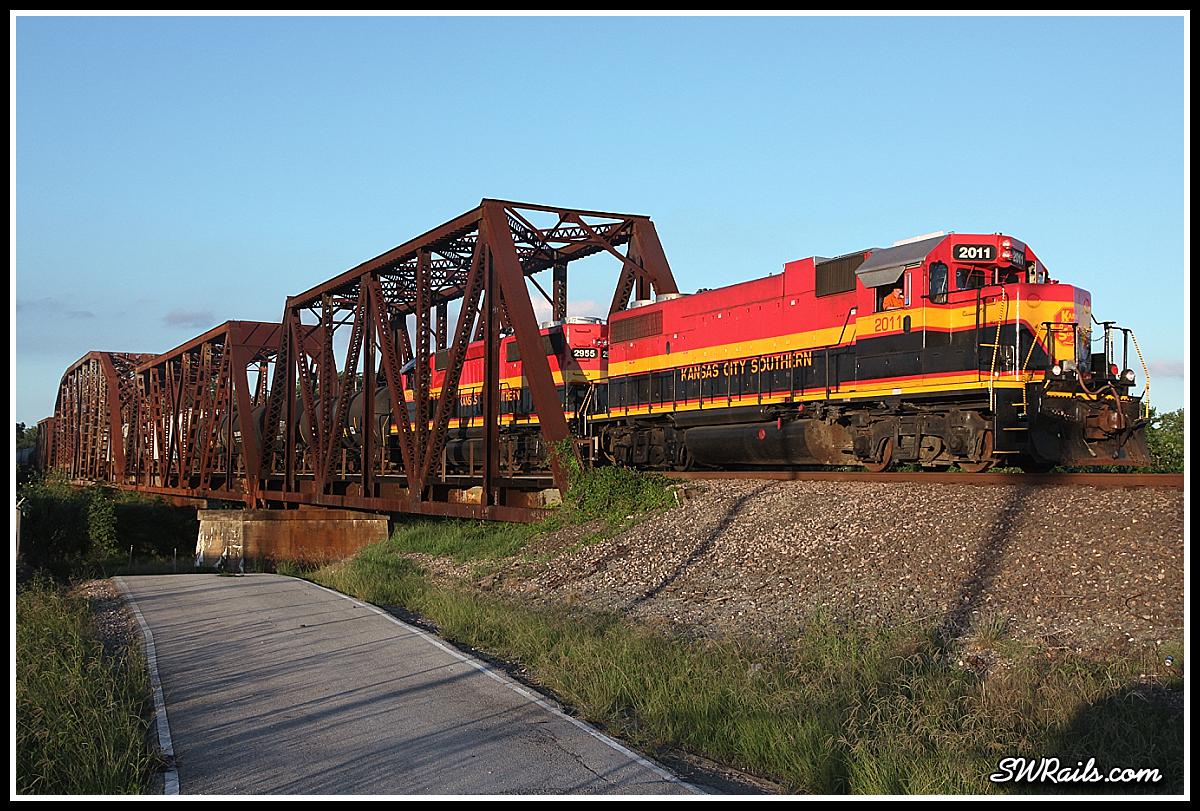
The KCS Rosenberg Local, led by GP38-2 2011, exited the west end of the Brazos River bridge at 7:46 PM.
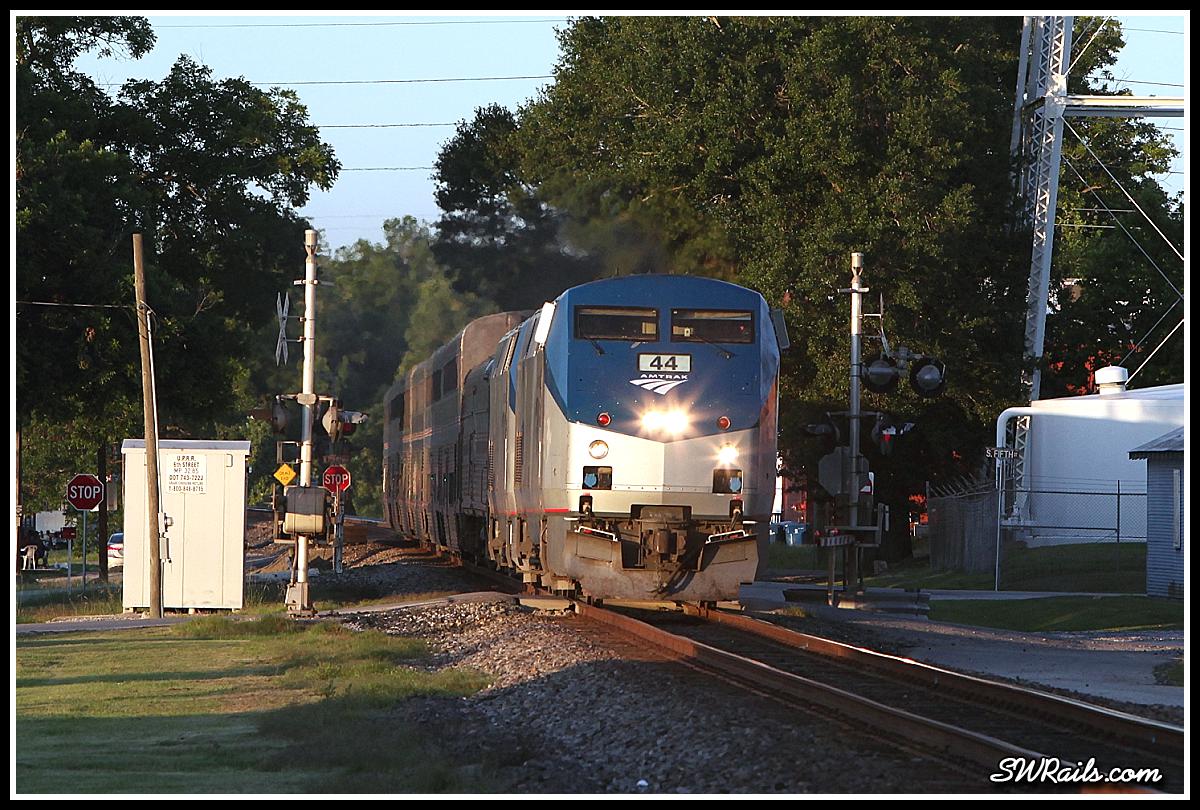
Back to the 8th Street grade crossing to wait for Amtrak #1. 9 minutes after the KCS local, AMTK 44 comes into view at 7:55 PM.
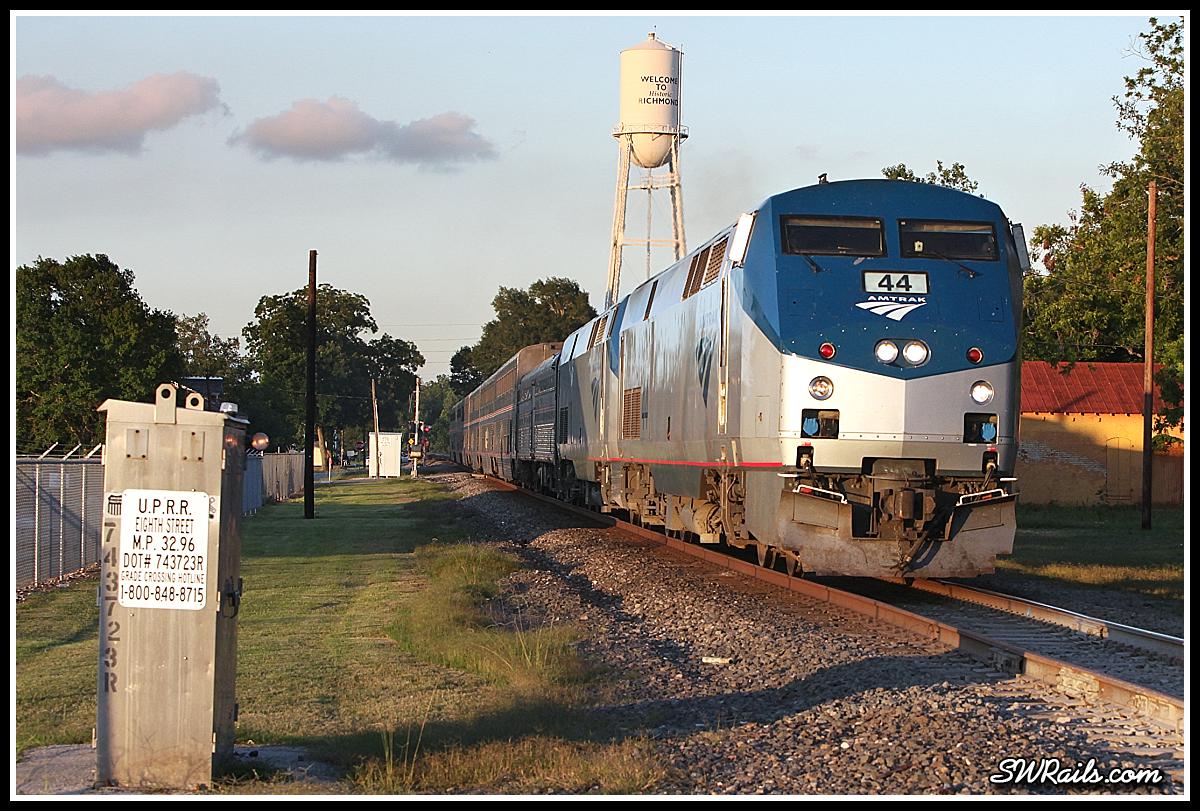
Check out just how long the shadows are. The shadow from the rail on the left reaches all the way to the base of the rail on the right. But it was clear enough to where the light was really nice; not hazy as is typical.
Back to the Brazos River bridge for the last westbound in the fleet. I thought I might get it in sun, but it was not meant to be. The sun dropped below the tree line about 4 minutes before BNSF 7909 arrived at 8:08 PM.

The bright red CP ES44AC trailing unit suggests that BNSF’s power shortage continues.
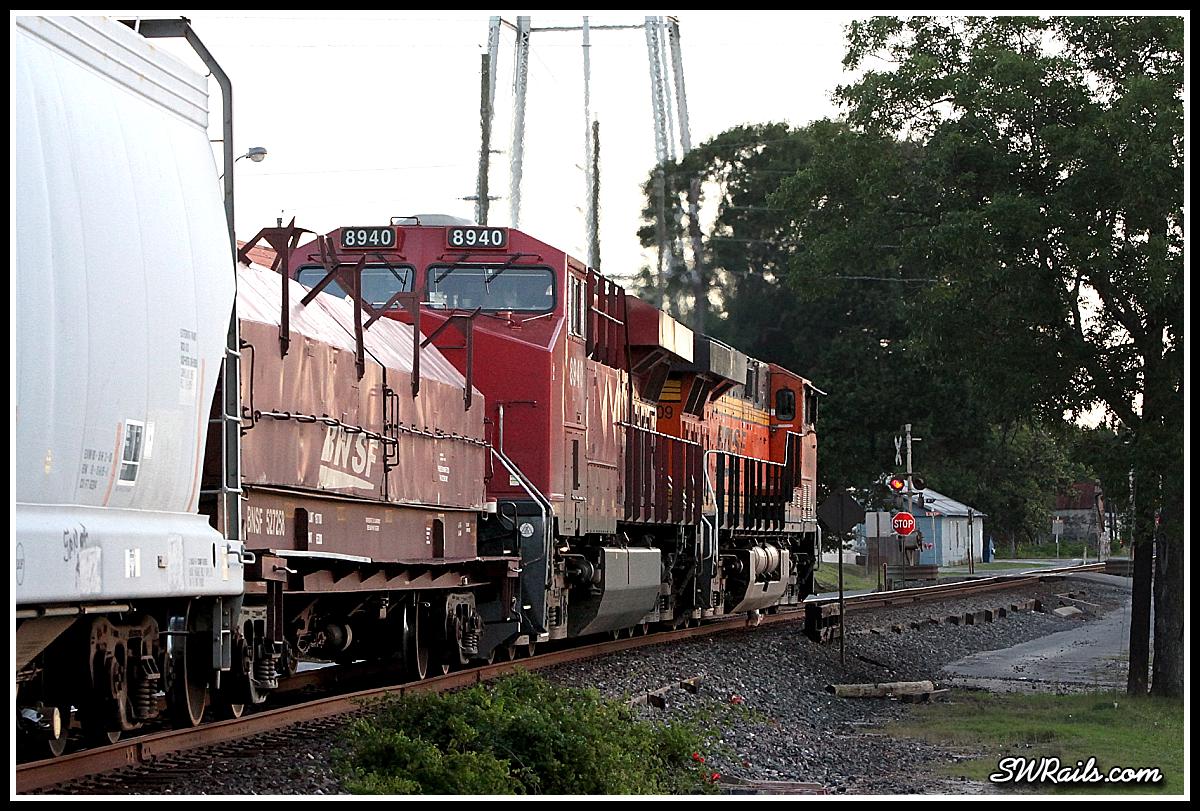
I didn’t quite run the table. I did catch all 5 trains, but I don’t get full credit for the last train on account the shot wasn’t in good light. Nevertheless, 5 westbounds in 54 minutes ain’t too shabby for my neck of the woods.
A Festivus Miracle!
You might recall a post from about 6 weeks ago that had an image of SP PA 6006 getting a bath. Click here to refresh your memory.
Since I posted it, I came across 2 more images of this same locomotive that were taken about 4-5 years apart in Ogden, UT. What struck me as an amazing coincidence, maybe even a Festivus miracle, was that the images were taken not only in the same town, but in virtually the exact same location at the SP’s Ogden roundhouse.
The first image shows the 6006 on October 3, 1958. It appears to have a recently replaced lead truck. Note the position of the unit relative to the utility pole in the background.
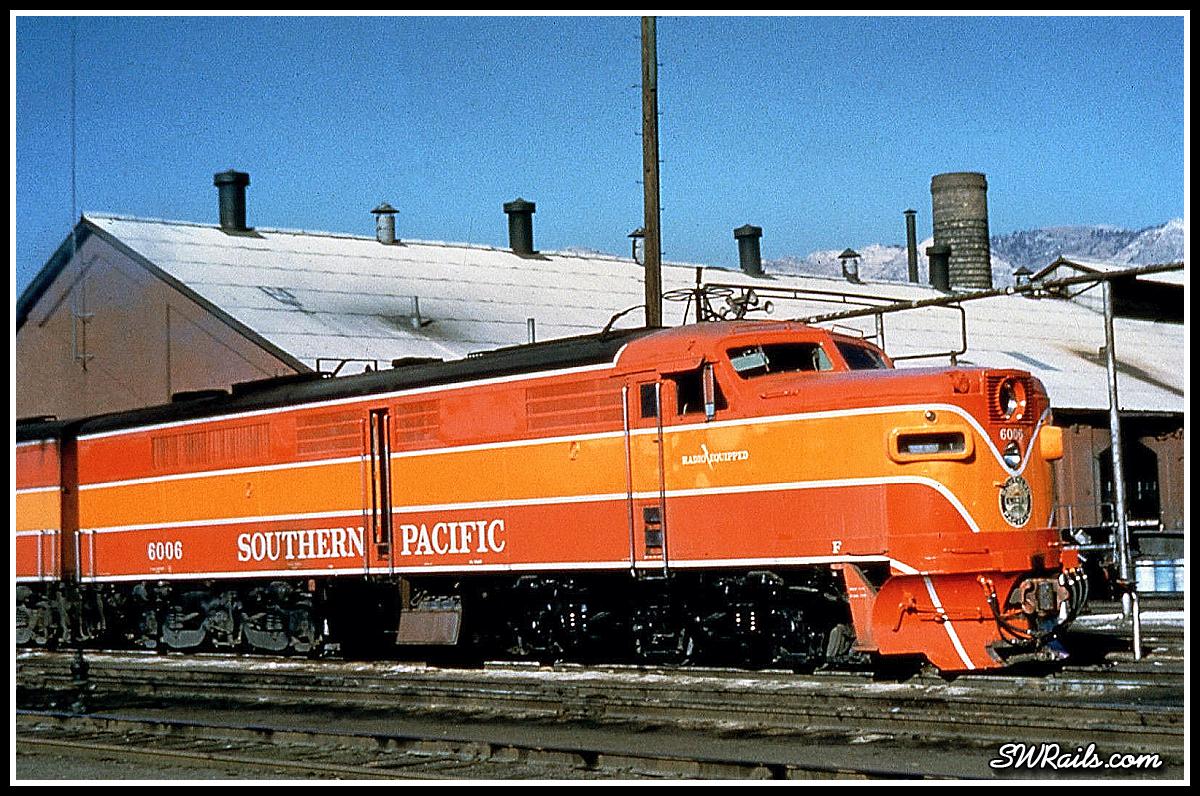
There’s no date on the second image, but we can narrow down the date to the 1962-1964 range. What’s my basis for this assertion?
The Southern Pacific adopted the lark gray & scarlet locomotive paint scheme in 1959. The paint on the second image isn’t fresh, nor it weather-worn, allowing me to infer the date range.
Based on the position of the utility pole in the background, the 6006 in the second image looks to be about 20 feet from the its location in image one.
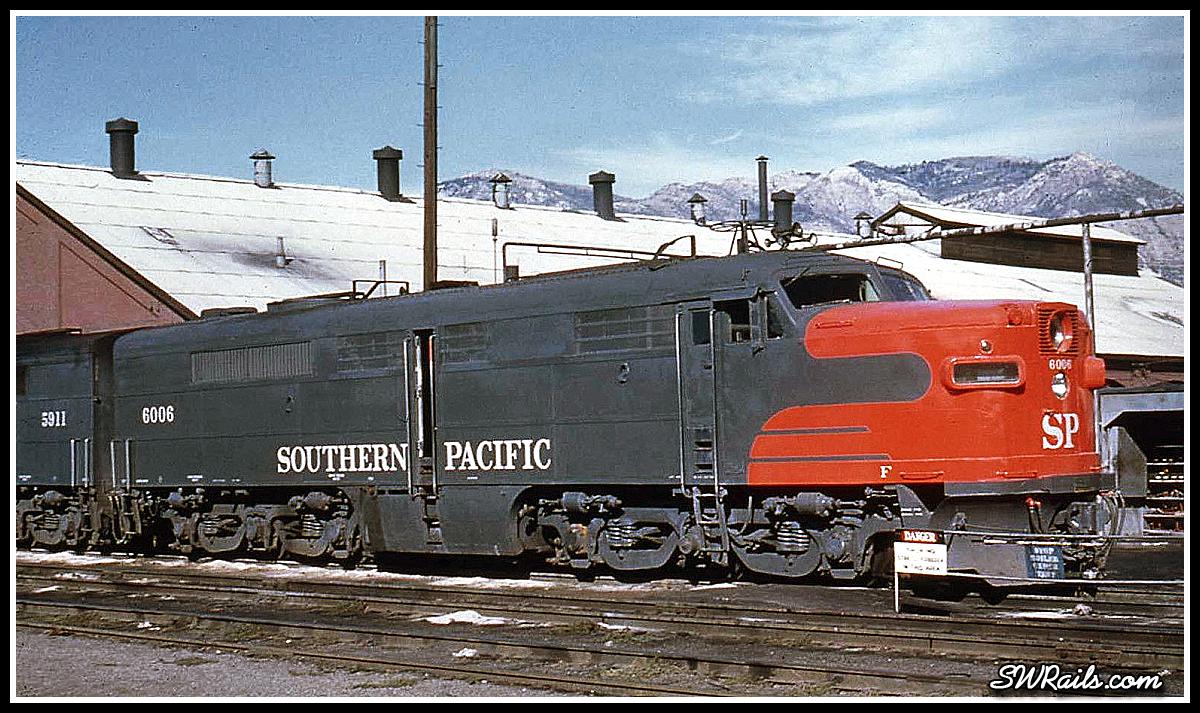
The background scenes are identical save the smokestack has been removed by the time of the second view.
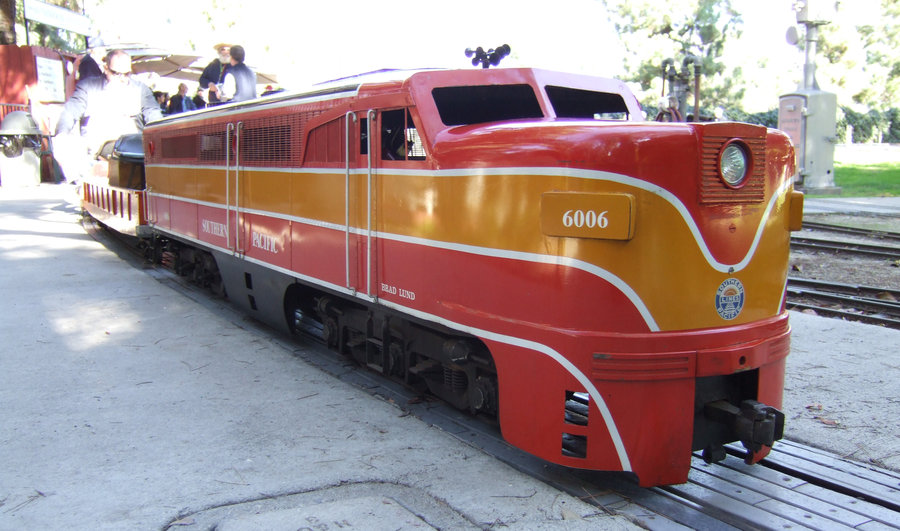
One last thing. There been a fair amount of coverage about Doyle McCormack and the PA that he’s restored to operational condition. Rightfully so.
I just don’t understand why there’s been no coverage about the SP PA that’s the subject of this post. It too is in operational condition in Southern California. Here’s an image of it:
Dodging Clouds
(Images taken May 29, 2014.)
It’s been a cloudy, rainy week here in Southeast Texas. So when the sun made a surprise appearance yesterday afternoon, I snuck out to try my luck with some westbound traffic that was headed my way.
I set up at Prison Road crossing (MP 26.26 on UP’s Glidden sub) to await the first train. Unfortunately, a small, but thick cumulus, cloud arrived about 2 minutes before UP 5003 West did. Had the train arrived 30 seconds later, it would have been a nice shot. But it didn’t.
I actually took a picture, but I deleted it. The locomotives and first 2-3 cars were in shade and the balance of the train was in bright sun. There was too much contrast, making it a useless shot. Too bad because the 2 trailing units were standard-cab UP C40-8’s which have been pulled from storage due to UP’s persistent power shortage.
After throwing some rocks to relieve my anger, I was ready for the next train. About 10 minutes later, I hear UP 7413 West talk to a signal maintainer about a grade crossing a few miles east of my location. OK, time to get ready.
Except that here comes another small patch of cumulus. Not wanting to get hosed again, I drove about 1 1/2 miles west where it appeared I could dodge the clouds long enough to get a shot.
The patch of clouds I just got away from started to ease my way, but not before UP 7413 with the QEWWC-29 in tow. You can see the sun/cloud demarcation line about 13 cars back.

I whine about clouds, but when they behave properly, they can make the shot.
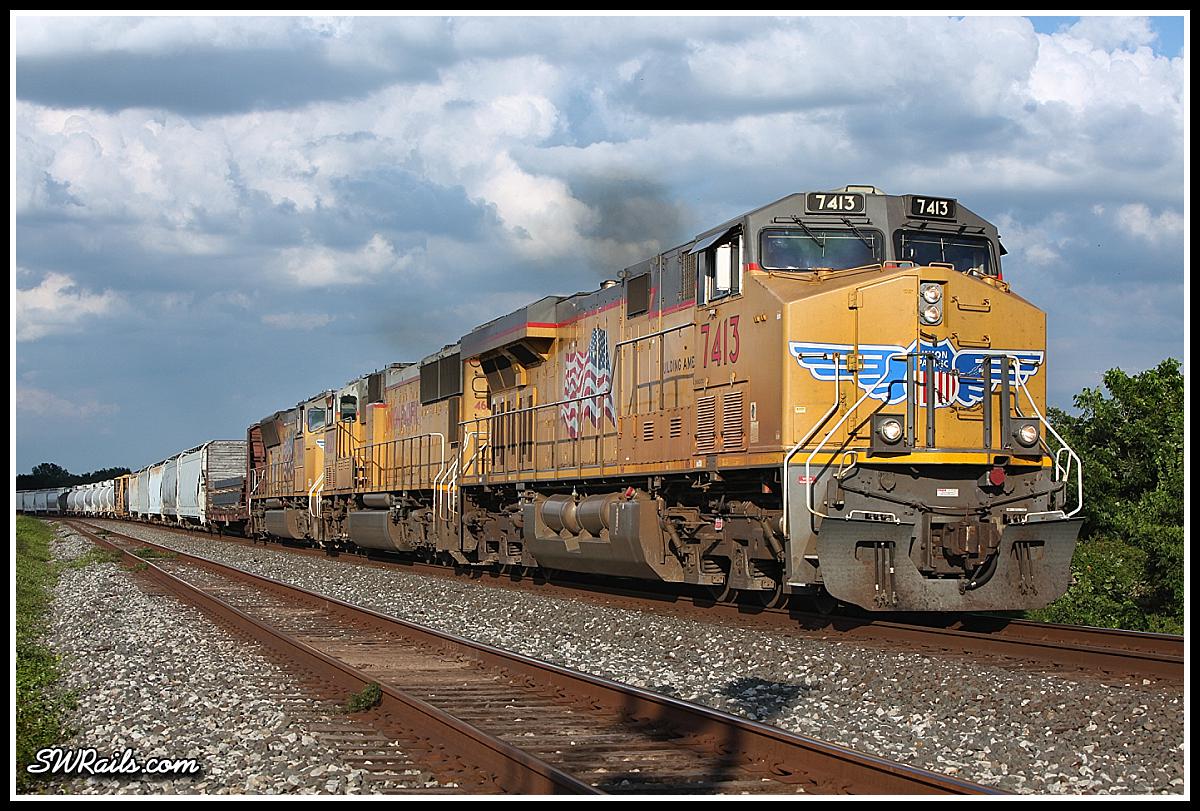
There was a good-sized block of UP’s ARMN reefers about halfway back.
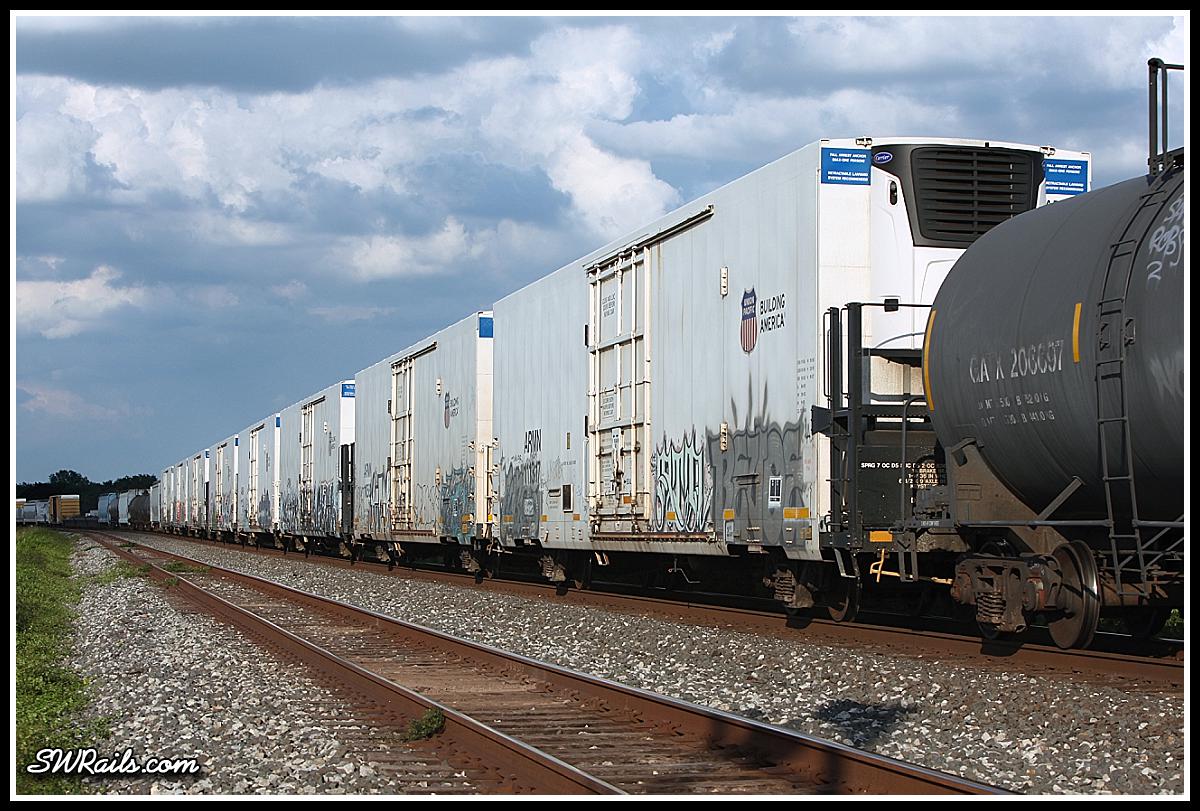
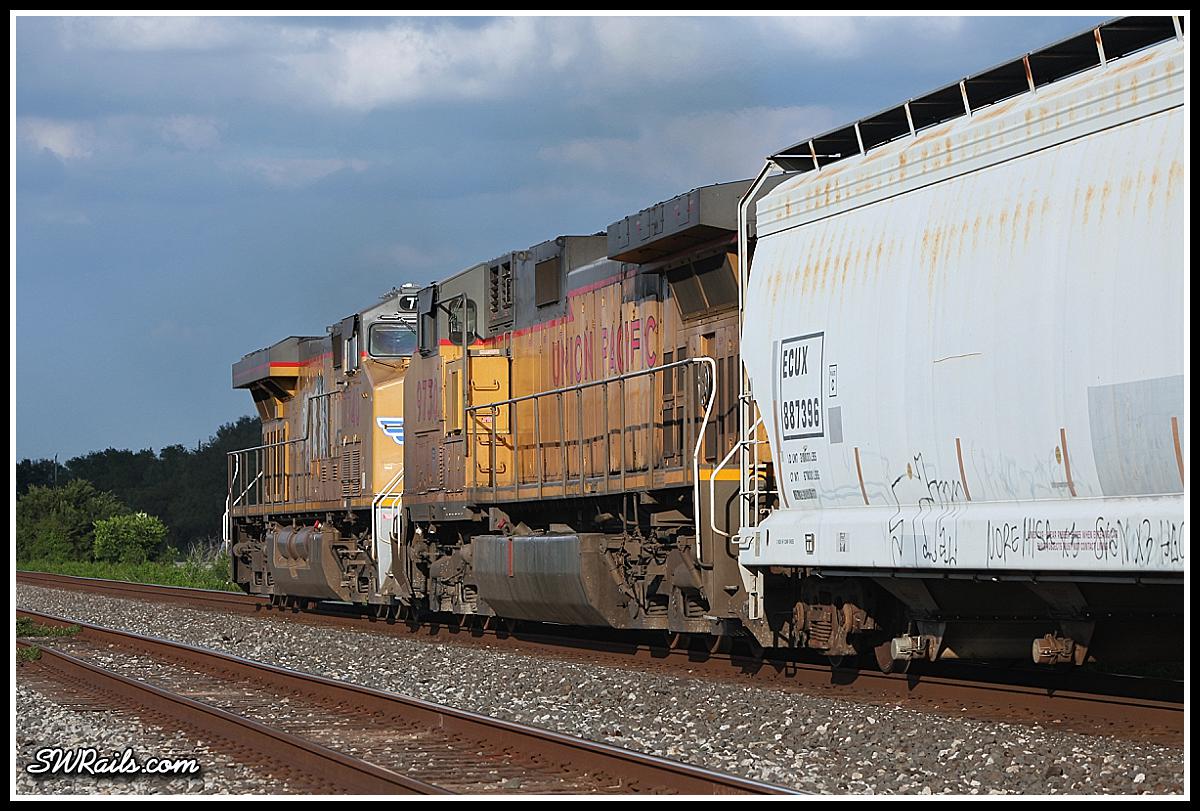
Last, but not least, no QEWWC is ever complete without its DPU’s. However, nose-to-nose DPU’s aren’t very photogenic, are they?
Once the QEWWC cleared up, I returned to the Prison Road crossing. The 2 mile tangent between there and CP SA025 offers the best light angle for summer, late afternoon shots.
It wasn’t long before the next westbound came into view, the IHOLA 29, with UP 9469 leading.
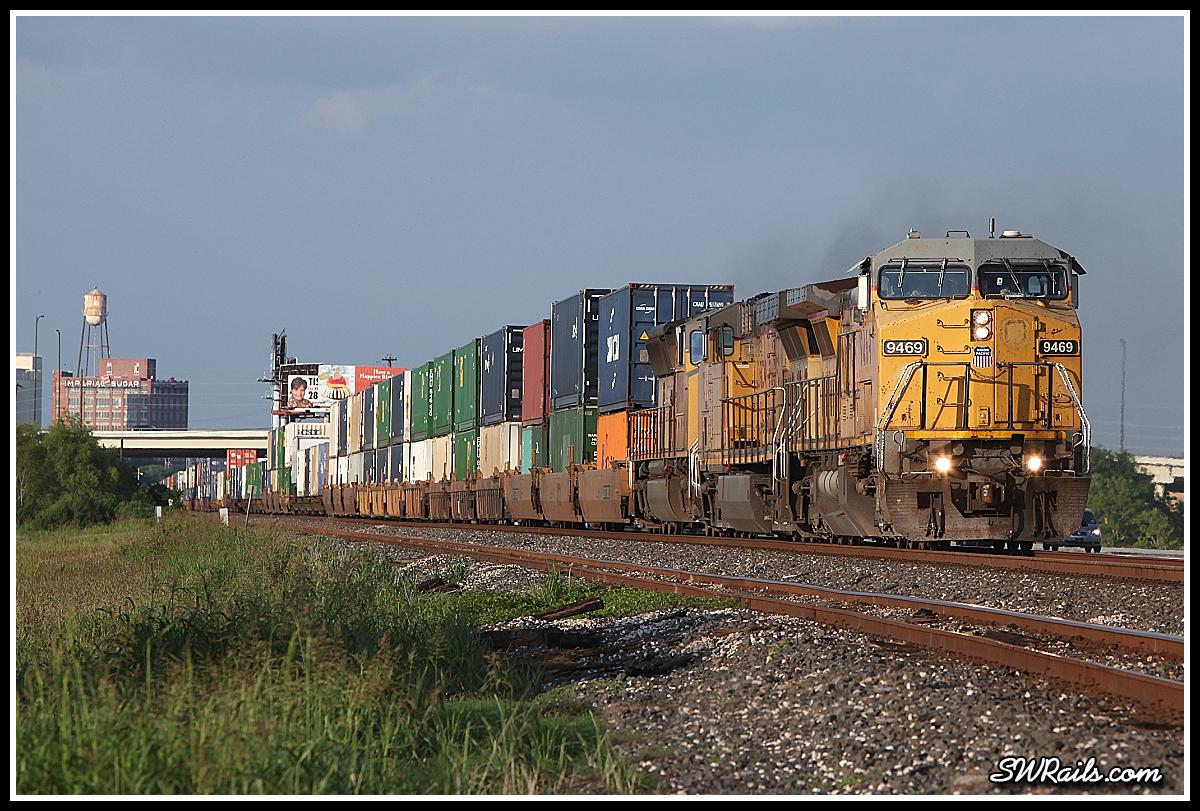
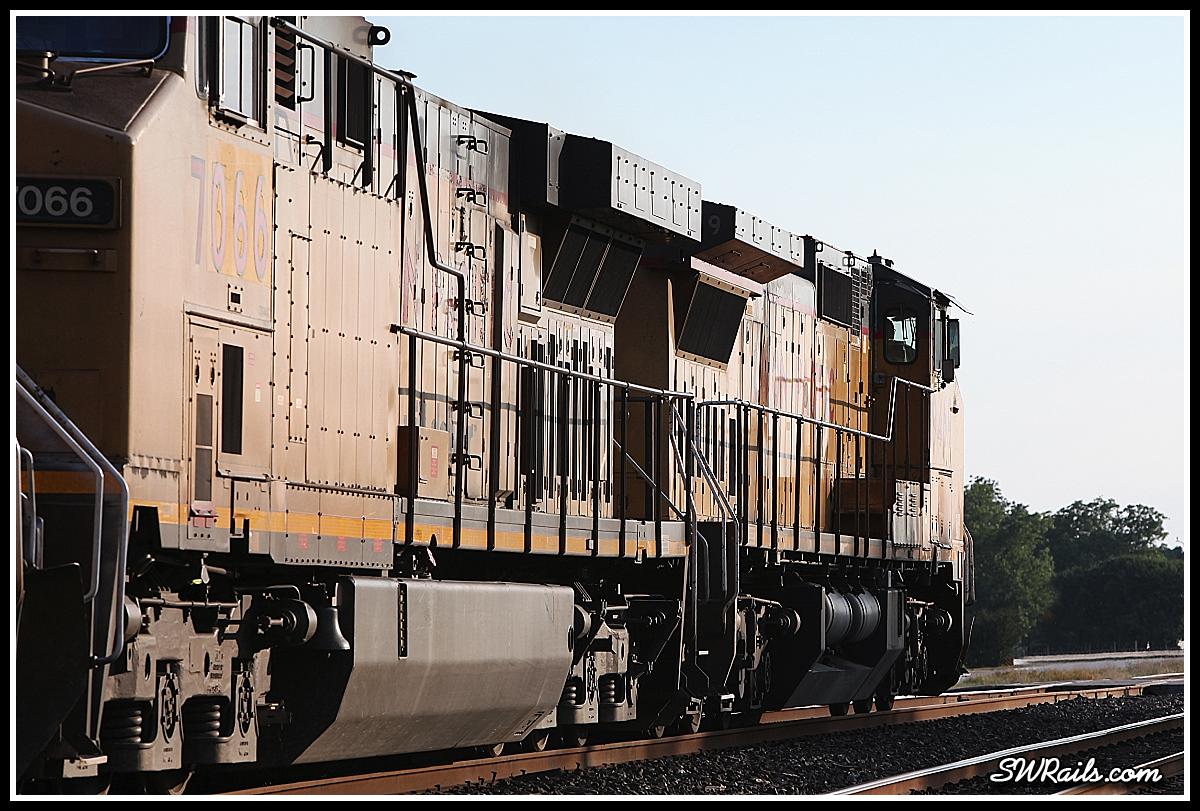
These older GE’s are typical power on rock trains and locals. You know UP is hurting for power when this 23-year old C41-8W is on a hot domestic intermodal.
The clouds have dissipated a bit since the QEWWC went by me, but they’re still looking good.
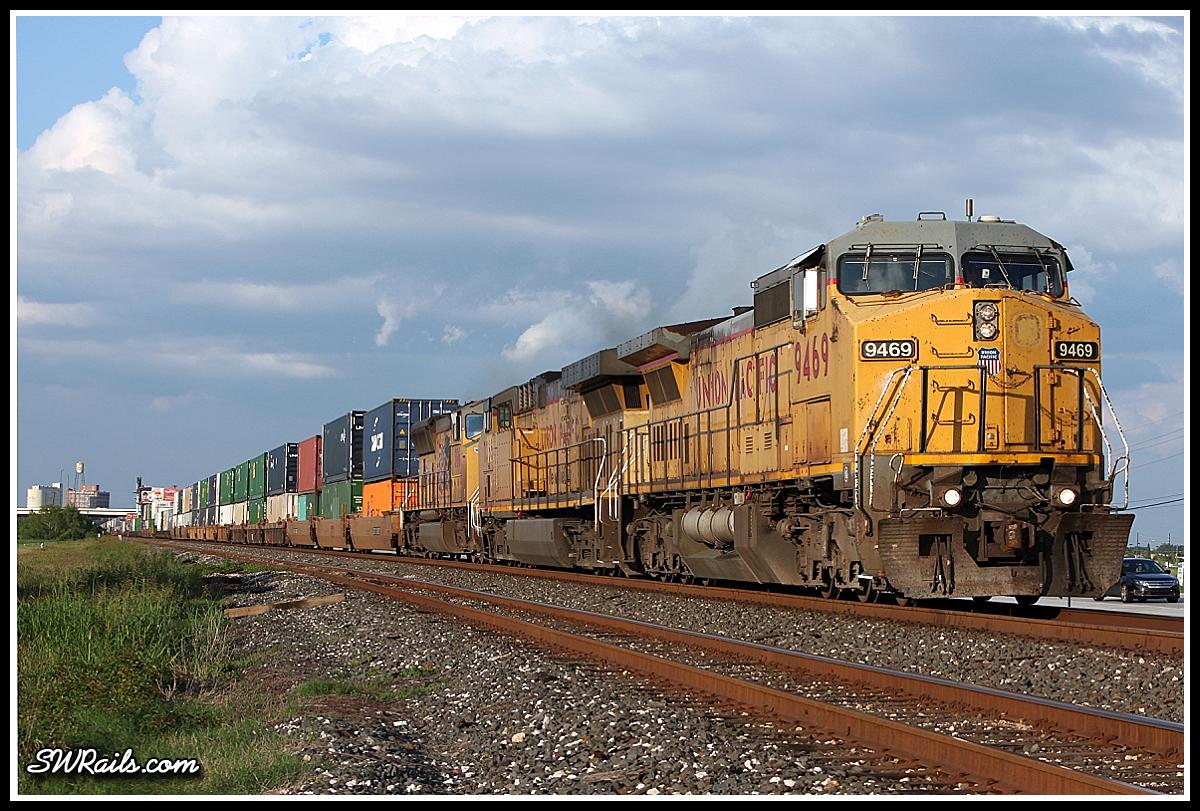
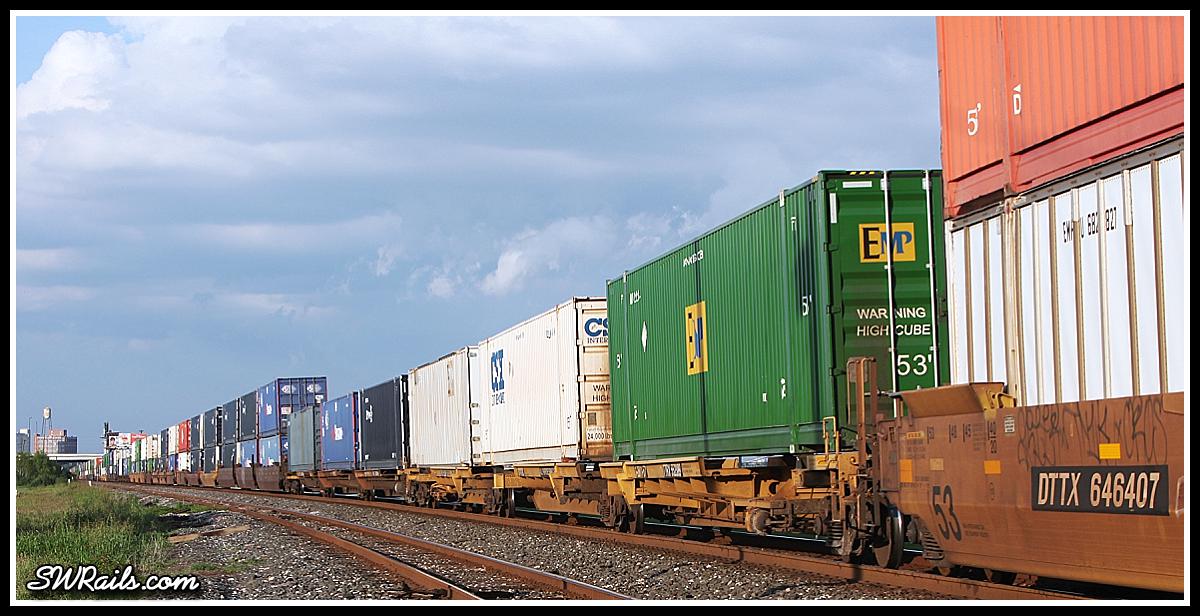
I’m no nativist xenophobe (sorry Dan Patrick), but I’ve always thought the domestic containers looked better than the foreign ones, not to mention they’re in much better condition.
The dispatcher was set to run 2 eastbounds now, so I took that as my cue to head home.
Old School Santa Fe
You know the drill. In the process of searching for a particular item, you come across other things and get so sidetracked, you forget what you were looking for in the first place. That’s the story of my life!
The bright side is that I find all sorts of interesting stuff, like these 4 images of Santa Fe freight equipment from 35 to almost 60 years ago, aka “the good old days”.
The first image is a very early Santa Fe intermodal car with a spotless red & white trailer. Of course they didn’t call it intermodal back then. It would have been called a piggyback or TOFC flat car. It appears to be a conventional flat car that was modified for TOFC service by adding side sills and a 5th wheel.
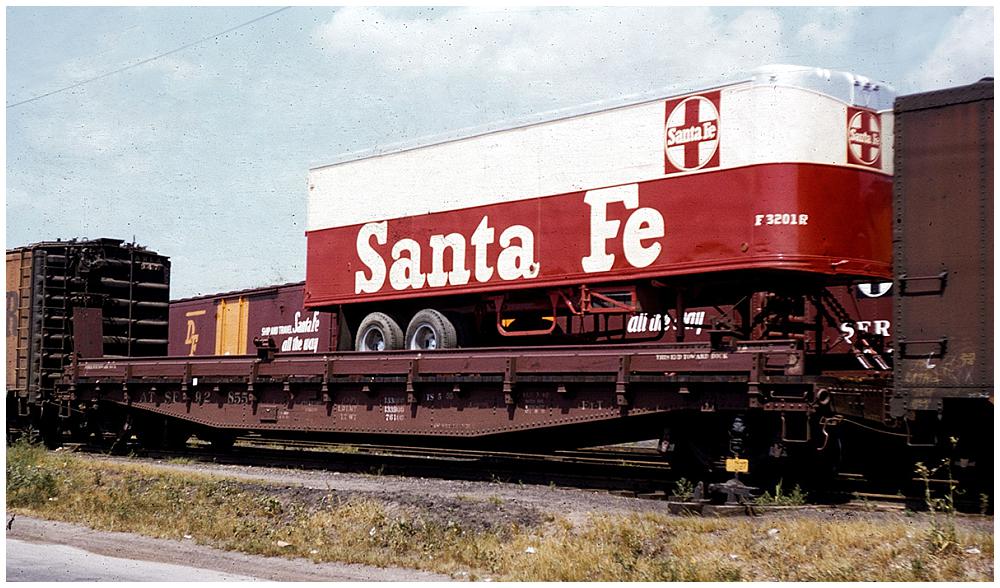
Early ATSF intermodal flat car 92855 at Chicago in 1955.
Within the next 18 years, TOFC service on the Santa Fe went from a novelty to a mainstay of traffic on the Chicago to California corridor. This 1973 image shows the final 2 versions of ATSF-owned 40″ trailers. Note how tare and wasted space have been reduced to a minimum.

3 40′ trailers and a caboose bring up the rear af a Santa Fe TOFC train in Illinois in 1973
The next image is likely to be the most mundane piece of equipment out there for a railfan in 1968 – a 50′ boxcar. I can’t really tell what the original color was on this BX-66 class box car, but I’m smitten with the Super Chief slogan. Contemporary railroaders are probably shocked to see ladders that go all the way to the top of the car, the high-mounted brake wheel, and the walkway on the roof of the car, all deemed very unsafe features and prohibited since the late 1970’s.
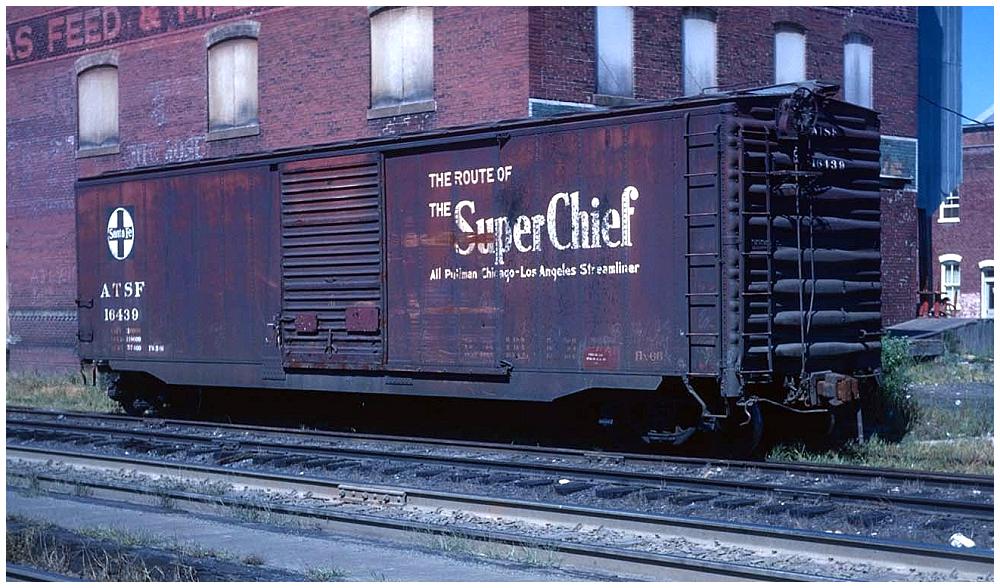
ATSF 16439, a 50″ single-door box car is at Manassas, VA in 1968.
Finally, TTX 852838 with a clean red Santa Fe rack. At first glance I thought it was a conventional 89′ auto rack, but then I realized it was topless!
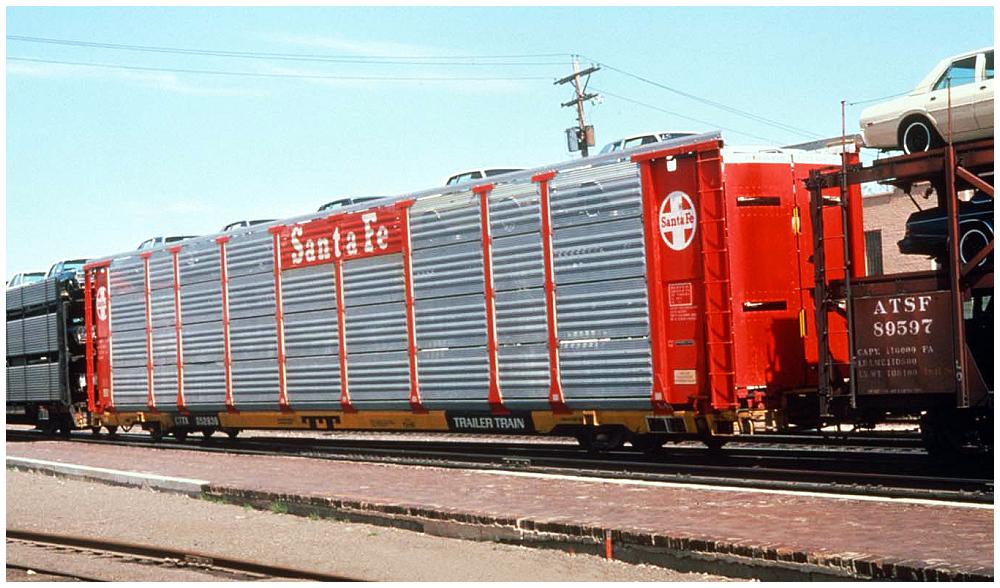
TTX 852838, an 89′ flat car with ATSF auto rack at Topeka in 1979
I’ve always been under the impression that there were 3 basic types of 89′ auto rack: open, with side-shields, and fully enclosed. Was fully enclosed, sans roof, a common variation of auto rack?
Down At The Depot
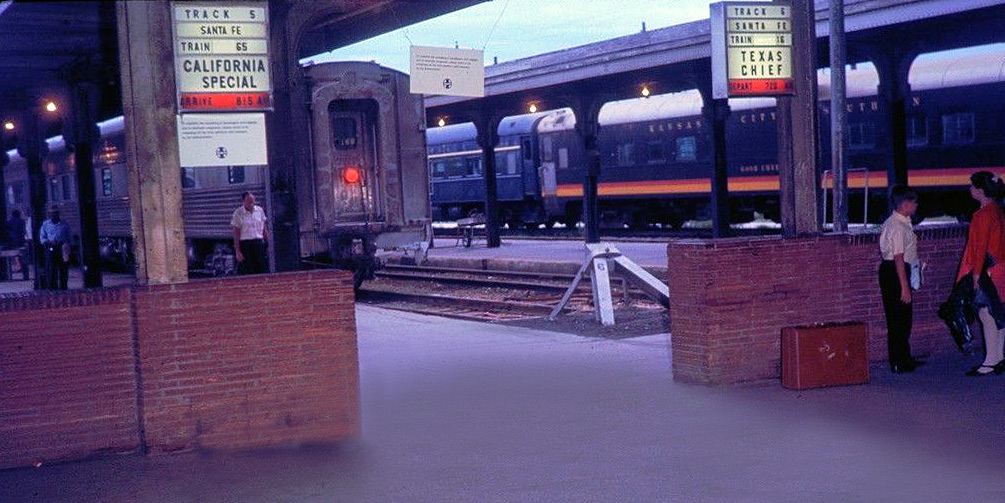
Today we’ll look at some vintage passenger trains, but from a different perspective than you might be accustomed to. Instead of your typical railfan view of an approaching train, let’s check out the view from just outside of the waiting room at Houston Union Station one day in June of 1968.
This first image was taken just before Santa Fe #16, The Texas Chief, departed at 7:20 AM on its roughly 24 hour run to Chicago’s Dearborn Street Station. Note the KCS passenger car in the background. It’s the Good Cheer, an observation/dining car that KCS donated to the NRHS-Gulf Coast Chapter in early 1968. The car would remain parked at Union Station for some 10 years until the Gulf Coast Chapter was able to complete its museum in northeast Houston. Click here to learn more about this car.
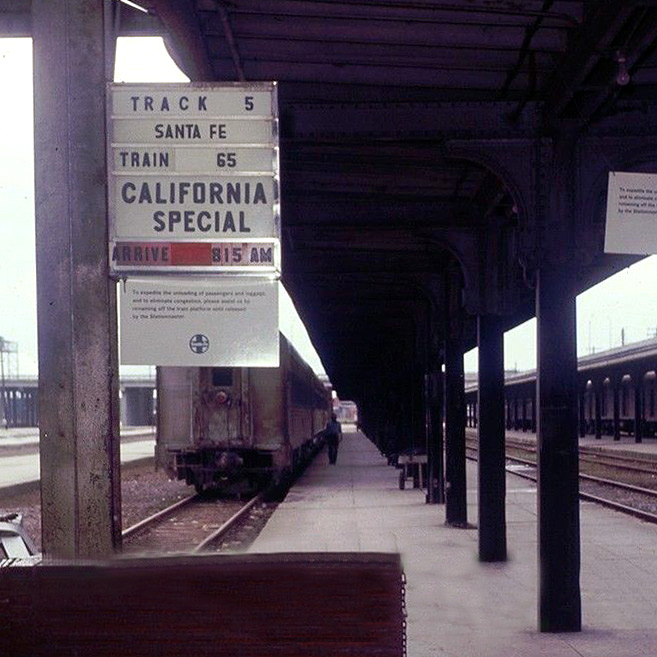
The next view is looking down the platform of track #5 around mid-day. The California Special, ATSF train #65, would typically arrive from Clovis, NM at 8:15 AM. The cars are being serviced in order to head back to Clovis as train #66, scheduled to depart at 6:45 PM. Note the Hwy 59 overpass in the background.
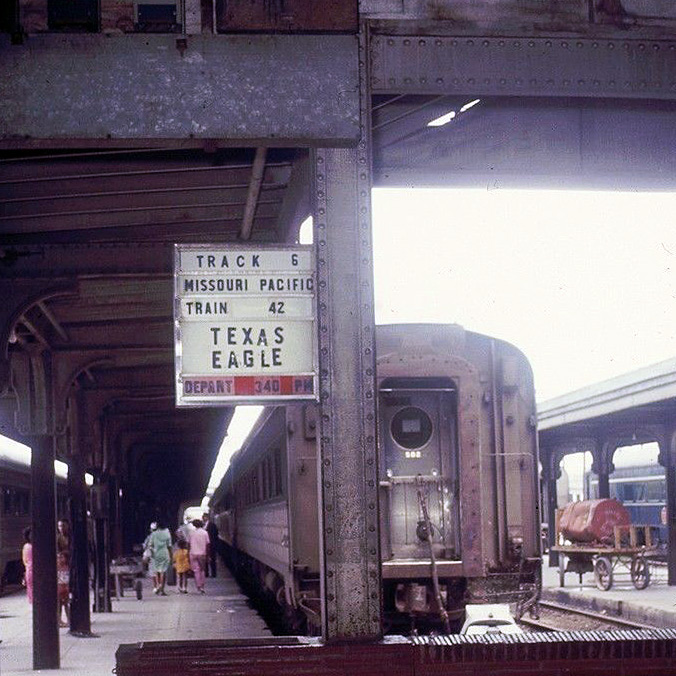
The last image is mid-afternoon, looking down platform #6. Passengers prepare to board MP train #42, the Houston section of the Texas Eagle, in anticipation of departing at 3:40 PM. Note the California Special equipment at far left.
The Houston Astrodome, aka the “8th Wonder of the World” was barely 3 years old when these photographs were taken. Little did any of the people in these 3 images dream that by the year 2000, a new stadium would stand on the Union Station property. Much less could they imagine that Union Station track #6 would be replaced with the 3rd base line of this future ballpark.
The Forgotten Heads-Up
Images from May 18, 2014
About a week ago, I learned that 3 private cars, en route to New Orleans, would be running through Houston on todays Amtrak #2. It’s great to get a heads-up on moves like this. Too bad I didn’t remember about the move, I might have set up in a better location.
After a leisurely Sunday morning breakfast, I ventured out to catch the eastbound Sunset Limited. I ended up at Ormandy, near MP 16 on UP’s Glidden sub.
Arriving there, I see the MLDEW, UP 4206, waiting on track 1 for a route to Englewood. The plan was to catch # 2 as it overtook the waiting freight train.

It wasn’t a bad plan, but I didn’t count on the high sun angle creating the wicked glare on the nose of P42DC #160.
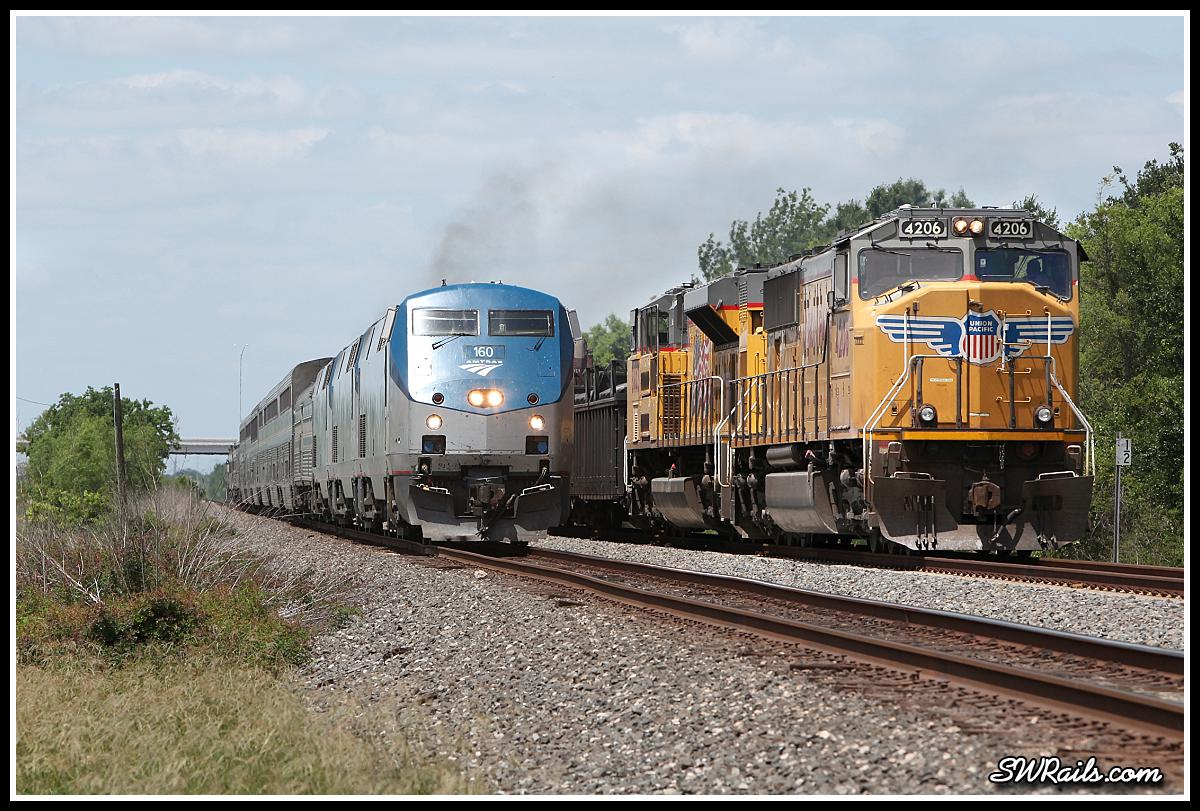
Pulling back to 70mm allowed me to salvage one shot without the glare.
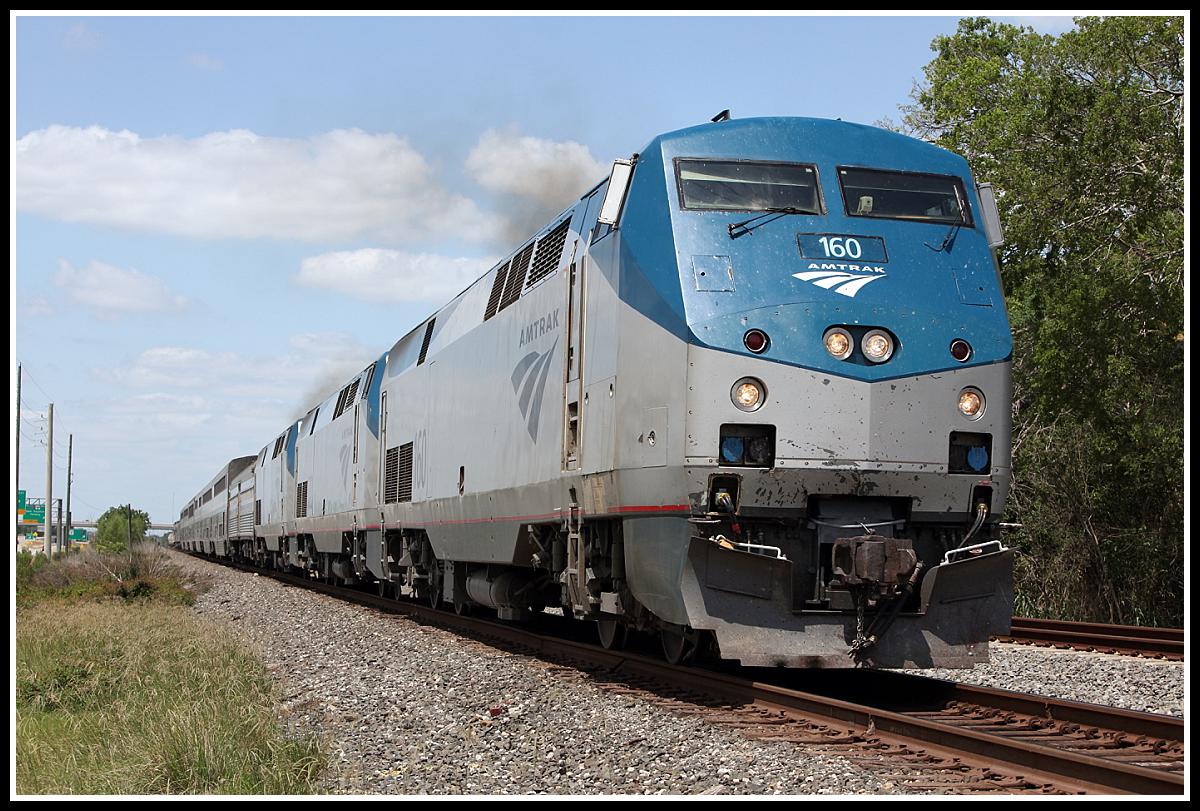
As the head-end was passing me, something seemed odd. Before I could ponder that question, I realized that #2 had an additional locomotive in its consist.
I quickly swung to my right to get a shot of the rare, for the Sunset Limited, 3-unit consist.

As the train blew by me at a good 60mph, I was wondering why were 3 locomotives on this train? I was also cursing my composition choice. A wider shot would have shown the 3-unit consist more clearly. Within a few seconds, I remembered the heads-up I had received about the private cars and that was the reason for the third unit. Then I realized I needed to get the camera back up to my eye if I was going to get some shots of the 3 PV’s!
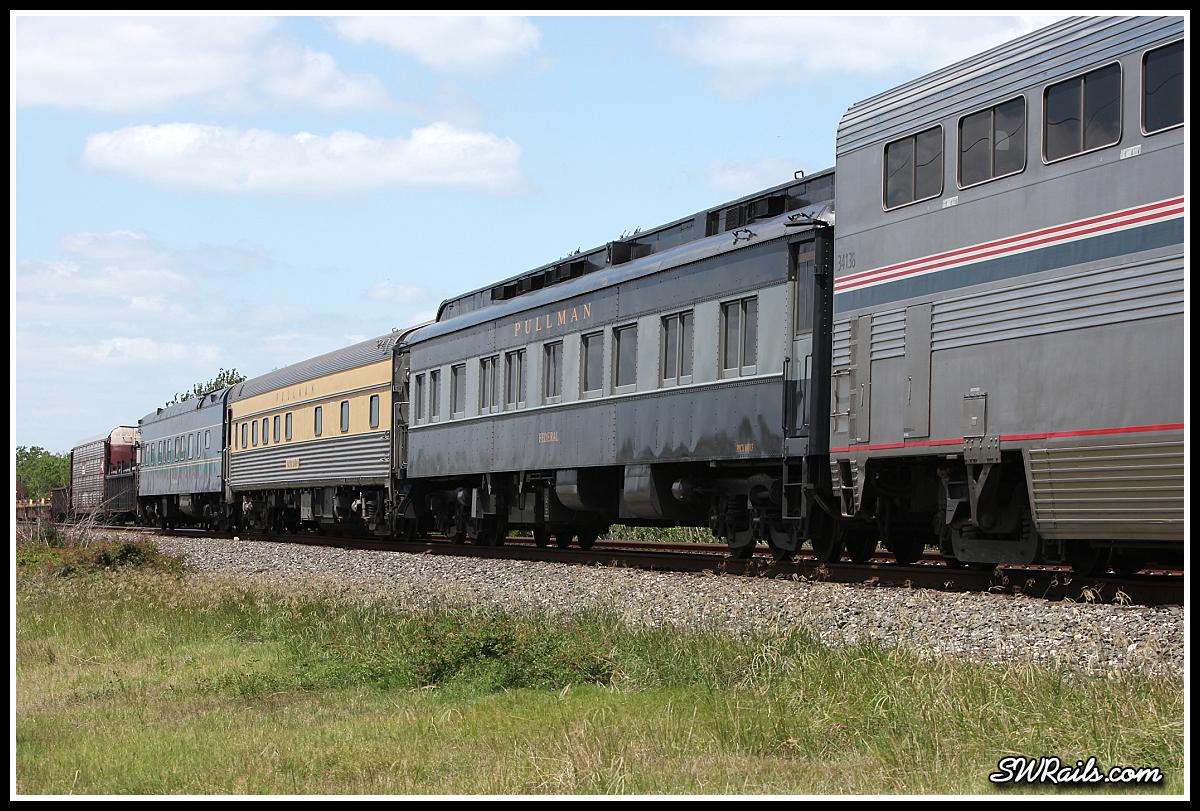
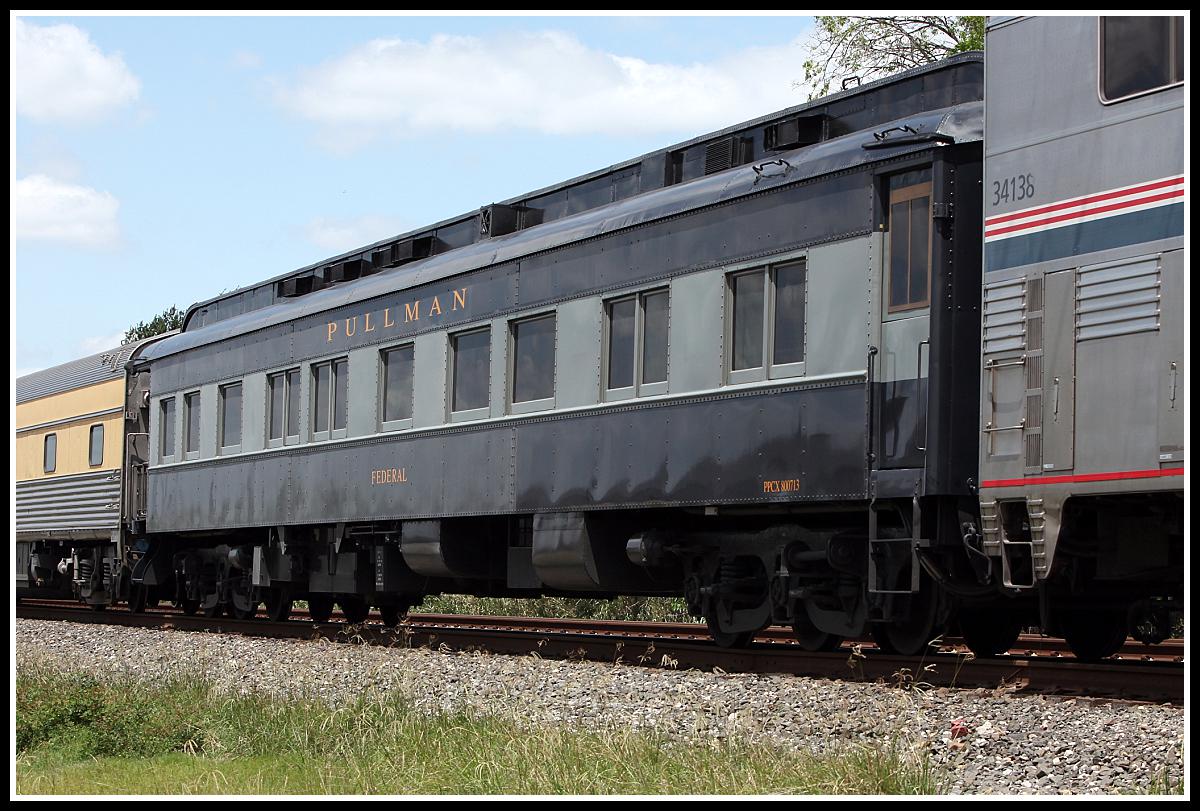
First out is PPCX 800713, the Federal. A 1911 vintage Pullman, it’s supposedly the oldest private car that meets the strict mechanical/electrical/brake requirements to be operated in an Amtrak train. Click here for a more information, and interior photos, of this 103 year old car.
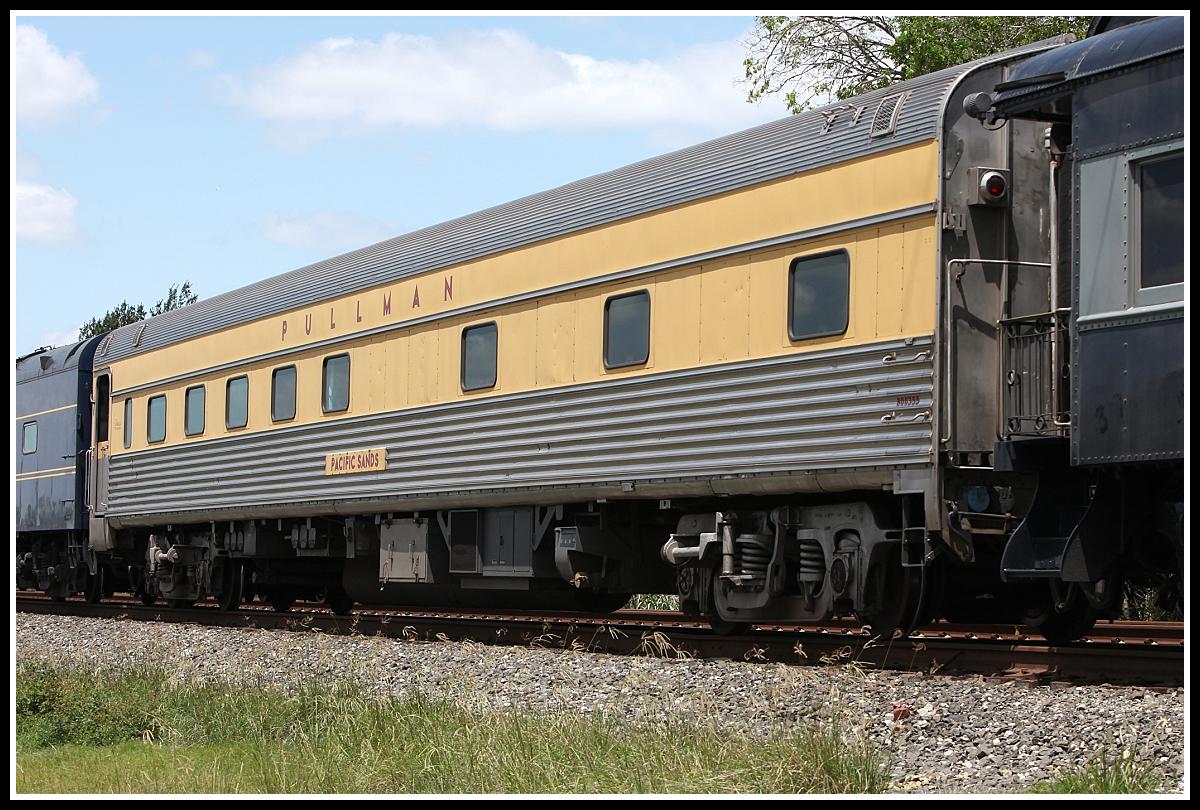
Next was 1950 vintage Pullman sleeper Pacific Sands. Click here for the history of this car.
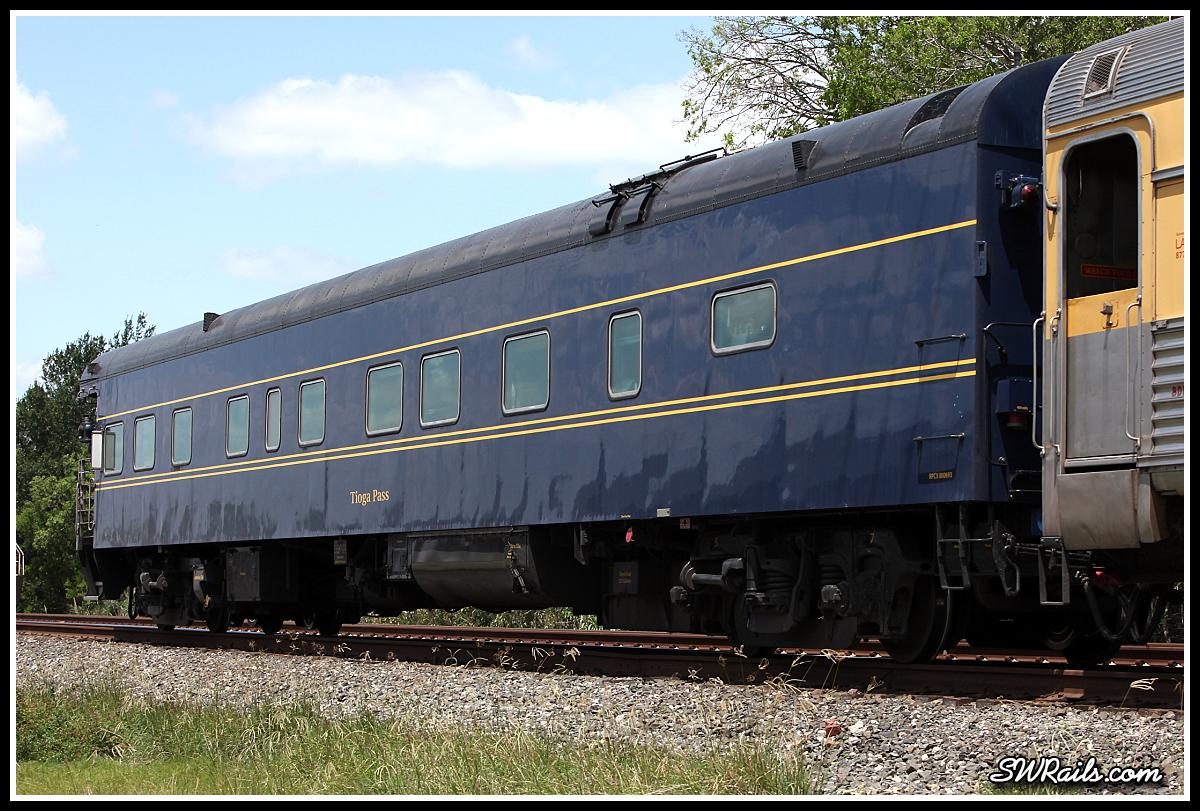
Bringing up the rear was Tioga Pass, a 1959 product of the Canadian National Shops in Point St. Charles, Quebec. It was one of 12 similar cars designed for railroad executives. Click here for the Tioga Pass website.
Some guys have all the fun!
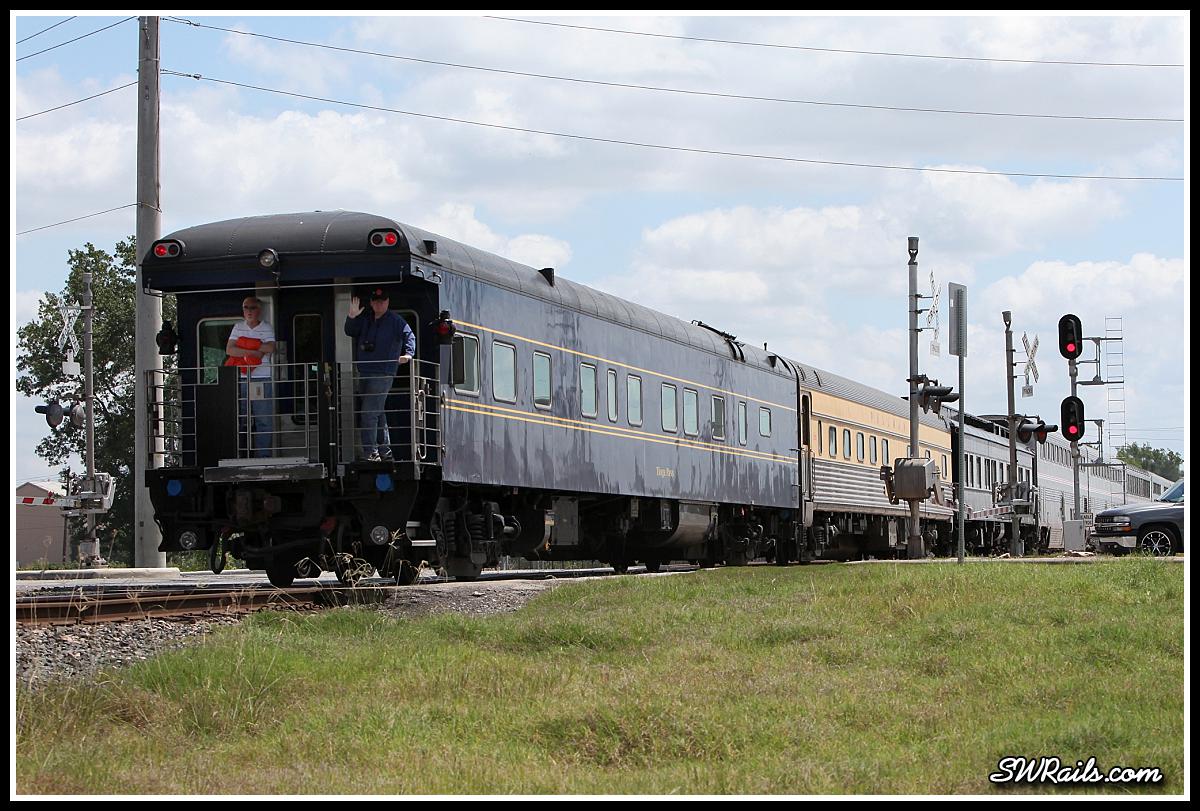
As the train receded, I again lamented the composition of my shots. It really would have been nice to get a more open view of this train. But that’s what I get for not remembering about the heads-up I had received…
Cotton Belt 300 Gets Around
I haven’t done an I Get Around post (a category that shows the same locomotive at a variety of locations) for some time. I was reminded of this recently when I was organizing SSW images and saw 4 of the same unit, SSW PA1 300.
The Cotton Belt owned 2 ALCO PA1’s, 300-301, acquiring them in 1949. They were delivered in Daylight colors, lettered St. Louis Southwestern. In late 1955, SSW chose to forgo its full company name on its diesels, re-lettering them with the line’s nickname, Cotton Belt. The work was done at the SSW shops in Tyler, Texas.
This first image shows SSW 300 at Texarkana in late 1955 / early 1956 shortly after being re-lettered.
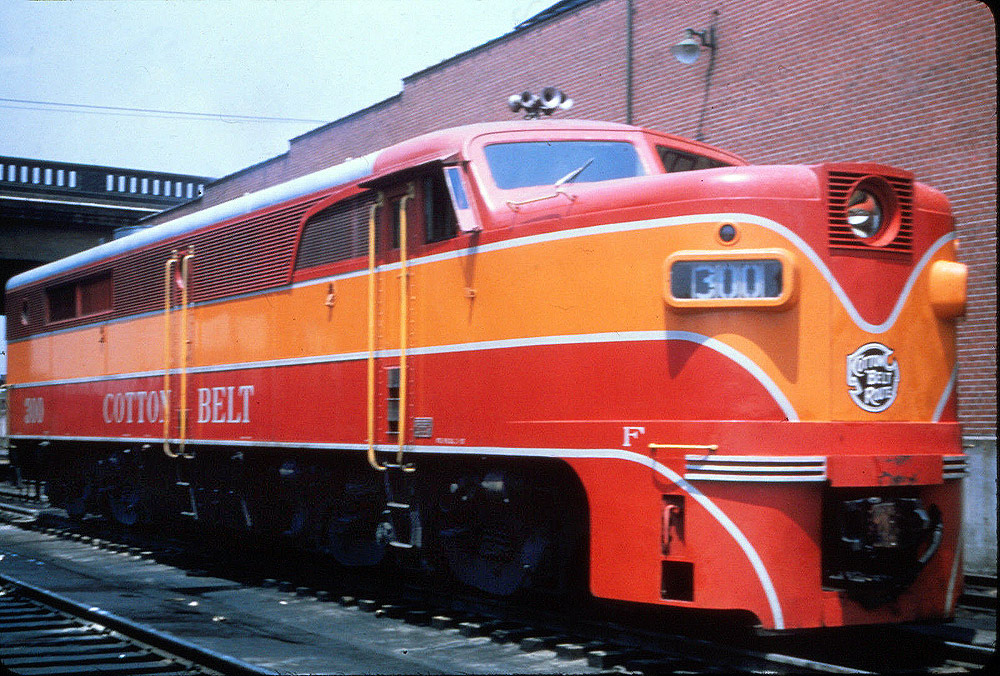
SSW PA1 at Texarkana shortly after being re-lettered with the SSW’s nickname.
By mid-1959, the only passenger service left on the Cotton Belt was between East St. Louis and Pine Bluff, #7 and #8. The 2 PA1’s and FP7A 306 were assigned to this service. As only one unit was needed for each train, the third unit would be used in freight service.
This next image shows SSW 300 in June 1959 departing Memphis with a Memphis – Pine Bluff manifest.

SSW PA1 300 leads an F7B/F7A duo in freight service at Memphis in June 1959.
But the dual-service career of SSW 300 was short-lived. December 7, 1959 was the final run for SSW trains 7-8, ending the passenger era on the Cotton Belt. As Cotton Belt parent Southern Pacific still had plenty of work for passenger diesels, the decision was made to transfer the 3 SSW passenger diesels to the SP. They went to California, arriving in late December of 1959.
Once in California, the PA1’s were used mainly on Trains 90-91, the Coast Mail, an all-stops train between San Francisco and Los Angeles. They did see occasional duty on the Coast Daylight. Click here for more about the Coast Mail trains.

SSW PA1’s 300 and 301 lead train # 90, the southbound Coast Mail, on one of their first trips after being transferred from the Cotton Belt to the Southern Pacific.
SSW 300-301 were re-numbered SP 6067-6068 at the Taylor Yard roundhouse on January 13, 1960, less than a month after arriving out west, making the above image exceedingly rare.
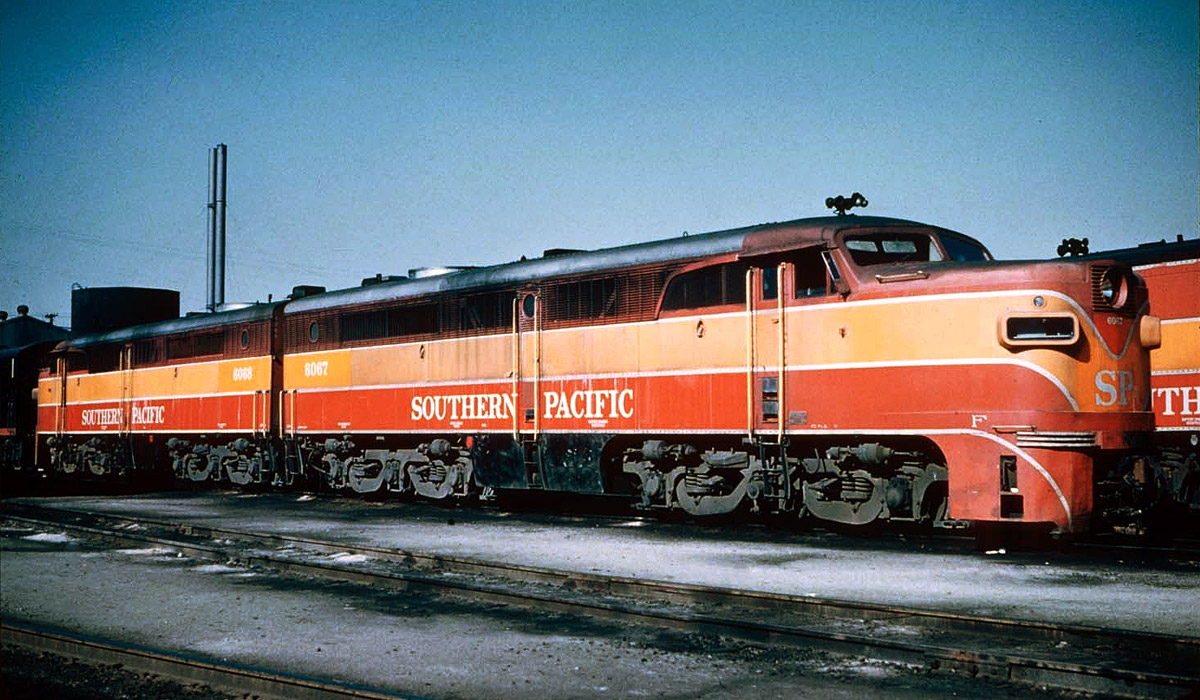
Erstwhile SSW 300 and 301 sport their new SP numbers and lettering at Taylor Yard in mid-1960, shortly before being painted into SP scarlet and gray. Note the patched numbers on their flanks.
These 2 units would lose their Daylight colors shortly after the above image was made, receiving SP scarlet and red at the Taylor Yard paint booth in Summer of 1960. They would only run in their new colors for a bit more than 3 years, as they were retired in November, 1963.
 * Joe Strapac’s book, Cotton Belt Locomotives, was my primary source for the historical data.
 Southwest Rails