Retro Cantilever Signal – Update
I speculated about an old cantilever signal in an earlier post. I’ve gotten some information from members of TrainOrders.com that clears up some of my questions.
T-O member atsf90mph downloaded a google earth image that shows the signal as it appears now:
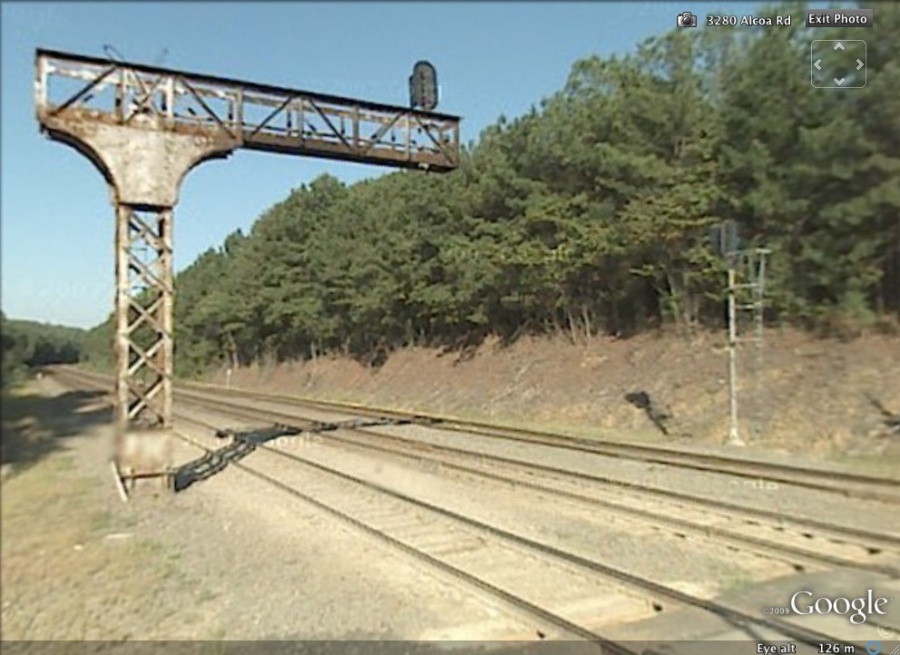
Current view of the UP signal at Bauxite Jct. AR - © Google Earth
Based on information from the MoPac Historical Society, this signal likely dates to the 1946-1948 time frame, when the MP did numerous upgrades to this line.
This nearly 70 year-old signal bridge appears to be in the twilight of its career, as the UP is upgrading signals in this area.
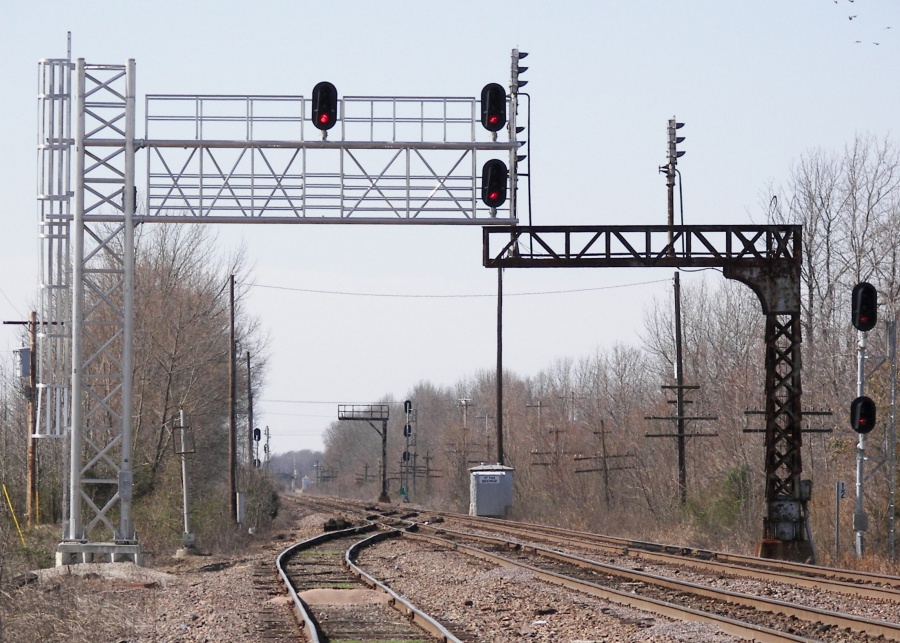
Signal structure transition at South Poplar Bluff, MO on March 21, 2008. © Zach Pumphery
Train Orders member Zach Pumphery was kind enough to share the above image showing the UP’s upgrading to modern signal structures on this same stretch of ex-MP trackage.
Southern Pacific, Before & After
Time for a new category here at Southwest Rails: Before & After. It will be for photos taken at the same location,separated by a number of years.
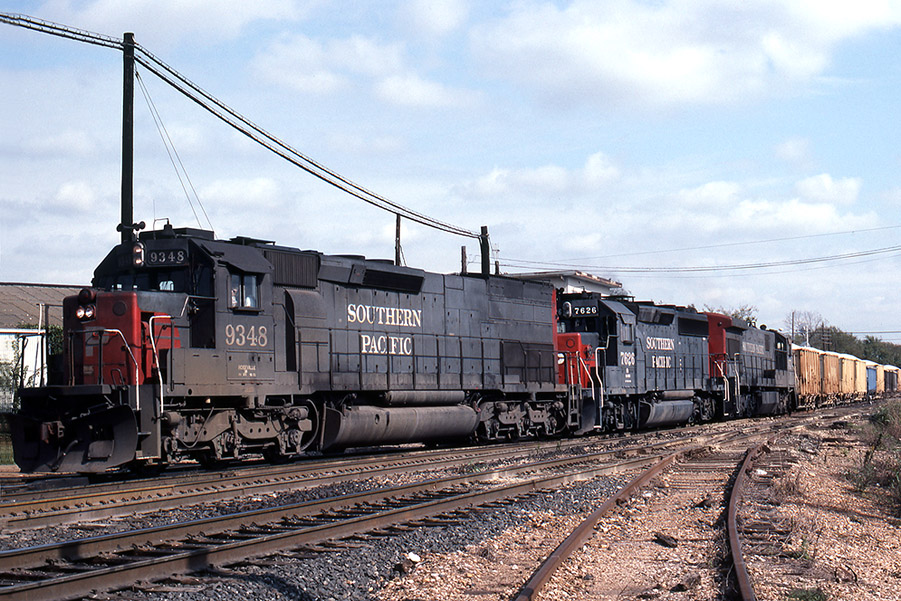
SP 9348 at Tower 26 with an HOASM on Nov. 23, 1985. © Robert Pierce
It’s a chilly Nov. 23, 1985 as SP 9348/7626/8771 make the turn onto SP’s Lufkin sub at Tower 26 interlocking in Houston, TX. You can see the top of the Tower 26 structure above the cab of the second locomotive.
T26 is where the Houston Belt &Terminal tracks cross over the SP’s Sunset mainline. The MP, BN and ATSF jointly owned the HB&T. This interlocking has a long, fascinating history that is covered nicely here at the txrrhistory.com site.
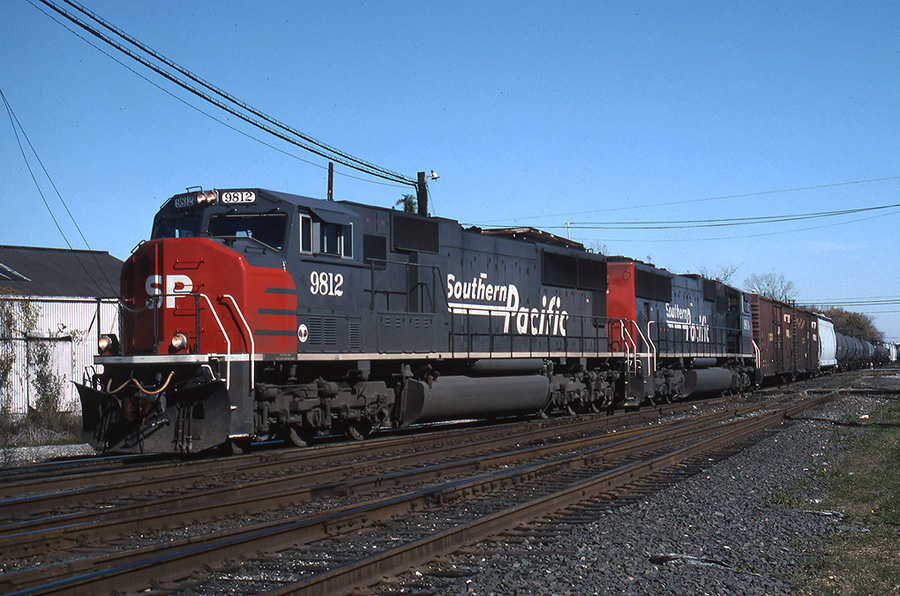
SP 9812 leads the SRASK onto the Lufkin sub on Dec. 22, 1994. © Robert Pierce
Nine years later, we see two 6-month old SD70M’s at the same location with another Alton & Southern bound manifest. The K suffix in the symbol indicated haz-mat was in the train’s consist.
The changes that occurred in only 9 years is obvious, beginning with the contrast between the motive power. The rail and ballast has been upgraded and the foreground spur is gone.
Of course the change between the second photo in 1994 and the present are even more pronounced. But that will have to wait for another post…
Retro Cantilever in Arkansas-Pic of the Day
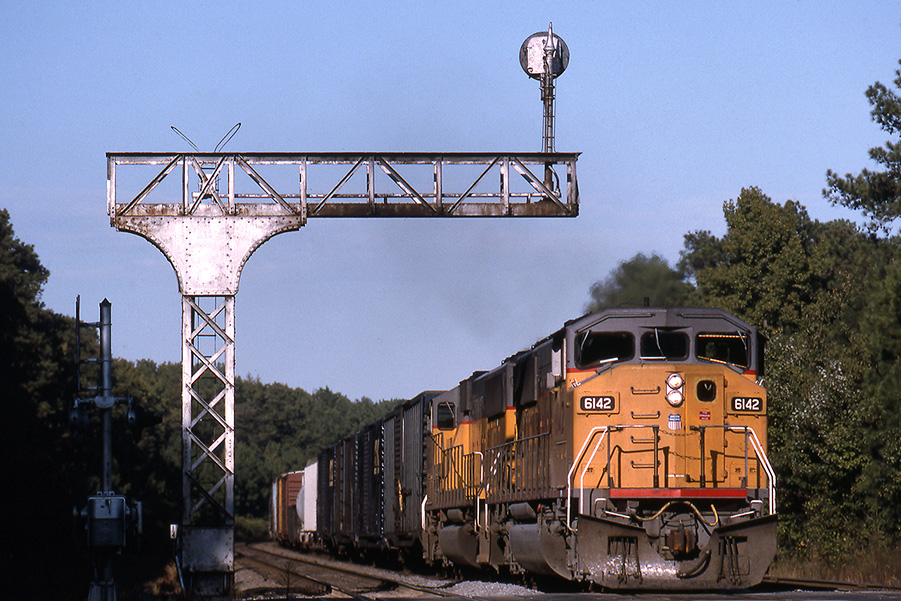
UP Manifest ASFW at Bauxite Jct. AR on Sept. 24, 1995 - © Jimmy DeNike
I’ll defer to any signal maintainers that may see this post, but this cantilever signal appears to be original equipment from when the MP first installed signals on this line.
I’d also venture a guess that this cantilever has been replaced since this photo was taken in 1995. Update: I would be wrong. Do a Google map street view for “3264 Alcoa Rd, Benton, AR”
Bauxite Jct. is about 15 miles southwest of Little Rock, AR.
Q-What Came Before Genesis? A-The Pooch
Remember, this is a railroad site, so the question has nothing to do with Adam & Eve and that talking snake.
The Genesis I’m referring to is GE’s Genesis™ series of passenger locomotive. The Genesis trademark applies to the P40, P42, and P32. The first P40 was delivered in 1993 with the first order of P42’s following in late 1996 and early 1997.
You have to go back to 1975 for the GE predecessor of the Genesis™ series. Amtrak ordered 25 P30CH locomotives in 1974, right before Amtrak decided they didn’t like 6 axle units in general. Additionally, crews didn’t like them because they were slow to load. Amtrak management didn’t like them because they weren’t as reliable as the EMD F40PH’s that started arriving in 1976.
But railfans liked them, as they provided a welcome change from the 210 F40PH’s that Amtrak would acquire. The P30CH was nicknamed “Pooch” by railfans because of the passing resemblance between the model designation and the word “pooch”.
By the time I moved back to Houston in 1988, 2 P30CH’s were the regular power for the Sunset Limited between New Orléans and Los Angeles. Unless mechanical issues arose, in which case an F40PH would pinch-hit step in for the ailing Pooch.
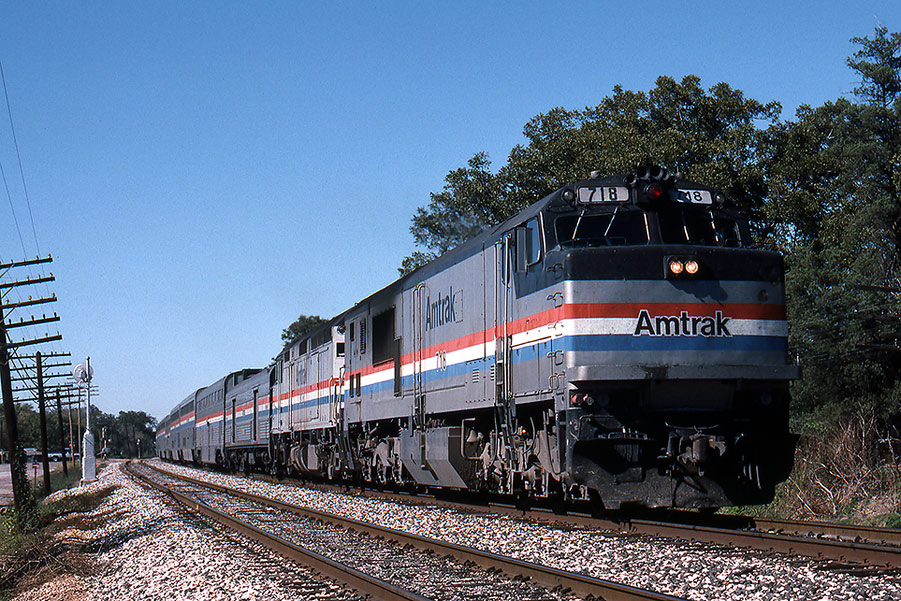
Amtrak #2, The EB Sunset Limited, is a few miles west of its Houston stop on Nov. 20, 1988.
That was the case on November 20, 1988 where we see the 718 and an F40PH on final approach to its station stop in Houston.
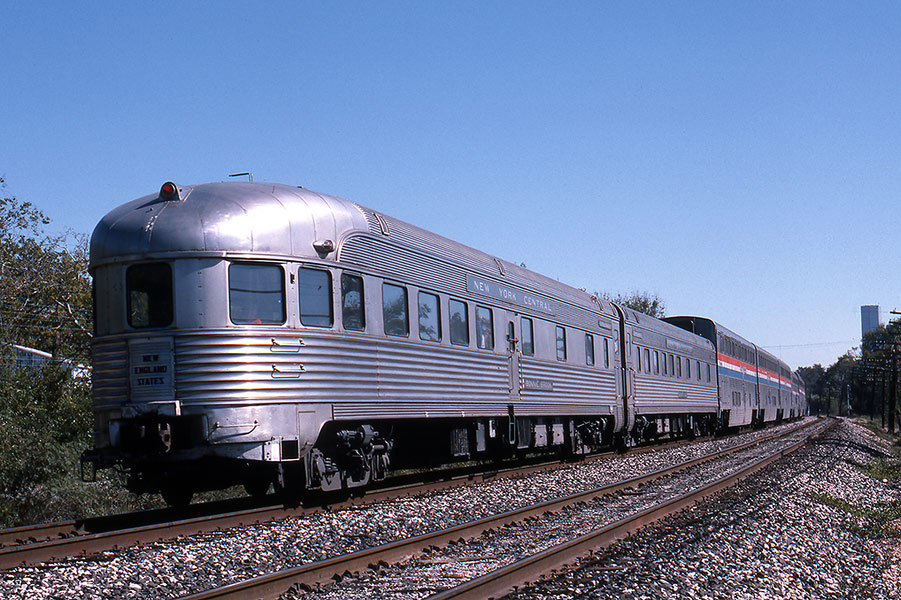
Two private cars bring up the rear of #2 into Houston on Nov. 20, 1988
The two PV’s look odd coupled to the Superliners, but I’m guessing no one on the two vintage passenger cars cares about that…
43 Years of Santa Fe Diesel History
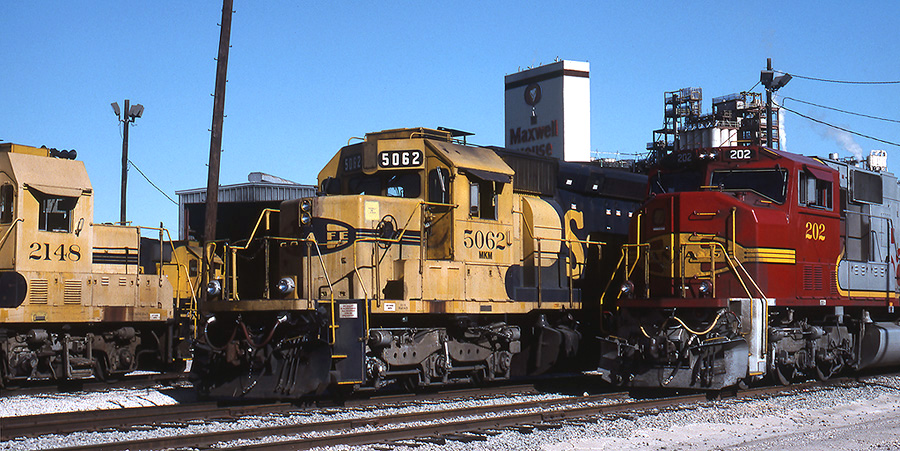
3 generations of EMD's hang out at HB&T's Milby Street roundhouse in Houston on Dec. 16, 1996
Nearly 43 years of Santa Fe diesel history congregate at the HB&T engine facility just east of downtown Houston.
GP7U 2148 was built as GP7 2757 in September 1952. SD75M 202 was built in March 1995, part of the very last order of locomotives to be delivered as ATSF units.
The GP7 has seen it all – the end of steam on the Santa Fe, streamliners behind matched sets of warbonnet F units in the 50’s and 60’s, all the way to the end of the Santa Fe itself.
BNSF 7671 West at Sugar Land – Pic of the Day
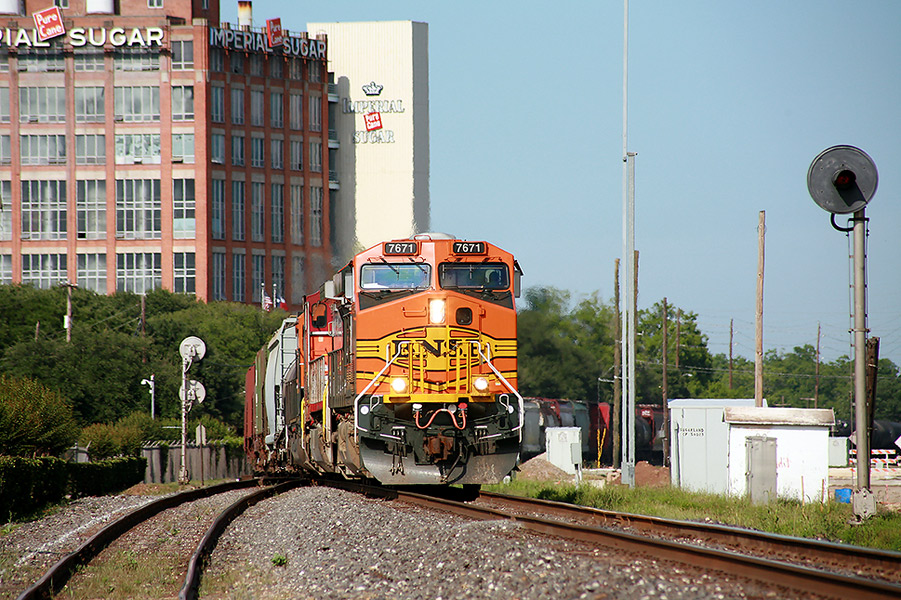
BNSF 7671 West hitting the east switch at Sugar Land, TX on May 6, 2006
I’ve missed posting a POTD a few times the last week. No time like the present to make amends…
In the Beginning…
No, I’m not going all Genesis on you. In digging through my archives, I came across some of the very first railroad pictures I took and I thought it would be fun to post them from time to time.
It was late 1971. I was a fearless 11-year-old with a 10 speed bike, a bus pass, and my Dad’s Kodak Instamatic. Taking pictures was so easy with that camera. You didn’t even have to focus!
I have scanned the original prints as my scanner can’t handle 126 negatives. The horrid textured paper used by Fox Photo is apparent in the scans, for which I apologize in advance. I have “improved” the scans by cropping, color correcting and anything else that could make the images viewable.
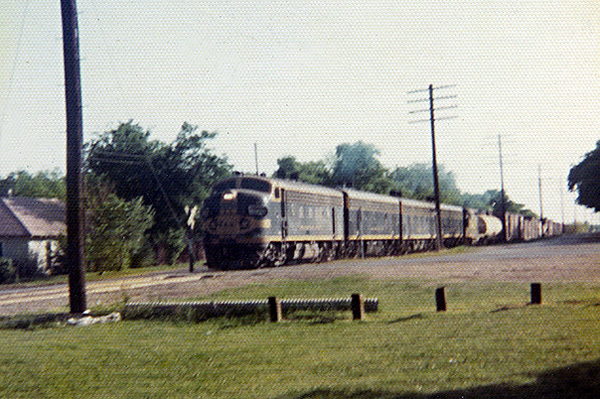
I’ll update this post, providing photo particulars, unless someone in comments beats me to it…
The Last SD45 Ordered* by the SP
First gets all the attention. First place in ratings, first in the race, first on the moon, etc. I get that. But somebody has to be last. Being last in a race or the NFL standings has to hurt your pride.
But last doesn’t always mean worst. Sometimes it just means last.

SSW 9155 with another SD45 and a U33C at Bealville, CA on May 23, 1977.
Cotton Belt 9155 and 2 other 6-axle units are clearly in Run 8 as they strain to overcome the uphill grade at Bealville, California on May 23, 1977.
SSW 9155 was the last SD45 ordered* by the Southern Pacific. It was part of a 4 unit order, SSW 9152-9155. All 4 were built in January of 1970.
But the SP’s love affair with the 20 cylinder engine was far from over. Beginning in 1972, the SP started receiving the first of nearly 250 SD45T-2’s.
* It’s standard form to explain the meaning of an asterisk at the end of a post, but I think I’ll defer to you readers to explain the asterisk in comments. No, you won’t win anything for being the first with the correct explanation, but you will get the satisfaction of being first.
The Crud Gets Around…
In going through slides, I notice that I’ve seen certain units at different points on a railroad. Nothing unusual there, as moving around is what railroad rolling stock does.
Nevertheless, it’s fun to note the coincidence. As such, I think it merits a new category here on Southwest Rails. Let’s call it “I get around”.
To kick off the category, SP SW1500 2507 is the participant.
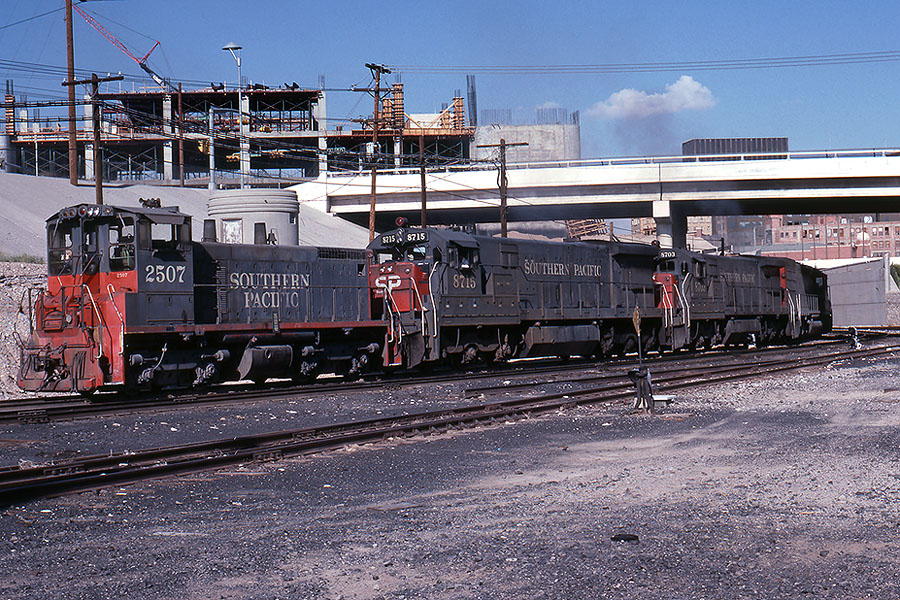
SP SW1500 2507 helps with a bad order set-out in El Paso, TX on Sept. 9, 1978
I’m at the west end of the trainway in El Paso, TX on a typically hot Sept. 9, 1978. A Dallas Street yard job with SP SW1500 2507 has coupled up to the power of a WB freight to pull a bad order car from the train.
When did union rules change to permit road crews to set out bad orders in yard limits?
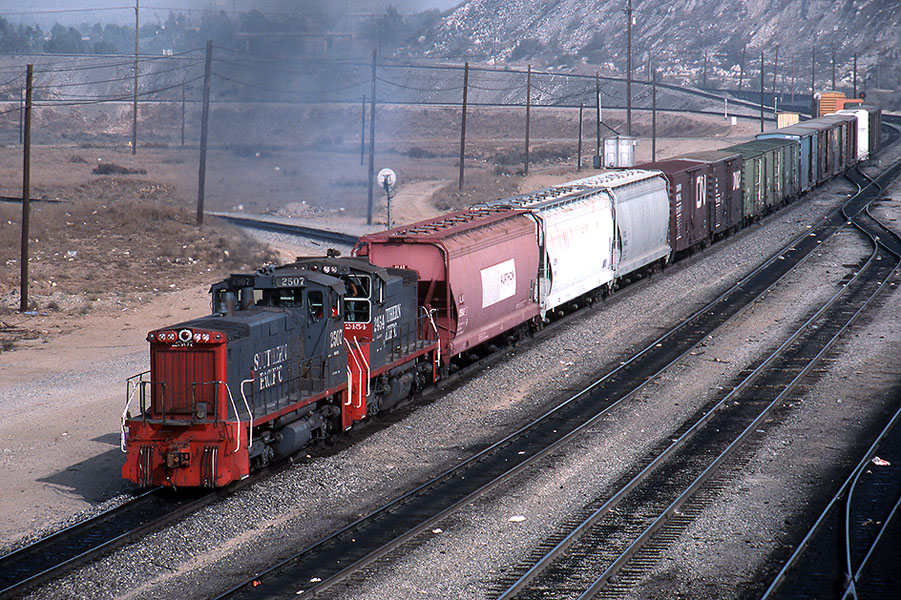
SP SW1500 2507 returning to West Colton with the Riverside local.
My next encounter with the 2507 was 9 years later. It and fellow SW1500 2454 are returning to West Colton Yard after a day work on the Riverside local.
The ascending track in the background is the Palmdale Cut-Off, completed in 1967, which permits traffic to and from Northern California to avoid the congestion of the LA basin.
WB at West Junction – Pic of the Day
Since the previous post ended up at West Junction, let’s continue with that location.
On my way home after a wedding shoot, I came across SP GP40 7133 holding the Eagle Lake Local at West Junction. That sounds like a great photo-op, right?
If you disregard the fact that it was about 1 A.M., slightly dark, very muddy ground, and a million mosquitoes, yes it would be an awesome photo-op.
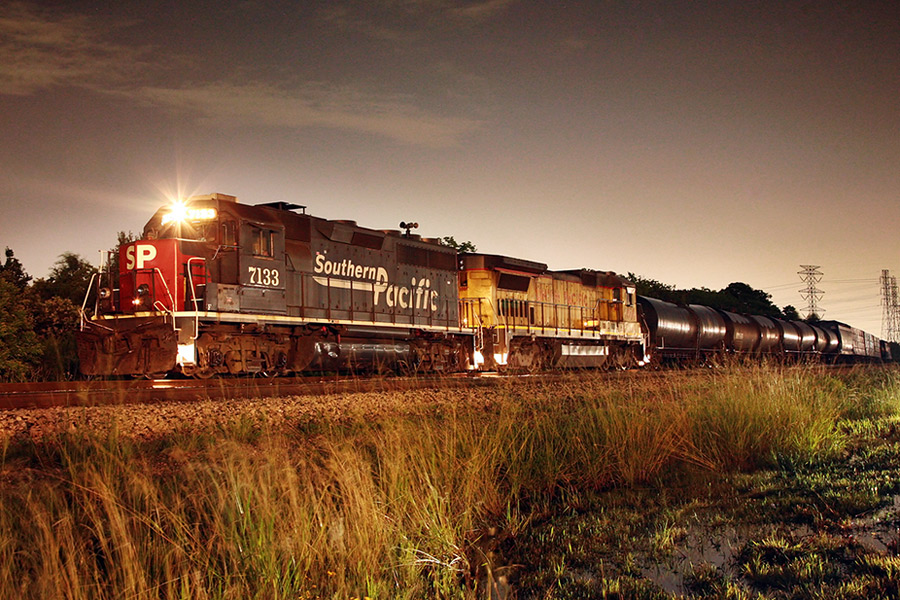
UP's Eagle Lake switcher waits at West Junction for an EB to get by on May 28, 2007.
I know the conductor on the 7133 thought I was crazy. Let’s just say I showed indifference in the face of adversity
A Game of Inches
A game of inches – that’s what they say about football. Railroad photography could be characterized the same way.
As to this image, you could also say it’s a game of seconds.
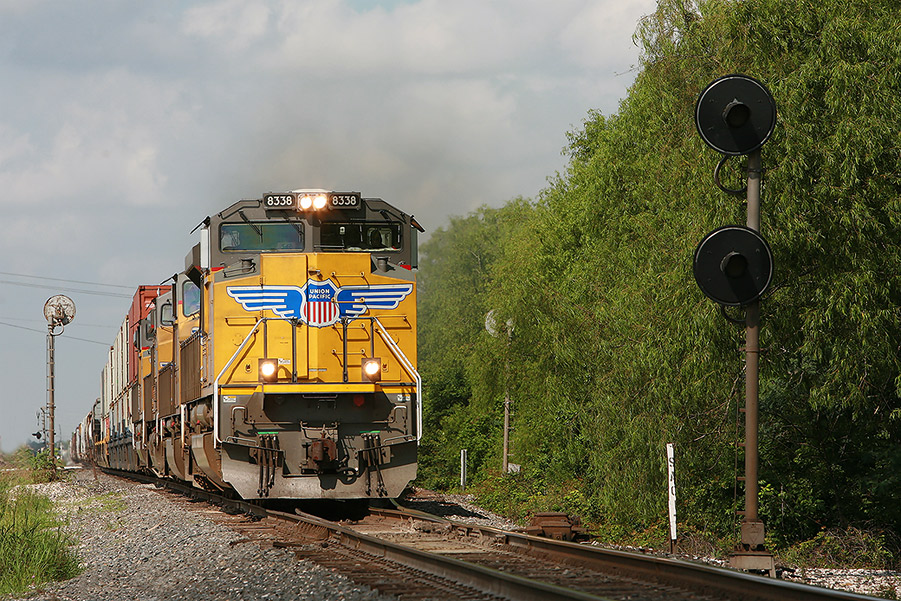
UP train QWCEW at Missouri City, TX on May 10, 2007
Running at track speed of 50 mph, UP SD70ACe 8338 is within a second or two of entering the pronounced cloud shadow visible in the foreground.
It was more cloudy than not this day, but with just enough openings to entice me to try my luck at catching a shot in full sun. As the train approached, I just knew that I’d get hosed because the cloud was moving slowly, but the train was moving quickly.
The only thing that saved me was the 200mm lens that allowed me to reach out just enough to get the job done.
Being partial to SD70ACe’s, I headed east to West Junction to see if I could get lucky twice.
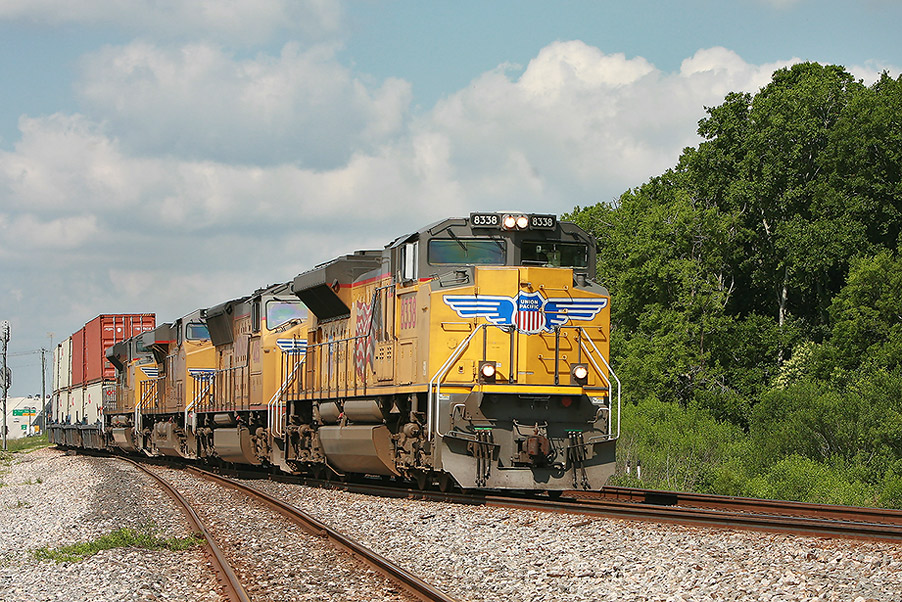
UP train QWCEW at West Junction on May 10, 2007
The clouds had opened up enough here to where there was no suspense for this shot. Which is just how I like it…
When Your Hopes Get Dashed…
I was worried when I learned D&RGW was taking over the Southern Pacific. The SP had always been my hands-down favorite railroad, and anything that imperiled the existence of the SP was obviously a concern.
My SP had already dodged one bullet when the ICC shot down the SPSF merger. When the Rio Grande announced that they were keeping the Southern Pacific name, and folding the D&RGW into the SP, I felt that the bullet might be dodged again.
When the SP began taking delivery of hundreds of new locomotives, complete with a bold new lettering style, I felt confidently hopeful that the SP would survive, even prosper for years to come.
Within a few short years of the roll-out of speed-lettered locomotives, much to my disappointment, the announcement was made that the UP would acquire the Southern Pacific.
As we all know, the SP wasn’t able to dodge this bullet.
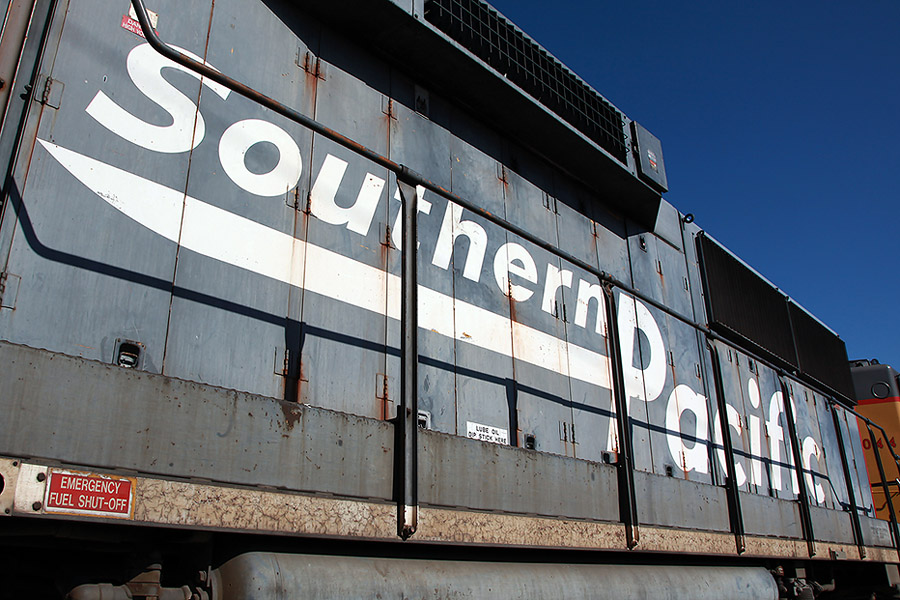
The hood of UP GP60 2045, Sugar Land, TX on Jan. 10, 2010
Every time I see an engine with this lettering, I’m reminded of just how short this era actually was. Nearly 14 years after the merger took place, it’s nice to still see a reminder of a time when SP power looked better than it had for years…
 Southwest Rails