Verdemont Storm Light – Pic of the Day
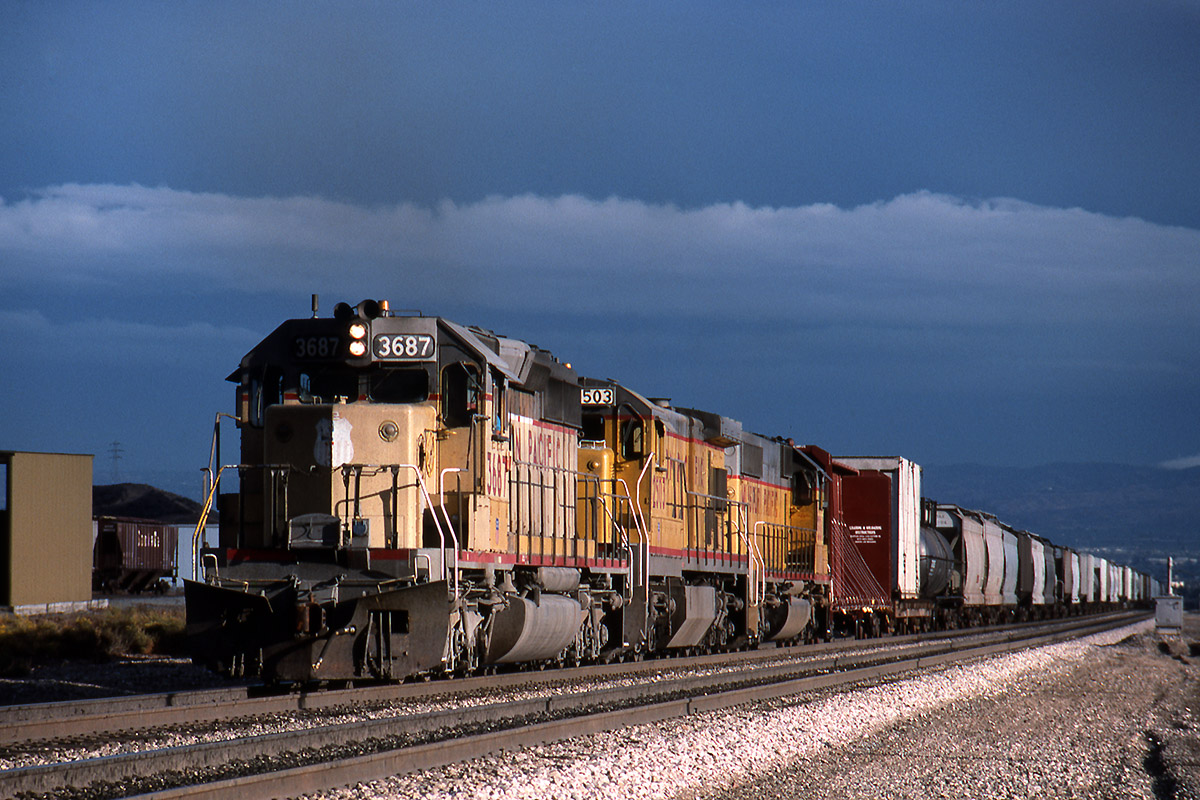
An eastbound UP manifest enters a patch of dramatic light at Verdemont, CA on Oct. 12, 1987
Today’s Trains – March 6, 2010 – Part 2
Picking up where I left off from Saturday’s rounds, I left Settegast to see what might be at North Yard / Basin Yard and points south.
After driving a bit, I came across the switcher that UP leaves at the west end of Booth Yard. UPY 2104 was available for a broadside view:

UPY 2104 is shut down, between assignments, at Booth Yard in Houston on March 6, 2010
UPY 2104 is an MP20GP genset unit. Its heritage, in chronological order, is order is MP GP50 3528, to UP 78, to UP 988, to UP 1686. The 1686 was retired by the UP on May 27, 2005.
The conversion from GP50 to genset was done by Motive Power Industries at Boise, Idaho. It was delivered to the UP in June of 2006.
Moving on, I heard a BNSF trackage rights train coming up the Strang Sub. I saw it first at the Central Avenue crossing:
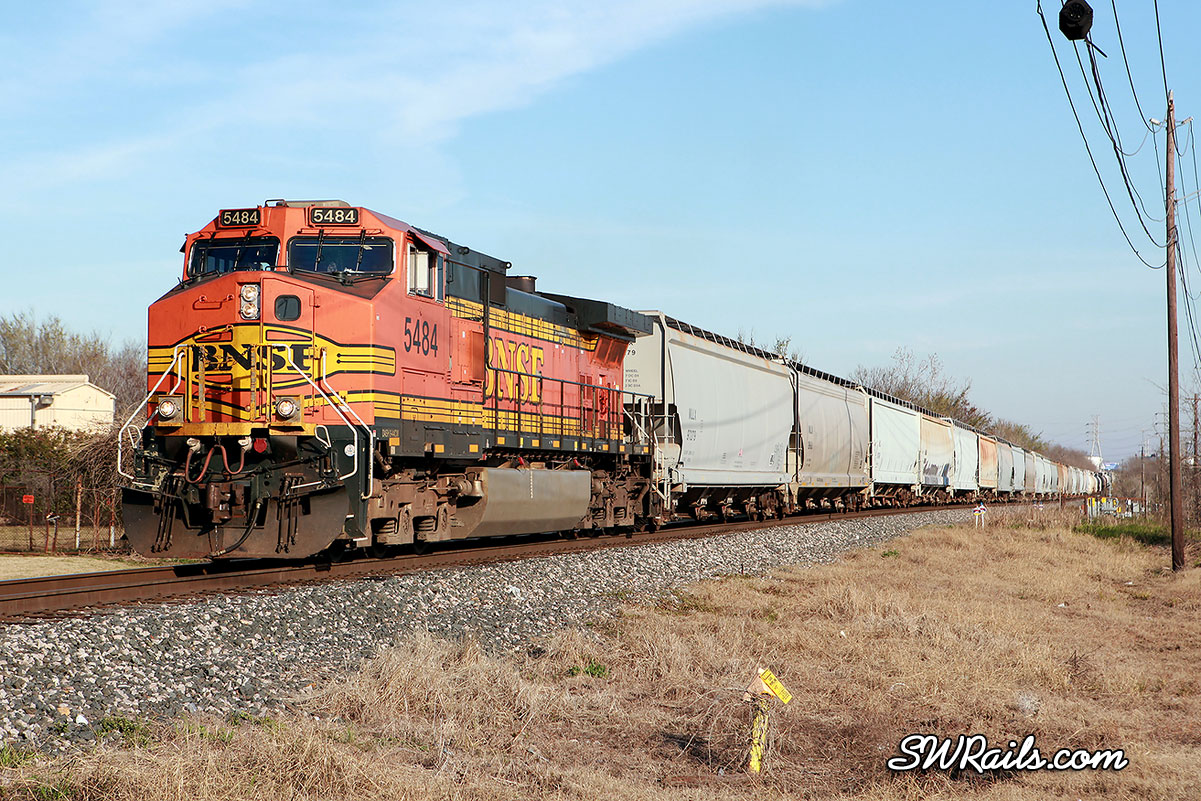
BNSF 5484 with a NB trackage rights train at MP 7 of UP's Strang Sub on March 6, 2010
As the entire 21 mile length of the Strang Sub is 20mph railroad, it was easy to jump ahead to catch this train at Manchester Junction.
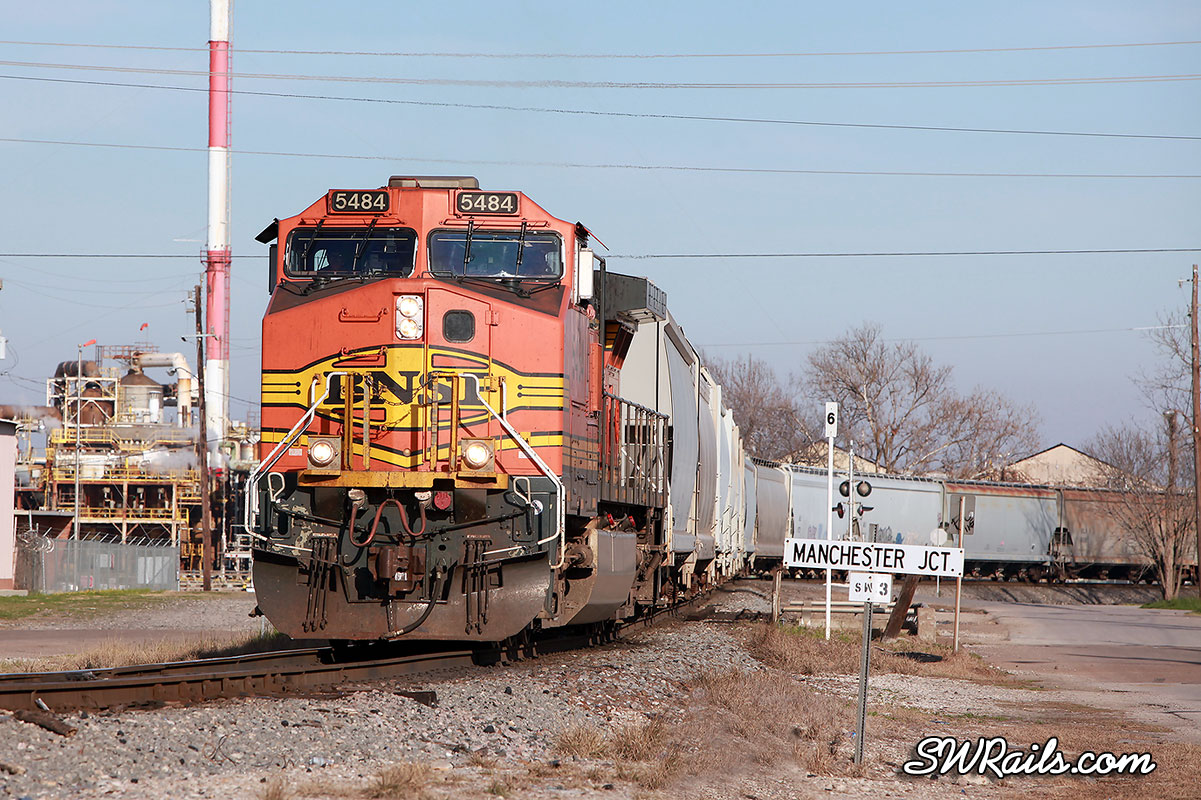
BNSF 5484 is one mile up the road at MP 6, Manchester Junction in southeast Houston
The 5484 is approaching the Tower 30 interlocking (The Katy Neck), where the dispatcher can line northbound trains to continue north via the Strang sub, southeast or northwest on the Galveston sub, or southwest on the Glidden sub.
As it turned out, the train was lined onto the Galveston sub toward downtown on the Galveston sub. I’d never shot a train on that particular stretch between Tower 30 and downtown, mainly because there isn’t much traffic on the line.
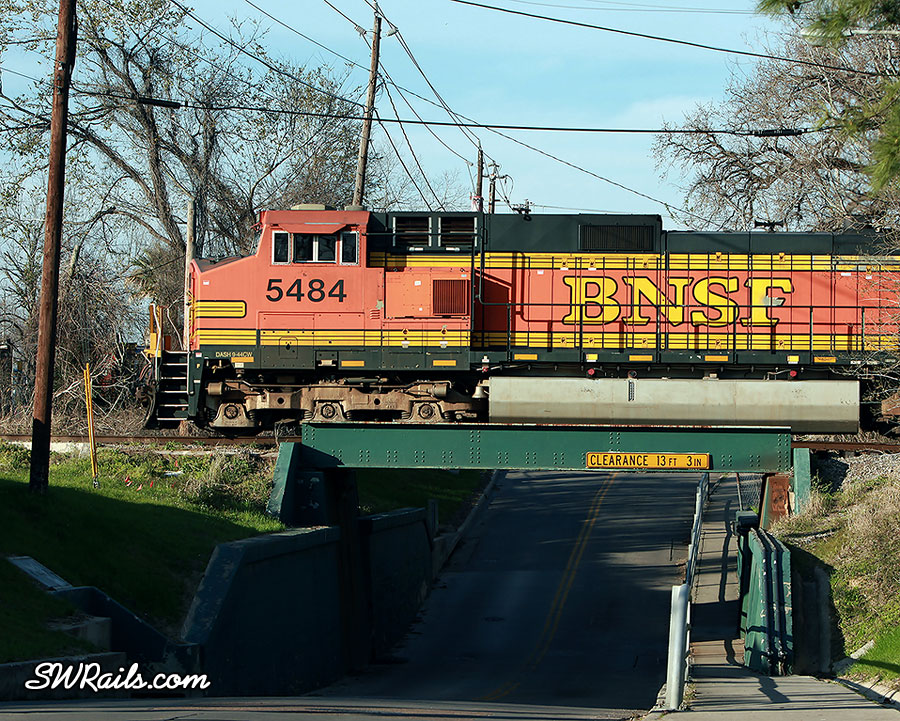
BNSF 5484 nears Tower 85, the junction of the UP Galveston sub with the UP East Belt sub
Most of the 4 miles of Galveston sub between downtown and Tower 30 cuts through backyards, with few conventional photo ops. That being the case, I opted for a broadside view as the train crossed over the nicely painted Forest Hill Blvd. overpass.
As the sun was dropping toward the horizon, I called it a day.
Today’s Trains – March 6, 2010
UP 1996, the SP heritage unit, arrived Friday morning on the MFWEW. I headed out to see if I couldn’t track it down. I drove all around Englewood and Settegast in vain.
I attribute my bad luck to the sun. As it was nice and sunny, of course I wasn’t going to find it. Now if had been cloudy raining, I would have found it immediately!
Nevertheless, I did see a few other things:
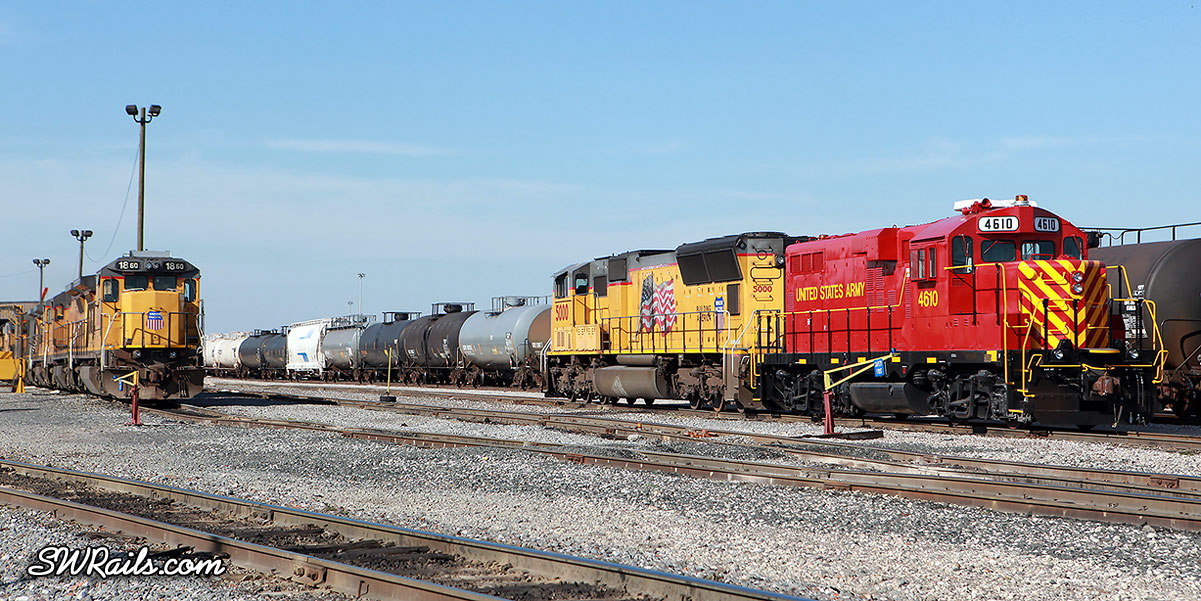
US Army 4610 mingles among UP power at Settegast Yard in Houston, March 6, 2010
The 4610 had worked most recently at the Army Ammunition Plant in McAlester, Oklahoma. It’s only my assumption that it’s headed back to work there. If any reader can correct me, please do so via comments or the contact tab at the top of the page.
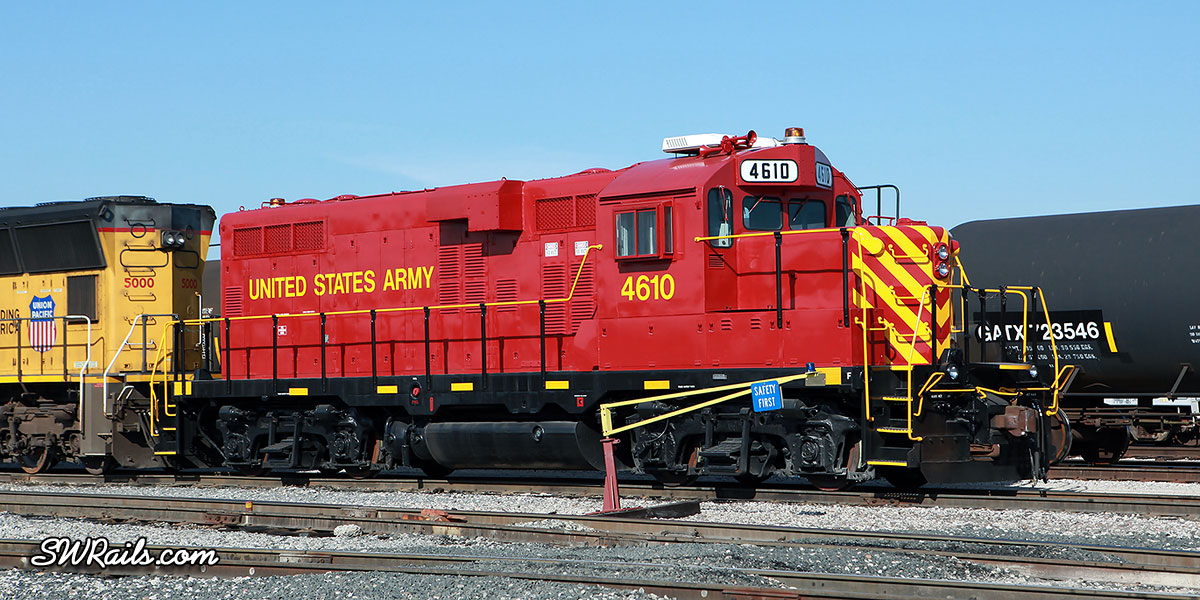
The 4610, a GP10, appears to be just overhauled, with fresh paint and a new A/C unit on the cab roof
GP 10 is the designation given to GP9’s that went through the early Geep re-build program done by the ICG at their Paducah, KY shop complex. The boxy air filter housing gives the unit away as a Paducah graduate.
The ICG was so pleased with the economics of their in-house re-builds, when they ran out of their own Geeps to re-build, they went to the used market to buy additional cores for their program.
The 4610 began life as a GP9B, UP 171B, built in March 1954. The UP retired the unit in 1976. Dealer Precision National Corp. acquired the unit, re-selling it to the ICG. The unit was completely re-built at Paducah, gaining a cab in the process.
Upon completion, the unit became ICG 8240 in June 1977. The ICG operated it until 1991, when it was retired (again). Locomotive dealer VMV Enterprises acquired the unit, re-selling it to the U.S. Army where it became their 4610 in early 1992.

UP SD9043MAC 8165 in a bass-ackward roster view, Settegast Yard on March 6, 2010.
I don’t know where the SD90MAC’s have been, but they’ve been all over the place recently in the Houston area. I’m guessing that this unit will not depart like this, as it’s no fun running a unit this long in reverse for more than a bit.
There were a few other things out there, but I’ll have to post that tomorrow…
Burlington Northern Variety Pack

Line-up of Burlington Northern power at New South Yard in Houston, Jan 15, 1989
The appearance of Burlington Northern motive power underwent a series of changes in 1985, continuing on through the merger with the Santa Fe in 1996.
The above view at HB&T’s ( Houston Belt & Terminal) New South Yard illustrates the changes through 1988. From left to right:
BN 3155 is in the “tiger stripe” scheme that the BN specified for the 1985 order of GP50’s, 3110-3162. This scheme was first tested on SD40-2 8002.
BN 8000 wears the classic green & black that was standard for BN power between 1972 and 1985.
OWY (Oakway) SD60 9039 is in EMD demonstrator colors. 100 SD60’s, 9000-9099, were leased by the BN, from Oakway, an EMD subsidiary, in 1986.
LMX 8589, a B39-8, is in version 1.0 of a gray/white/red scheme that was applied to 100 units leased from GE late 1987 and early 1988.
The Termite Train – Santa Fe Style
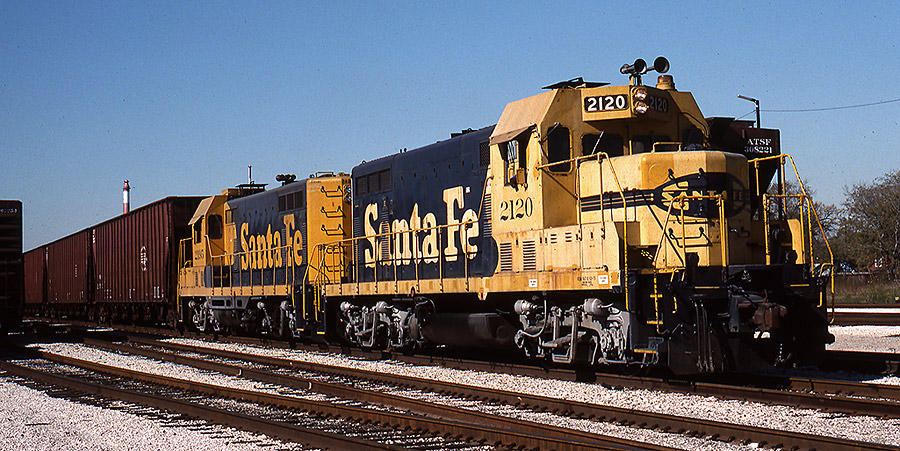
Two Santa Fe Geeps work a "termite train" at PTRA's Manchester yard in Houston on Dec. 9, 1990
ATSF 2120 and 2195, GP7 graduates of Santa Fe’s Cleburne rebuilding program, are switching a cut of MP wood chip cars. The train is at the PTRA’s (Port Terminal Railway Association) Manchester Yard in southeast Houston.
“Termite train” was the nickname train crews gave to trains whose cargo was wood chips. The chips would travel in high-sided open hoppers for delivery to the various paper mills on the east side of Houston.
The MP and the SP both operated this type of train to the Houston area until the mid 1990’s, when the last paper mill closed down.
These cars are en route to the Champion Mill that was in Pasadena, Texas. The cars were transferred to the PTRA, the Houston area terminal railroad, that actually served the Champion plant.
Historically, the PTRA used engines from the railroads that jointly owned it, the MP, ATSF, SP, BN, and until 1980, the Rock Island.
The PTRA did acquire its own power in 1996, but that’s another topic…
The Texas Eagle – in Louisiana
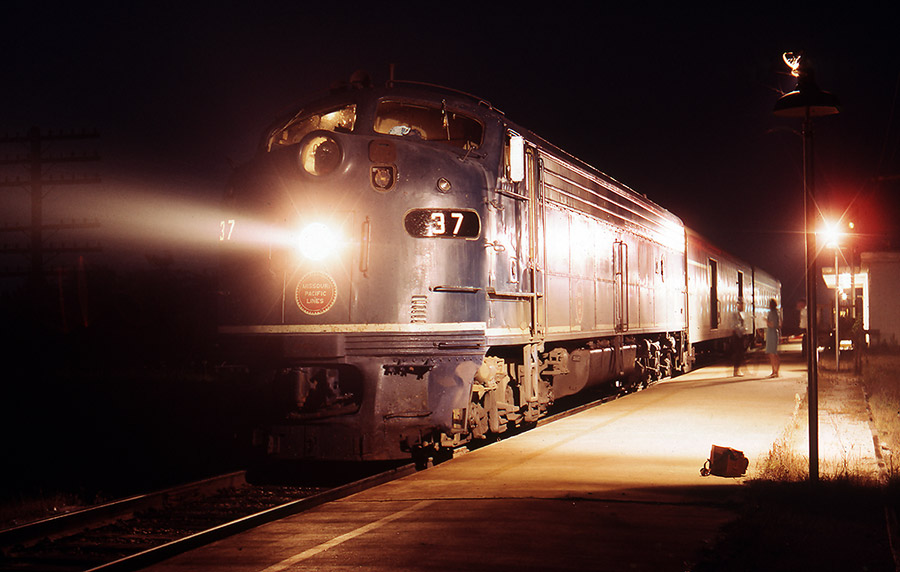
MP passenger train #22 at its 10:01 P.M. Shreveport, LA station stop on May 30, 1969
By 1969, most U.S. passenger service was on life support as the vast majority of Americans had chosen cars and planes as their preferred modes of travel.
The above view of Missouri Pacific Train #22 illustrates just how few passengers were traveling by train. E8A 37 will have no problem with its two car train – one baggage car and one coach.
Train 22 was the Fort Worth section of Train #2, the Texas Eagle. It departed Fort Worth at 3:50 PM. It made 23 intermediate stops before arriving to New Orleans at 5:35 the next morning.
Longview, Texas is where passengers would make connections to the Texas Eagle, train #1 to San Antonio or train #2 to St. Louis.
My First Train Chase!
In the summer of 1978, I was working at a photo lab in McAllen, in far South Texas, trying to save some money before I went to UTEP.
The counter of the store just happened to face the Missouri Pacific branch line that served the west side of the Rio Grande Valley, so I’d get to see the McAllen local just about every day.
This local originated at the MP yard in Harlingen and ran to McAllen, about 30 miles to the west. The crew would eat lunch in McAllen before taking their train back to Harlingen.
One day I heard the distinctive ( not in a good way) single note horn of the local doing its work in McAllen. I didn’t pay it much attention because I knew it was just another GP7, GP9, or GP18, all of which had become tiresome after months of the same thing every day.
When the train finally came into view, I instantly knew something was different. Instead of a Jenks blue Geep, the local had a red, white, and blue Geep! Bi-centennial GP18 1976, to be specific.
In the span of two seconds, I went from ho-hum to holy cow! to damn it! The coolest engine I’d ever seen and I was stuck at work. And my camera is at home. How wonderful.
My only hope was that the local would have work heading back to Harlingen and I could try to catch it after work.
Getting to 5:00 P.M. took an eternity. At 5:01 I was in mad-dash mode to get home, grab the camera, and start the chase.
After 45 minutes of driving through McAllen, Pharr, San Juan, Alamo and Donna (and cursing at every red light on Business 83) I finally caught up to the train at Weslaco, but traffic lights just kept killing me. Nothing is more aggravating than driving a new Mustang, yet being unable to get ahead of a train doing a lousy 30 mph.
I was finally able to get ahead of the train and got my first shot of the train crossing a large drainage canal between Weslaco and Mercedes. I knew that my late afternoon shots of an eastbound train were going to be sketchy, but I kept going east, if for nothing more that to watch the first bi-centennial unit I’d ever seen.
As dusk approached, I was going to try one last shot. I pulled ahead of the train, looking for a spot for my last shot of this train. I chose the Hwy 77 overpass over the MP tracks, on the west side of Harlingen.
Now that I was ahead of the train, it took its sweet time to arrive at my location, As the headlight finally came into view, all I could think about was to hold the camera steady, because I had never hand-held such a slow shutter speed, with a moving train to boot!
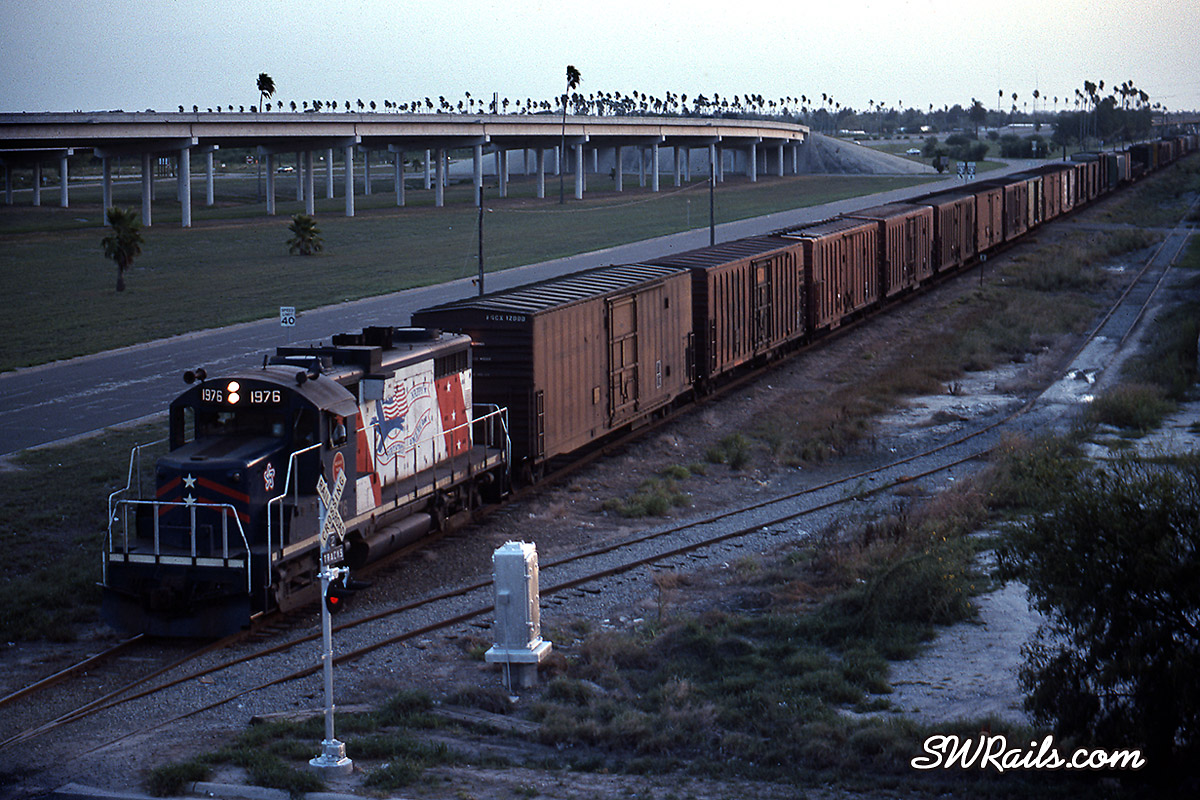
MP bi-centennial GP18 powers the McAllen local at Harlingen, TX on Aug. 11, 1978
When I got the slides back, I was underwhelmed with my shots of the train, especially the ones where I was virtually shooting into the sun. This was the only shot that I thought was marginal, and barely so because I let the crossing signal partially block the engine.
Today, nearly 32 years later, this slide is among my favorites because it’s the first bi-centennial unit I ever saw. Little did I know it would be the last time I’d see a bi-centennial engine.
A very proper subject for my first train chase….
SP B23-7 5111 – Before & After
The SP acquired 15 B23-7’s in June of 1980. Numbered 5100-5114, the 2300 HP units were intended for service on the relatively flat east end of the railroad.
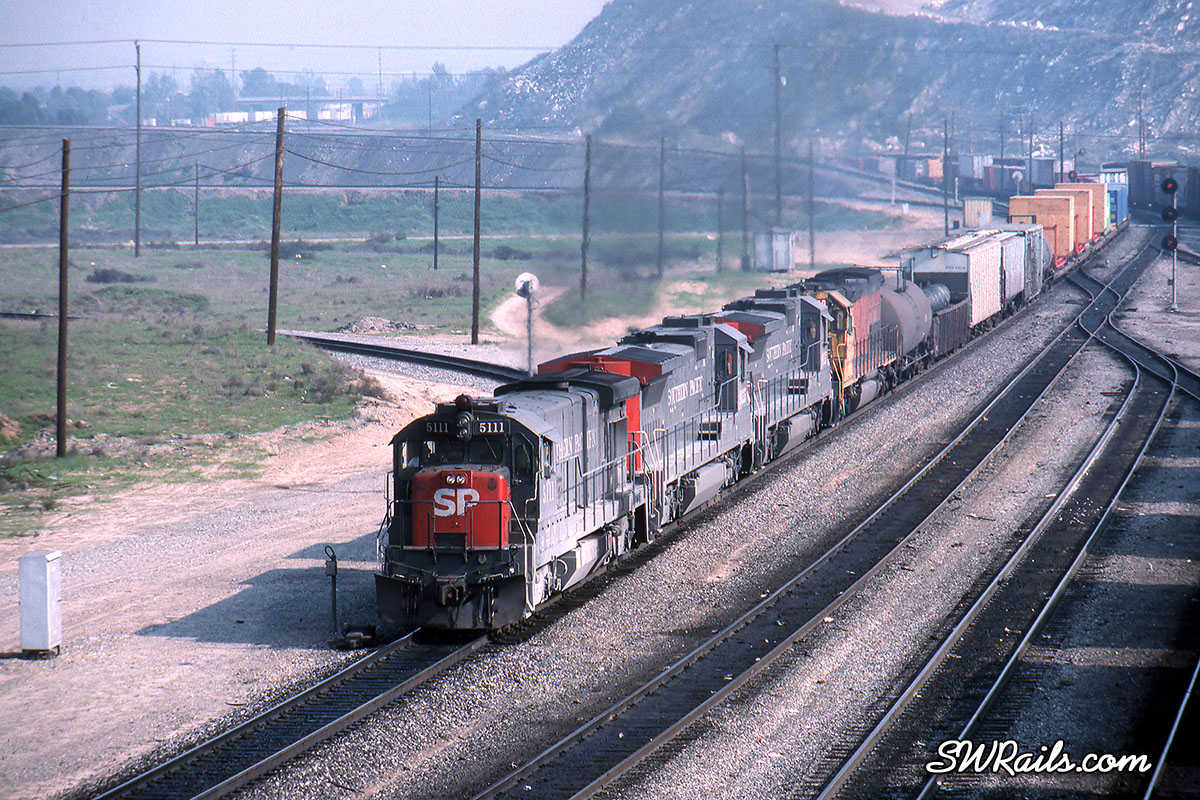
Interesting power for a shooter, B23-7 5111 brings an NOLXT into West Colton CA on Nov. 7 1987
Nevertheless, they could end up anywhere on the system, as evidenced by the 5111 on the point of an NOLXT (New Orleans – Long Beach Trailers) about to pass under the Pepper Ave. overpass at the east end of SP’s West Colton Yard.
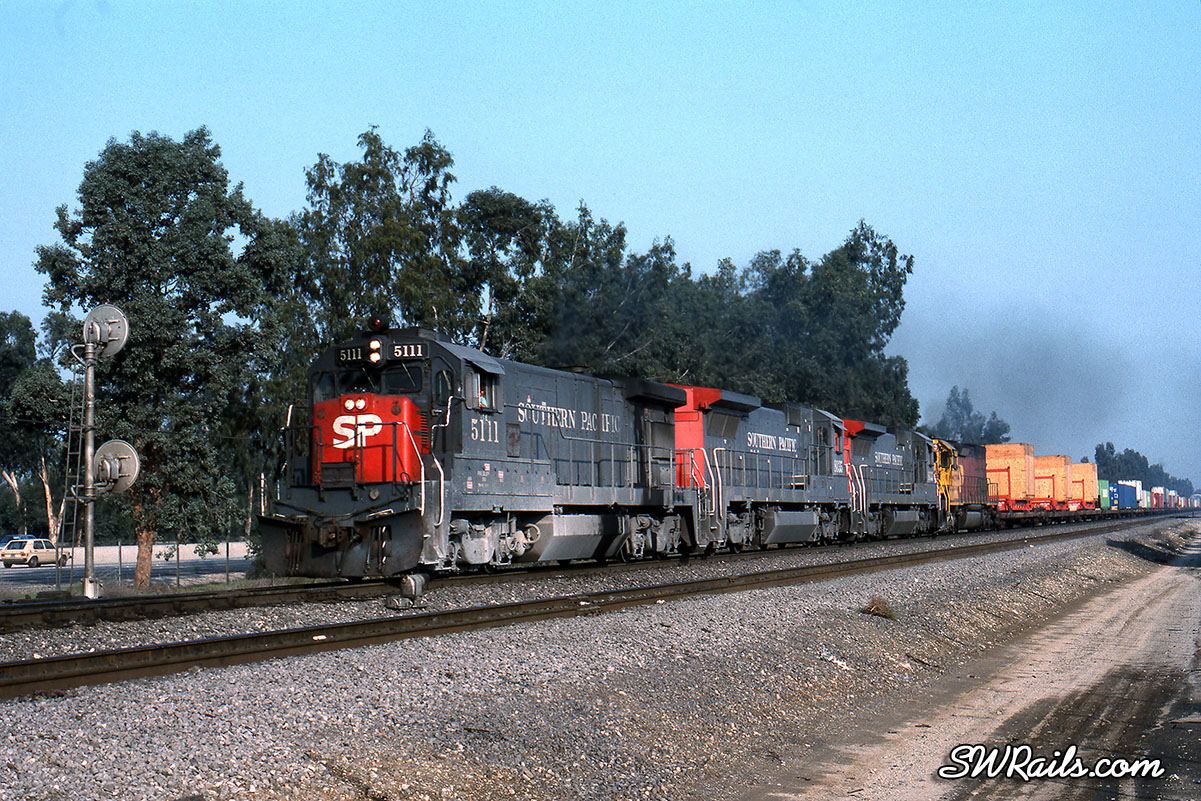
SP 5111 has the NOLXT on the move again at South Fontana, CA on Nov. 7, 1987
After a couple of hours for a crew change and making a head-end set-out, the NOLXT was on the move again. Fortunately, the haze had cleared up a bit allowing a much nicer shot of the train at South Fontana.
Fast forward 18 years – Christmas Day 2005. It’s a beautiful day in Houston, so I ask my wife and sons if they want to go for a ride. They accepted the offer, so we piled into the SUV.
Now, my family knows that any and all rides may involve some railfanning, especially when it’s sunny. They’re OK with that.
We ended up at UP’s Pierce Yard in North Houston, where we saw a string of locomotives that required further investigation. It was a string of about 20 units, all 4-axle GE’s that were retired.
As we drove along the line of retired power, I spotted the 5111 and instantly recalled seeing it in Southern California back in the day.
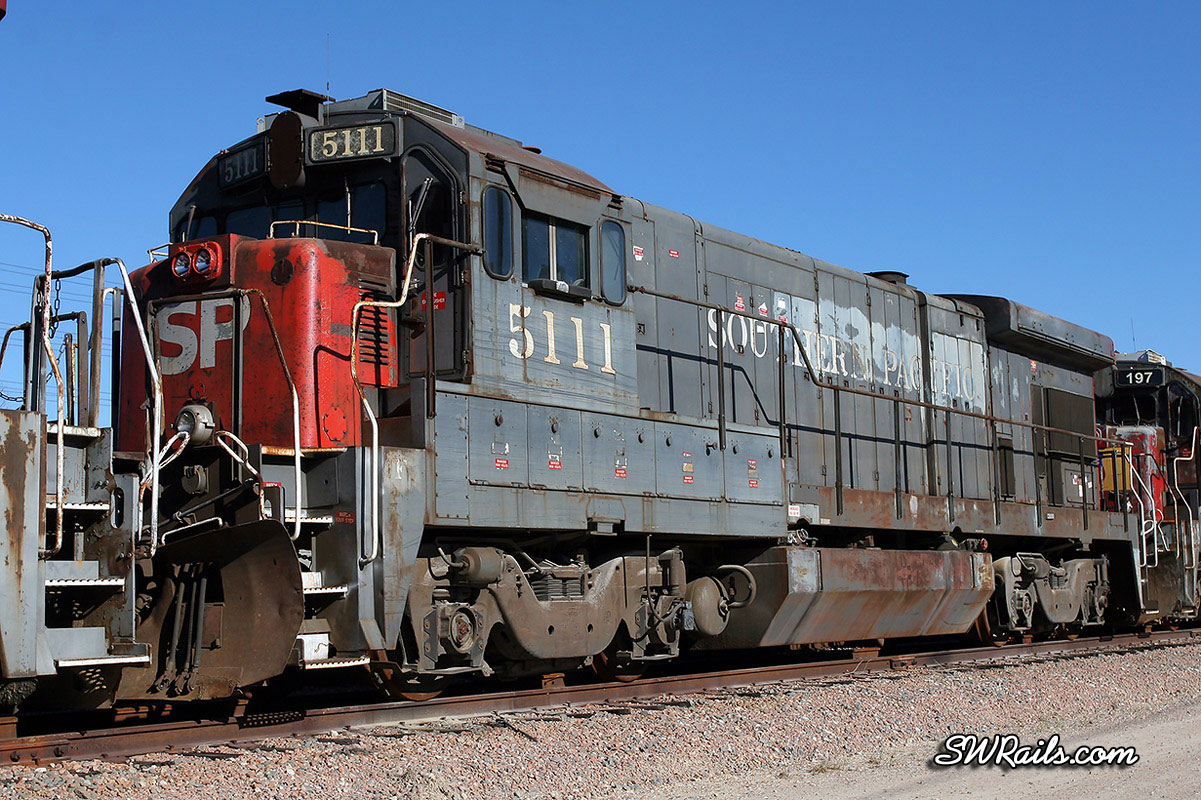
SP B23-7 in a dead line of retired power in Houston, TX on Dec. 25, 2005.
I felt a twinge of sadness knowing that the 5111 of my youth would never run again.
Unbeknownst to me, this would not be the absolute end of the line for the 5111. It became the core, providing the frame and trucks, for UPY 2644, an RP20GE Gen-Set unit built in 2007.
Obviously, I’d rather have SP 5111 still out there. But that’s not an option. So it’s nice to know that the 5111 didn’t get scrapped into bits of metal for export to China.
PS- I’m amazed at how good the 5111 looked in 2005, after 25 years of continuous service. None of the B23-7’s were ever re-painted, yet this 25 year-old paint job aged much better than most 5 year-old BNSF H3 paint jobs.
The Newest Mainline in America!
Last summer, the KCS Rosenberg Sub opened for business. Its 84.5 miles of 136 lb. rail resting on concrete ties supported by a deep bed of ballast is a state-of-the-art railroad, and a key link in the NAFTA Railroad. It is the newest mainline railroad in North America!
The KCS acquired the right-of-way between Victoria and Rosenberg, Texas that once hosted the Victoria Sub of the Southern Pacific. The SP line was abandoned in the late 1980’s in favor of running via the Cuero Sub to Victoria.
When the KCS received trackage rights over the UP to connect the KCS proper at Beaumont with the Tex Mex in Robstown, KCS trains were required to travel west to Flatonia, then south to Victoria, slightly out of the way.
This new line allows KCS trains to cut 67 miles from the UP route it previously took . The KCS expects to save about $1.2 million/month due to reduced trackage right payments to the UP. Additionally, transit times will be reduced by 4-6 hours.

The Southern Belle crosses the San Bernard River, near Kendleton, TX on July 16, 2009
KCS operated its Southern Belle business train to help inaugurate the new line. It made two round-trips July 16 and 17, 2009 between Kendleton and Victoria entertaining shippers and local officials.
Surprisingly, the pre-cast concrete girders used for the bridges on the line developed stress cracks. KCS had to replace all of the girders used on the line. The work took place late last year.
Not to be a tease….
I’m sure you’ve heard that the UP has another heritage unit in the works. Except it’s not to honor anything related to the UP’s heritage.
New AC45CTE 7469 was re-numbered 2010 and was painted in a scheme commemorating the centennial of the Boy Scouts of America.
The unit is currently at the North Little Rock Shops under a tarp. No official word on when it will be unveiled.

Eastbound in the Middle of Nowhere…
The drive from El Paso to San Antonio on U.S. Highway 90 is about 620 miles through some of the most desolate terrain in the U.S. The biggest town on this drive is Del Rio, yet its population is only 46,000.
Why Highway 90? Wouldn’t Interstate 10 be quicker?
Of course I-10 is quicker, but Hwy 90 follows the ex-SP Sunset Route mainline!
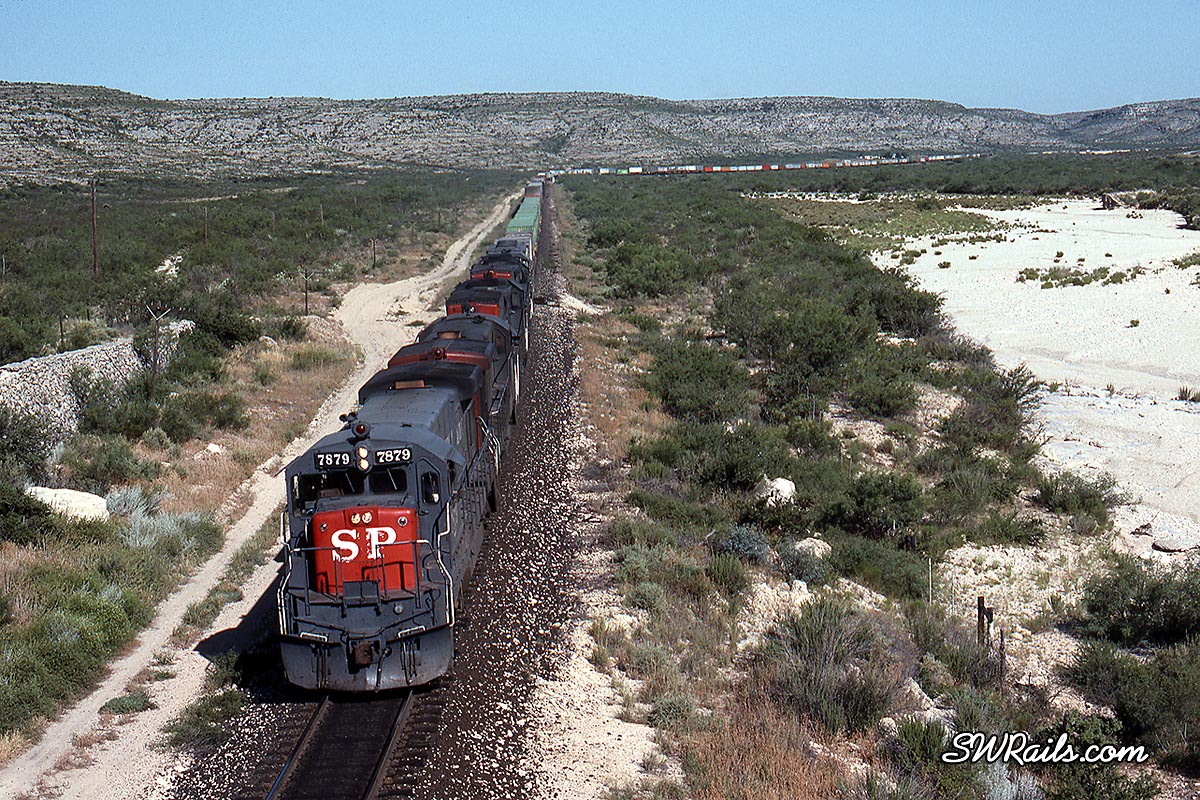
SP B30-7 7879 on the point of the LAAVT just east of Sanderson, TX on Jun 16, 1985
It’s early on June 16, 1985. A fresh crew has just departed Sanderson, Texas with a seemingly endless LAAVT (Los Angeles, CA to Avondale, LA Trailers). The train is about to pass under the Hwy 90 overpass.
Not only is this the middle of nowhere, but it just happens to be very near the mid-point of the run between El Paso to San Antonio.
El Paso is MP 827 of the Sunset Route. Sanderson is 297 miles to the east at MP 506. Travel another 321 miles east and you’ll be in San Antonio.
Sanderson was a crew change point on the SP before ID (inter-division) runs were implemented. The crew districts in 1985 were El Paso-Valentine, Valentine-Sanderson,Sanderson-Del Rio, and Del Rio to San Antonio.
Inter-division runs typically combined two districts into one, but the distances were too great to do that on the El Paso-San Antonio run.
Currently, the UP crew districts are El Paso-Alpine, Alpine-Del Rio, and Del Rio-San Antonio.
How Time Flies…
It seems like it was just yesterday that the ex-MP B23-7’s were running on the UP in regular freight service, then they were demoted to locals, and then just like that…they’re gone.
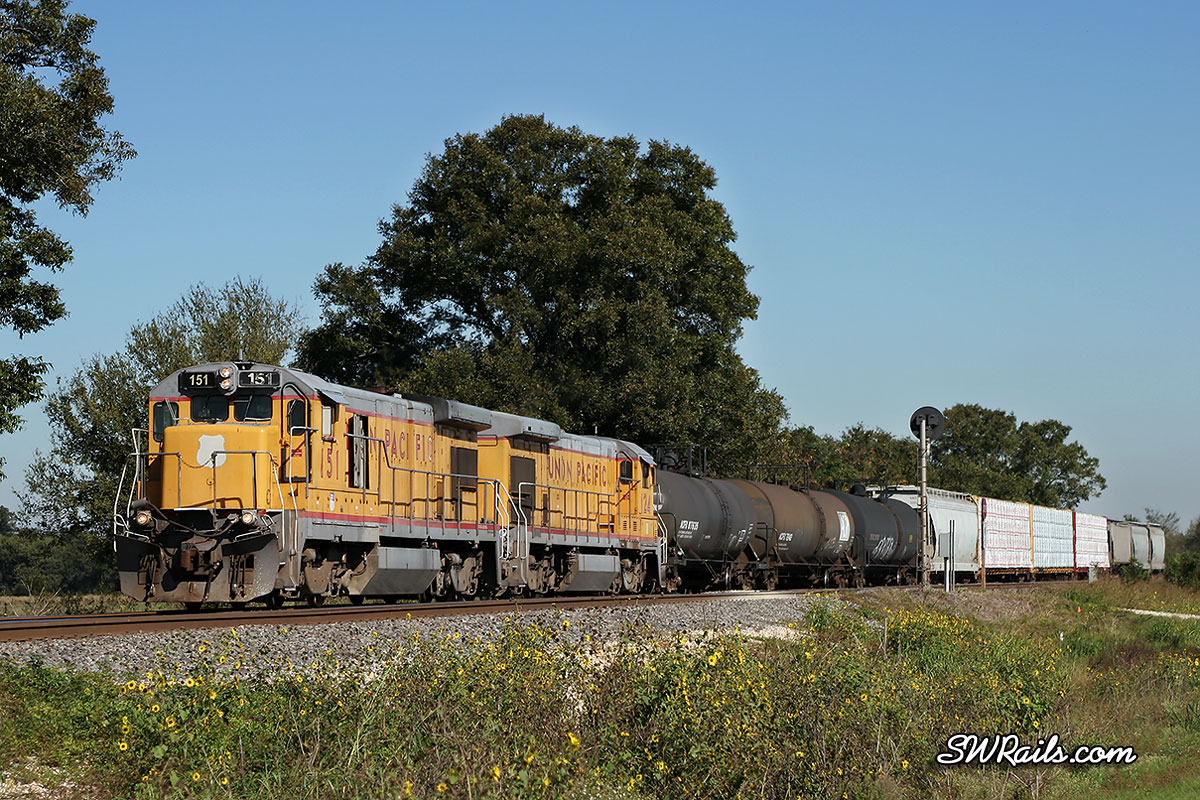
The Sugar Land local at the west switch of Harlem, CP SA030 on the Glidden Sub on Nov 5, 2004
Both of these units were retired in 2007. The 151 was the core for genset UPY 2648. As for the 124, I don’t know what became of her.
 Southwest Rails