Pre-BNSF Pumpkin
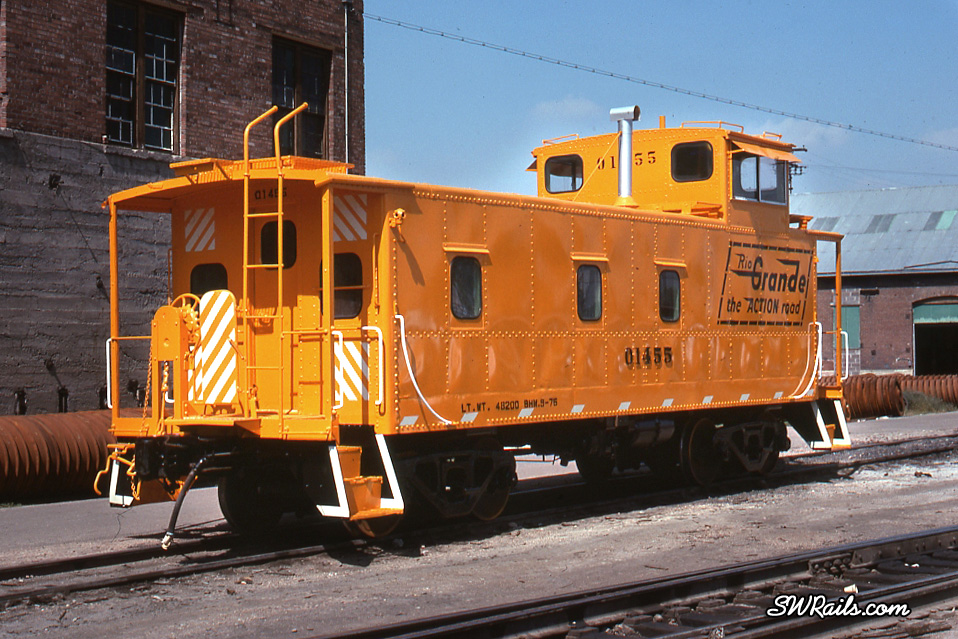
Freshly painted Rio Grande caboose 01455 at Denver, CO on Sept. 17, 1975
The original pumpkin scheme, Rio Grande orange & black, adorns Rio Grande caboose 01455 at Denver,CO on Sept. 17, 1975. Denver was home to the Burnham shop complex, where the Rio Grande did all heavy maintenance on its rolling stock.
The Original Warbonnet
Time for another look at some of the very first railroad photos I took.
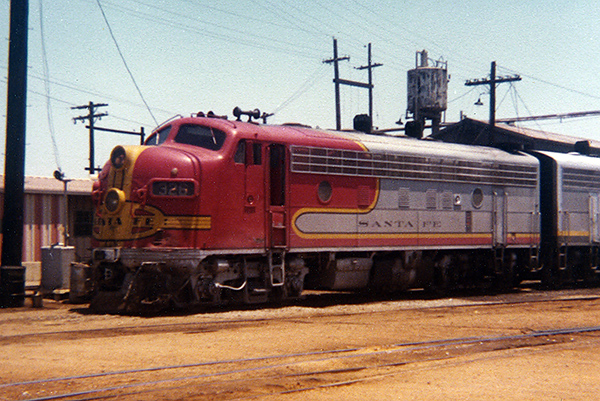
Santa Fe F7A 326 is at the Santa Fe's engine facility just north of Tower 55 in Summer, 1972.
By the time I took this picture, Amtrak had been in operation for just over one year. Santa Fe’s F-units that had been in passenger service were bumped into freight service, primarily in Texas and the mid-west.
Many of these F-units were re-painted into freight colors, which they wore for several years prior to being re-manufactured into CF7’s.

Santa Fe 326 passing through Miami, TX on Feb. 23, 1974
Fresh BNSF Is Really Fresh!
Sorry for resorting to a non-fresh 1990’s adjective, but I just couldn’t resist it.
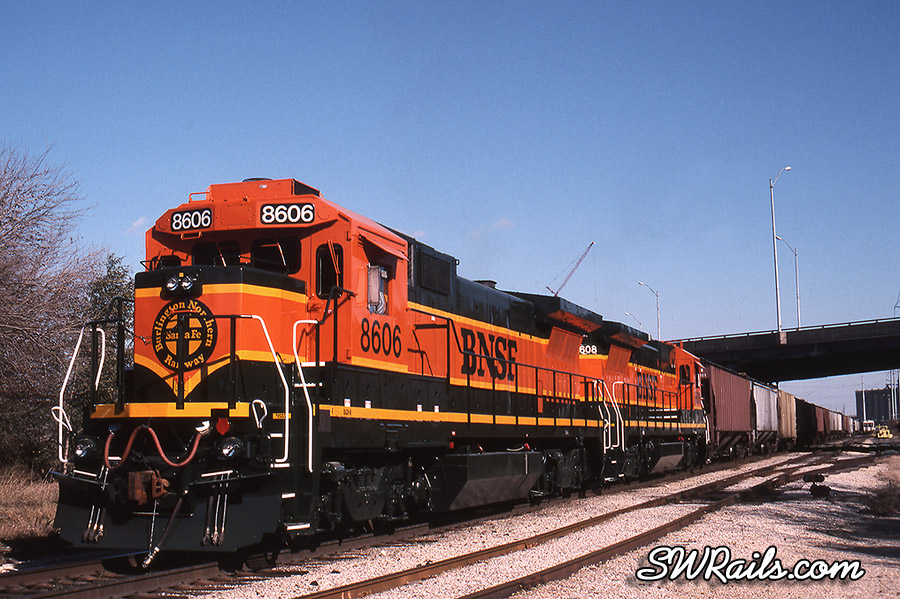
BNSF 8606 and 8608 prepare to depart Kansas City, KS with an empty grain train in June 2001.
The Santa Fe acquired 40 B40-8’s, 7410 to 7439, in the late 1980’s. They became BNSF 8600-8639. All but 2 of these units received the attractive Heritage 1 scheme during overhauls that occurred between 2000-2001.
UP 844 Back to Texas- I Heard the News Today, Oh Boy!
I’m sure you’ve all heard about the return of Union Pacific 844 to Texas next month to help the City of Harlingen, Texas celebrate the centennial of its founding.
My first reaction was to take the month of April off to become an 844 groupie, but that’s not too practical. I’ll have to settle for a couple of days on its way south through the Houston area, then a few more when it returns north.
Let’s take a look at the 844’s first trip to Texas, back in May 2006:
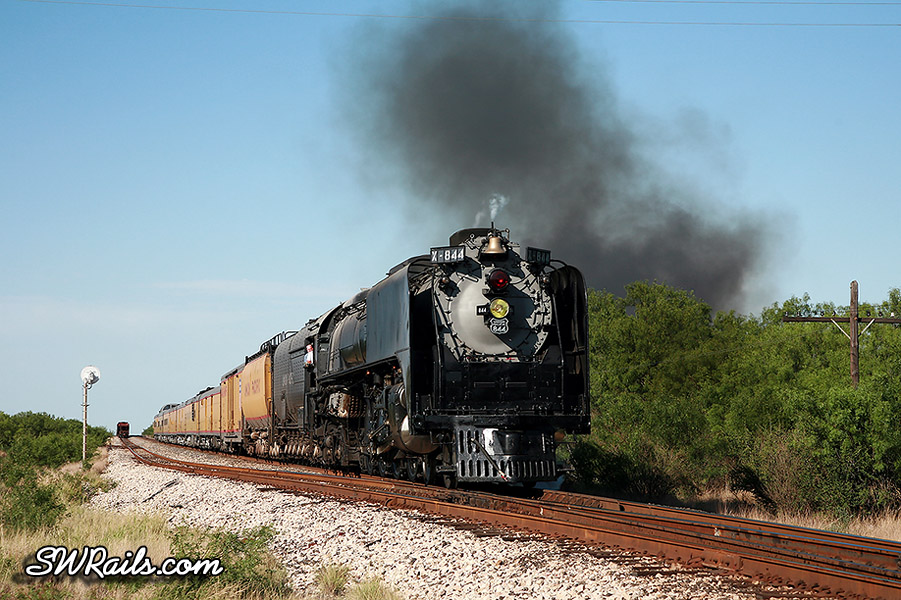
On the move after pausing to allow a grain train into the siding at Odlaw TX on May 12, 2006
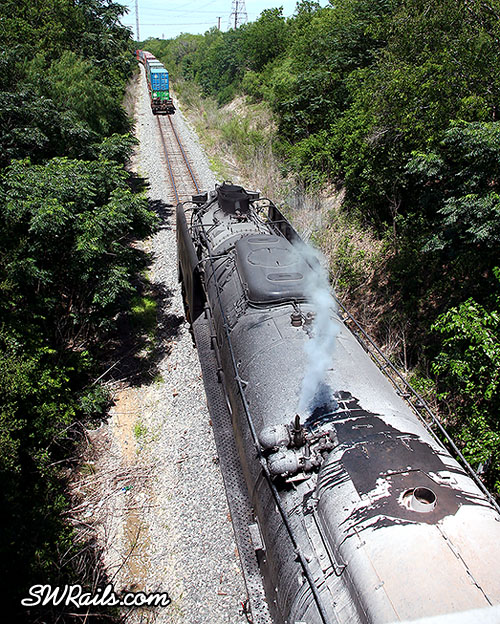
The 844 gets caught up in terminal congestion at San Antonio, May 12, 2006.
Like a junkie, I’m looking forward to another fix of UP steam. And remember, if you’re not speeding, you’re not trying…
SP E9 6051 – Before & After
SP E9A 6051 received its first application of classic “Daylight” colors when it was built in December 1954. It entered service at Los Angeles in January 1955.
It lasted just over 3 years in this scheme. In May 1958 it was painted in the experimental black with orange nose “Halloween” scheme. By 1959 it was re-painted into gray and scarlet “bloody nose” paint scheme.
After a short career of 15 years, it was retired on December 24, 1969 and donated to the Railway & Locomotive Historical Society shortly afterward.

RL&HS owned ex-SP E9A 6051 shown in storage at Sacramento, CA on July 28, 1977
It was deeded to the California State Railroad Museum in Sacramento in 1978. It was cosmetically and mechanically restored in the early 1980s and re-painted into its original 1955 appearance in the “Daylight” paint scheme.

SP 6051 attended the unveiling of UP 1996, the Southern Pacific Heritage unit.
Interesting to note that the 6051 has been in Daylight colors almost 30 years since its overhaul for the CSRM, compared to the 3 years it wore these colors originally.
By the way….
I’ll be out of town until Monday, so no updates until Monday evening.
See you then….
Westbound from East Yard – Pic of the Day
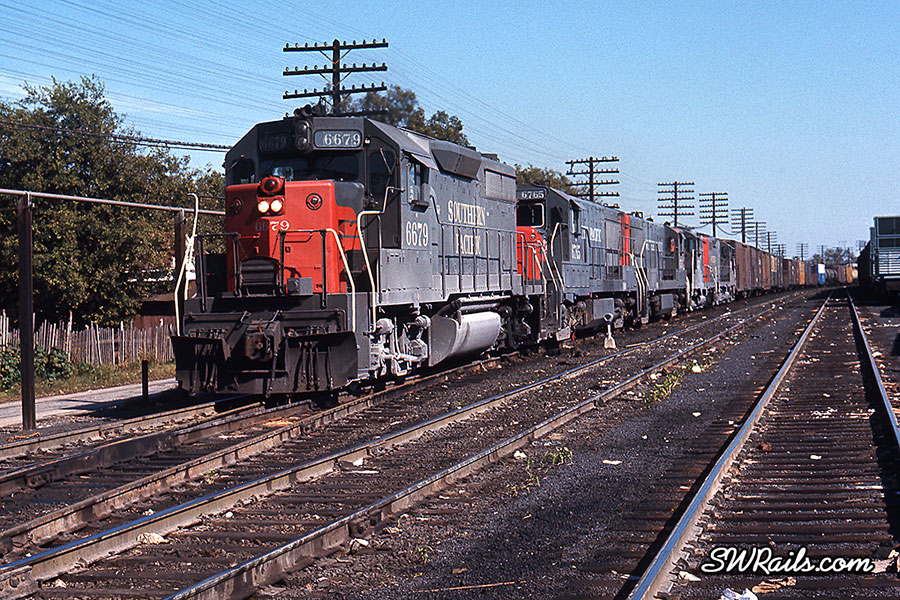
SP GP35 6679 on the point of a WB ready to depart East Yard in San Antonio in November 1968
Southern Pacific GP35 6679 is on the point of a WB manifest at East Yard in San Antonio. Trailing are 2 U25B’s and 2 GP9’s, an amazing lash-up for contemporary railfans, but quite run-of-the-mill for November 1968.
Norfolk Southern Power on UP Intermodal
UP’s INOLB (Intermodal New Orleans to Long Beach, CA) passes through the Tower 17 interlocking in Rosenberg, Texas on Dec. 11, 2004.
The train crosses the BNSF Gulf Division main at 0:25 seconds. At 0:37 seconds it hits the switch used by the KCS to access its Rosenberg sub to Victoria, Texas.
Backlit Bi-Centennial in Mercedes, Texas
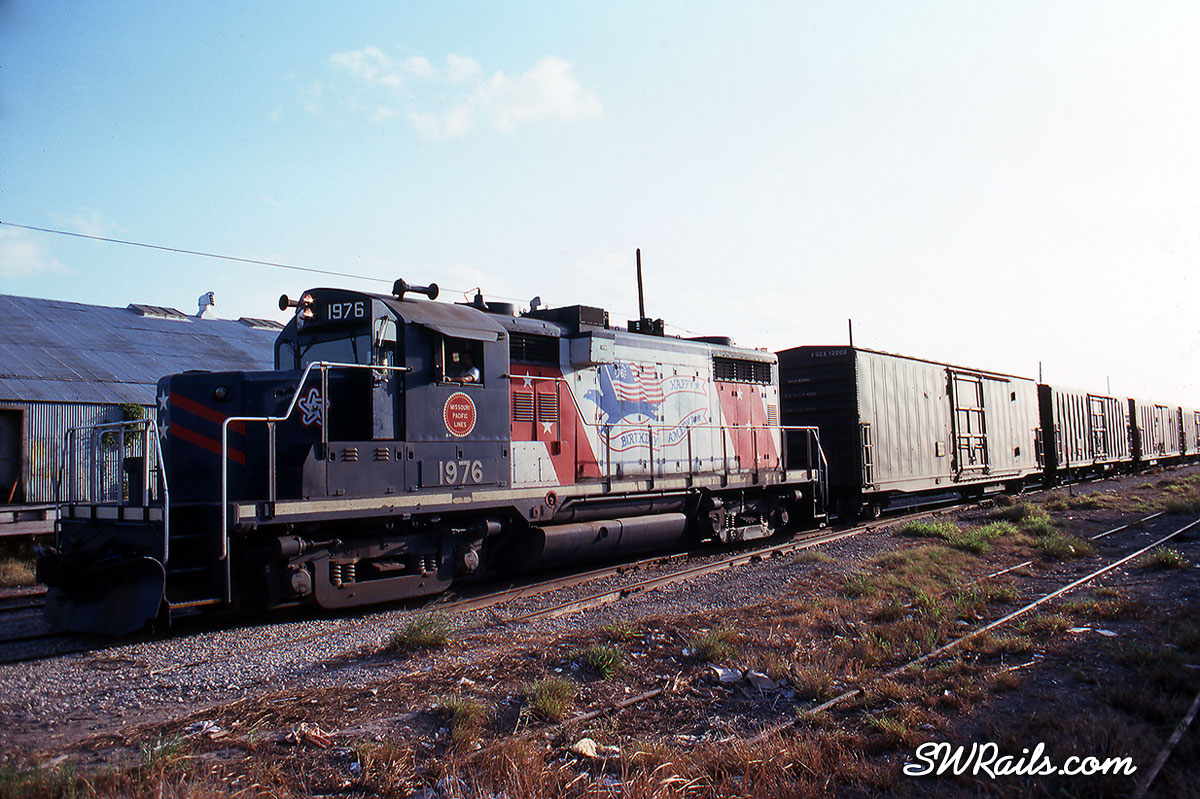
MP GP18 1976 passes eastward through Mercedes, TX on Aug. 11, 1978
In my recent post about chasing this train, I remarked how difficult it was trying to photograph a train coming out of the sun. It was late afternoon with the train going east. What can you really do?
You improvise. This shot from that chase is a good example. The more I could point the camera away from the sun, the better.
By using a wide-angle lens here, it allowed the train to come more into the right side of the frame. This minimized, as much as possible, the direct sun coming into the lens.
Notice how the sky on the left side in a nice shade of blue, while the right side is totally washed out.
The Englewood Ramp in 1989
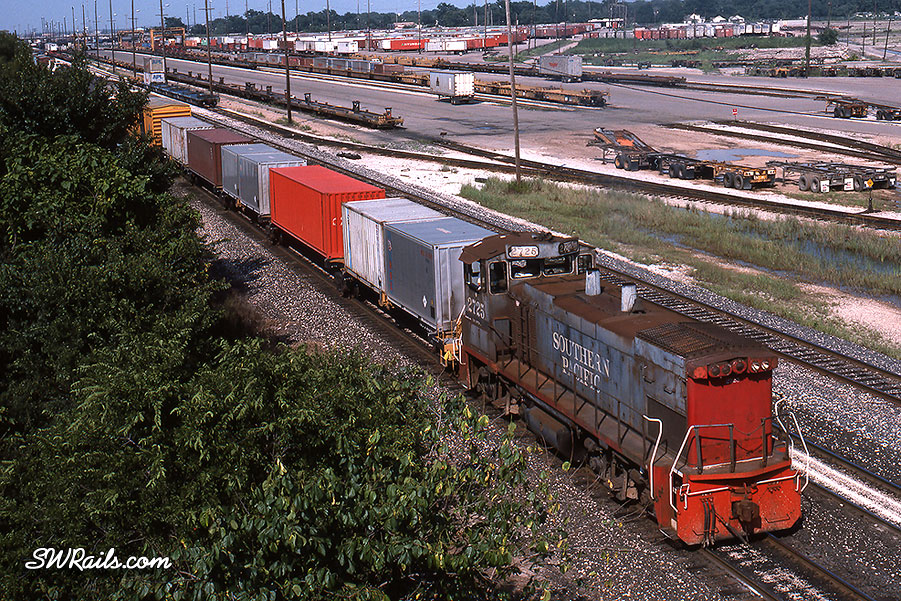
SP MP15AC 2725 pulls past SP's Houston Englewood Ramp on July 4, 1989
We’re on the east side of Houston on a steamy July 4, 1989. Looking east from the Waco Street overpass provides a good overview of SP’s Houston intermodal facility, located at the far west end of Englewood yard
MP15AC 2725 is pulling west on main 1 with a cut of cars. The first car is a “5-pack” spine car, commonly seen in COFC service before double-stacking became the norm for containers.
Shortest Intermodal Train Ever?
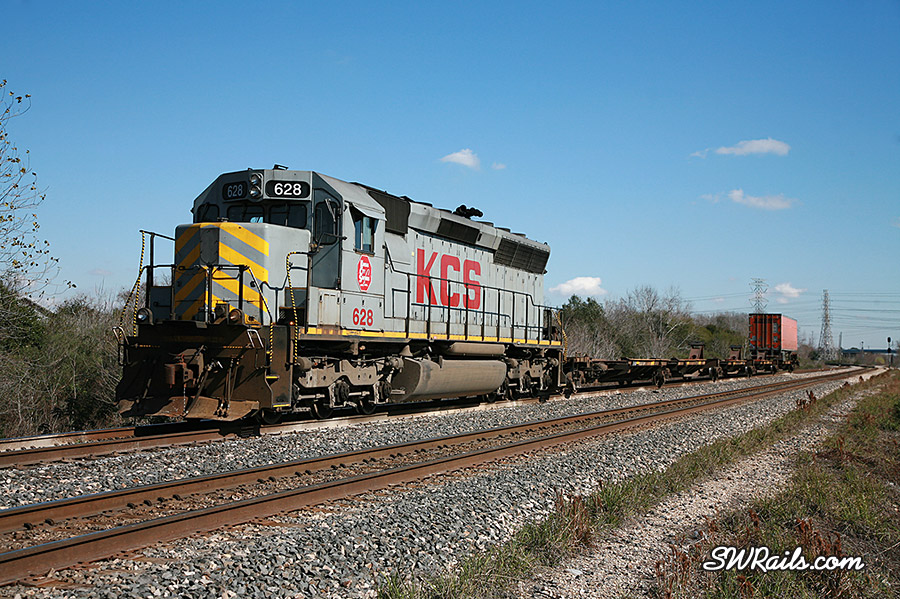
KCS 628 holds an IJALZ at West Junction, Jan. 26, 2007
It’s one thing to see a local with one car, but a long-distance intermodal with one trailer? The IJALZ (Intermodal Jackson, MS to Lazaro Cardenas, Mexico) is waiting for a new crew at West Junction, in southwest Houston.
One can only guess at why the train consists of but one trailer. My guess is that the KCS has committed to running the train for shippers, regardless of traffic.
Veranda Gas-Turbine on Sherman Hill
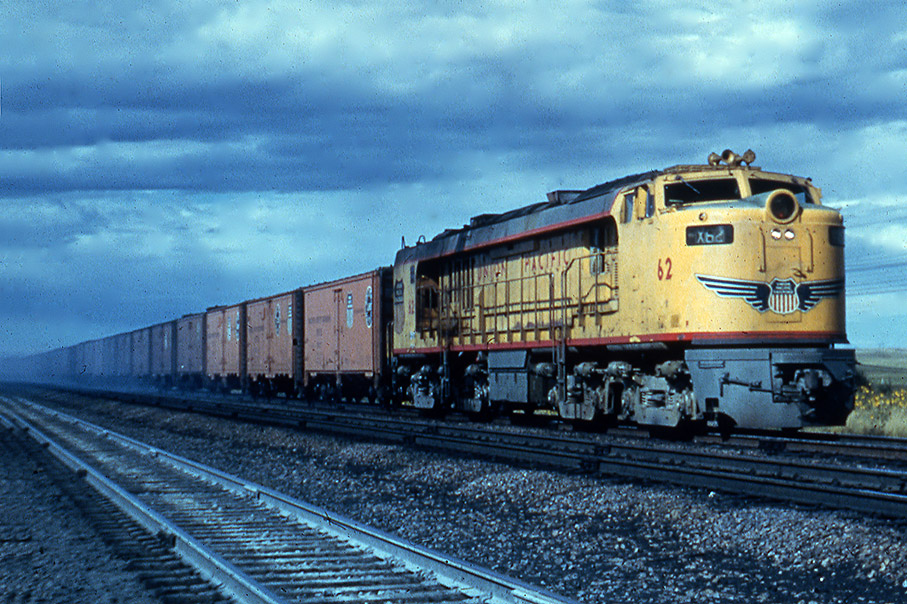
UP 62 with an EB perishable train approaching Cheyenne, WY in this undated view.
From the 4-8-8-4 Big Boy to the DDA40X Centennial, the UP has been at the cutting edge of locomotive design. The UP’s primary focus was to maximize the horsepower per unit.
UP 62 is a GE GTEL (Gas Turbine-Electric Locomotive), one of 15 Units 61 to 75 were delivered to Union Pacific beginning in 1954. These units were very distinctive because of the external walkways on the sides of the locomotives, earning them the nickname “verandas”. These units produced 4500 HP, more than double the horsepower of conventional diesels of the day.
All UP Gas-Turbine locomotives were retired by 1970 due to the increasing cost of the Bunker-C grade of fuel used to power the turbines.
 Southwest Rails