Evolution of A Corporate Image
Most railfans, myself included, typically feel that everything was better “back in the day”. One exception that comes to mind is the evolution of the KCS locomotive paint scheme.

The "ghost" scheme illustrated by KCS SD40 653 at DeQuincy, LA on Jan. 2, 1979

KCS SD45T-2 4502 with a Mexico-bound manifest at Stella, TX on Jan. 26, 2004
The ghost scheme was adopted in 1966 with the delivery of their first SD40’s. In 1989, the KCS changed the primary color to gray and added nose chevrons, but the design did not change.

Factory-fresh KCSM SD70ACe 4074 with the PALR train at Sugar Land, TX on Jan. 6, 2008
In early 2007, the KCS adopted a new scheme based on the colors of their “Southern Belle” passenger trains from the 1940’s.
No matter how much you may pine for the “good old days”, you must admit that today’s KCS freight trains look better than they ever have. IMHO, of course.
Stranger in a Strange Land
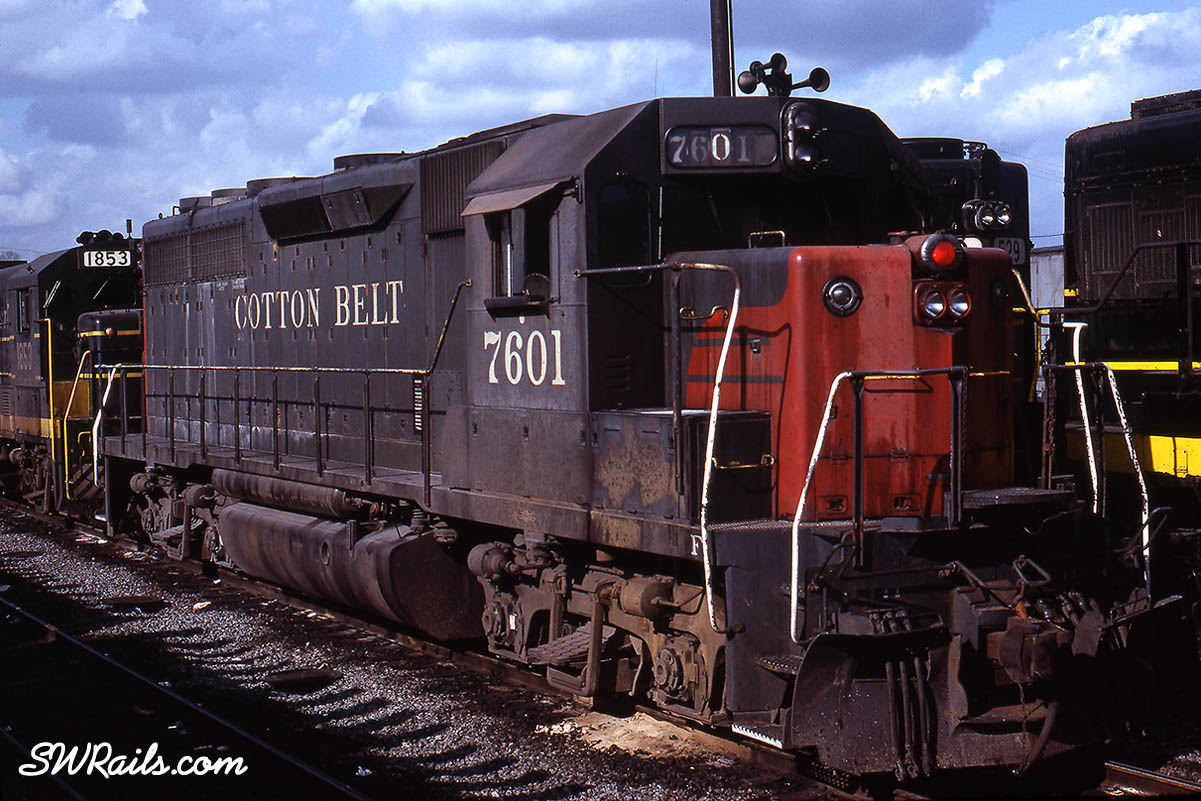
Cotton Belt GP40 7601 seemingly out of place surrounded by Seaboard Coast Line locomotives.
Southern Pacific locomotives could be found just about anywhere in the U.S. due to pool power agreements with its interchange partner railroads.
This February 1978 slide of SSW 7601 isn’t labeled with a location. All of the SCL power suggest it’s somewhere on the SCL system, placing the Cotton Belt unit somewhere between Richmond, VA and Tallahassee, FL.
Merger? What Merger?
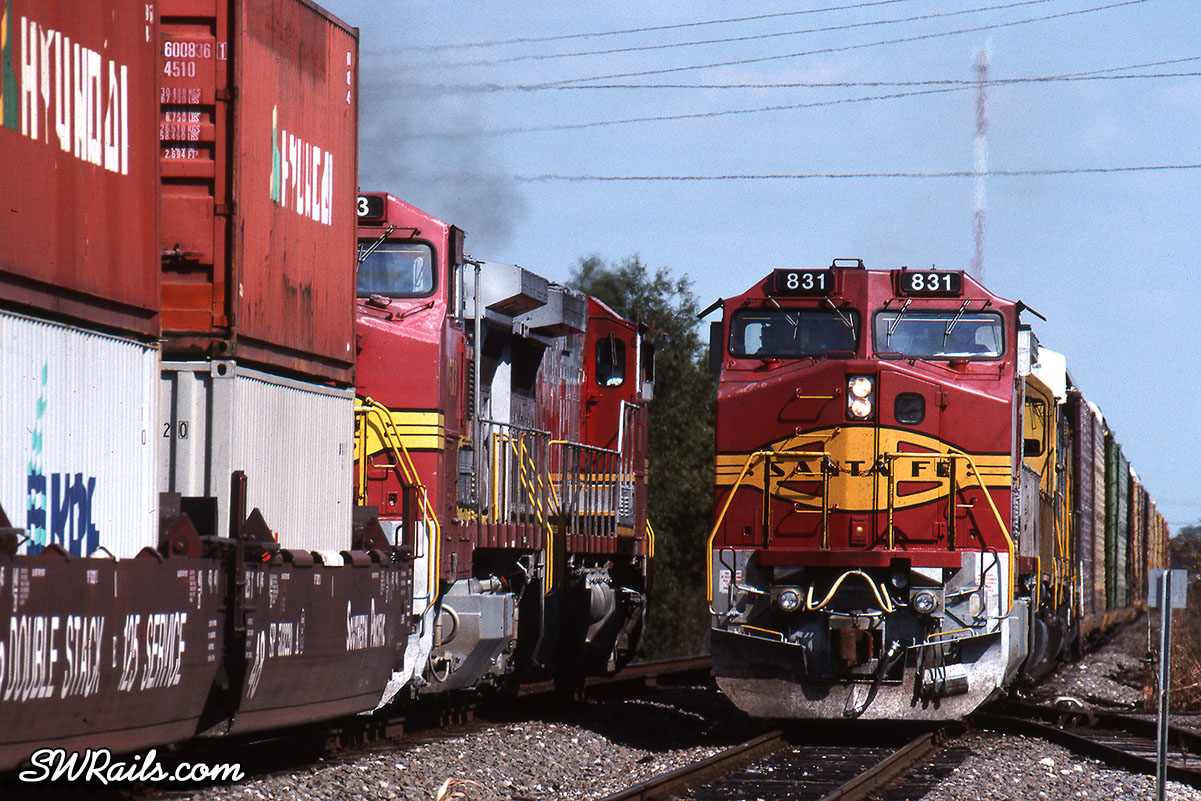
Two Santa Fe freights meet at Rosenberg, TX on Oct. 19, 1997
Warbonnets abound in this view at Rosenberg, TX on Oct. 19, 1997. More than 9 months have passed since the merger between the Santa Fe and the Burlington Northern, yet no overt changes are visible.
Yet I knew that the metaphorical storm clouds of change were just over the horizon, so I jumped at any chance to capture solid sets of Santa Fe power before they disappeared forever.
Santa Fe C40-8W 831 is stopped in the Rosenberg siding as a southbound stack train passes by on the main. As soon as the stack train clears, the 831 will continue its northward trip to Kansas City.
Was the Missouri Pacific a Boring Railroad?
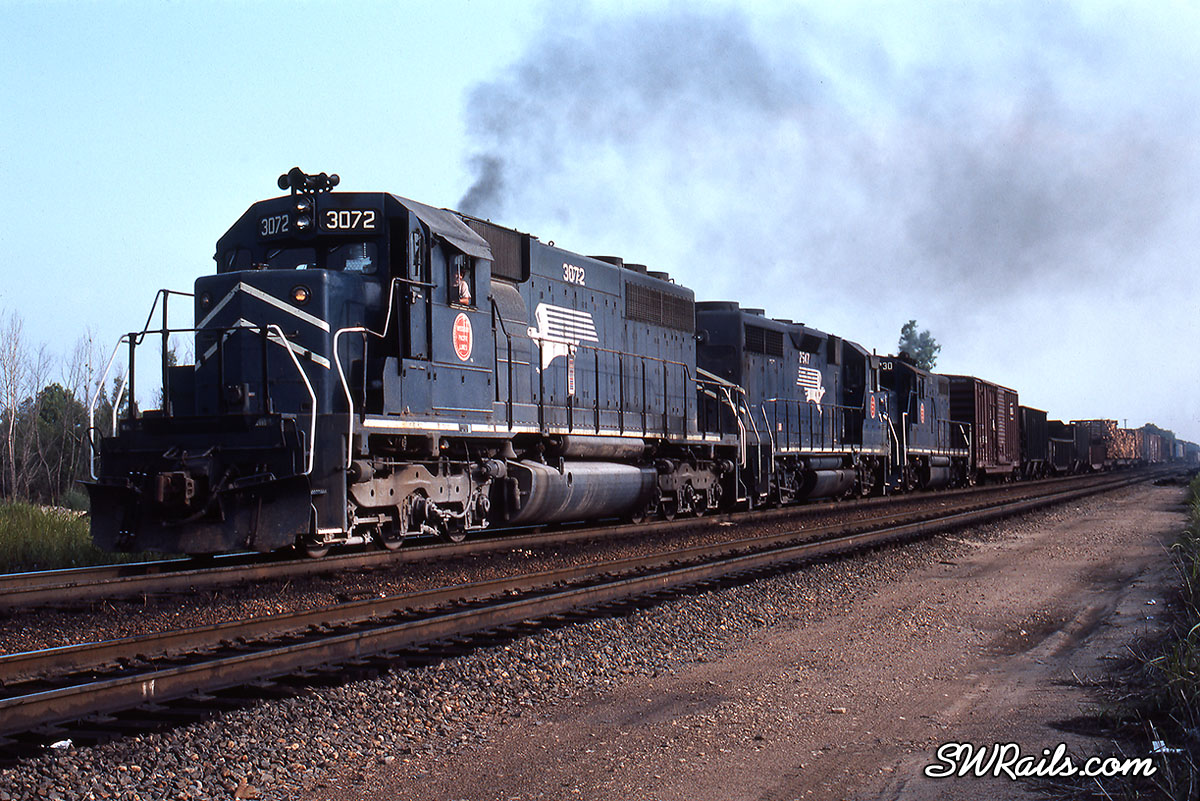
A Missouri Pacific manifest smokes it up at Texarkana, TX on May 30, 1980
The Missouri Pacific never had many hard-core fans because it was a boring railroad. True of False? This question came up in a recent conversation with a railfan.
The MP was not a glamorous railroad like the Santa Fe with its warbonnet-led passenger trains. The MP had no spectacular scenery like SP’s Donner Pass or Coast Line. The MP didn’t have a storied history like the Union Pacific. So I can see how the MP never had as many fans as these other railroads.
Then again, neither fancy passenger trains, beautiful scenery or history add anything to the bottom line for a railroad, and that’s all that mattered to MP management.
The MP never won any railfan popularity contests. But when the UP was looking for a merger partner in the early 1980’s, who got picked?
Wait for 2 East at South Fontana
South Fontana, at the far west end of SP’s West Colton Yard, is where single track begins as you go west toward Los Angeles.
As such, it was common to see westbound trains waiting for eastbound trains to clear up.

SP SD40T-2 8287 brings an Anaheim Hauler into West Colton on March 27, 1987 as an NOLXT waits at left.
“Hauler” was the nickname given to any transfer between SP yards in Southern California. The haulers were always fun to catch because they typically had interesting motive power, frequently combinations that were unique to the SP.
The power for the Anaheim on this day was SP 8287 / SP 4356 / SP 5315 / SP 5317 / SP 3202 / SP 5314. For those of you keeping score at home, that’s an SD40T-2 / SD9 / SD39 / SD39 / SDP45 / SD39, a lash-up possible only on the SP.

The going-away view from the other side of the overpass provides this view with I-10 at left. The train in the distance is an arrival at the west end of the West Colton receiving yard.
Right behind the Anaheim Hauler was the City of Industry hauler.
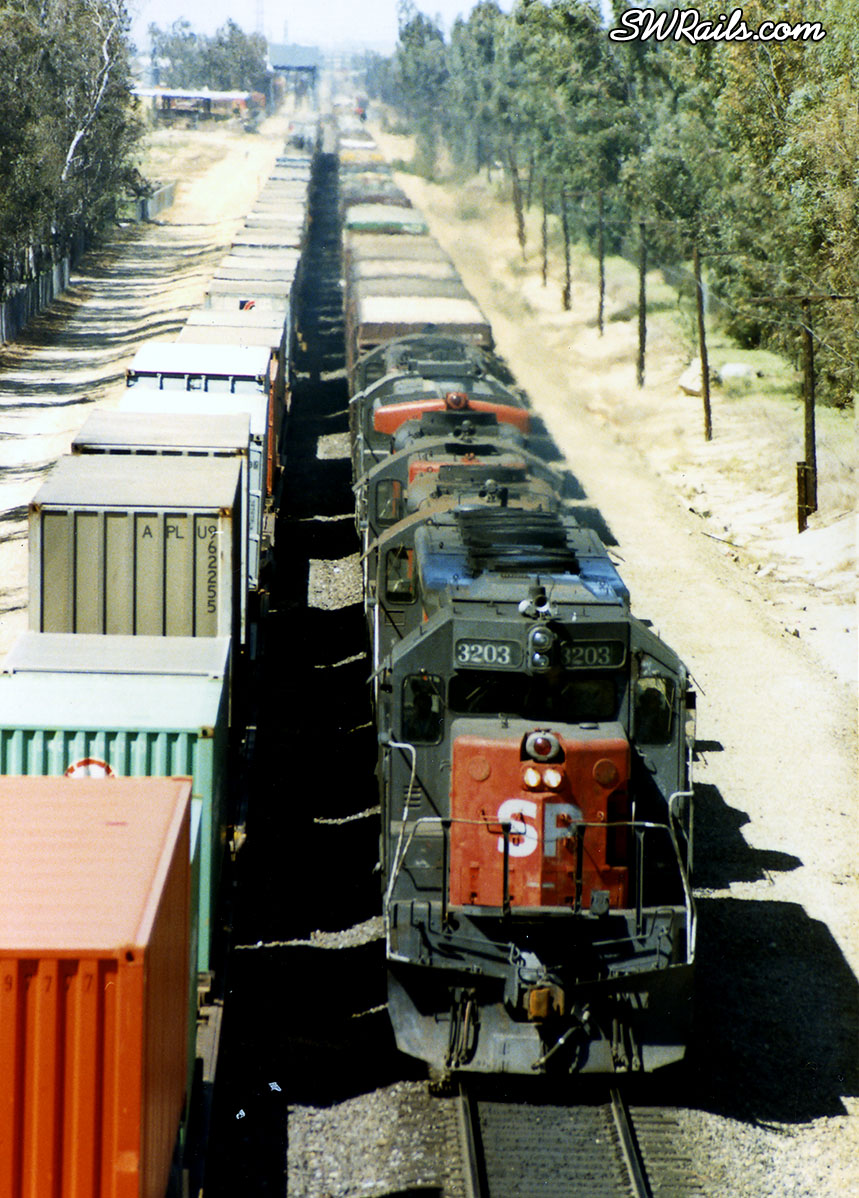
Ex-passenger service SDP45 3203 leads the City of Industry hauler eastbound at South Fontana, CA on March 27, 1987
As the 3203 passed by, it was preparing to stop as it had a red signal because the preceding train had not cleared up yet. I took advantage of the delay to re-locate to the next overpass to the east, Sierra Avenue.
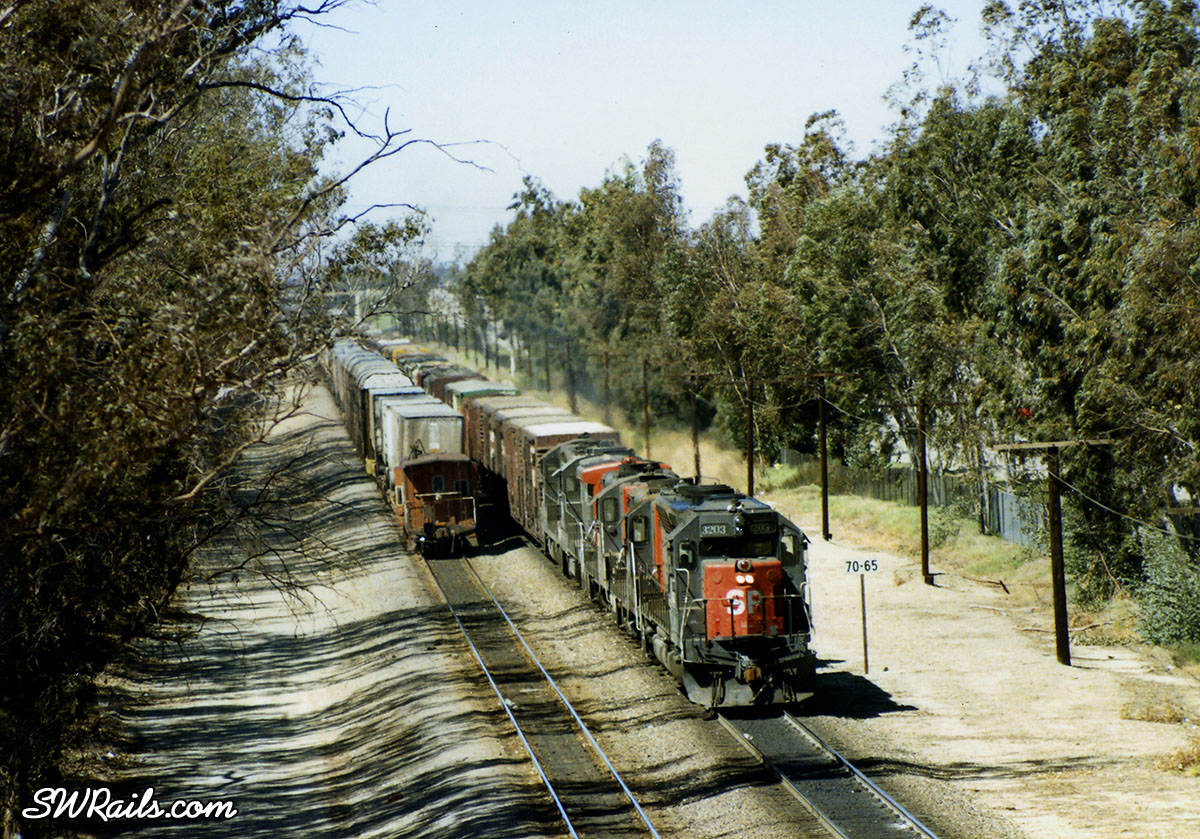
On the move again, the City of Industry Hauler clears the caboose on the NOLXT. Note the classic SP- style speed board to the right of the 3203 and the generous speed limit for freight trains.
My new vantage point, with the NOLXT no longer blocking my view, allowed me to get a good view of the motive power consist.
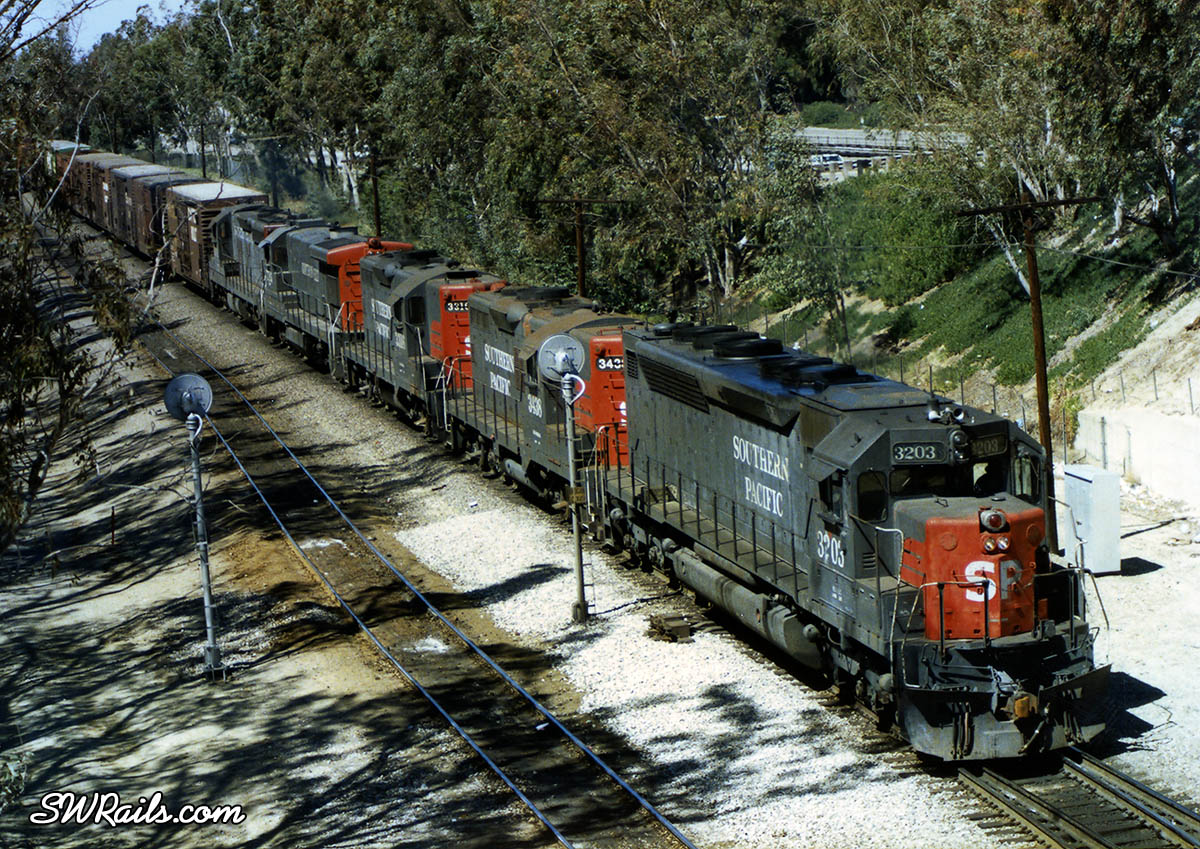
The City of Industry Hauler comes through the signals at Sierra Avenue.
The motive power consist was SP 3203 / SP 3438 / SP 3316 / SSW 7783 / SP 4342, an SDP45 / GP9E / GP9E / B30-7 / SD9.
PS- All of the images for this post were scanned from 4×6 prints.
On Short Time at Sugar Land
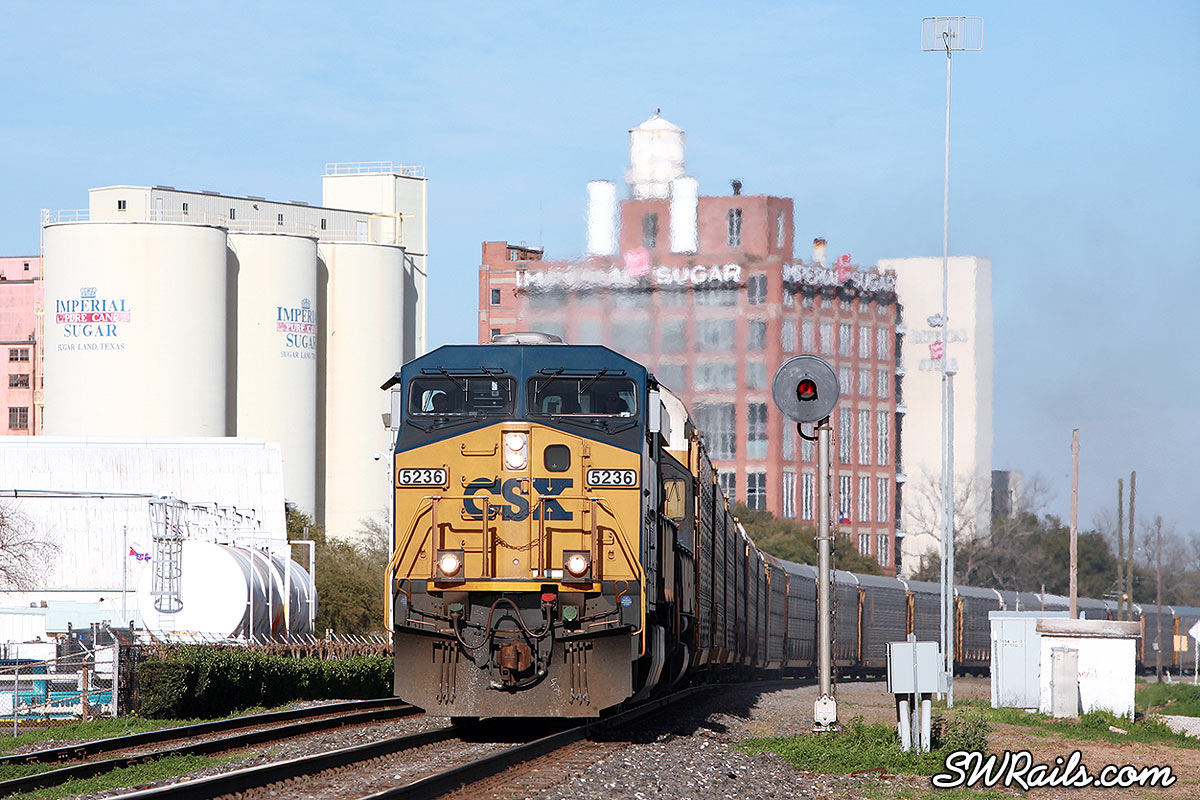
CSXT 5236 leads an empty UP auto rack train westbound at Sugar Land, TX on March 1, 2007
Short-time crew? I don’t think so, as they’ve just begun their trip from Houston to San Antonio with their train of empty auto racks.
The historic Imperial Sugar mill complex in Sugar Land is on short time. The company ceased production here in 2003 and the property was sold to developers in 2007.
Demolition work has begun, primarily removal of process equipment from the north side of the property.
As I understand, the char house (the brick building) and water tower will remain, but everything else will come down as part of a complete re-development of the 721 acre site.
The plan is for up to 870 single-family homes, some office/retail space and 200 acres of open space.
SP’s East Yard in 1968 – Pic of the Day
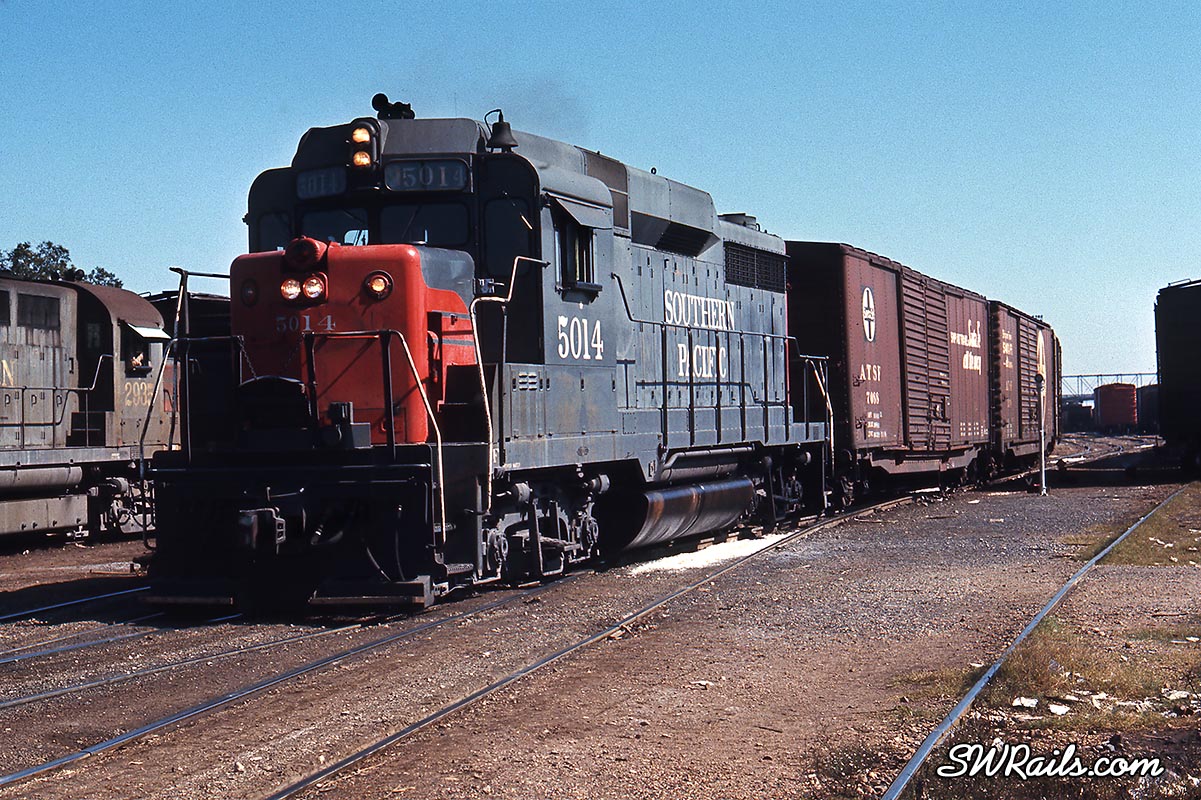
Southern Pacific GP30 5014 departs East Yard with a local freight in November 1968
What’s not to like in this 1968 scene from Southern Pacific’s East Yard in San Antonio?
A 5-year-old GP30 with the classic SP light package, 40′ boxcars, tracks sunk in the dirt, an Alco RS11 in the background…
I’m not so myopic to think that “everything was better” back in the day, but I sure do like everything I see in this classic image.
Never Give Up
Put a camera in my hands and I become the world’s biggest pessimist. When I’m photographing anything, be it a wedding or a train, I expect something will go wrong.
It’s not so much that I expect to mess up, but an awareness that I have to pay attention to a lot of details if I want to get the shot right. I can control many of the details; others, not at all.
Take the sun. The time of year, the time of day, the direction that the train is traveling. All of these play an important role in getting a well-lit train photograph.
So I have everything lined up for a nice shot of a BNSF empty grain train. I get set up as the train comes into view in the distance. What can go wrong?
How about a ginormous, Texas Gulf Coast cumulus cloud.
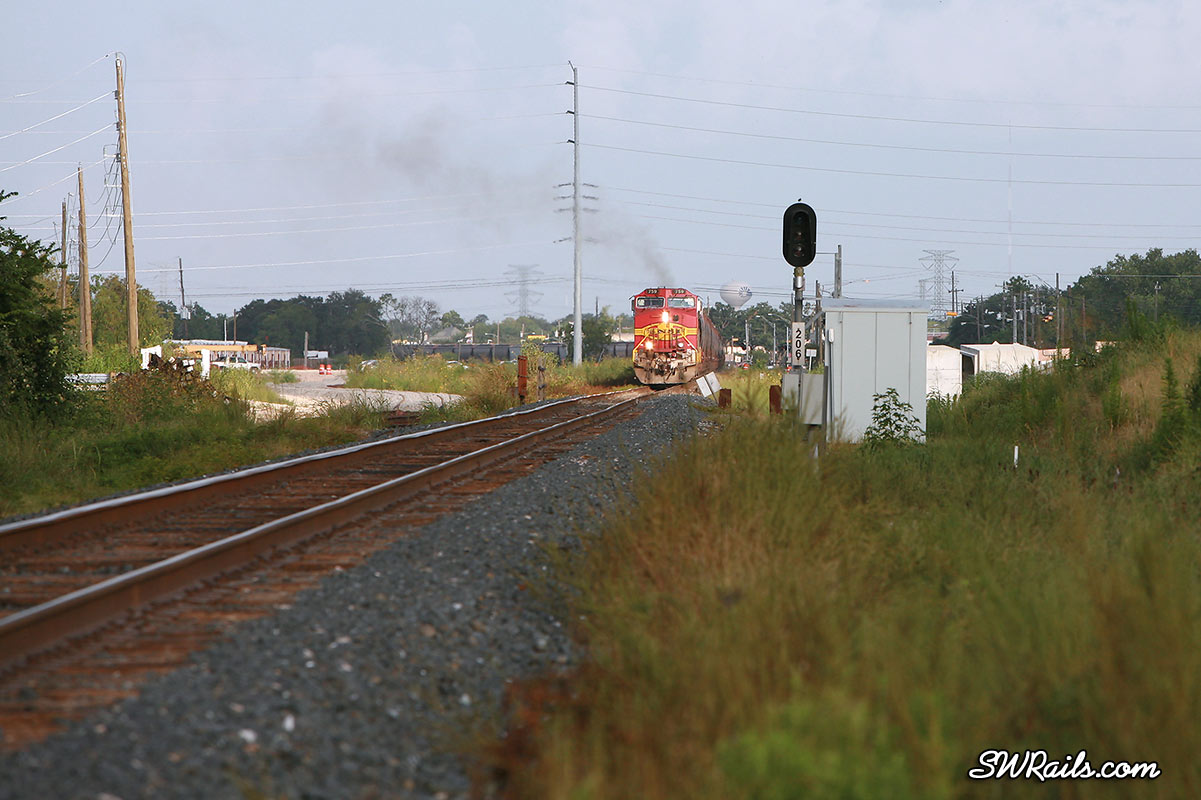
BNSF 759 approaches the intermediate signal at MP 20.6 of UP's Glidden Sub at Stafford, TX
I took the above picture just for the fun of it, figuring that one day I might think it was funny how the clouds rolled in. Because at this point in time, I was seriously annoyed!
In the past, I would’ve put the camera down, consoling myself with “there’s always tomorrow”.
But I’ve learned to never give up hope on getting the shot, especially when the train is running at restricted speed due to CTC problems and the wind that brought the cloud just might move it enough so I could get the shot.
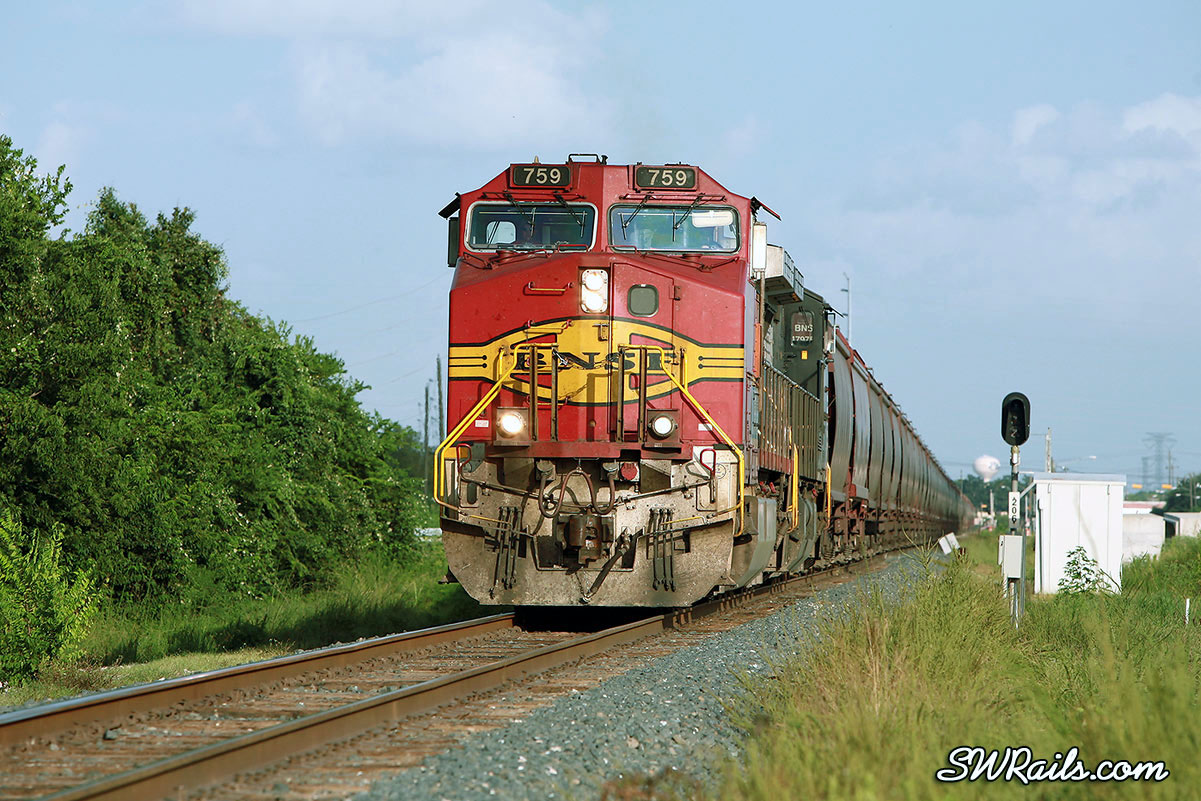
An empty grain train led by BNSF 759 passing MP 20.6 on UP's Glidden Sub on Aug. 19, 2007
I became a true believer in the old adage about Texas weather. “If you don’t like the weather, just wait a minute. It’ll change.”
Ho-Hum, Another 4 GE’s on a Stack train…
More than a few railfans are sick and tired of all the GE’s that seem to be on every train these days. I apologize in advance for making you look at yet one more train with a solid set of GE locomotives for power.
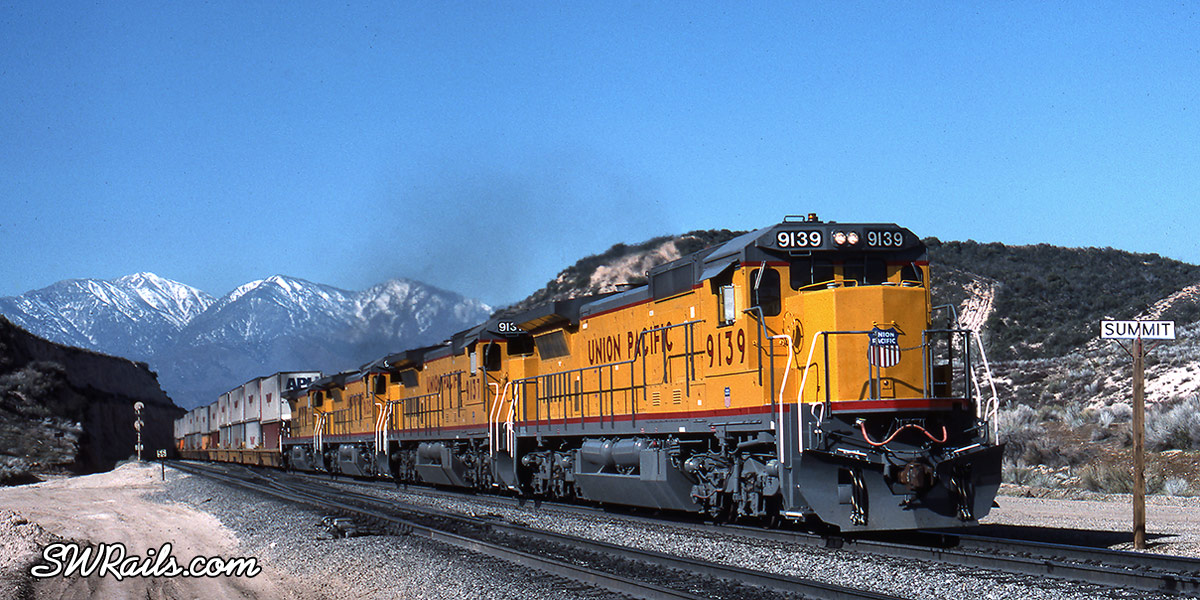
Four new GE C40-8's power the LAAP at Cajon Pass Summit on Feb. 16, 1988
It was seemingly yesterday when I photographed the C40-8’s when they were new. Therefore, I refuse to believe that the majority of these units are now stored throughout the UP system, in all likelihood, never to run again.
A Picture is Worth 1000 Words
Driving back from Fort Worth a few months ago, I stopped in Corsicana to explore a bit. I found my way to the junction of the Corsicana and Ennis Subdivisions, where I found two sets of local power.

UP local power laying over in Corsicana, TX on March 14, 2010
The tracks, from left to right, are the UP Ennis sub main, the Corsicana siding, engine spur, and the Corsicana sub main. The yellow metal building at left is UP’s Corsicana yard office.
Whenever employees tie down locomotives, it’s important that hand brakes are applied and that precautions be taken to ensure the units can’t foul adjacent tracks. Especially when the power is parked between two main lines as is the case here.
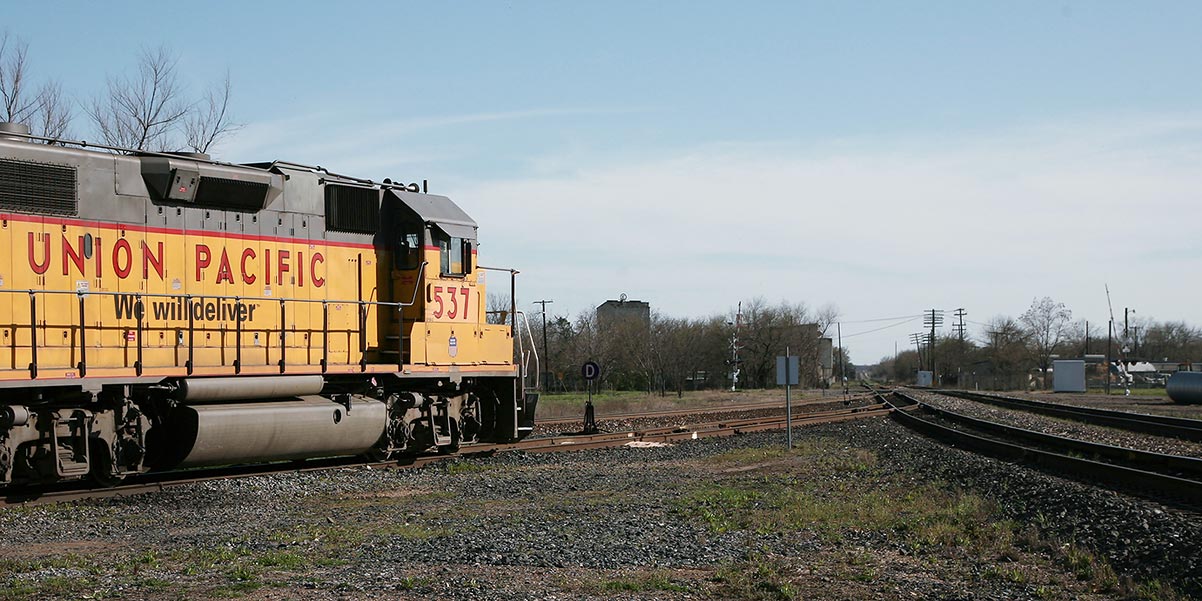
Note the derail protecting against the units accidentally fouling the adjacent tracks
The UP has installed an interesting sign to remind crews of the importance of derail protection and properly tying down equipment.
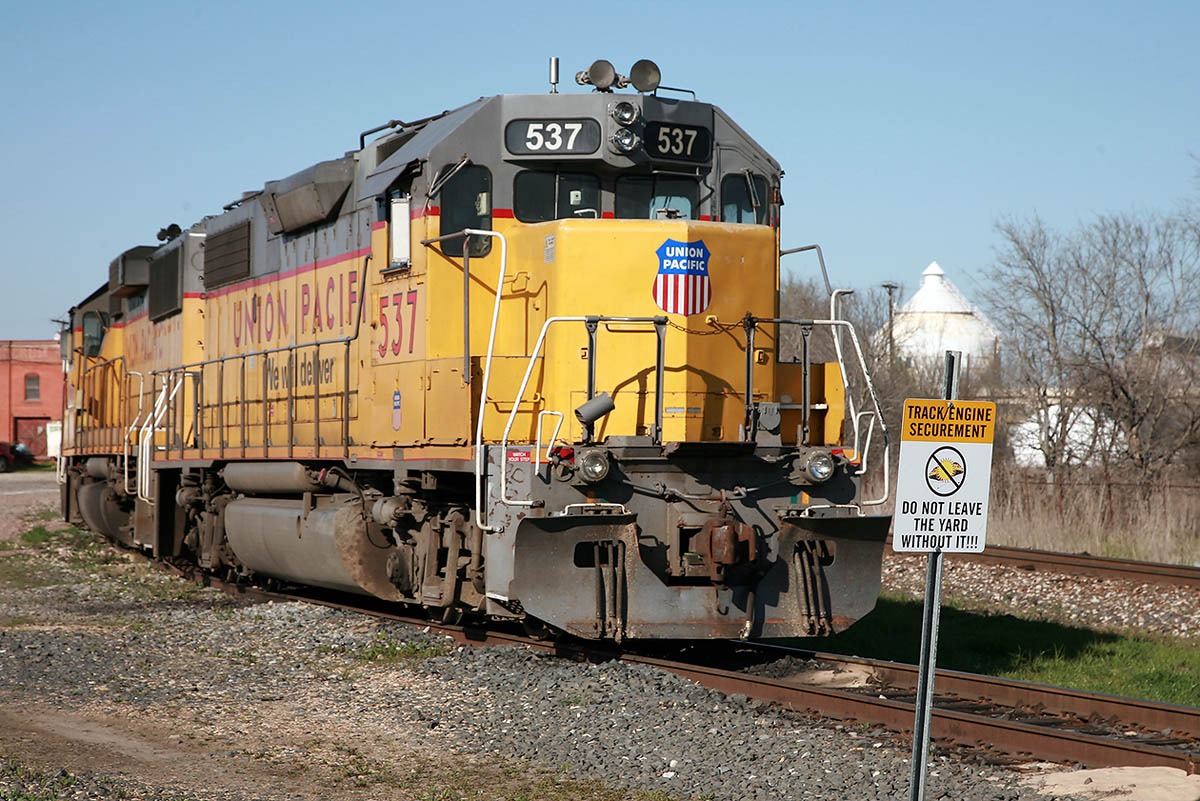

The image that's worth at least 1000 words -a graphic reminder of the consequences of carelessness
I haven’t seen this sign before. Is this unique to Corsicana, or is it used elsewhere on the Union Pacific?
UP Engineering Dept. Passenger Special
Union Pacific’s Engineering Dept. Passenger Special is out and about again. It came into Houston yesterday. Symboled SNLHO-09, it departed North Little Rock at 6 AM. Its 450 mile run took it through Texarkana, Marshall, Longview and Palestine en route to Houston.
Since the late 1990’s, Engineering Dept. specials have been powered by UP 6936, per the request of Bill Wimmer, UP VP-Engineering. Part of UP’s Historical locomotive collection, the 6936 is UP’s last operational Centennial locomotive.
Perhaps symbolic of Mr. Wimmer’s retirement promotion to VP-Operations in 2008, the 6936 is not pulling the Engineering Dept. special this year. Powering the train this year is UP 1995, the C&NW Heritage locomotive.
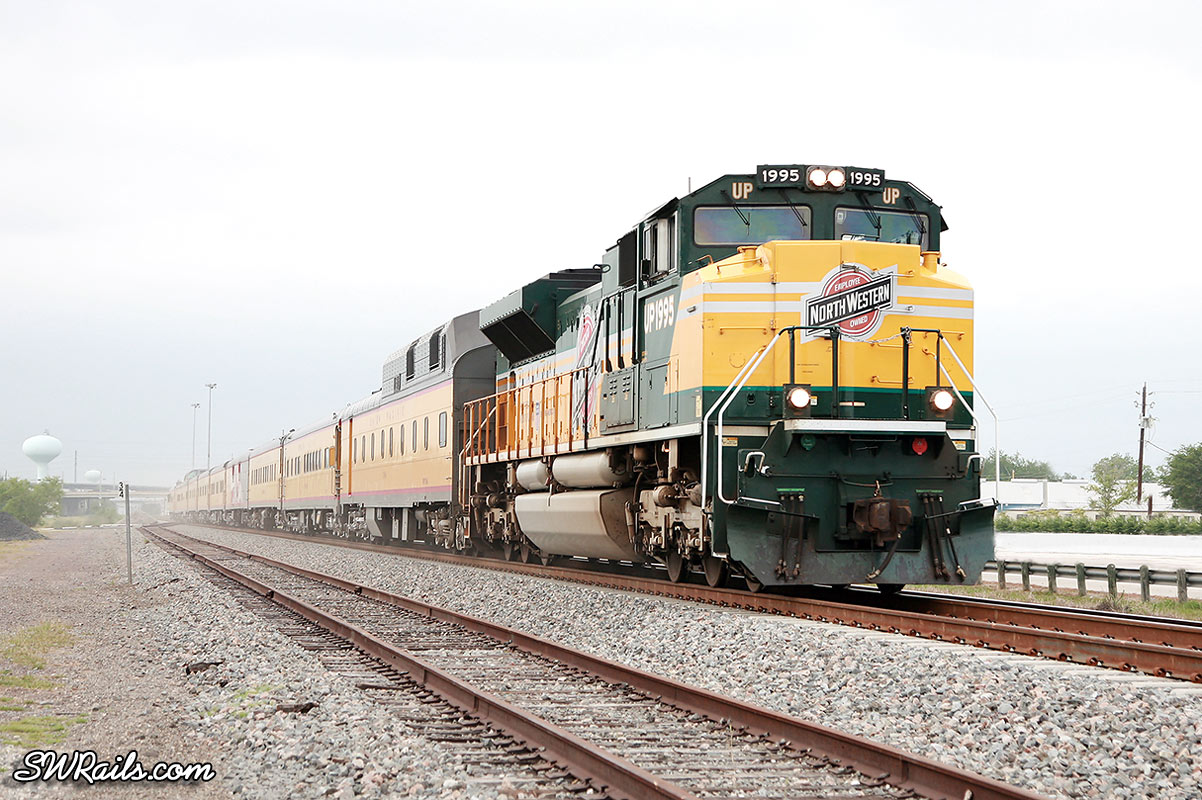
Flying by McGowan, MP 225 on the Palestine sub, at 4:58 PM on May 9, 2010
Note the dust being kicked up toward the rear of the train. Thanks to the 70mph speed limit on the Hardy Toll Road, we were able to get ahead of the train at Belt Junction.

The SNLHO-09 approaches Belt Junction, MP 229 on the Palestine Sub.
I assumed the train would travel via the East Belt, through Pierce Yard, to Settegast. En route to the next photo spot, I caught a glimpse of the train in the distance, but it looked like it was on the “wrong” track.
It turned out that the train was being routed via the Beaumont Sub, in order to bring the train into Settegast from the north.
No problem. A quick course correction got me to the Crosstimbers Rd. grade crossing near MP 380 of the Beaumont Sub for the following view:

UP Engineering Dept. special SNLHO-09 approaching Settegast yard in Houston, May 9, 2010
The train is about a mile or so from the top end of Settegast, but it will be easy to get ahead of it due to a 10mph speed restriction at Settegast Junction.
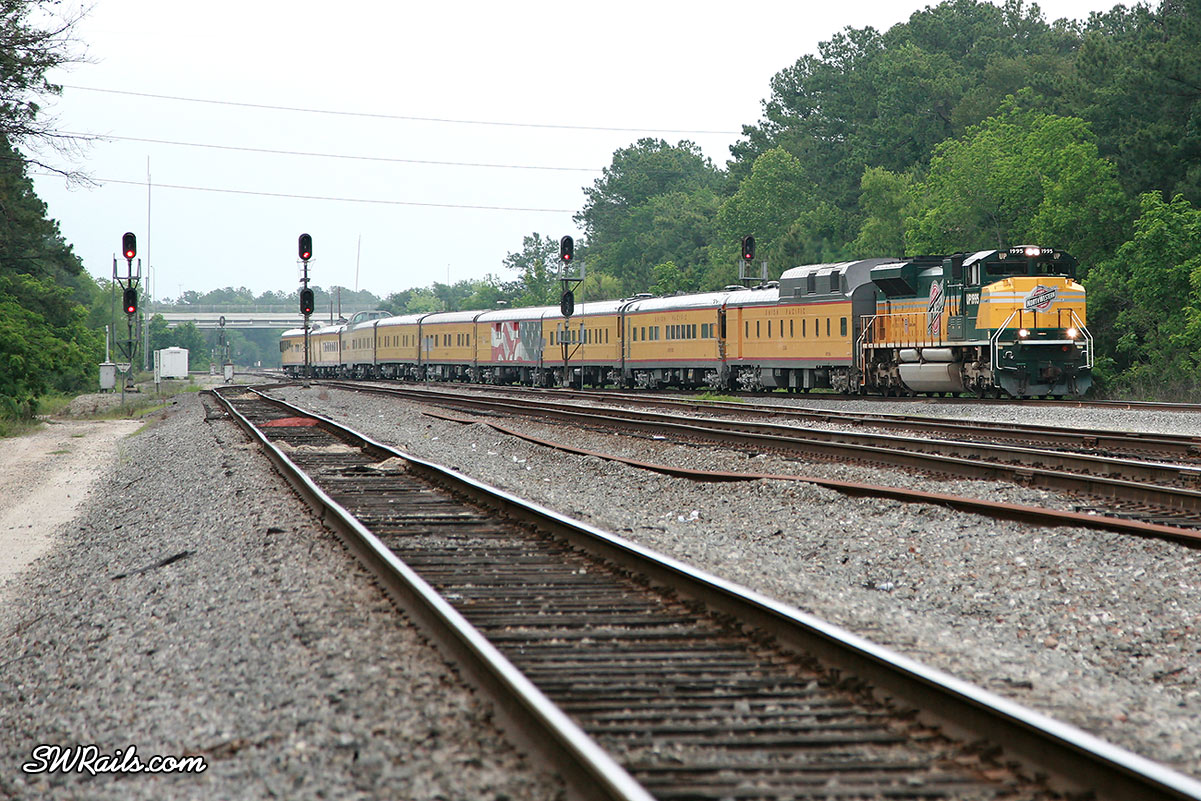
The SNLHO at the far North end of Settegast Yard. Settegast Jct. is in the background.
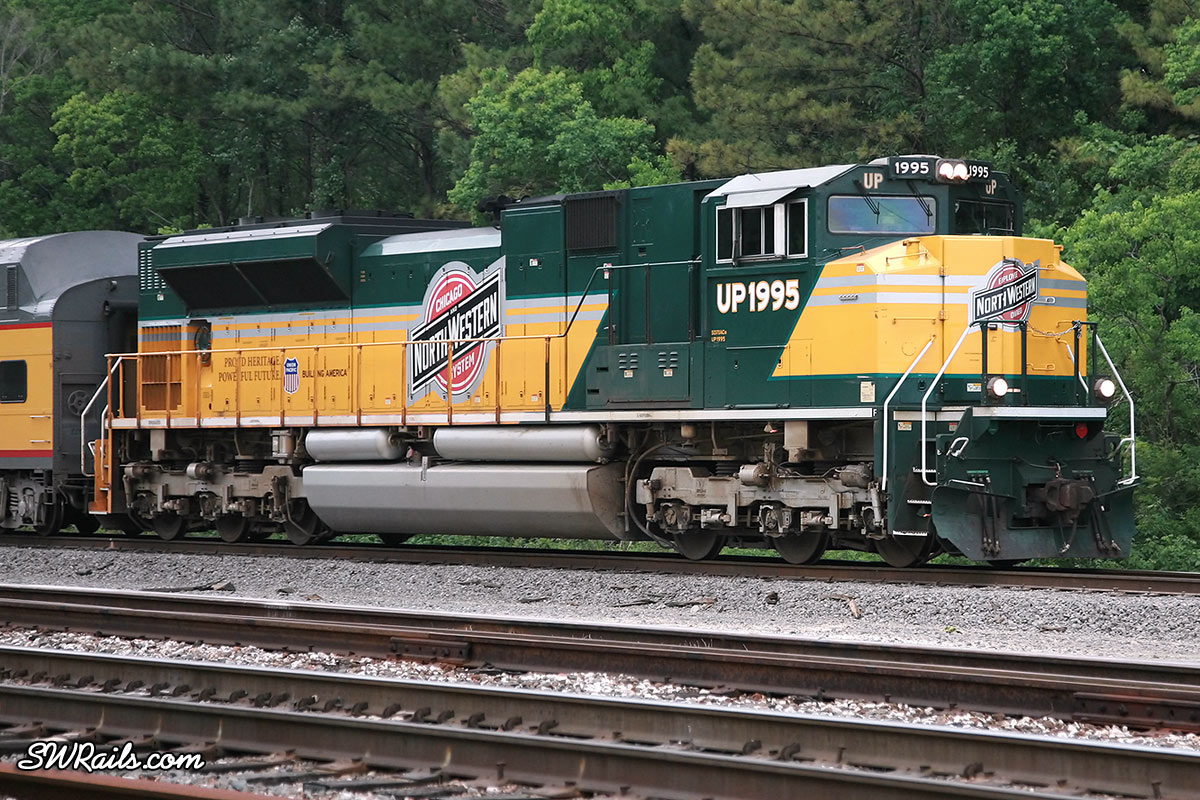
The train spent the night at Settegast Yard. The Engineering Special departed Houston at 5 AM this morning. Symboled SHOSA-10, it would review the Glidden sub between Houston and San Antonio.
UP Engineering Dept. Passenger Specials
Every year, UP Engineering Dept. officials from Omaha headquarters will travel via passenger special throughout the UP system to inspect the railroad physical plant.
Motive power for this train over the last 10 years or so had been UP 6936, UP’s sole remaining DDA40X. This was per the wishes of Bill Wimmer, UP VP-Engineering. because the heavy 8-axle unit was a good test of track condition, especially the vertical alignment of the track structure.
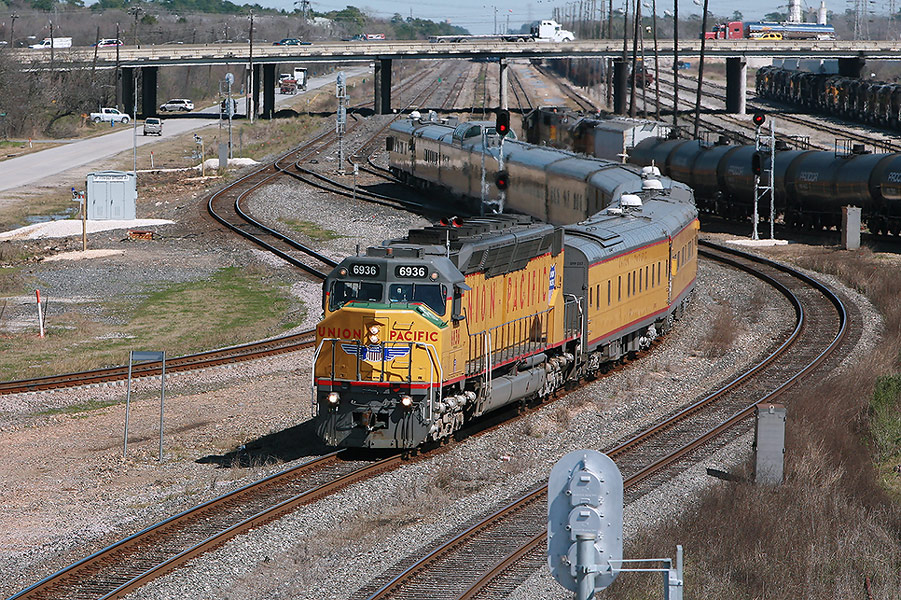
UP Engineering Dept. special SAVBL-18 at Englewood Yard in Houston, Feb. 18, 2008
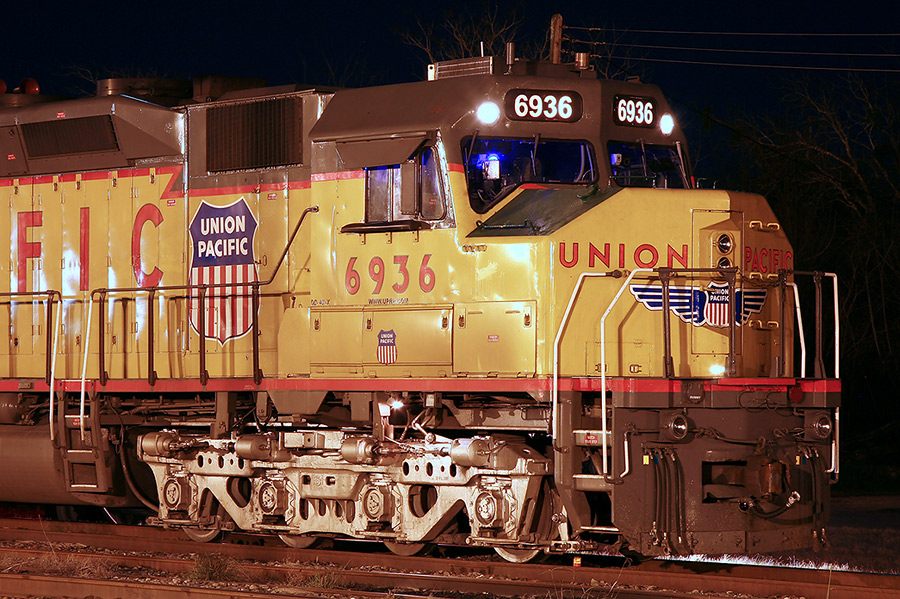
UP 6936 showing off one of its 4 axle trucks at Bloomington, TX Feb. 18, 2008
I posted some video of the 2008 visit to the Houston area by DDA40X 6936. You can view it here.
Since Mr. Wimmer’s retirement in 2009, the 6936 has not been used in this service. It seems his successor does not share Wimmer’s opinion about using the DDA40X for Engineering Dept. specials, so the days of seeing the last remaining Centennial operate around the system may be over for good.
 Southwest Rails