F Units in the Fifties on the Southern Pacific
Neighbor, how long has it been since you’ve had a nice serving of SP F-units in the 50’s?
Well, that’s too long!
(Apologies to Wolf Brand Chili’s advertising agency…)

SP 6392 leads First 804 around the famous Tehachapi Loop on Nov. 27, 1953.
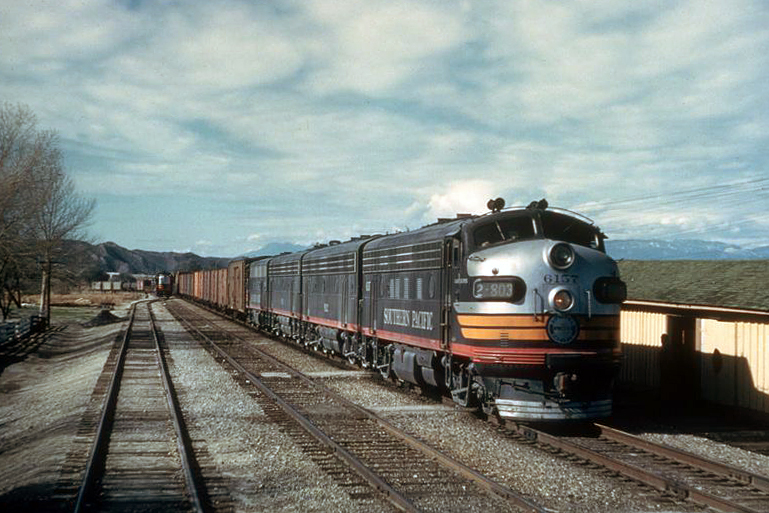
Second 803 passes through Humphrey, CA on January 26, 1956
Galveston Causeway Bridge – 100 Years Ago
I recently posted about the Galveston Causeway lift bridge replacement project, where the current 100′ long span will be replaced with a new 300′ long vertical lift bridge. The target date for installation of the new bridge is Feb. 14, 2012. I hope to get some pictures of this process, as it isn’t every day that new lift bridges are installed. Meanwhile, let’s look at some images of the Galveston Causeway from back in the day.
Originally, each of the three railroads into Galveston had its own bridge. The 1900 hurricane destroyed two of these bridges, and damaging the Santa Fe’s bridge. After the storm, the railroads agreed to pool resources, rebuild the Santa Fe’s bridge, and share the one bridge.
This is the original Santa Fe bridge, post 1900.
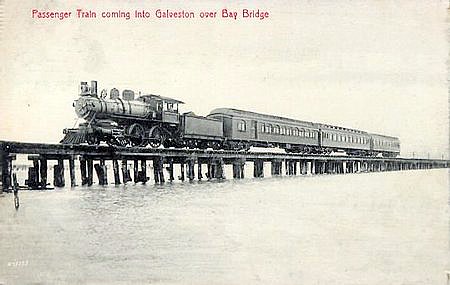
The all wood structure would be closed from time to time due to occasional fire / weather damage. As it was a critical connection to the mainland, the Texas Railroad Commission ordered the railroads to build a fire-proof causeway.
Construction began in 1909, with the new causeway opening for traffic on May 12, 1912. It had two tracks for the railroads, one track for an interurban train, and a 19′ wide brick roadway for automobiles. Additionally, a 30″ water line, providing fresh water to Galveston, also used the new causeway.

Opening day festivities for the new Galveston Causeway on May 12, 1912.
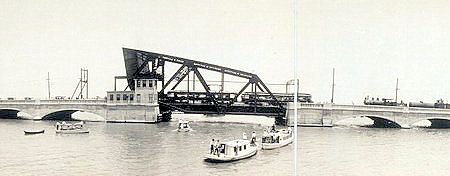
Opening day festivities for the new Galveston Causeway on May 12, 1912.
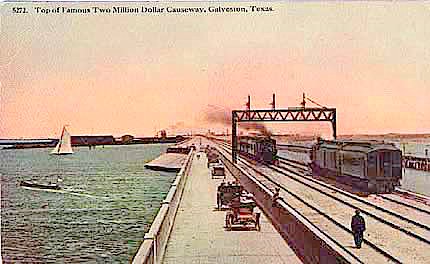
The Galveston Causeway originally had three tracks and a highway.
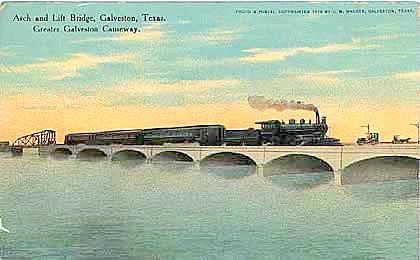
The causeway consisted of 28 70' long reinforced concrete arches.
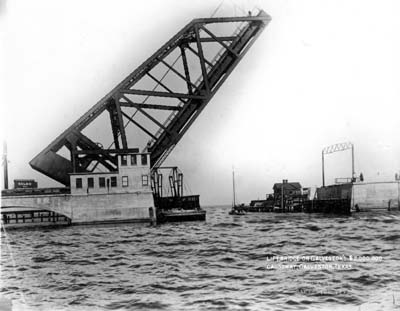
A 100' long bascule lift bridge allowed passage of marine traffic.
The original steel bridge had deteriorated to the point that it was replaced in 1989 with a new bridge, but still only 100′ long. The original 1909 design was based on single barge tows, with barges being 35′ wide back then. Barges are now up to 108′ wide and multiple tows are the norm, ranging up to 1,180′ long. Needless to say, this bridge was quite a bottleneck for marine traffic.
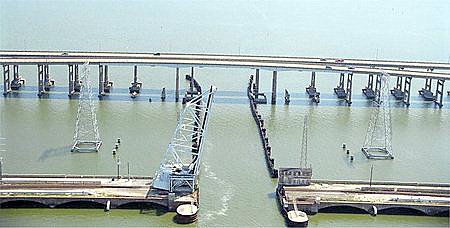
In 2001, the Coast Guard deemed the bridge an “unreasonable obstacle to navigation” and ordered the bridge’s owner, Galveston County, to alter the causeway providing a 300′ wide opening and 73′ vertical clearance. (The county owns the bridge, but BNSF operates the bridge under a 999 year lease. ) Funding for the $68 million project was not available until the 2009 economic stimulus package.
This image shows the current bridge, along with the I-45 causeway in the background. Note the guide path that was installed to keep marine traffic on the “straight and narrow” path.
For more information about this project, click here for an interesting Coast Guard PDF presentation about the new bridge. It has some good aerial photos. Click here for a detailed history of the causeway along with some great historical images. Click here to see my original post about the new bridge.
I’ll have more to post about this project soon.
Union Pacific 7605 – Before & After
My previous post ended with a photo of UP 7605, the DPU on a QWCEW train. Here’s another shot of that DPU eastbound by the old Imperial Sugar mill at Sugar Land, Texas on Jan. 24, 2012.
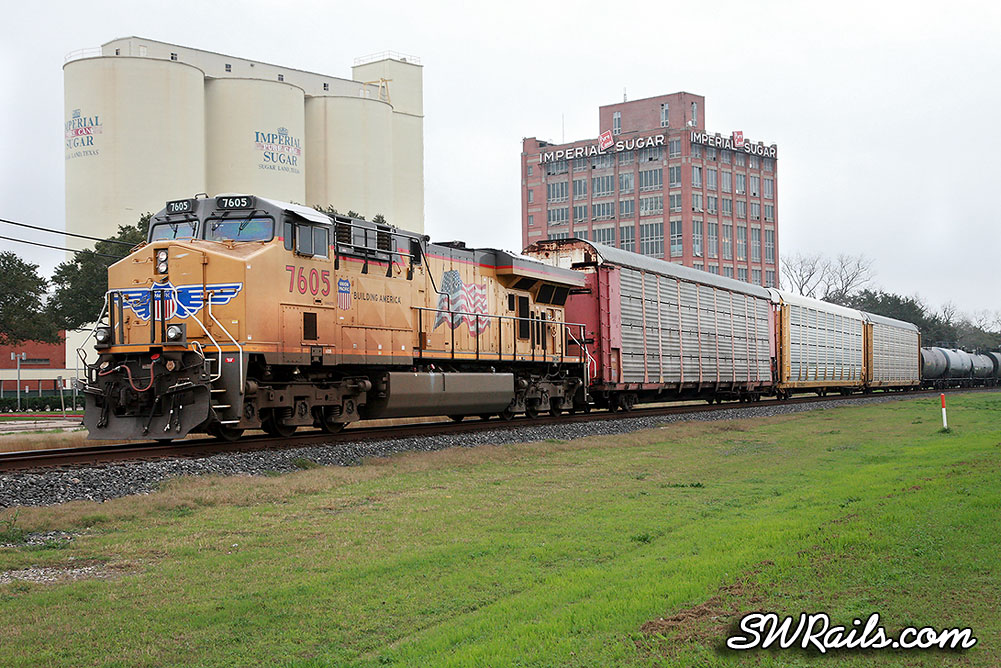
I noted that UP 7605 seemed familiar to me and left it at that. Here’s the rest of the story…
In early 2007, Union Pacific and General Electric conducted the “Green Locomotive Technology Tour” to showcase GE’s new Evolution Series locomotives. UP 7605 and 7606, two brand-new ES44AC’s, were selected to take part in this tour, along with several other locomotives that had new pollution-reducing technology.
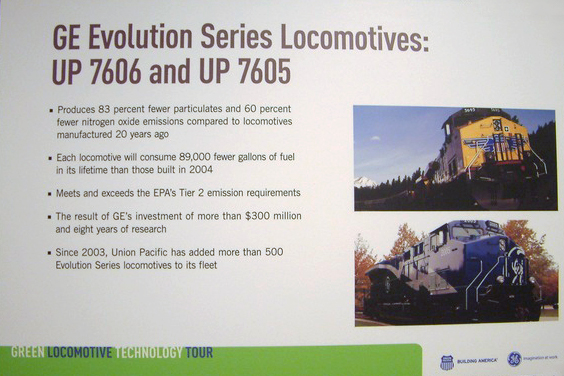
UP 7606 was in standard UP colors, but the 7605 was delivered in a unique GE blue, green and silver paint scheme.
Once the tour was concluded in March, 2007, these two units were released into system-wide service. As you might guess, the 7605 was quite a popular subject for railfan photographers.
I was able to catch up with it twice in the Houston area. Here’s the first shot I was able to get of this unique locomotive, shown leading the ILBEW-9 at Missouri City, Texas on April 13, 2007.
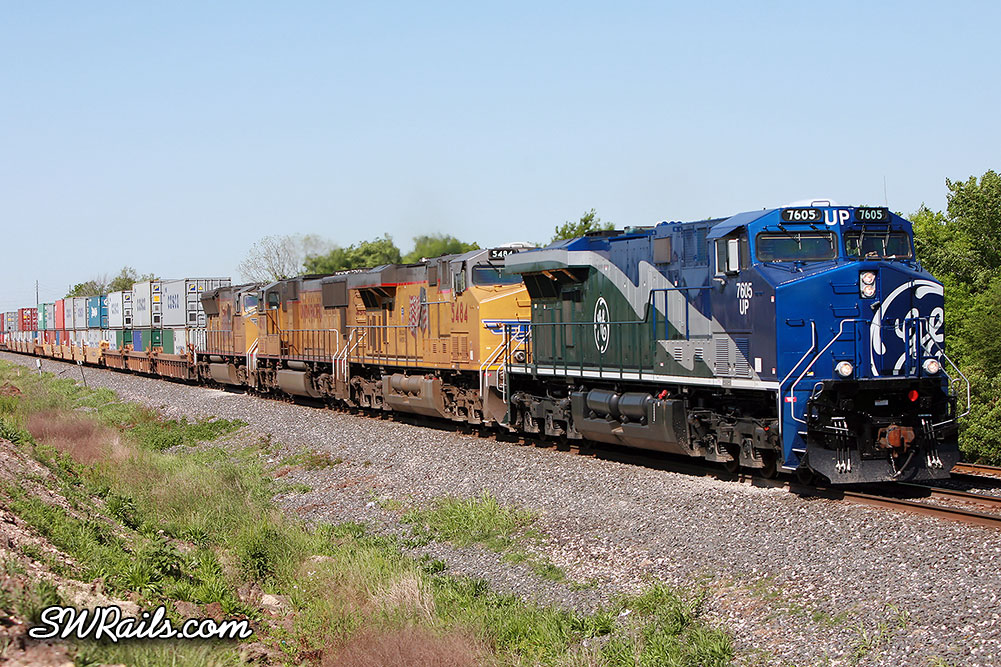
Like all good things, it did not last long in this scheme. The 7605 was routed to contract paint shop Mid-America Car in Kansas City in November, emerging in standard UP colors in December, 2007 .
Out & About – January 24, 2012
Despite overcast skies today, I headed out to see UP’s MKT heritage engine on its latest visit to the Houston area. It was on the QWCEW 21 which was originally scheduled into Englewood at 0503, but delays en route permitted me to catch it in daylight.
It was about 1530 when I heard the DS give an unforseen slow order to UP 7398 and UP 1988, at Harlem and Rosenberg, respectively. I immediately headed to Stafford to set up for the two eastbounds.
As I arrived to my spot near the intermediate signal at MP 20.6, I saw an approaching eastbound. As I bailed out of the car, I couldn’t understand how the first eastbound could get here so quickly, especially with the 10 mph slow order that it had to pass through.
As the train got closer, I was able to answer my question. It was neither of the trains I was aware of, but in fact a third eastbound, a KCS intermodal. It was running ahead of the two UP trains.
Check out the crew’s salutation of the photographer. (Click on the image for a better view)
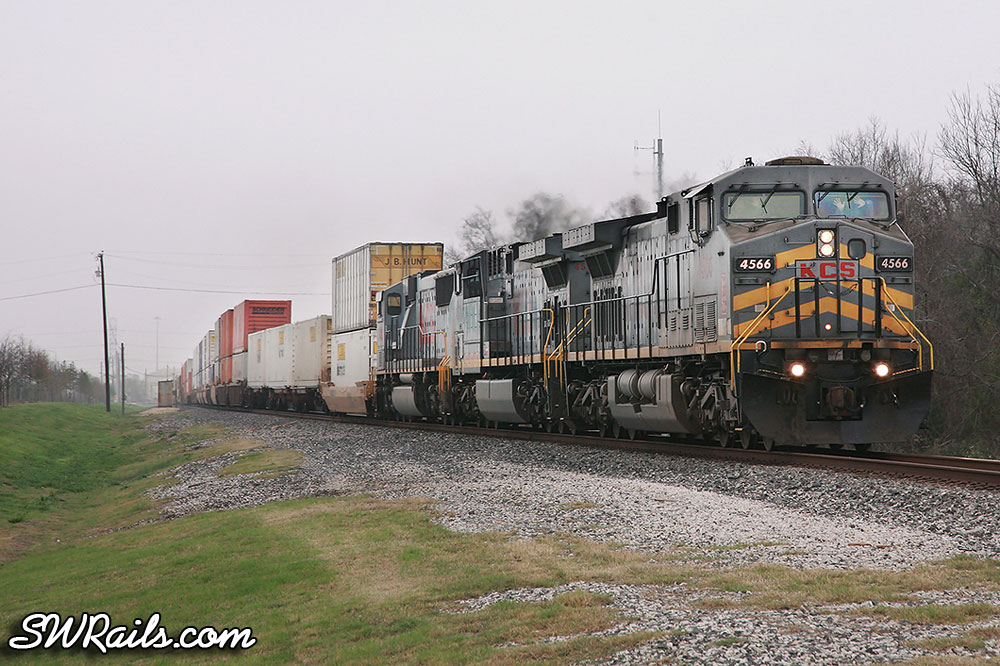
KCSM 4566 leads an EB intermodal at Stafford, TX on Jan. 24, 2012.
I wanted a different backdrop for the next 2 trains, so I drove 4 miles west along Hwy 90 to Sugar Land. The next train, UP 7398, came into view shortly. Interestingly, only one unit on the head end of this intermodal.
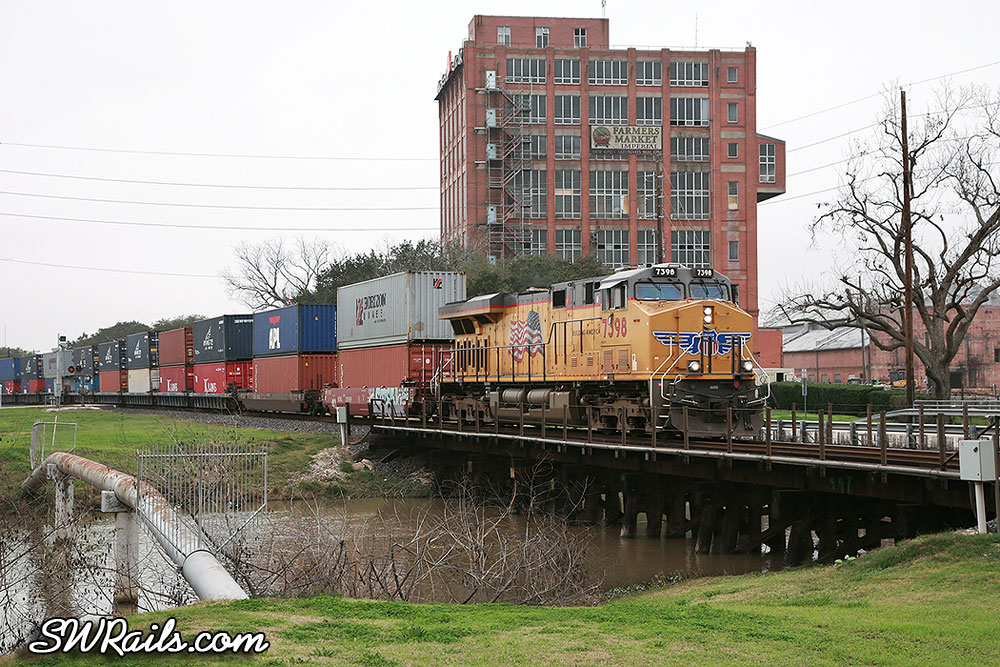
A block of “K” Line containers brightens up an otherwise dreary image.
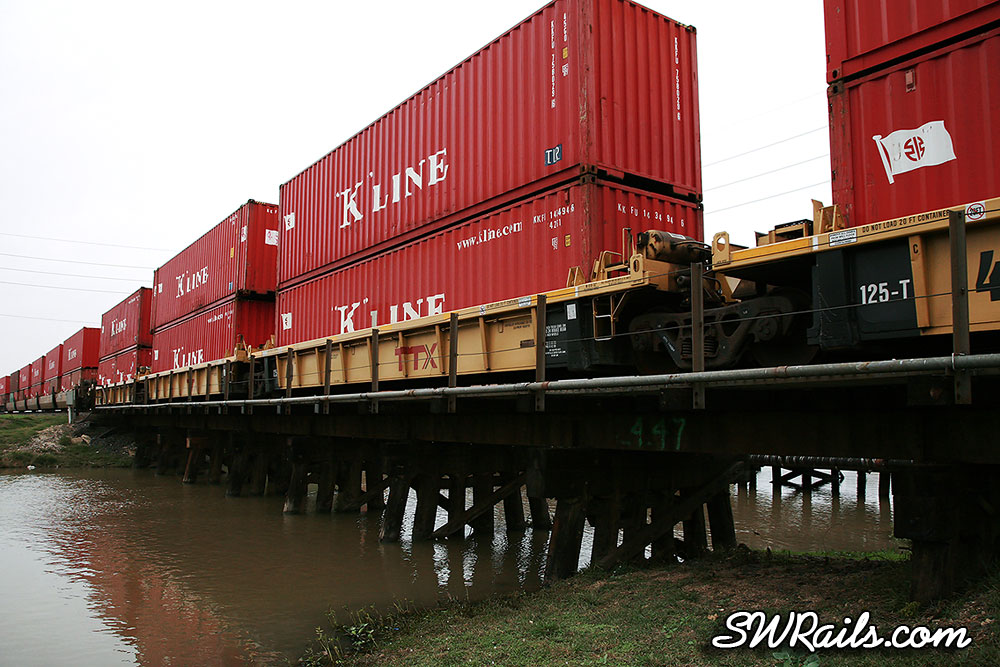
DPU UP 7433 comes into view as it shoves the train across Oyster Creek.

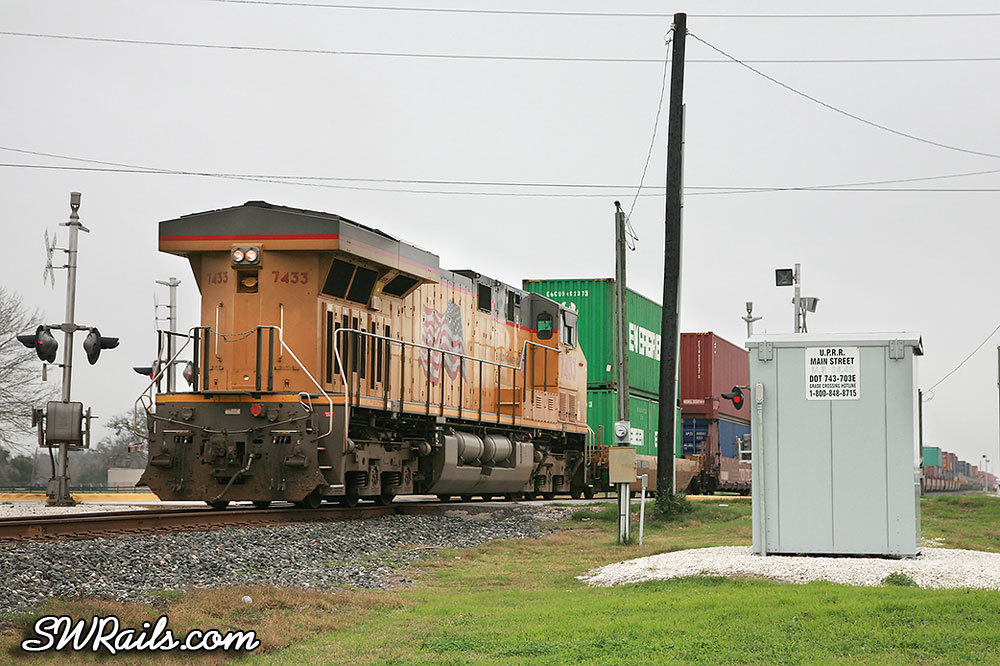
This 1×1 power consist (1 unit on the point and 1 DPU) on an intermodal is a first for me. KCS likes 1×1’s on loaded grain trains, but I’ve never seen it on an UP train, intermodal or otherwise.
Now that the two opening acts are by me, UP 1988 is up next. Seriously, after 5 years, you’d think that I’d be over the UP’s heritage units. But I’m not.
I moved to CP SA025 (east switch of Sugar Land) to await Miss Katy. Within 10 minutes, she came into view.

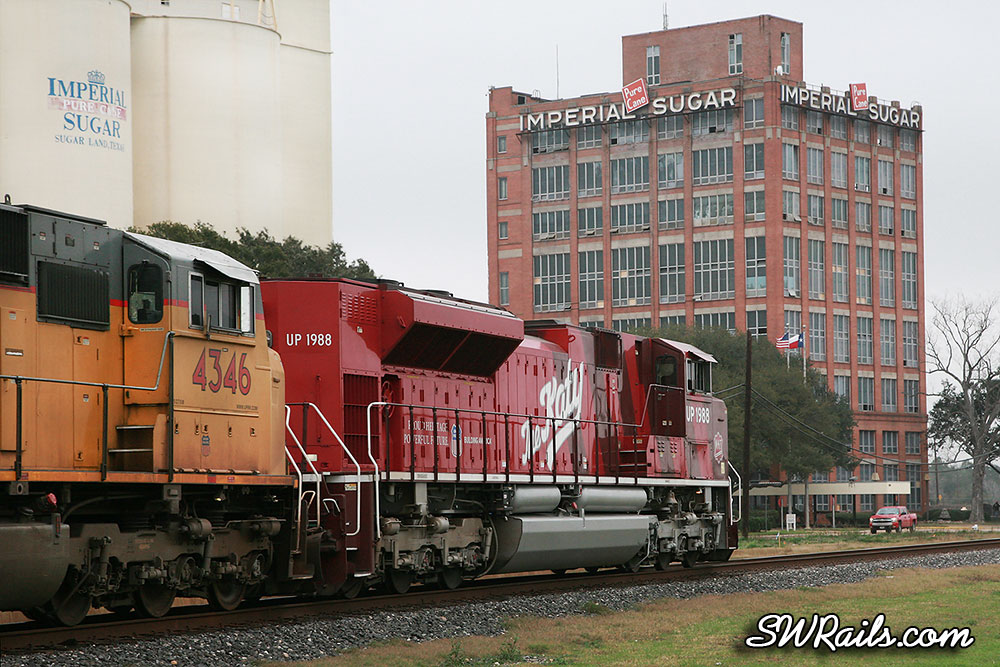
The QWCEW, and its westbound counterpart, QEWWC, are a sure bet to have DPU power. As expected, the DPU brings up the rear.
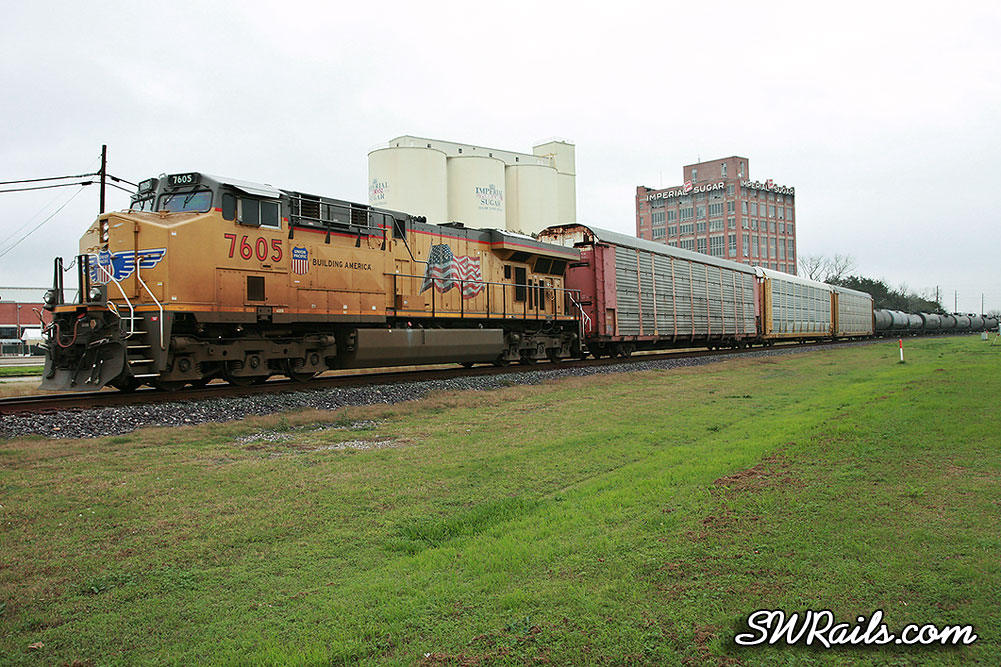
As the DPU passed me, I noticed it was UP 7605 . Hmmmm… There’s something about that number. It seems very familiar to me.
Out & About – Jan. 2, 2012
I flipped the radio on a bit before mid-day today, just to see how much traffic might be running on UP’s Glidden Sub. Within 30 seconds, the DS tells UP 8698: “I’m ready for you at the east end of Sugar Land.”*
* Eastbound trains that get an approach signal indication at CP SA028 (west switch of Sugar Land) will stop about a mile short of the east switch in order to not block crossings should the signal at CP SA025 (east switch of Sugar Land) be red. As the signal is not in view from this stopping point, eastbounds will wait for the dispatcher to advise when to proceed. Operating rules prohibit a dispatcher from telling a crew what any signal indication is, hence the DS will tell the crew only that he is “ready” , but the crew must view the actual signal indication. I know, I know…TMI.
Even though I had not achieved my goal of an overview of traffic, I had heard enough to grab some gear and head out to CP SA017, the east switch of Missouri City to set up for a fairly new SD70ACe on the point. Within 5 minutes, a QWCEW (Quality West Colton to Englewood) manifest came into view.
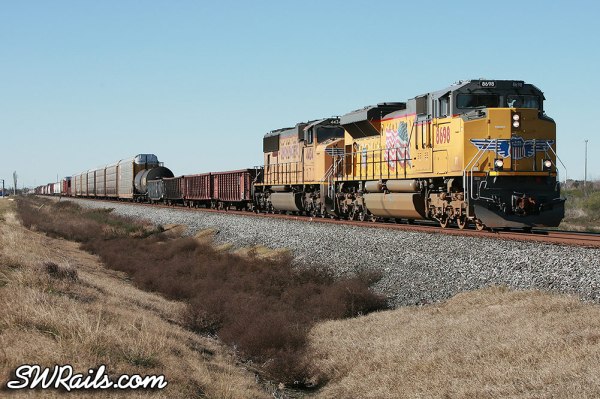
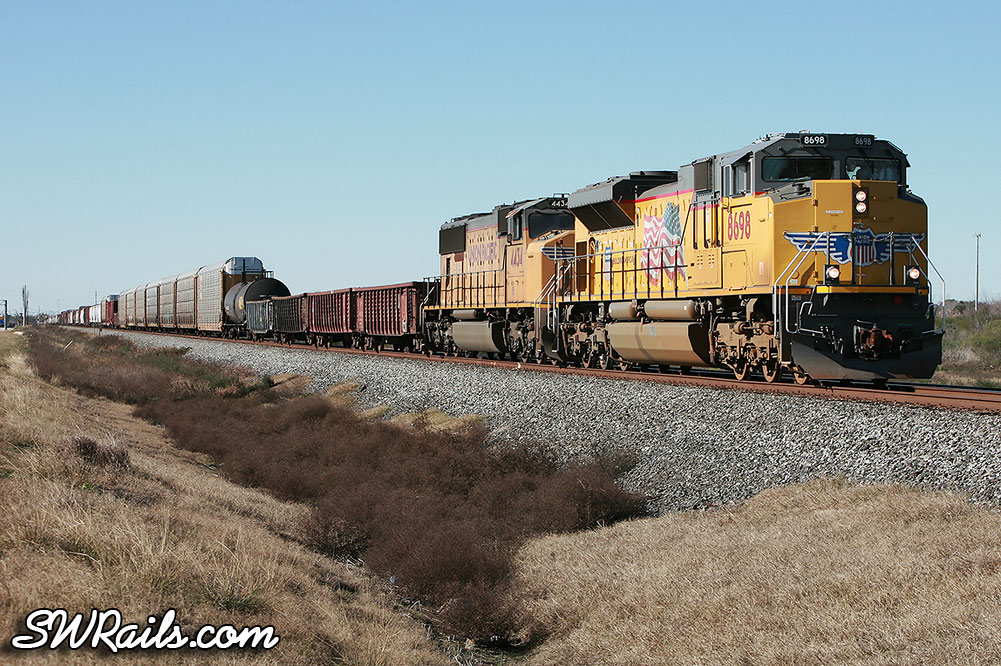
- UP 8698 is between switches at Missouri City, TX on Jan 2, 2012.
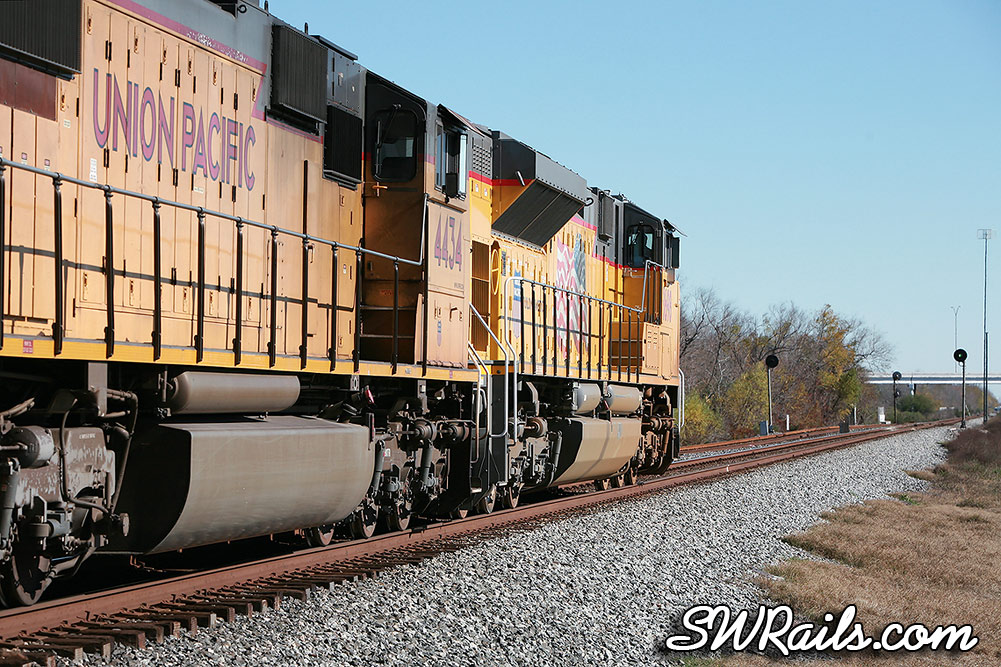
A quick pivot to my right provided this view of the 8698 as it neared the clear signal at CP SA017.
With traffic being light on Hwy 90 due to the New Year holiday, I was encouraged to head 5 miles east to CP SA012, West Junction, for another QWCEW photo-opp.
As I get in the car, I get the traffic overview I was interested in. I hear the DS give track & time to MOW until 1330, so this is the last train for a couple of hours. Oh well…
I got to West Jct. about 90 seconds before the 8698.

The track in the foreground is the Glidden sub main, which has just diverged from track 2 of the Terminal sub. The Terminal sub is the preferred route for Englewood-bound trains.
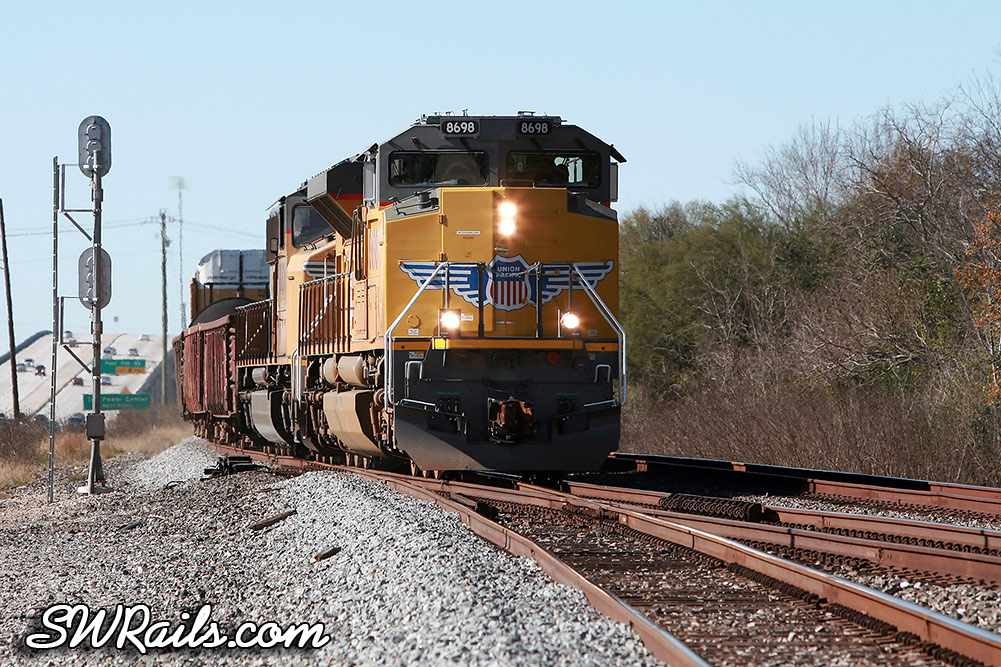
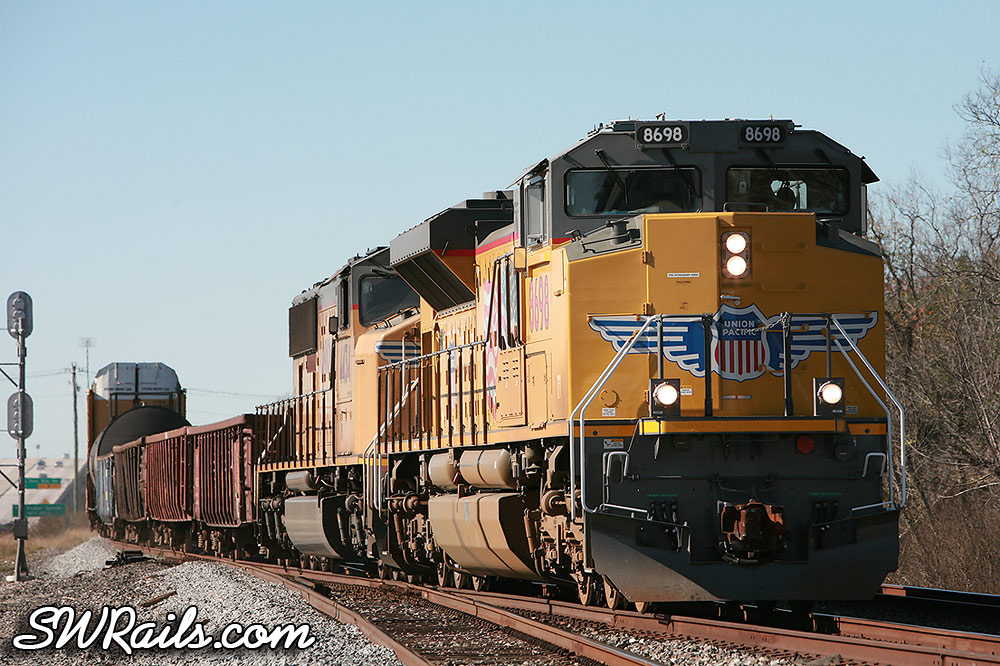

Once the power got by me, I got in the car quickly because it was pretty chilly and I, in my haste to get out of the house, didn’t bring a jacket. As soon as I got the car moving, I remembered that this train usually has DPU’s. Oh well, back in to the cold…
The wait was brief before UP 8486 came into view, shoving on the rear of the QWCEW.

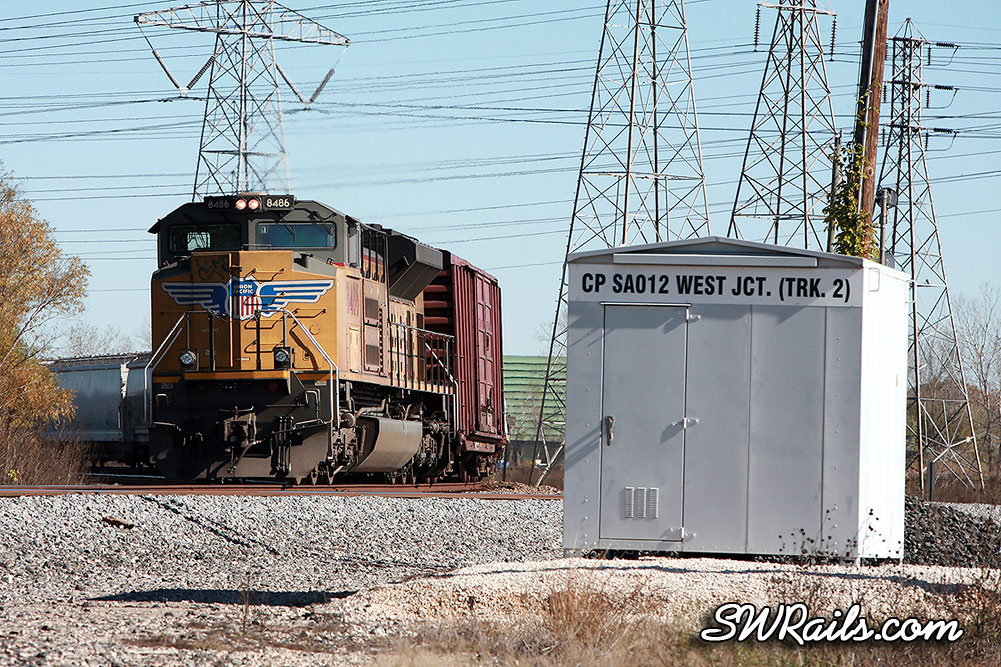
With the DPU by me, I headed home. I was about halfway home when I realized that I had just witnessed, and documented, a fairly uncommon event for the Union Pacific of 2012: a 3-unit power consist with not one GE locomotive!
Bridge on Borrowed Time
The venerable bascule lift bridge that carries BNSF and UP trains across the Gulf Intracoastal Waterway in Galveston Bay is slated to be removed from service any day now. It’s being replaced with a 300′ long vertical lift bridge. The current 100′ span, deemed state-of-the art when completed in 1912, is dangerously narrow for today’s barge traffic. More accidents occur as a result of collisions with this bridge than any other bridge on the Gulf Coast.
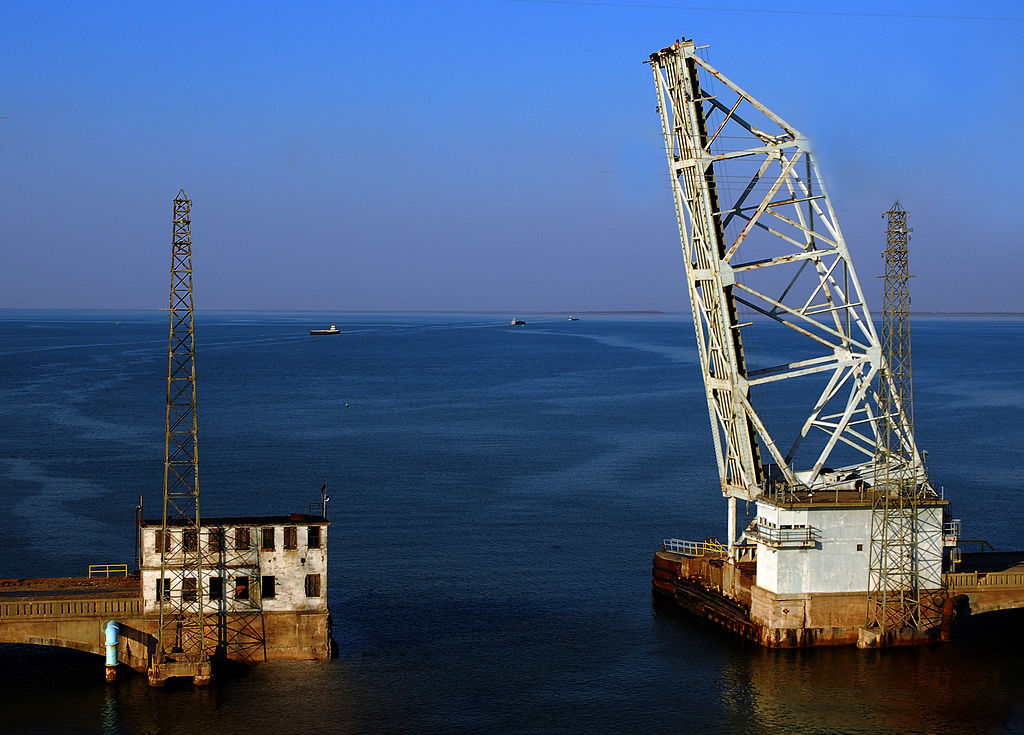
It was declared a hazard to navigation by the Coast Guard in 2001. The owner of the bridge, Galveston County, was ordered to replace it with a lift span of 300′ long. Funding was not available until 2009 when ARRA stimulus funds were allocated to this project.
Here how the project appeared in May, 2011. (Click any image to enlarge it.)
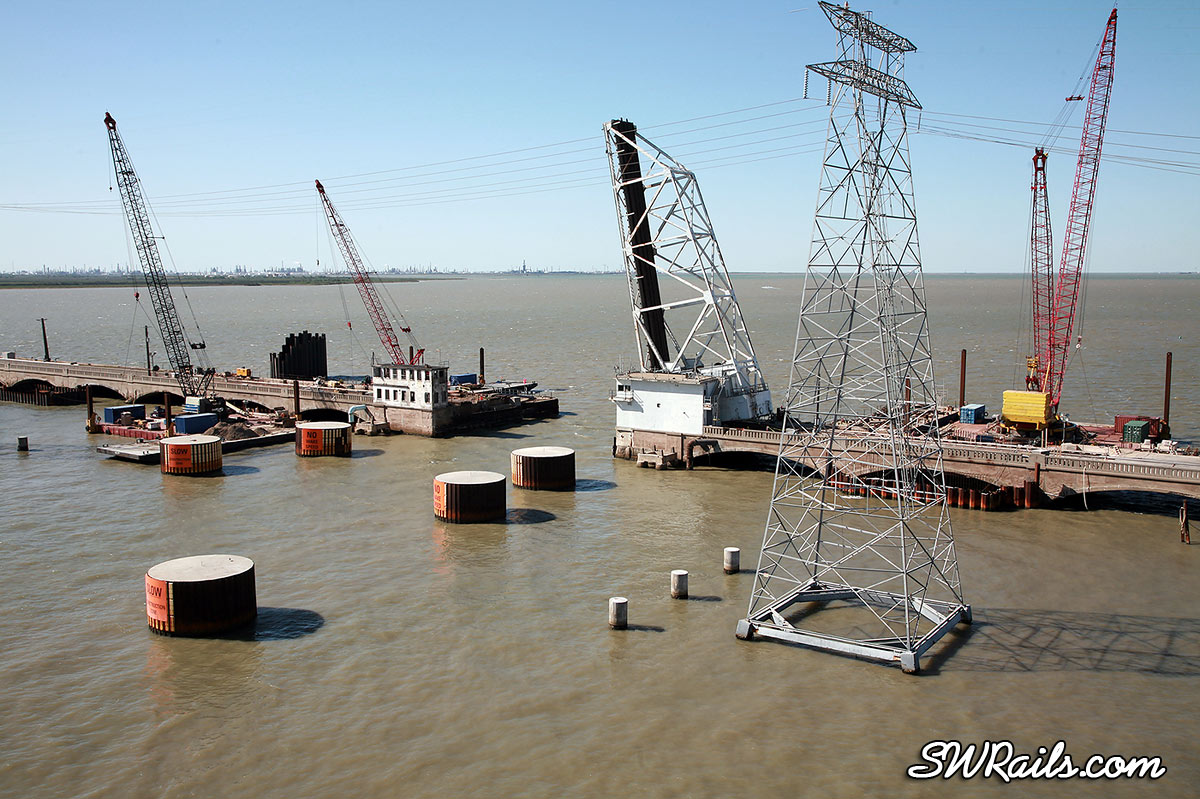

Over the next few days, I’ll post more images showing the progress of this project, as well as some interesting historical tidbits.
Out & About – Oct. 27, 2011
The downtown video job I was on this past Thursday ended early enough to where I could make a drive-by of the far west end of UP’s Englewood Yard.
I made it as far as the Waco Street overpass, MP 359.3 of the Terminal sub, where I encountered the QEWWC (Quality Englewood – West Colton). It was conducting its air test in preparation for departure. (You might recall a post from March 11, 2010 where I have a 1989 shot from this same location.)

UP 8552 prepares to depart Englewood Yard with a QEWWC train on Oct. 27, 2011.
As I was taking the above photo, I could hear an eastbound approach. I couldn’t see what it was because the overpass blocked my view. I only had to wait a moment before BC Rail (British Columbia Railway) GE 4646 popped into view with a light engine move into Englewood.
I’ve never seen BCRail power in Houston, or anywhere in the U.S. for that matter. The closest was some retired BCRail ALCO’s that were en route to Mexico in the mid 1990’s. I guess you really can see anything, anywhere, these days.

Since no other shots were available of the wayward Canadian locomotive, I moved west to the Bringhurst Avenue grade crossing to await the departure of the QEWWC.
Within 5 minutes, the QEWWC got highballed by the car department and started pulling west. Unfortunately, it traveled less than a mile before stopping short of Bringhurst Ave. account traffic at Tower 26.
I swapped lenses, putting the 70-200 in order to get these shots of the 8552 as it waited signal indication to proceed.
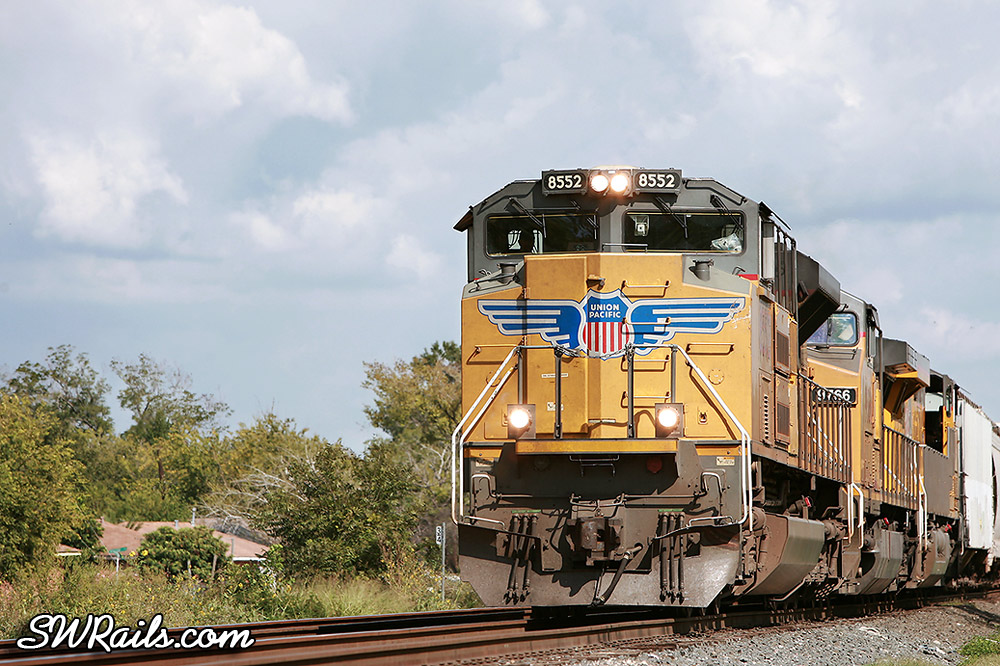
Note the Waco Street overpass is in the background of the next shot, illustrating just how little the 8552 moved after departing Englewood.
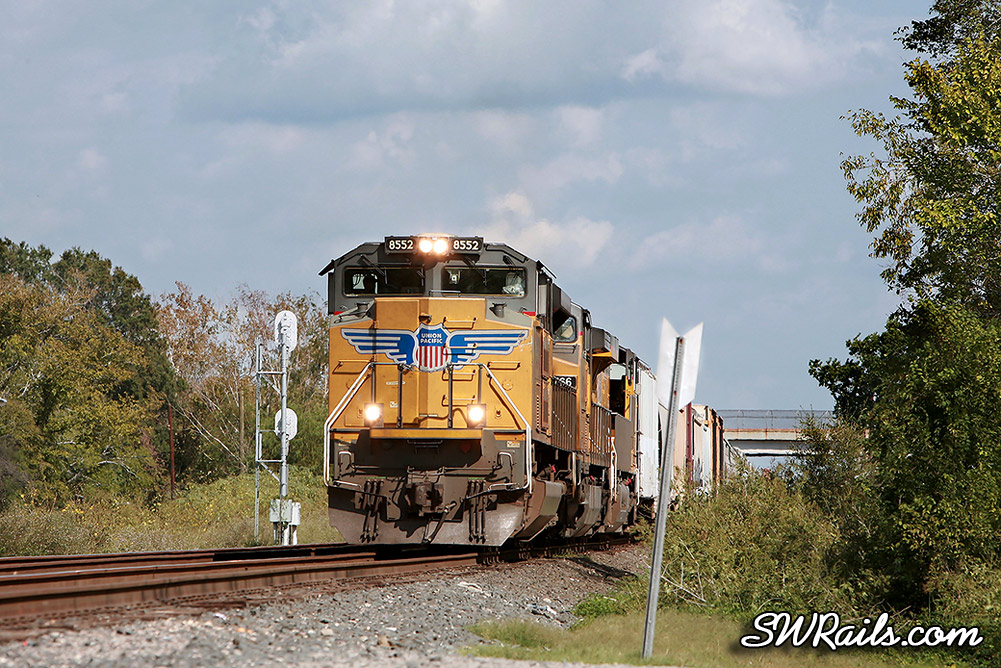
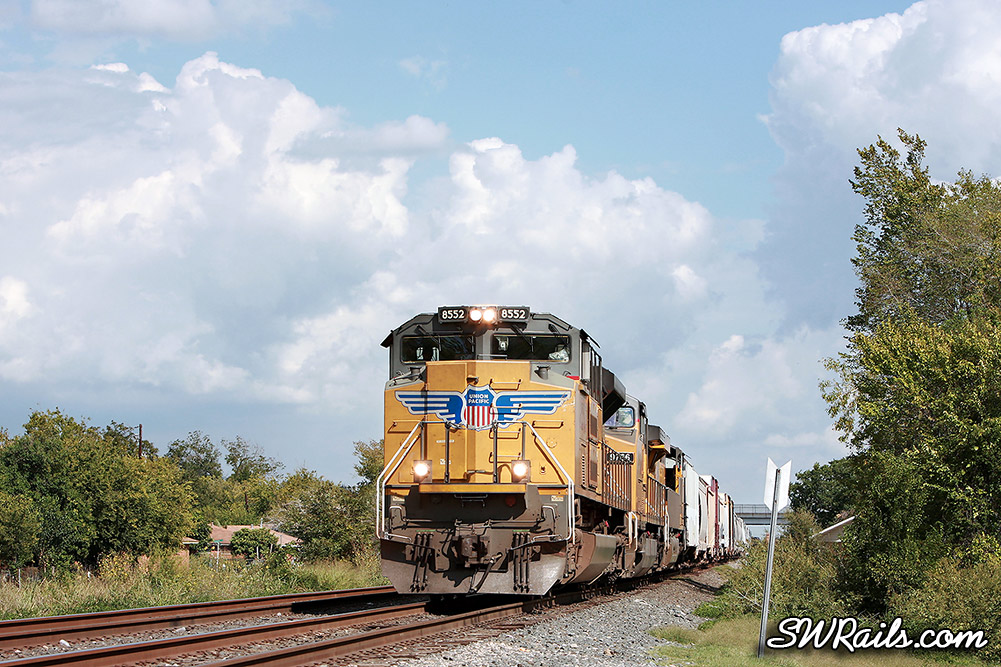

The train hasn’t moved in the 4 previous views, but I was able to achieve the different perspectives by adjusting my location slightly and using the full range of the 70-200 lens.
As the QEWWC wasn’t going anywhere soon, I headed home via South Main Street.
As I arrived at the South Post Oak grade crossing, I saw UP 7317, a MEWEY (Manifest Englewood – East Yard train getting re-crewed at Heacker.
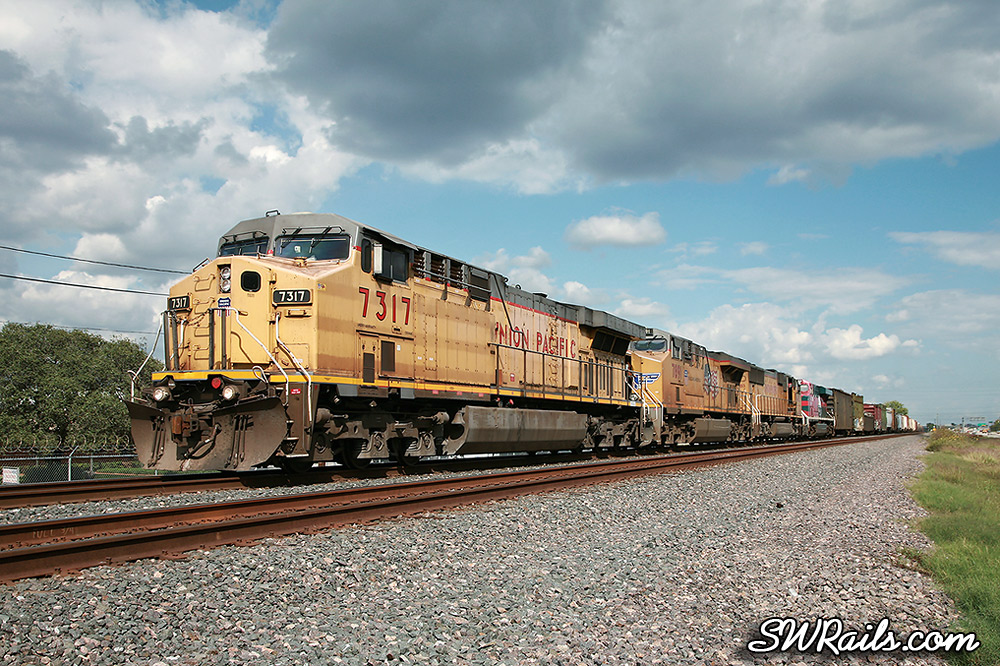
As this train wasn’t moving soon either, I packed it in and headed home.
The Inter-American
The Inter-American was a passenger train that operated between Laredo and Fort Worth, Texas. Amtrak inaugurated the service in January, 1973. The route was extended to St Louis in 1974, and to Chicago by 1976. The trains were routed over Missouri Pacific trackage.
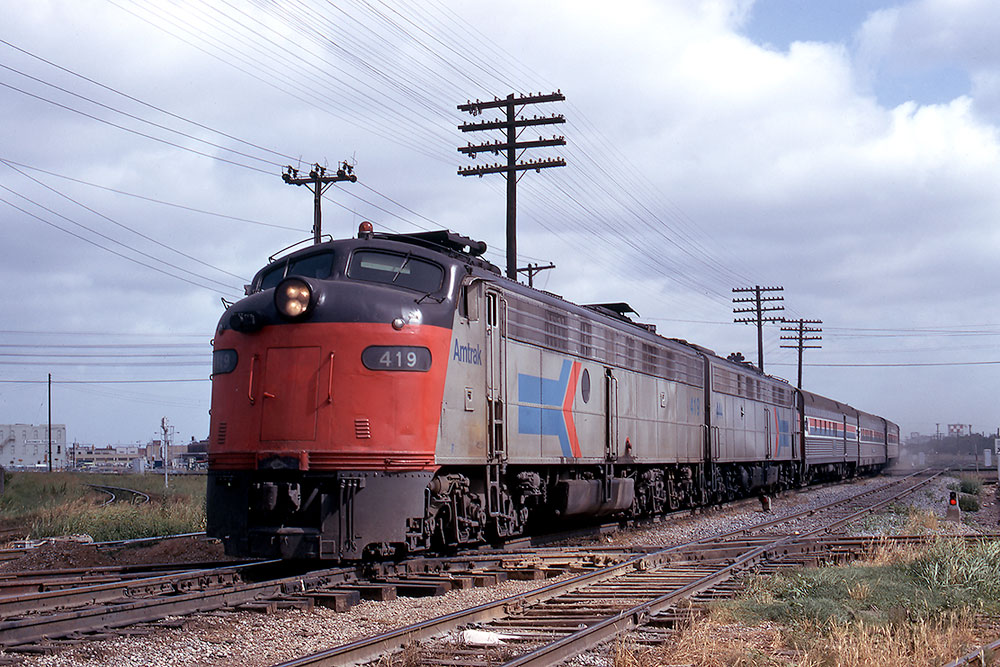
The southbound Inter-American departing Fort Worth, TX on May 30, 1974
Budget cuts in 1981 forced Amtrak to eliminate the Laredo to San Antonio segment, prompting Amtrak to drop the Inter-American name. The train was re-named “The Eagle” in honor of the Missouri Pacific passenger trains that traveled this route before Amtrak took over passenger train operations in 1971.
Additional routing adjustments in 1988 resulted in Amtrak re-naming this train the “Texas Eagle“, the name under which this service continues to the present.
PTRA – Back In The Day
With about 25% of PTRA’s locomotive fleet already in the new image that was rolled out this past July, and the balance slated to receive new paint by mid-2012, now might be a good time to look at some views at what will soon become nostalgia.
It’s Nov. 22, 2005 and PTRA 9602 and 9616 have just passed Manchester Jct. in southeast Houston with a southbound train of empty covered hoppers.
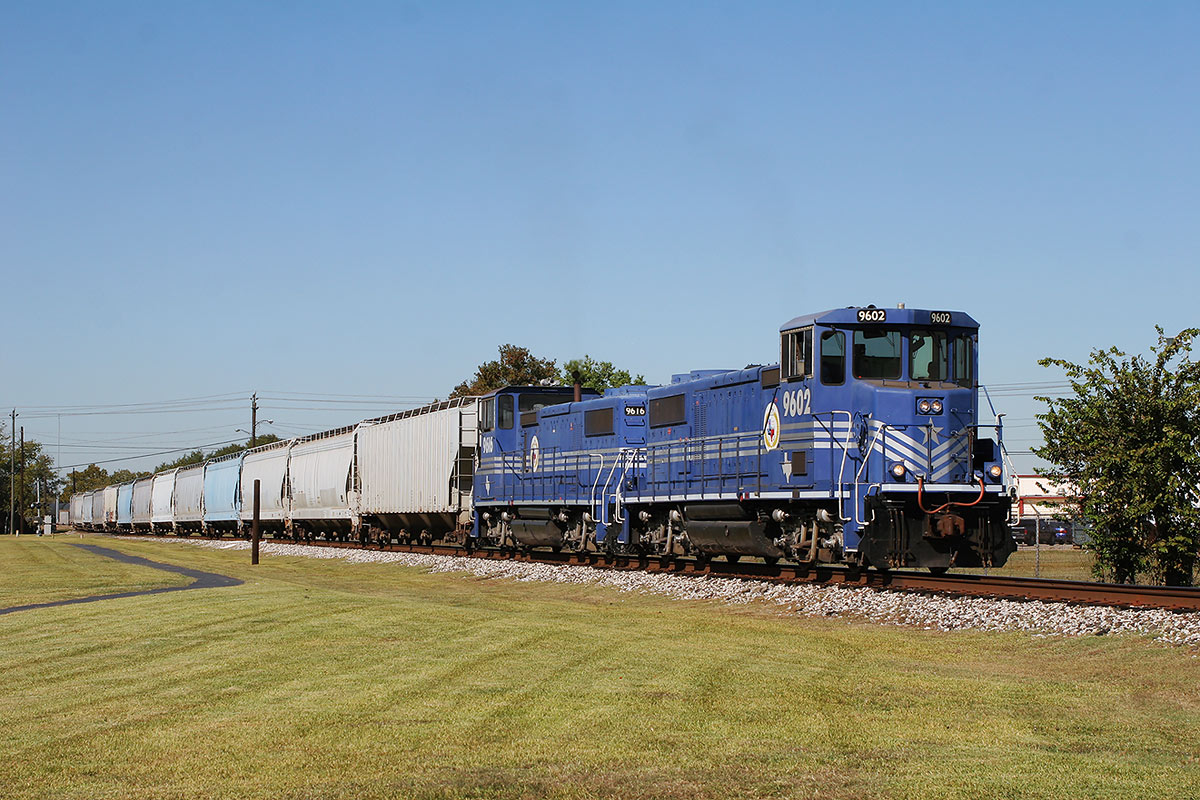
The same train is shown about a mile down the line, about to cross Sims Bayou.

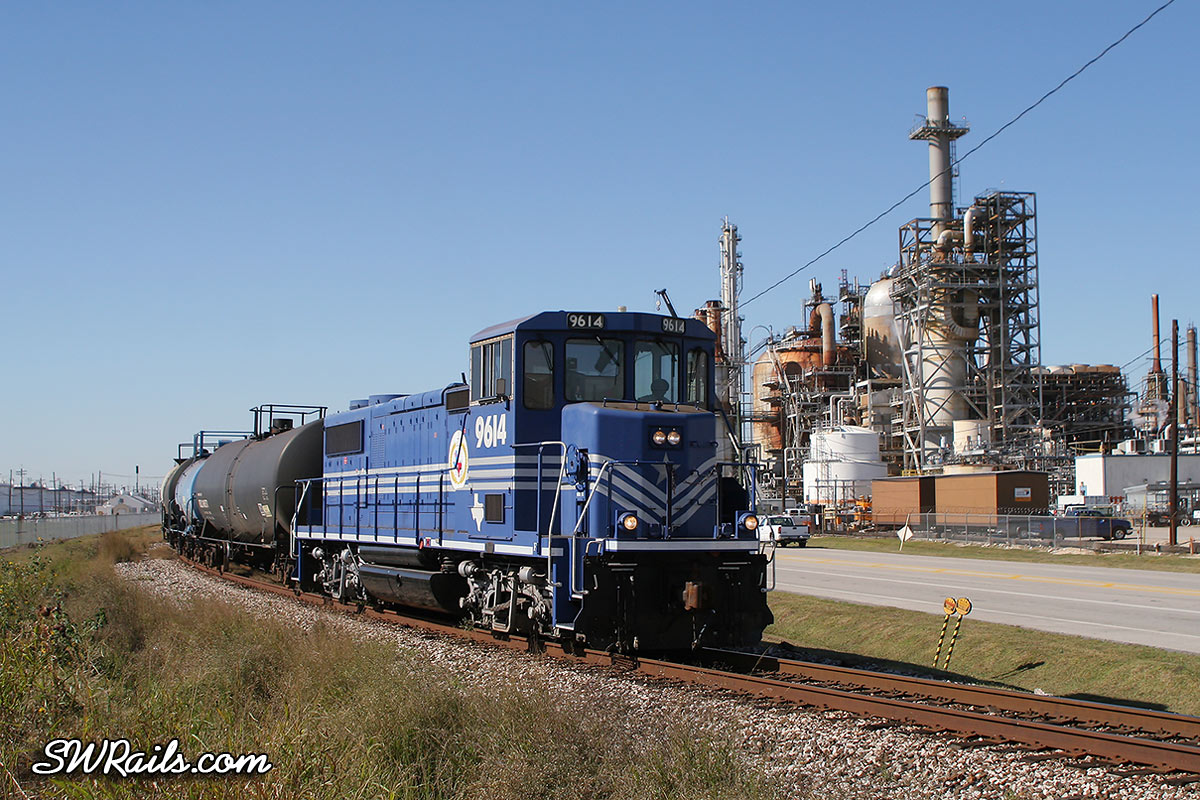
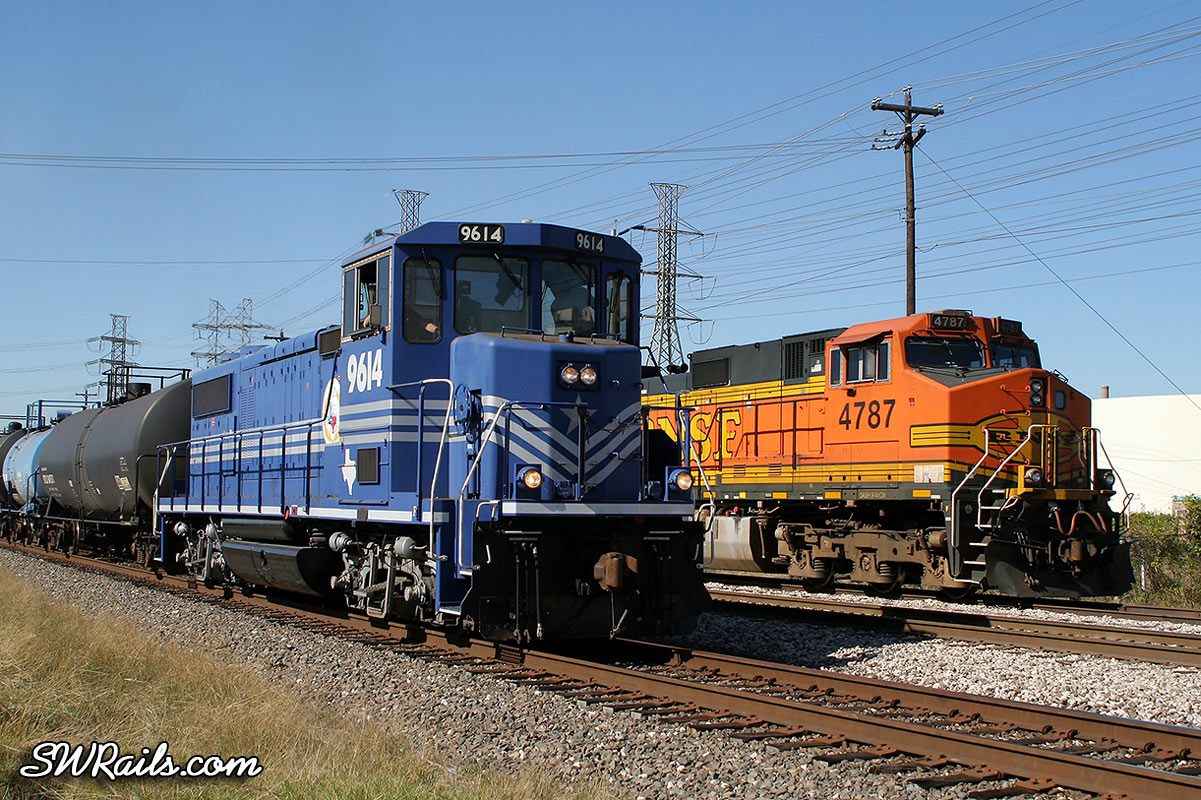
Six days later, we see PTRA 9614 just east (railroad south) of Sinco. The LyondellBasell refinery is in the background.
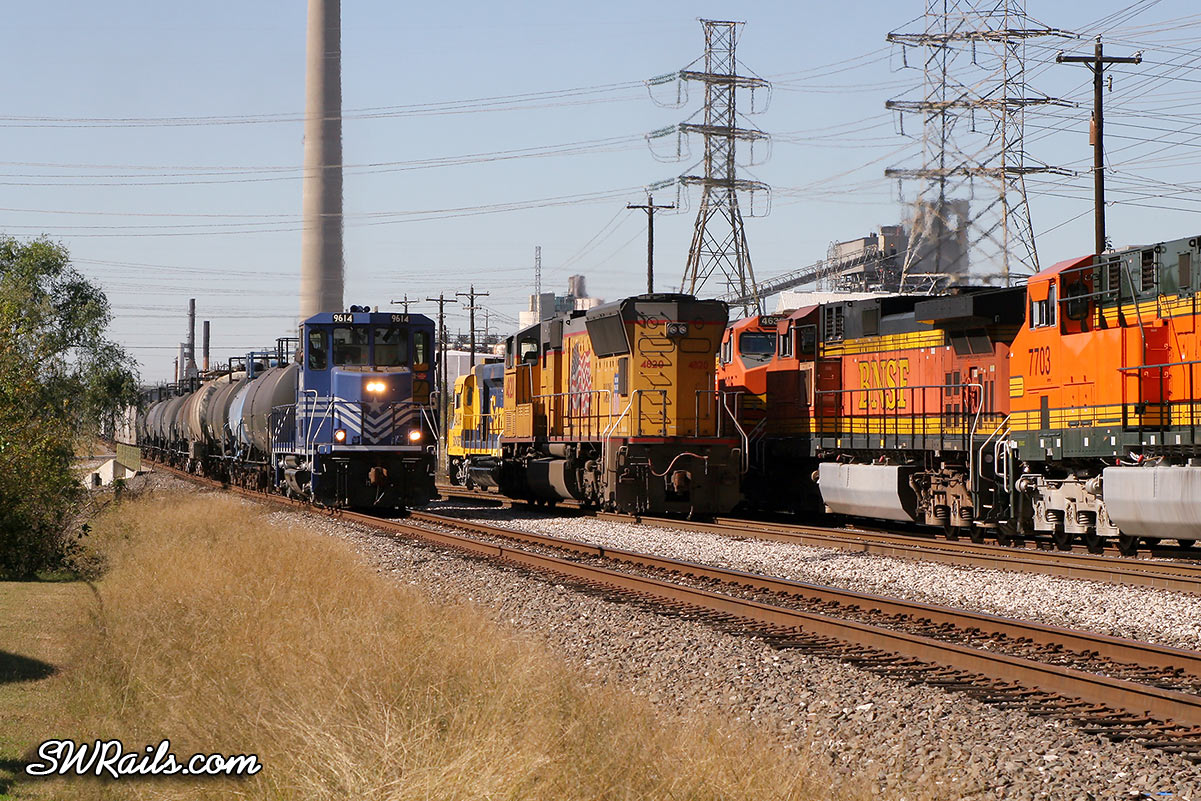
Approaching Pasadena Junction, the 9614 encounters UP and BNSF power being hostled.
Out & About – Oct. 21, 2011… Continued
When we left off, BNSF 980 was at Dayton Junction, where UP’s Baytown branch joins UP’s Lafayette sub mainline at Dayton, TX. I decided to follow this train back to Houston because I don’t get to see many BNSF H1 motors leading.
Getting to the west end of the yard ahead of the BNSF 990 was easy due to the 10mph speed restriction for trains at Dayton Jct. The only question is what will the clouds do?
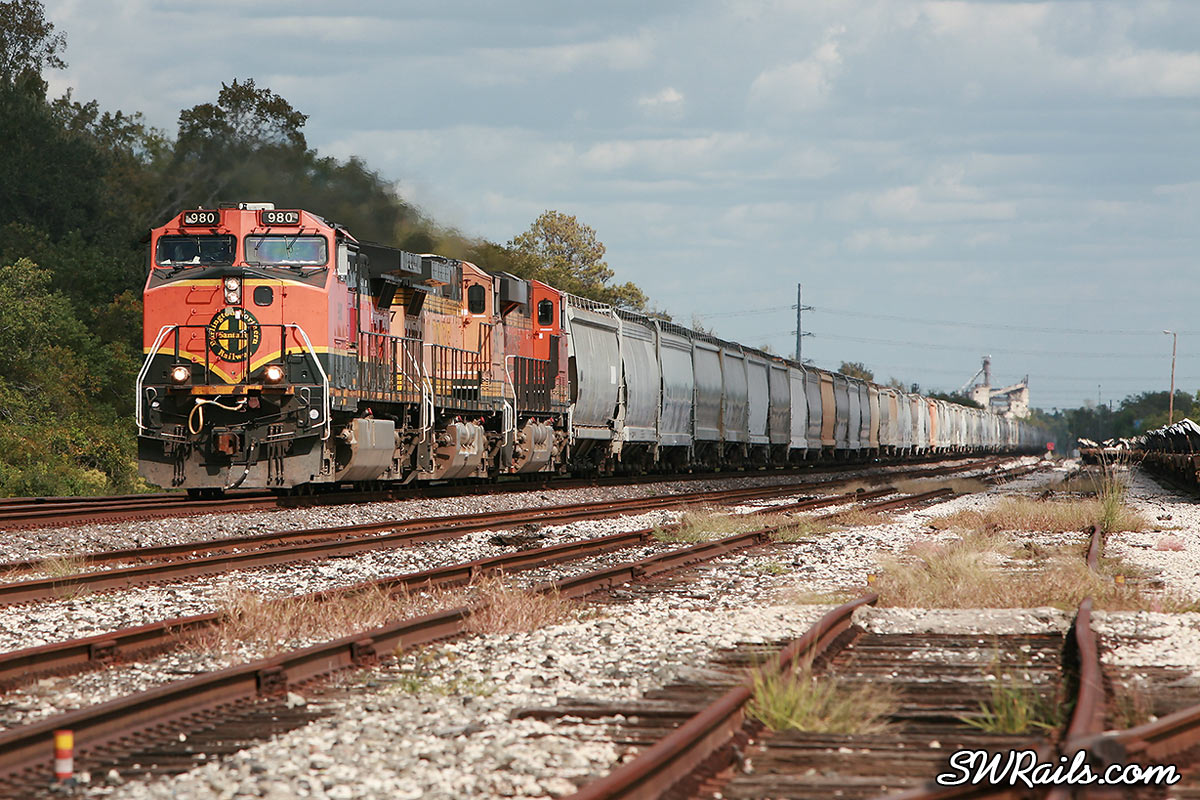
The head end and first 2-3 cars are in sun, the next 10 cars are not, the next 15 cars are, and the balance of the train is not in sun. Talk about random clouds!
Once the train was on the mainline, the engineer opened up the throttle.
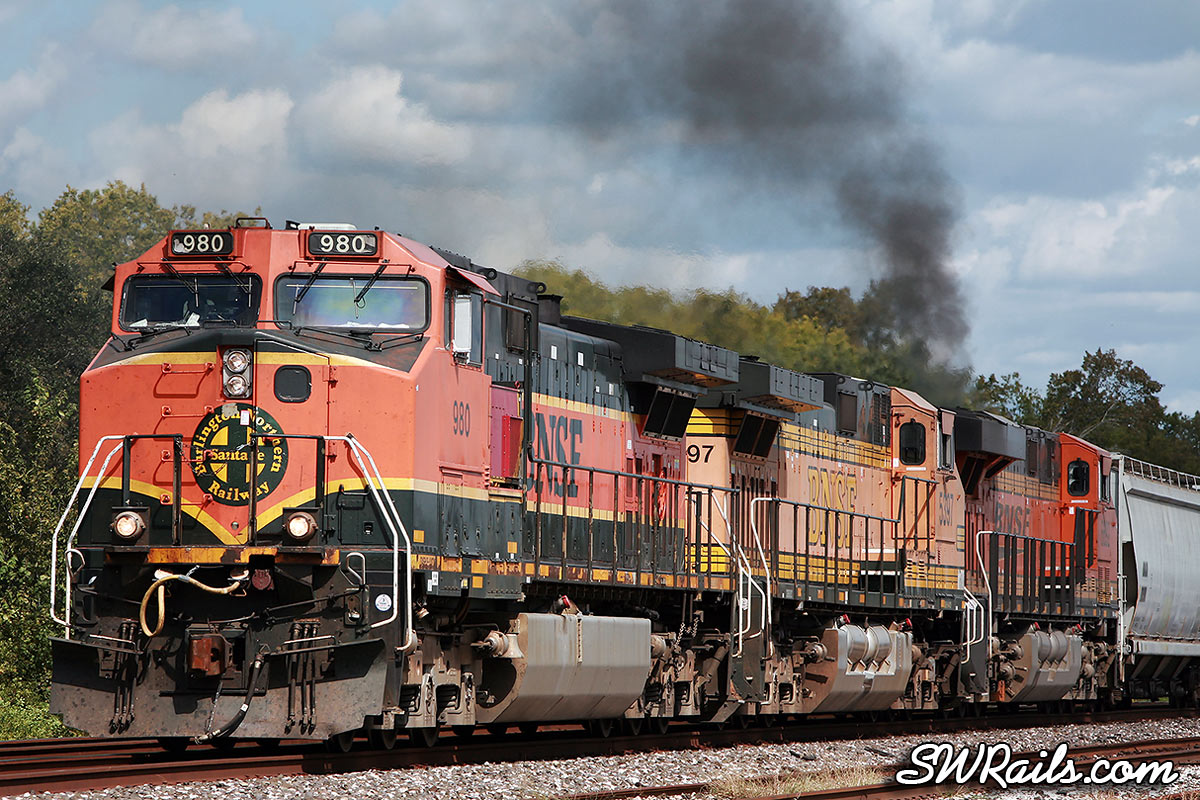
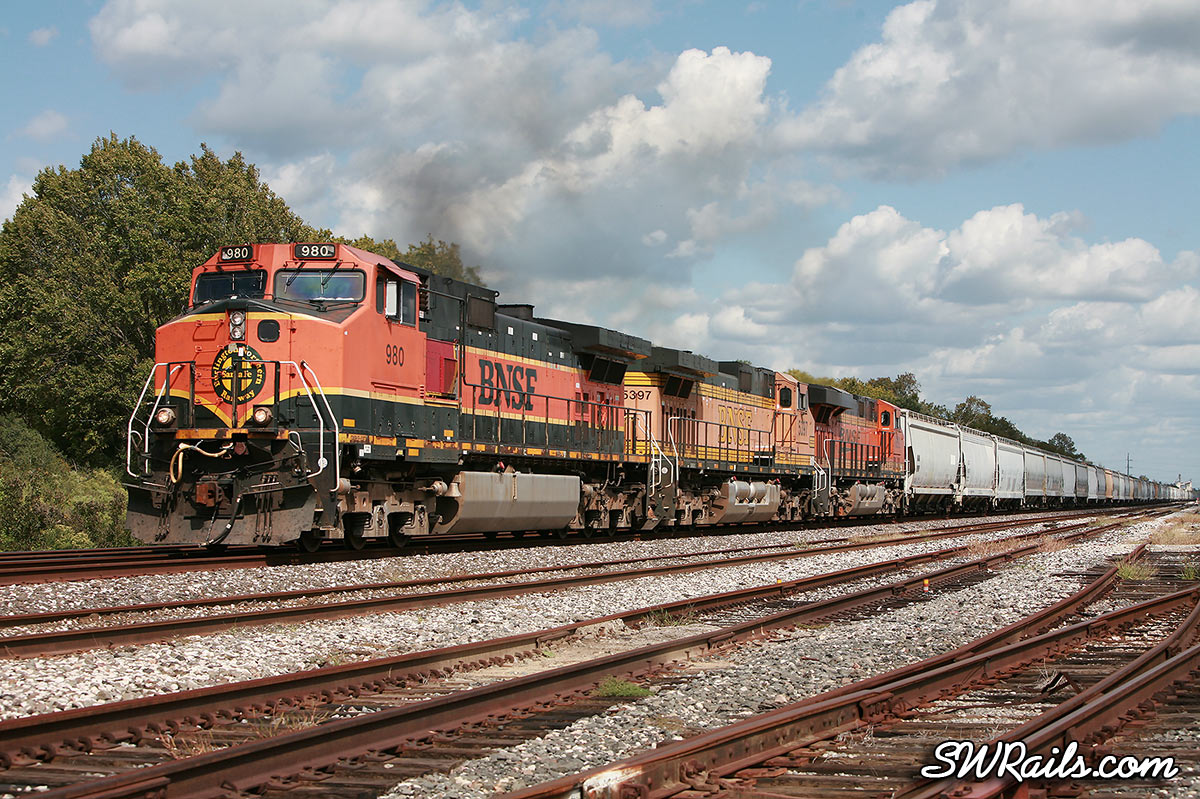
As the head end got by me, the clouds had arrived.
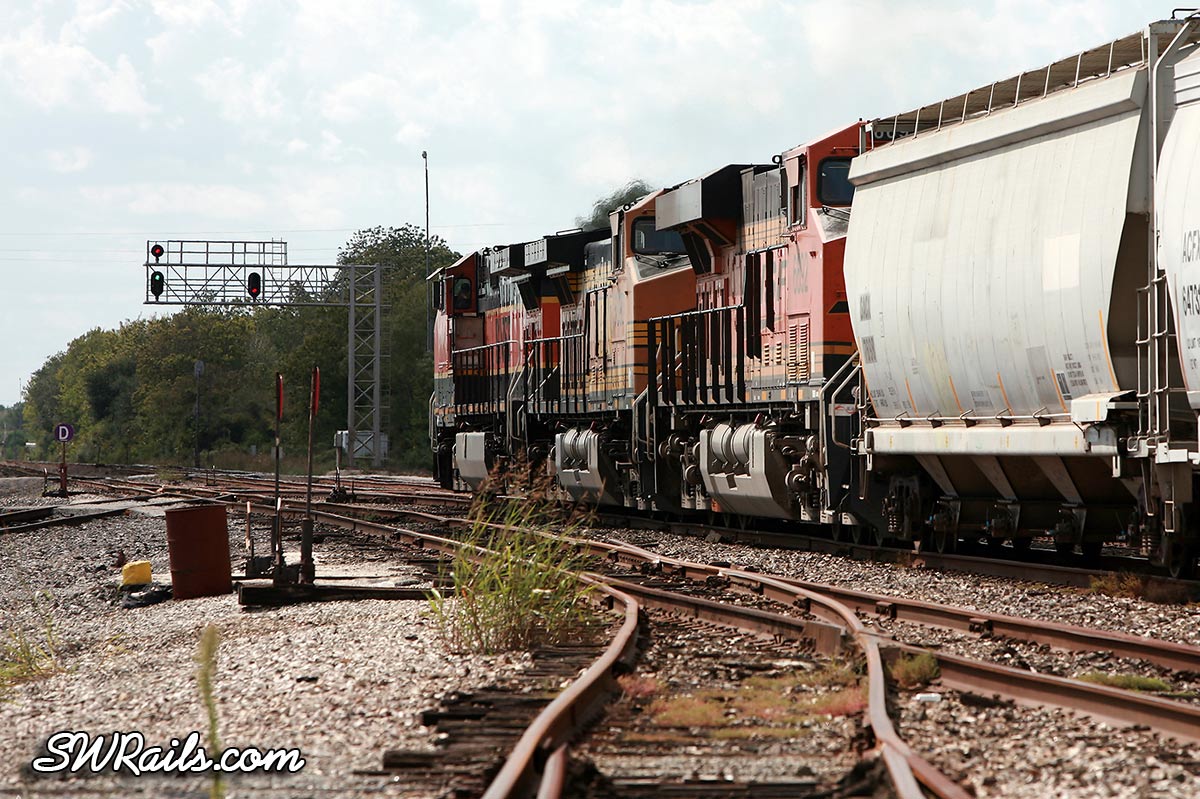
I headed west in search of the next shot. I turned into a little private crossing at MP 331. As the train approached, I just knew I was to getting cloud-hosed.
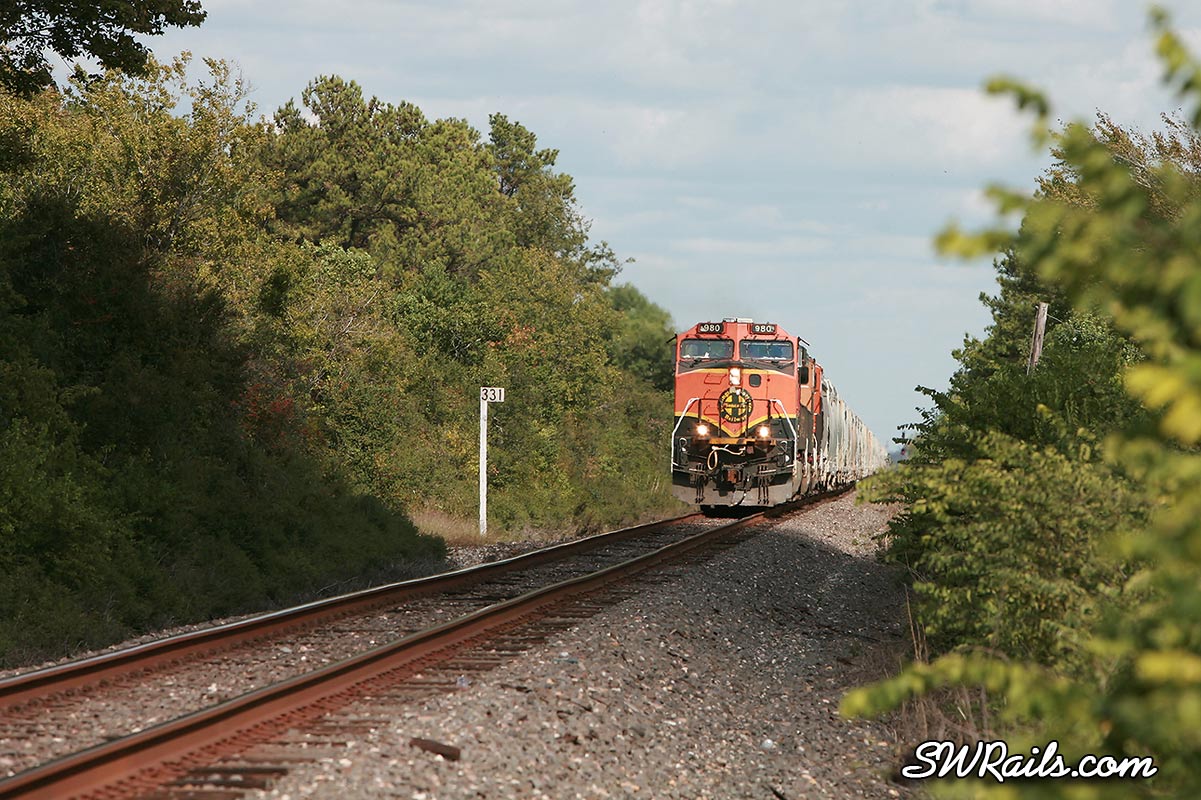
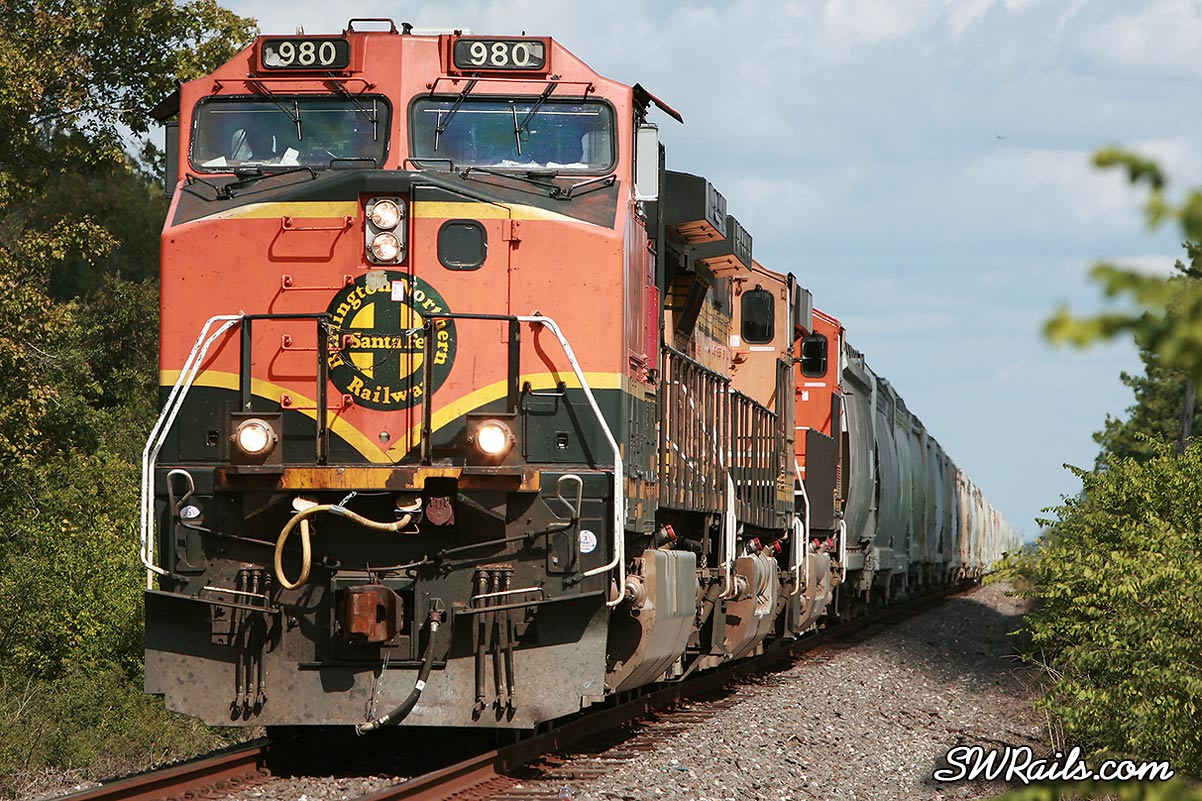
I wanted to get the lead unit even with the mile post, but this “in yo’ face” is OK too.
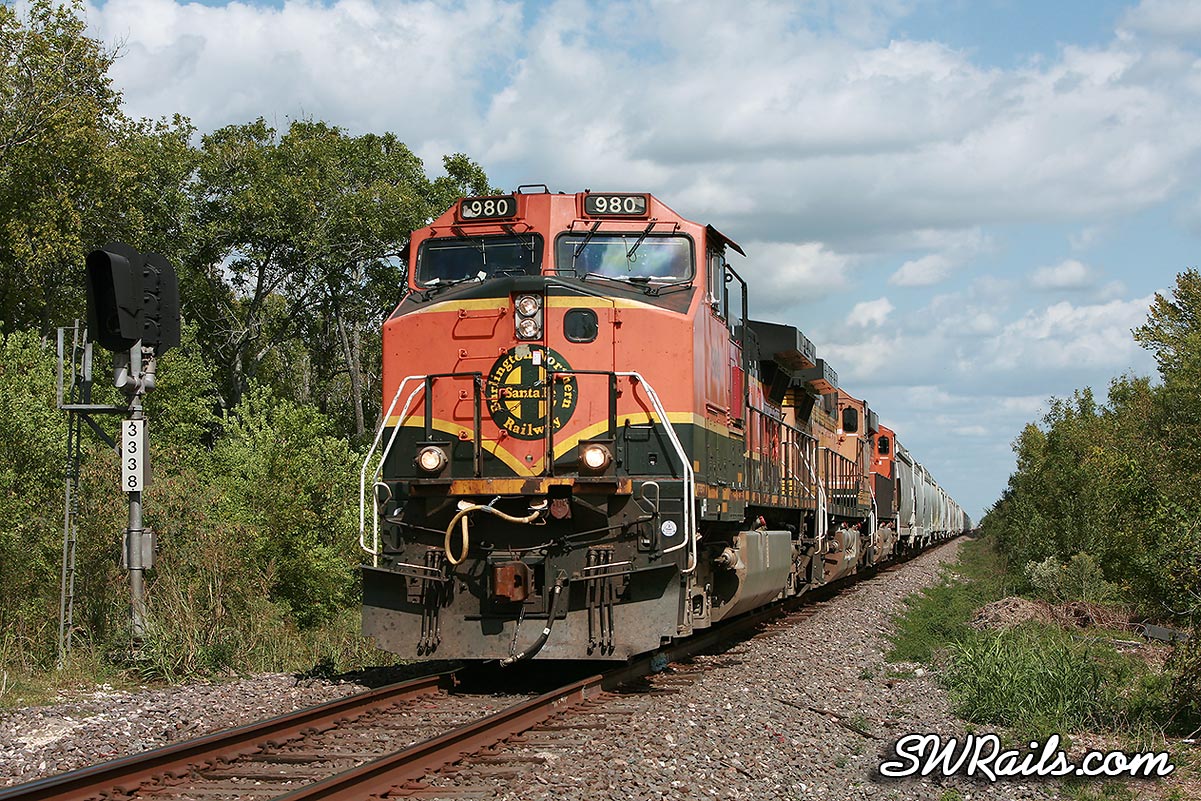
Next stop was the intermediate signal at MP 333.8. As much as I’ve whined about these clouds, don’t they look good when they’re properly positioned in the background.
Next stop was a crossing at MP 337.5, just east of the siding at Crosby. In case you were wondering, yes, this track is surrounded by vegetation, as are most tracks north and east of Houston.
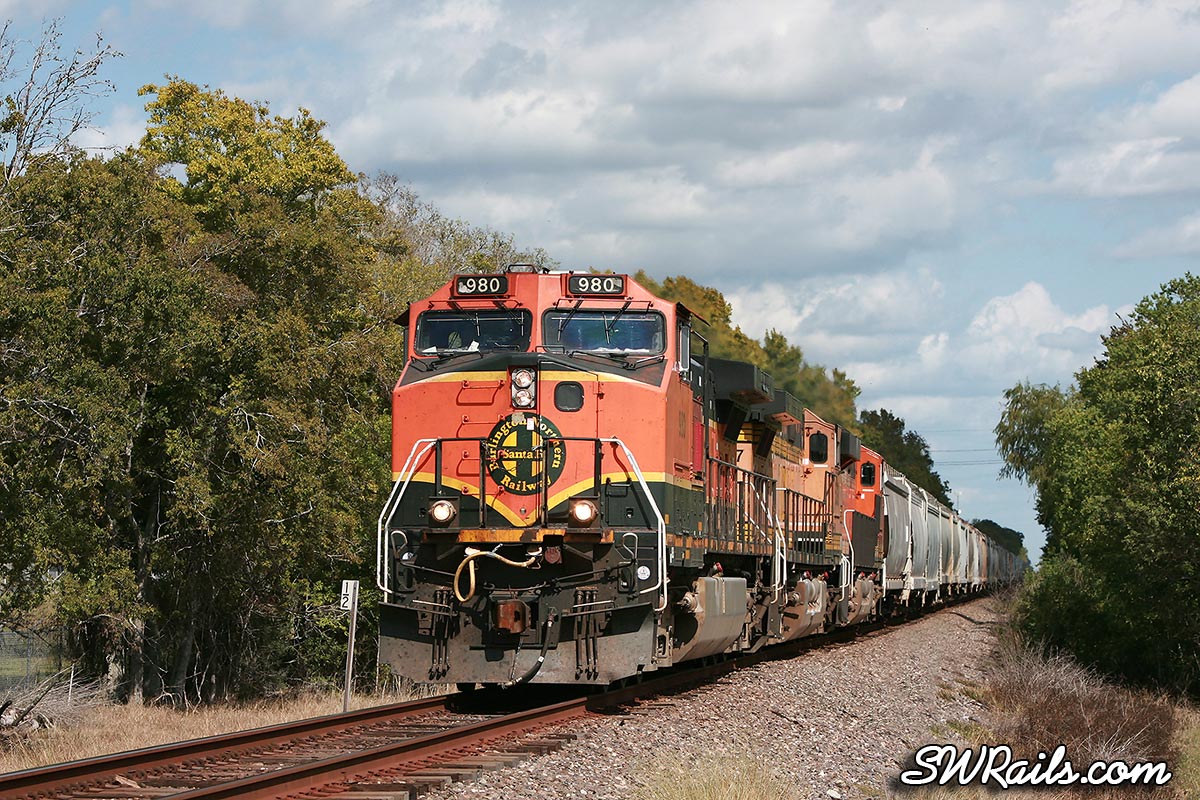
Enough of tunnels through weeds! I set up on the Old Hwy 90 bridge over the San Jacinto River. It wasn’t long before the BNSF 980 glided across the bridge.
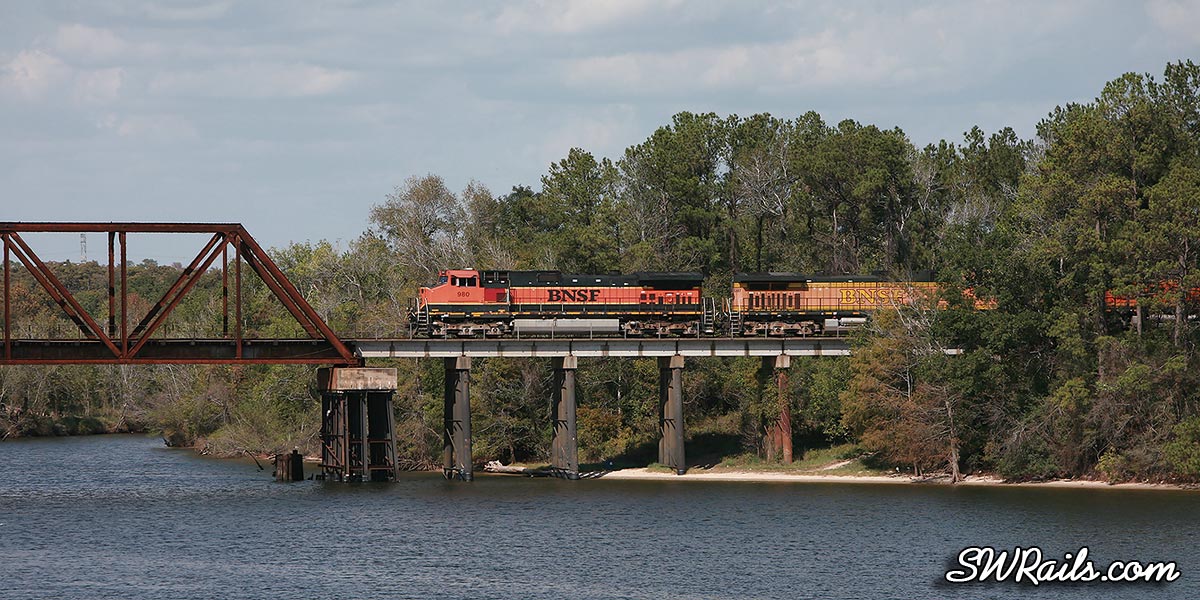
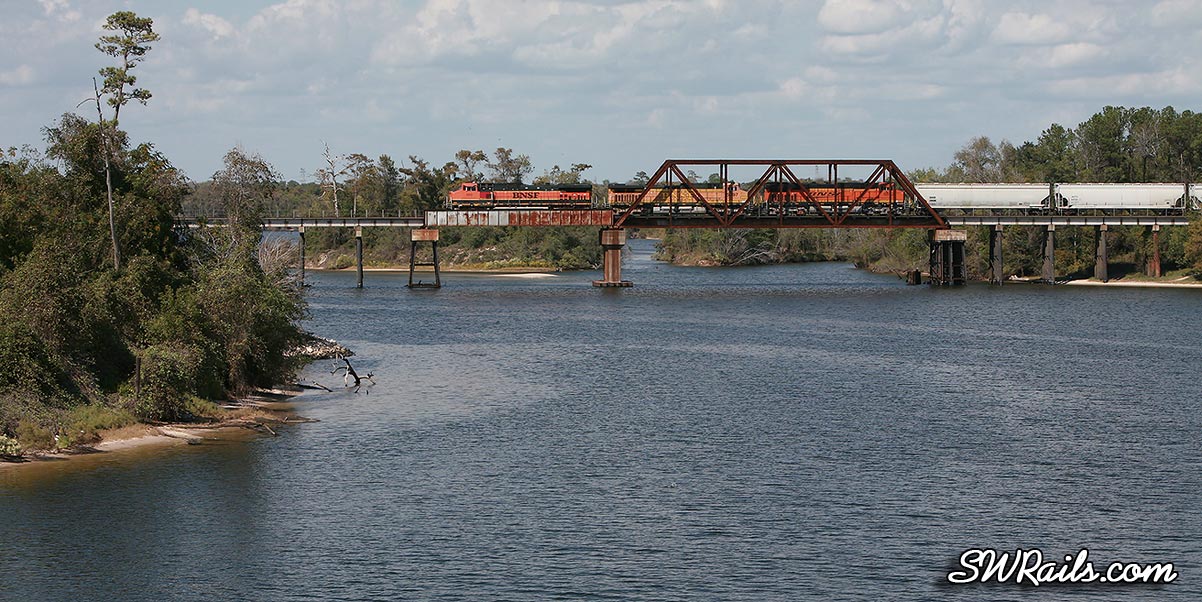
You’ve never heard of the San Jacinto River? That’s hard to believe. It holds the honor of being “one of the most polluted water-ways in Texas and contains a number of pollutants in high concentrations that are persistent in the water and riverbed.” But I digress…
Back to the BNSF 980. I caught up to it again just west of Sheldon, MP 345.
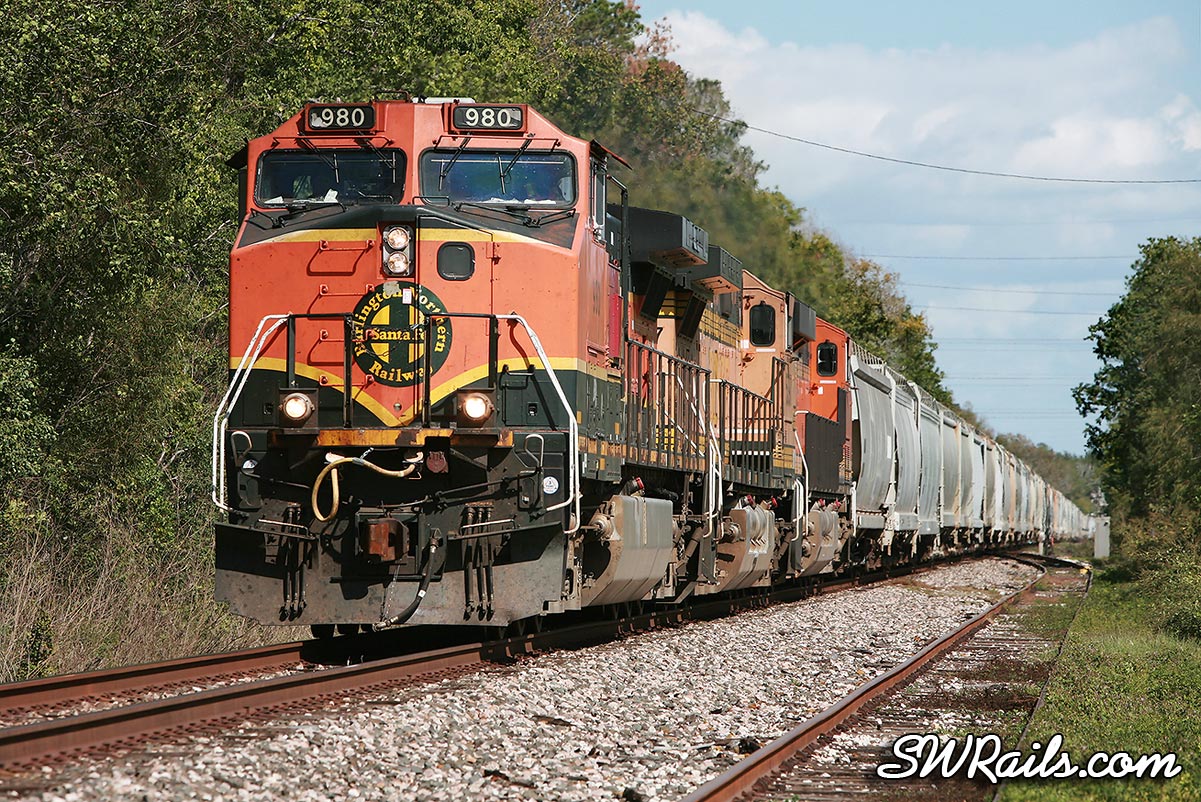
The going away shot seemed best in B&W.
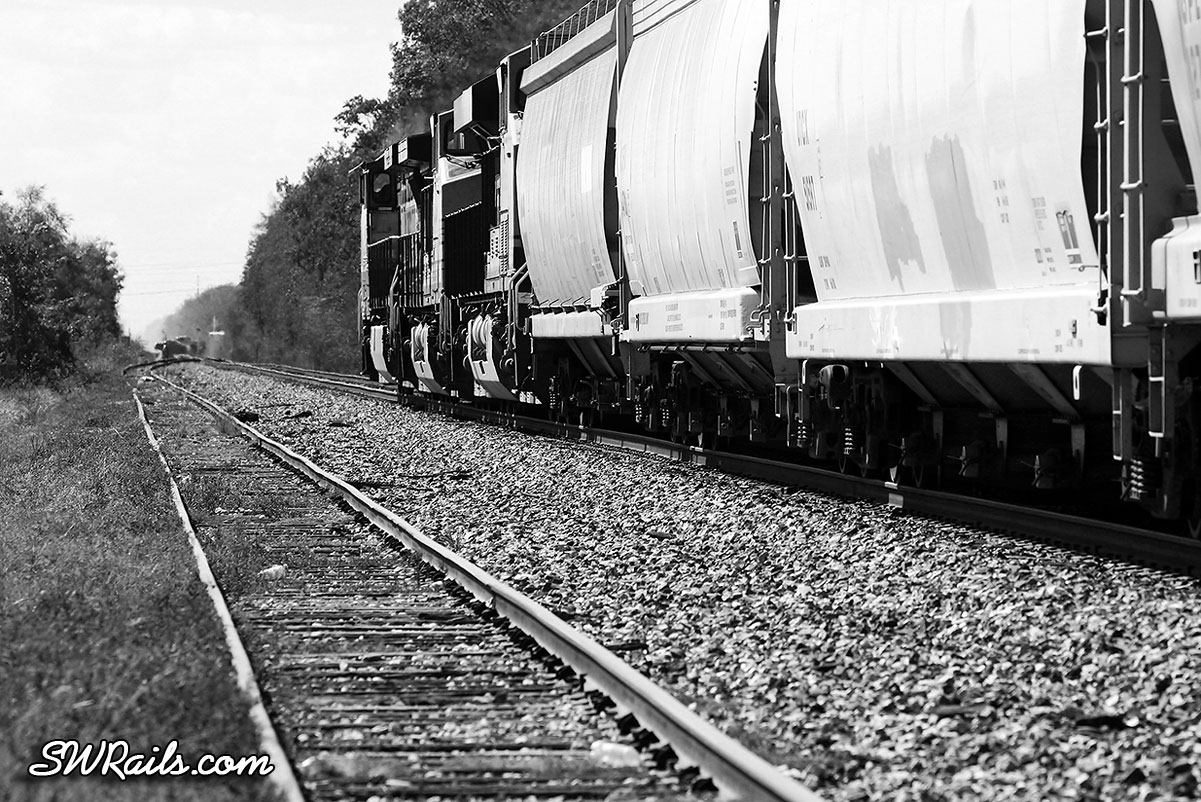
By this point, I was getting tired of this train (I know, you were tired 7 shots back!), but I decide to move to the east end of Hatchery, MP 346.7, for one last shot.
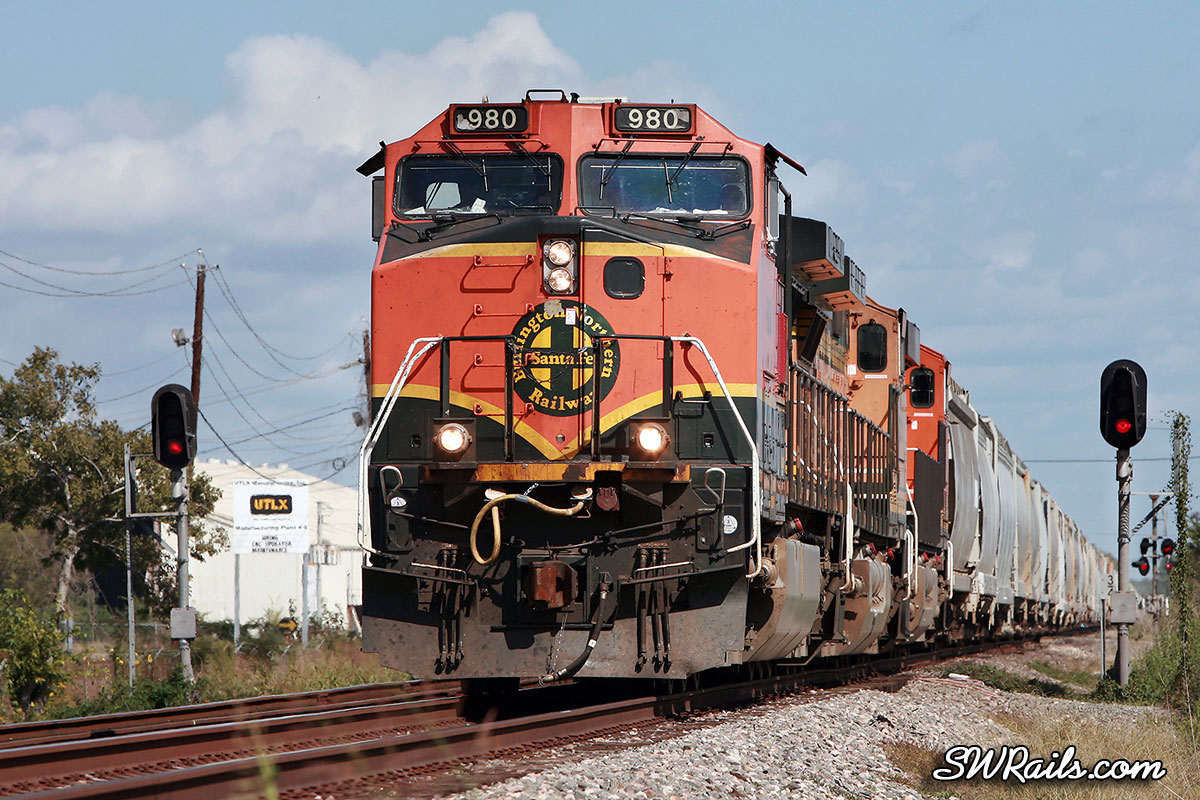
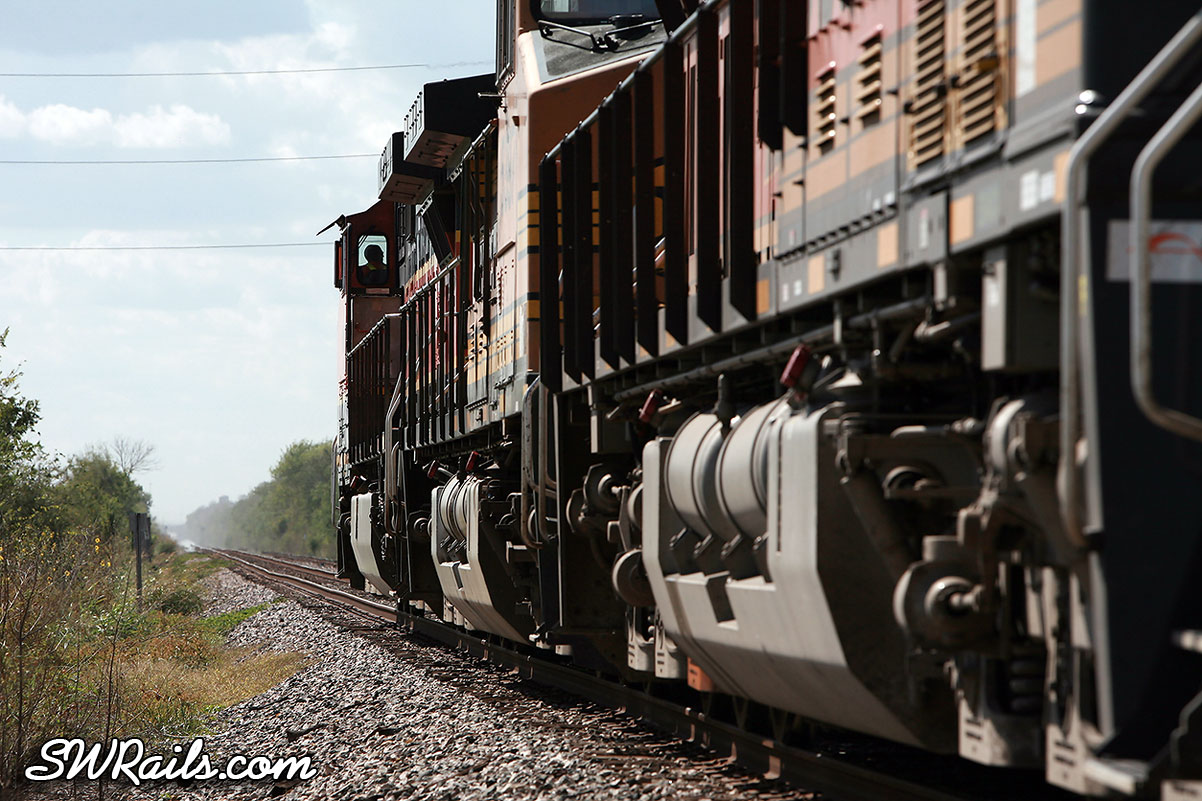
I broke off the pursuit here and headed home. I had been home for a few hours when I heard the Glidden sub DS give a track warrant to KCS 708. The number sounded familiar…
Of course! It was the same train I had seen departing Dayton at the beginning of my trip to Dayton. I headed out to the west end of the Sugar Land siding, with KCS 708 arriving shortly after I had set up.
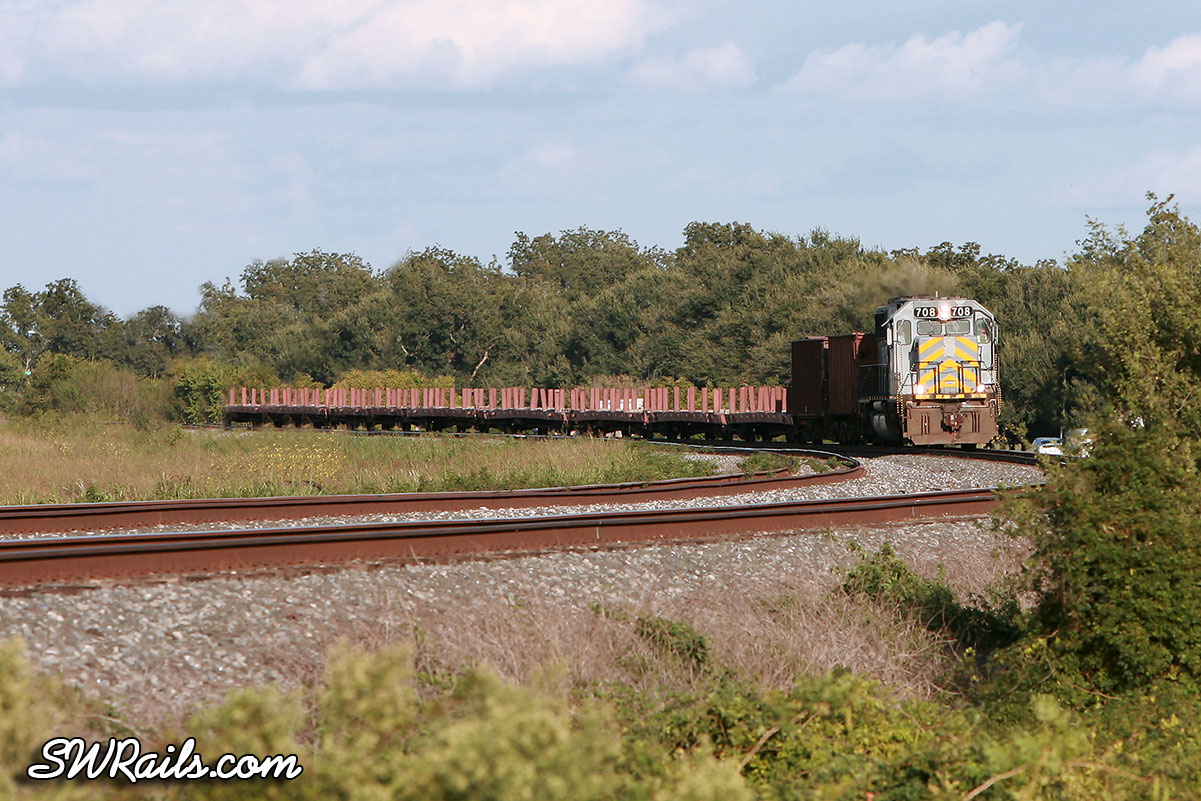
I wasn’t able to get a better shot of the train as it got closer due to the weeds to my left and at the right side of the frame. Somebody really needs to come out here with some cloppers…
En route home, I took a peek at the signal at CP SA025. It showed another westbound lined up, so I quickly made a u-turn and set up near the east switch of Sugar Land siding. Within 5 minutes, an MEWSA (Englewood to San Antonio) manifest arrived with UP 8057 on the point.
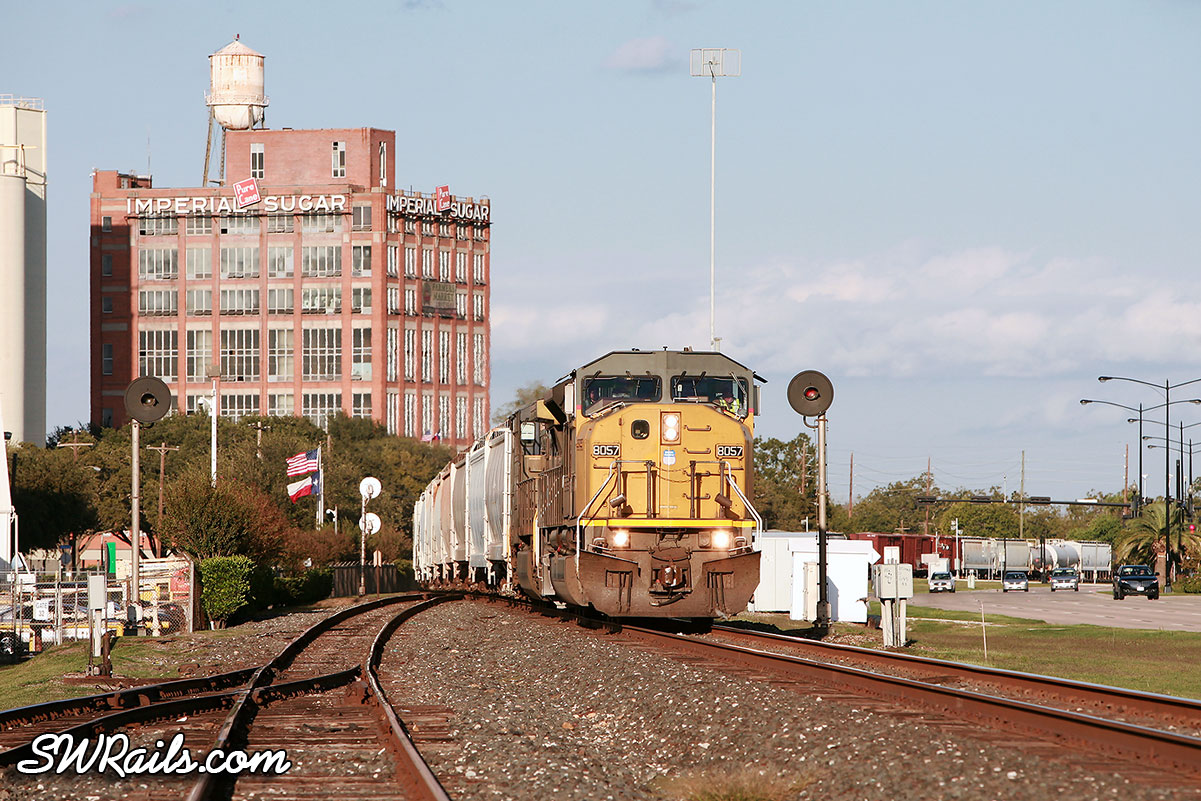
With the passage of UP 8057, I called it a day. To ensure no more railroad-related distractions, I turned off my radio and headed home.
Out & About – October 21, 2011
I went to Dayton, TX yesterday. Dayton is at MP 327 on UP’s Lafayette sub mainline, about 30 miles east of Englewood Yard in Houston. UP’s Baytown sub branches off from the east end of Dayton Yard. In addition, KCS and BNSF have trackage rights through there, so just about anything can be seen in Dayton.
Upon my arrival, a BNSF job with 2 gensets was waiting at the west end of the yard, with a headlight in the background. Note how the head end of each train is in good light, with a big cloud shading the train. The clouds were moving so quickly, I wouldn’t know until the last second whether I’d have good sun or not.
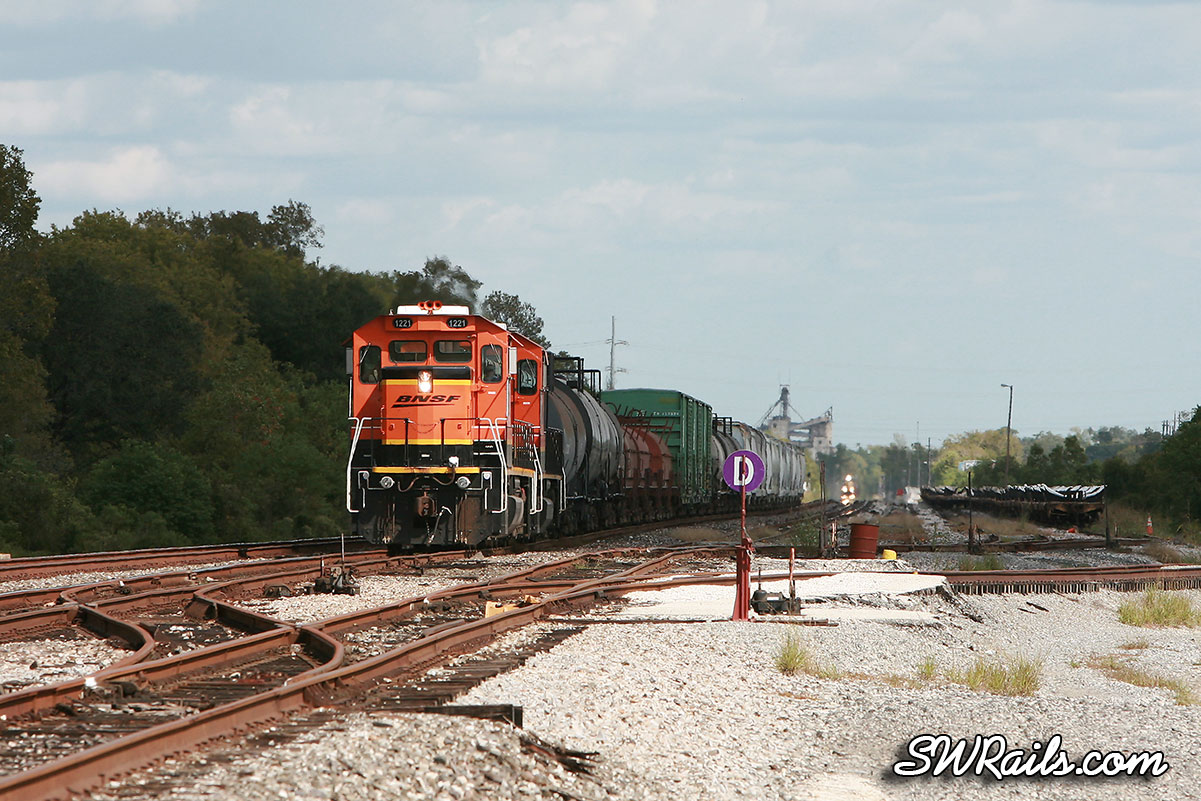
BNSF 1221 waits at the west end of Dayton, TX as a westbound approaches in the background.
The threatening cloud moved on as the distant headlight revealed itself as KCS 708.
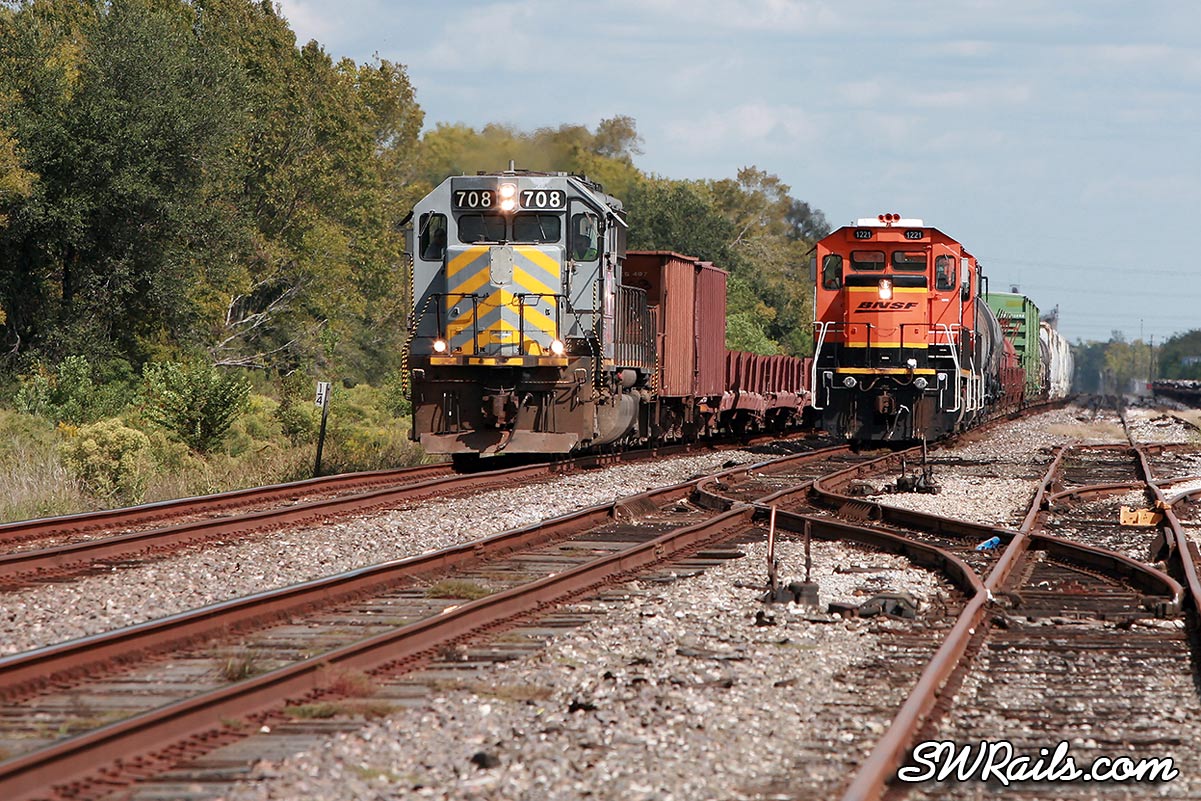
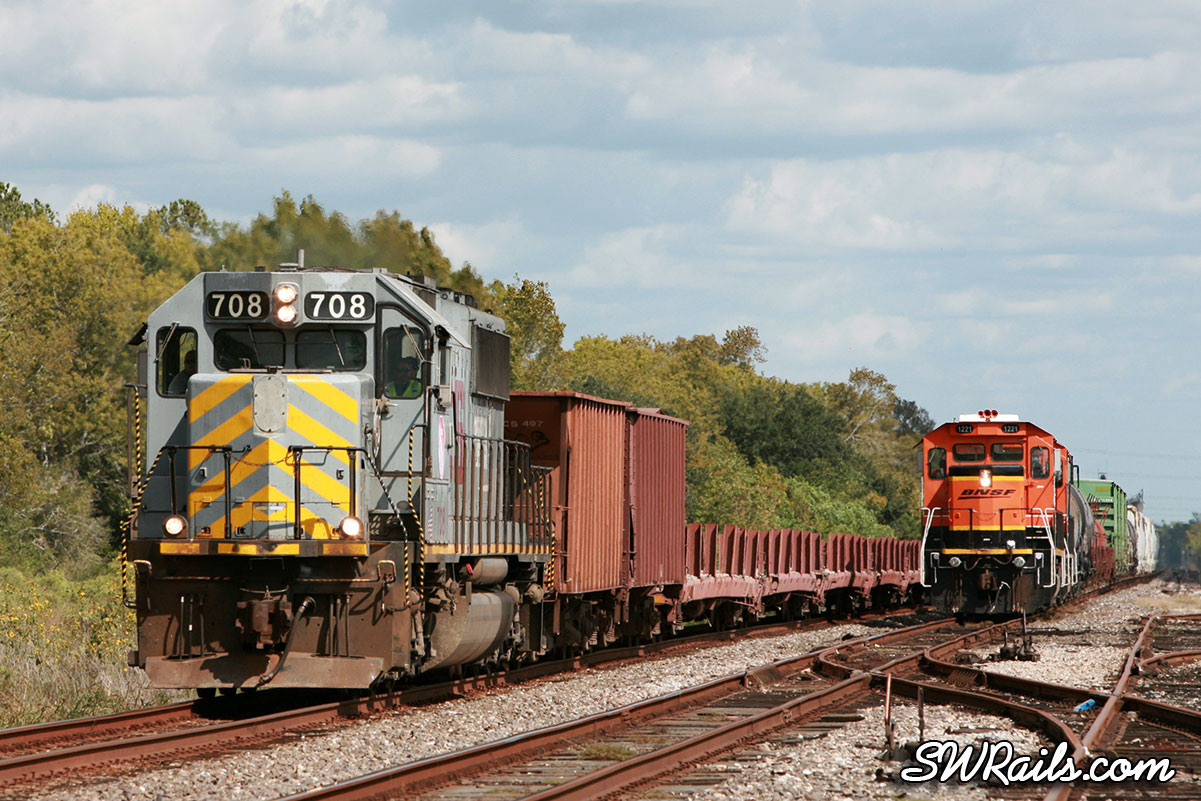
It was a short train of some odd-looking flat cars. The decks appeared to have ballast on them. Any KCS fan out there know just what these cars are for?

Once the KCS got by me I headed toward the east end of Dayton Yard where a BNSF train was coming off of the Baytown Branch. As soon as I arrived, I saw BNSF 980 crossing Hwy 90 as it prepared to enter Dayton yard.
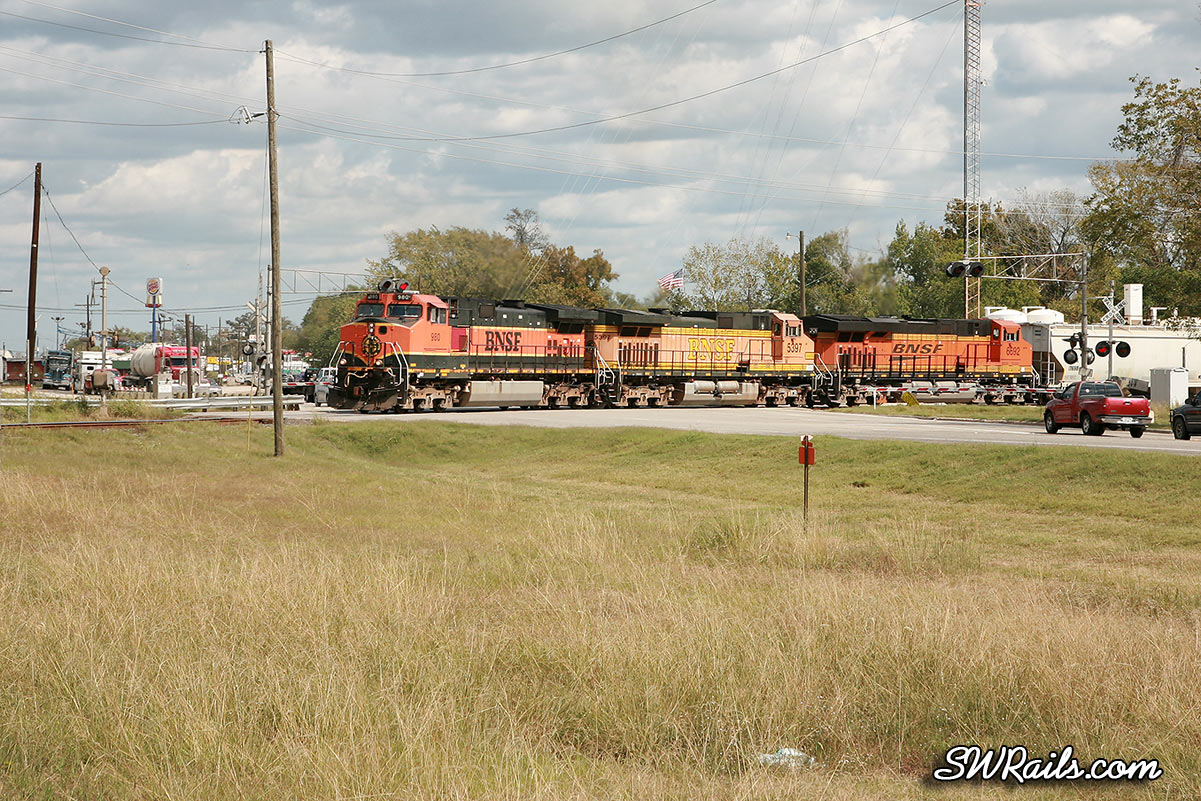
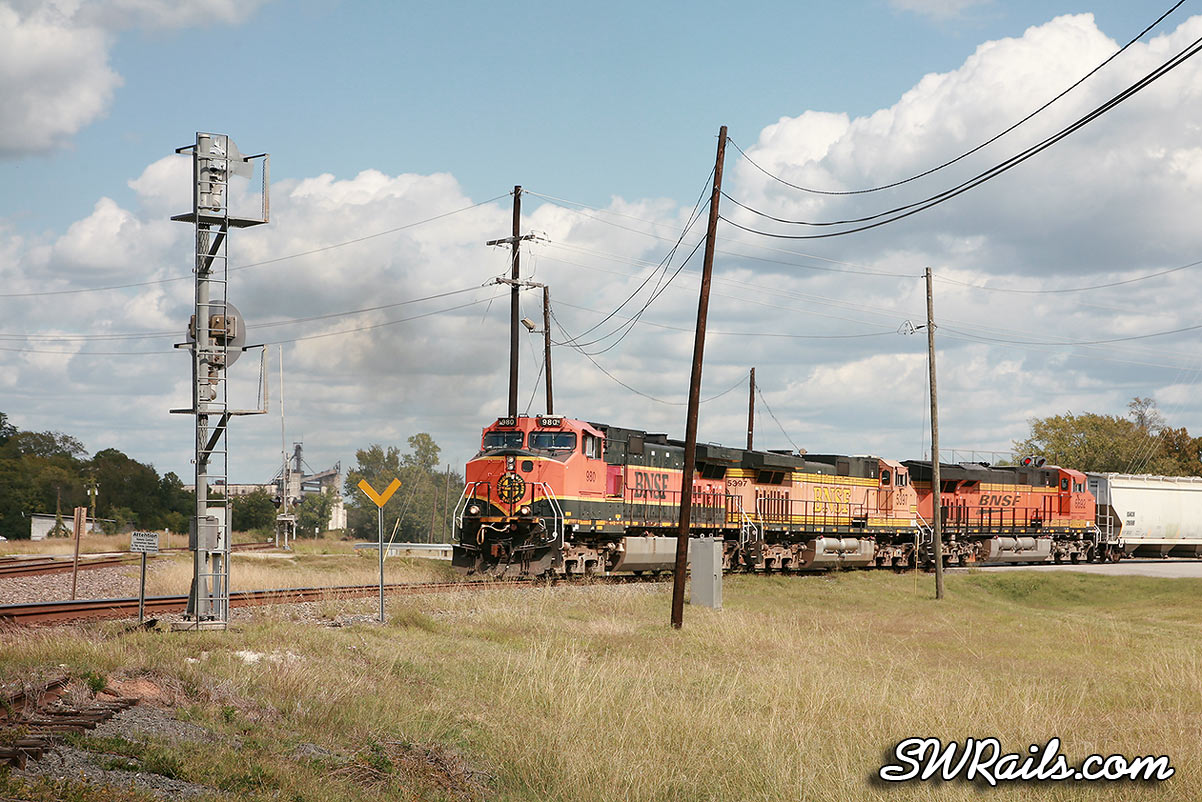
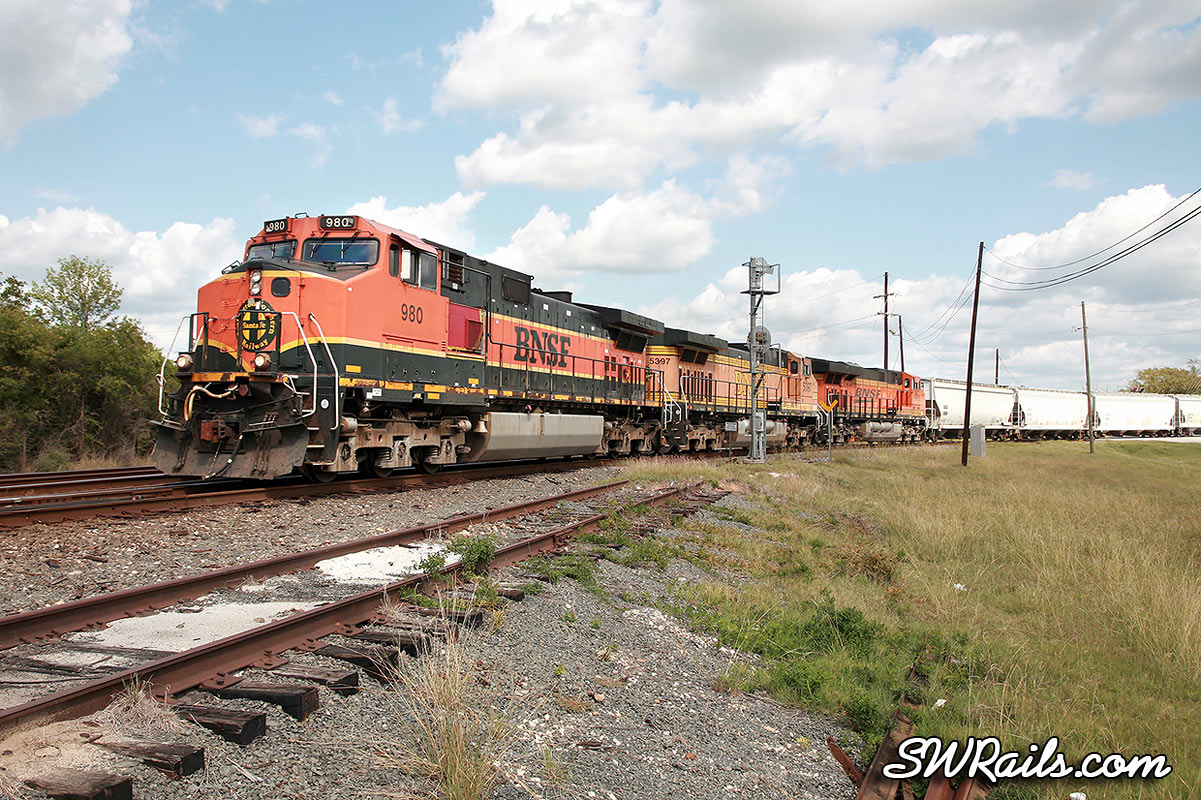
I don’t get to see much BNSF H1 on the point these days, so I decided to chase this train on my way back to Houston. The images from that chase will be the subject of my next post, hopefully tomorrow…
Blasting Out Of Bloomington
Crew change completed, UP SD70ACe 8343 and an NS GE blast out of Bloomington, Texas with a southbound manifest near midnight on Feb. 18, 2008.
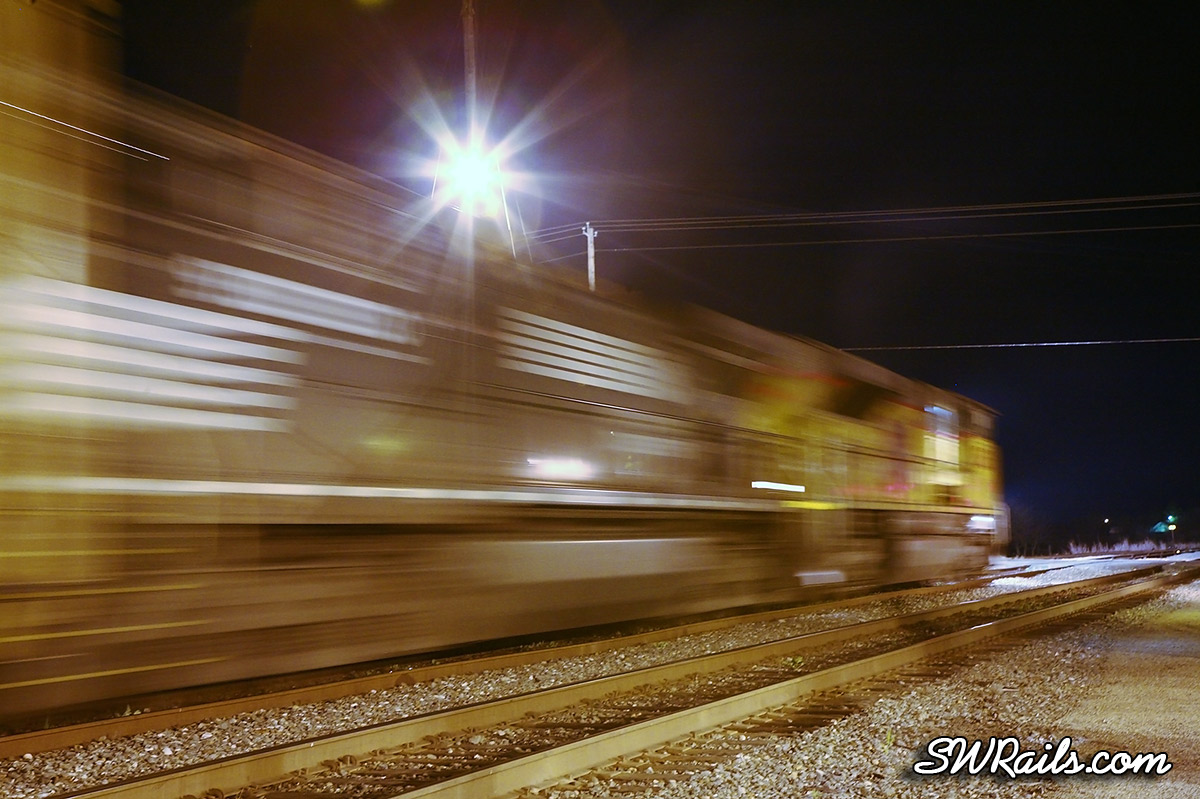
Or at least appears to blast…
The train is actually doing no more than 5 mph, but a slow shutter speed on my Canon 5D combined with the horizontal lines on the NS engine give the impression that the train is flying.
Camera settings were 1.6 second exposure at f4.0 with a 1600 ISO.
 Southwest Rails