PTRA Power – 1976
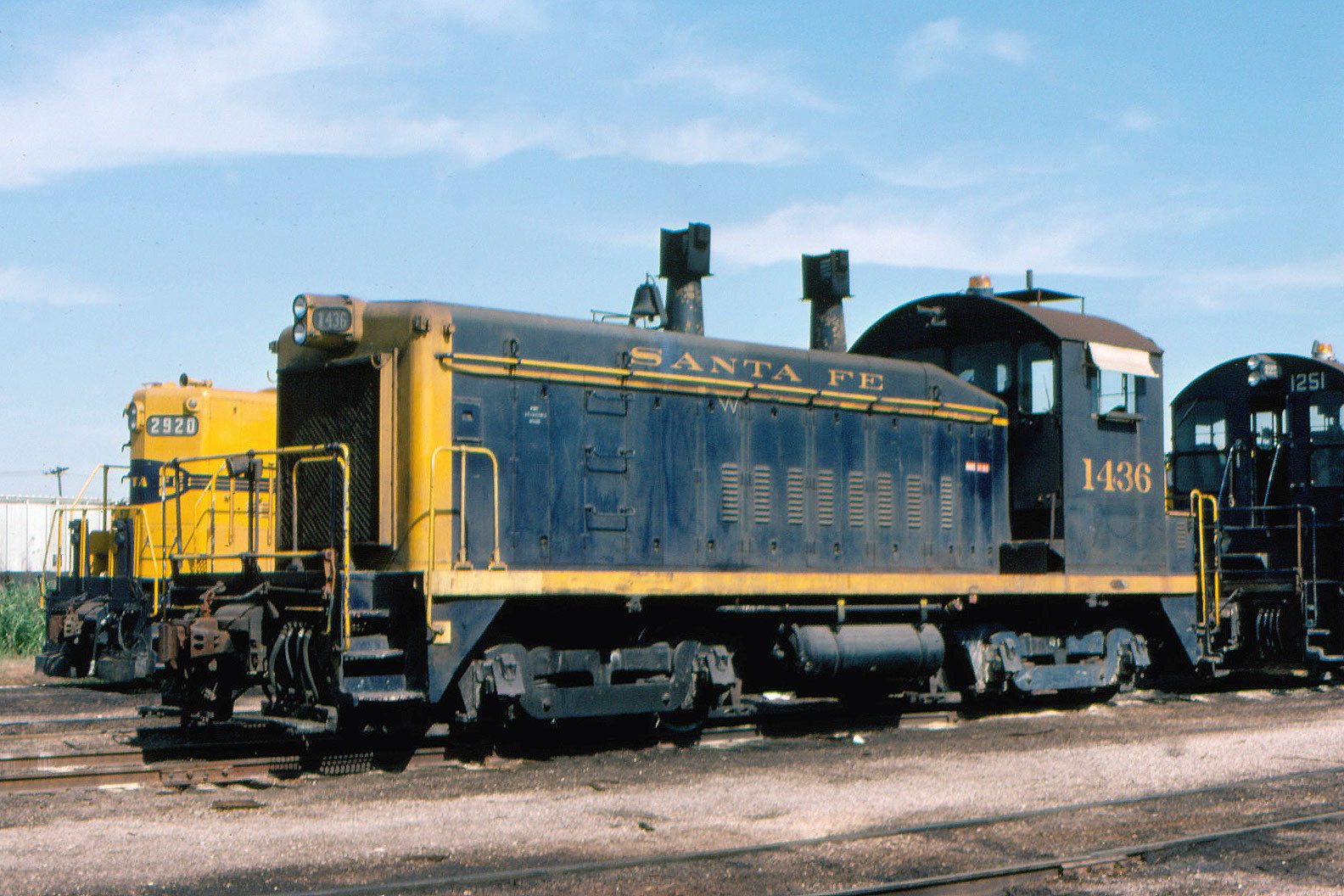
In case anybody cares about the PTRA, here’s a slide from my collection of Santa Fe SW9 1436 between assignments at the PTRA roundhouse in Houston on 4/25/76. It’s accompanied by MP 1251 and ATSF GP9 2920. PTRA motive power was supplied by its owner railroads until the 1996 arrival of the MK1500D’s. Before that, it wasn’t unusual to see power from all of its owner railroads (ATSF/BN/CRIP/MKT/MP/SP in 1976) mingling together here.
For the rivet counters, ATSF 1436 is a 1953-built SW9. It’s original road # was 2436 which it held until 1974 when ATSF decided to re-number all un-rebuilt switchers to the 1400 series. Upon graduating from its re-building at San Bernardino in 1/78, this unit became ATSF 1236 and received a Santa Fe model designation of SSB1200.
In 1984, the Santa Fe decided it was done with its 29 end-cab switchers. 18 went to Amtrak in partial trade for the 5250 class SDP40’s, with the balance sold to dealers or traded in to GE. This particular unit ended up at US Steel’s Fairless works in Pennsylvania.
Sugar Land TX – Now and Then
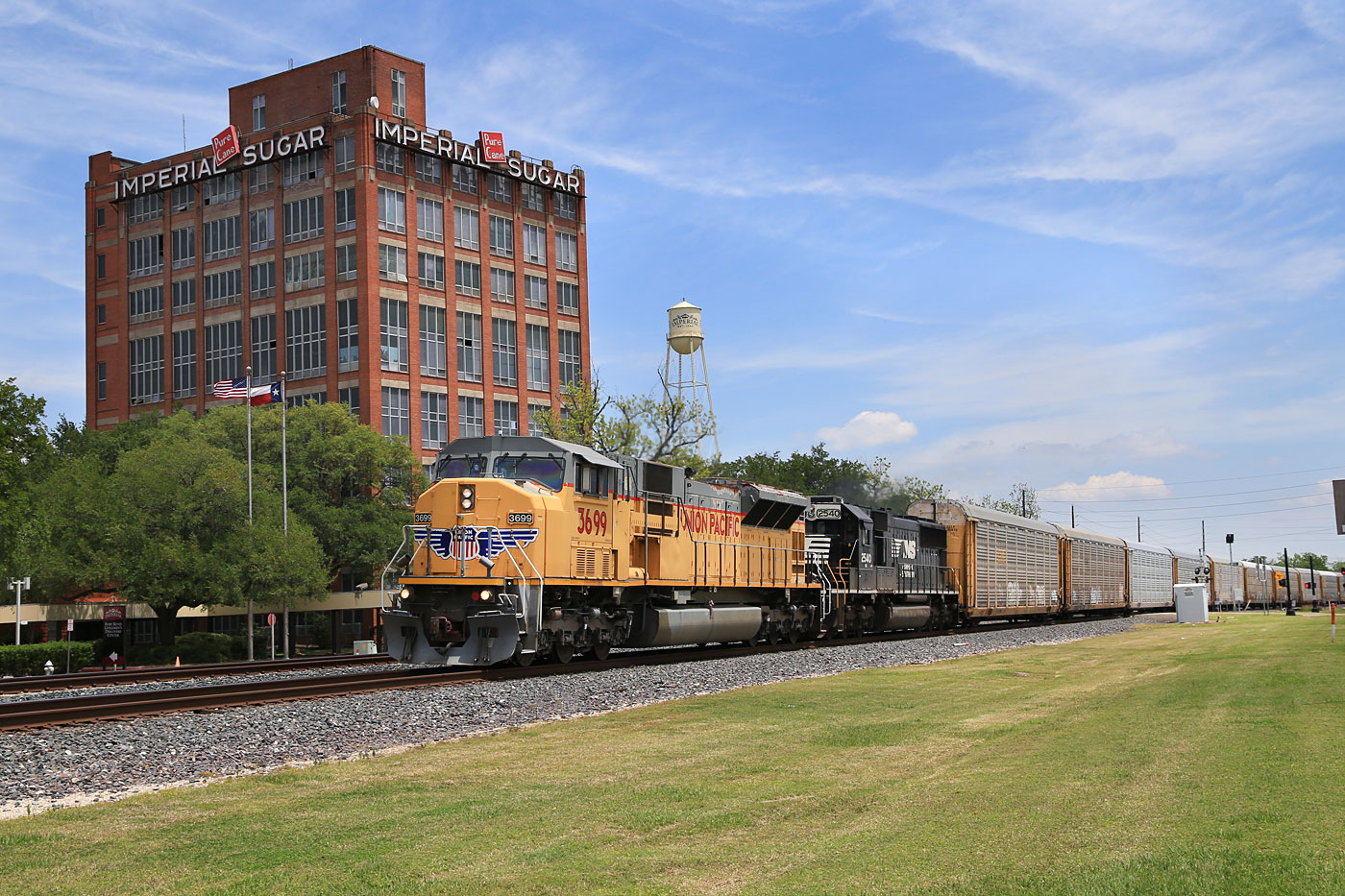
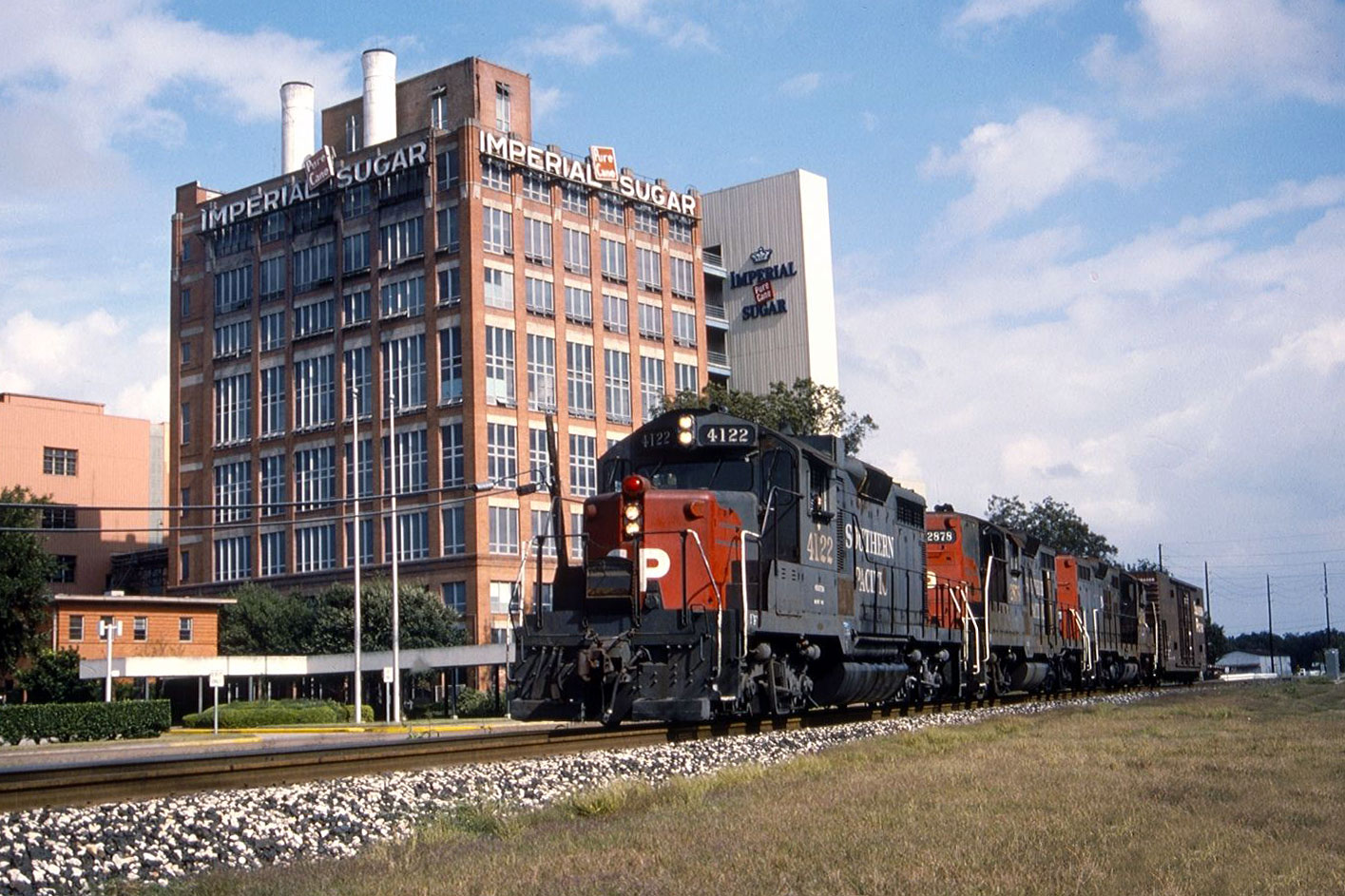
I had the good fortune of catching one of the dozen or so reactivated UP SD90MAC’s yesterday leading an empty auto rack train. UP 3699 led the AWFBVR 29 past the iconic Imperial Sugar mill building, virtually at the same location where SP GP20 4122 was captured leading a local just under 30 years ago on 11/25/88.
Lots of changes in 30 years, wouldn’t you say?
Who Needs Sun For Photography?
This past Monday evening, 4/16/18, found me pursuing my after-dark railfanning pastime, assisted by 6 speedlites. Nothing earth-shattering (thank goodness!), but some interesting trains nonetheless.
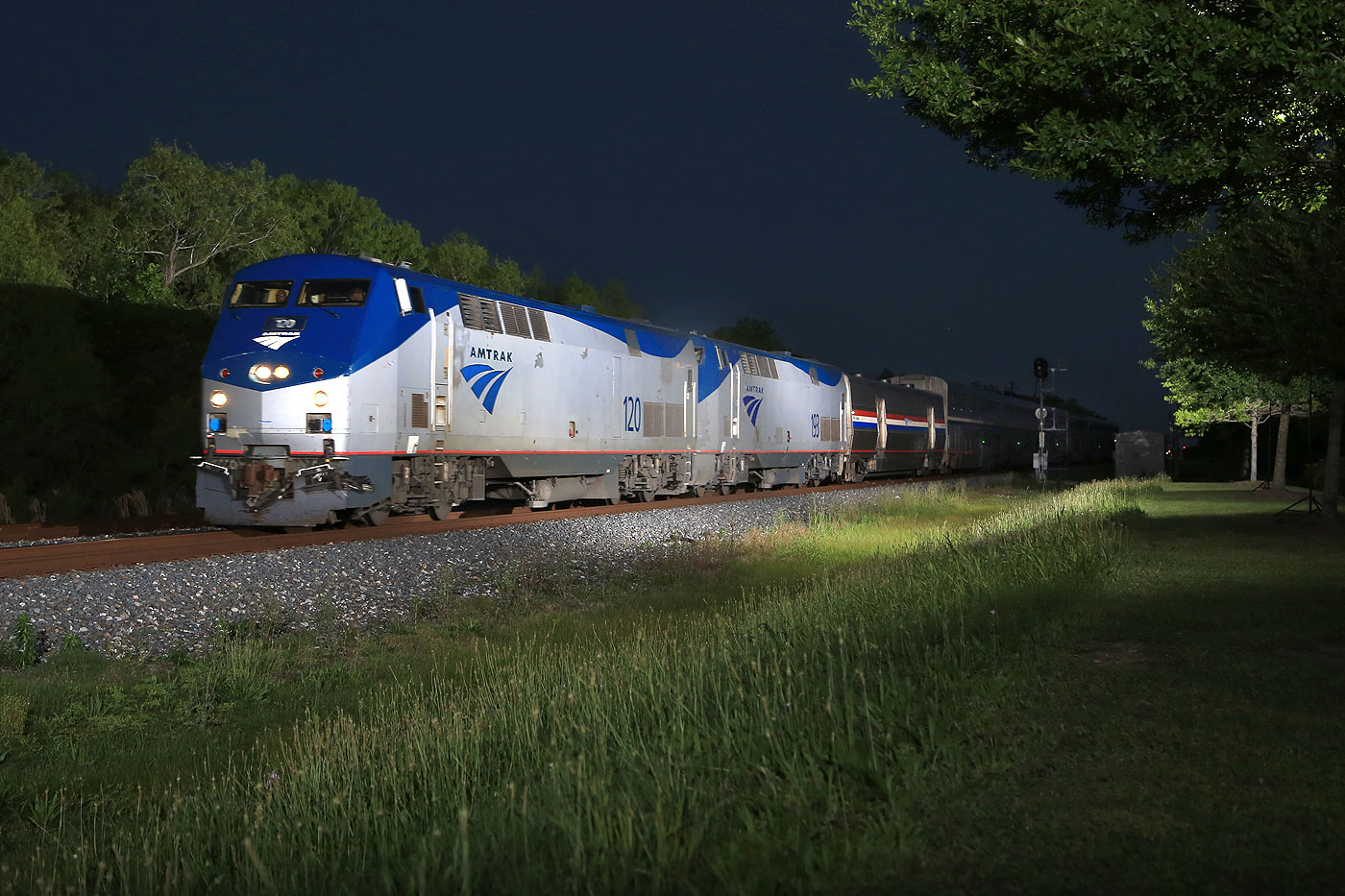
First up, Amtrak #1 was running about 30 minutes behind schedule, passing through Stafford, TX at 2007 with just a hint of color in the sky.
One of my main targets this evening was this train, the MSALI 16 with 2 NS motors. Anytime I can get 2 NS EMD’s together is a good time. It passed me in Stafford also, at MP 19.5, at 2031.
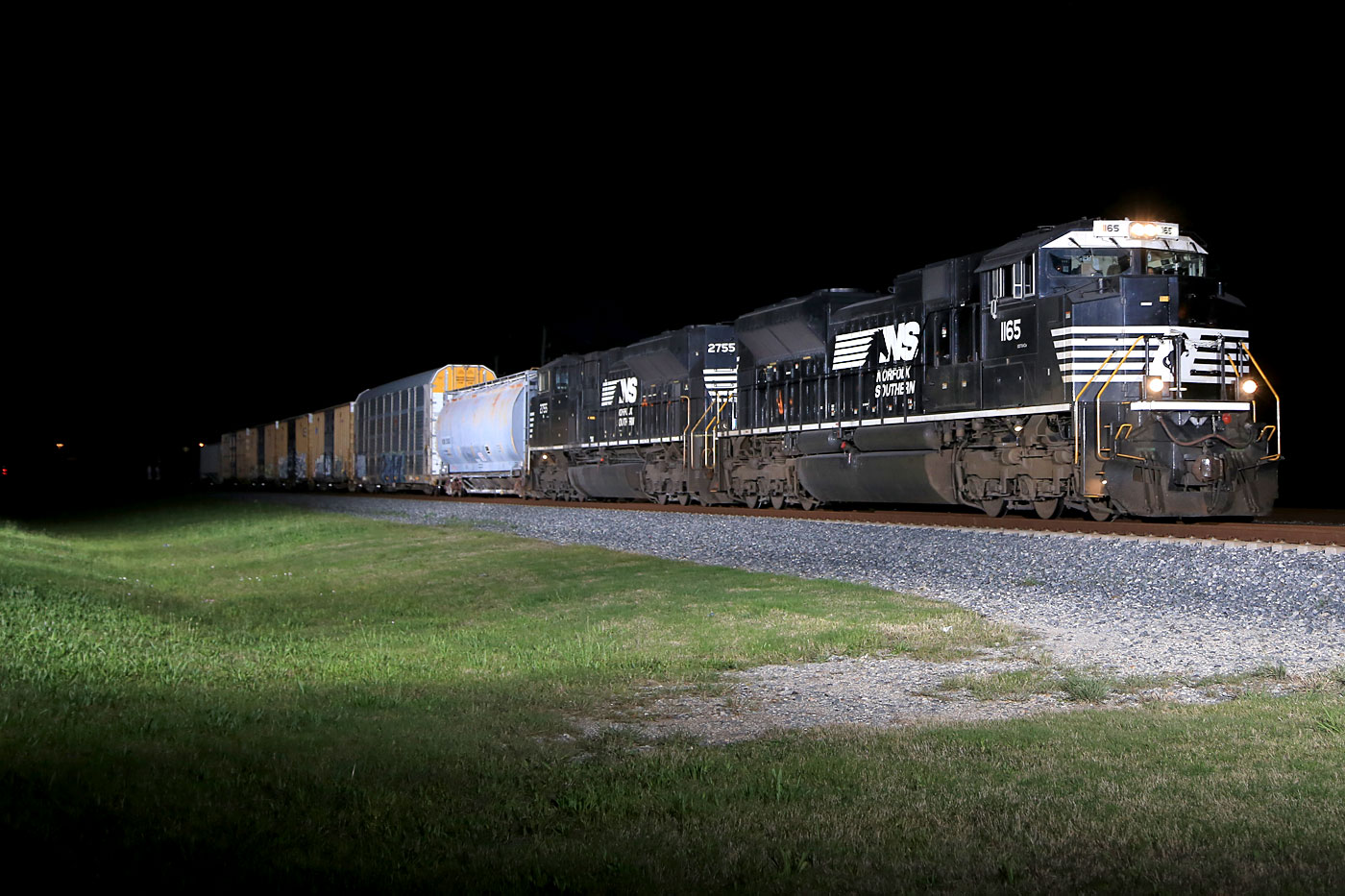
I almost wrapped up my evening after this train because UP Glidden sub traffic dried up and I had to complete my 1040. Alas, the 1040 would wait because I received word that the BNSF 191 local had 2 H-4 EMD’s on it. Off to Rosenberg I went to await it at the south switch. It took a little longer than I expected for it to arrive, but the wait paid off when I saw these beauties pass me at 2223.
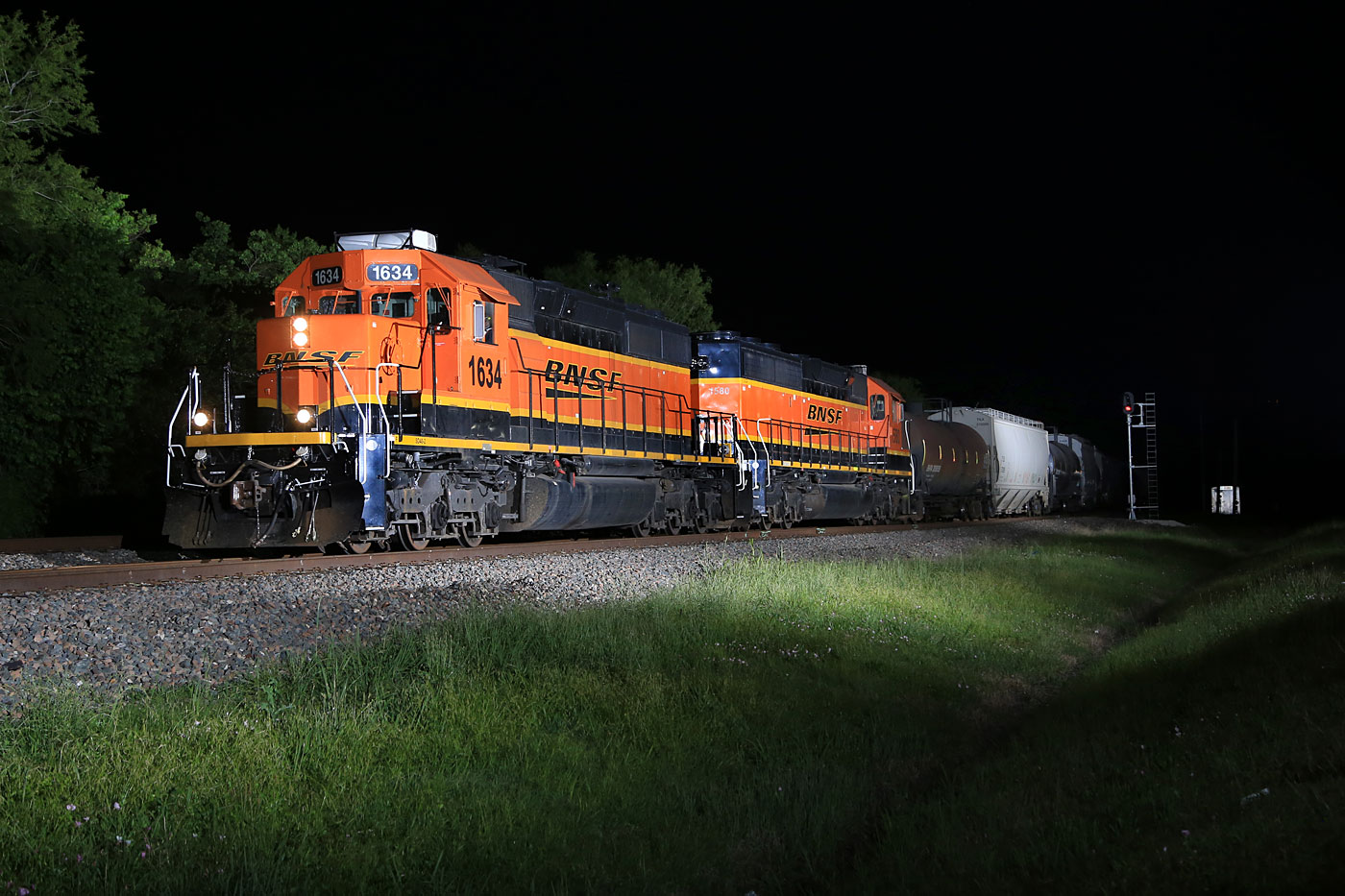
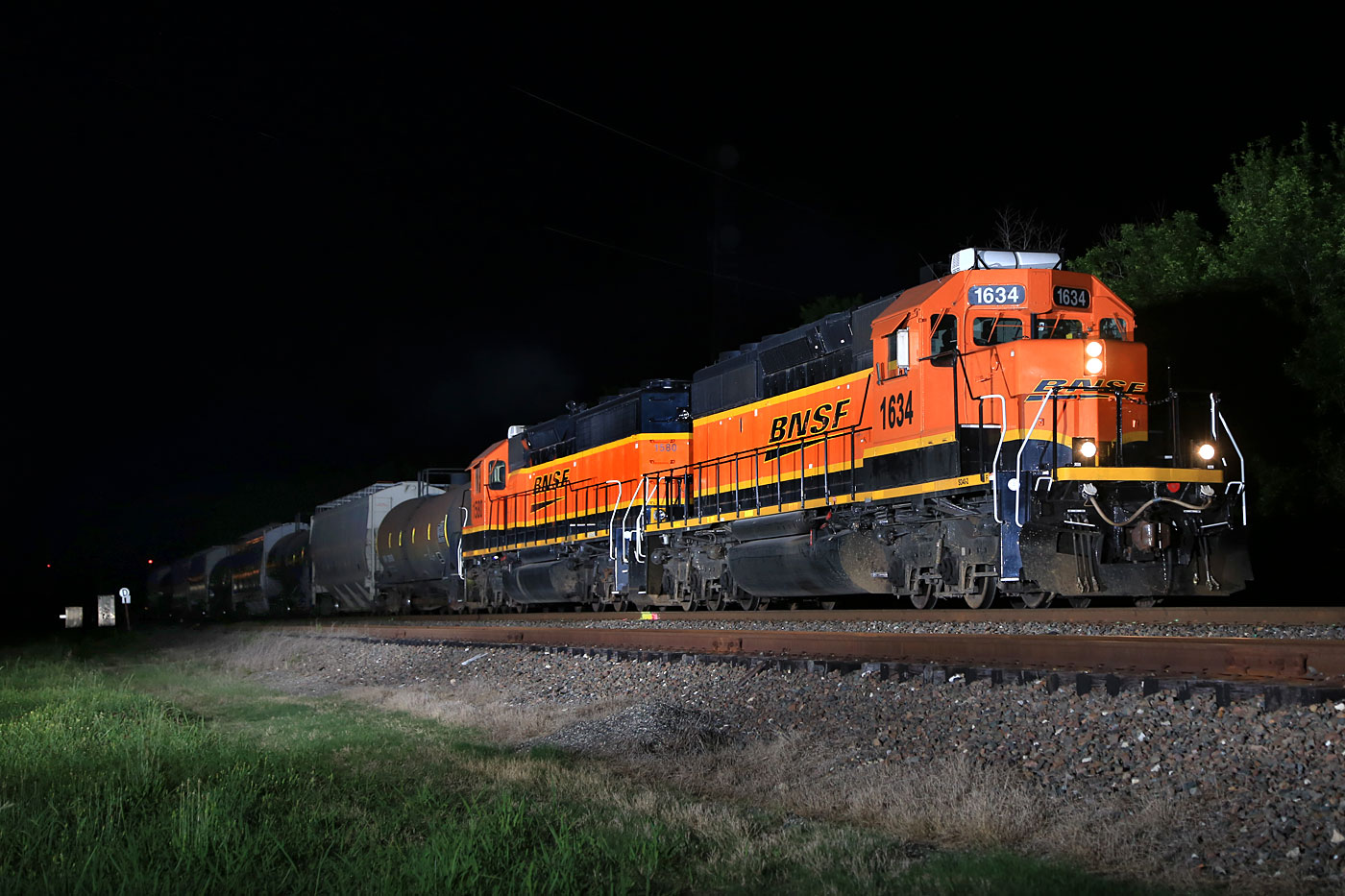
The 191 local would wait for 2 moves across the CP SA036 interlocking, allowing me plenty of time to relocate for one more view of it just north of the diamond at 2303.
As I waited for the BNSF local above, I could hear another of my targeted trains in the UP Rosenberg siding. I didn’t think I’d shoot it because the dispatcher had put FXE 4068 there about 2100, where I expected it would expire. When the DS told a KCS train that he’d follow one out of the Rosenberg siding, I knew my evening wasn’t done yet.
I relocated back to the Stafford area to await FXE 4068, the UAAUL, on an empty Magnetation train. It arrived at 2358.

As I waited for FXE 4068, ATCS showed a westbound was approaching me. I wasn’t worried because it was on Main 1 and wouldn’t block me, but I’d like to get a going away shot of it if possible. Luck was with me as seconds after the rear of FXE cleared, UP 8552 came by with the QEWWC 16 right at midnight.
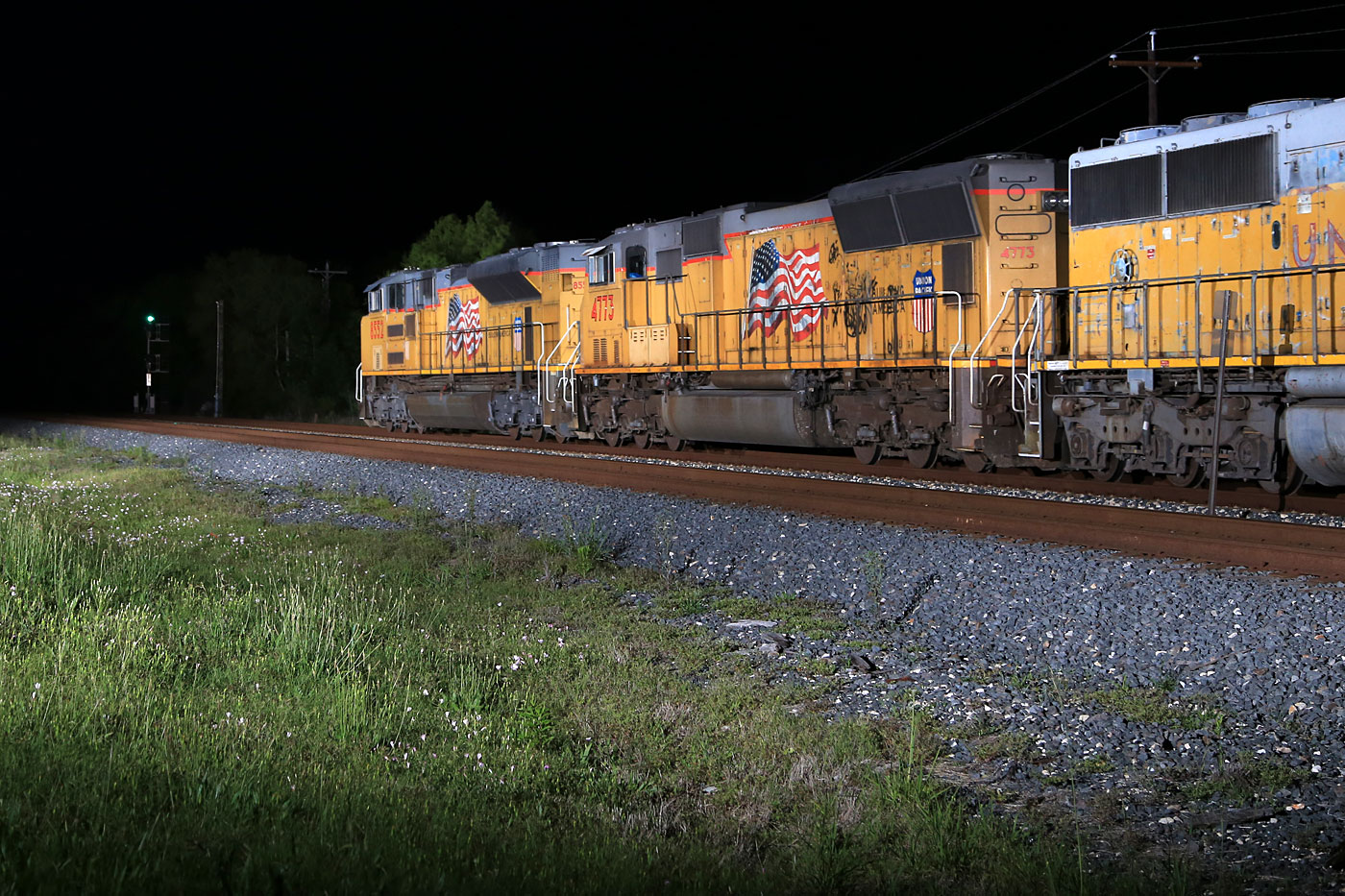
I didn’t realize there was an SD60M trailing until seconds after taking the shot. Oh well. But, it is the QEWWC, and there will be a DPU photo-op.
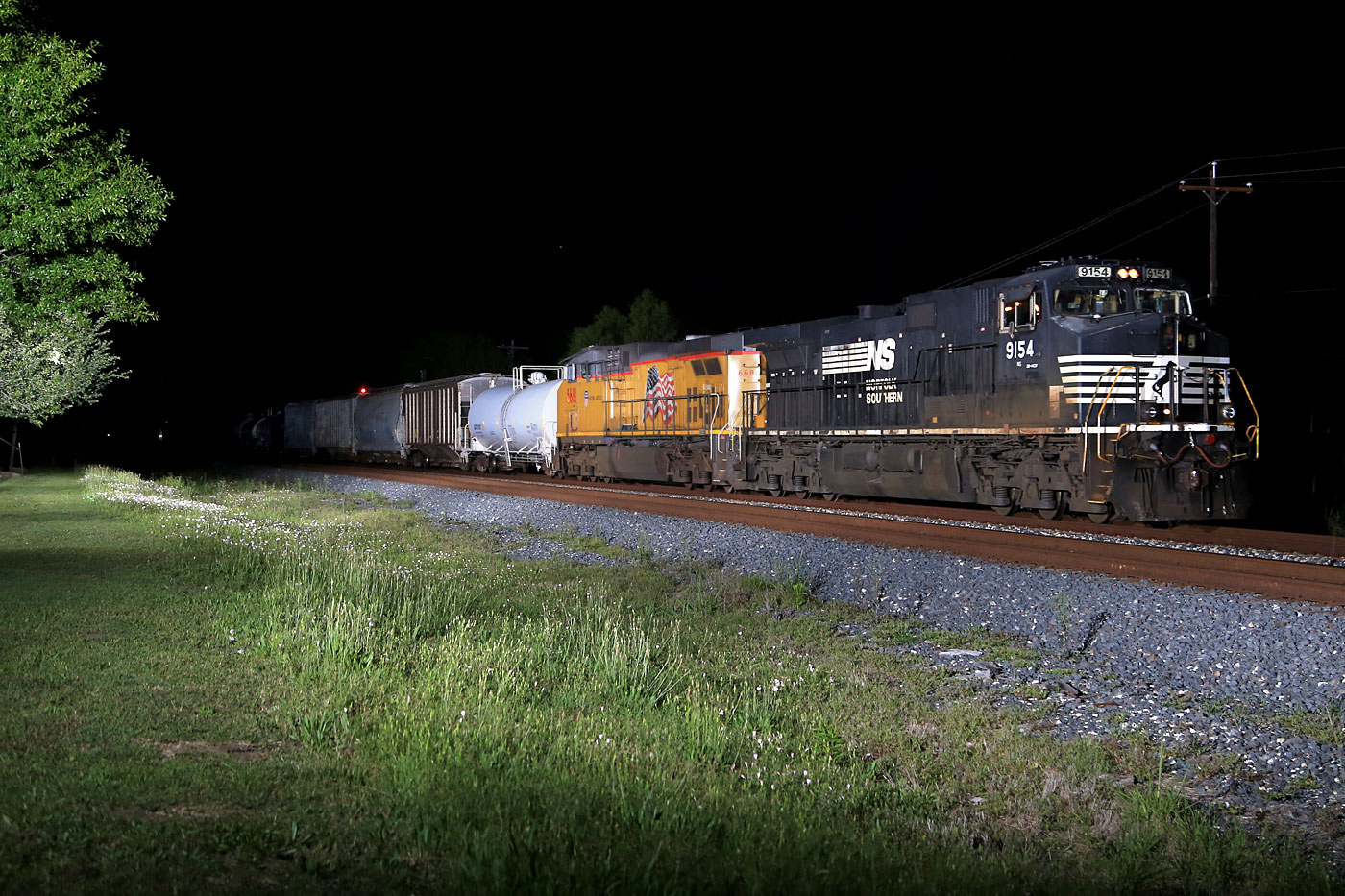
Last train was this KCS manifest with SD70ACe 4117 at 0012.
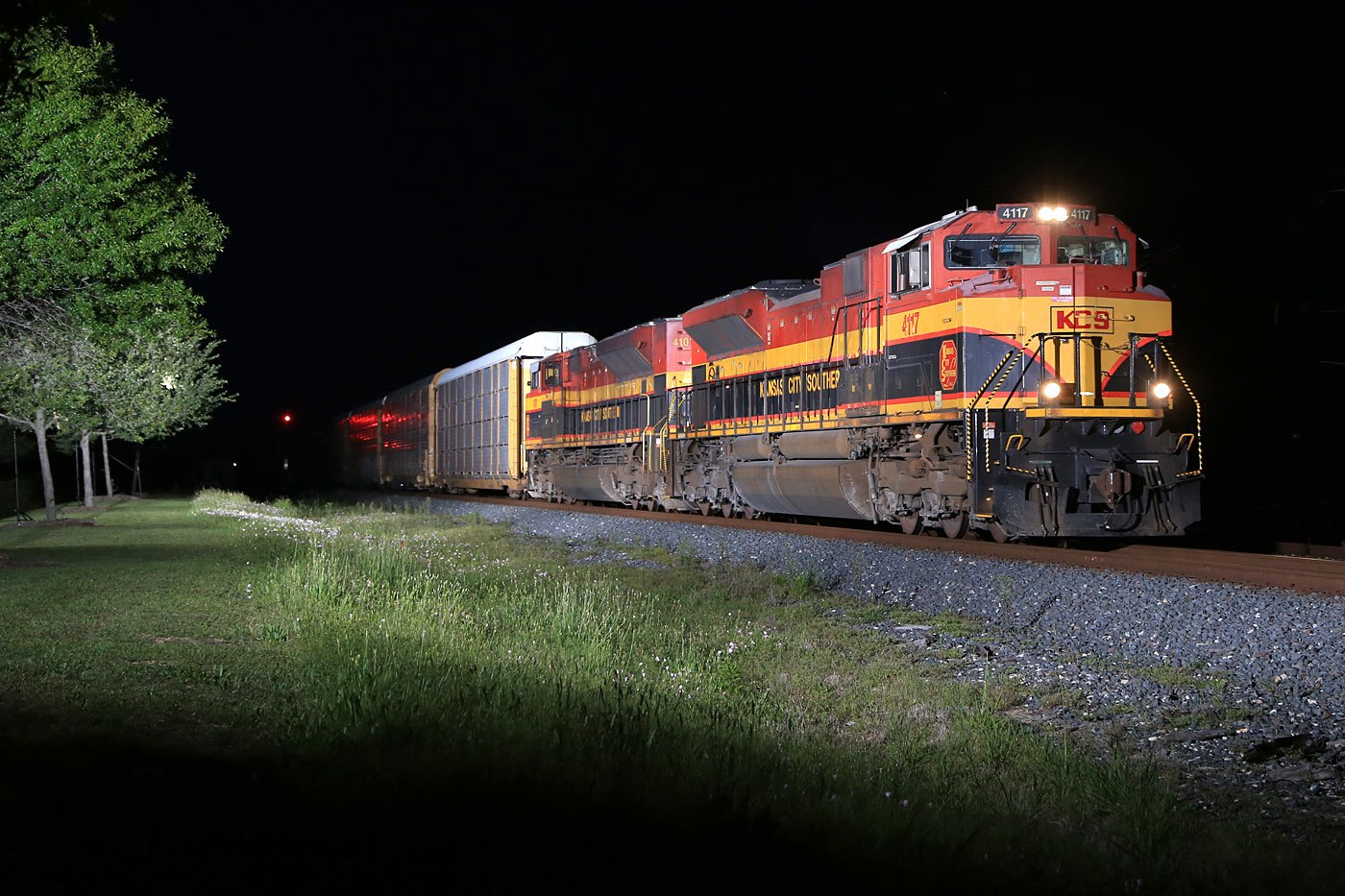
All in all, I’m getting a little better at the flashing game, but still lots of room for improvement.
Ten Years Ago, Never Again, Sad
Answer: Ten Years Ago, Never Again, Sad.
Question: When did UP 6936 last pass through Houston, when will it return to Houston, and how do I feel about it?
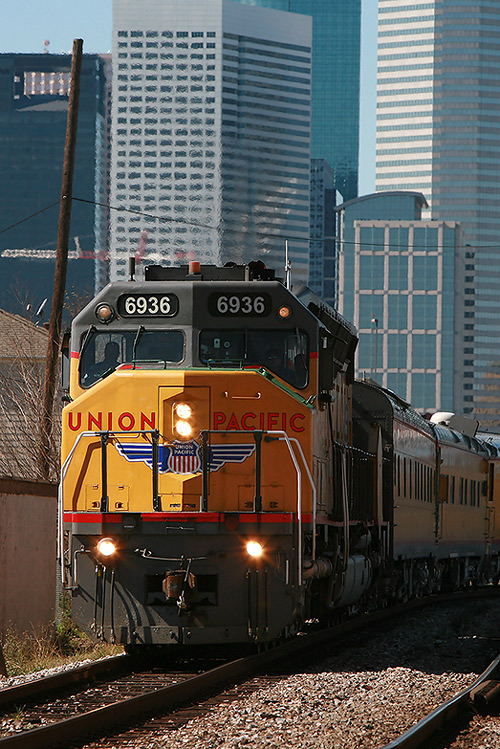
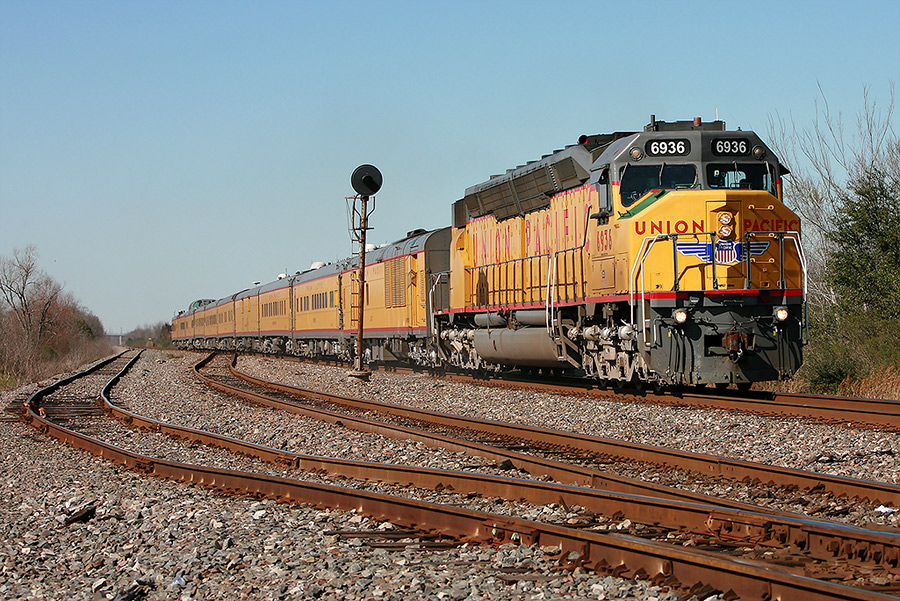
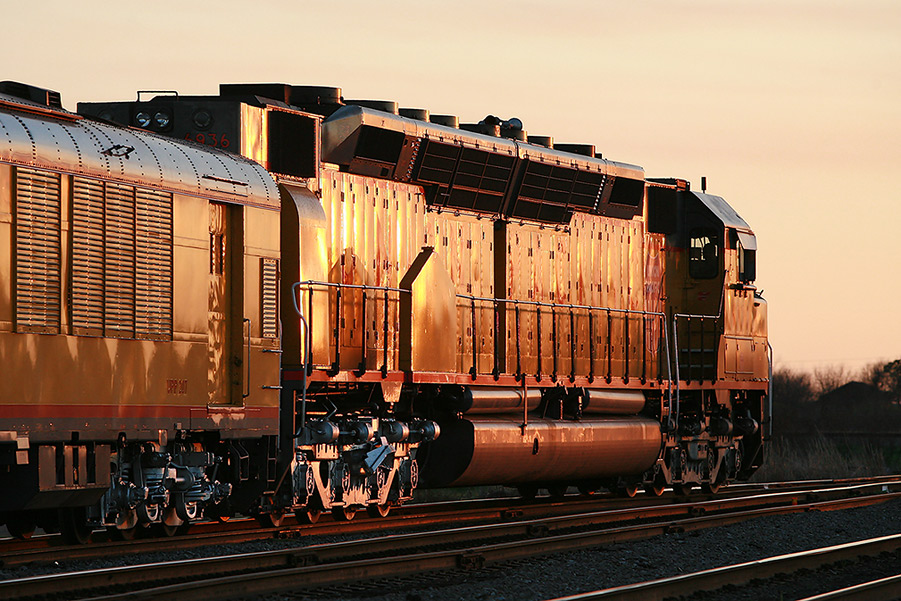
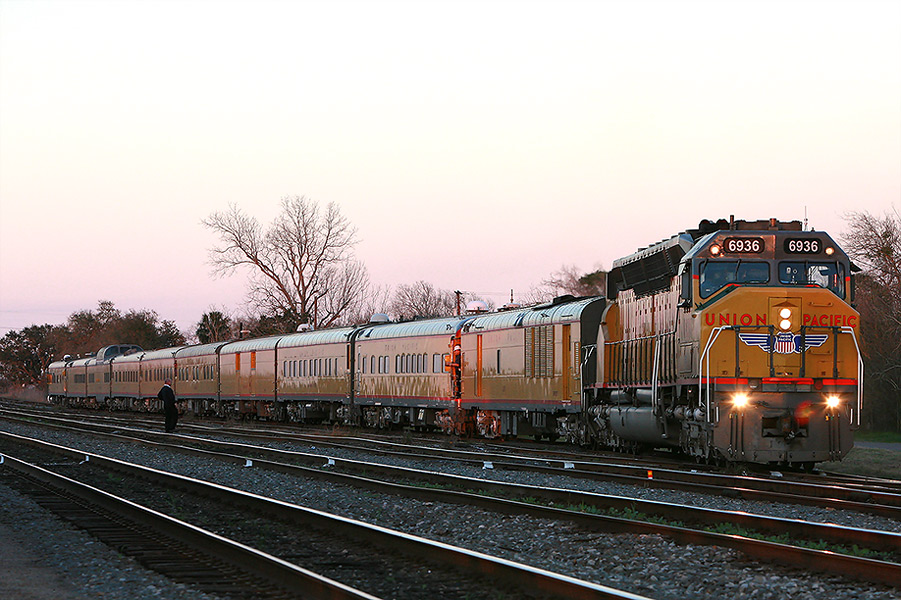
It’s been just over 10 years since UP’s last operating Centennial locomotive, 6936, passed through Houston. It was Bill Wimmer’s, head of UP’s Engineering Department, preferred locomotive to power their inspection trains throughout the system back then. Wimmer retired some years back, meaning the 6936 will never travel around the system again. That bites, but that’s business. And that’s life.
So indulge me in this trip down memory lane. Pics and (edited) text from a post that I made on Train-Orders back then.
Perfect weather, but everything else was a battle, in my quest to document the passage of UP 6936 leading the 2008 Wimmer Engineering Dept. special train through the Houston area on 2/18/2008.
The 6936 beat me to the first photo location I’d planned because I forgot to program my radio with a frequency that I’d need, so I had to go back home. I lost 30 minutes because of that mistake, then wreck related traffic congestion cost me another 10 minutes. Sigh.
We’re on the Wayside Ave. overpass as the SAVBL 18 (Special Avondale – Bloomington) approaches the Englewood Yard office for the crew change. I had just taken the first telephoto shot of the train when an HPD officer approaches me and wants to know what I’m doing. I try to explain quickly, but he’s not satisfied. He wants ID. So I miss some of my shots while I extract my ID so he can perform *Security Theatre*.
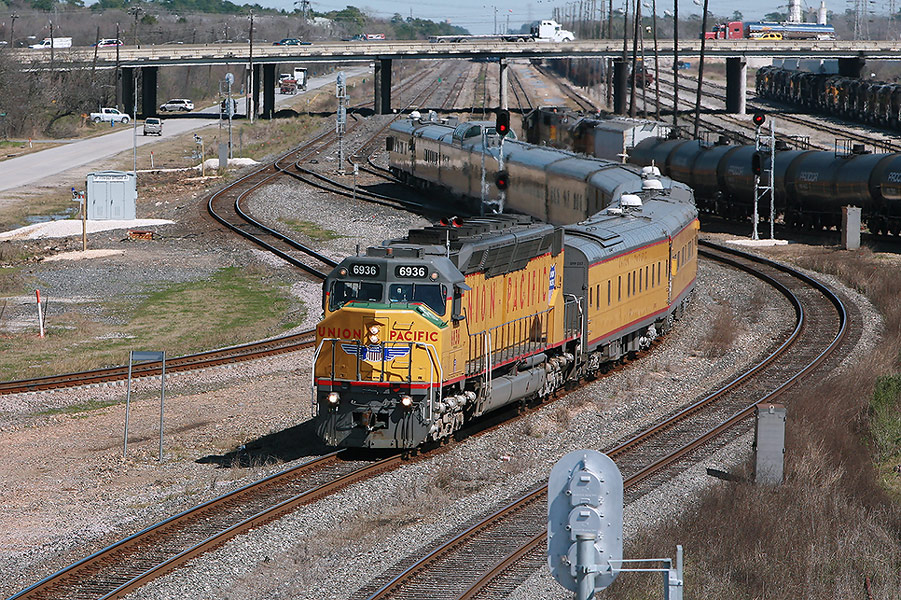
Fortunately, I wasn’t in a terrorist watch list and I had no unpaid parking tickets, so I was allowed to go on my way without too much time lost. Here we see the crew change at the east end of Englewood Yard.

Rolling past now-closed Tower 68 at the West end on Englewood. A UP Terminal Dispatcher now directs traffic from the Spring Dispatching Center.
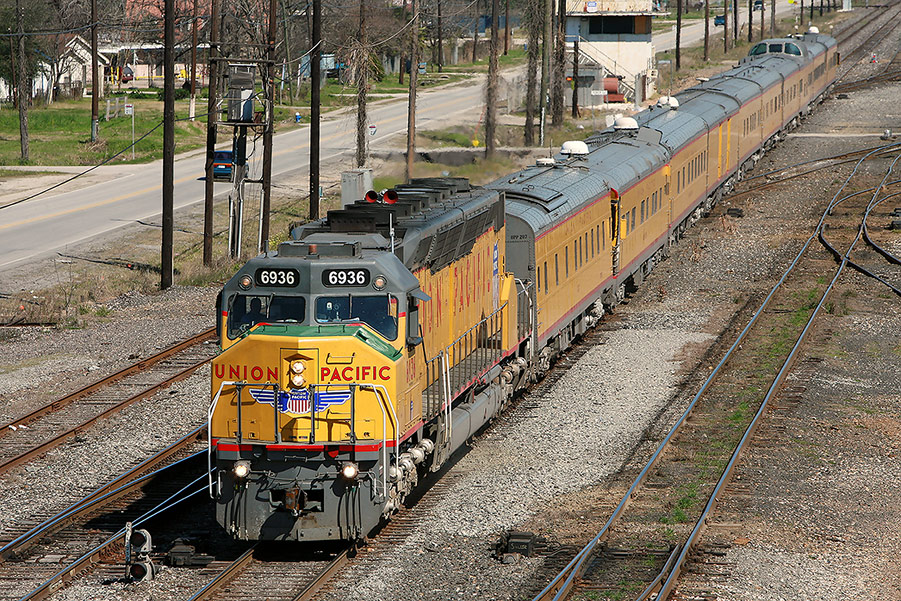
A mad dash takes me to the Sampson Street grade crossing, CP H237 on UP’s West Belt sub, to capture the shot of the 6936 and the Houston skyline.
More crazy driving gets me to North Hastings on BNSF’s Mykawa sub. UP uses BNSF track between T&NO Jct and Algoa to access the Angleton sub.
The next several shots I got of this train were video only account poor light angles, but light angles improved by the time we reached La Ward, Texas.

The train arrived to Bloomington right about sunset. Next shot shows the 6936 as it shoves its train into the Bloomington Yard.
The final shot shows the train arriving to its resting place for the night, just before the crew tied it down.
Galveston Drawbridge – Epilogue
Long-time readers might recall some posts I did in 2012 talking about the ongoing Galveston lift bridge replacement project, where a 300′ wide lift bridge replaced the old 100′ wide bridge. The old bridge was removed and the new bridge entered service in February 2012. Here’s a view of the old bridge in service.

The original plan was to scrap this bridge, but in an opportune confluence of events, California’s Sonoma-Marin Area Rapid Transit (SMART) was able to acquire the bridge for just over $4 million dollars. Over the following 5 years, the bridge was disassembled, shipped to northern California, reassembled on site and installed over the Petaluma River.
Here’s an early 2017 view of the Galveston drawbridge in place adjacent to the original, 111 year-old bridge.

This image,from late 2017, shows the old Galveston drawbridge installed in its new forever home.

Lastly, a very well produced video that shows the old Galveston lift bridge in operation, albeit without any trains.
UPY Jail Break!
As you know, UPY reporting marks are on locomotives that are primarily in yard service. They also work transfers in various UP terminals around the system.
It’s very uncommon, at least in the Houston area, for UPY power to stray more than a few miles from the major yards. So when I heard the DS give a warrant to UPY 2112 in Rosenberg this afternoon, I knew that’s where I needed to be.
The sun didn’t cooperate for this shot of UPY 2112 on the LHT 47 local just west of the Tower 17 interlocking.

25 miles to the west, UPY 2112 splits the signals at CP SA061 (east switch of Lissie,TX)

UP has 13 units in the UPY 2100 series. They’re MP20GP’s, all rebuilt from MP GP50’s back in 2005-2006. They’re all assigned to Houston. For more info about this small class of units, Don Strack’s site has the info.
Momma Was Not Always Right!
To be fair, she was right 99.9% of the time when she told me that nothing good happened at night!
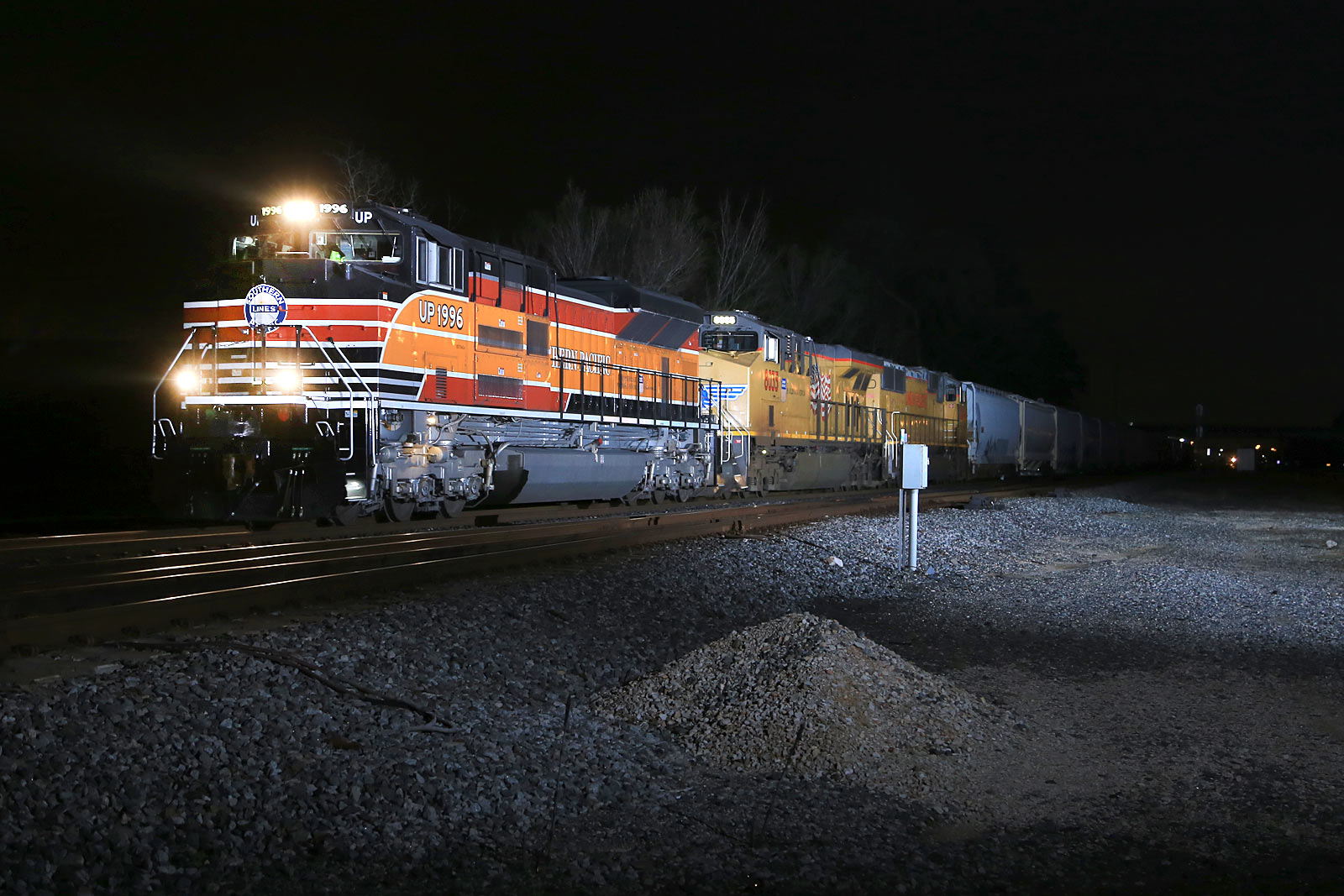
But 0.1% of the time, good things can happen at night such as last night’s UP QSPNL-08 train doing
some work at the north end of UP’s Lloyd Yard in Spring, Texas.
The “Born Too Late” Club
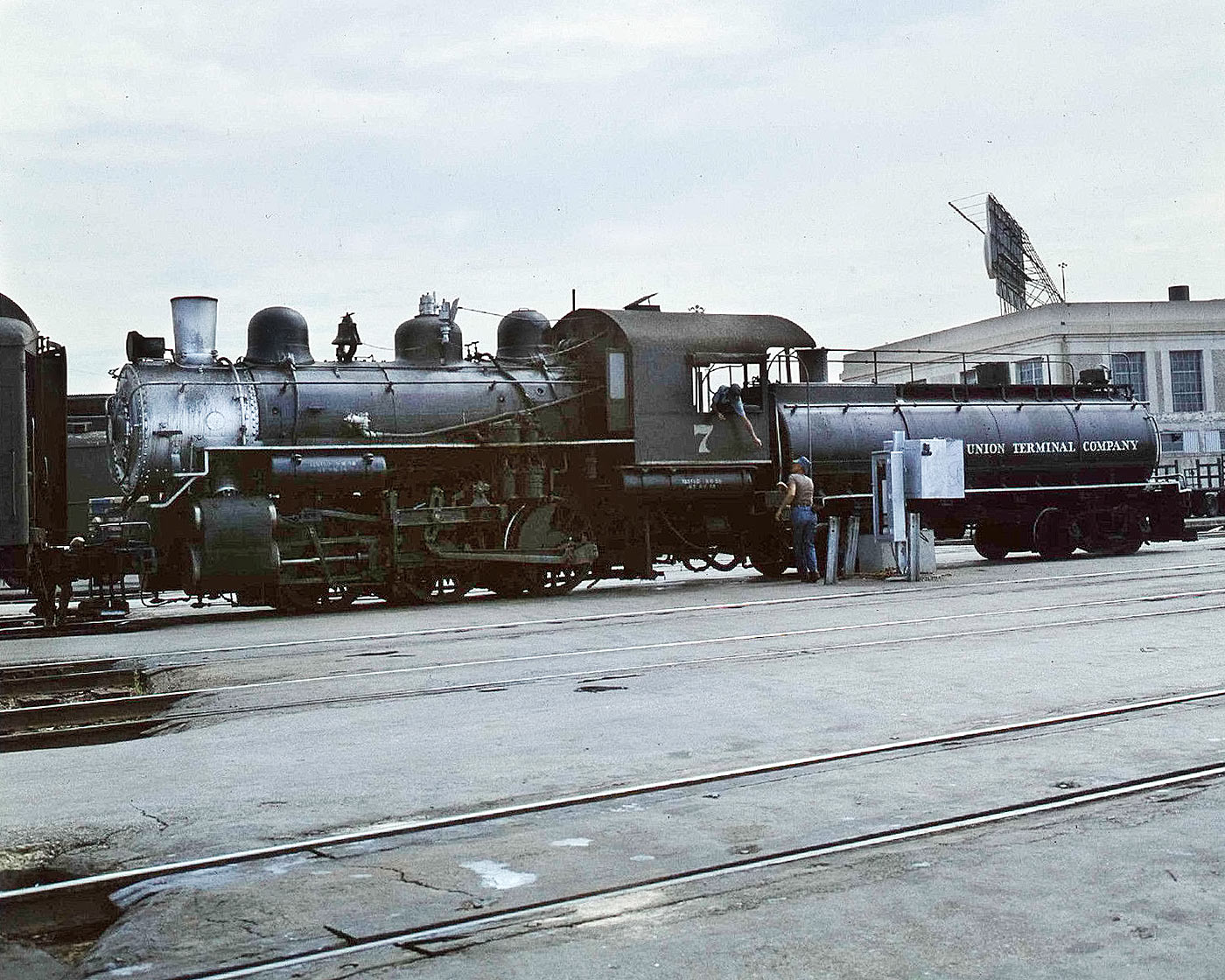
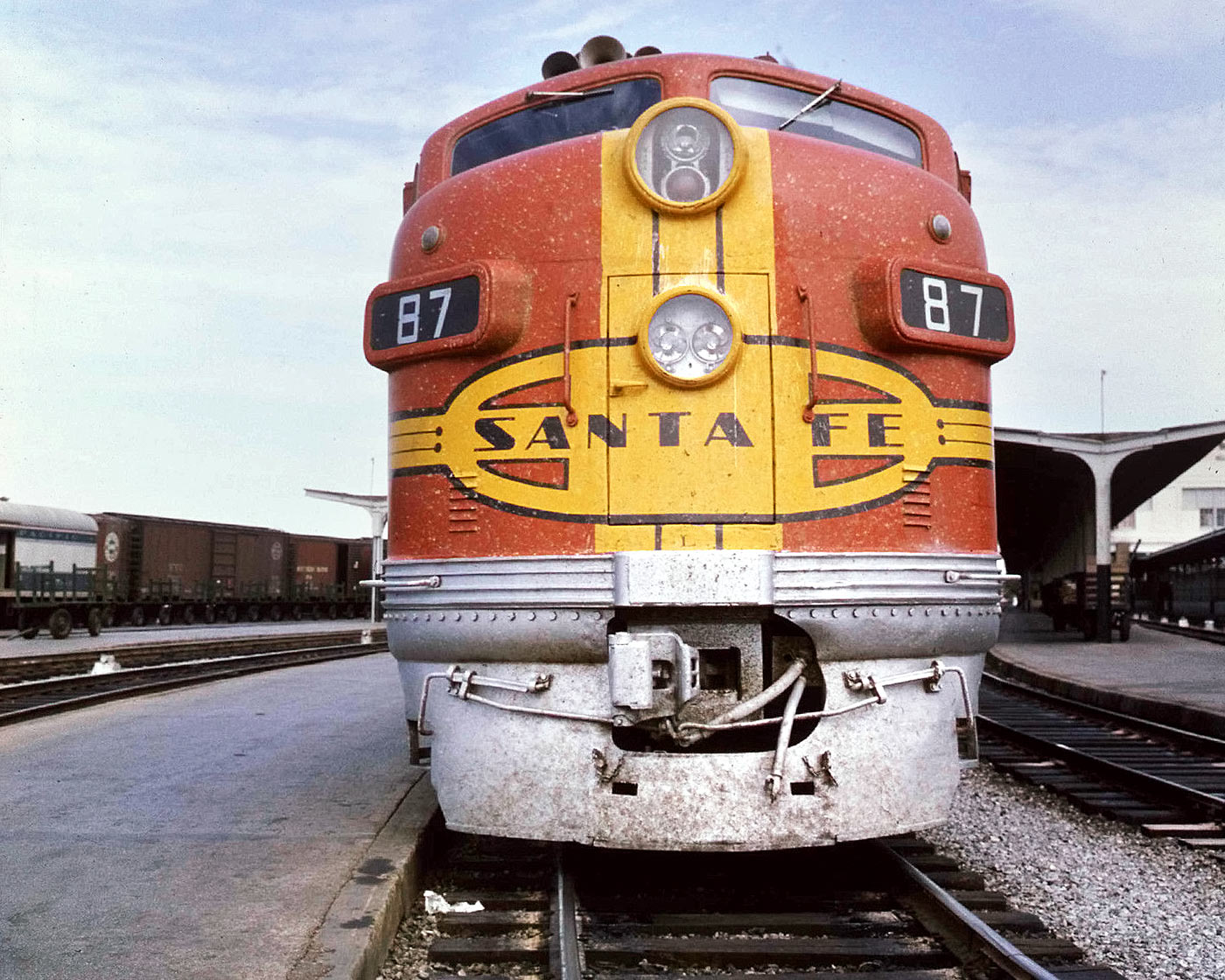
“I was born too late” is a common sentiment in the railfan community. These 3 images from Dallas Union Terminal drove the point home to me because some of my first railfan “trips” consisted of 12 year-old me riding a city bus to downtown Dallas and wandering around the, by 1971, lonely platforms.
These images (photographers unknown) from my collection aren’t dated, but context clues suggest they are from the early 1960’s meaning I was born 10 years too late.
Dallas Union Terminal 0-6-0 #7 worked until the the early 60’s at which point it was donated to the Age of Steam Museum at Fair Park in Dallas. It was It’s now under the auspices of the Museum of the American Railroad at Frisco.
ATSF E8A 87 parked at east end of the platform. Did the E’s work the Dallas section of the Texas Chief?
My favorite image is SSW 1004, a 9/43-built Baldwin VO1000, passing the east end of the platforms. It was retired in 1963. A fair amount of SSW VO1000’s were sold to the Georgetown and Texas-Southeastern railroads but 1004 was not. I can’t find a disposition for this unit. Any info you might have would be appreciated.

Three of a Kind
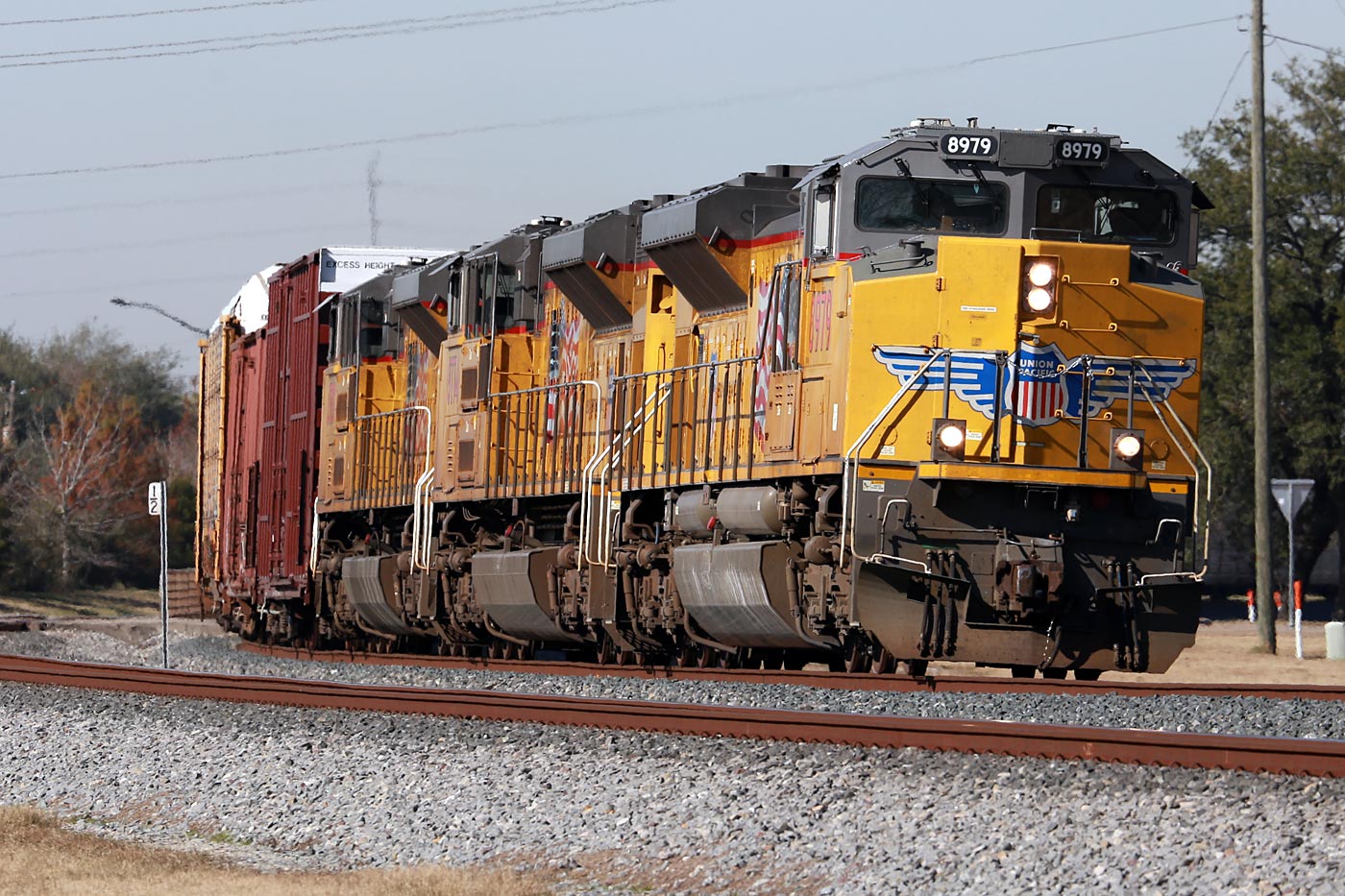
You’d think that a power consist of 3 SD70ACe’s would be fairly common on the UP, what with nearly 750 on the roster. But when you realize that there are 6000 or so other road units, that makes getting 3 lashed-up together pretty rare.
Today, 1/4/2018, was one of those rare occasions. Here are 3 shots of UP manifest (but mostly autos) MLDLIX passing MP 19.5 (Stafford, TX) at 11:12 AM with 8974/8774/8780
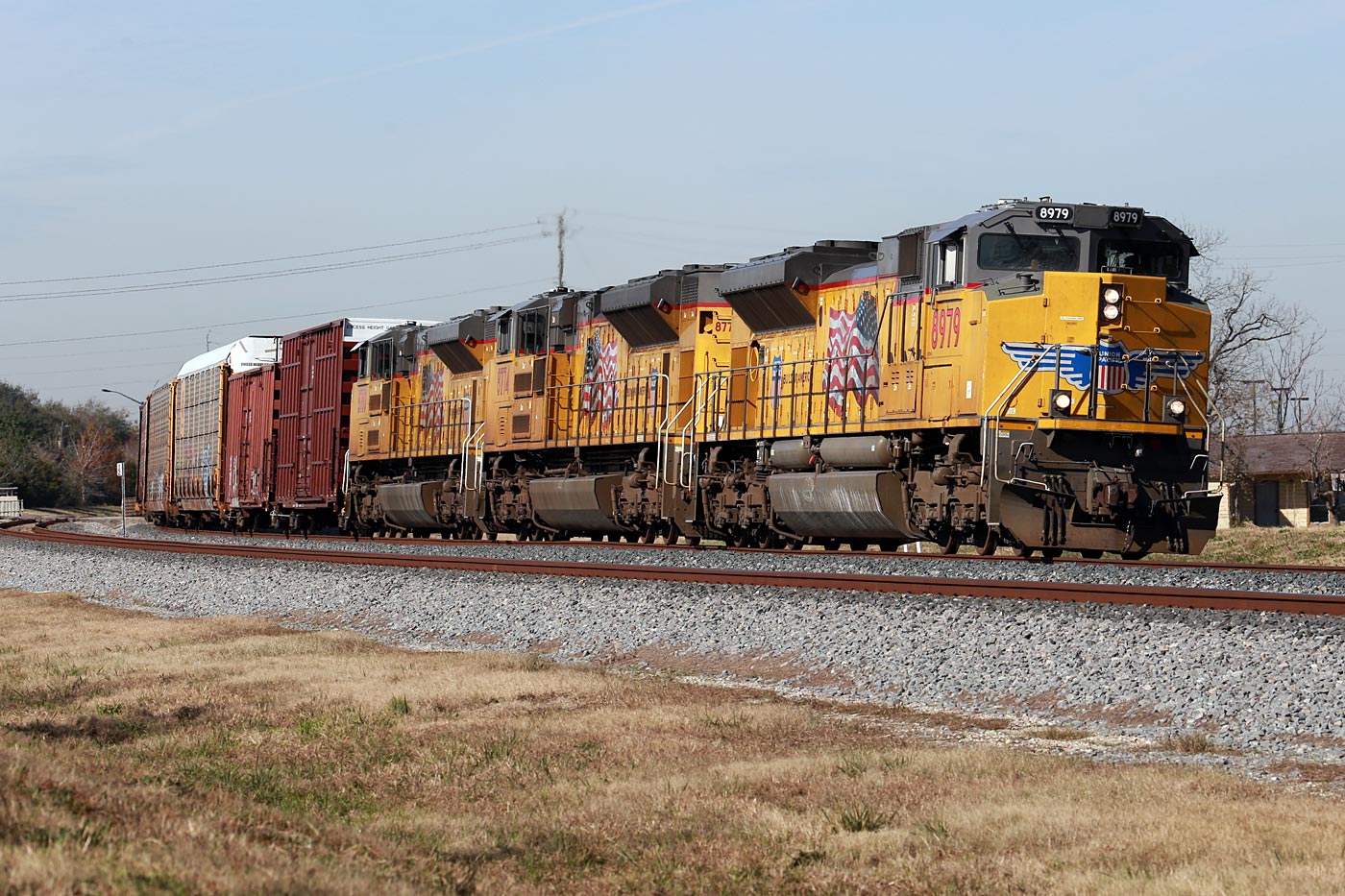
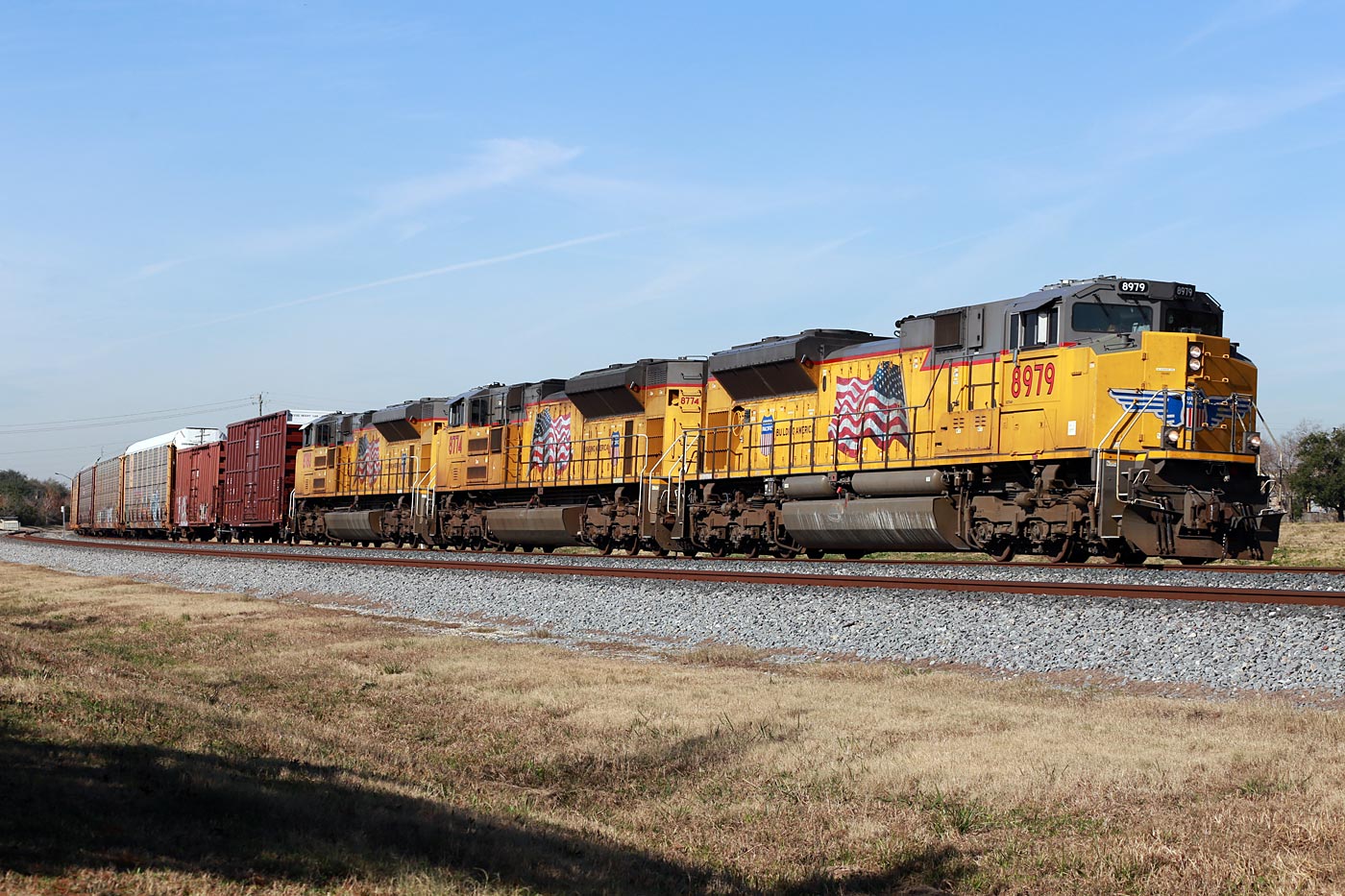
Brand-New UP SD70ACE T-4 on Amtrak
It hasn’t happened around the Houston area yet, but the Southern California crowd got to experience UP 3012 leading Amtrak #11 into Burbank, CA early this year. The freight unit was pinch-hitting for the lead P42 account a grade crossing incident that occurred in the Dunsmuir area. There’s an aviation bonus at the end of the video.
Lastly, to the extent you wonder why I don’t post more often here, I have been assimilated into the Facebook Borg. I do a lot of quick-hit type posts at the Railspot Group on Facebook.
Same Train, Different Day
I suspect that most railfans are pretty indifferent to Amtrak operations. If you’ve seen one Superliner trainset with 2 P42’s, you’ve seen them all right?
Then again, if equipment variety is your raison d’être, you’re probably in the wrong hobby. It’s 2017. If you’re lucky, you get to see all GE’s with a few ACe’s. If you’re not (BNSF transcon railfans), it’s all GE’s, all the time. (I do understand that one can travel the country tracking down old/rare/obscure operations, but that’s too much work for me 🙂 )
Anyhow, if variety doesn’t come to you, you can create variety with how/when/where you capture your images of the same stuff.
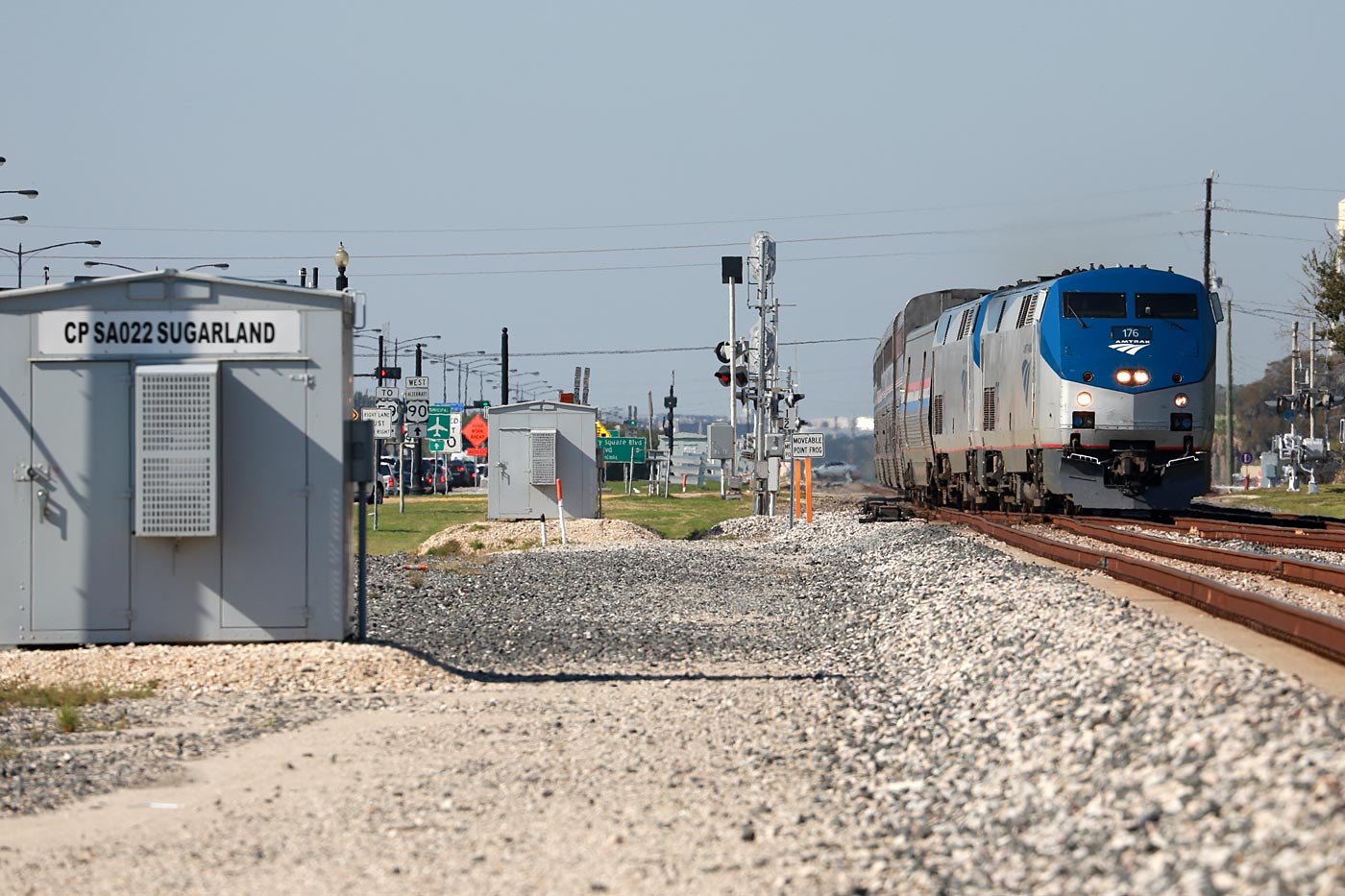
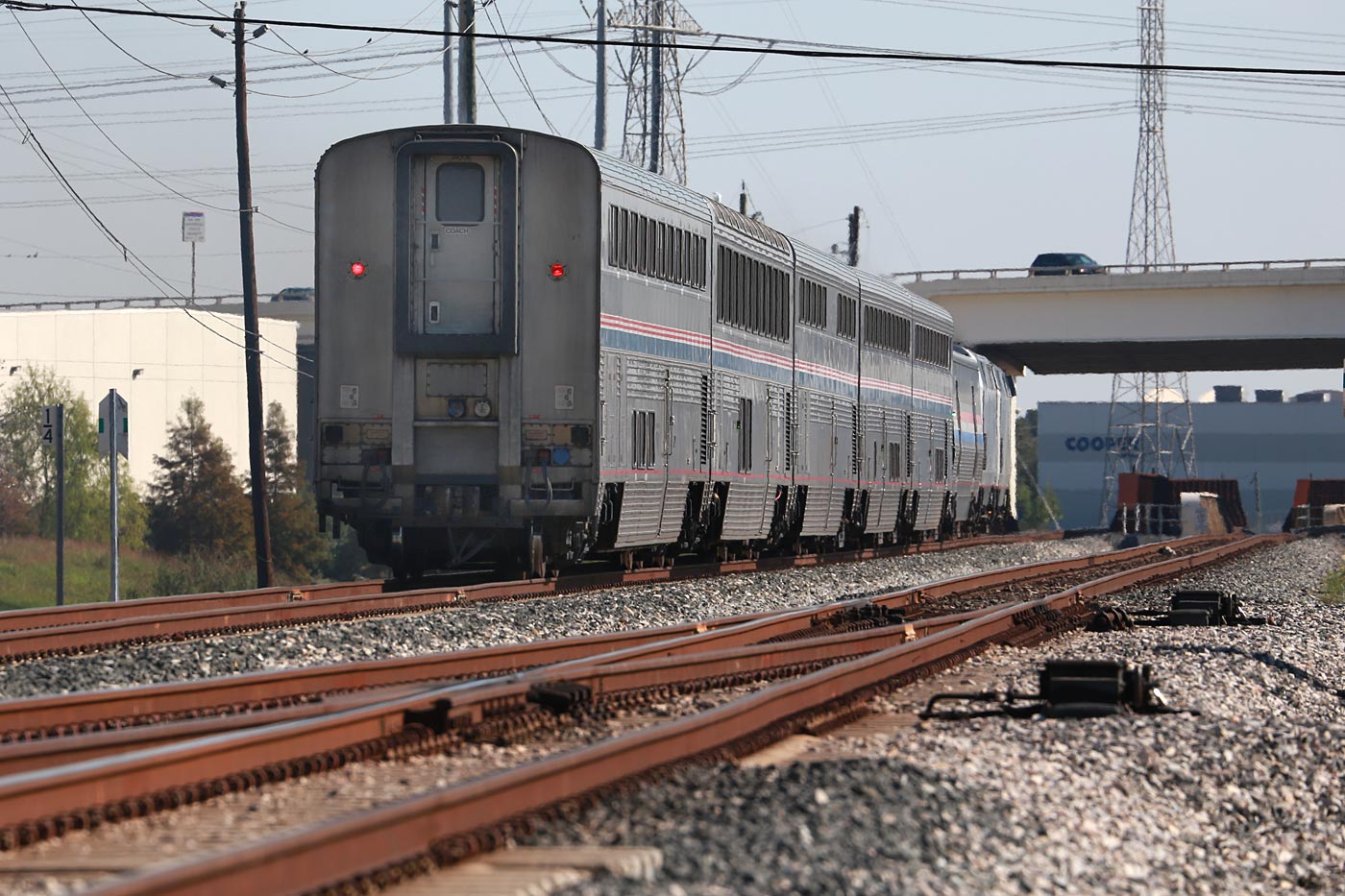
These shots of today’s Amtrak #2 are completely unremarkable equipment-wise. But upon learning via ATCS that the DS was routing it via the Sugar Land crossovers, I was able to create a different image, satisfying my desire to not make the same shots over and over.
Entering the crossover.
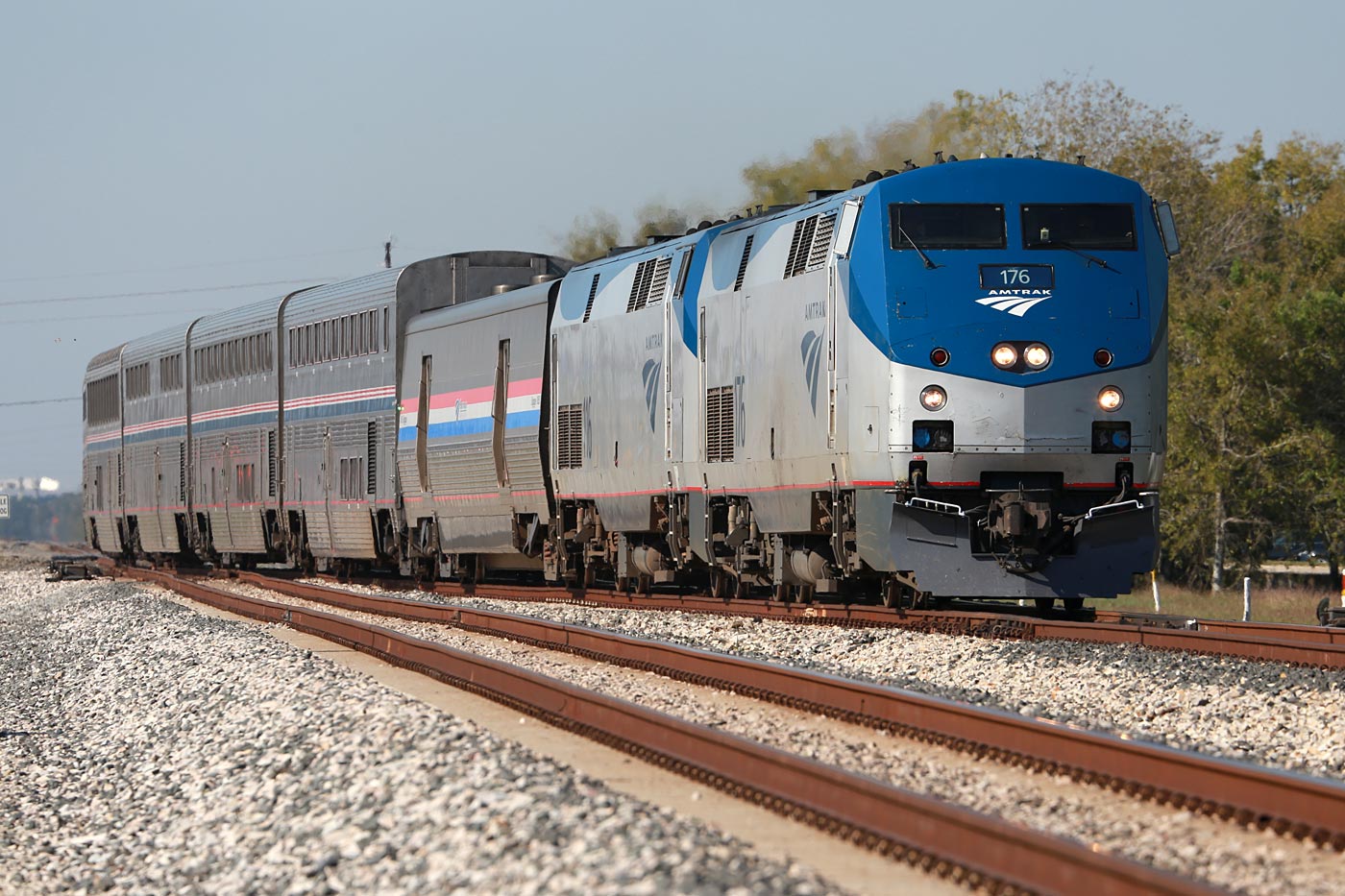
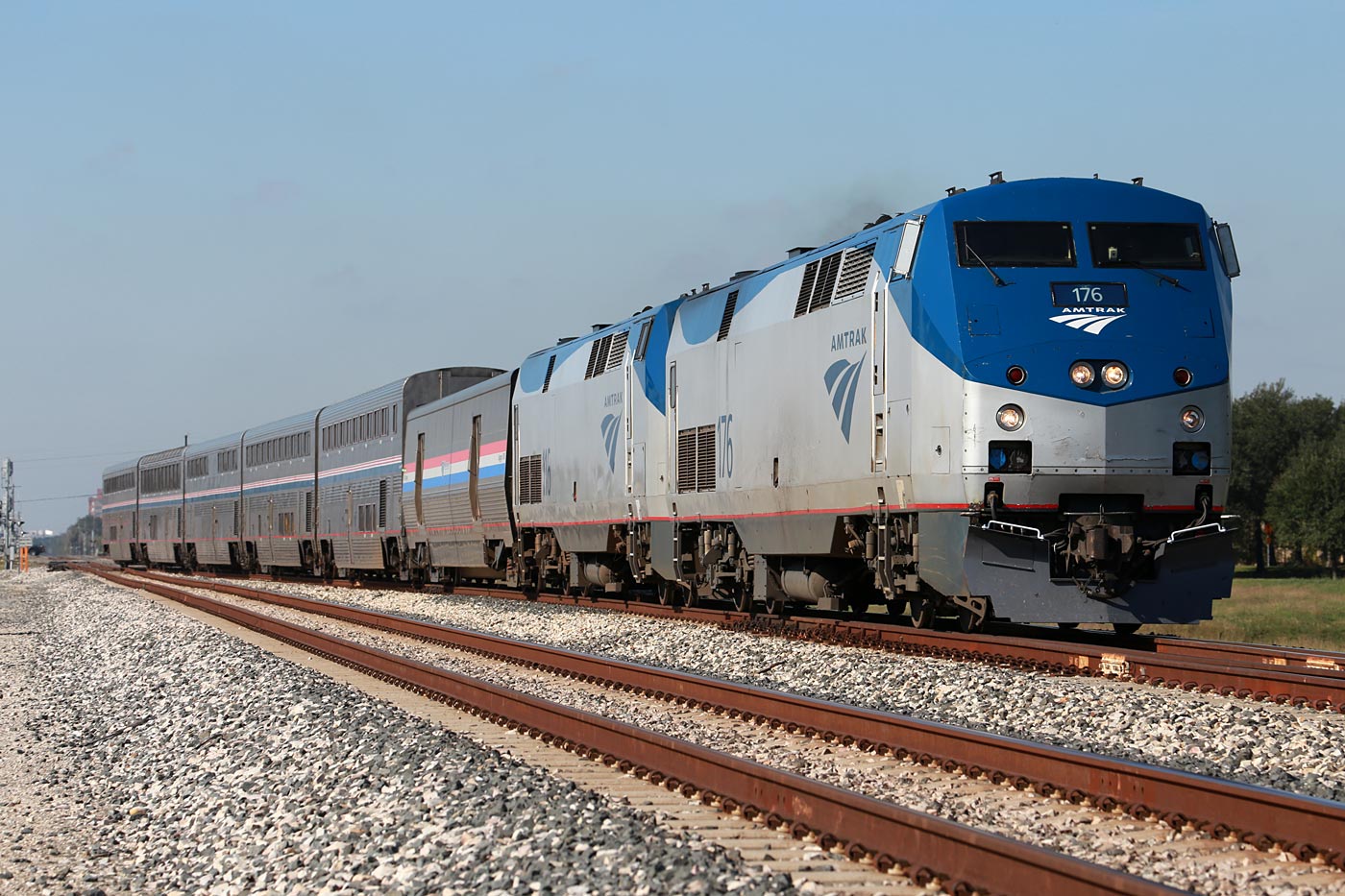
Clear of the speed restriction for the crossovers, the engineer opens the throttle to get back up to track speed for the remaining 30 miles to the Houston depot.

After Dark Railfanning – Progress Report
There’s hope for my after-dark railfanning imagery. My first attempts were less than stellar, but I got right back on the horse and have, IMHO, made some progress.
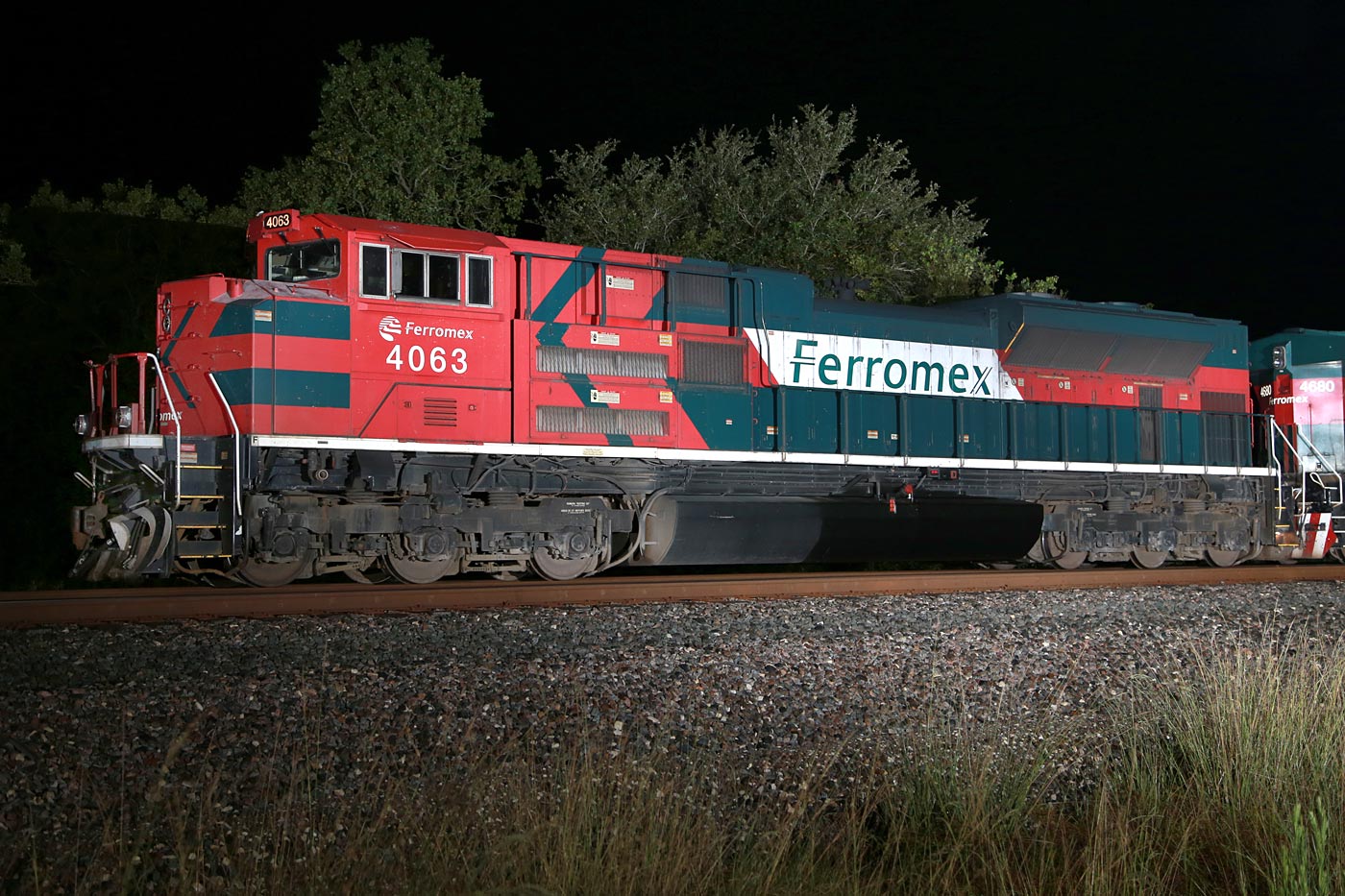
Last week, a pal and I headed out to catch an empty BNSF auto train, VALTLAR4 04 (Vehicle Alliance TX to Laredo TX) account it had two FXE motors. We knew the train would come in after dark, but didn’t think it would be midnight-thirty before we were able to photograph it. It wasn’t easy getting going the next morning after running around the southeast Texas boonies in the wee hours, but getting some nice images of this train was worth it.
FXE 4063 & 4680 hold BNSF train VALTLAR4 04 on 10/6/2017 as it waited for a new crew just north of Algoa TX.
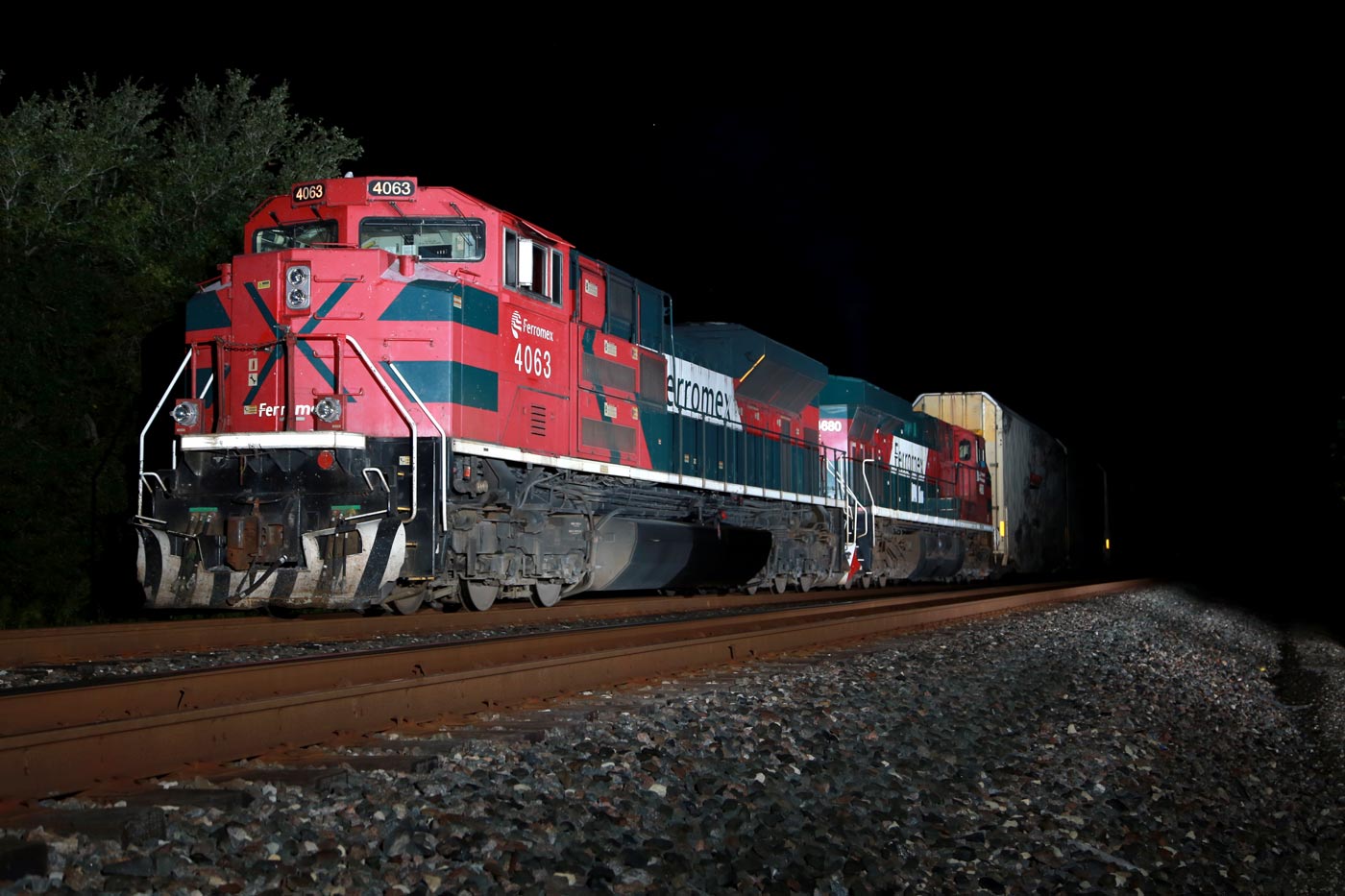
I like the lighting on this broadside-ish view.
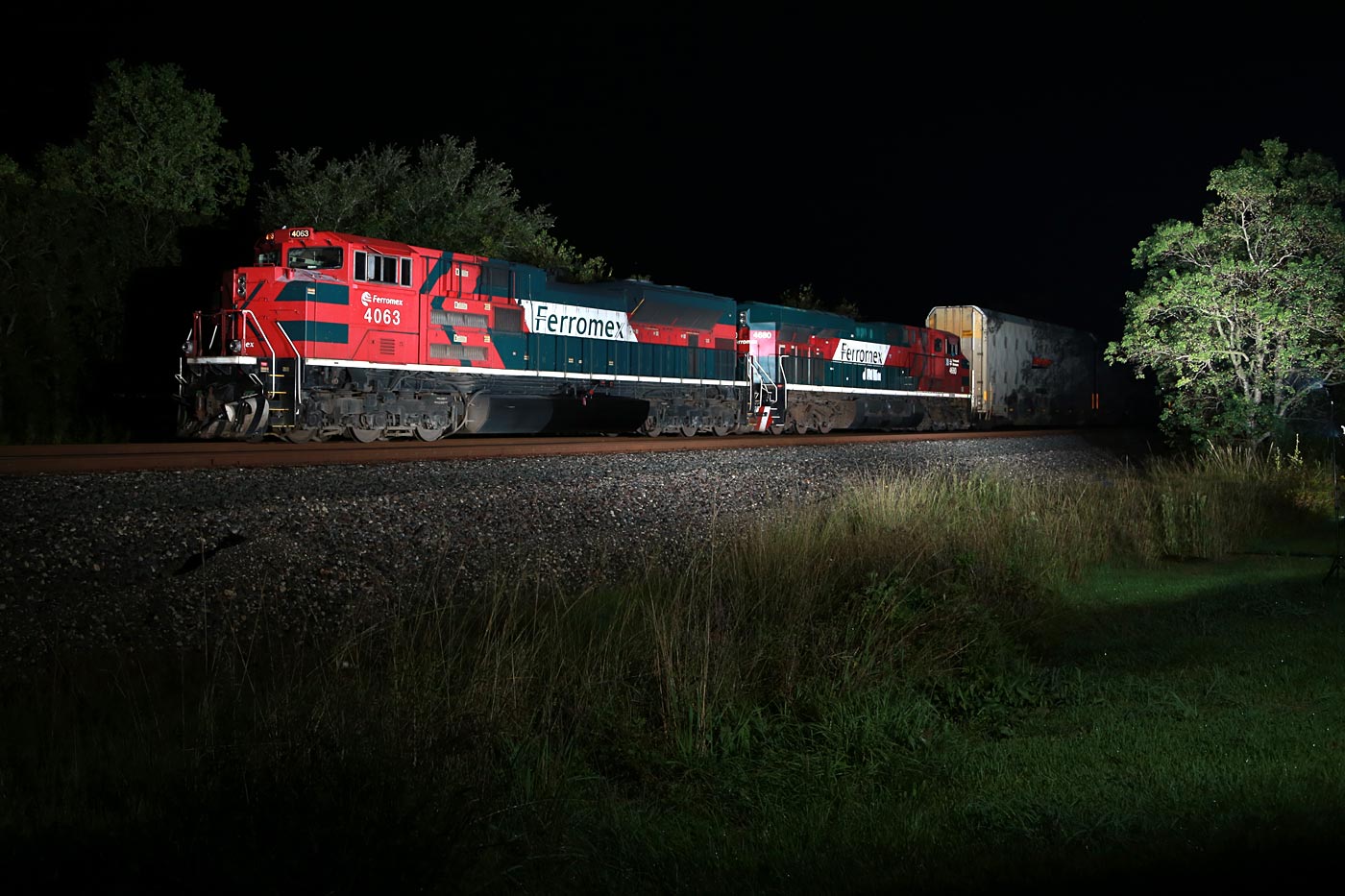
And of course the roster-geek in me like this roster view of a fairly clean SD70ACe
How to do it: Set up your lights properly, turn on the flashes/trigger/receivers, and depress the shutter release. Easy.
Everything is easy. Here’s how to rid the world of disease:
 Southwest Rails