False Alarm
I’ve posted a time or two about the re-development of the historic Imperial Sugar mill property here in Sugar Land. The next step in this project was the demolition of two buildings via implosion, which was scheduled for today, Dec 13, 2010, at 7:00 A.M. Fortunately, the red brick building at right will be preserved with the interior being converted to loft-style apartments.
We headed out early this morning to witness this event only to arrive at the location to find signs advising that the demolition was re-scheduled for next Saturday, Dec. 19.
As I was turning the car around to head back home, I noticed the CTC signal at the east end of Sugar Land light up with an approach indication for a westbound.
I had no intention of taking a picture of this train because it was still fairly dark. It was 6:40 A.M. and sunrise wasn’t until 7:09 A.M. Then again, with digital, it costs nothing to try.
By the time I got parked by the signal cabin at CP SA025, a headlight was visible announcing the arrival of the train. I set the camera to ISO 5600, fired a quick test shot, before deciding to go with 1/160 at f2.8.
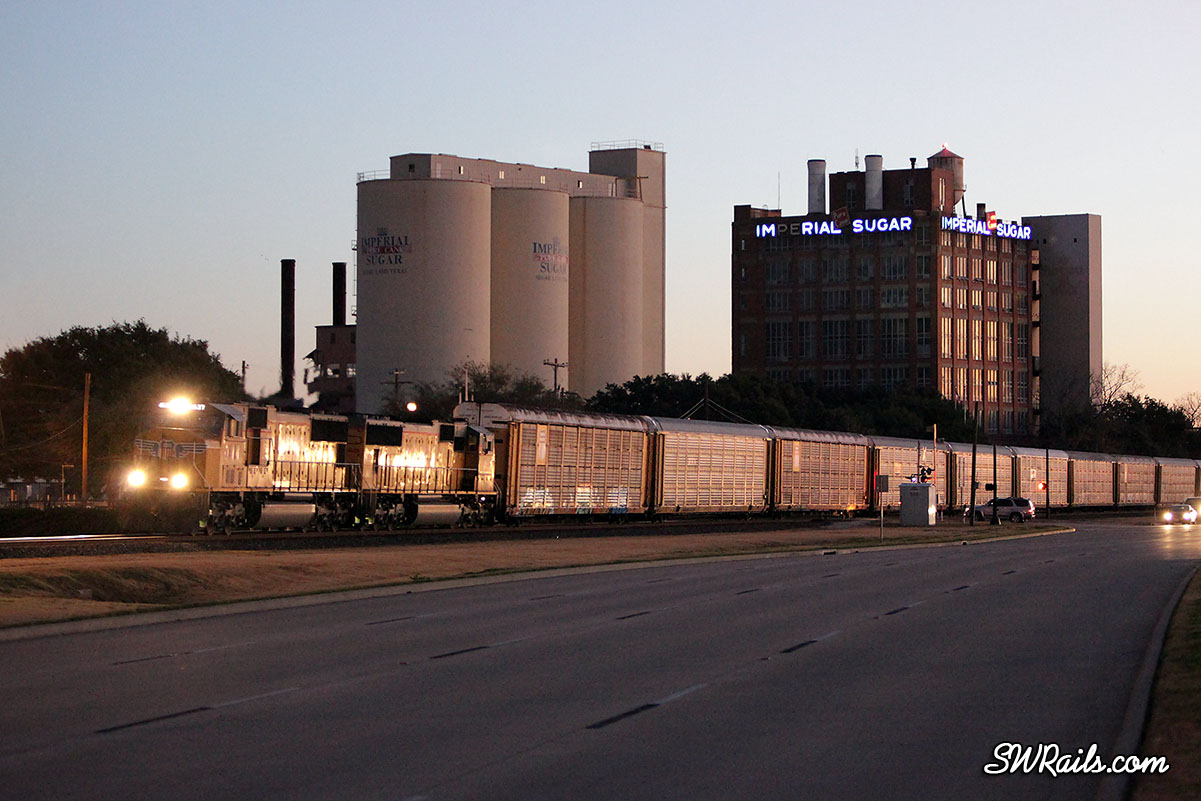
Thirty minutes before sunrise, UP SD70M's 4627 and 4626 lead an empty auto rack train by the Imperial Sugar Mill in Sugar Land,TX on Dec. 13, 2010
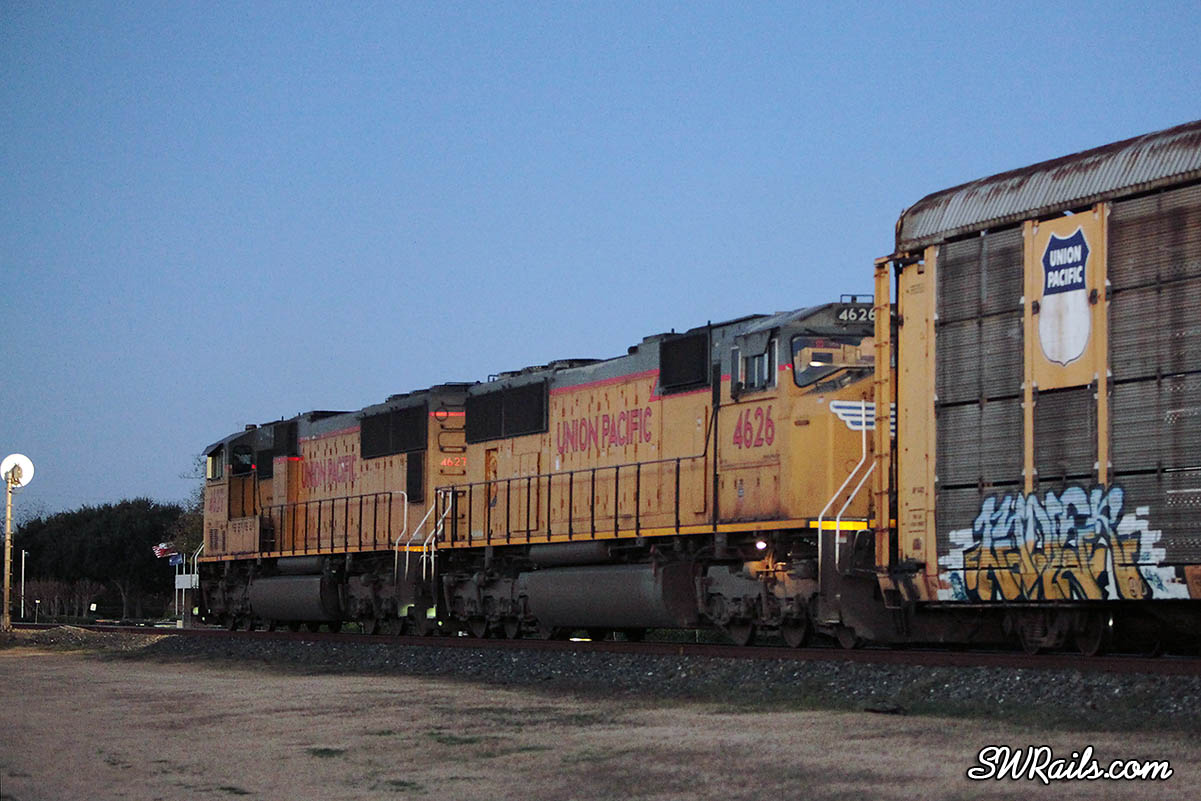
A quick pivot and provided this under-exposed going-away shot:
I realized that the shot was underexposed because I was no longer shooting toward the light. Another camera adjustment was needed, so I dropped the shutter speed to 1/85 second for one more going away view:
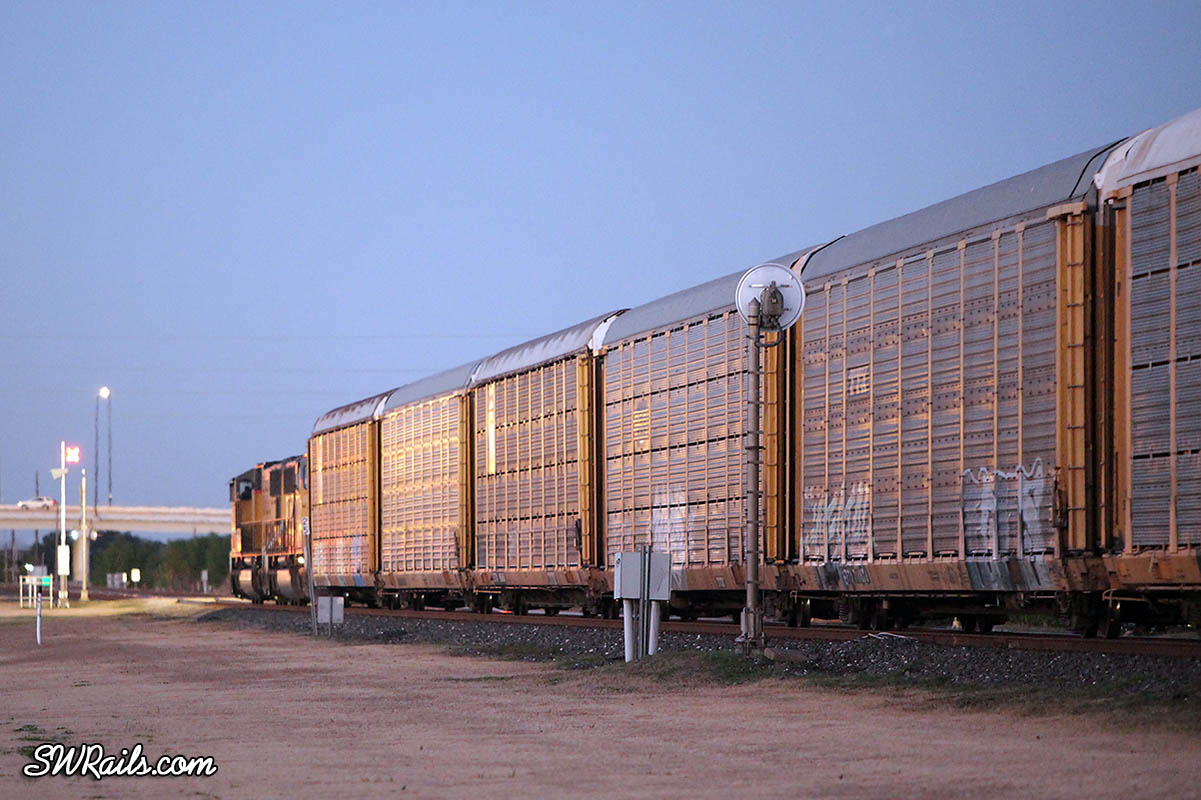
Each shot has an element that illustrates just how dark it actually was. (Click any image to see more detail)
- Shot 1: Note the neon lights on top of the main building.
- Shot 2: Note the interior lighting in the cab of the trailing unit.
- Shot 3: Note how the headlight is illuminating the right-of-way.
After detouring to buy some doughnuts for breakfast, we unexpectedly encountered an eastbound KCS manifest on the way home. By this time, it was 7:12 A.M., a whole 3 minutes after official sunrise. I was able to dial down the ISO to 1250, with a shutter speed of 1/200 at f5.0.
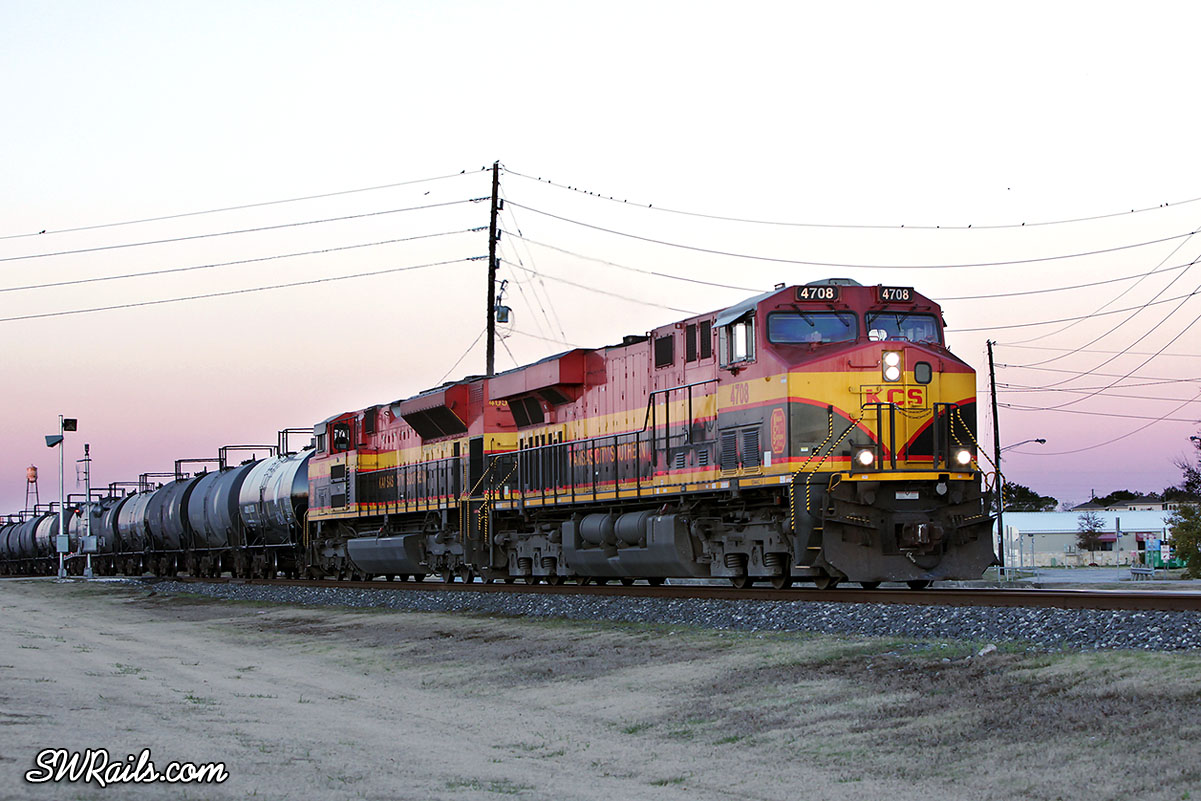
An empty KCS corn syrup train is eastbound at Sugar Land, TX at sunrise on Dec. 13, 2010.
Floor It!
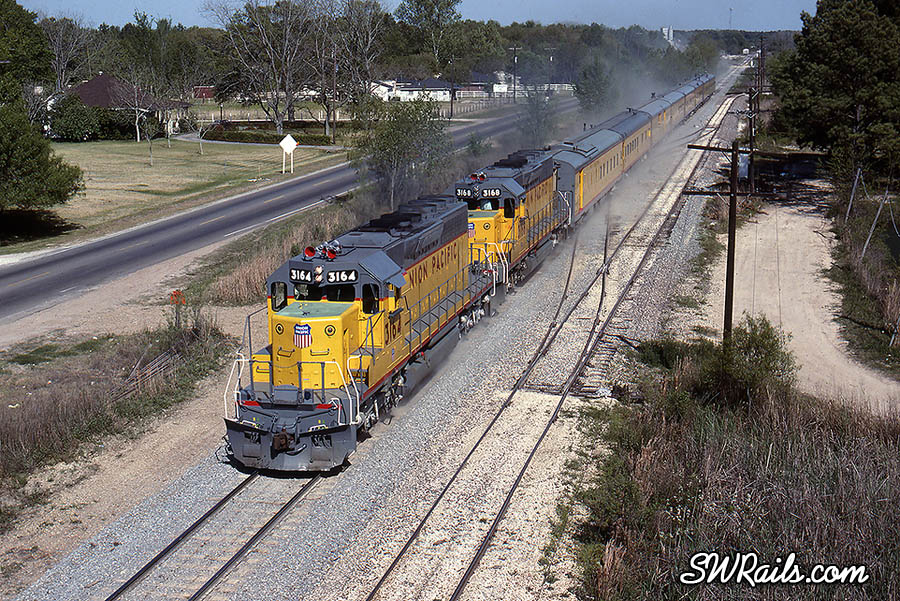
An 8 car UP passenger special kicks up the dust as it departs Spring, TX on April 1, 1983
The Union Pacific / Missouri Pacific / Western Pacific merger became effective on Jan. 1, 1983, culminating a process that had begun nearly 3 years before.
Dozens of special passenger trains were operated during, and after the merger process in order to allow operating officials to review the properties and monitor progress as the railroads were consolidated.
Three months to the day after the merger was official, UP 3164 and 3168 are about to pass under the I-45 overpass in Spring, Texas with an 8 car passenger special.
The train has just cleared Spring Junction less than a mile back and the engineer isn’t wasting any time in accelerating his train up to track speed.
Headed for Texas!
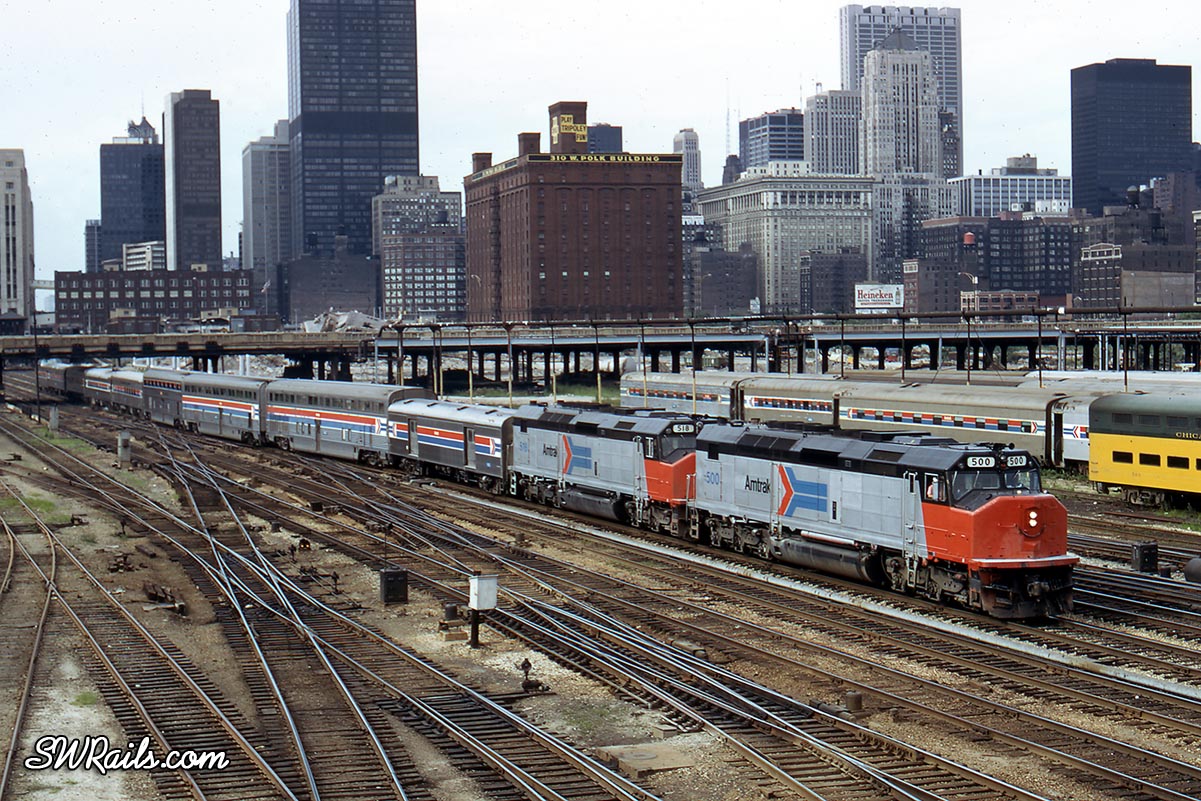
Amtrak Train #15, the Lone Star, departs Chicago for Houston on July 22, 1974.
The Lone Star was an Amtrak passenger train that operated daily between Chicago and Houston, via Kansas City, Oklahoma City, and Fort Worth .
It departed Chicago at 5:00 P.M. It covered the 1,367 miles to Houston in 27.5 hours, arriving at 8:30 P.M. the next day.
From the beginning of Amtrak in 1971 until May 1974, the train was named the Texas Chief, as it had been when it was operated by the Santa Fe.
When the AT&SF felt that Amtrak was not upholding Santa Fe service standards, it revoked the permission it had given Amtrak to use the “Texas Chief” trademark.
Amtrak re-named the train Lone Star. The train was discontinued in 1979 due to federal government budget cuts.
Harlem, Texas – Before & After
Harlem, Texas is an unincorporated area between Sugar Land and Richmond. It’s main claim to fame is a short Union Pacific (ex-Southern Pacific) siding that originally extended between MP 29 and MP 30.3 of UP’s Glidden subdivision mainline.
Due to the Harlem Road grade crossing near the mid-point of the siding, it wasn’t used much unless the train going in was very short. As a result, the UP extended the siding one mile to the east about 3 years ago.
Over the years I’ve photographed a few trains at Harlem. Let’s look at one of my first shots there, and my most recent effort. (Click any image to enlarge it)
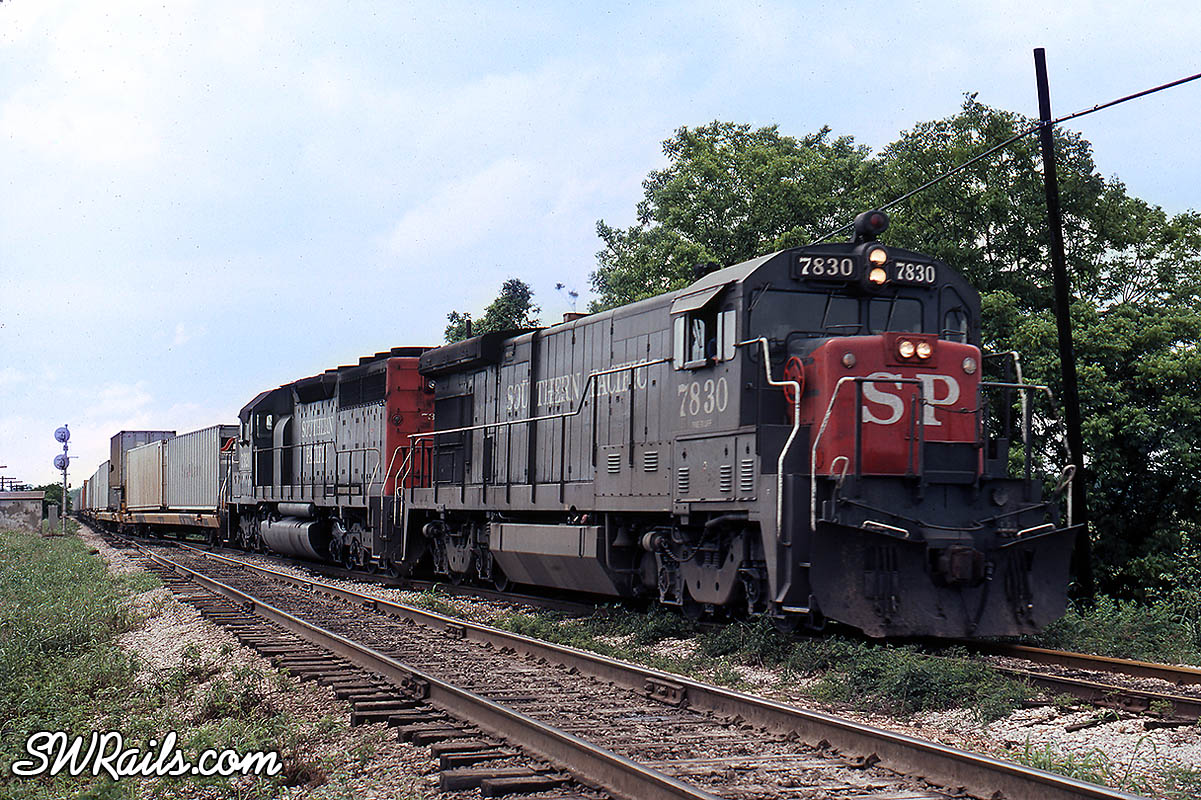
SP hotshot LAAVT (LA - Avondale Trailers) enters the west end of Harlem on May 3, 1981
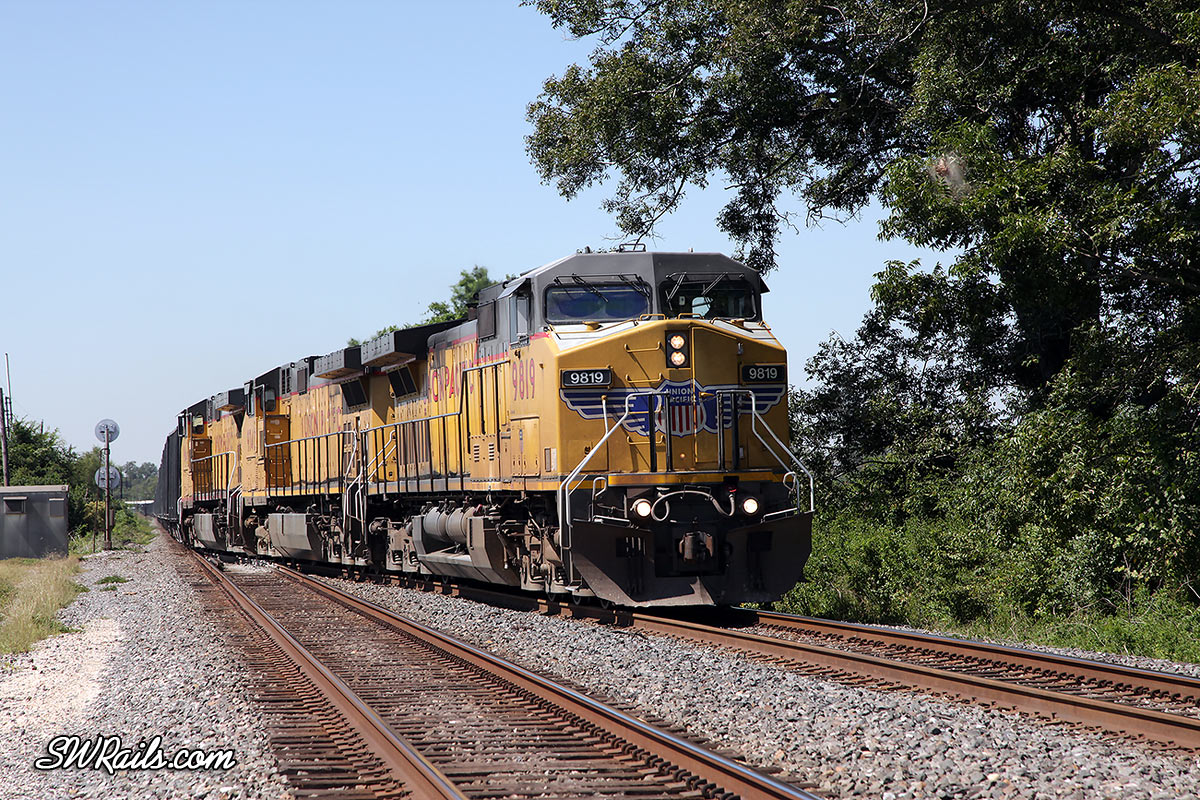
A loaded Union Pacific rock train enters the west end of Harlem siding on Oct. 5, 2010
At first glance, other than the color of the diesels, there doesn’t seem to be a lot of change at this location over the past 30 years.
A closer look reveals many changes, some subtle, others quite dramatic.
- The tree at right has grown quite a bit over the past 30 years.
- The code line was removed years ago.
- The condition of the physical plant is dramatically improved. No weeds or jointed rail on today’s Glidden sub mainline.
- The concrete signal equipment cabin has been replaced with an aluminum one, but the searchlight signal remains.
PS – I can’t believe 30 years has gone by!
The Sunset Limited – Back In The Day
Here’s a very rare view of Southern Pacific’s Sunset Limited during the 6-9 month period it operated with new Daylight painted diesels and older heavyweight passenger cars.
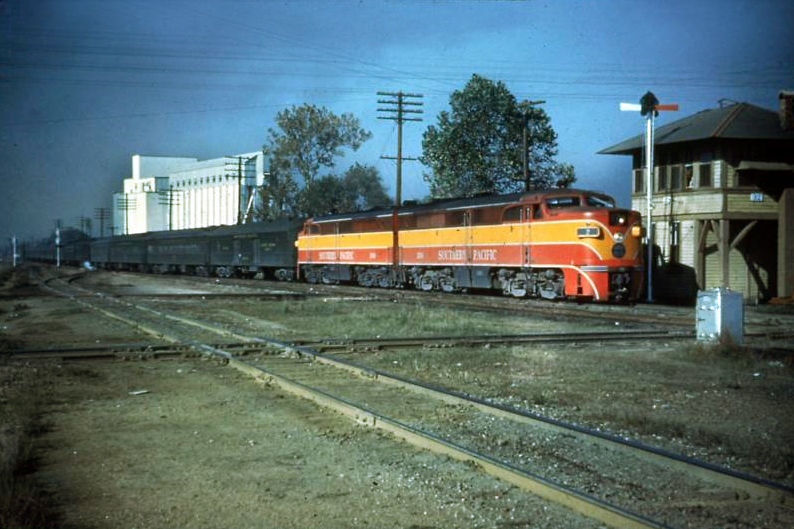
SP train #2 about to cross over Santa Fe tracks at Tower 32 in Beaumont, Texas in early 1950
When the Southern Pacific began to dieselize its passenger operations in the late 1940’s, Alco’s PA passenger diesel was the motive power of choice.
12 PA-1’s in the 6000 series were acquired for the Pacific lines in mid-1948. Another 12 PA-1’s arrived between June and August 1949 for its T&NO operations. These were numbered 200A,B – 205A,B
The Sunset Limited was operated with heavyweight equipment until mid-1950, at which time it was re-equipped with Budd streamlined trainsets.
The location of the photograph is quite interesting as well.
Tower 32 was the interlocking protecting the crossing between SP’s Sunset Route mainline and Santa Fe’s line into Beaumont. It was just west of the SP’s swivel bridge over the Neches River.
This stretch of SP trackage (the light purple broken line in the below image)) was abandoned in the 1960’s when the SP made a deal with the KCS to share the KCS Neches River lift bridge. The SP’s Neches River swivel bridge was then removed.

Great Southwest Railroad
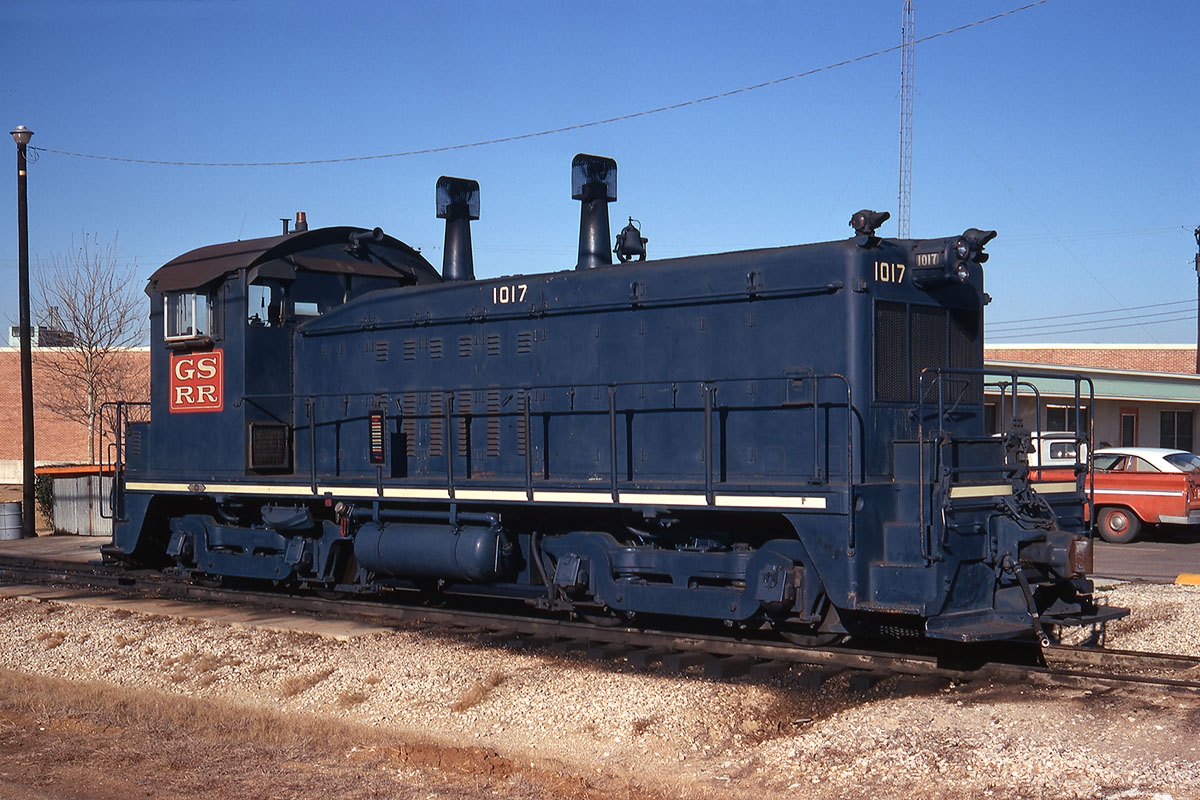
GSRR NW2 1017 idles in front of the Arlington, TX yard office on Feb. 13, 1971
The Great Southwest Railroad was a terminal and switching company serving the Great Southwest Industrial District in Arlington and Grand Prairie, midway between Dallas and Fort Worth.
Its motive power over the years was a variety of EMD switchers that were acquired from the MP.
The company was chartered on May 7, 1957, and began operations over its 22 miles of track in May 1959. In December 1960 the Texas & Pacific and the Rock Island each purchased 45 percent of the Great Southwest stock from the Great Southwest Corporation, the railroad’s parent company. The MP acquired the Rock Island’s stake as a result of the bankruptcy and shut-down of the Rock Island in 1980.
The railroad retained its operational independence until 1987 when the Great Southwest was merged into the Union Pacific.
The More Things Change, The More They Stay The Same
The two photos below were taken from the exact same spot in Rosenberg, Texas, separated by 101 years. The only difference between the two photos is the first picture was taken from the second floor of the tower, the second image was made from ground level.
So much change is apparent between 1909 and 2010 in these two photos, as you would expect. But what fascinated me was the one thing that’s remained constant for more than a century: the track layout at this location.
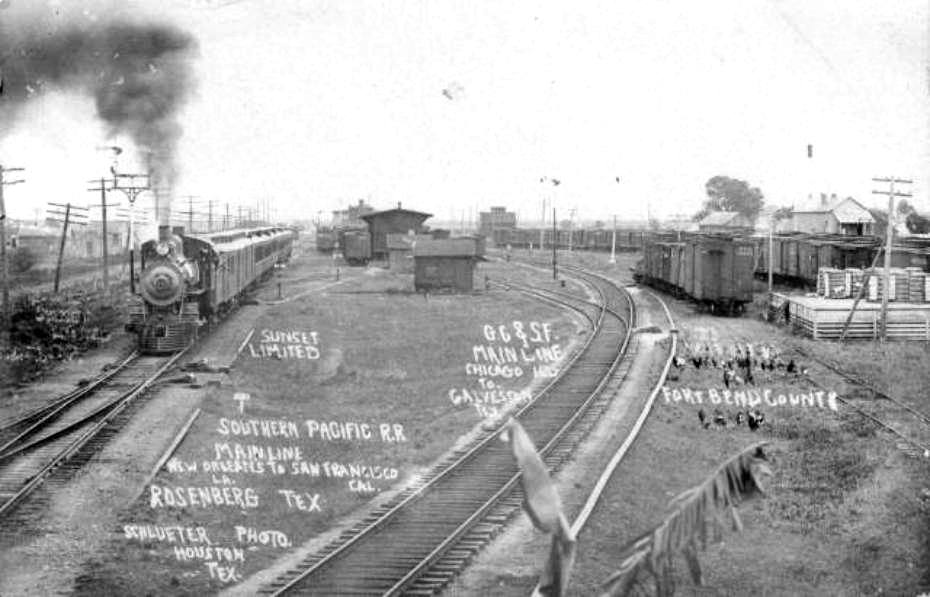
1909 view looking east from Tower 17 in Rosenberg, Texas (Click to enlarge image)
From left to right, the diverging route is the connector track from the SP to the Santa Fe, the SP Sunset Route mainline, and the Santa Fe Galveston sub mainline.
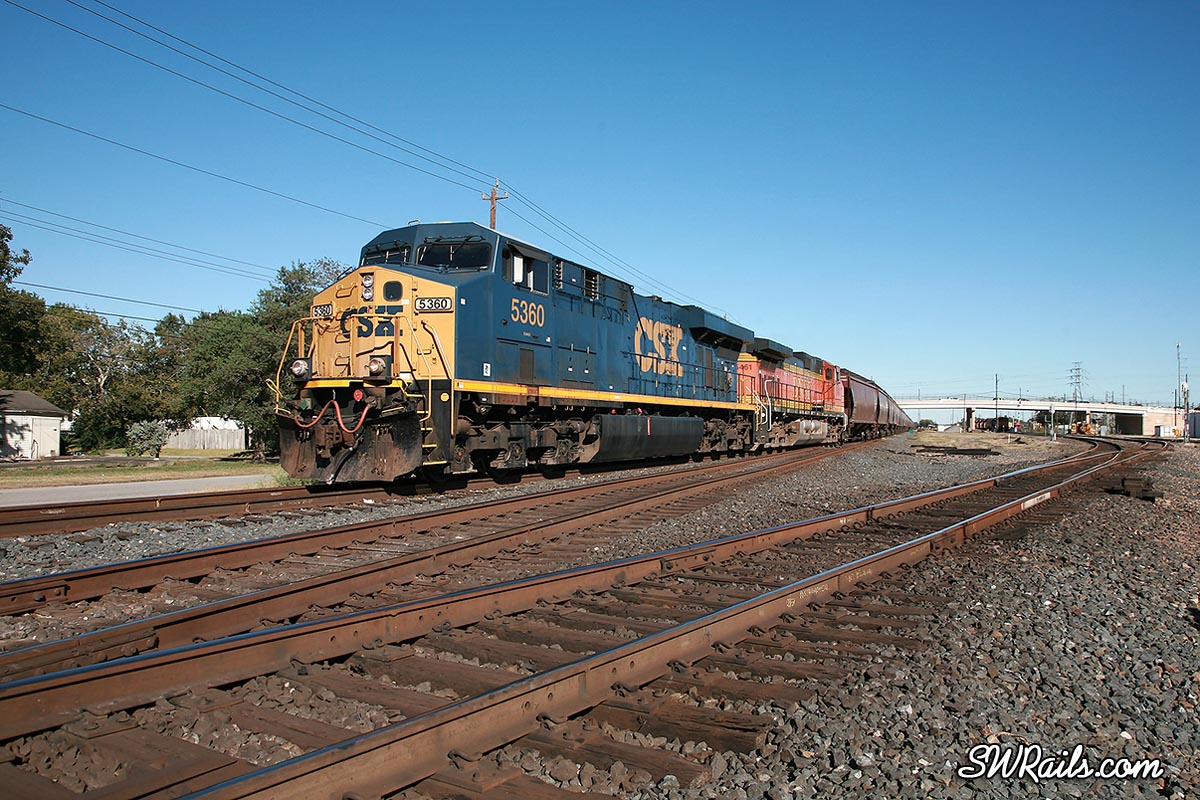
2010 view looking east from the foundation where Tower 17 stood (Click to enlarge image)
CSXT 5360 leads an empty BNSF grain train onto the BNSF Galveston sub mainline via the connector track off UP’s Sunset Route mainline
High Green at Hinda
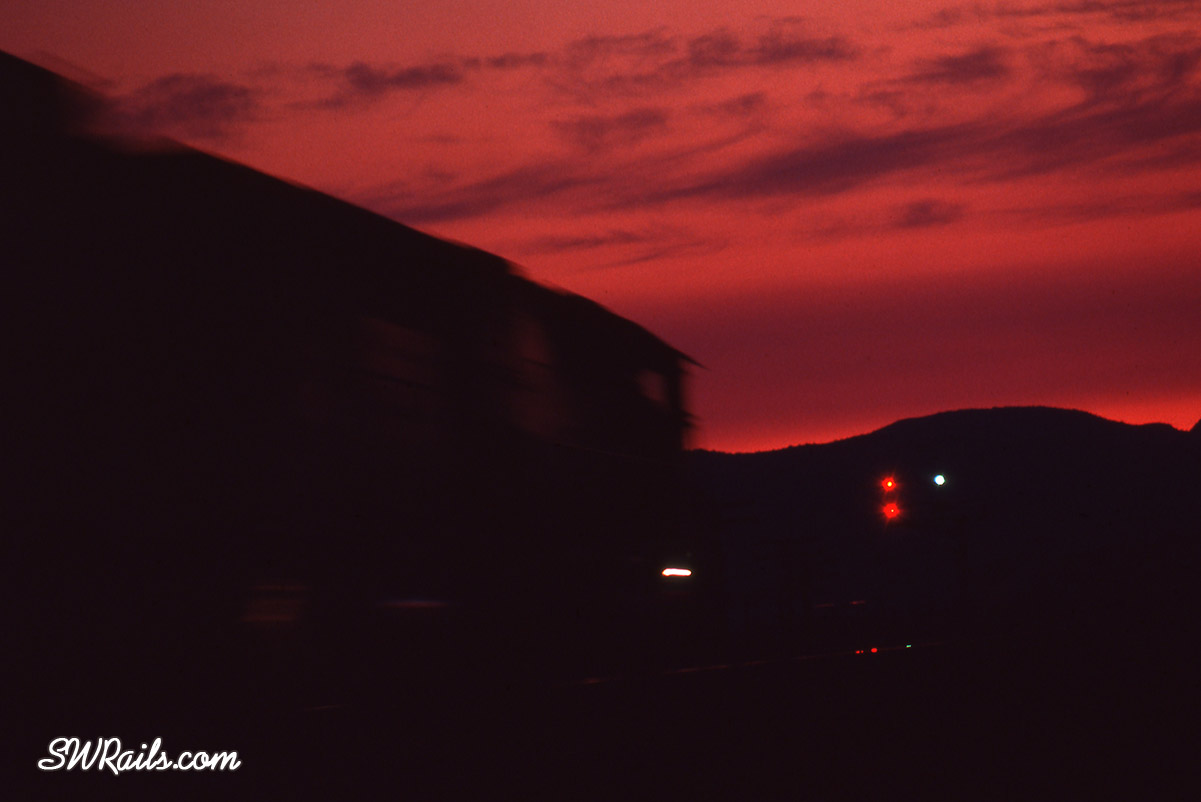
A high green beckons SP manifest KCOAM/K18 westward at Hinda, CA on Aug. 23, 1987
Back in the day, I would experiment with the camera every so often. Most of the time it was in vain, but sometimes I’d get a great picture. ( I guess that’s why it’s called an experiment.)
Heading home after a day of taking pictures I came across SP 9239 West, a KCOAM (Kansas City-Oakland manifest) train, stopped for a red signal at Hinda. Hinda is the first set of cross-overs west of Beaumont, CA.
As it was way after sunset, I didn’t intend to take any pictures. I hung around just to see what the train was waiting for.
Turns out the dispatcher wanted to run a westbound stack train, the ESMXT 21 (East St. Louis – ICTF Mitsui) , around this train. The second train arrived shortly, crossing over in front of the stopped KCOAM.
As I watched the action, I realized there just might be a photograph here. For some reason, I had a tripod with me, so I set everything as quickly as possible. I wanted to have some time to try different settings on the camera.
As I was taking the first shots, the signal turned yellow. Fortunately, but the train didn’t move. Most engineers don’t like following a train on hard yellows on a downgrade. They’d rather let the train ahead get further away so they can have a more favorable signal.
I had taken about a dozen or so time exposures when the signal turned green. As the engineer released the brakes, I took a final shot as the train started to move.
As each exposure was 10 seconds or so, I figured the last shot would be ruined due to the movement of the train.
As it turned out, that last shot was my favorite. It showed just enough motion of the train to complement the green signal indication.
PS- I kept detailed log books of consists back then. The KCOAM had 7 units on the point and a 4-unit helper set cut into the train.
The power was: 9239/9068/9282/9327/7485/6341/4149 with 6785/7379/7333/7447 as the helpers.
Super Bowl XXXVIII Steam
Over the years, many railroads have operated Super Bowl trains, passenger trains to wherever the Super Bowl was taking place. These special trains would transport railroad executives and shippers, as well as provide facilities to entertain guests before the game.
Super Bowl XXXVIII (That’s 38 for you non-Romans) was held in Houston on February 1, 2004. The Union Pacific operated a passenger special to the Houston Super Bowl, led by Challenger 3985.
As I wasn’t invited to be a guest of the UP on the train, I opted for the next best thing. We made several trips out to see the train on its way to Houston, and upon its return to Omaha.

UP's 2003 Super Bowl train at the North end of Hearne, TX on Jan. 25, 2004
I don’t remember why we didn’t go North of Hearne to meet the train, but that was the correct decision. Take a look at the railfan traffic jam at the far left of the above picture. (Click to enlarge the image)
The train layed over in Hearne, traveling to Houston the following day.
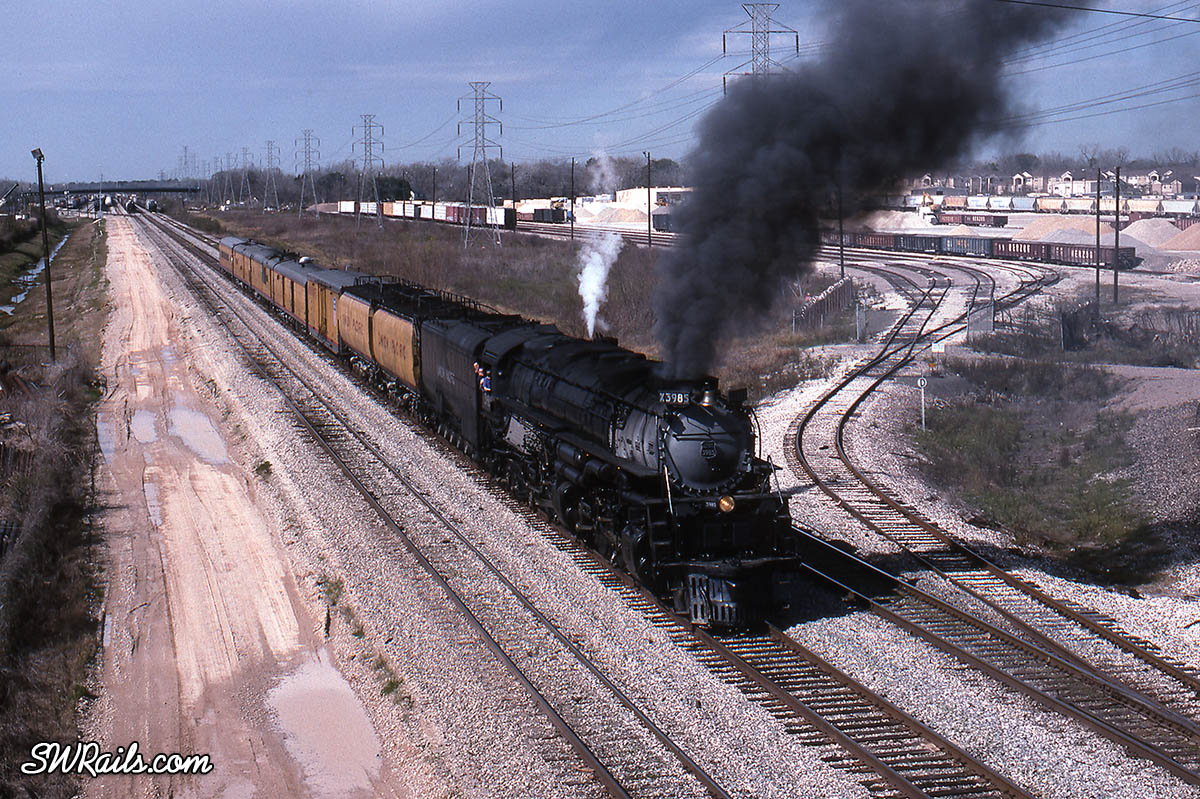
The 2003 Super Bowl train passes the ex-BN Hub Center in North Houston on Jan. 26, 2004
The train took a round-about path through Houston in order to reach Reliant Stadium.
It went via the East Belt from Belt Junction to Tower 87, Terminal Sub to North Jct, Spence cut-off to East Jct, Glidden Sub to Pierce Jct, than a reverse move about 1.5 miles on the Popp Industrial Lead.
The train was parked across from Reliant Stadium. It remained one week serving as headquarters for UP executives as they wined and dined shippers, politicians, and any other dignitaries.
The return to Omaha was set for the Tuesday after the game, February 3, 2004.
The first, and only place the train would be in good light was just east of Pierce Jct. There was a 1.5 mile stretch of the Glidden sub where the train would be going into the sun, and the track would be accessible.
I found a spot that was fairly open and got set up. As the train approached, I double-checked everything to make sure I’d get the picture.
Getting closer, the 3985 began to smoke, so much that it obscured just about the entire train. Wonderful.
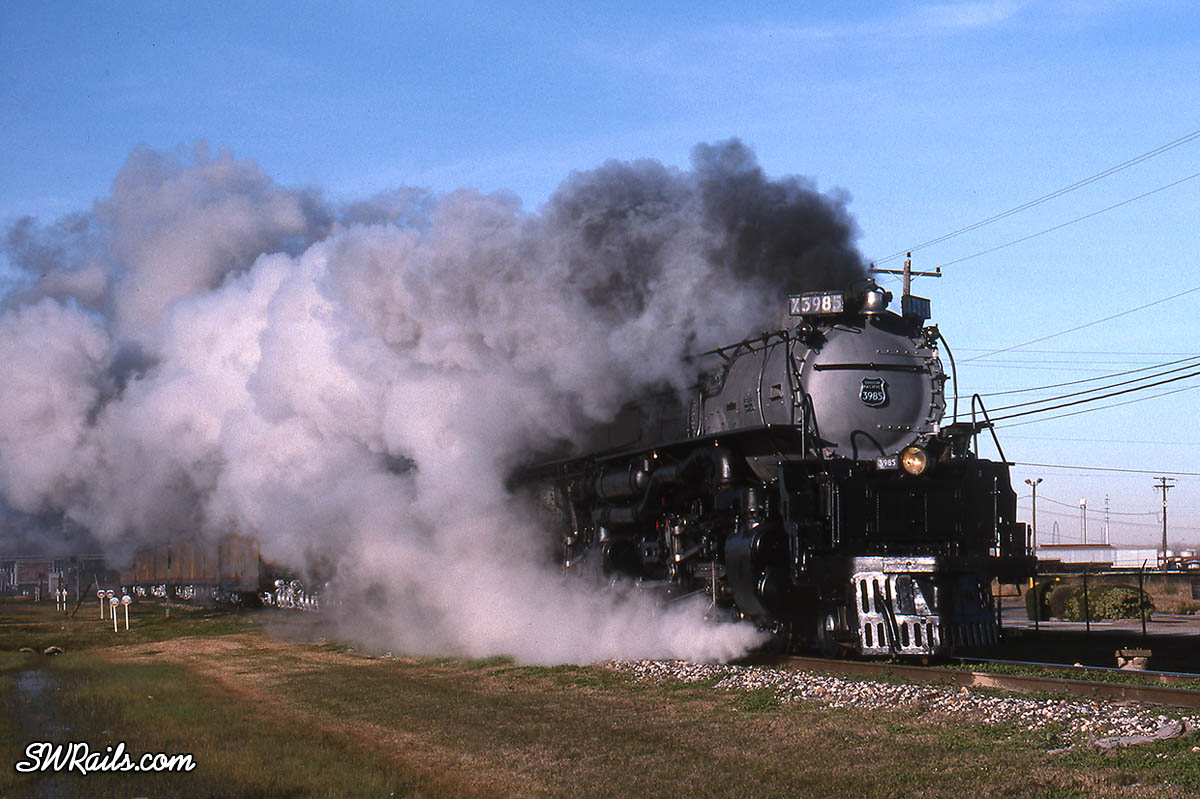
UP's Super Bowl Special is eastbound at MP 9 of UP's Glidden Sub on Feb. 3, 2004
I cursed my luck, as most railfans would do in this case. Fortunately, the train was traveling slowly enough that I was able to get ahead of it again,

UP 3985 and the UP Super Bowl train at MP 8 of the Glidden sub, Feb. 3, 2004
Previous drama notwithstanding, I ended up with the picture that I wanted on this stretch of track.
Within a mile, the road veers away from the track as you near T&NO Jct. The train would turn north at T&NO Jct. It would then be coming straight out of the low winter sun, the worst possible light for slide film, effectively ending any decent photo-ops.
KCS 4033 East – Out & About
Last Thursday I came across an eastbound KCS manifest at Prison Road Crossing in Sugar Land. It was just getting underway after meeting a westbound UP train.
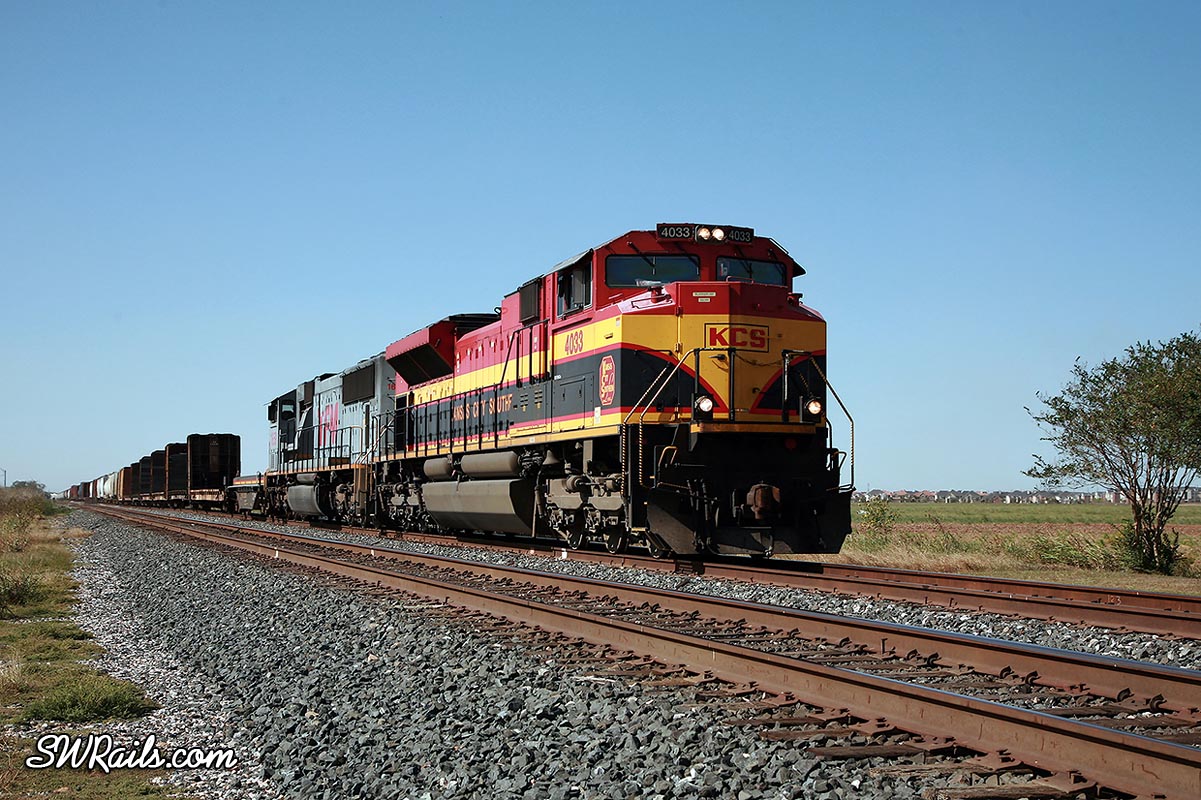
KCS SD70ACe 4033 gets its train underway after a meet at Sugar Land siding on Oct. 28, 2010
I was barely able to get to Stafford ahead of this train, not because it was going fast, but because of the way the traffic lights on Hwy 90 operate in conjunction with crossing gates.
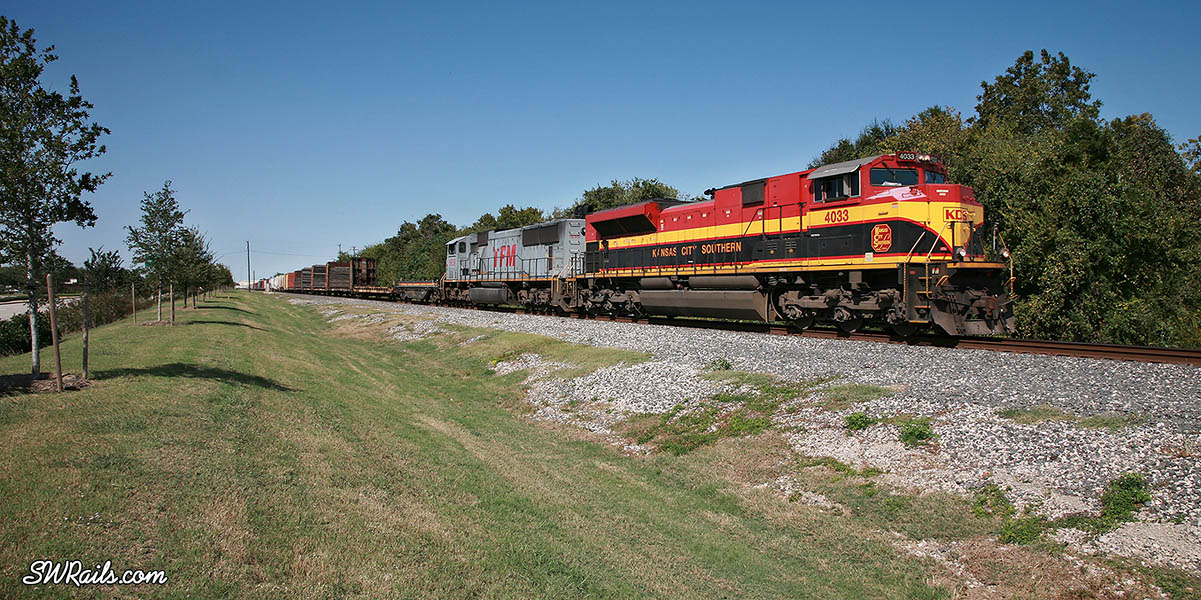
KCS 4033 passes recently installed landscaping in Stafford, TX on Oct. 28, 2010
The first freight car seemed odd, so I took a quick picture of it.
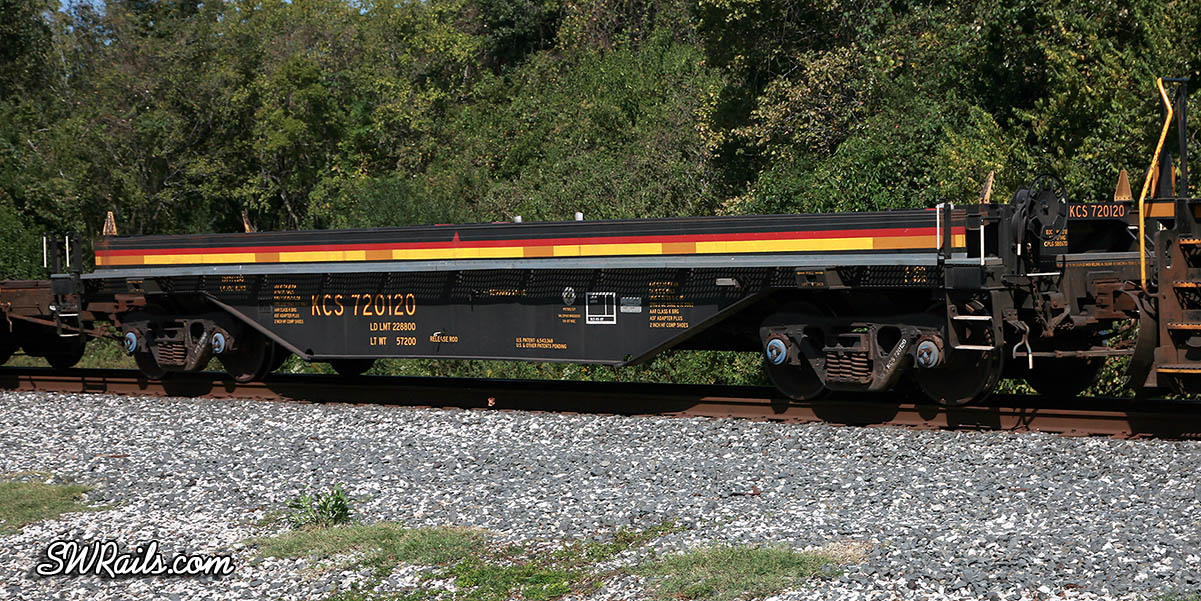
At first I thought it was an intermodal car for one trailer or container. Was I wrong! I looked it up at RailCarPhotos.com. It turns out that this is a coiled steel car, minus the covers.

You learn something new every day…
Commuting on the Southern Pacific
The Southern Pacific operated commuter trains between San Francisco to San Jose, California from the early 1900’s until the service was taken over by Caltrain in 1980.
Conventional passenger cars were the norm until 1955, when the SP received ten 145-seat double-deck gallery cars from Pullman Standard. 21 more arrived in 1956-1957.
By 1969, the commuter fleet consisted of 46 bi-levels and 55 standard coaches.
Motive power during the diesel era was 14 Fairbanks-Morse H-24-66 Trainmasters, in addition to 11 specially equipped GP9’s.
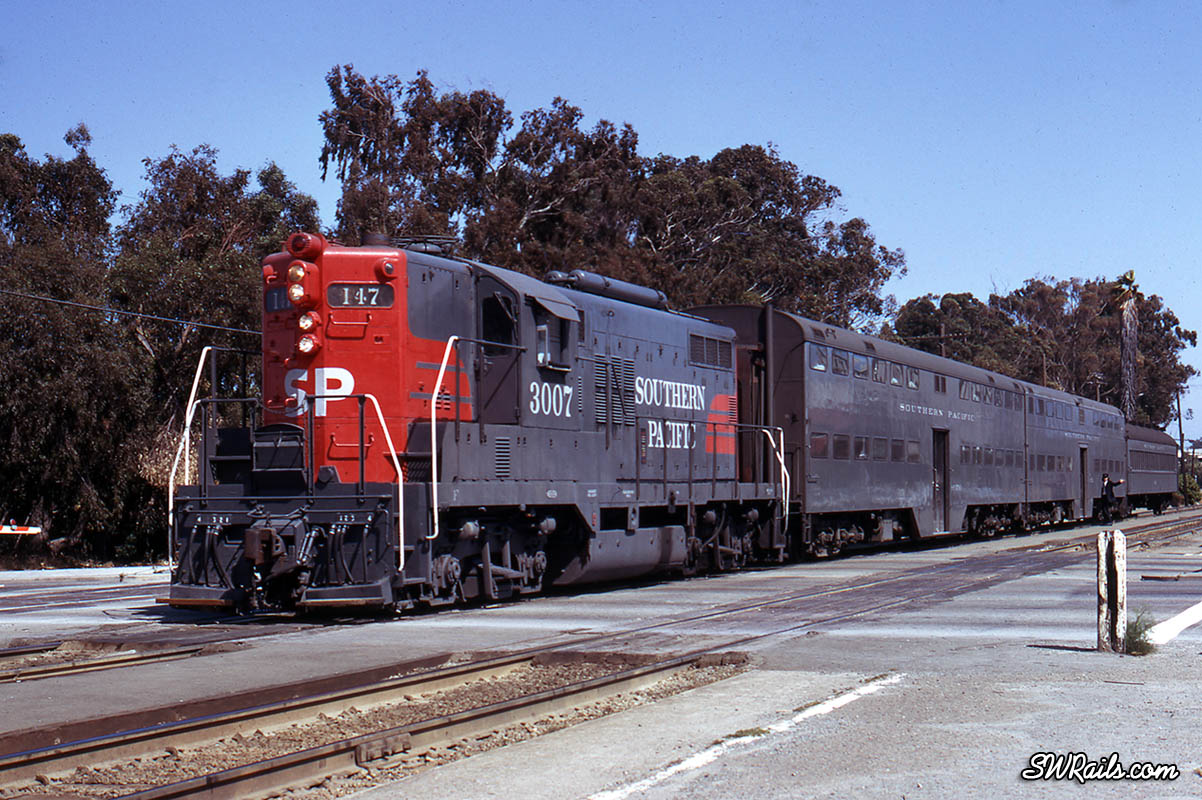
The conductor of SP commuter train 147 signals to depart Millbrae, CA on June 20, 1975
Note the interesting features that were unique to the GP9’s assigned to commuter service. Roof-mounted air tanks, steam generator stack, and the red “wings” on both ends of the unit.
Anybody care to venture a guess why there were wings on both ends of the passenger GP9’s?
Update: From comments, reader Ron Kiser replied with the correct answer: The wings on both ends indicated that the engine has dual controls. A control on both sides of the cab.
CSI-Rock Island
I dug a little deeper into the slide boxes and came across this shot of a fine-looking Rock Island freight powered by quite an eclectic group of locomotives.
This is from a dupe slide. There’s no information on the mount, but some sleuthing might be able to shed some light on this scene.
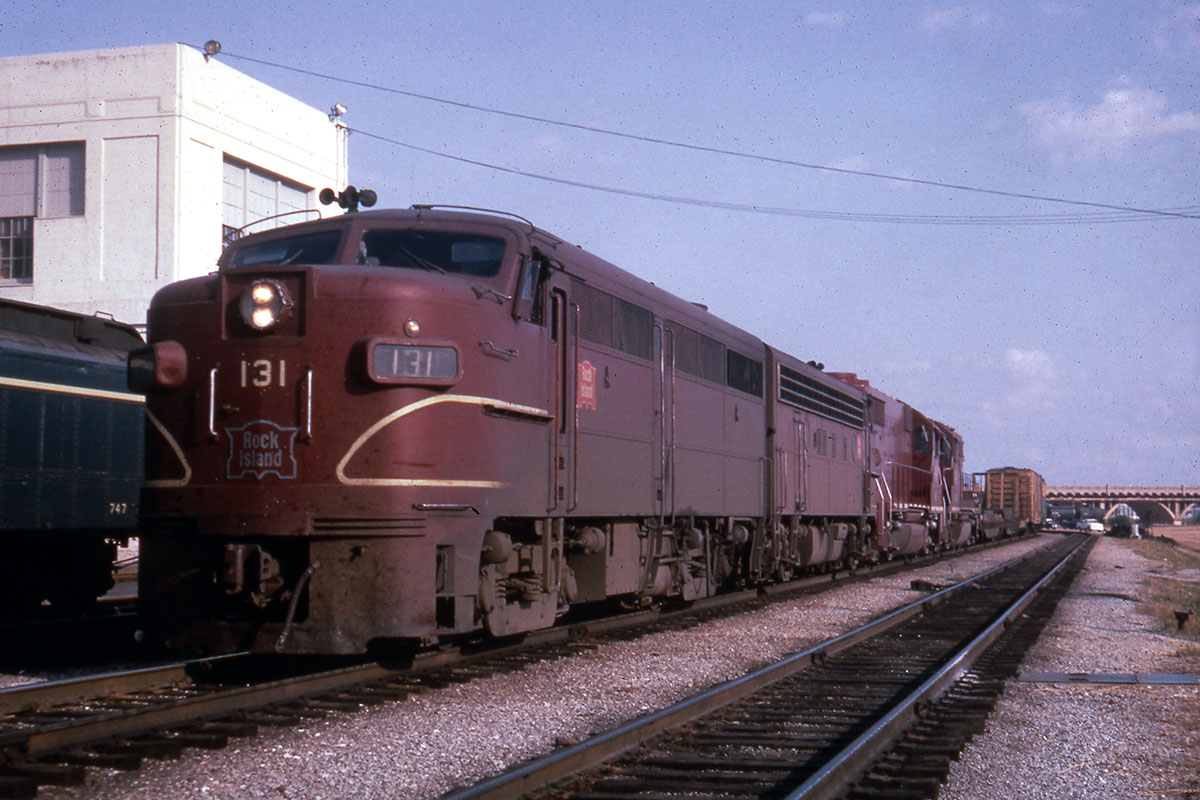
Right off the bat, I recognize the location as Dallas. The train is passing by the Dallas Union Terminal building. The bridge in the background confirms this. It’s the Houston Street viaduct over the Trinity River.
Looking carefully at the motive power provides clues about the date of the picture. The lead unit is an Alco FA that’s been re-powered with an EMD 567 engine. These engines were retired by 1970.
Second out is an F7B unit. The third and fourth units are brand-new GP35’s. My Rock Island roster book tells me that the RI received all of its GP35’s in early 1965.
Lastly, looking at angle of the sun indicates that it’s a late afternoon shot in the summer.
Conclusion: Rock Island 131 North is passing through downtown Dallas late summer 1965. The train is coming off the B-RI line which originates in Houston. The train is en route to its primary yard in the area, Peach Yard in Fort Worth.
 Southwest Rails