Out & About – Nov. 25, 2012
I really didn’t intend to get out today, what with other matters clamoring for attention. But I just happened to take the radio and camera when making the breakfast run. I had just gotten out of the subdivision when I hear Amtrak #2 call out a signal. Typically when I hear Amtrak on the radio, it’s too late to get trackside. Fortunately, today was not typical.
It was 10:44 AM when the assistant engineer called diverging approach at CP SA029, about 8 miles west of me. The fact that the train was going in and out at Harlem due to MOW would give me the extra few minutes I’d need to beat the train to the Dulles Ave. grade crossing. It took me right at 10 minutes to get into position, with the eastbound Sunset Limited appearing 3 minutes later, right at 10:57 AM.
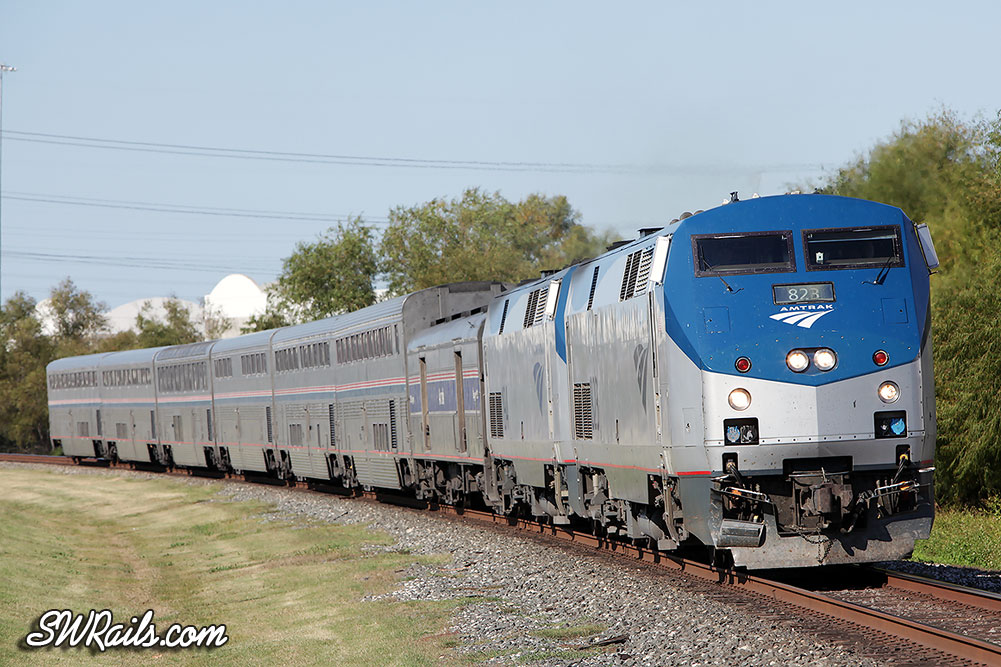
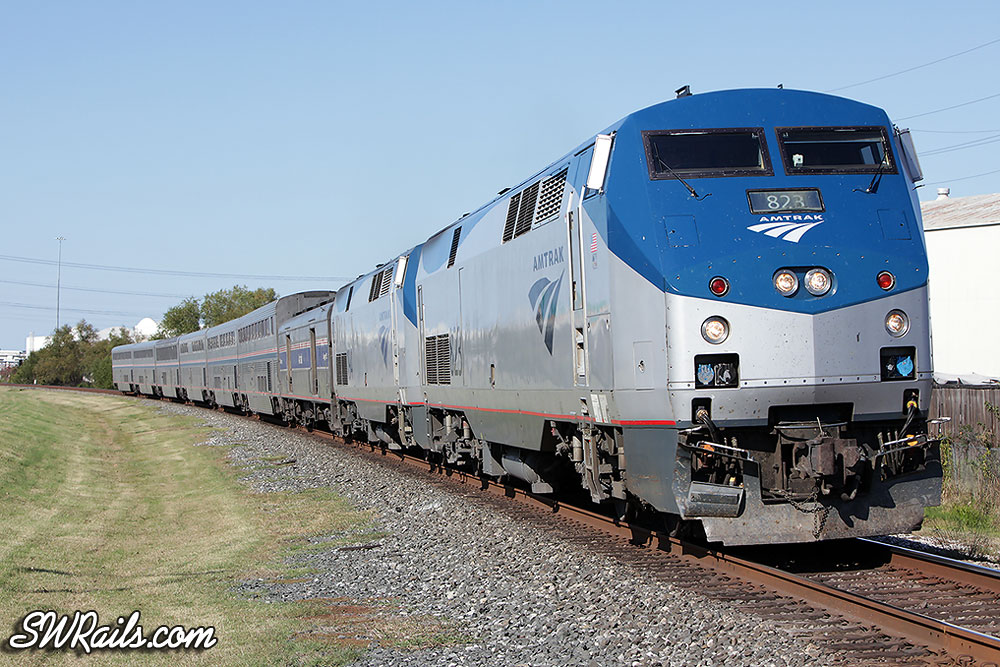
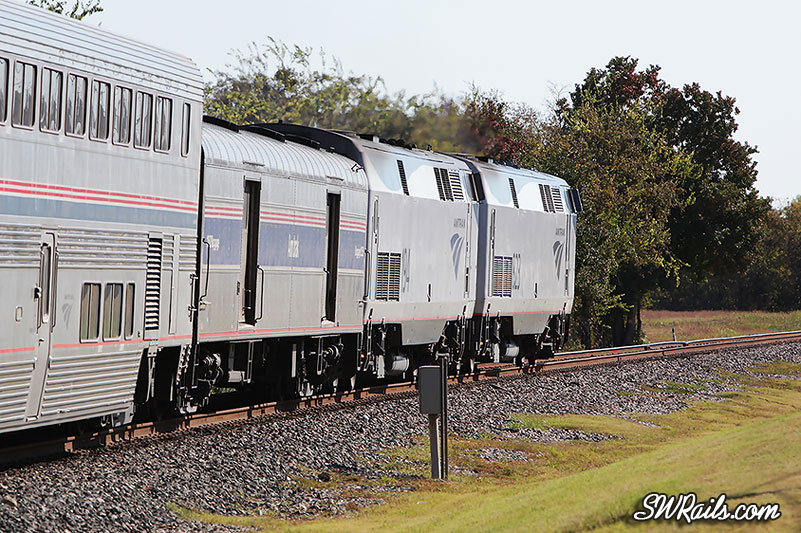
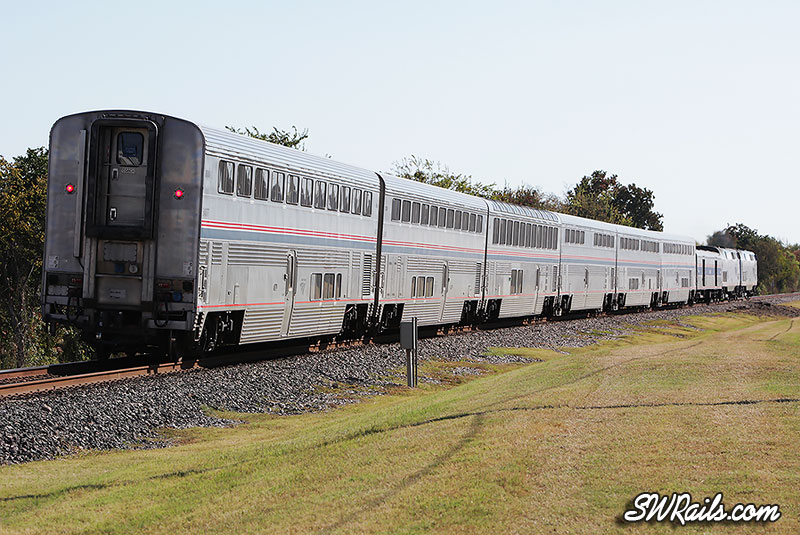
Railfanning done for the day, I got back on task, getting a bag of kolaches to go with our Sunday morning coffee.
Out & About – Nov. 24, 2012
Super weather today, so I played a bit of hooky from being productive and went trackside for a bit this afternoon. First up was an ILBEW (intermodal Long Beach-Englewood) train through Stafford just after 1:00 PM this afternoon:

I headed back home for some lunch and to take care of some things. I wrapped up about 3 PM and headed toward the curve at MP 21.5, just east of Hwy 59. Shortly after I got there, the detector at 15.6 announced a westbound, for which I was locked and loaded. Good thing I was, as one of my fave paint schemes led the MEWEG-24 (manifest Englewood-Eagle Pass) by me at 3:21 PM.
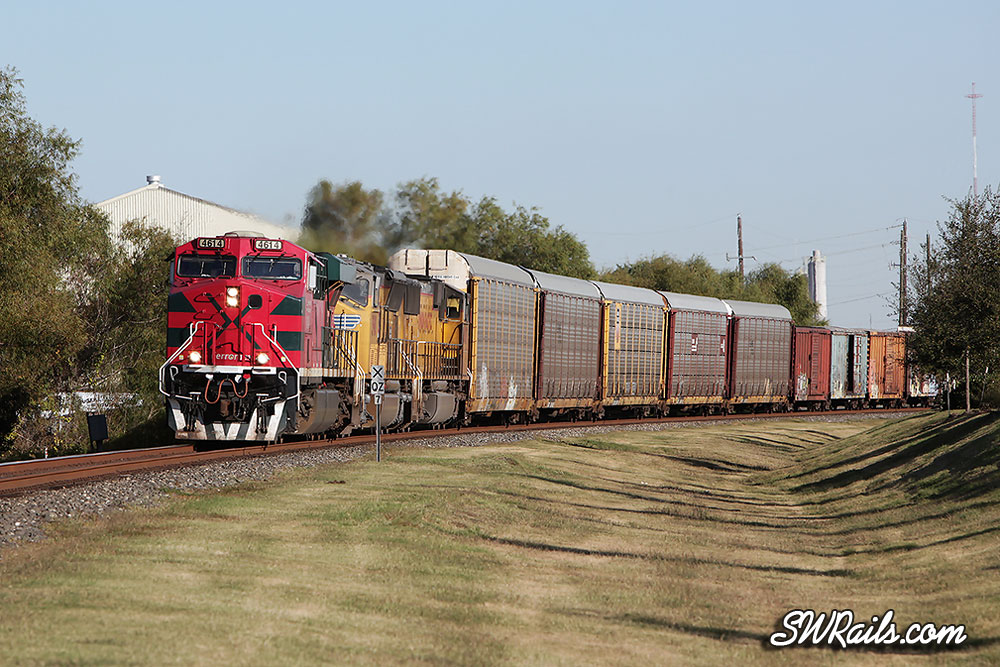
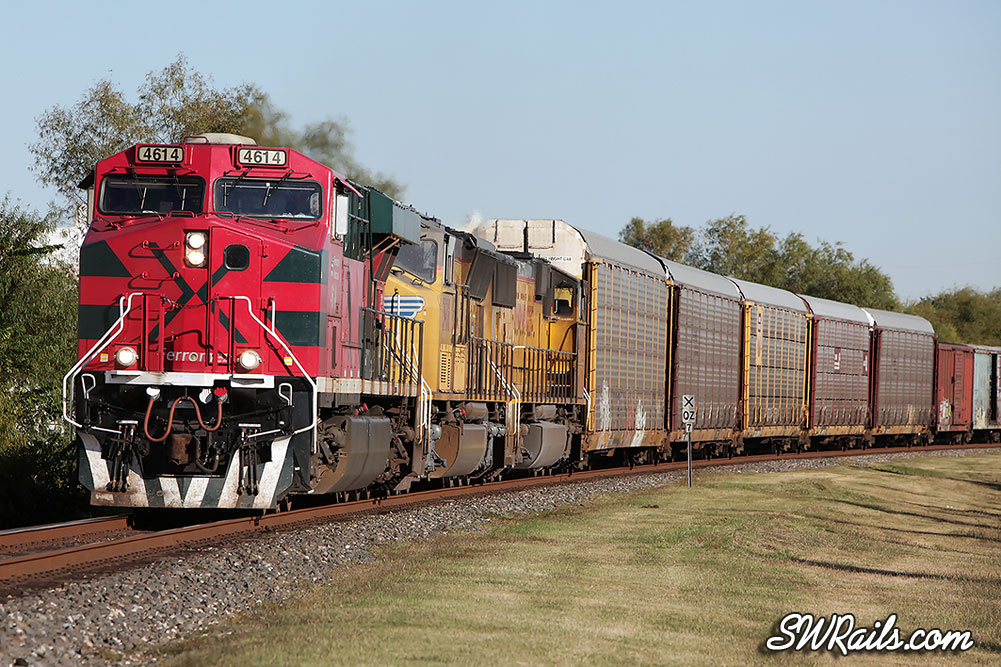
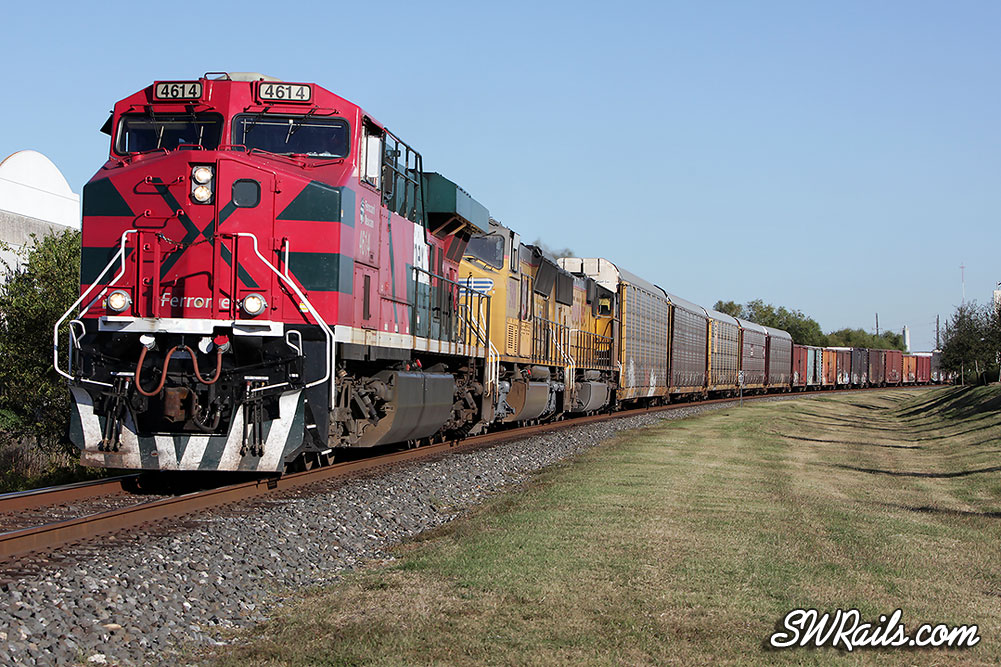
Ferromex on the point calls for another shot. The problem is the train is doing a good 50mph, there’s no eastbound traffic to slow it down, and Hwy 90 has a bazillion traffic lights. As such, US 59 toward Rosenberg was my only option.
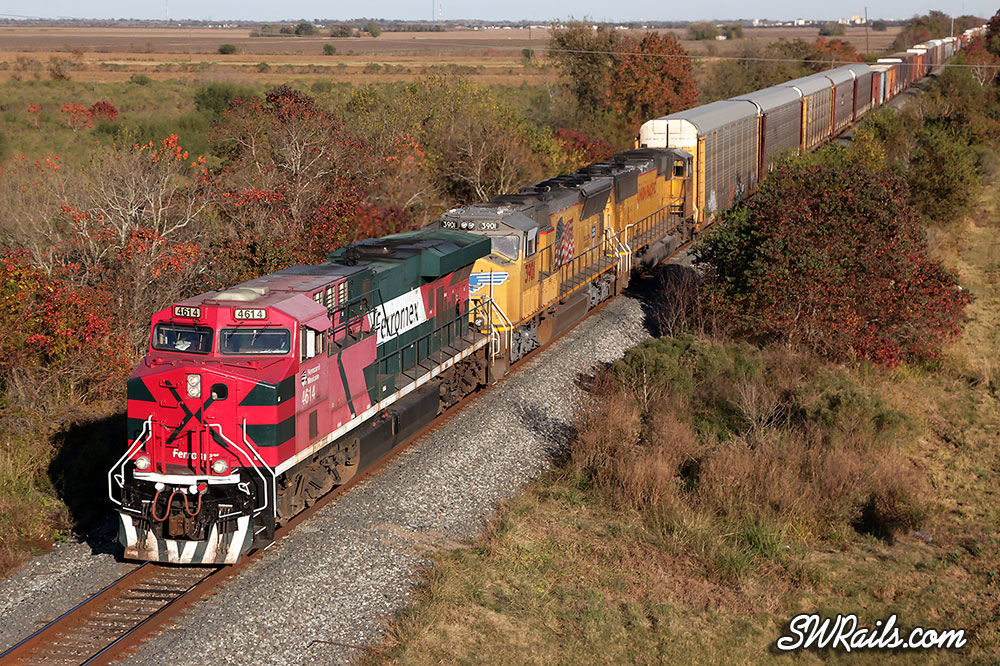
Upon my arrival to the Spur 10 overpass near MP 40, the MEWEG’s headlight was already in view. It made better time than I anticipated. FXE 4614 passed through what passes for fall colors in southeast Texas at 3:47 PM.
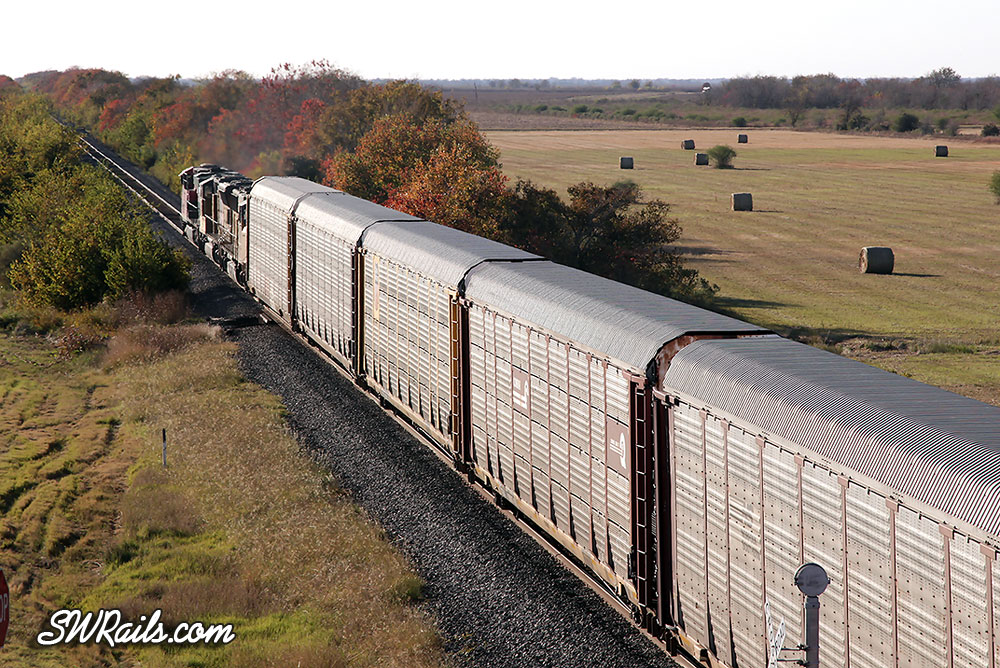
Returning to the car, I heard the DS give a track warrant to a westbound KCSM train. I headed toward the Tower 17 interlocking area to set up for a shot. As it turned out, a southbound BNSF train would go by first.
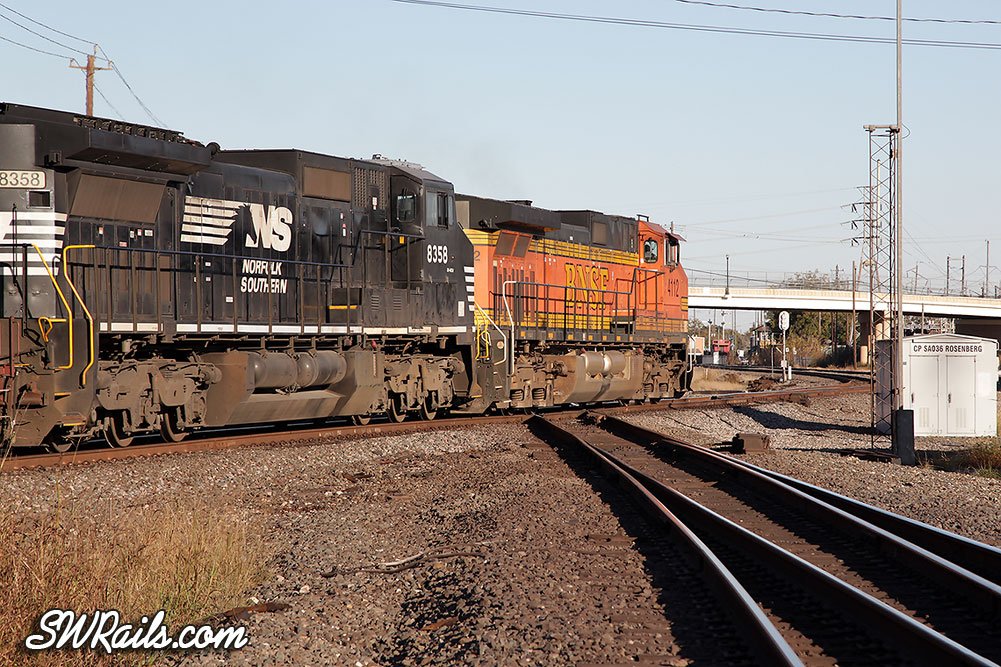
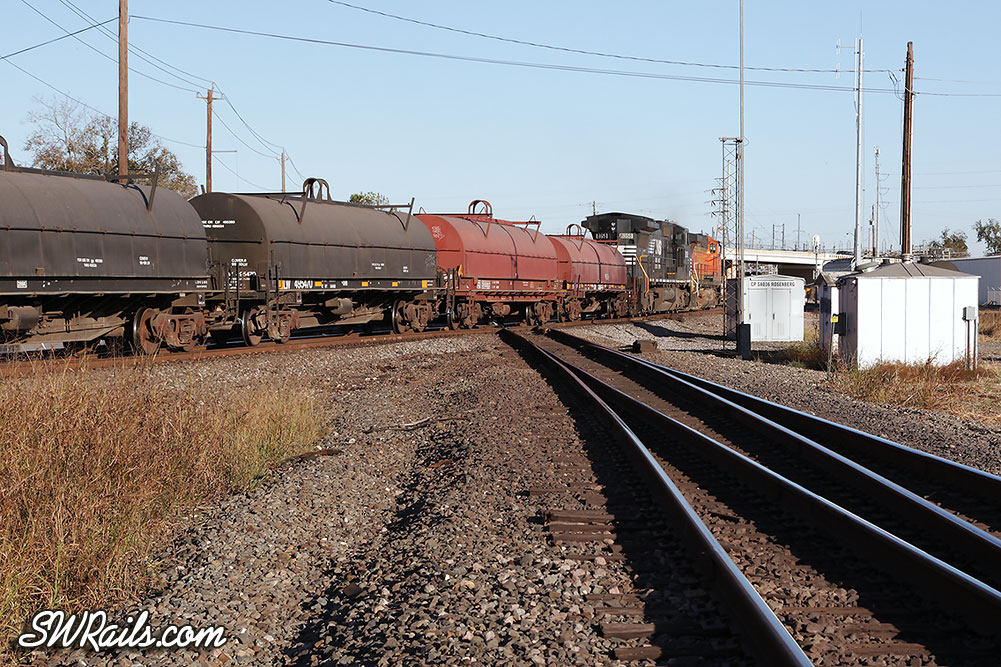
I decided against a tried-and-true shot of the KCSM at the interlocking. Instead, I ended up near MP 1.70 of UP’s Rosenberg sub where I found a another bit of those hard-to-find southeast Texas fall colors.
The only problem was the head-on sun angle really lit up the scotchlite on the nose of lead unit KCSM 4529. Once again, I’ll ask the existential question of our times- what can you really do?

The going away shot turned out to be my favorite shot of the day. I wasn’t even going to try it because I’m almost shooting into the sun, and well, you’re not supposed to do that, right? Good thing I forgot about that rule…
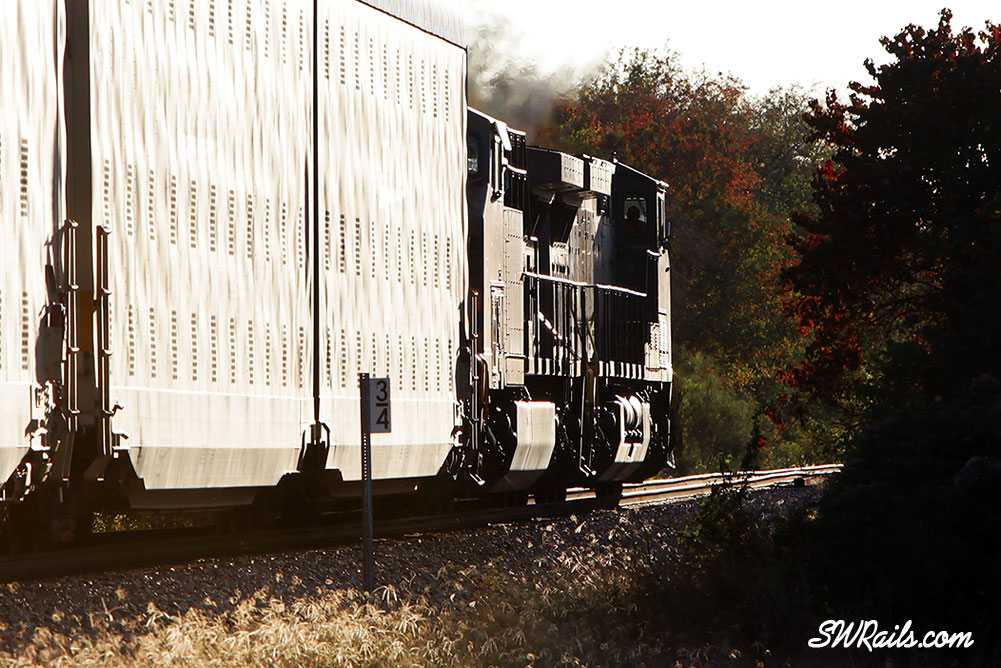
There were a few more trains in the area, but I needed to get back home to do my Christmas shopping. I’ve had my eye on a new book, “Southern Pacific Lines Across Texas and Louisiana 1934-1961”, and I just might order it tonight. I did say it was my Christmas shopping…
NS Heritage Power Visits Texas
On paper, it was supposed to be an epic chase – two NS Heritage locomotives leading a UP freight under almost perfect weather and lighting conditions. However, as you sports fans know, the game isn’t played on paper.
Word was that UP’s MEWEY-21 (Manifest Englewood -East Yard) would have 4 NS motors, the first two being NS heritage units. A trace showed the train was by Bringhurst Avenue (just west of Englewood) at 11:08 AM. Normally that would put the train into my neck of the woods shortly after noon, so I had all of these visions of a 3-4 hour photographic pursuit of the train as it traveled toward San Antonio.
We got out of the house, took care of a few errands, and headed toward West Junction where I hoped to get my first shots of the train. En route, I heard the DS tell the MOW foreman at Heacker that UP 8408 would be the next train through their Form B . I set up for it between switches at Missouri City, catching the MEWEG-21 (Manifest Englewood – Eagle Pass) at 11:27 AM.
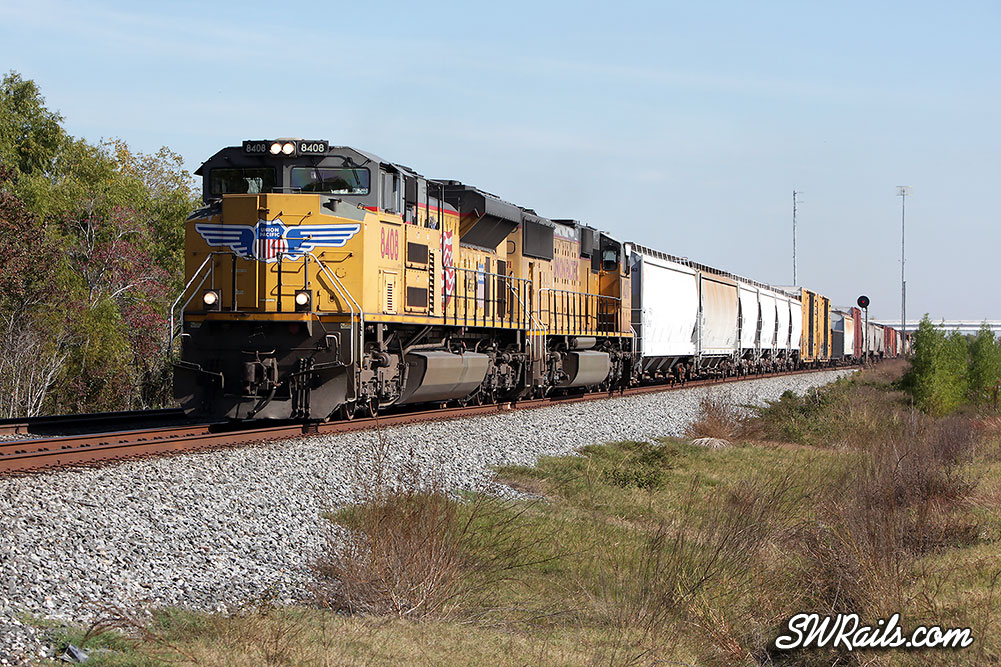
I fully expected the MEWEY to be right behind the MEWEG, so I went straight to West Junction to set up for it. Due to the Form B in effect, I knew I’d get a 5-10 minute heads-up to the arrival of the MEWEY, so I took a few shots of the double-track project around Heacker to pass the time. Once I was done with that, I stopped by a convenience store to load up on snacks in anticipation of the long chase of the MEWEY. And the wait began.
After an hour had gone by with no sign of my quarry or anything else , I did another trace of NS 1072, the lead unit of the MEWEY. The trace result was the same, by Bringhurst at 11:08 AM. Hmmmm? What to do? Do I sit tight, or do I drive the 25 miles to Houston to find the train?
I decided against driving to Houston, feeling that there was a good chance the train would get by me. I spent the next 45 minutes taking more pictures of the double-tracking project. Still no train, so time for another trace. “Passing Tower 26 at 12:33 PM”. The train had finally moved, but only two miles in 90 minutes! Maybe I should have gone to Houston after all!
At least the train is headed my way, right? Well, kind of. Turns out there’s a short-time KCSM train in front of the MEWEY. The plan is to patch the KCSM at Post Oak, but the relief crew has been delayed. Wonderful. Actually, better than wonderful because not only is it getting late, but there’s a bunch of clouds moving in from the north.
KCSM 4508 announces his imminent arrival by calling Foreman Huerta for clearance through the Form B, so I set up just west of West Junction, catching it at 1:46 PM.
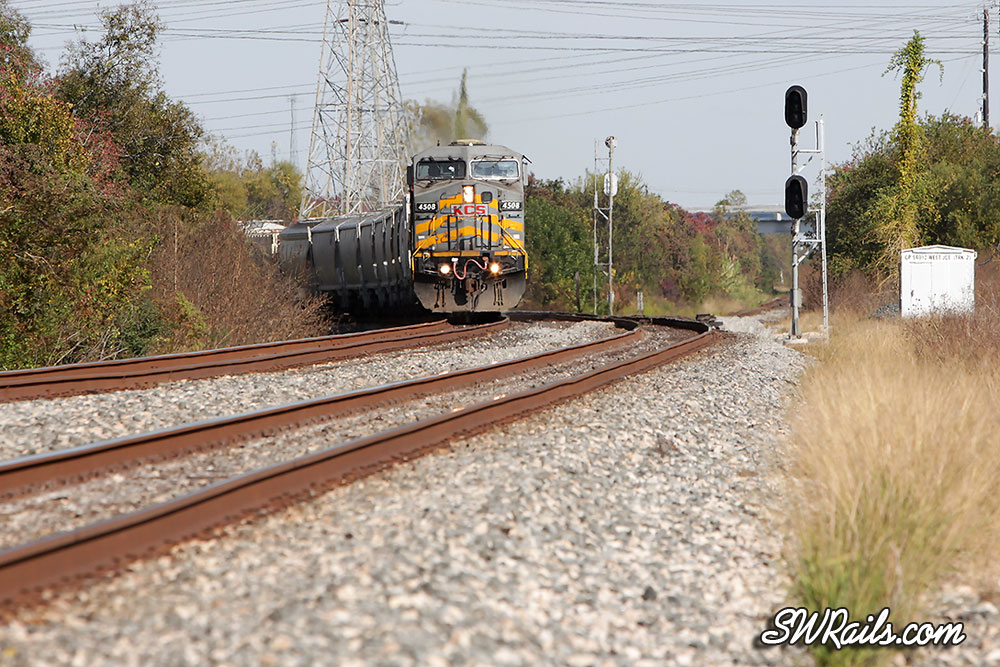

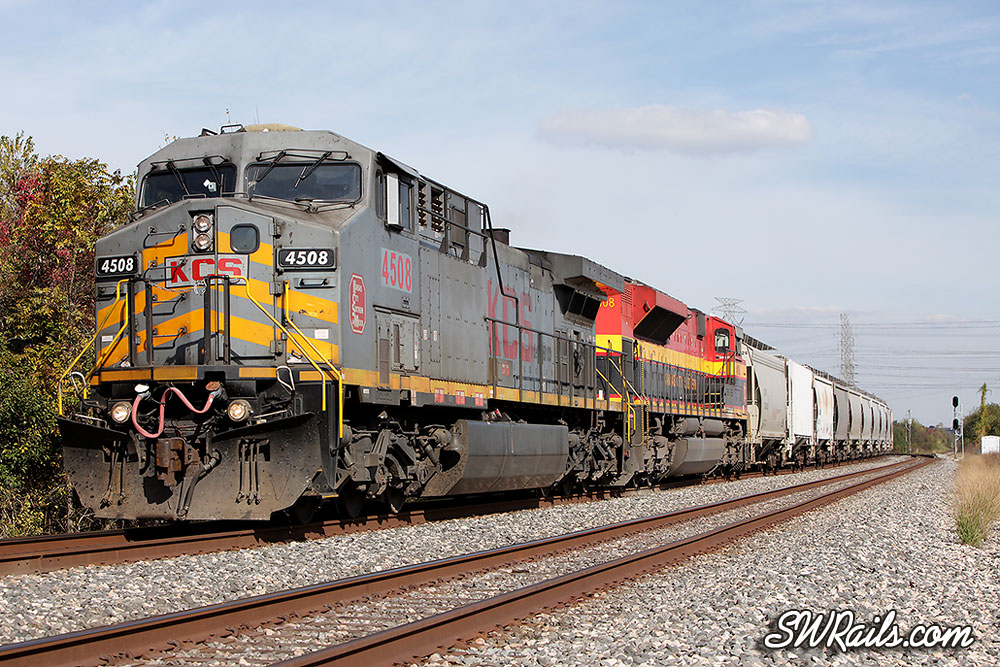
Knowing that the KCSM wasn’t going anywhere soon and that the DS had some eastbound traffic to run, I had no choice but to drive in to Houston. Hopefully the MEWEY was stopped somewhere shootable. A quick 10 mile drive shot down that hope, as I found the train stopped well north of the San Felipe grade crossing, photographically inaccessible.
Oh well, nothing to do but drive back. At this point it seemed that I’d get no shot of the MEWEY before sunset because the KCSM was still at Post Oak getting re-crewed, and nothing was moving west until 2 eastbounds got by.
As I was cursing my luck, the dispatcher called an audible. He decided to hold the eastbounds at Sugar Land and Harlem and would be running the MEWEY around the KCSM at Post Oak. I wonder if the decision was made because the MEWEY crew had been on duty over 5 hours by this point, had yet to travel 20 miles, and still had nearly 200 miles to cover before the crew expired.
No matter, at least I stood to get a few shots of the elusive beast before dark. By this point, the light between West Junction and Missouri City was too nosy. I went to Stafford, setting up just west of the intermediate signal at MP 20.6.
As I was waiting, there was an interesting conversation between Foreman Huerta and the MEWEY’s conductor. It went something like this:
“Foreman Huerta to NS 1072”
“NS 1072”
“You told me your lead unit was NS 1072, but the engine was an Illinois Terminal unit”
A 10 second pause ensued before the conductor responded.
“The engine is painted in some commemorative paint scheme, but reporting marks are NS 1072”
“OK, I just wanted to be sure, because it didn’t look like an NS unit”
“Thank you, NS 1072 out”
“Foreman Huerta out”
As the train came into range at 3:03 PM, the sun dove into some thick cirrus, but a quick adjustment to ISO 800 saved the day.
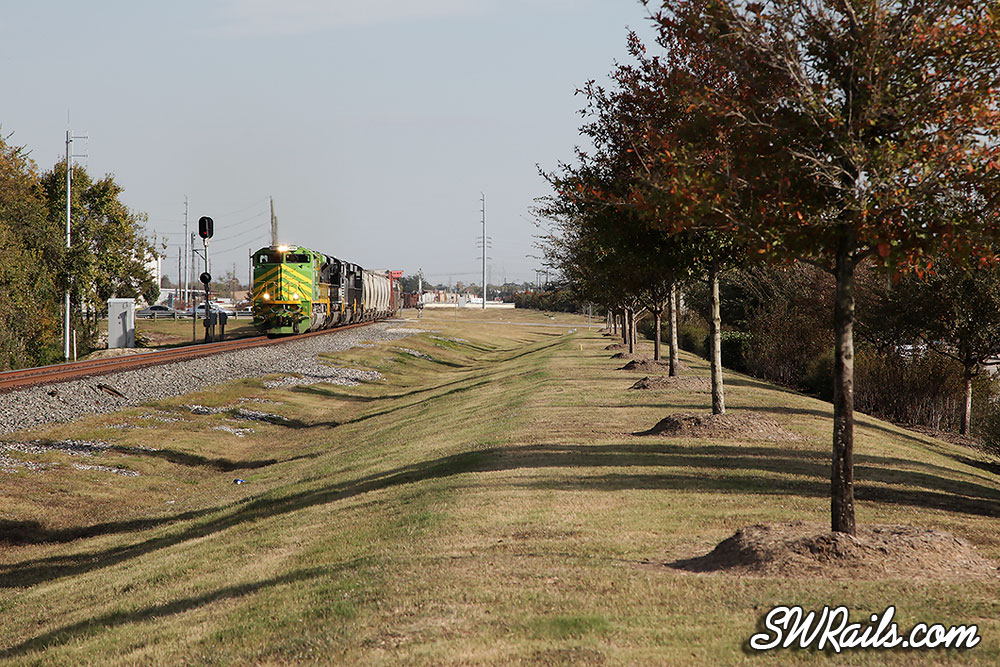
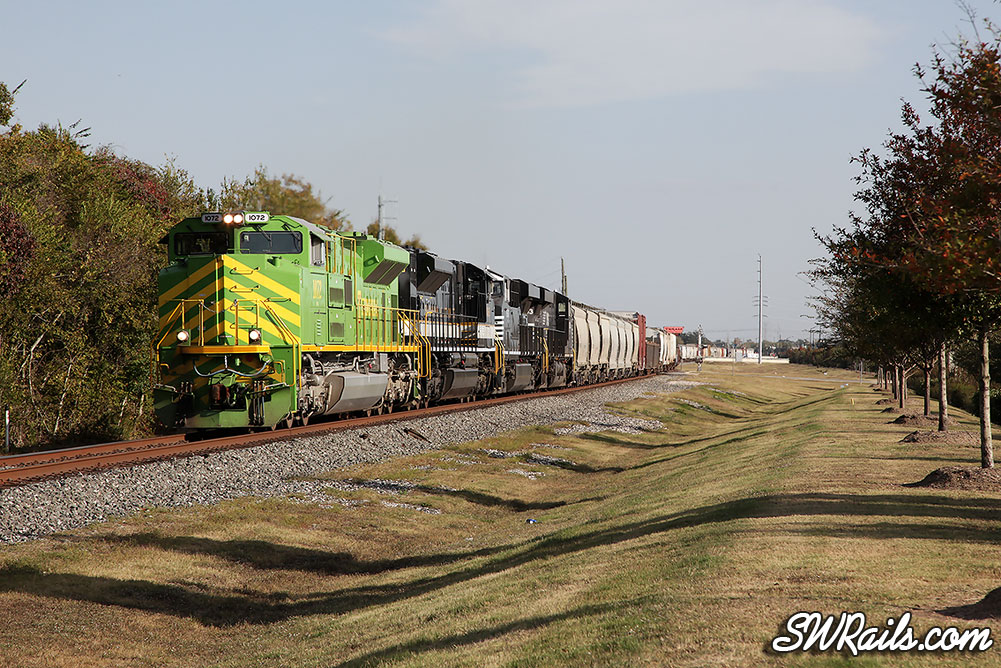
I never expected to see one, much less two NS Heritage units to come through here. Lead unit NS 1072 in Illinois Terminal colors, followed by NS 1065 in Savannah & Atlanta colors make the long wait worthwhile.
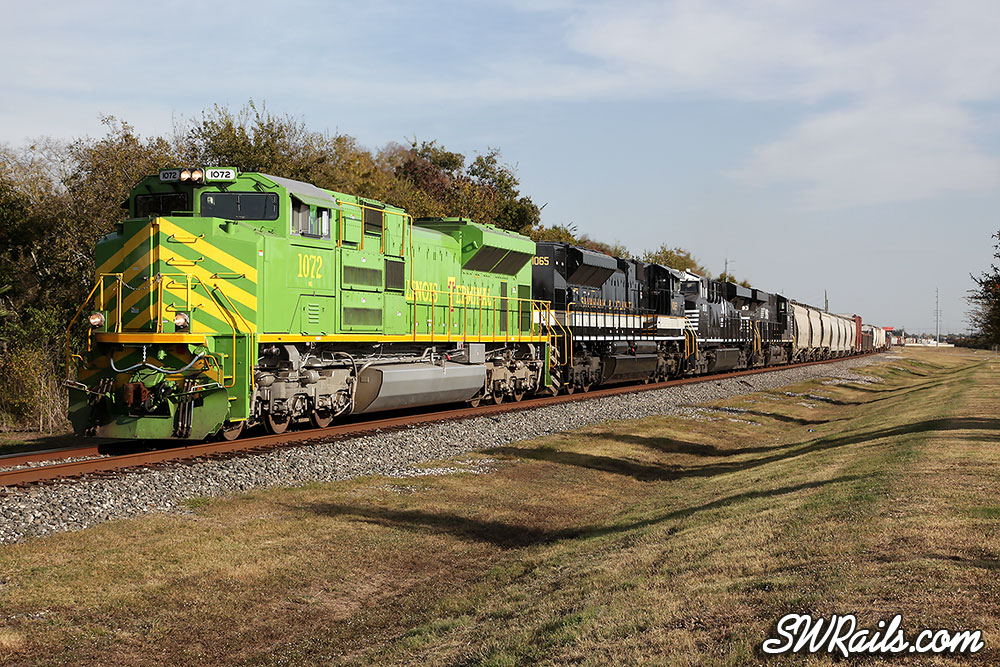

Hoping to get a shot in better light, and to double the productivity of the 3 1/2 hour wait, I drove to the Spur 10 overpass at the west end of Rosenberg. The clouds have really done a number on the light, but what can you really do?
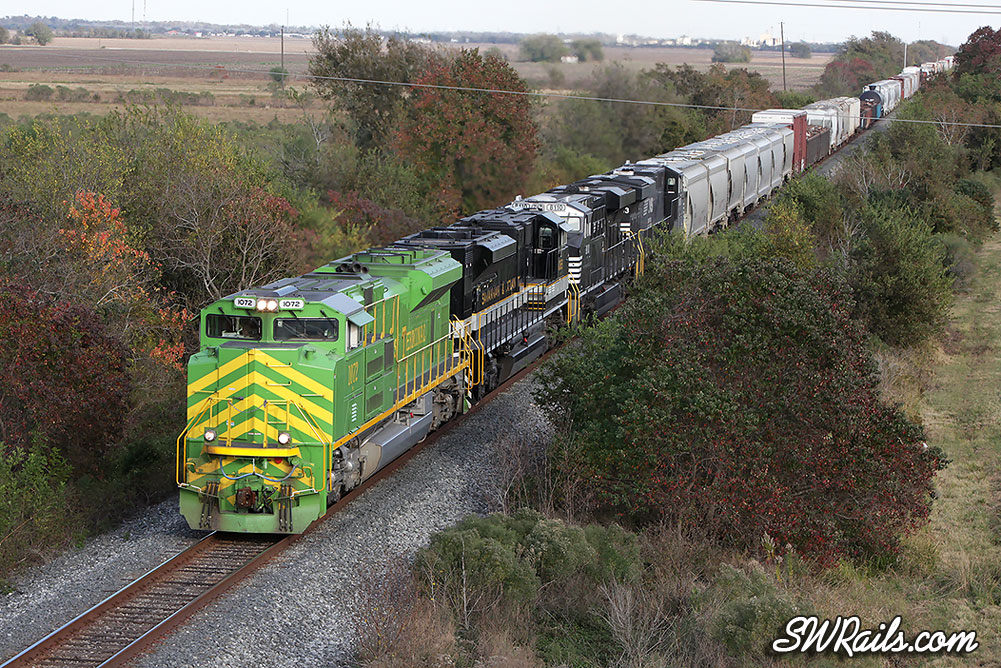
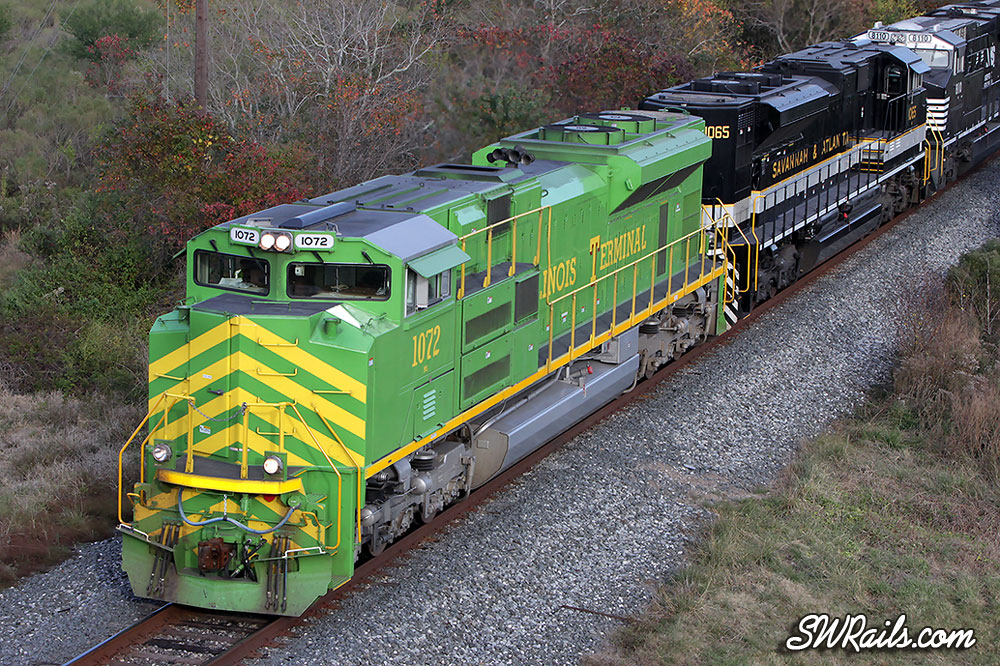
I was half-tempted to continue westward in the hope of getting better light, but I thought better of it. I contented myself with this going-away shot of the train as it heads west.
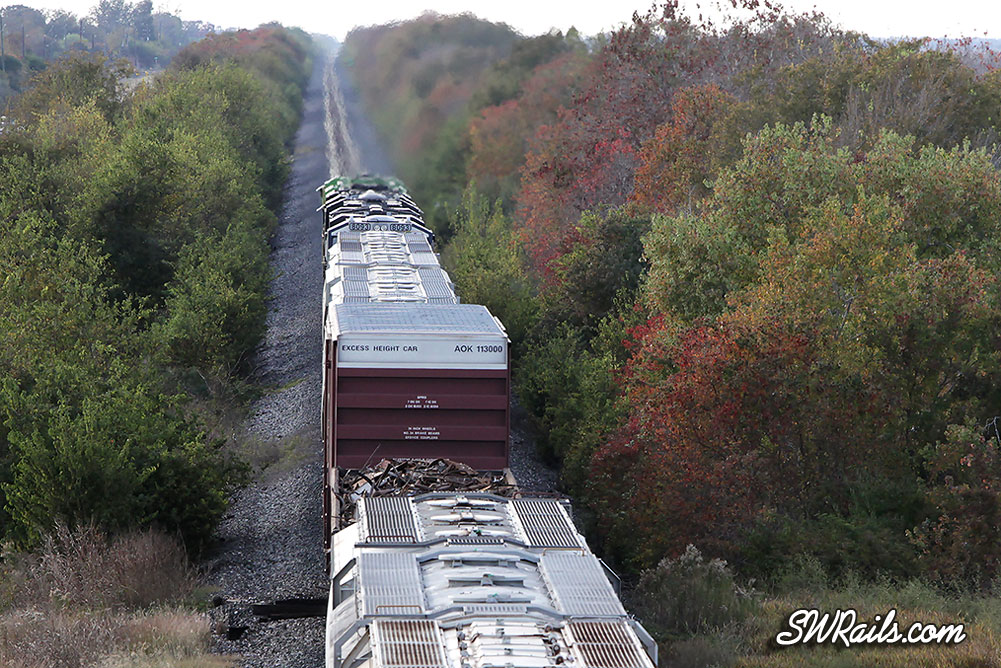
It’s my understanding that the NS 1072 and 1065 are en route for emissions testing in San Antonio. Hopefully they’ll return to the NS via the Glidden sub to where I might get another bite at this colorful apple.
Out & About – October 4, 2012
The beginning of October is one of my favorite times of the year. The worst of the summer heat is over and the sun is low enough in the sky to allow photography all day. As such, it didn’t take much for me to get out of the house on Thursday, October 4, 2012, as soon as I heard the Glidden sub DS tell KCS 4612 that he would see 2 westbounds at Sugar Land.
My first stop was “Prison Road” crossing, near MP 26 of the Glidden Sub. About a mile west of the east switch of Sugar Land, it’s the designated parking place for eastbounds so they don’t block crossings. Upon arrival, I was able to get a shot of the 4612, in the company of a gray KCS SD70ACe, patiently holding its intermodal train.

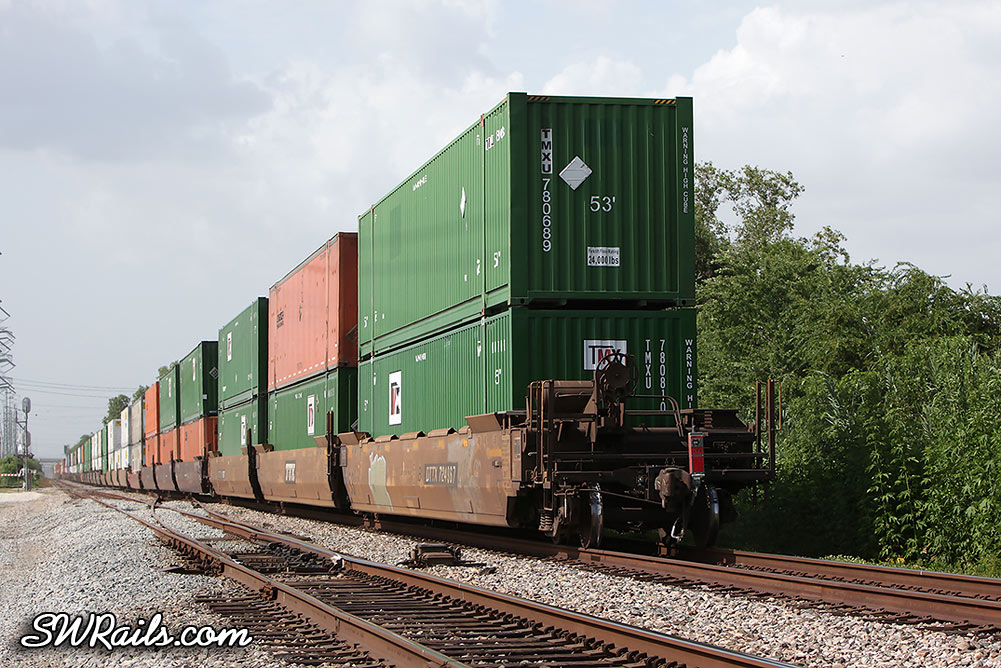
The first well car had an interesting pair of 53′ containers.
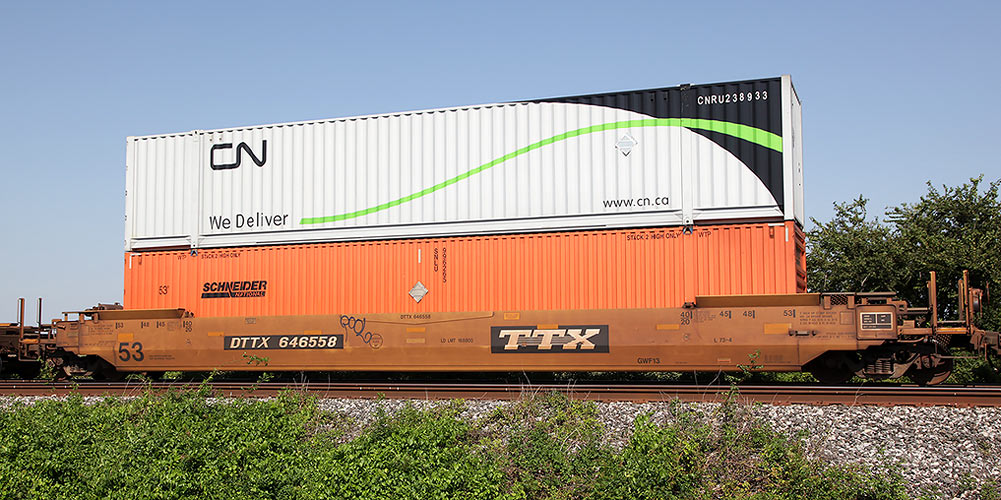
Next up would be the two westbounds as promised by the DS, but it was still too early to have decent light for a westbound here. After a bit of deliberation, I moved east about 1.5 miles to Oyster Creek. The sun hasn’t come around here either. My final answer was a wide-angle wedgie hoping to make the best of a backlit situation. After a 10 minute wait, the IAVLB-3 (Intermodal Avondale – Long Beach) train came into view.

Since the light at Oyster Creek wasn’t all that, so I headed back to Prison Road crossing with a new plan. Even if the light for the westbound wasn’t that good, maybe I could get a shot of the it meeting the KCS 4612 at the east end of Sugar Land siding.
Shortly after setting up, UP 6712 leading the MEWEG-04 (Englewood – Eagle Pass) came into view. Had I known an ex-C&NW patch unit was the leader, I would have opted for a more broadside view. Hindsight is always 20/20, isn’t it?


As the MEWEG was passing by me, the DS called KCS 4612 to advise “I’m ready for you at the east end of Sugar Land.” As soon as the MEWEG cleared, the eastbound KCS was already on the move.

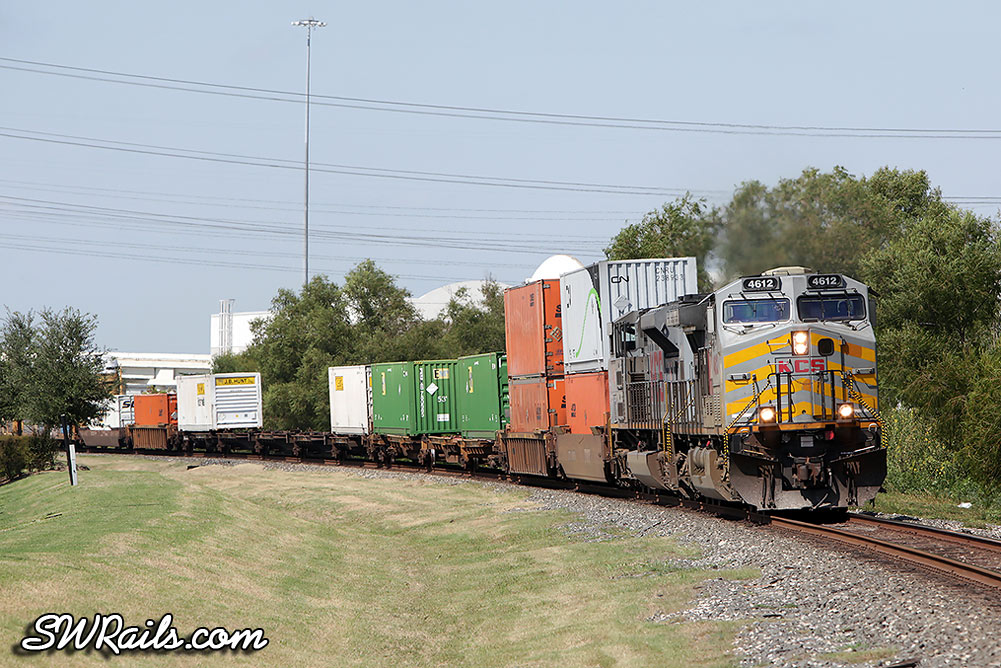
Wanting better nose light on the KCS 4612, I headed about 4 miles east to the Dulles Avenue grade crossing where the track turns into the sun a bit just enough to fix the nose light issue.

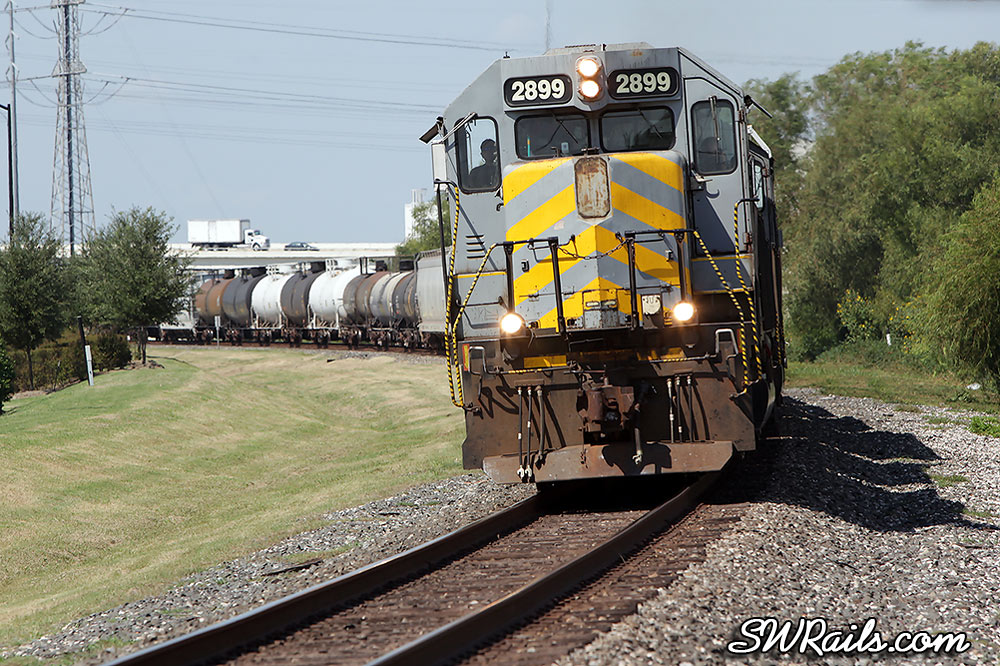
The KCS local was right behind the 4612, so I stayed put to capture it. I chose to mix it up a bit, shooting from the other side the track.
The DS advised the two foremen working the Form B’s related to the Heacker-Missouri City double-tracking project that there wouldn’t be any traffic for a few hours.
No trains? No problem. I’ve been wanting to catch up with the double-tracking work anyway, so I headed east. That will be the topic of my next post…
UP 844 & The UP150 Special’s Houston Arrival on 10/26/2012
Mostly cloudy and windy was the forecast for last Friday, October 26, 2012, but that wouldn’t be enough to keep me from heading out to capture the Houston arrival of Union Pacific’s 150th Anniversary Special Train. Then again, it’s not every day that UP’s “Living Legend” 4-8-4 844 leads a spotless passenger special into Houston.
The day started out fortuitously as my arrival to New Caney for my first shot was less than 3 minutes before the train blew by at a good 55-60mph. Thank goodness the train stopped to pick up passengers at Humble, or else I might not have been able to catch up with it until it stopped at the Tower 26 interlocking.
My second shot was along Hirsch Road, near East Mt. Houston Road. Light traffic and cooperative traffic lights allowed me to get to the Jensen Drive grade crossing in the nick of time for my third shot, a nice, slow run-by.
After that, the train slow-rolled down to the Tower 26 interlocking where it stopped to allow Amtrak #2 to get out of the depot. I was able to get set up in time to catch Amtrak drag east across the interlocking and shove south via the Carr Street connection. I’m not sure why Amtrak used the Carr Street connector as its route to the Beaumont sub vs. the normal Maury Street routing, as the moves it made today took much longer than normal.
Once Amtrak was out-of-the-way, the 844 dragged south across the interlocking where it met Amtrak #2 as it dragged north on West Belt main 1 en route to the Beaumont Sub. Afterward, the 844 shoved north on the Carr Street connection in order to access the Terminal sub for the westbound run toward the depot. Fair warning: the video action slows down dramatically for 4-5 minutes as Amtrak and the UP special make their moves back and forth.
I expected the special to head directly to the depot via main 2. I set up at the main 2 grade crossing of the I-10 feeder road, about 1/2 mile south of where main 2 separates from main 1. Much to my surprise, the train took main 1 westward.
“#%$^&%%#$$$# %&*$#&%%#” was my first reaction. My next reaction was to pack up quickly and head to the Taylor Street grade crossing several miles west.
I was the only person there at first, but within 2-3 minutes, another 6-7 cars of fans arrived in time to catch the shot as the 844 rolled by. At this point, it became apparent that the UP150 special would cross over to main 2 at Cheney Jct. and shove back to the depot. Accordingly, I drove to the Silver St. grade crossing. As soon as I arrived, there was an eastbound freight train in view.Apparently the DS was running a QWCEW train ahead of the 844’s shove.
Once the freight cleared up, the special’s reverse move come into view about the same time that a nice bit of sunshine arrived, allowing me to get the best light of the day. I thought that would be my final shot because Silver Street is less than a mile west of the depot. As it turned out, the UP wanted a proper arrival to the ceremony and a reverse move to the depot wasn’t going to cut it.
The 844 shoved about 3/4 mile past the depot, stopping under the University of Houston’s Downtown Campus building. After a bit of TD-2 / train crew communication difficulties, the special was cleared to makes its grand arrival to the ceremony.
Now you might be asking yourself why the train didn’t drag west to the depot on main 2 directly versus all of the back and forth moves? It’s my understanding that the curve on main 2 just west of San Jacinto Street is a bit too tight to accommodate the 844’s drivers and that the convoluted routing was the only way to get the train into the depot while avoiding this curve.
The 844 traversed this curve one time, back in April 2010, when the Hearne-Houston leg of the Valley Eagle arrived. If you’re interested, jump to the 11:00 minute mark of the video I captured that day and you’ll hear the pained squealing, and a few other ominous noises, when the 844’s went through this curve.
Once the train arrived, the ceremony took place, of which I only captured 30-40 seconds (you’re welcome!). Once the festivities were over, I captured the 844 as it slowly dragged the train past the Houston Avenue overpass in order to spot the train and locomotive for servicing, and preparation for the 2-day 150th Anniversary events set for Oct. 27th and 28th.
Sorry for the extremely long post, but I know that there might be 2-3 of you that are interested in the back-story of this video, plus I can read this post 20 years from now (hopefully) and remember all of the gory details…
Oh yeah, here’s the video:
Union Pacific Power Shortage?
Based on the last two trains I’ve photographed, you might think that the UP is going through a shortage of locomotives.
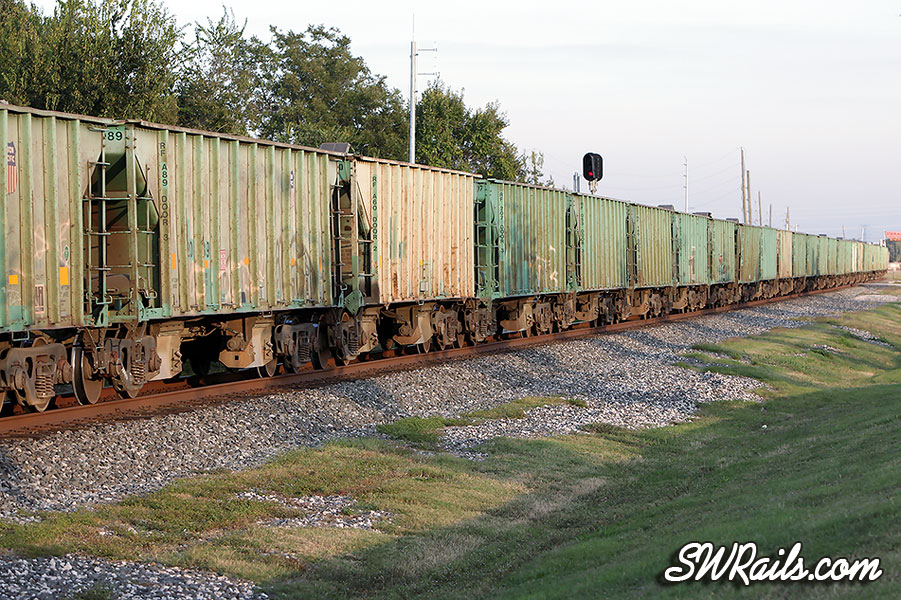
I caught a loaded UP ballast train at Stafford yesterday evening with only one unit, SD70M 4476, for power. The sun was flirting with some clouds near the horizon and I knew getting good sun would be a coin toss. As you can see, the clouds won the coin toss for the shot of the head end.

I won the next coin toss, as the sun popped into the clear for a moment for the all-important shot of the UP ballast hoppers.
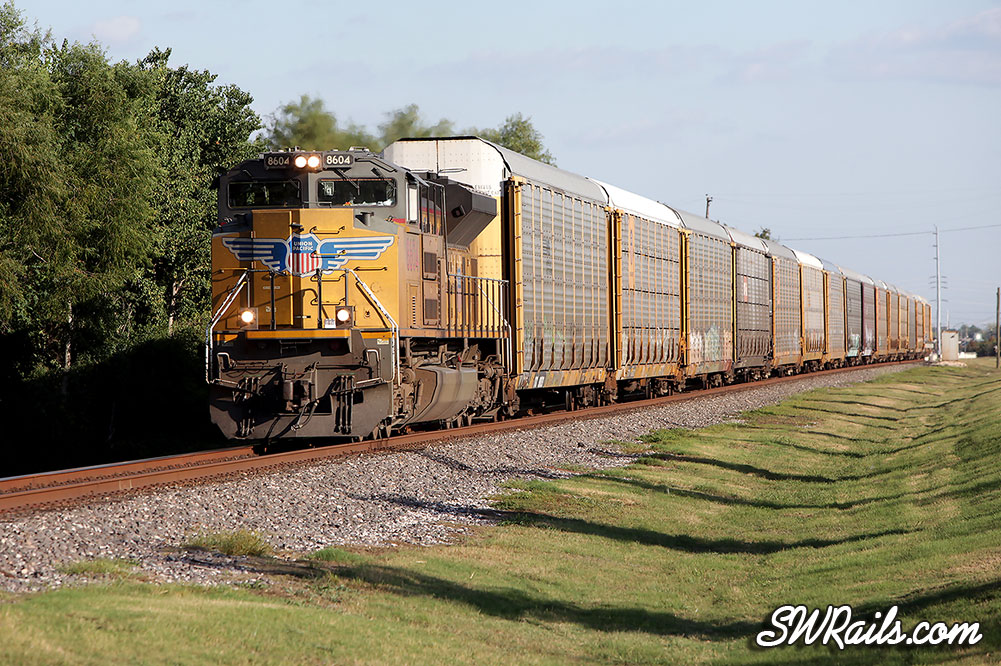
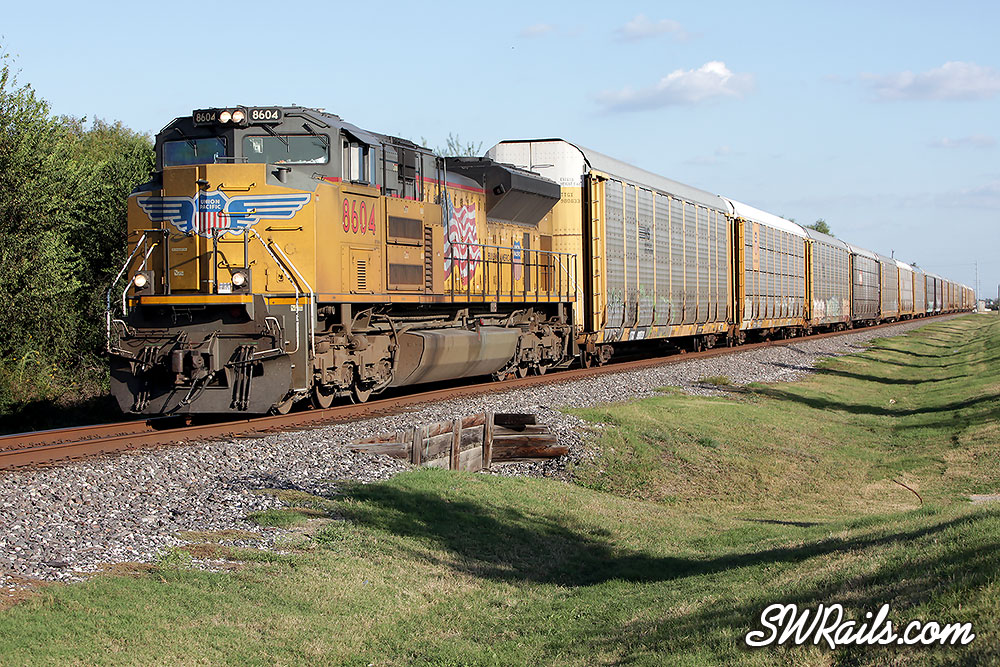
Today, 10/31/12, I was swamped at home with editing chores, unable to get out to enjoy the clear skies. Around 4:00 PM, I heard the Glidden sub DS talk to UP 8406 West at Heacker. As I needed to run a few errands, I stepped out, camera in hand. My first stop was the small culvert at MP 20.97, just east of the Dulles Avenue grade crossing.
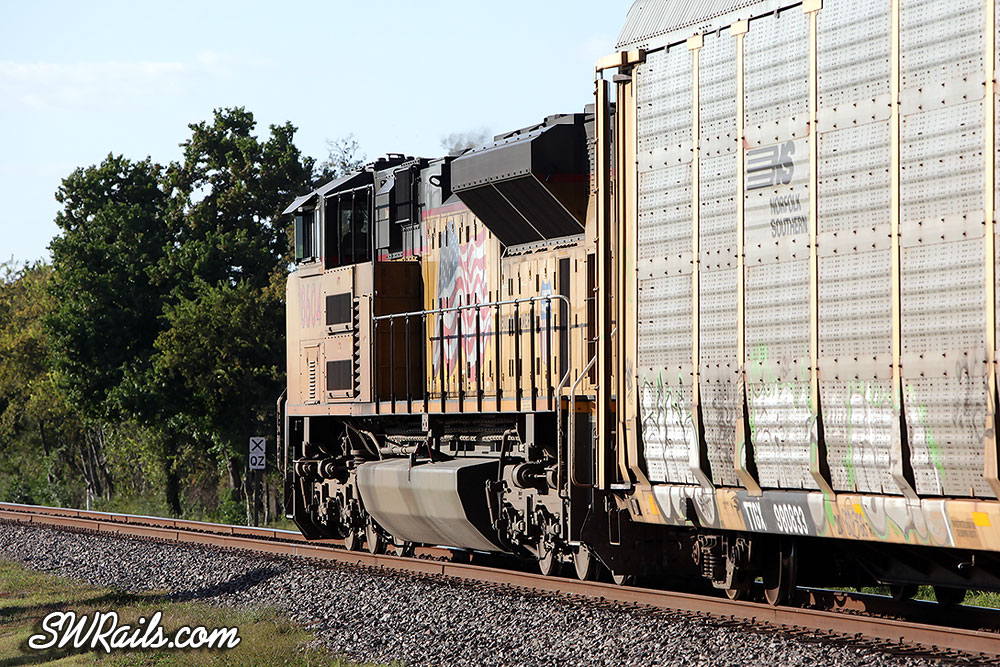
The train didn’t take long to arrive. It was the ASPEGR, the daily Spring, TX to Eagle Pass, TX empty auto racks. As it’s a relatively light train, it typically runs with a single locomotive.
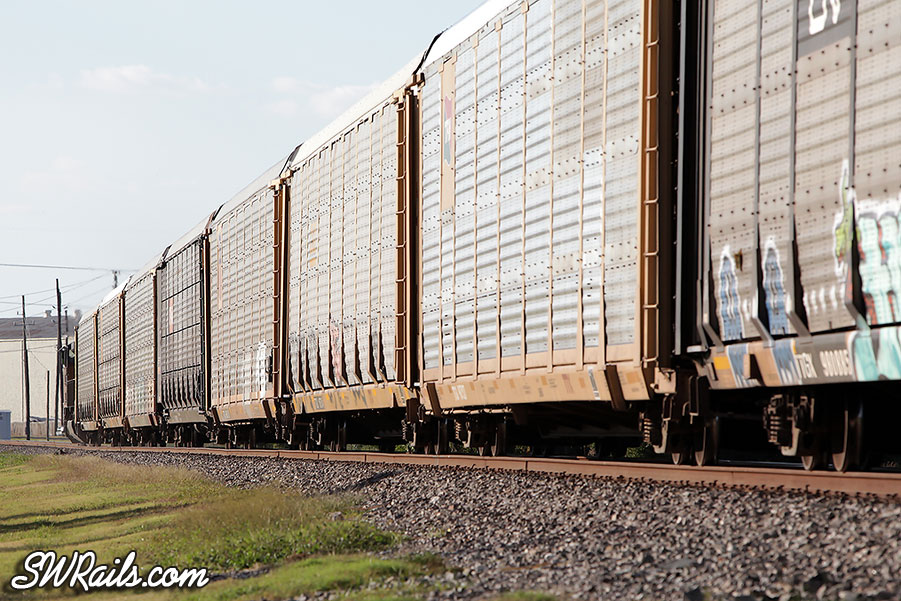
There were 3 other trains set to go by within an hour, but being eastbounds, I decided to get back on task and get the desperately needed car wash before going back home to grill fajitas. Then I had to make sure the house was ready for Halloween – curtains closed and lights off. I don’t want to be an accessory to juvenile tooth decay….
Cotton Belt in East Texas in the 1950’s
Let’s look at some Cotton Belt trains in East Texas in the 1950’s. First up is a shot of RS3 308 leading a local passenger train at Dallas Junction, in southwest Mount Pleasant, Texas in July of 1954. The 308 is just over 2 years old here, having been built in April, 1952. Dallas Jct. is where the Cotton Belt’s Dallas/Fort Worth branch line diverged from the East St. Louis – Corsicana mainline.

The next shot shows SSW FT 917 at Naples, Texas with an F7B/F7A on a freight train in January of 1956. Naples is about 18 miles east of Mount Pleasant. Note the crewman checking out the photographer

Last up is this 6/27/1958 view of T&NO F7A 376 at the Cotton Belt yard at Texarkana, Texas. T&NO 376 was built in mid-1953, and was from the final group of EMD F-units purchased by the Southern Pacific.

I believe the above view was taken from the Texas Viaduct, a long bridge over the ex SSW and MP yards in Texarkana. Here’s an aerial view of what the area looks like now.
Of course the yard has changed dramatically over the last 54 years, but the basic layout looks right. Do you agree? I’d especially like to hear from any Texarkanian readers.
PS – The viaduct has also changed dramatically. Currently a modern concrete structure, it was originally a wooden structure per this old postcard image I found.

It was built in the early 1930s by the city. It was torn down and rebuilt in the early 1970s.
The Sunset Limited – After Sunset
My late afternoon routine of photographing Amtrak #1 as it passes through the Sugar Land area might be on hiatus until next spring. It’s just too dark at 7:30 PM, the train’s approximate time through here.
The last couple of times I got out to do so, 9/22 and 9/26, really pushed my ability to get a decent image.
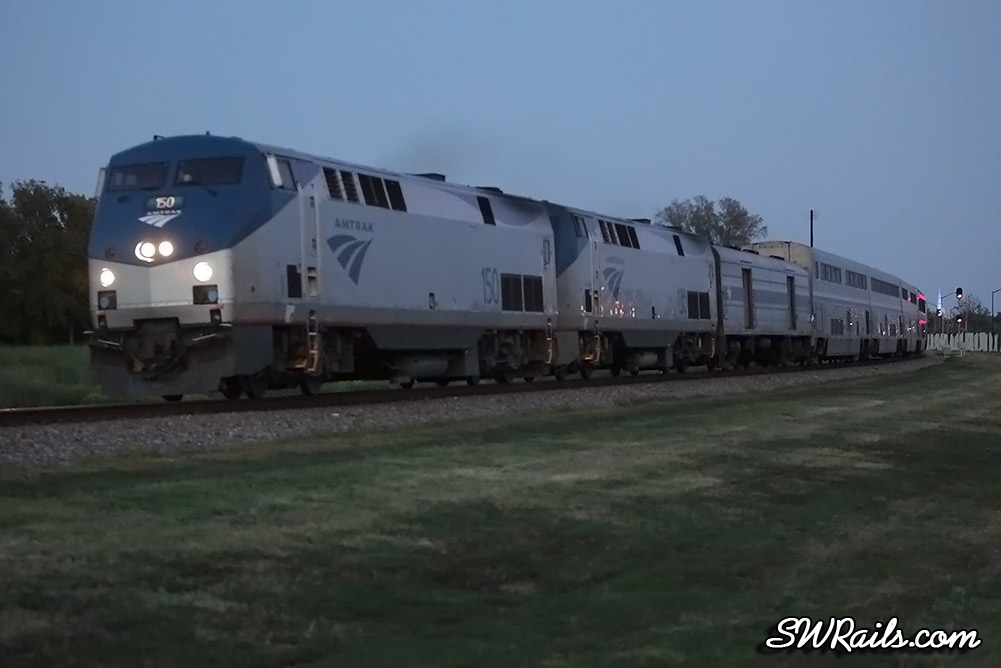
Here’s #1 passing by the old Imperial Sugar mill on 9/22. It’s about 15 minutes after sunset, but I got a nice ambient light assist from the businesses and traffic along Hwy 90. Note the exhaust belching from lead P42 52. The train had just cleared a slow order and the engineer is notching the throttle out to return to track speed.

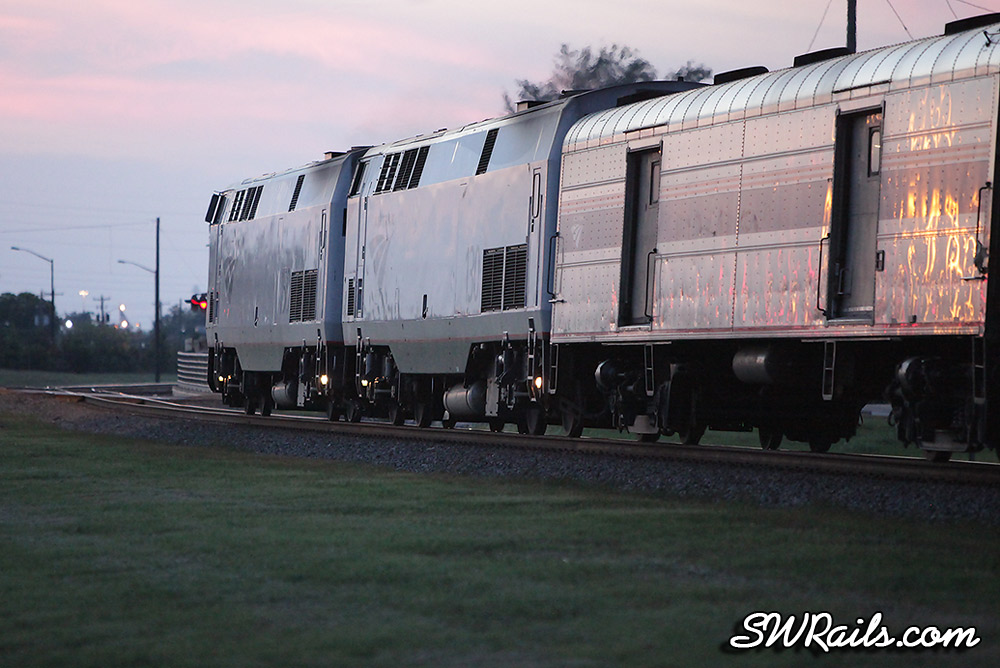
The going-away shots are interesting. The sky doesn’t seem that dark, but shooting at 6400 ISO will capture just about any photons that are out there. Note the headlight illuminating the track ahead. The brightness of the marker lights are also a good indication of just how dark it is.
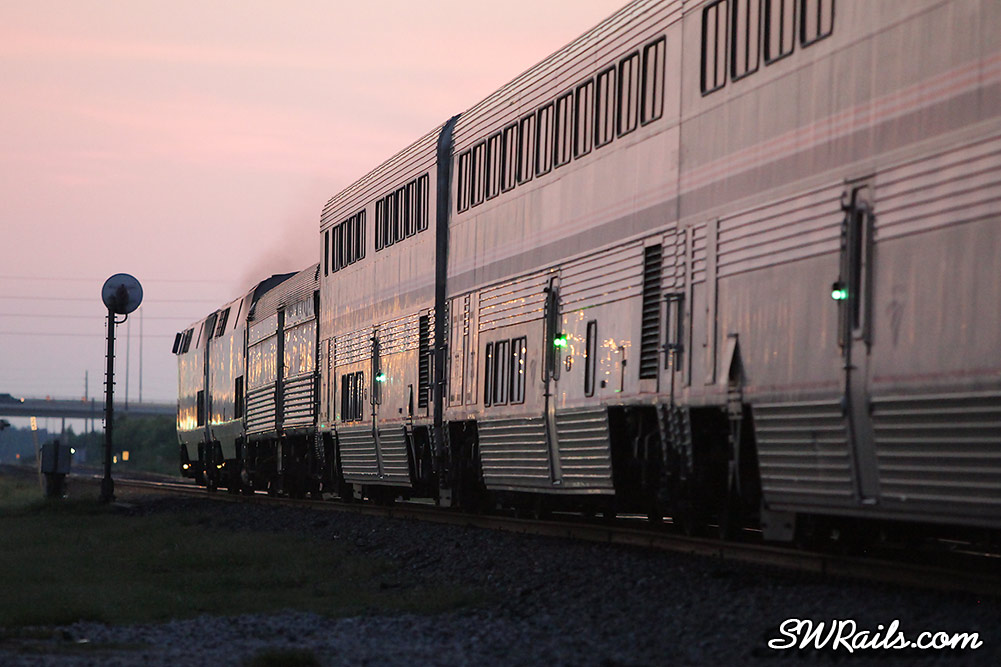

Four days later, I tried my luck again, but with a twist. I wanted to try a location that would be shielded from ambient light. I set up at CP SA 020, behind a concrete wall that the City of Stafford / TXDOT erected to shield the TXI aggregate plant from the delicate eyes of motorists on Hwy 90. Like I said, ISO 6400 really hoovers up whatever light is out there.
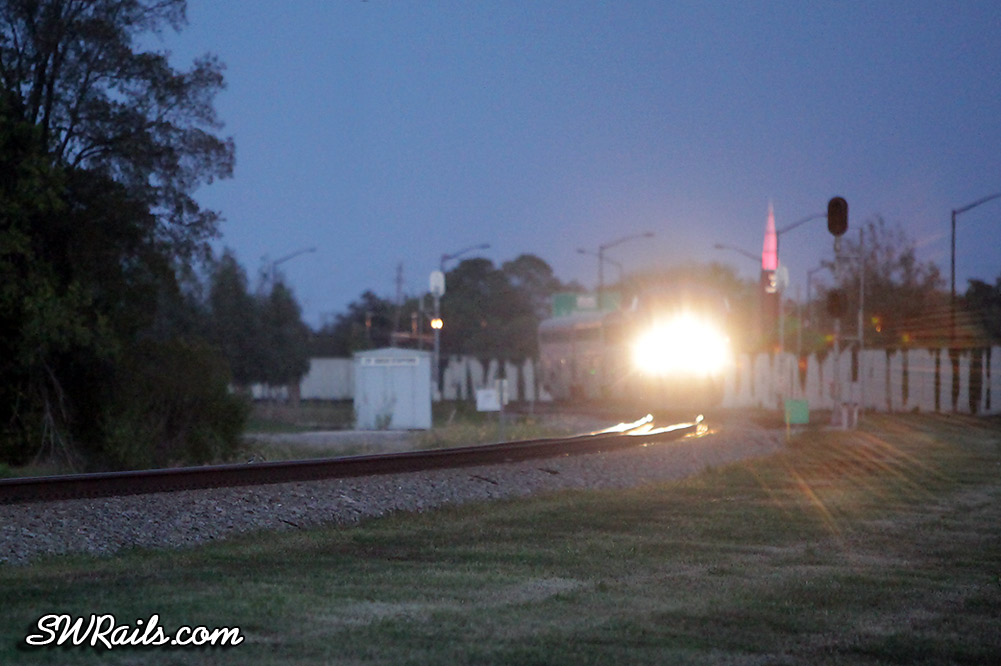
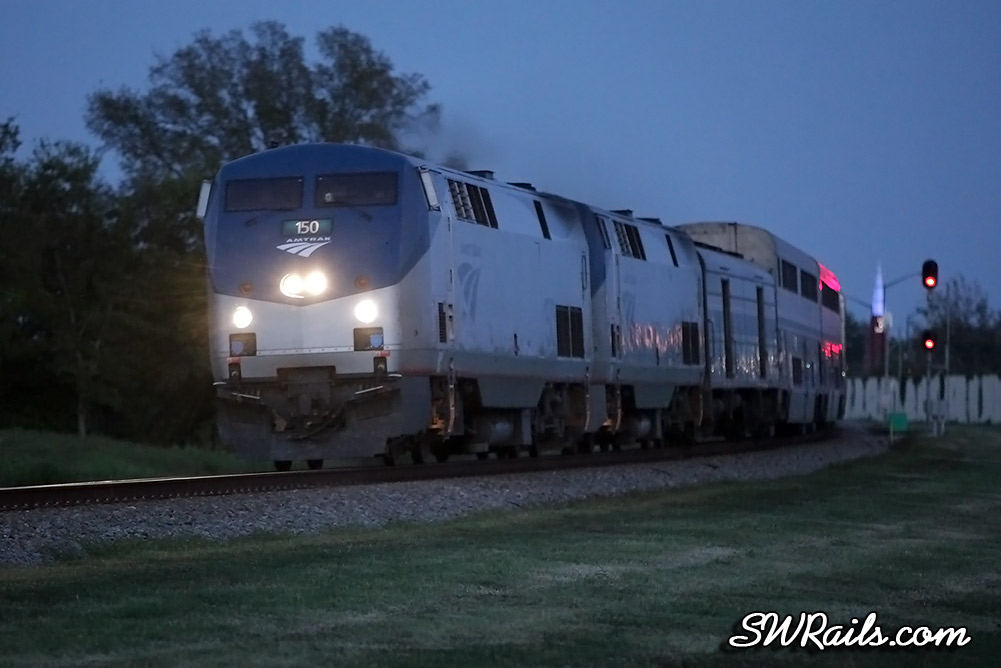
The next shot shows a bit of motion blur as the 1/400 second shutter speed just isn’t quick enough to freeze the motion of a passing train at 60 mph.
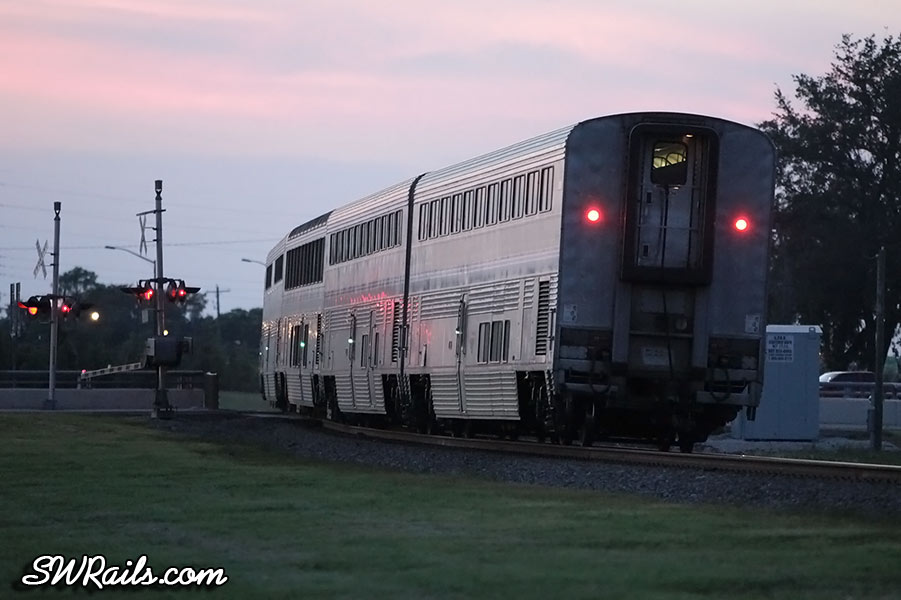
Illustrating the ambient darkness well, the last shot actually shows the interior lighting from the overhead racks in the last coach. (Click image to enlarge it.)
Shooting season for the westbound Sunset Limited might be over for now, but the light’s pretty sweet for its eastbound counterpart. Stay tuned…
Out & About – Sept. 10, 2012
Beautiful weather in Houston today, but an all-day video job downtown prevented me from capitalizing on it until late afternoon when I was able to take a few pictures on my way home.
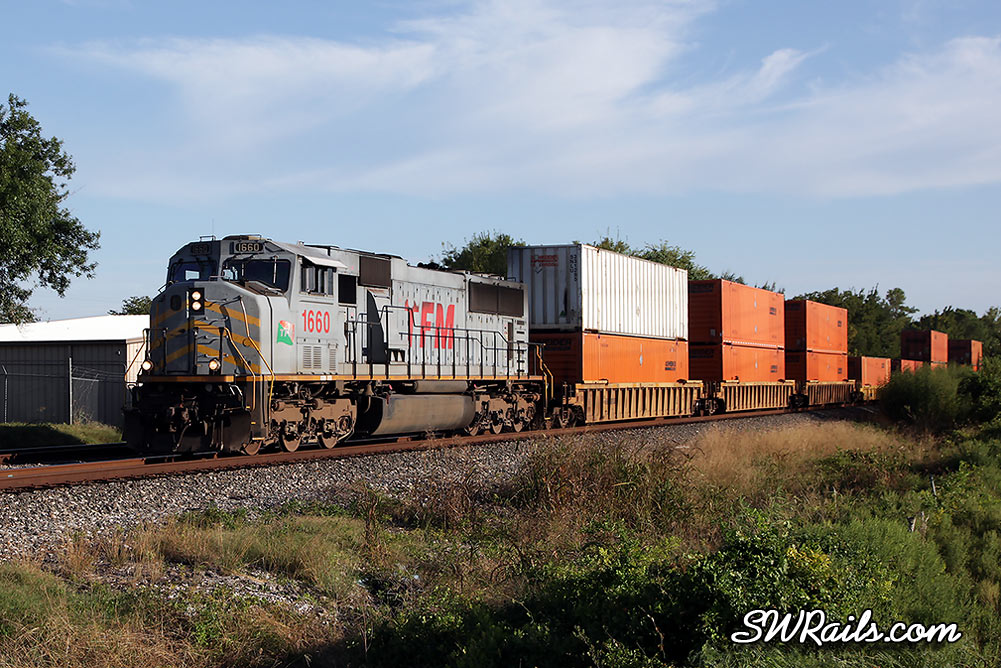
TFM SD70MAC 1660 was the sole power on this eastbound KCS intermodal that I caught at 6:15 PM at the Willowbend grade crossing, MP 374.83 on the Terminal subdivision.
KCS 2955, the KCS local was following TFM 1660. I considered waiting for it here, but chores at home, not to mention dinner, motivated me to hit the road. I did see it about 10 minutes later as it, and I, passed through Stafford, but there just wasn’t a shot to be had there.
Dinner, and the resulting clean-up, was quick. A quick check of amtrak.com at 7:15 PM informed me that the westbound Sunset Limited had departed Houston on-time at 6:55 PM. If I hurried, I just might be able to get a shot of it.
The traffic did cooperate, allowing me to get to the intermediate signal at MP 22.4 an entire minute before #1 arrived, precisely at today’s official sunset, 7:30 P.M.
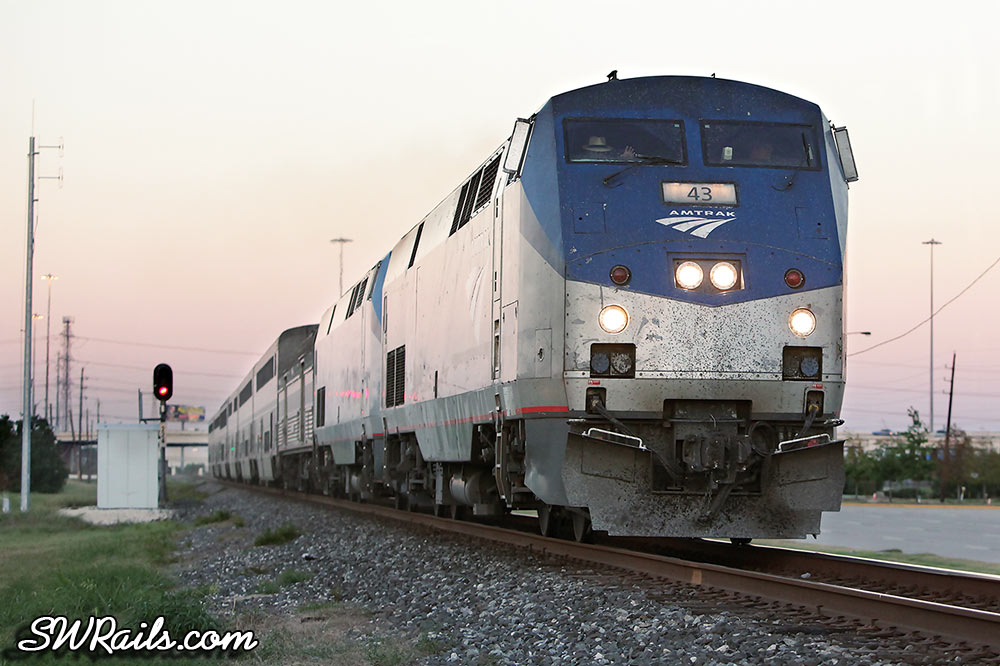
I was somewhat hesitant about setting the camera’s ISO at 2000, worried that the image would be noisy. But I’d rather deal with noise than speed blur from using too slow of a shutter speed. As it turned out, my worries were unfounded, as the image was noise-free.
Where Do I Sign Up?
I saw this on an automobile in Spencer, NC this past 4th of July. I sure wouldn’t mind having one on my car. I wouldn’t even mind the $70 premium, but moving to Nebraska is a bit much.
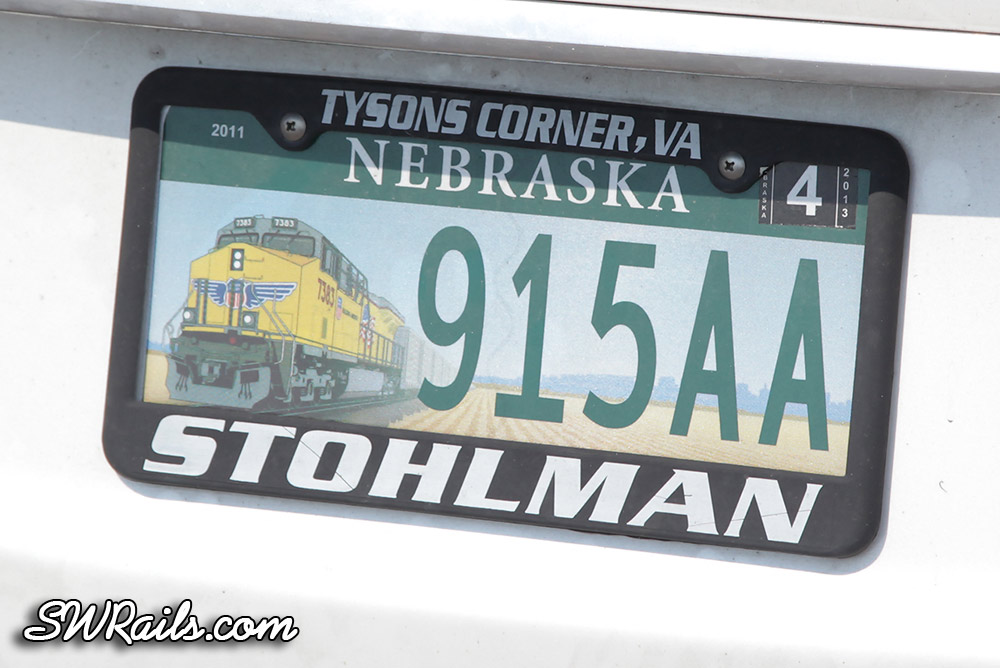
This particular design was sponsored by the UP Railroad Museum as part of their sesquicentennial celebration.
Are We There Yet?
Sundays are our designated day to travel to Pasadena, on the east side of Houston, to visit my mother. To the extent I can work in a bit of railfanning en route, it can be a win-win situation.
It’s typically a 30 minute drive from Sugar Land, but depending on traffic, the drive to Pasadena can take over two hours. Traffic jams on Sunday? Not really.
The time required to make the 25-mile drive to Pasadena can vary wildly due to rail traffic. Sometimes there’s not much rail traffic and it’s a quick trip. Other times there are trains that need to be photographed, side tracking me, turning a quick trip into a long, slow slog. Much to the chagrin of my long-suffering wife.
This particular Sunday, July 22, 2012, was special because I knew that UP ES44AC 7400 (Komen Foundation Pink Ribbon unit) was leading the eastbound “juice train” , ZLCAT-20, with an ETA into the Sugar Land area in the afternoon. The plan was to leave the house shortly after the train showed by the scanner at Lissie. Lissie is MP 61, about 35 miles west of Sugar Land. A Z train should take, at most, an hour to cover that distance.
UP 7400 was by Lissie at 1348, earlier than I would have liked because the sun was still too high. As we were preparing to depart, I heard the DS tell the ZLCAT to hold up at Rosenberg to allow traffic to clear up in the Houston terminal.
Good. A delay will allow the sun to drop, creating better light for the shots I had in mind. After hearing the DS tell the 7400 that he would move them shortly, that was our cue to head out. We left home around 3:20, expecting to see the ZLCAT by 4:00 PM, after which we would go to Pasadena.
It seemed like a plan.
We were in Stafford (MP 20) when the detector at MP 15.6 announced a train. Not knowing whether it was an eastbound going away, or a westbound coming toward us, I took the safe course and set up at the west switch of Missouri City (CP SA019). It was the right call, as a headlight came into view. Shortly thereafter, at 3:44 PM, UP SD70ACe 8365 blew by with an IHOSA intermodal train.
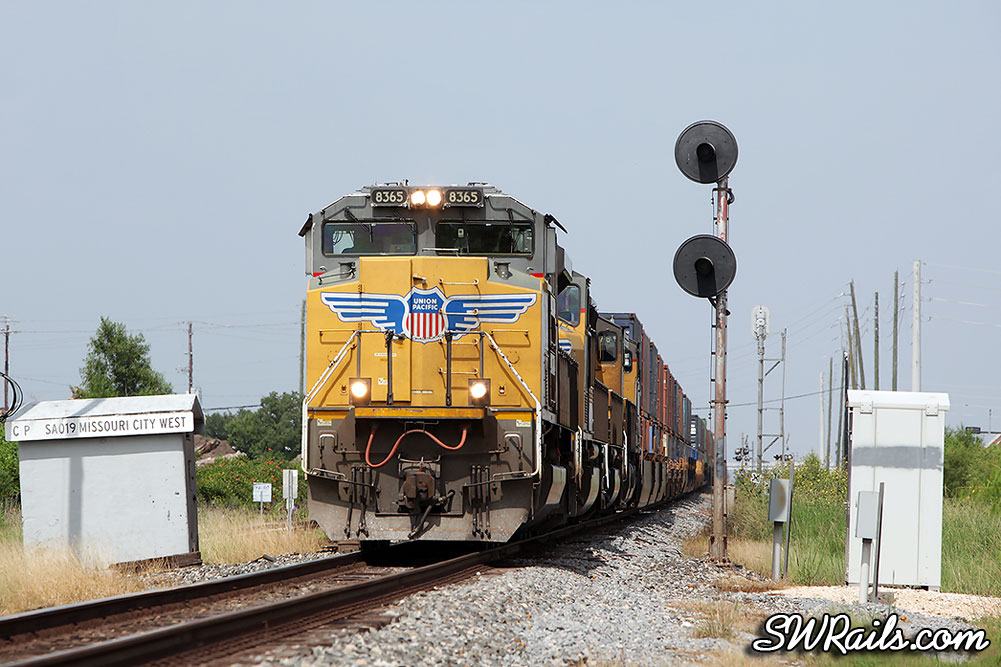
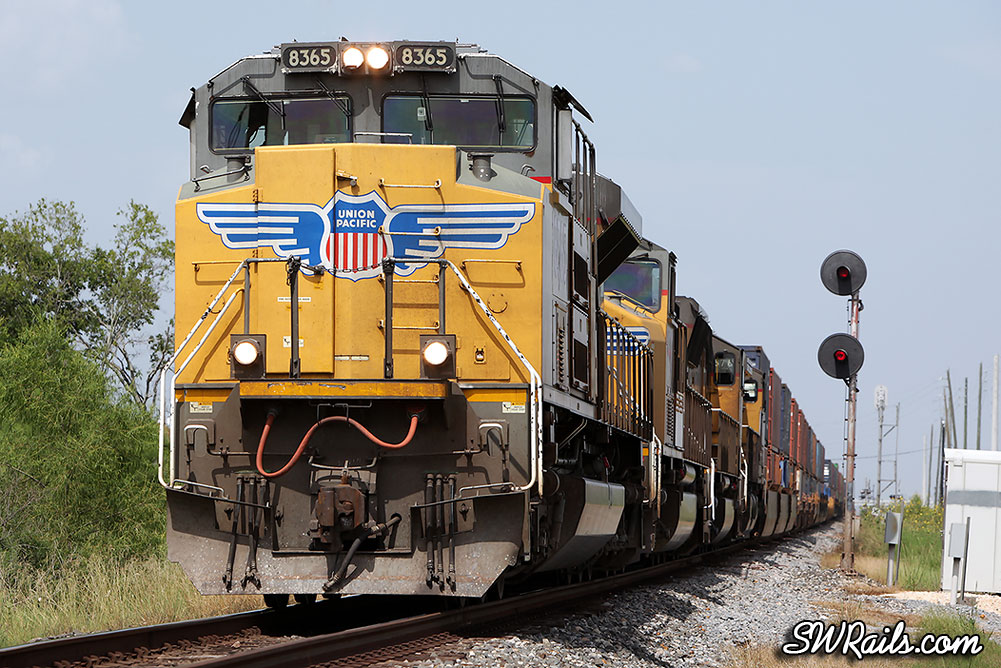
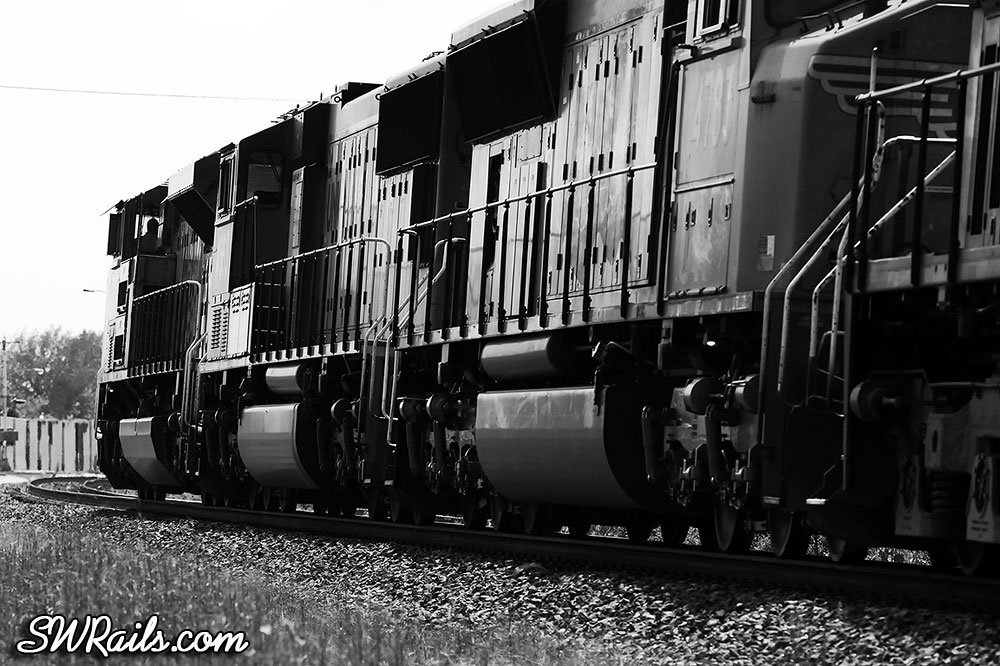
Back in the film days, I would never take a going-away shot of a train. At best it would be back-lit, at worst I would be shooting into the sun, and it would be a wasted slide.
Additional shots, however, in the digital era are virtually free. As such, I almost always take going-away shots like this. I actually like them because the “bad light” creates some cool images. I really like the contrast of the below shot, and the different, dynamic “feel” of it compared to the first two shots.
I really didn’t want to see a westbound because I knew that it would only serve to delay the eastbound Z train and its pink ribbon locomotive. But I knew that it would have to go by me eventually!
I was encouraged when I heard the IHOSA call a diverging approach at CP SA025. That told me that it was going in at Sugar Land, clearing the way for the eastbound ZLCAT.
My plan was to photograph the 7400 on the Terminal Sub, somewhere between West Junction and San Felipe. The tracks run north-south through there, offering a chance at decent light for the ZLCAT and its special lead unit.
I drove toward West Junction. Not liking any of the shots around there, I continued north. I finally stopped at CP LF372, the Bissonnet crossovers. By this point it was pushing 4:15 PM, and still no hint of UP 7400. I was getting a little antsy, as we had things to do in Pasadena, not the least of which was getting some dinner.
Finally, I heard the detector at MP 15.6. All right! I told my wife that the train I was waiting for would arrive within 10 minutes, and we’d hit the road to Pasadena shortly.
I set-up between the crossovers. The headlight appeared in the distance. As it got closer, something didn’t seem right. As I was composing, focusing, and tripping the shutter at 4:34 PM, I couldn’t believe what I was seeing- a KCS intermodal. Not that anything’s wrong with that.

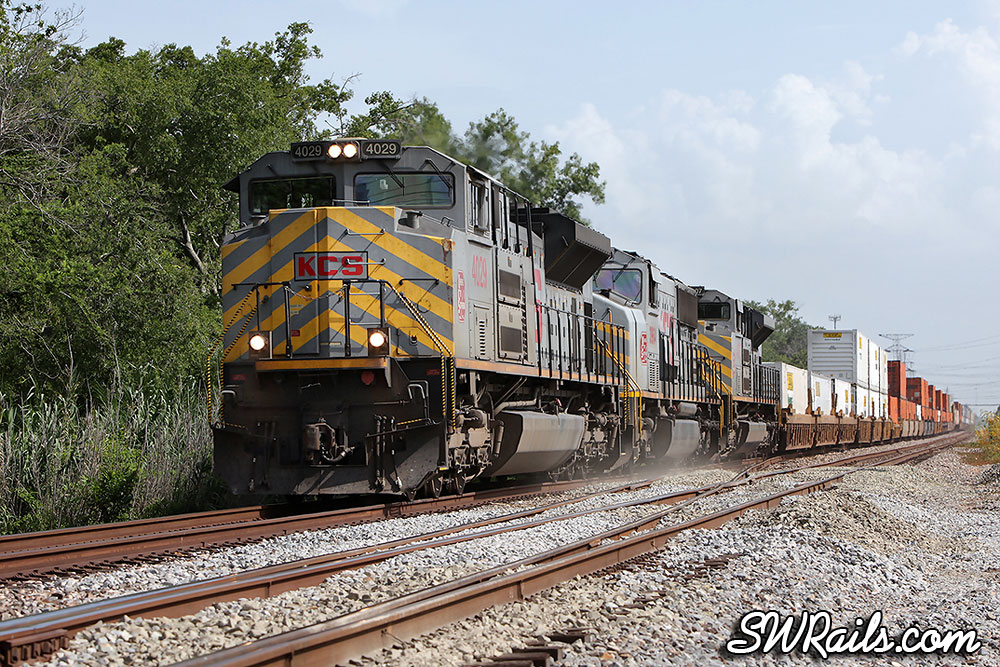
Needless to say, I wasn’t expecting that! I didn’t even know that KCS 4029 was even out there. All I can surmise is that it had been on the main somewhere between Sugar Land and Harlem and it was first to go east once the IHOSA went in at Sugar Land.
OK then. UP 7400 had to be next. And it had to be right behind the KCS that had just gone by. I gave that rosy forecast to my wife. She was actually OK with waiting as she was on the phone with her sister. Thank goodness for calling plans with unlimited minutes!
The next train didn’t trip the 15.6 detector until 5:08 PM. I told my wife that this had to be it, that regardless, we were leaving after this next train went by!
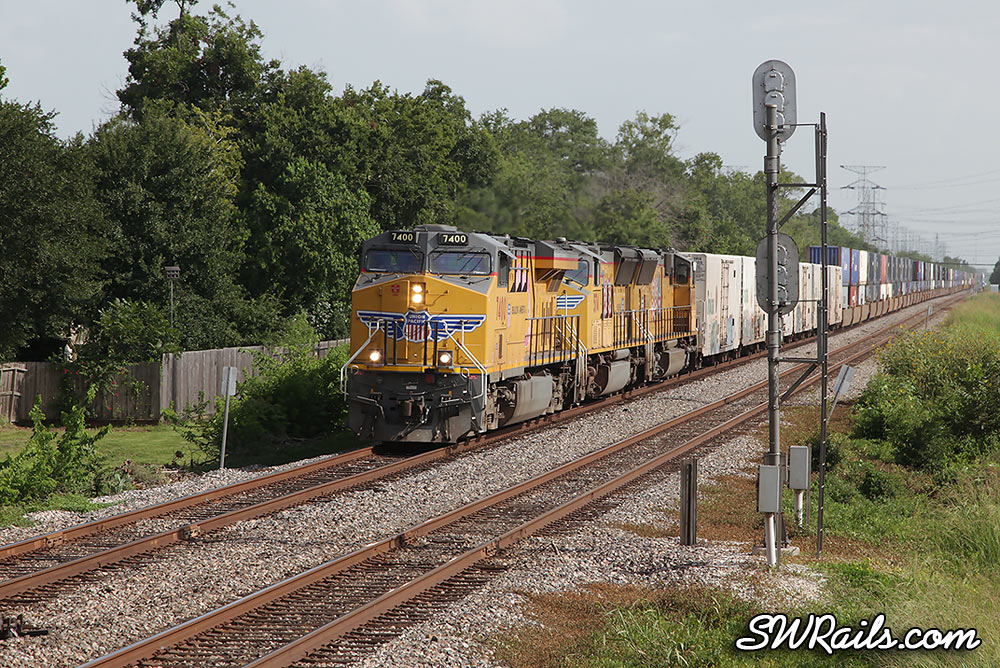
I set up at a different location for the next set of images, wanting to work the signals at the south end of the Bissonnet crossovers into the frame. Finally, UP 7400 leading the ZLCAT-20, came into camera range at 5:19 PM
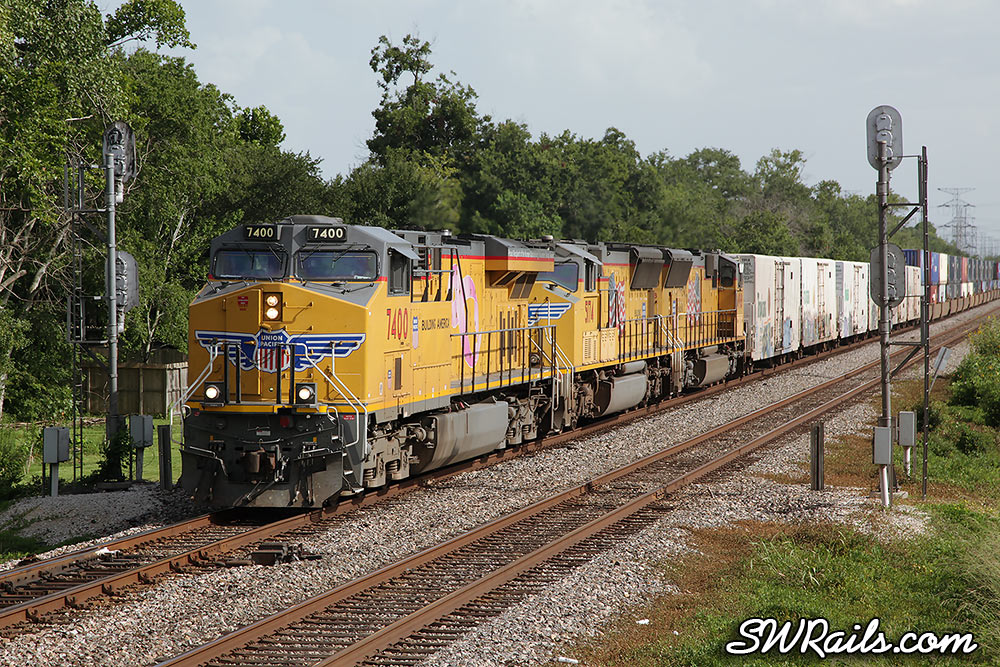
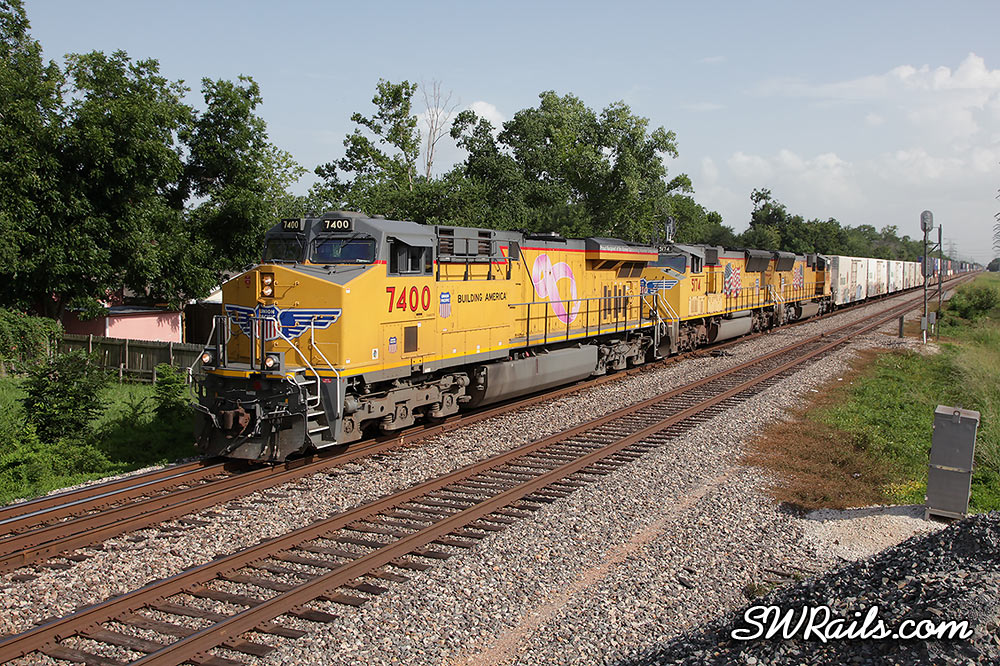
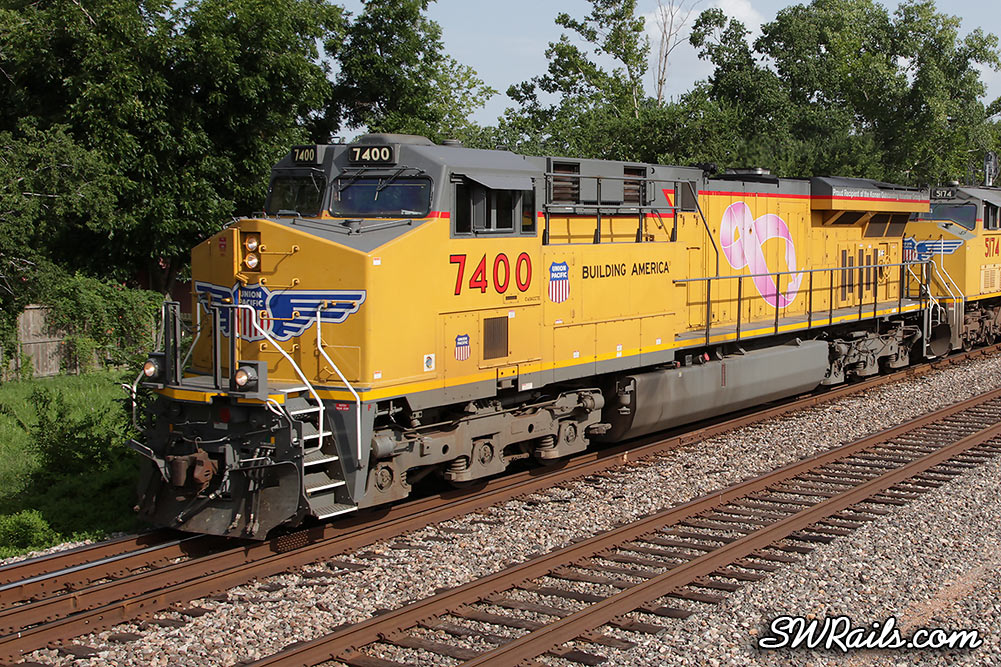
More going-away goodness:
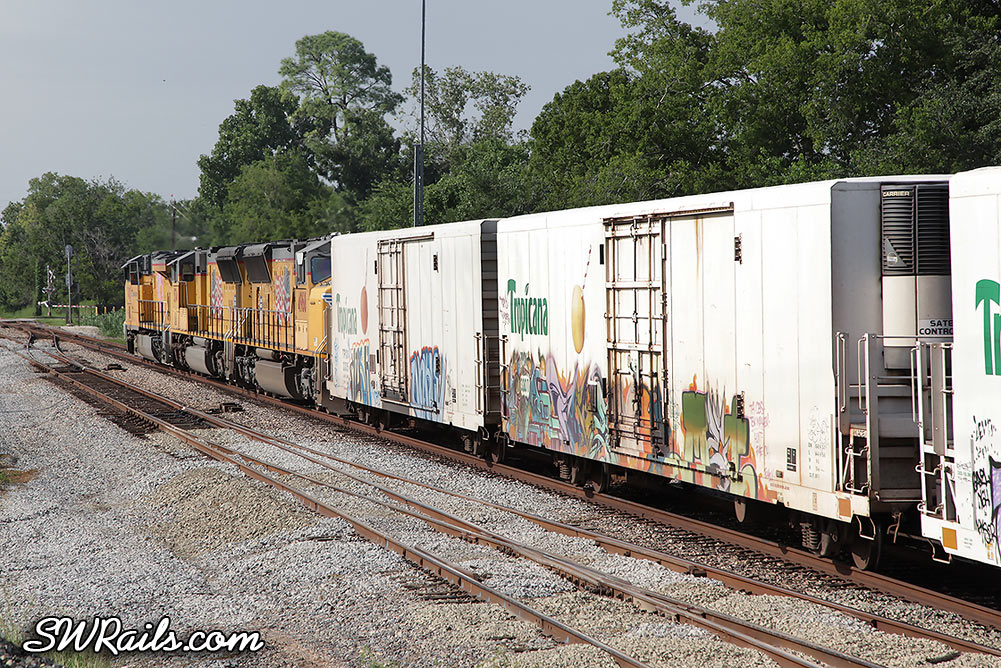
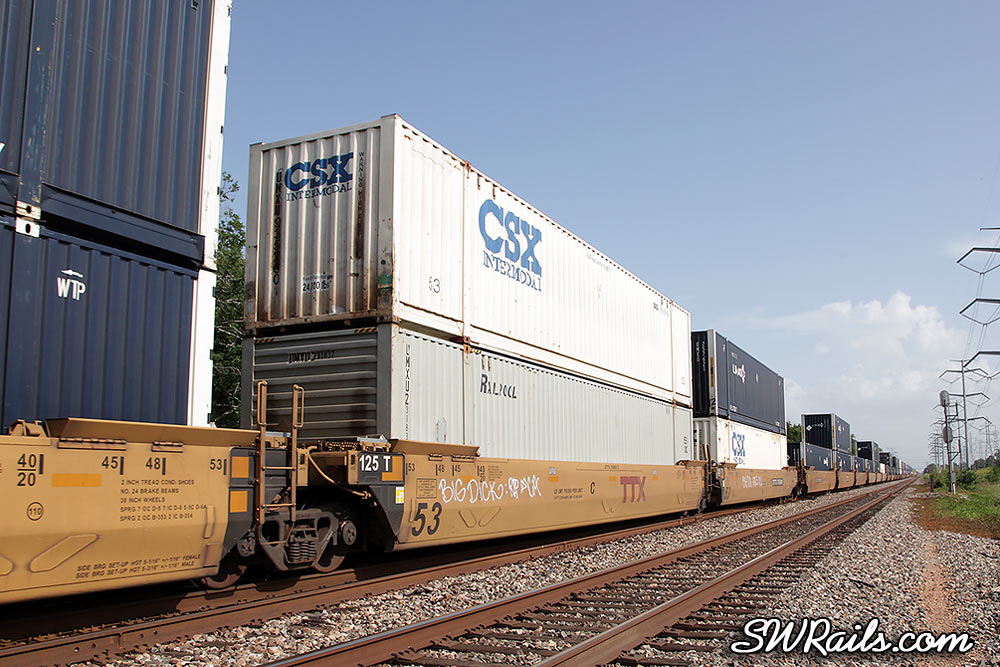
53′ CSXT and UMAX containers are fixtures on the ZLCAT and ZATLC trains. Click here for UP’s web page about the UMAX UP/CSXT partnership. They also have a short online video here.
SD70ACe 8353 brings up the rear of the ZLCAT.
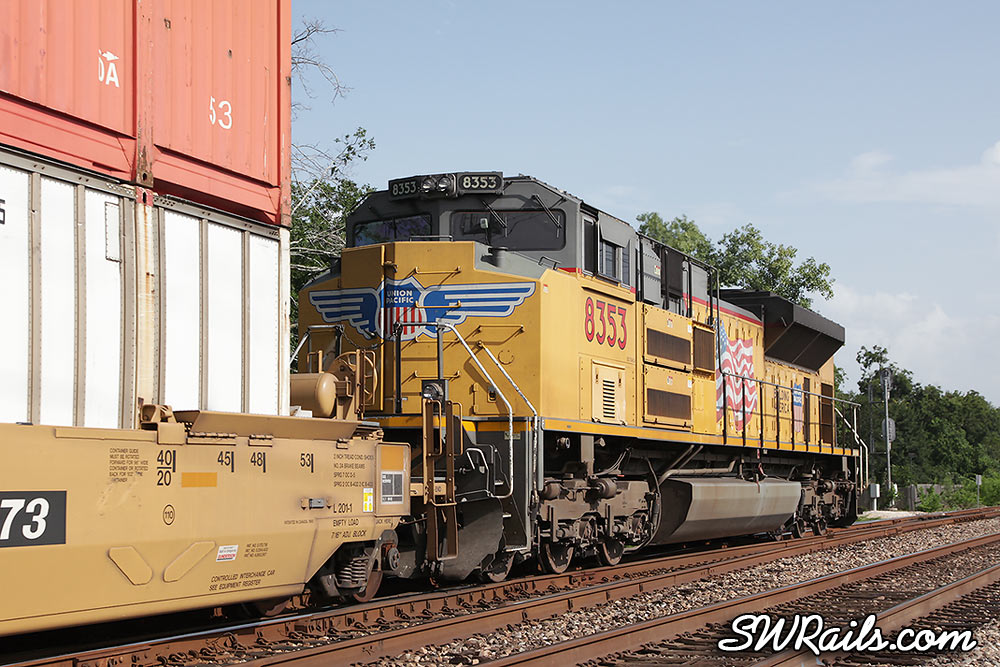

The train cleared up at 5:20, nearly 90 minutes later than I had anticipated. Then again, I did want to catch the train with the sun low in the sky. So I guess it evens things out, right?
We finally arrived at Mom’s place just before 6. All said and done, the 25 mile trip to Pasadena ended up taking about 2 1/2 hours, a new (low) speed record for me! Fortunately dinner was good and all was forgiven. Enough forgiveness, at least in my view, to stop on the way back home later that evening to photograph a westbound KCSM manifest at Stafford!
Today’s Sunset Limited at Sunset
As we approach the end of August, the days are becoming shorter. The end of summer isn’t here just yet, but it’s getting close. I won’t miss the oppressive heat, but I will miss my after-dinner ritual of photographing Amtrak’s Sunset Limited as it passes through the my neck of the woods in the early evening.
Since I have plenty of pictures, I decided to videotape today’s Sunset Limited as it passed through Sugar Land. I chose to set up at a slight bend in the track near MP 26.5, just west of Hwy 6. The plan was to get the train coming straight at the camera before passing to my left.
Since all of Sugar Land is a quiet zone, I was concerned about road noise along Hwy 90. But it worked out nicely as no noisy trucks passed by during the shoot, and as a bonus, the crew sounded the whistle as the train approached my location.
If you’d like to view the video in a larger format, you can click here to view the raw footage without any YouTube compression. It will auto-play, but it’s a large file (just over 10mb), so it will take a few seconds to load.
 Southwest Rails